
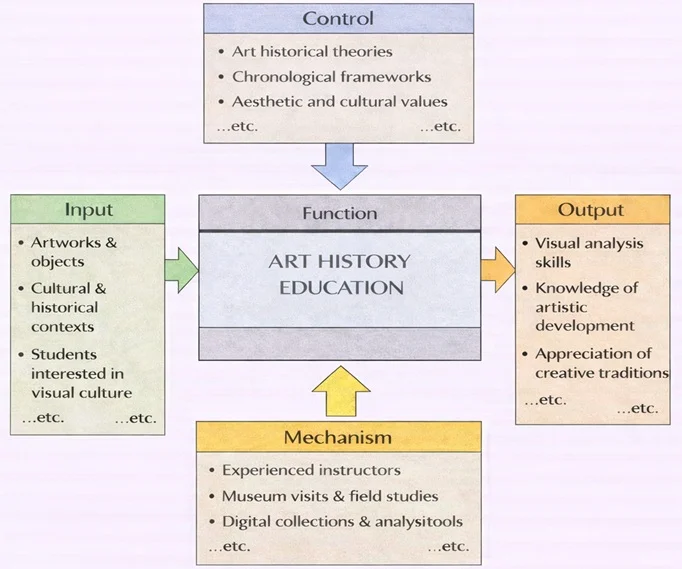
Art History Education is, in many ways, training the eye to think. Instead of treating paintings, sculptures, buildings, and everyday visual culture as silent objects, it teaches students to read them as historical evidence—full of choices, symbols, materials, and intentions. The key inputs include artworks and objects themselves, the cultural and historical contexts that surround them, and students who are drawn to images, design, and visual meaning. The learning process is guided by controls such as art historical theories, chronological frameworks, and aesthetic and cultural values, which help students place works in time, compare movements, and understand why different societies defined “beauty,” “craft,” or “genius” in different ways. The function is enabled by mechanisms: experienced instructors who model close looking and careful argument, museum visits and field studies that bring original works into view, and digital collections and analysis tools that expand access to global archives. When these elements align, the outputs are clear—stronger visual analysis skills, deeper knowledge of artistic development across periods and cultures, and a lasting appreciation for creative traditions that continue to shape how we see the world.
Art history is not simply the study of beautiful objects — it is a field that asks what visual culture reveals about the societies that produced it. Every artistic tradition reflects the values, beliefs, and power structures of its time, and tracing those connections across periods and cultures is what makes art history a genuinely historical discipline.
The relationship between art and ideas is one of the field’s central concerns. The history of ideas illuminates the intellectual currents behind major artistic revolutions — the humanism that drove the Renaissance, the nationalism that shaped Romantic painting, the social critique embedded in Modernism. Understanding what artists were responding to intellectually is often as important as understanding their technique.
Art has also always been entangled with power. Rulers and regimes have commissioned and controlled visual culture to express authority, justify ideology, and shape public memory — from imperial sculpture to revolutionary posters to civic monuments. The history of political systems provides essential context for understanding why certain artistic forms were promoted, suppressed, or repurposed across different periods.
Gender is another dimension that art history cannot ignore. Gender and cultural history raises questions that have transformed the field — about who was permitted to create art, whose experiences were considered worthy of representation, and how the gendering of artistic labour shaped what survives in the historical record.
The economics of art production matter too. Patronage systems, guild structures, art academies, and eventually commercial markets have all determined which artists could work, in which materials, and for which audiences. Economic history helps explain how the value of artistic labour has been defined and contested across time, and how the modern art market developed from aristocratic commission to global auction house.
Art has also served as a form of resistance and protest. The history of social movements includes rich visual traditions — anti-war murals, feminist performance art, anti-colonial graphics — in which creative expression became a direct form of political argument. These traditions remind us that art is not only a product of its social context but an active participant in shaping it.
Finally, art has played a significant role in international relations. Exhibitions, architecture, and cultural exchange programmes have long been deployed as instruments of cultural diplomacy, projecting national identity and building relationships across political divides. Images produced during wartime — propaganda posters, documentary photography, official portraiture — raise some of the sharpest questions art history has to offer about the relationship between visual culture, violence, and power.
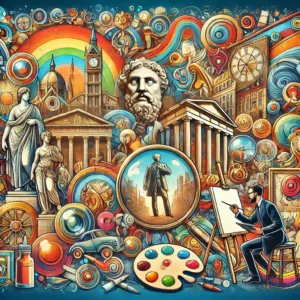
A vibrant, poster-style montage celebrates the sweep of art history. At the right, a seated artist paints at an easel beside a painter’s palette, tubes, and brushes—symbolizing making and learning by doing. Across the scene are classical marble statues and columned temples, a monumental carved head, and a central medallion with a standing figure, evoking ancient Greece and Rome and the Renaissance revival of antiquity. Clock towers, gears, and numerous clocks hint at art’s timeline and the role of technology and industrial change. Arches of rainbow color, swirling ornaments, and abstract shapes suggest modernism’s experimentation with form and color. Together these elements connect technique, patronage, and ideas across periods—antiquity, Renaissance, industrial modernity, and contemporary practice—capturing art as a continuous conversation between past mastery and present imagination.
Key Focus Areas in Art History
Evolution of Visual Arts
Art history traces how media, techniques, patronage, and ideas change over time. Below is a compact roadmap—pairing what changed (formal innovations) with why it changed (contexts such as religion, markets, technology, and politics).
Movements & Turning Points (selected)
- Renaissance (14th–16th c.)
- What: Linear perspective, naturalism, humanist subjects; oil on panel/canvas.
- Why: Civic/religious patronage in Italian city-states; classical revival.
- Artists/Works: Brunelleschi (perspective), Leonardo (Last Supper), Michelangelo (David), Raphael (School of Athens).
- Baroque (17th c.)
- What: Dramatic light, theatrical composition, movement.
- Why: Counter-Reformation persuasion; court spectacle.
- Artists/Works: Caravaggio (The Calling of St. Matthew), Bernini (Ecstasy of Saint Teresa), Velázquez (Las Meninas).
- Neoclassicism & Romanticism (late 18th–early 19th c.)
- What: Moral clarity & antique forms (Neoclassicism) vs. sublime emotion & nature (Romanticism).
- Why: Enlightenment ideals; revolutions; nationalism.
- Artists: David, Ingres; Delacroix, Turner, Géricault.
- Realism & Impressionism (mid–late 19th c.)
- Realism: Social truth, labor, everyday life (Courbet, Daumier).
- Impressionism: En plein air, optical color, transient light (Monet, Renoir, Morisot); break with the academy and embrace of urban modernity.
- Post-Impressionism & Avant-Gardes (c. 1886–1914)
- What: Structure (Cézanne), emotive color (Van Gogh), symbolism (Gauguin), pointillism (Seurat); then Cubism, Fauvism, Futurism.
- Why: Scientific color theory, photography’s challenge, fragmentation of modern life.
- Modernisms (1910s–1960s)
- Dada/Surrealism: Chance, dream, the unconscious (Duchamp; Dalí, Miró).
- Abstract art: Non-objective form (Kandinsky, Mondrian).
- Abstract Expressionism: Gesture, scale, process (Pollock, de Kooning, Lee Krasner).
- Minimalism/Conceptual: Reduction to material/idea (Judd, LeWitt, Kosuth).
- Contemporary Currents (1970s–today)
- Pop & Postmodern: Mass media, irony, appropriation (Warhol, Lichtenstein, Sherman).
- Photography/Video/New Media: From documentary to installation; net art; AI imagery.
- Social Practice & Institutional Critique: Community projects; museum decolonization (Hans Haacke, Theaster Gates).
- Global/Transnational: Biennials; diaspora & identity; environmental art (El Anatsui, Olafur Eliasson).
How to Analyze a Work (toolkit)
- Form: composition, color, line, space, technique, scale.
- Iconography: symbols, narratives, allegories.
- Context: patronage, market, technology, politics, religion, audience.
- Reception: criticism, exhibition history, later reinterpretations.
Development of Architecture
Architecture records the ambitions of societies—uniting structure, space, and symbolism. Materials and engineering methods drive style, while religion, empire, capital, and climate shape function.
Key Architectural Trajectories
- Classical & Islamic Foundations
- Greco-Roman: Orders (Doric/Ionic/Corinthian), arches & vaults; civic urbanism (Parthenon; Pantheon).
- Islamic: Hypostyle halls, muqarnas, courtyards; geometric/arabesque ornament (Great Mosque of Córdoba; Alhambra).
- Gothic (12th–16th c.)
- Pointed arch, ribbed vault, flying buttress; stained glass as “theology in light.”
- Examples: Chartres, Notre-Dame, Cologne Cathedral.
- Renaissance/Baroque
- Renaissance: Proportion, central plans, classical motifs (Brunelleschi, Alberti, Palladio).
- Baroque: Ellipses, dramatic sequences, urban scenography (Bernini & Borromini in Rome).
- Industrial & Modern (19th–20th c.)
- Iron/steel, reinforced concrete, curtain walls; new building types (stations, factories, skyscrapers).
- Modernism: “Form follows function,” open plans, pilotis and ribbon windows (Le Corbusier’s Villa Savoye, Mies’s Seagram Building, Bauhaus).
- Postmodern to Present
- Postmodern: Wit, historical quotation, pluralism (Venturi/Scott Brown, Graves).
- Parametric & High-Tech: Digital fabrication, expressive structure (Zaha Hadid, Foster + Partners).
- Sustainable Design: Passive strategies, net-zero buildings, regional materials (glazing optimization, mass timber).
Reading Architecture
- Plan/Section: spatial logic; circulation; public vs. private zones.
- Envelope: façade language, climate performance, symbolism.
- Urbanism: plaza, street wall, skyline; infrastructure connections.
Design and Decorative Arts
Decorative arts—furniture, ceramics, textiles, metalwork—and design bridge daily life and aesthetics. They track technology (from handcraft to mass production) and taste (from ornate to minimal).
Milestones
- Arts & Crafts (c. 1860–1910)
- Handcraft, honest materials, anti-industrial ethics (William Morris; Greene & Greene).
- Art Nouveau (c. 1890–1914)
- Whiplash lines, biomorphic ornament across furniture, glass, architecture.
- Examples: Horta’s Hôtel Tassel; Gaudí’s Casa Batlló and Casa Milà; Gallé glass.
- Bauhaus (1919–1933)
- Unification of art, craft, and technology; modularity; standardization.
- Figures: Gropius, Moholy-Nagy, Marcel Breuer (Wassily Chair).
- Mid-Century Modern (1940s–1960s)
- Warm minimalism; molded plywood, fiberglass, aluminum; human-scaled ergonomics (Eames, Saarinen, Jacobsen).
- Postmodern & Memphis (1980s)
- Colorful laminates, irony, anti-functional exuberance (Ettore Sottsass).
- Contemporary Design
- UX/UI, interactive objects, open-source fabrication, circular design (repairability, recyclability).
Evaluating Design
- Function: usability, ergonomics, safety.
- Form: proportion, material expression, visual hierarchy.
- Impact: lifecycle footprint, inclusivity, cultural resonance.
Interactive Analyzer: Visual Composition & Perspective Simulator
Adjust vanishing point coordinates, horizon lines, and color palette temperature to observe how spatial depth and emotional resonance are mathematically constructed in classical linear perspective.
One Scene, Many Styles: The Evolution of Visual Arts
To see how style shapes meaning, keep a single scene constant and let the art movements transform it.
Shared scene: A small riverside town at dusk. A stone bridge crosses the water; a marketplace bustles in the foreground; a church tower rises behind tiled roofs; a gust of wind moves clouds; two figures exchange goods near a cart; a dog drinks at the river’s edge.
Prehistoric (Cave Painting)
Depiction: The bridge becomes a simple arched mark; people and dog are reduced to stick- and contour-forms; the river is a wavering band. Ocher, charcoal, and clay pigments are dabbed and blown to create silhouettes on rough “rock” ground.
- Hallmarks: Symbol over likeness; earth palette; hand-stencil “signatures”.
- Effect: The town reads like a memory-map or ritual sign, not a view.
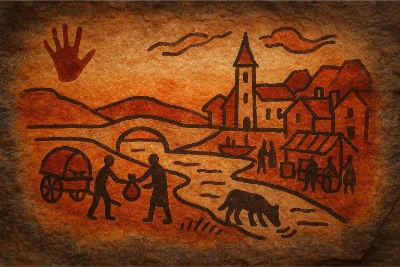
This image reimagines a twilight town as if recorded by prehistoric artists. Broad fields of burnt-ochre and sienna mimic mineral pigments on rough rock...
Classical Greek
Depiction: Marble relief style: the bridge is proportioned with geometric clarity; figures are idealized, standing in balanced contrapposto; the river is a gently incised flow.
- Hallmarks: Harmony, proportion, measured poise.
- Effect: The scene communicates civic order and moral balance.
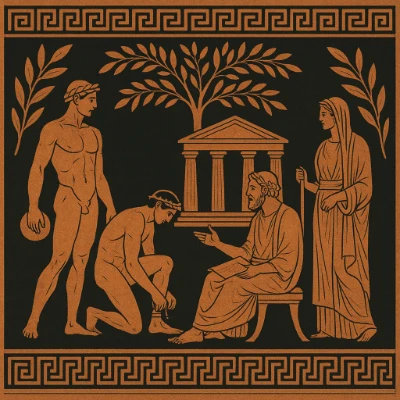
A square “vase painting” composition echoes Classical Greek pottery...
East Asian Ink-Wash (Sumi-e / Shui-mo)
Parallel global tradition (Tang–Qing dynasties; 7th–19th c.)
- Depiction: Soft washes build mist and evening glow...
- Hallmarks: Monochrome ink, value gradation...
- Effect: The town reads as mood and meditation...
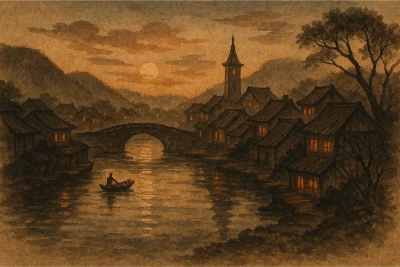
This image reimagines the riverside-town scene in the vocabulary of classical East Asian ink painting...
Gothic (Medieval Panel & Stained Glass)
Depiction: Gold-leaf background; the church dominates; bridge and market scale down hierarchically. Figures are elongated; drapery lines are rhythmic; the river is a blue ribbon.
- Hallmarks: Hieratic scale, narrative panels, spiritual emphasis.
- Effect: The town is a stage for salvation history.
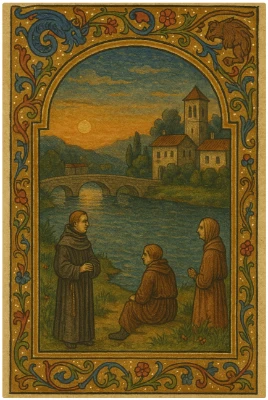
This image is designed in the style of a late-medieval illuminated manuscript. The central scene—set under an arched window—depicts a small town at evening: a triple-arched stone bridge spans the river, whose surface catches the orange light of the setting sun; behind it, compact houses and a towered church cluster on the far bank. In the foreground, three monks in brown and grey habits converse quietly on the grass. The decorated border of scrolling acanthus, blossoms, and tiny animals on parchment grounds the work firmly in Gothic manuscript conventions. Colors are tempered and enamel-like, outlines are clear, and scale is slightly hierarchical—architecture and figures simplified for legibility—echoing the period’s emphasis on didactic clarity and sacred reflection.
Renaissance (15th–16th c.)
Depiction: Linear perspective fixes a vanishing point on the bridge; atmospheric perspective cools distant roofs; anatomy and light follow observation.
Baroque (17th c.)
Depiction: A shaft of sunset light breaks through storm clouds to ignite the market; diagonals pull the eye across the bridge; deep chiaroscuro dramatizes forms.
Rococo (18th c.)
Depiction: Pastel palette; curling clouds; elegant figures; decorative charm.
Neoclassicism (late 18th–early 19th c.)
Depiction: Clean contours; figures posed as civic exemplars; rational structure.
Romanticism (19th c.)
Depiction: Dusk swells into sublime weather; expressive brushwork; emotional atmosphere.
Realism (mid-19th c.)
Depiction: Unidealized townsfolk; worn materials; muted palette; social truth.
Impressionism (late 19th c.)
Depiction: Broken brushstrokes; optical color; fleeting light; dissolving forms.
Post-Impressionism
Depiction: Structured strokes; symbolic color; emphasis on design and emotion.
Expressionism (early 20th c.)
Depiction: Distorted perspective; intense color; emotional exaggeration.
Cubism (1907–1914)
Depiction: Fragmented forms; multiple viewpoints; geometric planes.
Futurism (1910s)
Depiction: Motion lines; dynamic repetition; kinetic energy.
This modernist scene reimagines a quiet riverside village through Futurist dynamism. The sun radiates in blade-like bands, curving across hills, roofs, and water to imply motion and time. Angular forms reduce people, a cart, boatmen, and a dog to silhouettes, emphasizing rhythm over detail. Saturated oranges and teals in layered strokes create depth while echoing Art-Deco palettes. The result is a kinetic landscape where everyday life becomes a choreography of energy and speed.
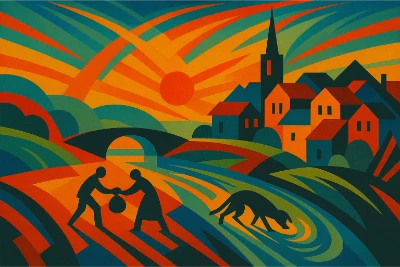
A stylized village unfolds in sweeping arcs and flat color bands typical of Futurism. Blade-like rays spin out from the sun, curving over hills, bridge, and water to suggest speed and rhythm. Figures and buildings are reduced to crisp silhouettes and interlocking planes in saturated oranges, teals, and deep greens.
Dada & Surrealism (1916–1940s)
Depiction (collage/surreal): A newspaper-print bridge; a clock floats above the river; the dog casts a fish’s shadow; chance juxtapositions create dream logic.
- Hallmarks: Anti-art wit, automatism, dream imagery.
- Effect: The town becomes the unconscious laid bare.
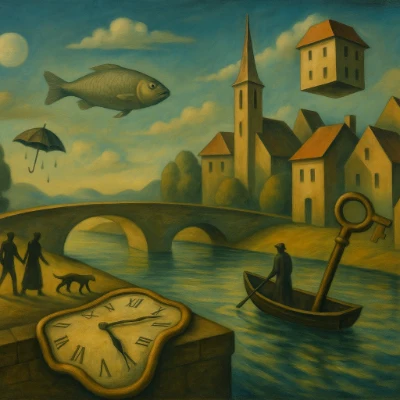
Abstract Expressionism (1940s–50s)
Depiction: No literal town—gesture stands in for bridge and river; dusky color fields carry the mood of evening; scale engulfs the viewer.
- Hallmarks: Gesture or color-field, immediacy, viewer immersion.
- Effect: The scene is distilled to feeling.
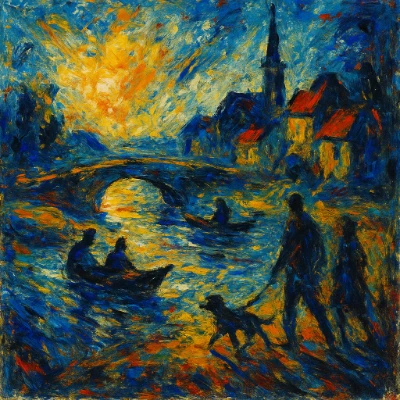
In the spirit of 1940s–50s Abstract Expressionism, the image privileges gesture over outline...
Pop Art (1960s)
Depiction: The marketplace becomes flat, bright panels with halftone dots; brand logos on awnings; a speech bubble over a vendor.
- Hallmarks: Mass-media imagery, irony, graphic clarity.
- Effect: Everyday commerce becomes cultural critique.

Rendered in a 1960s Pop Art idiom, the riverside town is flattened into graphic shapes...
Minimalism (1960s–70s)
Depiction: The scene reduced to a few rectilinear bands—sky, roofline, river—matte surfaces, industrial finish; figures omitted.
- Hallmarks: Reduction, repetition, objecthood.
- Effect: Perception and space replace narrative.
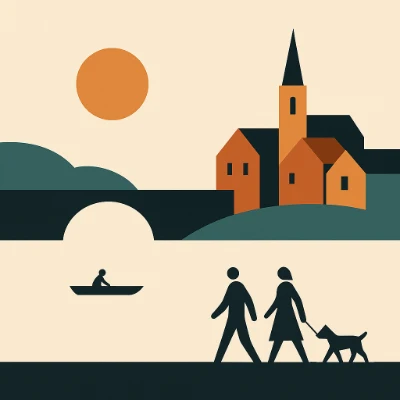
In a 1960s–70s Minimalist idiom, the scene is distilled to clean, hard-edged shapes...
Conceptual Art (late 1960s–)
Depiction: A wall text lists GPS coordinates of the bridge; a map and receipt are displayed; the work asserts that the idea is the artwork.
- Hallmarks: Idea over image; documents, instructions.
- Effect: The town exists as information, not depiction.
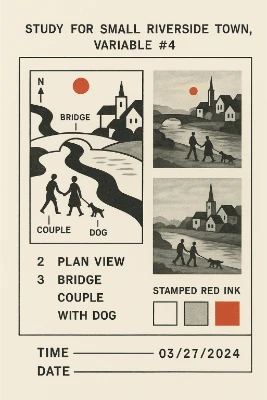
Working in a late-1960s Conceptual Art mode, the image presents the riverside town as information...
Contemporary (Global, Digital, Street)
Depiction: A projection-mapped mural animates dusk on the bridge; QR-coded portraits; AR interactions through a phone app.
- Hallmarks: Hybridity, participation, new media, social engagement.
- Effect: The scene becomes shared, interactive experience.
- Choose one subject and sketch it in three contrasting styles.
- Annotate composition, light, color, line, space, and intended mood.
- Present side-by-side to discuss how style re-codes meaning.
Art as Cultural Expression
Art encodes beliefs, power, memory, and identity. Reading works alongside rituals, laws, and media reveals how cultures represent themselves—and contest those representations.
Religious & Ritual Art
- Byzantine: mosaics as theology in gold light.
- Hindu: temple sculpture, darshan, cyclical time.
- Islamic: aniconic geometry and calligraphy.
Power, Protest, and the Public Sphere
- Propaganda: Roman portraiture; Baroque spectacle; socialist realism.
- Critique: Goya, Rivera, Picasso, Ai Weiwei.
- Street Art: Graffiti, memorials, community murals.
Identity & Representation
- Feminist & Queer Art
- Diaspora Art
- Indigenous Art
Memory & Museums
- Memorial practices and ethics
- Restitution and repatriation
Global Perspectives in Art History
A global lens tracks exchange along trade routes, empire, and diaspora.
Regions & Traditions
- Africa
- Asia
- Americas
- Oceania
- Islamicate Worlds
Cross-Cultural Currents
- Trade routes
- Transculturation
- Diaspora
- Global art system
Methods & Skills
- Comparative analysis
- Ethics of exchange
Applications of Art History
Understanding Cultural Values
Works of art function as archives of belief systems, power relations, and everyday life. Reading images, objects, and buildings alongside their patrons, audiences, and uses enables us to reconstruct what communities valued—and how those values changed.
- Ideology & Power: Court portraiture, triumphal architecture, and civic monuments encode authority, legitimacy, and statecraft.
- Ritual & Spirituality: Altarpieces, icons, mandalas, and mosque decoration visualize cosmologies and guide devotional practice.
- Social Life: Genre scenes, textiles, and ceramics reveal fashion, labor, and trade networks often missing from written records.
- Example: The theatrical scale and splendor of Baroque Rome (Bernini, Borromini) communicated Counter-Reformation zeal and papal power, while Dutch Golden Age interiors documented a rising merchant class and Protestant domestic virtues.
Aesthetic Appreciation & Visual Literacy
Art-historical training sharpens attention to form, technique, and style—skills transferable to all visual media.
- Close Looking: Analyze composition, color, scale, texture, and material to understand how meaning is produced.
- Comparative Method: Track motifs and methods across regions and periods to recognize continuity, rupture, and hybridity.
- Interpretive Frameworks: Apply iconography, semiotics, feminism, postcolonial theory, and reception studies to deepen readings.
- Outcome: More nuanced museum visits, better critique of advertising and film, and stronger design judgment in professional contexts.
Preservation of Cultural Heritage
Conservators, curators, and heritage professionals use art-historical research to safeguard objects and sites.
- Conservation Science: Technical study (X-radiography, infrared reflectography, pigment analysis) informs cleaning and stabilization strategies.
- Documentation & Provenance: Cataloging, archival work, and ownership research support legal title, repatriation, and insurance.
- Risk & Climate Planning: Mitigation for floods, heat, and conflict; emergency packing and digital backups.
- Examples:
- Cleaning of Michelangelo’s Sistine Chapel frescoes revealed original chroma and workshop practice.
- UNESCO campaigns and local stewardship to stabilize the Parthenon and safeguard Angkor Wat.
Inspiring Contemporary Art & Design
Makers mine the past for techniques, narratives, and forms—often recontextualizing them to address present concerns.
- Technique Transfer: Revival of fresco, tempera, natural dyes, and craft lineages within sustainable design.
- Reinterpretation: Postmodern quotation, remix, and digital appropriation interrogate authorship and originality.
- Case Studies:
- Contemporary architects adapt Gothic light and verticality to create low-carbon timber cathedrals.
- Photographers restage Renaissance compositions to critique race and gender in the canon.
Public History, Museums, & Cultural Diplomacy
Exhibitions and cultural programs translate scholarship for broad audiences and foster international dialogue.
- Curation & Education: Write labels, design interpretive media, and lead programs that connect collections to communities.
- Soft Power: Traveling shows, loans, and restorations build trust and showcase shared heritage.
- Equity & Inclusion: Community co-curation, multilingual access, and decolonizing practices broaden representation.
Policy, Law, & Ethics
Art history informs legal frameworks and ethical standards around ownership, restitution, and the art market.
- Cultural Property & Repatriation: Research underpins returns of looted antiquities and Nazi-era art.
- Intellectual Property: Image rights, fair use, and artist resale royalties.
- Market Due Diligence: Authenticity, condition, and context assessments for collectors, auction houses, and insurers.
Digital Humanities & Emerging Technologies
New tools expand access and analysis while raising fresh questions about preservation and authorship.
- Digitization & Access: IIIF image standards, open collections, and 3D scans for research and teaching.
- Computational Analysis: Style clustering, material mapping, and network graphs reveal patterns across large corpora.
- XR Interpretation: AR/VR reconstructions of lost spaces and original polychromy.
- AI & Ethics: Provenance verification vs. deep-fake risk; dataset transparency and cultural sensitivity.
Economic Development, Creative Industries & Tourism
Heritage districts, biennials, and design sectors drive local economies when paired with responsible planning.
- Place-Making: Adaptive reuse of industrial sites into cultural hubs.
- Cultural Routes: Museums and festivals generate employment and sustainable visitation.
- Entrepreneurship: Galleries, publishing, conservation studios, and cultural tech startups.
Health, Well-Being, & Community
Engagement with art supports mental health, empathy, and social connection.
- Museum Medicine: Programs for dementia care, veterans, and teens build memory, focus, and belonging.
- Public Art & Civic Repair: Memorials and murals foster dialogue, remembrance, and healing after trauma.
Careers & Transferable Skills
Art history cultivates research, writing, visual analysis, and project management applicable across sectors.
- Paths: Curator, educator, conservator, registrar, archivist, art lawyer, arts journalist, art advisor, gallery/museum operations, cultural policy, UX/UI, creative strategy.
- Skills: evidence-based argumentation, intercultural fluency, ethical decision-making, grant writing, and stakeholder engagement.
Why Study Art History
Understanding Visual Culture Across Time and Civilizations
Art history investigates how humans have pictured, built, and designed their worlds—from Paleolithic caves to Renaissance altarpieces, Qing court paintings, Yoruba bronzes, Bauhaus furniture, and contemporary digital media. Studying these objects in their original contexts—patronage, ritual, markets, politics, technology—shows how images and buildings both reflect and actively shape beliefs, identities, and power.
- What you learn: how form (composition, color, material, scale) produces meaning; how style travels through trade and empire; how audiences interpret works differently across time.
- Why it matters: visual media structure public memory, national narratives, and everyday choices—from monuments and museums to branding and social platforms.
Exploring the Intersections of Art, History, and Society
Art history is inherently interdisciplinary. It links visual evidence to religion, philosophy, literature, science, economics, and law.
- Historical arcs: the civic humanism of the Renaissance; Baroque art and the Counter-Reformation; art and industrialization; colonial encounter and anti-colonial modernisms; postwar abstraction and Cold War diplomacy; feminist, Black, Indigenous, and queer interventions; the Anthropocene and eco-aesthetics.
- Methods you’ll practice: formal and comparative analysis, iconography, social history of art, postcolonial critique, reception studies, and material/technical study.
- Result: a richer, evidence-based account of the past that integrates images, texts, objects, and spaces.
Developing Visual Literacy and Critical Thinking
Art history trains you to read images as carefully as texts—an essential skill in an image-saturated world.
- Close looking: identify visual strategies (light, perspective, texture), craft choices (pigments, binders, supports), and display contexts (altars, palaces, billboards).
- Argument & evidence: build interpretations that connect what you see to primary sources, technical data, and historical scholarship.
- Transferable outcomes: sharper analytical writing, persuasive presentations, ethical evaluation of visual claims (advertising, political imagery, AI-generated content).
Engaging with Museums, Heritage, and Conservation
Students learn how collections are built, interpreted, and preserved—and the ethics behind those decisions.
- Curation & education: label writing, gallery design, accessible storytelling, community co-curation, and inclusive practice.
- Conservation & science: imaging (X-ray, IRR), pigment analysis, climate mitigation, and preventive care for works on paper, textiles, sculpture, and architecture.
- Policy & law: provenance, restitution, cultural property, and repatriation frameworks.
- Hands-on learning: object studies, collections management, exhibition proposals, and digital cataloguing (IIIF, metadata).
Harnessing Digital Tools and Emerging Technologies
Digital humanities expand access and analysis while raising new ethical questions.
- Research: high-resolution open collections, 3D scans, GIS mapping of artistic networks, and computational pattern analysis for style, trade, and workshop practice.
- Interpretation: AR/VR reconstructions of lost architecture and original polychromy; interactive timelines and story maps for public engagement.
- Ethics: transparency in datasets, consent and cultural sensitivity, and critical awareness of deep-fake risks versus authentication tools.
Preparing for Diverse Careers in the Arts and Beyond
Art history builds research rigor, visual analysis, project management, and intercultural communication.
| Career Pathways | Core Skills Gained | Sample University-Level Tasks |
|---|---|---|
| Museum & Gallery (curator, educator, registrar) | Collections research, label writing, audience engagement, collections care | Design a thematic exhibition with checklist, floor plan, and interpretive texts |
| Conservation & Heritage | Technical analysis, condition reporting, risk assessment, ethics | Create a conservation treatment proposal with imaging and material study |
| Art Market & Cultural Policy | Provenance, valuation, due diligence, legal frameworks | Draft a provenance dossier; analyze a restitution case study |
| Media, Design, Education, Law | Visual literacy, argumentation, writing, stakeholder communication | Visual rhetoric analysis; curatorial storytelling for multiple audiences |
What Studying Art History Looks Like
- Seminars & studios: discussion-based classes with object handling or site visits.
- Primary sources: artists’ letters, contracts, travelogues, criticism, restoration records.
- Assessment: visual analyses, research essays, catalogue entries, exhibition proposals, digital projects (3D models, interactive maps).
- Field learning: museums, archives, heritage sites, and community arts organizations.
Takeaway: Art history offers a visually engaging, intellectually rigorous route into the humanities. It cultivates critical seeing, ethical reasoning, and cultural fluency—capacities that travel well across academic disciplines and careers while deepening our understanding of how images and spaces shape the human story.
Art History: Conclusion
Art history is far more than a catalogue of masterpieces; it is a disciplined way of seeing that connects images, objects, and built spaces to the people and systems that produced them. By tracing how patrons, technologies, beliefs, and audiences shaped the visual world—from Paleolithic caves and Kushite pyramids to Baroque chapels, Edo prints, Bauhaus workshops, and immersive digital art—we recover the stories of power, devotion, resistance, pleasure, and memory that structure human life.
Studying art history refines visual literacy and critical judgment. It teaches close looking and evidence-based interpretation; it joins formal analysis to archival research, scientific imaging, and ethical reflection on ownership, restitution, and conservation. In doing so, it illuminates how images persuade, monuments commemorate or exclude, museums narrate identity, and design shapes daily behavior.
What Art History Equips You To Do
- Read visual and spatial evidence with the same rigor applied to texts.
- Link artworks to their material making, social function, and global circulation.
- Evaluate museum practices, provenance, conservation ethics, and cultural policy.
- Communicate clearly across audiences—through writing, curation, and digital storytelling.
Looking ahead, the field remains vital to contemporary questions: decolonizing collections and returning cultural property, documenting heritage at risk from climate change and war, using digital tools to reconstruct lost contexts, and ensuring that future technologies are deployed with cultural sensitivity. The result is a discipline that is historically grounded, globally attentive, and civically engaged.
In short, art history offers a window into the diversity and complexity of human expression and a mirror that helps us understand our own image-saturated present. It enlarges empathy, deepens cultural understanding, and shows how creativity—across time and place—has imagined, challenged, and remade the world we inhabit.
Interactive Concept Explorations
How does linear perspective mathematically organize viewer orientation in Renaissance painting?
What role did patronage play in defining artistic style during the Counter-Reformation?
How do technical conservation tools like Infrared Reflectography (IRR) change historical interpretation?
Art History – Frequently Asked Questions
What is Art History, and what does it study?
Art History studies visual art across time and cultures — including painting, sculpture, architecture, photography, and more — in order to understand how people express ideas, beliefs, identities, and social change through images and spaces.
How does Art History differ from studio art or art-making?
Unlike studio art, which focuses on creating new works, Art History analyses existing works and contexts. It examines style, technique, iconography, patronage, cultural meaning, historical context, and how art reflects or shapes society — rather than producing art itself.
What kinds of questions does Art History ask?
Art historians ask: Who made this artwork, when and why? What materials and techniques were used? What cultural, religious or political ideas does it express? How was it displayed or received? How did artists influence each other across time and place?
What types of sources are used in Art History research?
Sources include paintings, sculptures, drawings, buildings, photographs, manuscripts, prints, advertisements, digital media, as well as historical documents, letters, critiques, and archival records. Art historians also use technical analysis, provenance records, cultural context, and comparative works to interpret meaning and significance.
Why is Art History relevant beyond art museums?
Art History helps us understand identity, power, ideology and social change because art often reflects culture, politics, religion, and social values. It can reveal how societies view beauty, authority, memory, and resistance. Understanding art fosters critical thinking about today's visual culture, media, architecture, design, advertising, and public space.
What skills does studying Art History develop?
You will develop skills in visual analysis, critical thinking, contextual research, comparative analysis, writing, and interpreting historical and cultural meaning. You will learn to read images and spaces like texts — analysing symbolism, style, and social context — which is valuable in many fields beyond art.
What career paths can Art History lead to?
Possible paths include roles in museums and galleries, heritage and conservation, curation, research and education, art criticism, publishing, cultural institutions, arts administration, media and journalism, academic study, and roles in architecture, design, or cultural policy.
How does Art History relate to other subjects like history, cultural studies, or anthropology?
Art History overlaps with history, cultural studies, anthropology, media studies, and architecture: it examines how art and visual culture reflect social, political, and cultural processes. By studying art in historical and social context, you gain cross-disciplinary insight into identity, power, migration, technology, and global exchange.
Is prior artistic skill required to study Art History?
No. Art History focuses on analysis, interpretation, and critical thinking rather than the ability to draw or paint. While familiarity with basic visual vocabulary helps (such as composition, colour, form), what matters most is observation, curiosity, reading and writing skills, and the ability to analyse cultural context.
How are Art History courses typically assessed at university?
Assessment often includes essays, image or object commentaries, presentations, source analysis, comparative studies, and sometimes curatorial or research projects. You may be asked to interpret artworks in social and historical context or compare different periods or cultures critically.
How can I prepare now for studying Art History?
You can start by visiting museums (physically or online), reading about art movements and history, analysing images and architecture around you, and practising writing short reflections on what you see. Use critical questions: Who made this art? What does it say about society, identity, or values? Observing visual culture with a historical and cultural lens helps build the skills needed for Art History study.
Why is Art History important in modern contexts with digital media and globalisation?
In a globalised, media-saturated world, visual culture is everywhere — in advertising, social media, architecture, design, and virtual spaces. Art History equips you to understand, critique, and contribute to visual culture with awareness of history, identity, representation, and social impact. It helps bring historical perspective to contemporary design, media, and public discourse.
Comprehensive Practice Module: Art History Mastery
Section 1: Foundational Review Questions
- What is art history and why is it important to study?
Answer: Art history is the study of visual art in its historical context, examining the evolution of artistic styles, techniques, and cultural influences over time. It provides insights into the social, political, and economic conditions that shape artistic expression, deepening our understanding of human experience and cultural identity. - How do art historians analyze visual culture?
Answer: Art historians analyze artworks through composition, symbolism, technique, and historical context. They interpret iconography and style to uncover meaning and social commentary, building narratives that explain visual expression across time. - What methodologies are commonly used in art historical research?
Answer: Methods include formal analysis, iconography, and contextual study. These approaches examine visual elements, symbolic meaning, and historical conditions to understand how art reflects its time. - How can art history contribute to our understanding of cultural identity?
Answer: Art history reveals how societies express values, beliefs, and traditions through visual culture, showing how identities evolve and how art shapes collective memory. - What impact has technology had on the study and preservation of art history?
Answer: Technology enables digital archiving, high-resolution analysis, and global access. Tools like 3D modeling and virtual reality enhance research and preservation while broadening accessibility. - How does art history intersect with other academic disciplines?
Answer: It connects with anthropology, sociology, literature, and more, offering interdisciplinary insights into how art reflects social and cultural dynamics. - What role does patronage play in the creation and dissemination of art?
Answer: Patronage provides financial and social support, influencing artistic themes, styles, and distribution, revealing underlying economic and political forces. - How can art history be used to critique contemporary social and political issues?
Answer: It analyses visual rhetoric and symbolism to examine power, ideology, and resistance, linking past and present cultural expressions. - How do art historians interpret the symbolism present in different art movements?
Answer: By studying visual elements and context, they uncover how symbols reflect cultural values and historical conditions. - How does the study of art history enhance our understanding of visual narratives in media?
Answer: It provides tools to decode images, revealing how visual communication shapes perception, opinion, and cultural meaning.
Section 2: Analytical & Scenario-Based Thought Exercises
- How might digital technology transform the preservation and study of art history in the coming decades?
Answer: Digital technology is set to transform the preservation and study of art history by enabling high-resolution digital archives and virtual museums. These tools preserve fragile works and make them globally accessible, while AI analysis and 3D modeling reveal new insights into techniques and context. Moreover, digital tools promote interdisciplinary research and democratize access to education. Virtual and augmented reality create immersive experiences, redefining how art history is studied and taught. - In what ways can interdisciplinary research enrich our understanding of art history?
Answer: Interdisciplinary research integrates perspectives from anthropology, sociology, and cultural studies, providing deeper insight into how social and political factors shape art. This approach reveals the relationship between art and society. It also enables new methods such as digital humanities, using data analysis to uncover patterns across time and regions, enriching interpretation and relevance. - How can art history challenge dominant cultural narratives and promote alternative perspectives?
Answer: Art history challenges dominant narratives by uncovering marginalized voices and hidden biases. It promotes inclusivity by examining overlooked artists and movements. This critical approach fosters dialogue and supports cultural transformation by questioning established interpretations. - What impact does globalization have on art and its interpretation?
Answer: Globalization facilitates cultural exchange, creating hybrid artistic forms that reflect interconnected societies. It enriches creativity and interpretation. However, it also raises concerns about cultural homogenization, requiring careful analysis of global versus local influences. - How might the study of art history contribute to environmental and sustainability movements?
Answer: Art history explores how artists represent nature and environmental issues, shaping public awareness. It reveals changing attitudes toward nature over time. Contemporary eco-art and sustainability themes allow art history to contribute to environmental discourse and advocacy. - How can museums and cultural institutions use art history to engage the public in critical cultural dialogue?
Answer: Museums engage audiences through inclusive exhibitions, interactive displays, and diverse perspectives. These approaches encourage reflection and dialogue. Public programs such as talks and workshops further deepen engagement and cultural understanding. - How might the rise of social media influence the dissemination and reception of art historical scholarship?
Answer: Social media expands access to art history, enabling global sharing and real-time discussion. It democratizes knowledge and broadens audiences. However, it also requires balancing accessibility with scholarly rigor to avoid oversimplification and misinformation. - How can art historical research influence contemporary art and creative practice?
Answer: Art historical research provides inspiration, techniques, and context for contemporary artists. It enables reinterpretation of past styles for modern issues. This dialogue between past and present enriches creative practice and cultural discourse. - What role do personal narratives and memory play in the interpretation of art history?
Answer: Personal narratives add emotional depth and context, connecting individual experiences with broader history. They introduce diverse perspectives and make art history more inclusive and dynamic. - How might economic factors influence the production and consumption of art in historical contexts?
Answer: Economic conditions shape artistic production through patronage and market forces, influencing style and accessibility. This reveals how art operates both as cultural expression and economic commodity. - How can the study of art history contribute to cultural diplomacy and international relations?
Answer: Art fosters cross-cultural understanding and shared identity, supporting diplomacy and cooperation. It informs cultural exchange programs and strengthens international relationships. - How might emerging trends in sustainability influence contemporary art and its historical interpretation?
Answer: Sustainability shapes contemporary art through eco-conscious themes and materials, prompting new interpretations. This shift encourages broader discussions about art’s role in addressing global environmental challenges.
Section 3: Quantitative & Formal Art-Historical Calculations
- Linear Perspective Orthogonal Convergence Calculation: In a Renaissance painting, a vanishing point is placed at coordinate (Xvp, Yvp) = (300, 200) pixels on a canvas of width W = 600 pixels and height H = 400 pixels. An architectural column base starts at bottom-left position (X1, Y1) = (50, 400). Calculate the slope m of the perspective orthogonal line connecting the column base to the vanishing point using m = (Yvp − Y1) / (Xvp − X1).
Solution:
1. Substitute given values: ΔY = 200 − 400 = −200; ΔX = 300 − 50 = 250
2. Calculate slope m = −200 / 250 = −0.8
Answer: Slope m = −0.8 (declining at an 0.8 pixel ratio per horizontal pixel toward the center). - Golden Ratio Compositional Framing: An artist frames an altarpiece canvas with total width W = 162 cm. Applying the Golden Ratio proportion (φ ≈ 1.618), calculate the primary focal point distance Xfocal from the left margin using Xfocal = W / φ.
Solution:
1. Formula: Xfocal = 162 / 1.61803398
2. Compute value: Xfocal ≈ 100.12 cm
Answer: Primary focal point lies approximately 100.1 cm from the left edge. - Radiocarbon Decay in Wood Panel Authentication: A Renaissance wooden panel painting has a measured Carbon-14 activity ratio A(t) / A0 = 0.945. Given the half-life of Carbon-14 is t1/2 = 5,730 years and decay constant λ = ln(2) / t1/2 ≈ 0.00012097 yr−1, calculate the age t of the timber using t = −ln(A(t) / A0) / λ.
Solution:
1. Calculate natural logarithm: ln(0.945) ≈ −0.05657
2. Divide by λ: t = −(−0.05657) / 0.00012097 ≈ 467.6 years
3. Subtract from current year (2026): 2026 − 468 = 1558 CE
Answer: The timber dates back approximately 468 years (circa 1558 CE). - Gothic Cathedral Flying Buttress Load Vectoring: A Gothic cathedral stone vault exerts a horizontal thrust force Fh = 120 kN and a vertical weight force Fv = 160 kN at the springline point. Calculate the magnitude of the resultant thrust force Fres = (Fh2 + Fv2)1/2 that the flying buttress must support.
Solution:
1. Square individual forces: 1202 = 14,400; 1602 = 25,600
2. Sum squares: 14,400 + 25,600 = 40,000
3. Square root: (40,000)1/2 = 200 kN
Answer: Resultant vector force Fres = 200 kN. - Pigment Reflectance Spectrometry Ratio: In a conservation lab, reflectance spectrum analysis of a blue drapery pigment shows 82% reflectance at wavelength λ = 450 nm (ultramarine blue) and 12% reflectance at λ = 650 nm (red spectrum). Calculate the Reflectance Contrast Ratio Cblue = R450 / R650.
Solution:
1. Ratio calculation: Cblue = 82 / 12 = 6.833
Answer: Reflectance Contrast Ratio = 6.83 : 1 (confirming pure lapis lazuli / ultramarine composition). - Exhibition Lighting Lux Hour Allowance: A sensitive watercolor on paper has a maximum annual light exposure limit of Lmax = 50,000 lux-hours per year. If the gallery display illumination is set to I = 50 lux, calculate the maximum number of display hours H permitted per year (H = Lmax / I) and the daily display limit assuming a 250-day exhibition year.
Solution:
1. Total allowable hours: H = 50,000 / 50 = 1,000 display hours per year
2. Daily limit: 1,000 / 250 = 4 hours per day
Answer: Maximum 1,000 display hours per year (4 hours per day over 250 days). - Museum Digital Archive Compression Expansion Factor: An ultra-high-resolution multispectral scan of an oil painting yields an uncompressed TIFF image file of size Sraw = 4.8 Gigabytes (GB). When compressed for web distribution, the file size is reduced to Scompressed = 96 Megabytes (MB). Calculate the compression ratio (Cr = Sraw / Scompressed, where 1 GB = 1,000 MB).
Solution:
1. Convert raw size to MB: 4.8 GB × 1,000 = 4,800 MB
2. Calculate compression ratio: Cr = 4,800 / 96 = 50
Answer: Compression Ratio = 50 : 1 (a 98% reduction in file storage space).