Prepare for University Studies & Career Advancement
Quantum Superposition in Quantum Mechanics
Quantum superposition is a foundational concept in physics that challenges our everyday understanding of reality. It proposes that quantum systems can exist in multiple states simultaneously until measured or observed. This counterintuitive idea, central to modern physics, underpins much of quantum mechanics and lies at the heart of innovations like quantum computing. To grasp the implications of superposition, students must first understand the nature of atomic physics, including how quantum numbers and electron configuration govern the probabilistic behavior of particles within the structure of the atom.
The idea of a system being in a superposition of states—such as a particle being in two places at once or an electron having multiple spin orientations—is best described using the formalism of the wave function and Schrödinger’s equation. These mathematical tools predict the probabilities of different outcomes but not the definite results until observation. The principles of superposition extend to macroscopic systems, as explored in thought experiments like Schrödinger’s cat, and have implications for quantum tunneling and wave-particle duality. These effects are not just theoretical—they are experimentally verified and crucial in fields such as condensed matter physics and nuclear physics.
Quantum superposition also interacts deeply with other phenomena in particle physics, where entities like bosons and fermions exhibit behaviors that challenge classical intuition. These particles interact via the fundamental forces, and their dynamics are best described using quantum field theory. For example, in processes such as nuclear fission or nuclear fusion, particles transition between superposed states as they exchange energy and interact. Superposition is also critical in analyzing nuclear reactions and decay patterns in radioactivity and isotopes.
Furthermore, superposition ties closely to the philosophical and probabilistic debates surrounding Heisenberg’s uncertainty principle and the phenomena of quantum entanglement. These concepts suggest a reality in which outcomes are not predetermined but emerge through observation, an idea that challenges the deterministic worldview of relativity. Even within statistical mechanics, superposition alters how systems evolve under uncertainty. Aspiring physicists who master these ideas are better equipped to navigate the complexities of modern physics and engage with advanced research and technologies shaped by quantum theory.
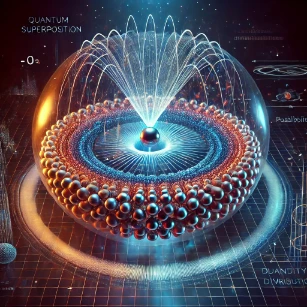
A visually striking depiction of quantum superposition, illustrating a quantum particle existing in multiple states simultaneously with wavefunction overlays and probability distributions.
This digital illustration represents the principle of quantum superposition, where a single quantum particle can exist in multiple states at once until measured. The central sphere symbolizes the quantum particle, while the layered and radiating waveforms surrounding it depict overlapping probability amplitudes of different possible states. The dome-like transparent boundary reinforces the idea of confinement within a potential well or observation boundary, with the surrounding grid indicating the quantum field framework. This visualization emphasizes how superposition underpins quantum computing, tunneling, and the probabilistic nature of quantum mechanics.
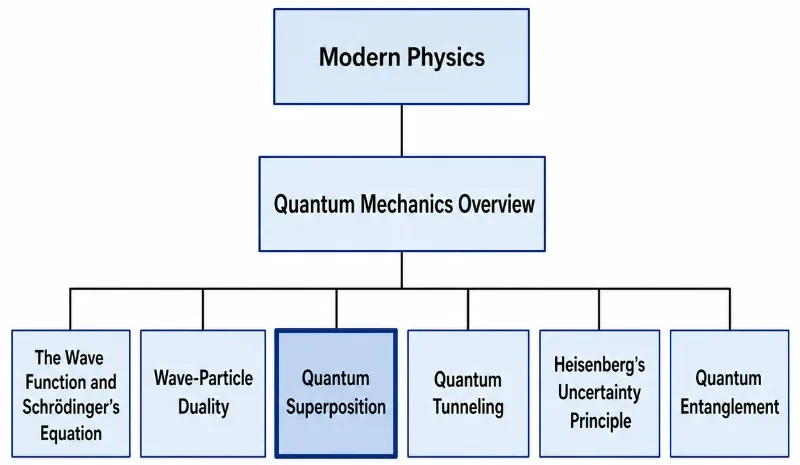
Quantum Superposition within the Quantum Mechanics pathway: this chart highlights how superposition connects with wavefunctions, wave-particle duality, tunneling, uncertainty, and entanglement.
Concept of Quantum Superposition
In classical physics, objects are usually described as having well-defined states. A ball, for example, is either on the ground or in the air; it is not normally treated as being in both conditions at the same time. In quantum mechanics, however, microscopic systems such as electrons, photons, and atoms can be described by a combination of possible states before measurement. This principle is known as quantum superposition.
Mathematically, a quantum system is described by a wavefunction, usually written as ψ. The wavefunction contains information about the possible states of the system and the probability amplitudes associated with them. If a quantum system can be found in two possible states, written as |A⟩ and |B⟩, then a superposed state may be written as:
|Ψ⟩ = α|A⟩ + β|B⟩
In this expression, |Ψ⟩ represents the superposed quantum state. The symbols α and β are complex probability amplitudes. They do not directly give the probabilities by themselves, but their squared magnitudes do.
The probability of obtaining state |A⟩ when the system is measured is:
P(A) = |α|2
The probability of obtaining state |B⟩ is:
P(B) = |β|2
For a two-state system with no other possible outcomes, the probabilities must add up to one:
|α|2 + |β|2 = 1
Before measurement, the system should not be imagined simply as a tiny classical object secretly choosing one state while hiding the answer from us. Instead, quantum mechanics represents the system as a superposition of possible states. When a measurement is made, one definite result is obtained, with probabilities determined by the wavefunction.
Key Idea
Quantum superposition means that a system can be represented as a combination of possible states before measurement. The wavefunction gives probability amplitudes, and measurement gives one observed outcome.
Examples of Quantum Superposition
Electron Energy States in Atoms
Electrons in atoms are not always restricted to a single definite energy state before measurement. A quantum electron can be represented as a superposition of possible energy states. For example, an electron in a hydrogen atom may be described as a combination of the first and second energy levels before a measurement is made.
When the electron’s energy is measured, the result is one definite energy value. The probabilities of the possible outcomes are determined by the wavefunction. This does not mean that the electron behaves like a tiny classical object jumping randomly between levels before measurement. Instead, the quantum state contains a structured combination of possibilities.
Photon Polarization
Photons, or particles of light, can also show superposition through their polarization states. A photon may be horizontally polarized, written as |H⟩, vertically polarized, written as |V⟩, or in a superposition of both states.
A simple equal superposition may be written as:
|Ψ⟩ = (1 / √2) · ( |H⟩ + |V⟩ )
The factor 1 / √2 is important because it gives equal probabilities for the two possible measurement outcomes. If the photon is measured in the horizontal–vertical polarization basis, the probability of obtaining |H⟩ is 1/2, and the probability of obtaining |V⟩ is also 1/2.
This principle is important in quantum optics, where photon states are used to study interference, measurement, entanglement, and quantum communication.
Quantum Bits: Qubits
In quantum computing, a qubit, or quantum bit, can be represented as a superposition of the |0⟩ and |1⟩ states.
A general qubit state may be written as:
|Ψ⟩ = α|0⟩ + β|1⟩
Here, α and β are probability amplitudes. If the qubit is measured in the |0⟩, |1⟩ basis, the probability of obtaining |0⟩ is |α|2, while the probability of obtaining |1⟩ is |β|2. For a properly normalized qubit:
|α|2 + |β|2 = 1
This is different from a classical bit, which is either 0 or 1 at a given moment. A qubit can carry a combination of possible outcomes before measurement. Quantum computers use superposition together with interference and entanglement to perform certain kinds of calculations in ways that classical computers cannot easily reproduce.
Key Idea
Superposition appears in many quantum systems, including electron energy states, photon polarization, and qubits. In each case, the system is described by a combination of possible states before measurement.
Schrödinger’s Cat Thought Experiment
Schrödinger’s cat is one of the most famous thought experiments in quantum mechanics. Erwin Schrödinger proposed it in 1935 to show how strange quantum superposition becomes when it is imagined at the scale of ordinary objects.
The thought experiment imagines a sealed box containing a cat and a quantum event, such as the possible decay of a radioactive atom. The quantum event is connected to a device that would determine whether the cat is found alive or not when the box is opened.
Before observation, quantum mechanics may describe the radioactive atom as being in a superposition of “decayed” and “not decayed” states. If the whole box is treated as one quantum system, this seems to imply that the cat’s condition is also linked to a superposed state.
The purpose of the thought experiment is not to suggest that cats in ordinary life are casually both alive and not alive. Instead, it highlights a deep question: when does a quantum system stop being described as a superposition of possibilities and become a definite observed outcome?
This is why Schrödinger’s cat remains important. It draws attention to the measurement problem in quantum mechanics. The experiment asks how the mathematical description of microscopic quantum systems connects with the definite results we see in the everyday world.
Key Idea
Schrödinger’s cat is not mainly about a cat. It is a thought experiment about measurement, superposition, and the difficulty of connecting quantum possibilities with definite classical outcomes.
Mathematical Framework of Superposition
The mathematics of superposition comes from the linear structure of quantum mechanics. One important expression of this structure is the Schrödinger equation, which describes how a quantum state changes with time.
In Dirac notation, the time-dependent Schrödinger equation may be written as:
iℏ (∂ / ∂t) |Ψ(t)⟩ = Ĥ |Ψ(t)⟩
Here, |Ψ(t)⟩ represents the quantum state of the system at time t. The symbol Ĥ is the Hamiltonian operator, which represents the total energy of the system. The symbol ℏ is the reduced Planck constant.
The important point is that the Schrödinger equation is linear. This means that if |ψ1⟩ and |ψ2⟩ are possible solutions, then a linear combination of them can also be a possible solution:
|Ψ⟩ = α|ψ1⟩ + β|ψ2⟩
In this expression, α and β are probability amplitudes. The state |Ψ⟩ is not simply one state or the other. It is a structured combination of the two possible states. This mathematical property is the foundation of the superposition principle.
When the system is measured, the result is one definite outcome. The probabilities of different outcomes are determined by the squared magnitudes of the probability amplitudes, such as |α|2 and |β|2.
Key Idea
Superposition is possible because quantum mechanics is linear. If two quantum states are allowed, then a properly formed combination of those states can also describe a valid quantum state.
Measurement and Wavefunction Collapse
A critical feature of superposition is the concept of wavefunction collapse. Before measurement, a quantum system may be described as a superposition of possible states. When a measurement is made, one definite outcome is obtained.
Before measurement: The system is described by a superposed quantum state.
Upon measurement: The system gives one of the possible eigenstates, with probability determined by the squared magnitude of its probability amplitude, such as |α|2.
This process is inherently probabilistic. In standard quantum mechanics, measurement gives definite outcomes according to probabilities determined by the wavefunction. How and why this transition from superposition to definite outcome occurs remains a major subject of debate in quantum foundations.
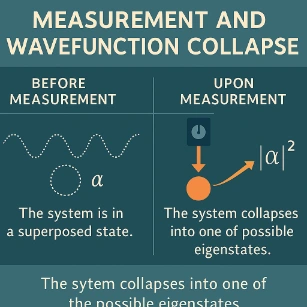
Measurement and Wavefunction Collapse: illustrating the transition from a superposed quantum state to a definite eigenstate upon observation, emphasizing the probabilistic nature of collapse.
This educational illustration portrays the process of wavefunction collapse in quantum mechanics. A particle is initially depicted in a superposition of multiple possible states, visualized through overlapping waveforms or probabilistic layers. Upon measurement, this superposition collapses into a single, well-defined outcome—an eigenstate—determined by the probability amplitude squared. The image captures the dramatic reduction of quantum uncertainty through observation, highlighting the inherently probabilistic nature of quantum measurements. This collapse is central to understanding how quantum systems transition from ambiguity to certainty during interaction with a measuring device, a phenomenon that continues to puzzle and inspire physicists.
Quick Check: Measurement and Collapse
Measurement in quantum mechanics does not simply reveal an ordinary hidden classical state. It gives one definite outcome from a quantum state described by probabilities.
1. What describes the quantum system before measurement?
A. A single fixed classical resultB. A superposed quantum stateC. A random number with no structureD. A measurement device only
Answer: B. Before measurement, the system may be described by a superposed quantum state containing different possible outcomes.
2. What determines the probability of obtaining a particular outcome?
A. The squared magnitude of the probability amplitudeB. The colour of the measuring deviceC. The mass of the observerD. The classical size of the particle
Answer: A. If an outcome has amplitude α, its probability is given by |α|2.
3. Why is wavefunction collapse considered conceptually difficult?
A. Because quantum mechanics has no mathematicsB. Because it raises questions about how definite outcomes arise from superpositionC. Because particles cannot be measuredD. Because all outcomes happen with equal probability
Answer: B. Collapse is conceptually difficult because quantum theory describes a superposition before measurement, yet actual measurements give definite outcomes.
4. Which statement is the most careful description of measurement?
A. Measurement always proves the particle secretly had one classical state all alongB. Measurement gives one observed result, with probabilities determined by the wavefunctionC. Measurement removes all uncertainty from every future situationD. Measurement has no effect in quantum mechanics
Answer: B. Measurement gives one definite observed result. The probabilities of possible results are determined by the wavefunction.
Key takeaway: Wavefunction collapse is a teaching description for how a quantum system described by several possible outcomes gives one definite result when measured.
Physical and Philosophical Implications
Challenge to Classical Reality
Superposition challenges the classical idea that particles always possess definite properties before measurement. In quantum mechanics, a system may be described by a combination of possible states until a measurement gives one definite outcome.
Quantum Nonlocality
Superposition, when combined with entanglement, leads to quantum correlations that cannot be explained by ordinary classical ideas. In entangled systems, measurements on separated particles can be strongly linked, even when the particles are far apart.
Observer Effect
The role of measurement in wavefunction collapse raises deep questions about how quantum possibilities become definite observed outcomes. These questions lead to different interpretations of quantum mechanics, including the Copenhagen interpretation and the Many-Worlds interpretation.
Superposition is one of the key ideas behind quantum computing. A qubit can be represented as a combination of the |0⟩ and |1⟩ states before measurement. This allows quantum computers to use superposition, interference, and entanglement together when carrying out certain specialised calculations.
Quantum algorithms such as Shor’s algorithm for factoring and Grover’s algorithm for search show how quantum systems can solve some problems in ways that are very different from classical computers. Superposition alone does not make a quantum computer automatically powerful; its usefulness depends on how amplitudes are arranged, combined, and measured through carefully designed quantum circuits.
Quantum computing and superposition: qubits can be represented as combinations of possible states, allowing quantum algorithms to use interference and measurement in powerful ways.
This digital illustration shows quantum computing as a process built from superposition, quantum circuits, and controlled measurement. Glowing qubits suggest the ability of quantum states to hold combinations of possibilities before measurement. Circuit pathways and abstract algorithmic structures represent how quantum computers manipulate probability amplitudes rather than simply performing ordinary parallel calculation. The image helps students connect the idea of superposition with quantum algorithms, cryptography, optimisation, and future computing technologies.
Quantum Cryptography
Superposition also plays an important role in quantum communication and cryptography. In Quantum Key Distribution (QKD), information can be encoded using quantum states such as photon polarisation states. Because measurement can disturb a quantum state, an attempt to intercept the communication may leave detectable traces.
This does not mean that quantum cryptography is magic or automatically unbreakable. Its security depends on careful physical implementation, reliable devices, and proper protocols. However, the use of quantum measurement gives QKD a distinctive advantage: eavesdropping can, in principle, be detected because observing the quantum state can change the information being transmitted.
Quantum Sensors and Metrology
Quantum sensors and precision measurement devices use superposition to detect extremely small changes in physical quantities. Examples include quantum gyroscopes, atomic clocks, magnetometers, interferometers, and other devices that rely on delicate phase relationships between quantum states.
In these systems, superposition allows a quantum state to evolve along more than one possible path or condition before being recombined. The resulting interference can reveal tiny changes in rotation, acceleration, time, magnetic fields, or gravitational effects. This makes quantum metrology important in navigation, geophysics, precision timing, aerospace systems, and fundamental physics experiments.
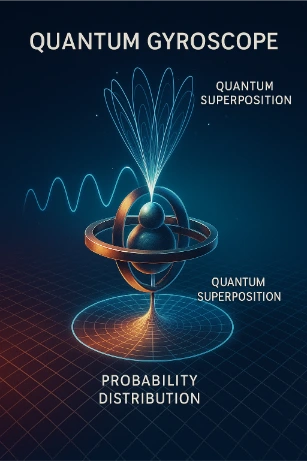
Quantum gyroscope: superposition and phase coherence can support highly sensitive measurements of rotation and orientation.
This digital illustration presents a futuristic quantum gyroscope designed for precision rotational sensing. The central gyroscopic structure suggests a system whose quantum state is carefully controlled, while glowing trajectories and probability fields represent superposition and phase evolution. Holographic grids and circular paths suggest how tiny changes in rotation may be detected through quantum interference. The image helps students see how superposition is not only an abstract idea, but also a foundation for advanced sensing technologies used in navigation, aerospace, submarines, and high-precision measurement systems.
Key Idea
Quantum superposition is useful because it allows quantum states to carry and combine possibilities before measurement. In computing, cryptography, and sensing, this makes new forms of information processing, security, and precision measurement possible.
Quantum Clock: Demonstrating the use of quantum superposition in precision timekeeping, where atomic states evolve in parallel to enhance timing accuracy.
This illustration portrays a conceptual quantum clock that leverages the principle of superposition for ultra-precise timekeeping. The central mechanism is framed by dynamic quantum waves and interference patterns, symbolizing multiple simultaneous atomic states. These overlapping states allow the quantum clock to measure time intervals with remarkable accuracy, surpassing classical atomic clocks. The design integrates quantum coherence and probabilistic phase evolution, crucial for quantum metrology and fundamental physics experiments exploring time at microscopic scales.
Experimental Evidence of Superposition
Quantum superposition is not just theoretical—it has been observed in numerous experiments:
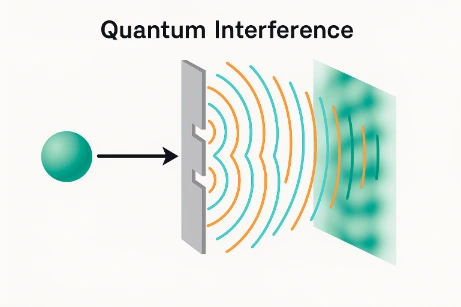
Double-Slit Experiment: Particles like electrons and photons exhibit interference patterns when not observed, demonstrating superposition of paths.
Quantum Interference Pattern from the Double-Slit Experiment
Superconducting Circuits: Macroscopic superpositions have been observed in superconducting quantum circuits, where electric currents flow in opposite directions simultaneously.
Interference of Large Molecules: Experiments have shown that even large molecules (like buckyballs) can exhibit superposition, suggesting the boundary between quantum and classical behavior is not yet fully understood.
Why Study Quantum Superposition in Quantum Mechanics
Foundation of Quantum Theory
Quantum superposition is one of the most fundamental principles in quantum mechanics. It asserts that a quantum system can exist in multiple states simultaneously until it is measured. This principle challenges classical notions of determinism and reality, and provides a radically different framework for understanding physical systems. Studying this concept is essential to grasping the mathematical and conceptual basis of quantum physics.
Interference and Probability Amplitudes
Superposition allows for interference between quantum states, which leads to outcomes governed by probability amplitudes rather than fixed certainties. These interference effects explain phenomena like diffraction patterns in the double-slit experiment. Understanding how amplitudes combine is critical for predicting the likelihood of measurement outcomes. This makes quantum mechanics both powerful and counterintuitive.
Wave-Particle Duality
Quantum superposition underpins the idea that particles can behave as waves and vice versa. Electrons, photons, and even larger molecules can show wave-like interference patterns when in superposed states. This duality defies classical distinctions and is a defining feature of quantum behavior. Exploring superposition helps students understand how particles exhibit both discrete and continuous properties.
Measurement and Collapse
A key aspect of superposition is that measurement causes a quantum system to collapse into a single observable state. This collapse introduces fundamental questions about the nature of observation and reality. It also plays a central role in quantum paradoxes, such as Schrödinger’s cat. Studying this process leads to a deeper appreciation of the philosophical and technical challenges in quantum theory.
Basis for Quantum Technologies
Superposition is the operational principle behind quantum technologies such as quantum computing, quantum cryptography, and quantum sensors. In a quantum computer, for instance, qubits leverage superposition to perform parallel computations. This opens up new possibilities for solving problems that are intractable for classical computers. Understanding superposition is therefore crucial for anyone interested in the future of quantum engineering and innovation.
External References
These external references provide trusted background reading on quantum superposition, measurement, qubits, and the wider conceptual foundations of quantum mechanics. They are useful for students who want to compare the Prep4Uni.online explanation with established educational and scientific sources.
Review an accessible explanation of key quantum ideas and how they connect to modern quantum technologies.
Quantum Superposition: Conclusion
The principle of quantum superposition is central to quantum mechanics. It shows that a quantum system can be represented as a combination of possible states before measurement. This challenges classical ideas of fixed reality, simple causality, and strict determinism, while raising deep questions about measurement and observation.
Superposition has been confirmed through experiments involving interference, photons, electrons, atoms, and other quantum systems. It also supports important modern technologies, including quantum computing, quantum cryptography, and quantum sensing. As research continues, superposition remains one of the key ideas shaping both our understanding of nature and the development of future quantum technologies.
Mathematically, a quantum system is described by a wavefunction, often written as ψ. If a quantum system can be found in two possible states, |A⟩ and |B⟩, the superposition principle allows the system to be represented as a linear combination of those states:
|Ψ⟩ = α|A⟩ + β|B⟩
Here, |Ψ⟩ is the superposed state, while α and β are complex probability amplitudes. These amplitudes determine the likelihood of obtaining state |A⟩ or state |B⟩ when the system is measured.
The probabilities are given by the squared magnitudes of the amplitudes:
P(A) = |α|2
P(B) = |β|2
For a two-state system with no other possible outcomes, the total probability must be one:
|α|2 + |β|2 = 1
Final Takeaway
Quantum superposition is not just a strange idea about particles. It is a mathematical and experimental principle that explains how quantum systems carry possibilities before measurement and why quantum technologies can behave in ways classical systems cannot.
Frequently Asked Questions: Quantum Superposition
1. What is quantum superposition?
Quantum superposition is the principle that a quantum system can exist in several possible states at the same time, with each state assigned a probability amplitude. Only when a measurement is made does the system yield a single definite outcome, selected according to these probabilities.
2. How is quantum superposition different from classical states?
In classical physics, a system is either in one state or another, even if we do not know which. In quantum mechanics, a system can genuinely be in a combination (superposition) of states, where none of the classical alternatives is fully realised until measurement. This leads to interference effects that cannot be explained by classical uncertainty alone.
3. How is superposition represented mathematically?
Mathematically, superposition is described using wavefunctions or state vectors. If |1⟩ and |2⟩ are possible states, then a general state can be written as a|1⟩ + b|2⟩, where a and b are complex probability amplitudes. The squared magnitudes |a|2 and |b|2 give the probabilities of obtaining each outcome when a measurement is made.
4. How does the double-slit experiment illustrate superposition?
In the double-slit experiment, a single electron or photon passing through a pair of slits behaves as if it travels through both slits at once in a superposition of paths. The overlapping probability amplitudes produce an interference pattern on the screen, which disappears if we measure which slit the particle actually passed through.
5. Does superposition mean a particle is literally in two places at once?
Superposition means that, before measurement, the particle does not have a single definite position that we can assign in a classical sense. Instead, its position is described by a spread-out wavefunction. Saying it is “in two places at once” is a shorthand for this more subtle idea, not a literal picture of a tiny object duplicated in space.
6. What happens to a superposition when we make a measurement?
When a measurement is made, the superposition appears to “collapse” to a single outcome: one definite value of the measured quantity. After the measurement, the system is described by the state corresponding to the observed result. The probabilities of different outcomes are determined by the squared magnitudes of the amplitudes in the original superposition.
7. How is interference related to superposition?
Interference arises when probability amplitudes from different components of a superposition combine. In some regions they reinforce each other (constructive interference) and in others they cancel (destructive interference). This interference pattern is a distinctive signature that the system was in a genuine superposition, not just a classical mixture of alternatives.
8. What role does superposition play in quantum computing?
In quantum computing, qubits can exist in superpositions of 0 and 1, written as a|0⟩ + b|1⟩ rather than being strictly 0 or 1. Collections of entangled qubits can represent and process many correlated possibilities at once, which allows certain quantum algorithms to achieve speedups over classical methods when combined with interference and clever measurement strategies.
9. What is the difference between a quantum superposition and a statistical mixture?
A statistical mixture describes a situation where a system is definitely in one of several states, but we do not know which. A quantum superposition describes a single quantum state that is a coherent combination of components. Superpositions can show interference, while mixtures cannot; this makes them distinguishable in carefully designed experiments.
10. What is Schrödinger’s cat thought experiment and how does it relate to superposition?
Schrödinger’s cat is a thought experiment where a cat in a sealed box is linked to a quantum event, such as the decay of an atom. Before opening the box, the combined system is described as a superposition of “alive” and “dead” states. The scenario highlights how strange quantum superposition seems when extended from microscopic particles to everyday objects.
11. Why do we not observe obvious superpositions in everyday life?
Macroscopic objects interact constantly with their environment, which rapidly destroys delicate quantum coherences through a process called decoherence. As a result, large-scale superpositions become effectively indistinguishable from classical mixtures, and everyday objects appear to have well-defined positions and properties rather than visible superposed states.
12. Why is it useful for students to learn about quantum superposition before university?
Understanding quantum superposition helps students appreciate how quantum systems differ fundamentally from classical ones, and why concepts like probability amplitudes and interference are central in modern physics. It prepares them for more advanced topics such as quantum mechanics, quantum information, and solid-state physics, where superposition is a key organising idea.
Quantum Superposition: Review Questions and Answers
1. What is quantum superposition? Answer: Quantum superposition is the principle that a quantum system can be represented as a combination of possible states before measurement. When measured, the system gives one definite outcome, with probabilities determined by the wavefunction.
2. How is quantum superposition represented mathematically? Answer: It is represented by a linear combination of basis states. For example, a two-state system may be written as |Ψ⟩ = α|A⟩ + β|B⟩, where α and β are probability amplitudes.
3. What role does interference play in quantum superposition? Answer: Interference occurs when probability amplitudes combine. Depending on their relative phase, they can reinforce one another or cancel one another, changing the probability of different measurement outcomes.
4. How does superposition challenge classical physics? Answer: Classical objects are usually described as having one definite state at a given time. Quantum superposition allows a microscopic system to be described as a combination of possible states before measurement, which changes how we understand physical reality at small scales.
5. What is meant by the “collapse” of the wavefunction? Answer: In many introductory descriptions, wavefunction collapse means that a quantum system described by a superposition gives one definite result when measured. The word “collapse” is a useful teaching term, although deeper interpretations of measurement can differ.
6. How does superposition contribute to quantum computing? Answer: In quantum computing, qubits can be represented as superpositions of |0⟩ and |1⟩. Quantum computers use superposition together with interference and entanglement to perform certain tasks in ways that may be much more efficient than classical methods.
7. What experimental evidence supports quantum superposition? Answer: Interference experiments with photons, electrons, atoms, and even larger quantum systems support the idea of superposition. The double-slit experiment is one of the clearest examples because particles produce interference patterns when their possible paths are not measured.
8. How is decoherence related to the loss of superposition? Answer: Decoherence occurs when a quantum system interacts with its environment. This interaction can destroy the delicate phase relationships between components of a superposition, making the system behave more like a classical object.
9. What is the significance of Schrödinger’s cat? Answer: Schrödinger’s cat is a thought experiment that highlights the difficulty of applying quantum superposition to everyday objects. It is mainly about measurement and the boundary between quantum possibilities and definite classical outcomes.
10. How can superposition be used in secure communication? Answer: Superposition is part of the foundation of quantum communication. In quantum key distribution, measuring a quantum state can disturb it, helping reveal whether an eavesdropper has interfered with the communication.
Quantum Superposition: Thought-Provoking Questions and Answers
1. How might superposition change our understanding of reality? Answer: Superposition suggests that microscopic systems should not always be imagined as having one definite classical property before measurement. Instead, quantum mechanics describes them using probability amplitudes. This challenges the everyday idea that all physical properties are fixed before we observe them.
2. How could superposition transform computing and data processing? Answer: Superposition allows qubits to represent combinations of possible states. When combined with interference and entanglement, this can help quantum computers solve certain specialised problems more efficiently than classical computers.
3. How does superposition affect our interpretation of measurement? Answer: Superposition shows that measurement in quantum mechanics is not simply a passive act of looking at a pre-existing classical value. Measurement is connected to how a quantum system gives a definite result from a range of possible outcomes.
4. Can superposition be observed in macroscopic systems? Answer: Superposition is well established in microscopic systems. Observing it in larger systems is much harder because interactions with the environment cause decoherence. Studying larger quantum systems helps scientists explore the boundary between quantum and classical behaviour.
5. How could better control of decoherence improve quantum technology? Answer: If quantum systems can be better protected from environmental noise, they can remain coherent for longer. This would improve quantum computers, quantum sensors, and quantum communication systems.
6. What does superposition suggest about cause and effect in quantum systems? Answer: Superposition does not destroy cause and effect, but it shows that quantum processes often cannot be described using simple classical pathways. Instead of one definite route before measurement, quantum mechanics may describe several possible contributions through probability amplitudes.
7. How do superposition and entanglement work together? Answer: Superposition allows systems to be described as combinations of possible states. Entanglement links the states of different systems in ways that cannot be explained by ordinary classical correlation. Together, they produce many of the most powerful and unusual features of quantum mechanics.
8. Can superposition explain consciousness? Answer: Some speculative ideas have suggested possible links between quantum effects and consciousness, but this is not established science. For students, it is better to treat superposition first as a tested principle of microscopic physics before applying it to highly uncertain areas.
9. How does superposition relate to the many-worlds interpretation? Answer: In the many-worlds interpretation, the different parts of a superposition are treated as corresponding to different branches of reality after measurement-like interactions. This is one interpretation of quantum mechanics, not a settled conclusion accepted in only one way by all physicists.
10. What techniques help scientists study superposition in new systems? Answer: Scientists use techniques such as interference experiments, superconducting qubits, trapped ions, cold atoms, and large-molecule interferometry to study superposition in increasingly controlled and complex systems.
11. How might superposition contribute to energy-efficient technology? Answer: Superposition may support more efficient ways to solve some computational problems, especially when combined with quantum algorithms. However, practical energy advantages depend on hardware design, error correction, cooling needs, and the specific task being performed.
12. What ethical questions arise from superposition-based technologies? Answer: Quantum technologies may affect data security, privacy, finance, communication, defence, and access to advanced computing. Responsible development requires attention to fairness, security, transparency, and social impact.
Numerical Problems and Solutions
1. A quantum state is given by ψ = (1 / √2)(ψ1 + ψ2). Calculate the probability of finding the system in state ψ1.
Solution:
P1 = | 1 / √2 |2 = 1 / 2
Answer: The probability of finding the system in state ψ1 is 1/2.
2. If ψ = (1 / √3)ψ1 + √(2/3)ψ2, find the probability of measuring state ψ2.
Solution:
P2 = | √(2/3) |2 = 2 / 3
Answer: The probability of measuring state ψ2 is 2/3.
3. Two waves interfere with amplitudes A and A. Find the resulting intensity for constructive interference.
Solution:
ψtotal = A + A = 2A
I ∝ |ψtotal|2 = |2A|2 = 4A2
Answer: The resulting intensity is proportional to 4A2.
4. For destructive interference of equal amplitudes, calculate the resulting intensity.
Solution:
ψtotal = A − A = 0
I ∝ |ψtotal|2 = 0
Answer: The resulting intensity is zero.
5. A quantum system is in the state ψ = (1/2)ψ1 + (√3 / 2)ψ2. Find both probabilities.
Solution:
P1 = | 1/2 |2 = 1/4
P2 = | √3 / 2 |2 = 3/4
Answer: The probabilities are P1 = 1/4 and P2 = 3/4.
6. If a system is measured and found in state ψ1, what happens to the original superposition in a simple collapse description?
Solution:
In a simple collapse description, the system is now described by the measured state:
ψ → ψ1
Answer: The system is described by ψ1 after the measurement.
7. A particle has wavefunction ψ = A(ψ1 + ψ2), where ψ1 and ψ2 are orthonormal states. Find the normalization constant A.
Solution:
|A|2(1 + 1) = 1 ⇒ 2|A|2 = 1
|A| = 1 / √2
Answer: A valid normalization choice is A = 1 / √2.
8. Two equal-amplitude components differ by a phase of π. What type of interference occurs?
Solution:
A phase difference of π means the two components are opposite in phase:
ψtotal = A − A = 0
Answer: Destructive interference occurs.
9. Convert a phase difference of 90° into radians.
Solution:
θ = 90° × (π / 180°) = π / 2 ≈ 1.57 rad
Answer: 90° = π/2 rad.
10. If probability amplitudes are 0.6 and 0.8, verify normalization.
Solution:
P = (0.6)2 + (0.8)2 = 0.36 + 0.64 = 1
Answer: The state is properly normalized because the total probability is 1.
11. A two-state system has equal probability of measurement in ψ1 and ψ2. Write one possible normalized state.
Solution:
Equal probabilities mean P1 = P2 = 1/2.
One possible choice of amplitudes is A1 = A2 = 1 / √2.
Therefore:
ψ = (1 / √2)(ψ1 + ψ2)
Answer: One possible normalized state is ψ = (1 / √2)(ψ1 + ψ2).
12. If a measurement yields ψ2, what is the probability of obtaining ψ1 immediately after, assuming no further evolution?
Solution:
Immediately after measurement, the system is described by the measured state ψ2. Therefore:
P(ψ1) = 0
Answer: The probability of obtaining ψ1 immediately after is 0, assuming no further evolution of the system.