
Drawing on histories of military and political influence (Input), learners compare strategies, campaigns, and governing choices, while using agreed criteria and standards (Control) to avoid shallow conclusions. Over time, the course produces durable outcomes (Output): students gain a grounded understanding of how authority is asserted, how conflict changes political systems, and how tactics—both military and political—shape real decisions. Supported by expert teaching, archival sources, and focused case studies (Mechanism), students learn to test claims against evidence, distinguish propaganda from analysis, and explain why some power structures endure while others collapse.

The interplay between military and political power has profoundly shaped historical transformations. Throughout time, the consolidation of authority often relied on a blend of force, ideology, and institutional frameworks. From ancient empires to modern nation-states, control has been exerted not only through weapons but also through legislation, public education, and diplomacy.
Early thinkers in economic thought and theory recognized the influence of warfare on economic organization and state power. The emergence of centralized governance was frequently supported by conscription and control over economic production. Developments in industrial and technological history further changed the scale and efficiency of military operations.
These changes reverberated through labor structures, as shown in labor history and labor and social policy. Wartime mobilization demanded reorganization of the labor force, influencing both class structures and post-war welfare initiatives. Likewise, education history reveals how schooling systems were used to cultivate loyalty and readiness for national service.
Mechanisms of governance, particularly through electoral history, were often influenced or disrupted by military rule. Issues of electoral fraud and integrity became central concerns where democratic processes were undermined by armed coercion or manipulated representation. The evolution of electoral systems and political parties provides further insight into how states institutionalized power through formalized procedures.
Some of the most dynamic challenges to political power came from movements outside the state, such as those analyzed in guerrilla warfare and insurgency studies. These forms of resistance redefined how power could be wielded and contested. At the same time, intellectual political history provides a lens through which competing ideologies sought to legitimate or reject militarized governance.
Alliances, as studied in history of alliances, and treaty analysis, have served to enhance or curb military ambitions through negotiated power structures. These diplomatic practices are vital for understanding modern geopolitical frameworks and the shifting contours of influence.
The transformation of warfare itself is documented in technological history of warfare and the role of media and tools in shaping public opinion and political outcomes, such as the role of technology in elections.
Underlying all this is the social dimension. From social history and history of social movements to the impacts on urban and rural history, the lived experiences of populations shaped—and were shaped by—the military-political nexus. Gender also played a crucial role, with perspectives from women’s history revealing how conflict restructured gender roles and civil rights.
Finally, economic motivations behind many conflicts are laid bare in trade and commerce history. The connections between economic control and armed dominance reinforce the idea that military and political power are not distinct but deeply interwoven in the historical development of human societies.
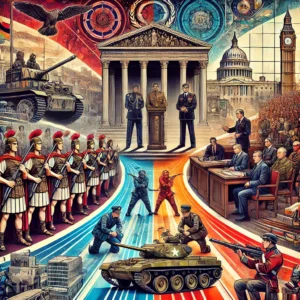
Force and Authority: Military Power in Political Systems
Political power is not sustained by ideas alone—it is often backed by force. Military institutions play a central role in shaping authority, defending states, and sometimes controlling them. Studying the relationship between military and political power reveals how force, legitimacy, and governance interact.
Curriculum Hub Cluster Navigation
Explore the interconnected sub-topics within Political Systems to understand how military force, constitutional boundaries, and institutional frameworks interact within the broader curriculum roadmap:
History of Political Systems – Overview
Trace how different systems of governance evolved and how institutional authority is established across epochs.
Political Ideologies
Explore how ideas about power, order, and authority define and justify the domestic role of armed forces.
Military & Political Power (Current Module)
Examine how armed forces enforce state authority, manipulate governance, and shape political stability or collapse.
Electoral Systems & Political Parties
Study how military influence interacts with political competition, voter representation, and party dynamics.
Constitutional History
Understand how legal frameworks mandate civilian control and attempt to restrict military intervention.
Comparative Politics
Compare cross-national models of civil-military equilibrium, coup vulnerability, and structural governance.
Colonial & Post-Colonial Systems
Investigate how colonial security apparatuses transitioned into post-independence military intervention.
Bureaucratic & Administrative History
Examine state logistics, administrative integration, and civil service interactions with defense institutions.
Understanding the Nexus of Military and Political Power
Definition and Scope
Military power refers to the ability of armed forces to protect, project, and sometimes impose governance. Political power involves the authority to make decisions, allocate resources, and govern populations. The intersection of these powers occurs when militaries influence or control political decision-making.
Core Dimensions
- Civil-Military Relations: Examines how military institutions interact with civilian governments.
- Military as a Political Actor: Analyzes when and why militaries intervene in governance.
- Military Power Projection: Explores how states use military force to achieve political objectives domestically and internationally.
Historical Development of Military and Political Power
Ancient and Classical Civilizations
- The Role of the Military in Early States: Early civilizations, such as Mesopotamia and Egypt, relied on military forces to defend territories and expand empires. For example, the Assyrian Empire was renowned for its militarized governance and use of force to maintain control.
- Praetorian Guards in Ancient Rome:
- Context: The Praetorian Guards were elite soldiers tasked with protecting Roman emperors.
- Political Influence: Over time, they became political kingmakers, deposing and installing emperors at will (e.g., in 41 CE, assassinating Emperor Caligula and elevating Claudius).
- Legacy: Highlighted the dangers of militaries wielding unchecked political power.
Feudal and Medieval Periods
- Knights and Feudal Lords: Military power was decentralized, with feudal lords maintaining private armies. During the Hundred Years’ War (1337–1453), military leaders like Joan of Arc emerged as decisive political figures.
- The Ottoman Janissaries: Elite infantry units formed from enslaved Christian boys trained to serve the Ottoman sultan. Over time, the Janissaries gained severe political influence, frequently intervening in imperial succession disputes.
Modern Era
- Professionalization of Militaries: The 18th and 19th centuries saw the professionalization of armed forces, aiming to subordinate them to state governance. Napoleon Bonaparte exemplified how a genius commander could dominate both military and political spheres simultaneously.
- Colonial and Post-Colonial Military Influence: Colonized nations inherited militarized governance structures, contributing to post-colonial military coups in states like Ghana and Nigeria during the 1960s.
Civil-Military Relations
The balance between civilian and military authority is a central theme in understanding military and political power.
Models of Civil-Military Relations
- Civilian Control: Militaries are subordinate to elected civilian authorities (e.g., the United States emphasizing civilian leadership via the Department of Defense).
- Military Dominance: Militaries directly or indirectly control governance (e.g., Myanmar’s military maintaining rule through coups and constitutional provisions).
- Hybrid Models: Civilian and military authorities share power uneasy co-existence (e.g., Pakistan alternating between civilian governance and direct military intervention).
Factors Influencing Civil-Military Dynamics
- Institutional Design: Constitutions and legal statutes that define boundaries for military involvement.
- Economic Control: Militaries that manage significant industrial resources exert huge political leverage (e.g., Egypt’s military controlling vast commercial enterprises).
- External Influences: Foreign military aid or geopolitical backing can prop up militarized regimes (e.g., Cold War superpower proxy support).
Military Coups and Their Consequences
Military coups occur when armed forces illegally overthrow a civilian government and assume state control.
Causes of Coups
- Weak Civilian Institutions: Fragile legal structures invite military intervention.
- Economic Crises: Severe economic instability creates public discontent exploited by officers.
- Ethnic or Regional Divisions: Fractured societies encourage militaries to claim the role of “stabilizing arbiter.”
- External Support: Covert backing by foreign intelligence or foreign states.
Examples of Modern Coups
- Turkey (1980): The armed forces intervened citing internal strife and terrorism, eventually drafting a new constitution before restoring civilian rule.
- Egypt (2013): The military ousted elected President Mohamed Morsi following massive anti-government protests.
Consequences of Coups
- Political Instability: Recurrent intervention erodes confidence in democratic institution building.
- Authoritarianism: Military regimes prioritize security over civil liberties and political freedoms.
- Economic Impact: Unpredictable military governance deters foreign investment and weakens long-term development.
Military Power in International Politics
Militaries shape not just domestic politics, but global order and international relations.
Military Alliances
NATO (North Atlantic Treaty Organization) demonstrates how collective defense agreements shape international balance-of-power strategies and deter aggression.
Interventions and Peacekeeping
Multinational operations under the United Nations utilize military forces to preserve post-conflict stability and protect civilian populations.
Illustrative Case Studies of Military Influence on Governance
- The Roman Empire: The Praetorian Guard showed how armed force designed for protection can corrupt and hijack political succession.
- Post-Colonial Africa: Post-independence coups in Ghana, Nigeria, and Uganda highlight structural challenges in building civil supremacy over legacy security institutions.
- The Cold War: Both the US and Soviet Union backed militarized governments to secure geopolitical spheres of influence, often sacrificing democratic governance.
Practical Benefits of Analyzing Military and Political Power
- Policy Development: Informs civil-military legal guardrails and constitutional reform to prevent autocratic encroachment.
- Conflict Resolution: Provides tools to diagnose coup risk factors and rebuild post-conflict security sectors.
- Global Security: Enhances diplomatic strategies for arms control, peacekeeping, and collective security.
Key Motivations for Studying Military and Political Power
Understanding the Relationship Between Force and Authority
Exploring the Role of Armed Forces in State Development
Analyzing the Balance Between Civilian Control and Military Autonomy
Recognizing the Impact of Military Power on Global Politics
Preparing for Careers in Politics, Security Studies, and International Affairs
Interactive Simulation: Coup Vulnerability & Civil-Military Balance Model
Adjust institutional parameters below to observe how civilian oversight, defense spending share, and political stability calculate a state’s projected Coup Vulnerability Index (CVI) over a 10-year timeline.
Civil-Military Stability Index Simulator
Interactive Case Study Review (Click to Expand Answers)
Test your conceptual grasp of military and political interactions by toggling the scenarios below:
Case 1: Why did the Praetorian Guard transition from bodyguards to sovereign kingmakers?
Case 2: How do military commercial enterprises undermine civilian governance in modern regimes?
Case 3: What distinguishes a military junta from a professional defense force under civilian supremacy?
Military and Political Power: Concluding Insights
The relationship between military institutions and political power is a dynamic and complex aspect of governance. From the influence of the Praetorian Guards in Ancient Rome to modern military coups in Egypt and Myanmar, history demonstrates the dual role of militaries as protectors and potential disruptors of political systems. By examining these interactions, we gain valuable insights into fostering balanced civil-military relations, promoting democratic governance, and preventing authoritarianism.
Frequently Asked Questions: Military & Political Power
What does it mean by the relationship between military and political power?
The relationship refers to how armed forces (the military) and state governance (political institutions) interact: the military can uphold, support, or intervene in political power — shaping who governs, how policies are enforced, and how authority is maintained or changed.
When and why does the military intervene in politics or become politically powerful?
Military intervention often occurs during crises — such as wars, economic collapse, political instability, or weak institutions — when the armed forces view themselves as guardians of order or the state. In many cases, a perception of failed civilian rule, internal conflict, or external threat prompts the military to seize or claim power.
What is a military government or junta, and how does it differ from a civilian government?
A military government (or junta) is a regime led by military officers rather than elected civilian leaders. In such regimes, the armed forces may rule directly or exert strong control over nominal civilian institutions; unlike civilian governments, military regimes often rely on coercion, command structures and suppression of dissent.
Can military influence remain behind the scenes rather than through overt rule?
Yes — even without formal takeover, militaries can exert political influence through institutional power, control over security, pressure on civilian leaders, or covert intervention. Such influence may shape policy, civil-military relations, and governance without the appearance of a formal military government.
How does military power support or weaken state authority and governance?
A capable military can support state authority by defending the state from external threats, maintaining internal order, and upholding government rule. However, when the military becomes too powerful politically, it can weaken democracy, civil liberties, and institutional checks — especially if it overrides or bypasses civilian oversight.
How have different historical contexts influenced militaries’ role in politics?
Historical contexts such as decolonisation, weak post-colonial institutions, ethnic or social conflict, economic crises, or international pressures have often produced conditions where militaries step in. In many newly independent or developing states, the military has played a key role in shaping governance when civilian systems were fragile.
What is the difference between civilian control of the military and military rule?
Civilian control means that elected or civilian institutions set policy, govern the state, and command the military under legal and constitutional norms. Military rule, by contrast, occurs when the armed forces themselves govern or dominate civilian institutions — disrupting the separation between military and politics.
How does military power shape foreign policy and international relations?
Because military strength offers coercive and deterrent capabilities, states with strong militaries can project power abroad, influence international decisions, deter threats, and shape geopolitical outcomes. Military-backed regimes often depend heavily on external security and alliances, which can shape both domestic and foreign policy decisions.
How have scholars studied the interaction between military institutions and political power over time?
Scholars analyse civil-military relations, historical cases of coups and military regimes, institutional structures, the role of security forces in governance, and the causes and consequences of military intervention. This includes both comparative studies across countries and historical-context analyses of specific states.
What are some consequences — for society and governance — when the military dominates politics?
Military dominance can lead to reduced political freedoms, suspension of democratic institutions, suppression of dissent, and governance oriented toward security rather than public welfare. It may also result in instability, lack of accountability, and difficulties in building inclusive, participatory political systems.
Why is it important to study the history of military and political power for students of political systems?
Because military–political relations have shaped many states’ development, understanding this history helps explain why certain states became authoritarian or experienced coups, why institutions evolved the way they did, and how civil-military balance affects democracy, governance and state stability. This awareness is crucial for understanding contemporary political dynamics globally.
Can military influence be compatible with democratic governance?
In theory, yes — democracies often maintain militaries under civilian oversight, where the military is professional and apolitical. The challenge is ensuring clear legal and institutional boundaries, accountability, and civilian supremacy over armed forces, so that the military remains a defence institution rather than a political actor.
End-of-Page Practice & Assessment Module
Section 1: Foundational Review Questions
Test your fundamental knowledge of civil-military terminology, historical precedents, and political frameworks.
- What is meant by military power in the context of political systems?
Answer: Military power refers to the capacity of a state’s armed forces to exert influence over political decisions and maintain or challenge political authority. It encompasses both the technological capabilities and the organizational strength of military institutions. Historically, military power has been a decisive factor in state formation, regime change, and the enforcement of national policies. This concept highlights the relationship between force and governance, demonstrating how military strength can shape political outcomes. - How has military power historically influenced the formation of states?
Answer: Throughout history, military power has been central to the formation and consolidation of states. Conquering armies and victorious generals often laid the groundwork for new political orders and territorial boundaries. The ability to mobilize and maintain large military forces allowed emerging states to enforce laws, protect borders, and assert sovereignty. Consequently, the evolution of state structures has been deeply intertwined with military successes and innovations in warfare. - What role have military coups played in shaping political systems?
Answer: Military coups have been pivotal events in many countries, often resulting in abrupt changes in leadership and shifts in political direction. Such coups typically occur when military leaders seize control to address perceived governmental inefficiencies or corruption. They can lead to periods of authoritarian rule or, conversely, trigger demands for democratic reform. The recurring occurrence of coups underscores the fragile balance between civilian authority and military power in many political systems. - How do military institutions impact the stability of political regimes?
Answer: Military institutions significantly affect the stability of political regimes by acting as both protectors and potential challengers of governmental authority. A well-organized military can secure a state against external threats and internal dissent, contributing to regime stability. However, when the military becomes politicized or oversteps its boundaries, it can undermine democratic processes and destabilize governance. Thus, the relationship between the military and the state is critical for maintaining a balanced and resilient political system. - What is the relationship between militarism and nationalism in historical contexts?
Answer: Militarism and nationalism have often been closely linked, with a strong national identity reinforcing the glorification of military prowess. In many historical contexts, nationalist sentiments have been bolstered by a powerful military that is seen as the embodiment of a nation’s strength and honor. This relationship has led to policies of aggressive expansion and defense, as well as cultural narratives that celebrate military achievements. The interplay between militarism and nationalism continues to influence contemporary political ideologies and state behavior. - How have military alliances and conflicts shaped international political dynamics?
Answer: Military alliances and conflicts have played a crucial role in shaping international political dynamics by creating networks of mutual defense and by redrawing geopolitical boundaries through war. Alliances such as NATO have provided collective security, influencing the balance of power between nations. Conversely, prolonged military conflicts have led to shifts in global influence, often resulting in the rise and fall of empires. These interactions have continuously redefined international relations and the global distribution of power. - In what ways have civilian governments interacted with military institutions over time?
Answer: Civilian governments have historically maintained a complex relationship with military institutions, balancing the need for security with the imperative of democratic governance. In some instances, civilian authorities have successfully integrated the military into a system of checks and balances, ensuring accountability and preventing military overreach. However, there have also been periods when the military has exerted undue influence over political decision-making, often leading to authoritarian rule. The evolution of civil–military relations reflects ongoing efforts to harmonize security needs with democratic principles. - How does the balance of power between the military and political institutions affect governance?
Answer: The balance of power between military and political institutions is fundamental to effective governance, as it determines who ultimately holds authority within the state. When civilian control is strong, military power is typically subordinate and focused on national defense rather than political intervention. Conversely, an imbalance in favor of the military can lead to authoritarian regimes and the erosion of democratic institutions. Achieving a harmonious balance is essential for stable governance, ensuring that military capabilities support rather than supplant political leadership. - What factors contribute to the militarization of political power in certain regimes?
Answer: The militarization of political power in certain regimes is often driven by a combination of historical, economic, and social factors. In many cases, external threats or internal instability have led governments to prioritize military strength as a means of consolidating power. Economic resources may be heavily allocated to defense, while political rhetoric glorifies the military as the protector of national interests. This emphasis on military power can overshadow civilian institutions, resulting in a governance structure that relies on force rather than democratic processes. - How do historical examples of military influence inform contemporary debates on civil-military relations?
Answer: Historical examples of military influence provide critical insights into the challenges and opportunities inherent in civil–military relations today. By studying past instances of military intervention and the consequences of unchecked armed power, policymakers can better understand the importance of maintaining civilian oversight. These lessons highlight the need for clear constitutional boundaries and institutional safeguards to prevent military dominance in political affairs. Contemporary debates often draw on historical precedents to advocate for reforms that promote transparency, accountability, and balanced governance.
Section 2: Analytical & Scenario-Based Thought Questions
Deep-dive into structural challenges, technological transformations, and strategic dilemmas surrounding civil-military dynamics.
- How have historical shifts in military technology influenced political power structures?
Answer: Historical shifts in military technology, such as the introduction of gunpowder, mechanized warfare, and nuclear capabilities, have dramatically reshaped political power structures by altering the nature of conflict and state security. These technological advancements have not only increased the lethality of military forces but also redefined the strategies and tactics of warfare, thereby influencing how states project power both domestically and internationally. As military technology evolves, it can shift the balance of power between nations, often rendering older methods of governance obsolete and necessitating new forms of political organization. Furthermore, cyber capabilities and autonomous systems challenge traditional concepts of state sovereignty and internal law enforcement. - What are the long-term effects of military dominance on a nation’s democratic institutions?
Answer: Military dominance can have profound long-term effects on a nation’s democratic institutions by undermining the balance of power and eroding civilian control over governance. When the military exerts significant influence over political decision-making, it often leads to the centralization of power and the marginalization of democratic processes. This can result in the weakening of institutions designed to ensure accountability, such as independent judiciaries and free press, ultimately stifling political pluralism and citizen participation. Over time, societies struggle to transition back to fully civilian rule as entrenched military economic interests resist reform. - How can nations effectively balance military preparedness with the need for democratic accountability?
Answer: Nations can effectively balance military preparedness with democratic accountability by establishing clear legal frameworks that delineate the roles and responsibilities of military and civilian institutions. Implementing robust systems of checks and balances, such as parliamentary oversight committees and independent audit boards, ensures defense policies and military expenditures are subject to public scrutiny. Additionally, encouraging professional military education focused on constitutional duty ensures officers internalize civilian supremacy. - What role does military ethics play in shaping the relationship between armed forces and political leaders?
Answer: Military ethics plays a crucial role by establishing moral and professional standards that guide military conduct. These ethical principles ensure military actions align with broader societal values, human rights, and international law. Upholding military ethics fosters trust between armed forces and civilian authorities, establishing that soldiers serve the constitution rather than temporary partisan figures, thereby preventing unlawful coups. - How do historical instances of civil-military conflict inform our understanding of political crises today?
Answer: Historical civil-military conflicts highlight recurring structural triggers—such as severe economic collapse, systemic corruption, or institutional gridlock—that predispose societies to armed intervention. By studying past crises, political scientists can spot early warnings where military officers begin positioning themselves as political arbiters, allowing policymakers to enact preventive constitutional reforms before civilian rule collapses. - In what ways might future geopolitical shifts alter the balance between military power and political authority?
Answer: Emerging technologies like AI warfare, hypersonic defense, and cyber sabotage accelerate the speed of conflict, compelling civilian leaders to delegate greater immediate authority to defense apparatuses. Concurrently, regional realignments and multilateral security treaties may require domestic military structures to align with international norms, creating friction between national political autonomy and collective security obligations. - How can historical patterns of military intervention in politics help predict future trends in civil-military relations?
Answer: Analyzing historical coup cycles reveals that states with previous military governments suffer high rates of coup recurrence (“coup traps”) unless institutional civil control is aggressively rebuilt. Predictive models evaluate defense budget percentages, executive strength, and civil rights protections to quantify democratic vulnerability to military overreach. - What are the potential impacts of increased military spending on the political landscape of a nation?
Answer: Diverting budget reserves into heavy military expenditure often starves social programs, infrastructure, and healthcare, fueling social unrest. Politically, expanding defense budgets enhances the political influence of defense contractors and military elites, creating a self-reinforcing lobby that prioritizes national security framing over social welfare policies. - How do international military alliances influence domestic political power structures?
Answer: International alliances compel member nations to standardize defense policies, civilian oversight mechanisms, and budgetary norms. While alliance participation can protect weak democracies from domestic coups due to foreign pressure, it can also limit national policy autonomy by binding governments to external strategic objectives. - In what ways can the decentralization of military power contribute to improved democratic governance?
Answer: Decentralizing armed command prevents single military figures from easily mobilizing national forces for a central capital coup. Regional military accountability paired with localized civil administration strengthens public trust and ensures defense assets strictly support territorial defense rather than internal political control.
Section 3: Analytical Calculations & Quantitative Assessment
Solve these quantitative problems evaluating defense expenditure ratios, civil-military stability indices, and force projection dynamics.
- Defense Budget Share Calculation:
A state has a Total National Budget of $450 billion. If its Military Expenditure is $67.5 billion, calculate the percentage of the budget dedicated to defense. If civilian oversight rules stipulate that defense must not exceed 12% of the budget to prevent militarization, determine by how many percentage points the current budget exceeds this ceiling.
Solution / Calculation:
1. Calculate Defense Share = ($67.5 billion / $450 billion) × 100% = 15.0%.
2. Calculate Threshold Excess = 15.0% – 12.0% = 3.0 percentage points.
Result: Defense accounts for 15.0% of the budget, exceeding the recommended civilian threshold by 3.0 percentage points. - Coup Vulnerability Index (CVI) Formula:
Suppose a state’s Coup Vulnerability Index (CVI) is calculated using the weighted formula:CVI = (0.40 × EconInstability) + (0.35 × MilAutonomy) – (0.25 × CivOversight)Given EconInstability = 80, MilAutonomy = 70, and CivOversight = 30 (all measured on a 0–100 scale), calculate the state’s CVI. Is it above the critical danger threshold of 50?
Solution / Calculation:
1. Compute Weighted Terms:
• Economic component = 0.40 × 80 = 32.0
• Military component = 0.35 × 70 = 24.5
• Civilian oversight deduction = 0.25 × 30 = 7.5
2. Aggregate CVI = 32.0 + 24.5 – 7.5 = 49.0.
Result: CVI is 49.0. It is just below the critical threshold of 50.0, indicating moderate-to-high instability risk. - Force Mobilization Ratio:
Nation A has a total active population of 25,000,000 citizens. During wartime mobilization, 3% of the total population is conscripted into active armed forces. If 15% of those conscripted forces are assigned directly to administrative and political security roles, calculate:
a) Total active military force mobilized.
b) Number of military personnel assigned to political security roles.
Solution / Calculation:
a) Mobilized Force = 25,000,000 × 0.03 = 750,000 personnel.
b) Political Security Roles = 750,000 × 0.15 = 112,500 personnel.
Result: 750,000 total troops mobilized, with 112,500 dedicated to political/internal security apparatuses. - Military Economic Autonomy Ratio:
A country’s military earns $4.2 billion directly from state-owned commercial enterprises (off-budget) and receives $7.8 billion from official parliamentary budget appropriations. Calculate the military’s Off-Budget Reliance Percentage relative to its Total Revenues.
Solution / Calculation:
1. Total Revenue = $4.2 billion + $7.8 billion = $12.0 billion.
2. Off-Budget Percentage = ($4.2 billion / $12.0 billion) × 100% = 35.0%.
Result: The military derives 35.0% of its total funding off-budget, presenting significant challenges for civilian fiscal control. - Peacekeeping Force Allocation Calculation:
A global security alliance deploys 48,000 peacekeeping troops across 4 conflict zones. Zone 1 receives 35% of troops, Zone 2 receives 25%, and the remaining troops are divided equally between Zone 3 and Zone 4. Calculate the exact troop deployment for Zone 4.
Solution / Calculation:
1. Combined share for Zone 1 & Zone 2 = 35% + 25% = 60%.
2. Remaining share for Zones 3 & 4 = 100% – 60% = 40%.
3. Zone 4 share = 40% / 2 = 20%.
4. Zone 4 Troop Count = 48,000 × 0.20 = 9,600 troops.
Result: Zone 4 receives exactly 9,600 peacekeeping troops. - Post-Coup Civilian Control Recovery Metric:
Following a constitutional reform, a nation reduces military parliamentary seat reservations by 25% every 2 years. If the military initially holds 80 seats, how many reserved seats will remain after 6 years (3 transition cycles)?
Solution / Calculation:
1. End of Cycle 1 (Year 2): 80 × (1 – 0.25) = 60 seats.
2. End of Cycle 2 (Year 4): 60 × (1 – 0.25) = 45 seats.
3. End of Cycle 3 (Year 6): 45 × (1 – 0.25) = 33.75 ≈ 34 seats (or 33 rounded down depending on statutory law).
Result: Approximately 33 to 34 reserved seats remain after 6 years of reform. - Arms Trade Balance Ratio:
Country X imports $3.5 billion in advanced weapons systems while exporting $700 million in light defense technology. Calculate the defense trade deficit ratio (Imports / Exports).
Solution / Calculation:
1. Trade Ratio = $3,500,000,000 / $700,000,000 = 5.0.
2. Expressed as a ratio: 5:1.
Result: The nation imports $5 of military hardware for every $1 it exports (5:1 deficit ratio).