
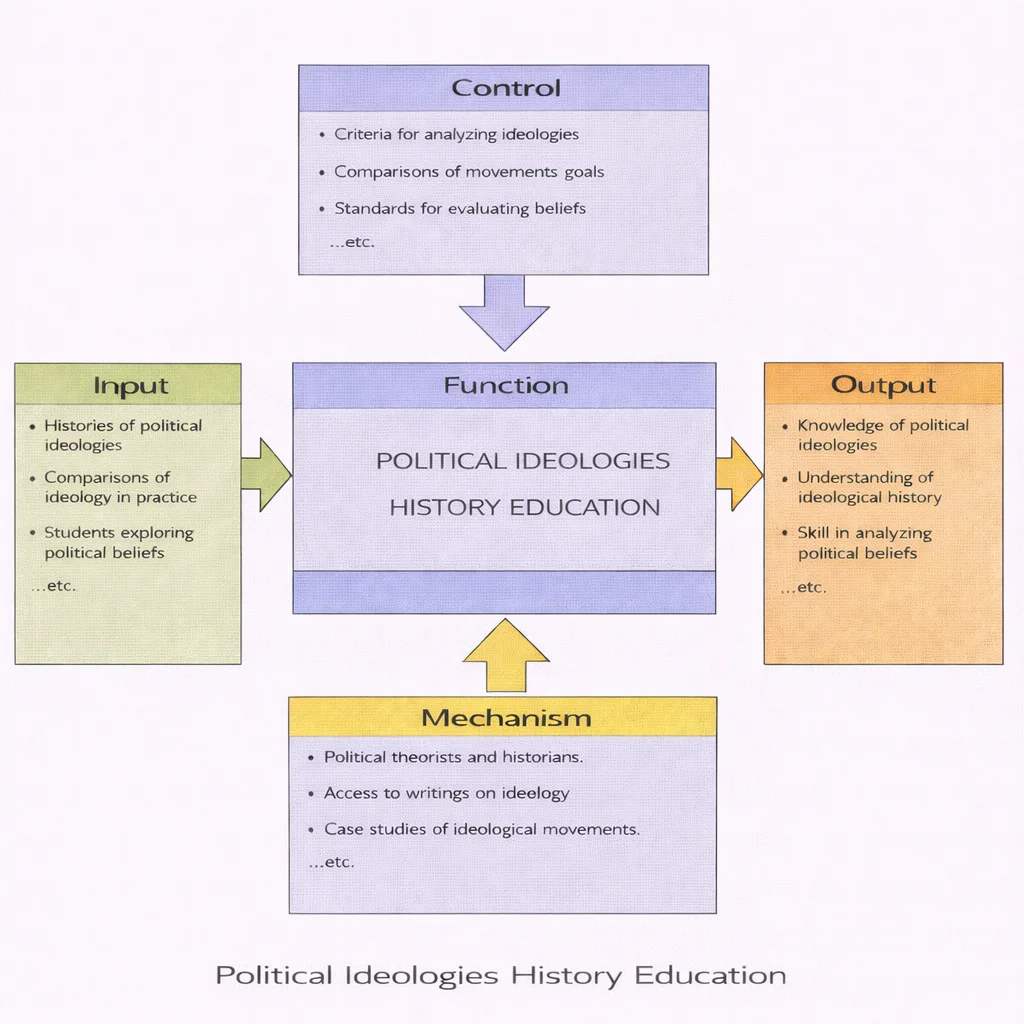
Political Ideologies History Education can be understood as a structured process that transforms historical material into disciplined judgment. The inputs provide the substance: narratives of how ideologies form, spread, compete, and reshape societies, plus comparisons that show how ideas look different when translated into institutions and policies. The controls act like intellectual guardrails—clear criteria for analysis, fair comparison across movements, and standards for evaluating claims—so learners do not confuse slogans with arguments or popularity with coherence. The mechanisms supply the “engine room” of learning: informed educators, reliable texts and sources, and well-chosen case studies that reveal ideology in action. When these parts work together, the outputs are more than definitions; students develop a grounded understanding of ideological history and the analytical skill to examine political beliefs carefully, tracing how ideas influence real choices, conflicts, and compromises.
Political ideologies are the conceptual frameworks that shape how societies understand power, governance, justice, and rights. They offer competing visions of how states should function and how resources, responsibilities, and liberties should be distributed. Tracing their evolution reveals deep interconnections with broader developments in history, ranging from revolutions and social movements to war and diplomacy. Studying political ideologies equips students to critically analyze the foundations of modern governance and the contested meanings of democracy, authority, and freedom.
The emergence of different ideological traditions is closely linked to the evolution of economic thought and theory. For instance, liberalism developed alongside classical economics, while socialism and Marxism arose in response to industrial capitalism and the exploitation highlighted in labor history. As economies grew more complex, so too did ideological debates over labor and social policy, market regulation, and redistributive justice.
Educational systems often play a key role in the transmission and reinforcement of dominant ideologies. This is particularly evident in the context of education history, where state-led curricula have historically promoted national identity, civic duty, and political conformity. Conversely, counter-ideologies often emerge from grassroots social movements challenging established norms.
Electoral structures provide another avenue through which ideologies are expressed and contested. The design of electoral systems and political parties significantly influences how ideologies are organized, promoted, and transformed. This is intertwined with the historical context of electoral history and critical challenges to fairness such as electoral fraud and integrity.
Conflicts over ideology have often extended into the realm of warfare, where the outcomes of revolutions, rebellions, and international wars have led to new political systems. The study of guerrilla warfare and insurgency highlights how ideologically driven movements mobilize against established regimes. Meanwhile, developments in the social and cultural history of warfare and technological history of warfare reveal how ideological conflicts have evolved with changing tools and narratives.
Diplomacy, too, is often guided by ideology. Nations historically form alliances not just out of strategic interest but also shared political values, as seen in the history of alliances. Treaties—examined through treaty analysis—can be tools for institutionalizing ideological principles at the international level.
Some of the most transformative ideological struggles have taken place in the domestic arena, including battles for representation and rights. The suffrage and civil rights movements reveal how political ideologies become manifest in campaigns for equality and citizenship. These struggles are often entangled with issues of class and gender, as further explored in women’s history and urban and rural history.
The development of ideologies is also shaped by intellectual inquiry and debate, found within intellectual political history. These abstract discussions often translate into concrete political positions, especially when disseminated through modern platforms and influenced by technological trends—like the role of technology in elections.
Ultimately, the world of political ideologies is dynamic, intersecting with industrial development as shown in industrial and technological history, trade relations reflected in trade and commerce history, and the philosophical trajectories documented in the history of economic thought. Understanding these ideological legacies provides insight not just into the past, but into the continuing debates that shape global politics today.
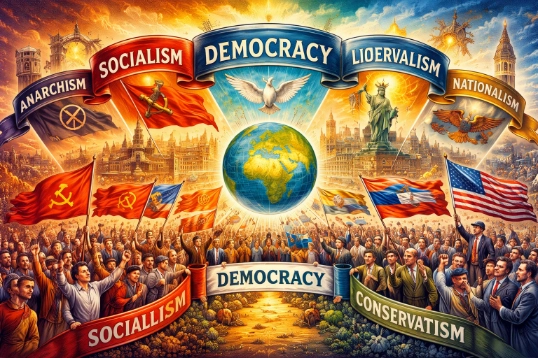
Ideas that Shape Power: Understanding Political Ideologies
Political systems are built on ideas. Ideologies provide frameworks for understanding authority, justice, freedom, and order. They influence how societies organize governance, justify power, and respond to change across different historical contexts.
Curriculum Hub Cluster Navigation
Explore the sub-topics within Political Systems to understand how ideological frameworks interact with state authority, military power, and constitutional governance across our curriculum roadmap:
History of Political Systems – Overview
Trace how different forms of governance developed and how ideas shaped political organization across epochs.
Political Ideologies (Current Module)
Explore belief systems that define authority, individual rights, economic structures, and the state’s role in society.
Military & Political Power
Examine how ideologies justify or challenge the use of force in state governance and civil-military relations.
Electoral Systems & Political Parties
Study how ideological differences are institutionalized through party platforms and electoral mechanics.
Constitutional History
Understand how core ideological principles are codified into supreme legal frameworks and bills of rights.
Comparative Politics
Compare how different competing ideologies shape structural governance across democratic and autocratic states.
Colonial & Post-Colonial Systems
Investigate how imperial belief systems influenced rule and how anti-colonial ideologies drove liberation movements.
Bureaucratic & Administrative History
Examine how state institutions translate abstract political philosophies into daily administrative policies.
Major Traditions in Political Ideologies
Liberalism
Liberalism emphasizes individual freedoms, equality, and the role of government in protecting rights and promoting economic opportunities.
Historical Development
- Origins: Emerged during the Enlightenment (17th–18th centuries), influenced by thinkers like John Locke and Montesquieu. Locke’s concept of natural rights (life, liberty, and property) became foundational to liberal thought.
- Classical Liberalism: Focused on limited government, free markets, and personal liberty. Adam Smith’s The Wealth of Nations (1776) advocated for economic liberalism, emphasizing free trade and minimal state intervention.
- Modern Liberalism: Evolved in the 19th and 20th centuries to address social inequalities, advocating for a more active government role in education, healthcare, and welfare protections.
Impact
Liberalism underpins modern constitutional democracies, influencing fundamental declarations of human rights and market-based economies (e.g., the American Declaration of Independence in 1776 and the French Declaration of the Rights of Man in 1789).
Socialism
Socialism advocates for collective ownership of resources and production, aiming to reduce economic inequality and promote public social welfare.
Historical Development
- Origins: Emerged as a response to the rapid economic disparities of industrial capitalism in the 19th century. Early utopian socialists like Robert Owen proposed cooperative communities.
- Marxism: Karl Marx and Friedrich Engels’ Communist Manifesto (1848) argued that capitalism inherently exploits labor, predicting a proletarian revolution and a classless society.
- Democratic Socialism: Combines socialist redistributive goals with democratic political governance, exemplified by Scandinavian welfare models balancing markets with robust social safety nets.
Impact
Socialism shaped global political movements and 20th-century state development, including the 1917 Bolshevik Revolution in Russia and the formation of modern Western labor policy.
Conservatism
Conservatism emphasizes tradition, social order, constitutional continuity, and gradual reform over radical restructuring.
Historical Development
- Origins: Rooted in the writings of Edmund Burke, whose Reflections on the Revolution in France (1790) argued for preserving tested institutions and cautious reform over violent disruption.
- Modern Conservatism: Adapted to support free-market economics, fiscal discipline, and individual responsibility while maintaining traditional institutional values (e.g., Thatcherism in the UK and Reaganomics in the US).
Impact
Conservatism has shaped policies promoting national sovereignty, rule of law, institutional stability, and market-driven economic growth.
Fascism
Fascism is an authoritarian, ultranationalist ideology that subordinates individual freedoms to the state, emphasizing militarism, dictatorship, and centralized control.
Historical Development
- Origins: Emerged in the early 20th century as a militant reaction against liberalism and socialism. Benito Mussolini’s Fascist Party in Italy (1920s) introduced totalitarian state control and corporatism.
- Nazi Ideology: Adolf Hitler’s National Socialism (Nazism) combined fascist authoritarianism with aggressive racial supremacy, leading directly to the Holocaust and World War II.
Impact
Fascism resulted in global devastation, human rights violations, and catastrophic warfare during the mid-20th century before being defeated by allied democratic and socialist powers.
Other Key Traditions of Political Ideologies
Communism
Advocates for a stateless, classless society achieved through the abolition of private property. Historical examples include the People’s Republic of China established under Mao Zedong in 1949, which later transitioned toward market socialism.
Anarchism
Rejects all centralized state authority, advocating for voluntary, self-governed communities. During the Spanish Civil War (1936–1939), anarchist organizations in Catalonia managed local industries and agricultural collectives.
Environmentalism
Focuses on ecological sustainability, climate change mitigation, and environmental preservation, promoting green policy platforms within democratic legislative systems.
Practical Manifestations of Political Ideologies in Action
Marxism’s Impact on 20th-Century Governance
In the Soviet Union, Marxism-Leninism guided state policy through centralized economic planning and collectivization. In China, Maoist ideology driven by agrarian revolution led to massive campaigns such as the Great Leap Forward.
Liberalism in the Modern Era
The U.S. New Deal during the 1930s under Franklin D. Roosevelt reflected social liberalism, expanding federal regulation and creating social safety nets to rescue the capitalist economy during the Great Depression.
Conservatism in the Post-War Era
Thatcherism in the United Kingdom during the 1980s reshaped post-war politics by privatizing state industries, deregulating financial markets, and curbing trade union power.
Fascism and Totalitarianism
In Nazi Germany, totalitarian fascist control mobilized state propaganda, aggressive territorial expansion, and systematic genocide, demonstrating the extreme danger of unchecked autocratic ideologies.
How Political Ideologies Shape Public Policy and Society
- Governance and Policy: Ideologies dictate legislative priorities, such as socialist support for universal healthcare versus conservative support for market competition.
- Social Movements: Grassroots campaigns align with ideological goals, such as feminist movements leveraging liberal individual rights arguments for gender equality.
- International Relations: Global alliances and conflicts mirror ideological splits, as demonstrated by the multi-decade Cold War between Western capitalism and Soviet communism.
Reasons to Delve into the Study of Political Ideologies
Understanding the Ideas That Shape Political Action and Institutions
Exploring the Range of Ideological Traditions
Analyzing the Influence of Ideology on Policy and Society
Recognizing the Role of Ideology in Mobilization and Conflict
Preparing for Thoughtful Engagement and Academic Inquiry
Interactive Tool: Political Spectrum & Economic Policy Simulator
Adjust the policy sliders below to observe how different balances of state economic intervention and civil liberties position a regime on the 2D political compass matrix over a 10-year period.
2D Political Ideology Spectrum Simulator
50% State Regulation
Interactive Case Review (Click to Toggle Explanations)
Test your analytical understanding of historical ideological transformations by toggling the questions below:
Case 1: How did classical liberalism evolve into 20th-century modern social liberalism?
Case 2: What intellectual distinction separates Democratic Socialism from Revolutionary Marxism-Leninism?
Case 3: Why is Edmund Burke considered the foundational philosopher of modern conservatism?
Closing Perspectives on Political Ideologies
Political ideologies offer frameworks for understanding the organization of power, governance, and society. From the individual liberties championed by liberalism to the collectivist goals of socialism, the cautious reforms of conservatism, and the authoritarian control of fascism, these ideologies have shaped the trajectory of history. By studying their evolution and impact, we can better understand the complexities of political systems and the ongoing debates that define governance in the modern world.
Frequently Asked Questions: Political Ideologies
What is a political ideology?
A political ideology is a more or less coherent set of ideas, values, and beliefs about how society should be organized and how power should be used. It offers a framework for interpreting politics, evaluating institutions, and guiding action on issues like authority, rights, equality, and the role of the state.
Why is the study of political ideologies important in political history?
Political ideologies shape parties, constitutions, revolutions, and public policies. Studying them historically shows how ideas such as liberalism, conservatism, socialism, nationalism, or fascism emerged, competed, and changed over time—and how they influenced real political systems, conflicts, and reforms.
How do political ideologies differ from simple opinions or policy preferences?
Individual opinions or policy preferences may concern a single issue, such as taxes or education. Political ideologies, by contrast, offer a broader worldview: they link many issues together, propose general principles about authority and justice, and often provide a story about the past, present, and desired future of society.
What are some of the major political ideologies that have shaped modern history?
Major ideologies include liberalism, conservatism, socialism, communism, fascism, nationalism, anarchism, and later variations such as social democracy, Christian democracy, environmentalism or green politics, and different strands of feminism and identity-based movements. Each has diverse internal traditions and national versions.
How do political ideologies influence constitutions and political institutions?
Ideologies shape how political actors design and justify institutions. For example, liberal ideas have supported constitutions with rights and checks and balances; socialist ideas have inspired state planning and social welfare; nationalist ideas have influenced borders and citizenship. Constitutional history is often also a history of competing ideologies.
Do political ideologies stay the same over time?
No. Political ideologies evolve as they respond to new events, social changes, and criticisms. Liberalism in the nineteenth century is not identical to liberalism today; socialism, conservatism, or nationalism have all taken different forms in different places and periods. Historical study traces how core ideas are reinterpreted and combined.
What is the relationship between political ideologies and political parties?
Political parties often organize themselves around ideological labels, such as conservative, social democratic, or green. However, parties are practical organizations that seek votes and power, so they may blend or moderate ideas. Political history examines how party programs express, adapt, or dilute ideological traditions over time.
How have revolutions and major crises affected political ideologies?
Revolutions, wars, economic depressions, and other crises frequently discredit existing belief systems and open space for new or radical ideologies. The French and Russian Revolutions, the World Wars, the Great Depression, and the end of the Cold War all prompted powerful rethinking of liberal, conservative, socialist, and nationalist projects.
Are political ideologies always explicit and organized?
Not always. Some ideologies are spelled out in manifestos and philosophical texts. Others are more implicit in everyday assumptions, traditions, or common sense. Historians often look for underlying ideological patterns even when actors do not use ideological labels or see themselves as following a doctrine.
How do political ideologies interact with religion, culture, and social identity?
Political ideologies do not exist in a vacuum: they draw on religious beliefs, cultural narratives, class interests, ethnic and national identities, and gender norms. In many societies, religious or cultural traditions have been reinterpreted in ideological terms, producing, for example, religious nationalism, liberation theology, or culturally specific forms of liberalism or socialism.
Why do different countries adapt the same ideology in different ways?
When ideas travel, they are reshaped by local histories, institutions, and social structures. Liberalism or socialism in one country may differ markedly from their counterparts elsewhere because they develop in conversation with different political struggles, legal systems, colonial legacies, and cultural expectations.
How can studying political ideologies help students engage with contemporary politics?
Studying political ideologies historically helps students recognize familiar terms, question simplistic labels, and understand why debates about freedom, equality, authority, identity, and justice remain contested. It equips them to read party programs, media arguments, and public debates more critically and to see how current conflicts draw on long-running ideological traditions.
End-of-Page Practice & Assessment Module
Section 1: Foundational Concept Mastery
Test your understanding of primary ideological principles, historical figures, and political definitions.
- What are political ideologies and why are they important in political systems?
Answer: Political ideologies are comprehensive sets of beliefs and values that explain how societies should be organized and govern themselves. They provide a framework for understanding political behavior, guiding policy choices, and influencing the distribution of power. Ideologies serve as the foundation for political movements, enabling citizens to align around common principles and goals. Their importance lies in their ability to shape governance, inform public debate, and drive social change. - How did classical political ideologies influence early political systems?
Answer: Classical political ideologies, such as those rooted in ancient Greek and Roman thought, laid the groundwork for modern political theory by emphasizing concepts like citizenship, justice, and the rule of law. These early ideas introduced the notion that political power should be exercised with rationality and public interest in mind. They provided the intellectual basis for later developments in democratic and republican governance. The influence of classical ideologies is evident in the enduring principles that continue to underpin contemporary political institutions. - What is liberalism and how has it influenced modern political thought?
Answer: Liberalism is a political ideology that champions individual freedoms, equality before the law, and limited government intervention in personal affairs. It emerged during the Enlightenment as a response to absolute monarchies and has since shaped modern democratic governance through its emphasis on human rights and market economies. Liberalism promotes open societies where debate and dissent are encouraged, and it has influenced constitutional frameworks worldwide. Its evolution reflects a continual commitment to balancing personal liberty with social order. - What are the core tenets of conservatism and how did they emerge historically?
Answer: Conservatism is characterized by a commitment to tradition, social stability, and a cautious approach to change. Historically, it emerged as a reaction to revolutionary movements and rapid societal transformations, advocating for the preservation of established institutions and cultural values. Conservatives emphasize the importance of gradual evolution rather than abrupt reform, arguing that long-standing traditions provide the necessary continuity for a stable society. This ideology has profoundly influenced policies related to law and order, national identity, and social hierarchy. - How has socialism evolved as a political ideology and impacted state governance?
Answer: Socialism evolved as a response to the inequalities and exploitation observed during the Industrial Revolution, advocating for collective ownership and the redistribution of wealth. It seeks to create a more equitable society through state intervention and social welfare programs, challenging the dominance of capitalist structures. Over time, various forms of socialism have emerged, from democratic socialism to more centralized, state-controlled models. Its impact on state governance is evident in policies aimed at reducing economic disparities and promoting social justice. - How do political ideologies influence policy-making and governance structures?
Answer: Political ideologies shape policy-making by providing a set of guiding principles that inform legislative agendas and administrative actions. They influence decisions on economic regulation, social welfare, and individual rights, determining the overall direction of government policies. Ideologies also affect the organization of political institutions, as parties and leaders align their governance models with their core beliefs. This interplay between ideology and policy ensures that the governance structure reflects the values and priorities of the society it serves. - In what ways do political ideologies shape public opinion and electoral behavior?
Answer: Political ideologies shape public opinion by framing the issues and debates that dominate the political landscape, influencing how citizens perceive policies and leaders. They provide narratives that help individuals understand complex social and economic issues, guiding voter preferences and behavior during elections. Ideological alignment often leads to the formation of political parties and movements that mobilize supporters around shared values. Consequently, the strength and appeal of an ideology can significantly affect electoral outcomes and the stability of democratic systems. - How have political ideologies contributed to revolutionary and reform movements throughout history?
Answer: Political ideologies have been a driving force behind revolutionary and reform movements by articulating grievances and proposing alternative visions for society. They have mobilized masses to challenge existing power structures, as seen in events like the French and Russian revolutions. These ideologies provided the intellectual justification for radical changes, inspiring citizens to demand greater freedoms, equality, and social justice. The transformative impact of these movements has reshaped political systems and led to significant institutional reforms. - What role does nationalism play within the spectrum of political ideologies?
Answer: Nationalism is an ideology centered on the promotion of a shared national identity and the interests of a nation-state. It often emphasizes cultural unity, historical continuity, and the sovereignty of the people within a defined territory. Nationalism can serve as a unifying force, rallying citizens around common symbols and values, but it can also lead to exclusionary practices and conflicts with other nations or groups. Its influence is evident in both democratic and authoritarian contexts, where it can drive policies related to immigration, foreign relations, and internal cohesion. - How do contemporary political ideologies reflect historical developments in political thought?
Answer: Contemporary political ideologies are deeply rooted in historical developments that have evolved through revolutions, reforms, and intellectual debates over centuries. Modern ideologies like neoliberalism, democratic socialism, and postmodern conservatism reflect adaptations to current social, economic, and technological challenges while drawing on classical principles. They synthesize historical lessons with new ideas to address issues such as globalization, inequality, and digital governance. This continuity and evolution underscore the enduring influence of historical political thought on today’s governance models.
Section 2: Analytical & Scenario-Based Thought Questions
Analyze complex ideological conflicts, media impacts, and institutional adaptation through critical inquiry.
- How have historical political ideologies shaped the evolution of modern democratic institutions?
Answer: Historical political ideologies have played a fundamental role in shaping modern democratic institutions by providing the intellectual foundation for concepts such as liberty, equality, and the rule of law. Ideologies like liberalism and republicanism introduced the idea that power should be derived from the consent of the governed, influencing the development of representative governments and constitutional frameworks. This evolution is evident in the establishment of parliamentary systems, the protection of individual rights, and the implementation of checks and balances. Furthermore, the legacy of these ideologies is reflected in ongoing efforts to enhance participatory governance and social equity. - What are the potential consequences of ideological polarization in contemporary political systems?
Answer: Ideological polarization can lead to a fragmented society where consensus and compromise become increasingly difficult. It often results in a divided electorate dominated by extreme positions that impede balanced policy-making. The consequences include legislative gridlock, decreased public trust in government, and the erosion of democratic norms. Moreover, polarization limits collaborative problem-solving on complex national issues, risking the alienation of moderate voters and fueling social instability. - How does the interplay between economic interests and political ideologies influence policy-making?
Answer: Economic interests and political ideologies interact continuously: ideologies provide the theoretical framework for interpreting economic phenomena, while economic realities force ideologies to adapt. For example, neoliberalism advocates for deregulated markets, whereas social democracy insists on public intervention to ensure equitable distribution. When global economic conditions shift, policymakers re-evaluate ideological assumptions to design tax, trade, and welfare policies that balance economic efficiency with social stability. - In what ways might emerging social movements redefine traditional political ideologies?
Answer: Emerging social movements challenge legacy political ideologies by bringing marginalized concerns—such as climate justice, digital privacy, and intersectional civil rights—into mainstream discourse. By leveraging digital mobilization and grassroots organizing, these movements force traditional political parties to incorporate new principles into their platforms, fostering hybrid ideological models that adapt classical philosophy to modern social challenges. - How do ideological shifts impact international relations and global power dynamics?
Answer: Major domestic ideological shifts alter a state’s foreign policy orientation, reshaping international treaties, strategic alliances, and diplomatic priorities. A transition toward liberal internationalism encourages multilateral cooperation and open trade, whereas a turn toward national populism leads to unilateralism, tariff protectionism, and alliance friction. These shifts redefine global power balances and multilateral institution effectiveness. - What challenges arise from the convergence of different political ideologies in a globalized world?
Answer: Globalization brings contrasting ideological traditions into direct contact, creating friction over international standards, human rights definitions, and trade regulations. Navigating these differences requires multi-state compromises that may dilute domestic political doctrines. Achieving global consensus on shared threats (such as climate change or cyber governance) becomes difficult when nations operate under fundamentally opposing views of state authority and individual rights. - How can educational systems contribute to a balanced understanding of political ideologies among citizens?
Answer: Educational institutions foster balanced civic understanding by teaching the historical context, core texts, and policy outcomes of diverse ideological traditions. Integrating interdisciplinary curricula—combining history, economics, and political philosophy—encourages critical thinking and respectful debate. Equipping students to evaluate competing claims objectively reduces ideological dogmatism and strengthens democratic deliberation. - What role does media play in shaping and transforming political ideologies in the digital age?
Answer: In the digital age, media serves as the primary arena for ideological transmission. Algorithmic sorting, social media channels, and 24-hour news networks accelerate the dissemination of political narratives. While this allows rapid mobilization and alternative viewpoint access, it also risks creating ideological echo chambers, sensationalizing partisan divides, and spreading misinformation that distorts public understanding of complex policy issues. - How do political ideologies influence identity politics and social cohesion within diverse societies?
Answer: Political ideologies frame how social groups understand their historical status, rights, and political goals. When ideologies emphasize universal civil rights and inclusive civic nationalism, they enhance social cohesion across diverse populations. Conversely, when ideologies leverage exclusionary nationalism or polarize group identity for partisan advantage, they deepen societal fractures and compromise social trust. - In what ways can comparative studies of political ideologies inform strategies for conflict resolution?
Answer: Comparative ideological studies help mediators analyze the underlying belief systems driving political disputes. Understanding how different societies have successfully reconciled competing values—such as balancing free enterprise with state welfare or minority rights with majority rule—provides adaptable frameworks for negotiating peace agreements and building resilient post-conflict governance structures. - How do religious beliefs interact with secular political ideologies in shaping state policies?
Answer: Religious doctrines frequently intersect with secular ideologies, providing moral frameworks that influence public stance on social legislation, education, and human rights. When religious values align with secular social justice principles, they reinforce reform coalitions; when they conflict with secular constitutional norms, intense legal and political debates emerge regarding state neutrality, individual autonomy, and religious freedom. - What are the implications of the rise of populism for traditional political ideologies and democratic governance?
Answer: Populism disrupts traditional left-right ideological spectrums by pitting a perceived “virtuous public” against established political elites. This rhetoric often bypasses formal party structures and challenges institutional checks and balances. While populism can bring ignored working-class grievances to the forefront of national debate, it also presents risks to democratic stability if it undermines judicial independence, press freedom, and constitutional protections.
Section 3: Mathematical & Quantitative Ideological Analysis
Perform step-by-step mathematical calculations analyzing legislative voting indices, political polarization metrics, and policy expenditure ratios.
- Parliamentary Seat Share Calculation:
In a nation’s 350-seat parliament, seats are distributed among four ideologically aligned parties:- Social Democratic Party: 126 seats
- Liberal Democratic Party: 98 seats
- Conservative Party: 84 seats
- Green Party: 42 seats
Calculate the percentage share of seats for the Social Democratic Party. If a majority coalition requires strictly more than 50% of total seats, determine the minimum number of seats needed and whether a coalition between the Social Democrats and the Greens satisfies this requirement.
Solution / Calculation:
1. Social Democratic Seat Percentage = (126 / 350) × 100% = 36.0%.
2. Majority Threshold = 350 / 2 = 175 seats; strictly more than 50% requires at least 176 seats.
3. Combined Social Democratic + Green seats = 126 + 42 = 168 seats.
4. Compare: 168 seats < 176 seats required.
Result: Social Democrats hold 36.0% of seats. A coalition with the Greens yields 168 seats, falling 8 seats short of the 176-seat majority threshold. - Ideological Polarization Index (IPI) Formula:
A political science institute measures societal polarization using the index formula:IPI = (0.45 × PartisanDistance) + (0.35 × MediaEchoIndex) – (0.20 × CivicTrust)Given PartisanDistance = 82, MediaEchoIndex = 75, and CivicTrust = 40 (on a 0–100 scale), calculate the state’s IPI. Determine if it exceeds the severe polarization threshold of 55.0.
Solution / Calculation:
1. Partisan component = 0.45 × 82 = 36.90.
2. Media component = 0.35 × 75 = 26.25.
3. Civic trust deduction = 0.20 × 40 = 8.00.
4. Aggregate IPI = 36.90 + 26.25 – 8.00 = 55.15.
Result: The state’s IPI is 55.15, slightly exceeding the severe polarization threshold of 55.0. - Welfare vs. Market Expenditure Ratio:
A government allocates $180 billion to social welfare/healthcare programs (socialist policy indicator) and $45 billion to corporate tax subsidies and industry deregulation grants (market-liberal indicator). Calculate:
a) The Welfare-to-Market Expenditure Ratio.
b) The Welfare share as a percentage of combined expenditure.
Solution / Calculation:
a) Expenditure Ratio = $180 billion / $45 billion = 4.0. Expressed as 4:1.
b) Combined Total = $180 billion + $45 billion = $225 billion.
Welfare Percentage = ($180 billion / $225 billion) × 100% = 80.0%.
Result: The policy expenditure ratio is 4:1, with social welfare representing 80.0% of combined outlay. - Voter Turnout & Ideological Mobilization Percentage:
Out of a total eligible voting population of 18,500,000 citizens, 68% turn out in a national election. If an ideologically driven populist movement secures 42% of the cast votes, calculate the exact number of votes received by the populist movement and its percentage support relative to the total eligible voting population.
Solution / Calculation:
1. Total Votes Cast = 18,500,000 × 0.68 = 12,580,000 voters.
2. Votes for Populist Movement = 12,580,000 × 0.42 = 5,283,600 votes.
3. Support Share relative to Total Eligible Population = (5,283,600 / 18,500,000) × 100% = 28.56%.
Result: The movement received 5,283,600 votes, representing 28.56% of total eligible voters. - Taxation Redistribution Metric:
Under a progressive tax reform proposal, an upper income bracket taxed at a base rate of 28% experiences a rate increase of 15% (relative). Calculate the new tax rate. If this rate generates an additional $14.7 billion in revenue and 60% of this revenue is directed toward public education initiatives, calculate the precise amount allocated to education.
Solution / Calculation:
1. New Tax Rate = 28% × (1 + 0.15) = 28% × 1.15 = 32.2%.
2. Education Allocation = $14.7 billion × 0.60 = $8.82 billion.
Result: The new progressive tax rate is 32.2%, generating $8.82 billion for public education. - Electoral District Gerrymandering Shift Index:
Due to boundary redistricting, an urban electoral district’s liberal voter percentage changes from 58% out of 120,000 voters to 49% out of 150,000 voters. Calculate:
a) The net change in the absolute number of liberal voters in the district.
b) The percentage point change in liberal voter representation.
Solution / Calculation:
a) Initial Liberal Voters = 120,000 × 0.58 = 69,600 voters.
New Liberal Voters = 150,000 × 0.49 = 73,500 voters.
Net Change = 73,500 – 69,600 = +3,900 voters.
b) Percentage Point Change = 49% – 58% = -9 percentage points.
Result: While the absolute count increased by 3,900 voters, liberal voter representation decreased by 9 percentage points due to district expansion. - Media Echo Chamber Amplification Model:
An online political video starts with 12,000 views. Over a 4-day viral spreading period within an algorithmic echo chamber, views increase by 85% each day. Calculate the total view count at the end of Day 4.
Solution / Calculation:
1. Growth Formula: Views = Initial × (1 + rate)days
2. Day 4 Views = 12,000 × (1 + 0.85)4 = 12,000 × (1.85)4
3. Compute (1.85)4 ≈ 11.7135
4. Total Views = 12,000 × 11.7135 = 140,562 views.
Result: The video reaches approximately 140,562 total views by the end of Day 4.