
Condensed matter physics explores the diverse and fascinating behaviors of matter in its solid and liquid states, making it one of the most vibrant branches of physics. Grounded in the framework of modern physics, this field investigates how atoms and particles interact collectively to produce phenomena such as superconductivity, magnetism, and crystallinity. It builds upon the quantum foundation established in atomic physics and is deeply intertwined with the concepts of quantum mechanics.
The microscopic structure of solids, including their atomic arrangement and electron configuration, determines a material’s physical properties. These atomic-level descriptions draw upon ideas like quantum superposition and wave-particle duality, which challenge classical conceptions of particle behavior. Phenomena such as quantum tunneling and quantum entanglement play pivotal roles in explaining superconductors, semiconductors, and other complex systems.
To understand the macroscopic behavior of these systems, condensed matter physicists often rely on tools from statistical mechanics. This framework connects microscopic interactions to observable properties like temperature, conductivity, and phase transitions. Many of these insights are enhanced by quantum field theory, which provides a more unified description of how particles and fields interact in large ensembles.
Condensed matter systems often include exotic materials such as those governed by nuclear interactions or composed of complex isotopes studied under radioactivity. Moreover, advanced developments such as high-temperature nuclear fusion and nuclear fission can influence material behaviors at extreme conditions. Interactions at these levels are often governed by fundamental forces and are analyzed in the context of relativity when near-light-speed particles are involved.
Understanding condensed matter also requires insights from particle physics, particularly the behavior of fermions (matter particles) and bosons (force carriers). These particles interact via gauge fields that describe the electromagnetic, weak, and strong forces within materials. The fine balance of these forces gives rise to magnetic ordering, band structure, and other condensed matter phenomena.
At a deeper level, condensed matter is a fertile ground for exploring theoretical principles such as Heisenberg’s uncertainty principle and interpreting the wave function in real-world applications. Whether dealing with semiconductors or superfluids, these principles illuminate the rich complexity of collective particle behavior.
From the atomic lattice to quantum spin systems, condensed matter physics bridges the gap between fundamental theory and practical technology. It informs modern electronics, quantum computing, and materials science, empowering students to explore how underlying principles of the atom shape the macroscopic world. As you journey through this subject, you will connect ideas across atomic structure, subatomic interactions, and quantum principles, forming a robust understanding of the materials that underpin our technological future.

This vibrant illustration blends the microscopic and the technological to represent condensed matter physics.
    In the foreground, detailed microchips and circuit boards sit on a glowing, grid-like surface with branching pathways, suggesting electrons moving through solid materials.
    Above and around them float many colorful spheres and atom-like icons, hinting at lattices, quasiparticles, and collective effects in solids.
    The background contains cosmic-style swirls and faint scientific markings that evoke advanced theory, while the overall composition connects atomic-scale structure to real-world devices—semiconductors, superconductors, and engineered materials that power modern technology.
1. Condensed Matter Physics within Modern Physics
Modern Physics brings together several closely related fields that explain matter, energy, space, time, particles, fields, atoms, nuclei, and large-scale material behaviour. Condensed Matter Physics acts as the bridge connecting single-particle quantum mechanics to macroscopic technology and materials science.
Modern Physics – Overview
Introduces the main ideas, branches, and connections that define modern physics beyond the classical view of nature.Relativity
Explains how space, time, motion, and gravity are understood when speeds are high or gravitational fields are strong.Statistical Mechanics
Links microscopic particle behaviour to large-scale properties such as temperature, pressure, entropy, and thermal equilibrium.Quantum Mechanics
Describes the behaviour of matter and energy at very small scales, where probability, wave behaviour, and measurement become central.Particle Physics
Explores fundamental particles and forces, helping students understand the basic building blocks of matter and interactions.Nuclear Physics
Focuses on atomic nuclei, radioactive decay, nuclear reactions, fission, fusion, and the energy stored inside matter.Atomic Physics
Examines atomic structure, electron energy levels, spectra, and the ways atoms interact with light and radiation.Condensed Matter Physics
Studies how the collective behaviour of particles gives rise to material properties such as conductivity, magnetism, crystals, and superconductivity.Quantum Field Theory
Describes particles as excitations of underlying fields and provides a deeper framework for understanding forces and interactions.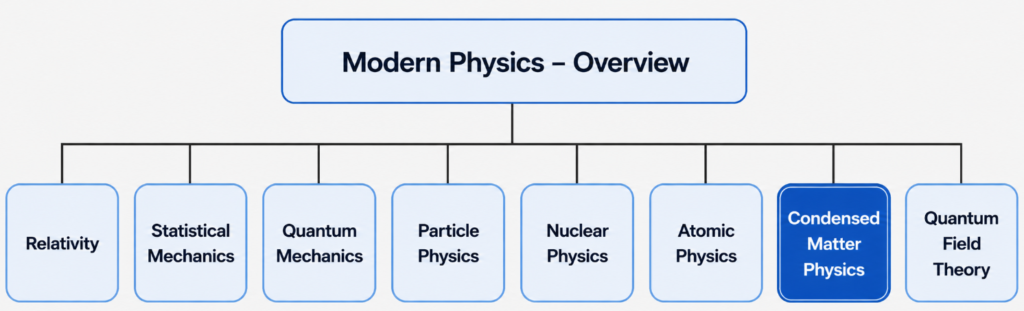
This image presents a visual structure chart for the Modern Physics cluster on Prep4Uni.online.
    Modern Physics appears as the parent topic, linked to eight major branches: Relativity, Statistical Mechanics, Quantum Mechanics, Particle Physics, Nuclear Physics, Atomic Physics, Condensed Matter Physics, and Quantum Field Theory.
    Condensed Matter Physics is highlighted to show its position as the current focus page, helping students understand how it connects to the broader study of modern physics.
2. Key Concepts in Condensed Matter Physics
Condensed Matter Physics studies how large numbers of atoms, ions, electrons, and molecules behave when they are packed together in solids, liquids, and complex materials. A single atom may be understood using atomic physics, but a material is different because many particles interact at the same time. This collective behaviour gives rise to crystals, metals, semiconductors, magnets, superconductors, and many advanced materials used in modern technology.
1. Crystalline and Amorphous Solids
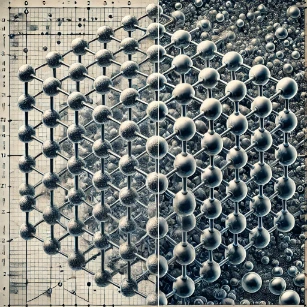
Solids may look continuous to the eye, but at the microscopic level they are built from atoms or molecules. In a crystalline solid, the atoms are arranged in a repeating pattern called a lattice. Metals, salts, and many semiconductors have this kind of ordered structure. The regular arrangement allows scientists to predict how waves, electrons, and defects move through the material.
In an amorphous solid, the atoms are not arranged in a long-range repeating pattern. Glass and many plastics are common examples. They may still be solid, but their internal structure is more disordered. This difference in arrangement affects properties such as transparency, brittleness, melting behaviour, and electrical response.
Real crystals are never perfectly ideal. They contain defects, such as missing atoms, extra atoms, impurities, or shifted lattice planes. Controlled impurities in semiconductors make modern electronics possible.
2. Band Theory of Solids
Band theory explains why some materials conduct electricity easily while others resist current flow. In isolated atoms, electrons occupy separate energy levels. In solids, huge numbers of atoms are packed closely together, so these energy levels spread into bands. The most important bands are the valence band, where electrons are usually bound, and the conduction band, where electrons can move more freely.
In a conductor, such as a metal, electrons can move easily because the conduction band is partly filled or overlaps with the valence band. In a semiconductor, such as silicon, there is a small energy gap between the valence and conduction bands. With heat, light, or controlled impurities, electrons can cross this gap and carry current. In an insulator, the gap is much larger, so electrons cannot move freely under normal conditions.

3. Quasiparticles
In many-particle systems, it is often too difficult to follow every atom and electron individually. Condensed Matter Physics solves this problem by using the idea of quasiparticles. A quasiparticle is a useful way to describe a collective pattern that behaves like an independent particle.
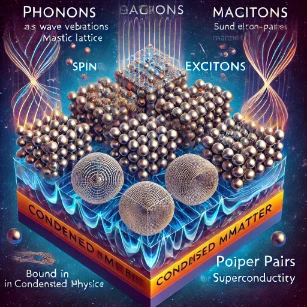
A phonon represents a quantum of vibration in a crystal lattice. It helps explain heat flow and sound propagation in solids. A magnon represents a wave of aligned spins in a magnetic material. An exciton is a bound pair of an electron and a hole. A Cooper pair is a paired state of electrons that helps explain superconductivity.
4. Phases of Matter and Phase Transitions
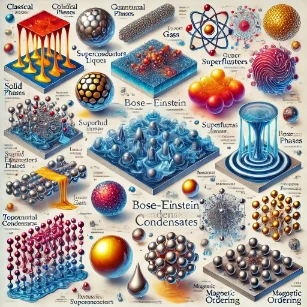
A phase of matter is a state with a particular type of order and behaviour. Condensed Matter Physics explores quantum phases, magnetic phases, superconducting phases, superfluid states, Bose-Einstein condensates, and topological phases. A phase transition occurs when a material changes from one phase to another, often accompanied by symmetry breaking.
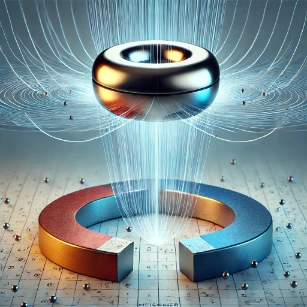
5. Superconductivity
Superconductivity is a state in which a material conducts electricity with zero electrical resistance. Superconductors also exhibit the Meissner effect, expelling magnetic fields from their interior. In conventional superconductors, this is explained by BCS theory, where electrons form Cooper pairs.
6. Magnetism
Magnetism in materials arises mainly from electron spin and orbital magnetic moments. In ferromagnetism, moments align parallel. In antiferromagnetism, neighbouring moments align oppositely. In paramagnetism, moments align only in external fields. Modern research also leverages electron spin in spintronics.

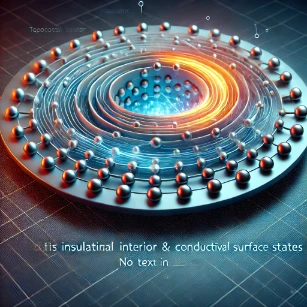
7. Topological Insulators
Topological insulators are insulating in their interior but conduct electricity on their surfaces or edges. This conduction is protected by topological symmetry, making surface states unusually robust against disorder or impurities.
Quick Check: Key Concepts in Condensed Matter Physics
1. What is the main difference between a crystalline solid and an amorphous solid?
A. A crystalline solid has a repeating atomic pattern, while an amorphous solid lacks long-range order
B. An amorphous solid always conducts electricity better than a metal
C. A crystalline solid has no atoms inside it
D. Both solids must have exactly the same internal structure
B. An amorphous solid always conducts electricity better than a metal
C. A crystalline solid has no atoms inside it
D. Both solids must have exactly the same internal structure
Answer: A. Crystalline solids have ordered repeating structures, while amorphous solids have more disordered internal arrangements.
2. What does band theory help explain?
A. Why some solids conduct electricity and others do not
B. Why planets orbit the Sun
C. Why liquids evaporate faster in wind
D. Why sound travels through air
B. Why planets orbit the Sun
C. Why liquids evaporate faster in wind
D. Why sound travels through air
Answer: A. Band theory explains how electron energy bands determine whether a material behaves as a conductor, semiconductor, or insulator.
3. What is a quasiparticle?
A. A useful way to describe a collective pattern in a material as if it behaves like a particle
B. A planet smaller than Earth
C. A particle that exists only in water
D. A type of chemical container
B. A planet smaller than Earth
C. A particle that exists only in water
D. A type of chemical container
Answer: A. A quasiparticle helps physicists describe complex collective behaviour, such as lattice vibrations, spin waves, excitons, or Cooper pairs.
4. What happens during a phase transition?
A. A material changes from one state or form of order to another
B. A material disappears completely
C. Atoms stop existing
D. Electrons become planets
B. A material disappears completely
C. Atoms stop existing
D. Electrons become planets
Answer: A. A phase transition occurs when a material changes its state or internal order, such as melting, becoming magnetic, or becoming superconducting.
5. What is special about a superconductor?
A. It can conduct electricity with zero electrical resistance under suitable conditions
B. It is always hotter than the Sun
C. It blocks all forms of electricity permanently
D. It is the same as ordinary plastic
B. It is always hotter than the Sun
C. It blocks all forms of electricity permanently
D. It is the same as ordinary plastic
Answer: A. A superconductor can carry electric current without resistance below a critical temperature and can also show the Meissner effect.
6. What is the main idea behind magnetism in materials?
A. Electron spins and magnetic moments can align or respond to magnetic fields
B. Magnetism is caused only by gravity
C. Magnetism occurs only in liquids
D. Magnetic materials contain no electrons
B. Magnetism is caused only by gravity
C. Magnetism occurs only in liquids
D. Magnetic materials contain no electrons
Answer: A. Magnetism in materials comes from electron spin and magnetic moments, which can align in different ways depending on the material.
7. What makes a topological insulator unusual?
A. It can be insulating inside but conducting on its surface or edges
B. It melts at every temperature
C. It has no quantum behaviour
D. It is always a perfect gas
B. It melts at every temperature
C. It has no quantum behaviour
D. It is always a perfect gas
Answer: A. A topological insulator can block current in its interior while allowing current to move along its surface or edges.
3. Experimental Techniques in Condensed Matter Physics
Condensed Matter Physics depends heavily on experiments because internal structures reveal patterns in atoms, electrons, spins, and energy bands that cannot be determined by appearance alone.
1. X-ray Crystallography
X-rays scattered by crystal lattices produce diffraction patterns. By analysing these patterns, scientists determine atomic spacing, symmetry, and 3D structure.
2. Scanning Tunneling Microscopy (STM)
STM uses quantum tunnelling between a sharp metallic tip and a surface to map atomic-scale topography and local density of states with high spatial resolution.
3. Angle-Resolved Photoemission Spectroscopy (ARPES)
ARPES uses the photoelectric effect to measure the kinetic energy and emission angle of ejected electrons, allowing direct mapping of electronic energy bands and Fermi surfaces.
4. Neutron and X-ray Scattering
Neutrons carry a magnetic moment without electric charge, penetrating deeply into materials to probe lattice vibrations (phonons) and magnetic ordering (spin structures).
5. Transport Measurements
Transport methods evaluate electrical resistivity, thermal conductivity, Hall coefficient, and magnetoresistance to characterize conductors, semiconductors, and superconductors.
Quick Check: Experimental Techniques
1. Which technique is commonly used to determine the atomic structure of a crystal?
A. X-ray crystallography
B. Weather forecasting
C. Sound recording
D. Ordinary photography only
B. Weather forecasting
C. Sound recording
D. Ordinary photography only
Answer: A. X-ray crystallography uses diffraction patterns to reveal atomic arrangements inside crystals.
2. Which technique uses quantum tunnelling to image surfaces at the atomic scale?
A. Scanning Tunneling Microscopy
B. A thermometer
C. A simple ruler
D. A wind tunnel
B. A thermometer
C. A simple ruler
D. A wind tunnel
Answer: A. STM uses tunnelling current between a sharp tip and a conductive surface.
3. Which technique helps map electron energy and momentum in a material?
A. ARPES
B. A stopwatch
C. A weighing scale
D. A compass only
B. A stopwatch
C. A weighing scale
D. A compass only
Answer: A. Angle-Resolved Photoemission Spectroscopy (ARPES) maps electronic band structures in energy and momentum space.
4. Mathematical Foundations & Formulas
Fundamental relations governing condensed matter phenomena include Fermi energy, BCS superconducting gaps, and phonon quantization:
- Fermi Energy (Free Electron Gas):$$ E_F = \frac{\hbar^2}{2m_e}(3\pi^2 n)^{2/3} $$where n is electron density and me is electron mass.
- Superconducting BCS Gap Relation:$$ \Delta(0) = 1.76 k_B T_c $$where Δ is the zero-temperature energy gap and Tc is the critical temperature.
- Lattice Phonon Energy:E = hν = ℏω
5. Applications of Condensed Matter Physics
Semiconductor Devices
Doped silicon forms p-n junctions, enabling microprocessors, transistors, integrated circuits, LEDs, and solar cells based on controlled band gap transitions.Superconductors
Zero-resistance coils generate powerful, stable magnetic fields for medical MRI scanners, particle accelerators, and maglev transportation systems.Magnetic Materials & Spintronics
Ferromagnetic domains power motors and transformers, while spintronic devices utilize electron spin orientation for non-volatile MRAM and high-density storage.Photonic Materials
Engineered optical band gaps control light emission and absorption in fiber-optic communications, semiconductor lasers, and solar harvesting.Nanotechnology
Quantum confinement in low-dimensional systems (quantum dots, carbon nanotubes, graphene) creates novel mechanical, optical, and catalytic material behaviors.6. Key Terms Glossary
- Condensed Matter Physics
- The field studying solids, liquids, and macroscopically bound multi-particle quantum systems.
- Crystal Lattice
- A regular, repeating 3D spatial arrangement of constituent atoms or ions in a solid.
- Amorphous Solid
- A solid lacking long-range periodic translational symmetry, such as glass or polymers.
- Band Gap
- The forbidden energy interval separating the top of the valence band from the bottom of the conduction band.
- Quasiparticle
- An emergent particle-like excitation representing collective interactions in a many-body system.
- Phonon
- A quantised unit of collective mechanical vibration within a crystal lattice.
- Cooper Pair
- A bound pair of electrons coupled via attractive electron-phonon interactions at low temperatures.
- Superconductivity
- A quantum phase characterized by zero electrical resistivity and complete expulsion of magnetic flux (Meissner effect).
- Topological Insulator
- A bulk insulator possessing spin-momentum locked conductive surface boundary states.
7. Frequently Asked Questions
What is condensed matter physics?
Condensed matter physics is the branch of modern physics that studies the physical properties of materials in their solid and liquid (condensed) states. It explores how large numbers of atoms or electrons, interacting together, give rise to phenomena such as conductivity, magnetism, superconductivity, and phase transitions that cannot be understood by looking at isolated particles alone.
How is condensed matter physics related to solid-state physics?
Solid-state physics is a major subfield of condensed matter physics that focuses on solids, especially crystalline and electronic properties such as band structures and semiconductors. Condensed matter physics is broader: it includes solid-state physics but also studies liquids, soft materials, complex fluids, and systems such as liquid crystals, polymers, and colloids.
What are phases of matter and phase transitions in condensed matter physics?
Phases of matter, such as solids, liquids, gases, and more exotic states like superconductors or quantum magnets, are different ways in which large collections of particles can organise themselves. A phase transition occurs when a material changes from one phase to another, for example when ice melts into water or a metal becomes superconducting at low temperature. Condensed matter physics uses thermodynamics and statistical physics to describe how and why these transitions occur.
What is a crystal lattice and why is it important?
A crystal lattice is an ordered, repeating arrangement of atoms or ions in a solid. The symmetry and spacing of the lattice strongly influence a material’s mechanical, electronic, and optical properties. By analysing lattice structures with tools like X-ray diffraction, condensed matter physicists can understand how atomic-scale patterns lead to macroscopic behaviour such as strength, anisotropy, and band structures.
What is band theory and how does it explain conductors, semiconductors, and insulators?
Band theory describes how the allowed energy levels of electrons in a crystal form continuous bands separated by gaps. In conductors, electrons partially fill a band so they can move easily under an electric field. In insulators, the valence band is full and separated from the next band by a large energy gap, so electrons cannot move freely. Semiconductors have smaller gaps, allowing their conductivity to be tuned by temperature, impurities, and external fields, which is essential for electronic devices.
What are quasiparticles and why are they useful?
Quasiparticles are effective particles that emerge from the collective behaviour of many interacting particles in a material. Examples include phonons (quantised lattice vibrations), magnons (spin waves), and excitons (bound electron–hole pairs). Although they are not fundamental particles, treating complex excitations as quasiparticles makes it much easier to describe transport, heat capacity, magnetism, and many other condensed-matter phenomena.
What is superconductivity in condensed matter physics?
Superconductivity is a quantum state of certain materials in which electrical resistance drops to zero below a critical temperature and magnetic fields are expelled from the interior. In conventional superconductors, electrons form bound pairs that move coherently through the lattice without scattering. Condensed matter physics studies both conventional and unconventional superconductors, their mechanisms, and their potential technological applications in magnets, power transmission, and quantum devices.
How does condensed matter physics explain magnetism in materials?
Magnetism in materials arises from the spins and orbital motions of electrons and how they interact. Depending on how these microscopic magnetic moments align, materials can be paramagnetic, ferromagnetic, antiferromagnetic, or display more complex magnetic order. Condensed matter physics uses quantum mechanics and many-body theory to explain why certain materials become permanent magnets, why others only respond weakly to fields, and how magnetic domains and spin waves behave.
What are soft condensed matter systems?
Soft condensed matter refers to materials that are easily deformed by thermal fluctuations or small forces, such as polymers, colloids, foams, gels, and liquid crystals. Their properties sit between solid and liquid behaviour and are strongly influenced by entropy and microscopic structure. Studying soft matter helps explain everyday substances like plastics, biological tissues, and complex fluids, and connects physics to chemistry, biology, and materials engineering.
What experimental tools are used in condensed matter physics?
Condensed matter physicists use a wide range of experimental tools to probe materials, including X-ray and neutron scattering, electron microscopy, scanning probe microscopy, transport and optical measurements, and spectroscopy techniques such as photoemission. These tools reveal structure and dynamics across many length and time scales, from atomic arrangements to collective excitations, and are often combined with low temperatures, high pressures, and strong fields.
How is condensed matter physics important for modern technology?
Condensed matter physics underpins many technologies, including semiconductors, transistors, and integrated circuits; lasers and optoelectronic devices; magnetic storage and spintronic components; superconducting magnets and sensors; and many functional materials used in energy, transport, and communication. Understanding how electrons and atoms behave collectively in materials is key to designing new devices and improving existing ones.
Why should students learn condensed matter physics before university?
Learning condensed matter physics before university shows students how abstract concepts in quantum mechanics and statistical physics translate into the behaviour of real materials and technologies. It provides a gateway to fields such as electronics, materials science, nanotechnology, and quantum information, and helps students appreciate how the collective behaviour of many particles can produce rich and surprising phenomena in the everyday world.
8. Assessment Exercises
Part 1: Review Questions
Q1. What is condensed matter physics and why is it important?
Answer: Condensed matter physics studies macroscopically bound multi-particle systems in solid and liquid phases. It explains emergent phenomena such as conductivity, magnetism, and superconductivity, driving modern electronic and material technology.
Q2. How do crystal structures influence the properties of materials?
Answer: Lattice symmetry and atomic spacing determine mechanical strength, electronic band structure, charge carrier mobility, thermal expansion, and optical refraction.
Q3. What role does band theory play in condensed matter physics?
Answer: Band theory categorizes materials by energy band gaps between valence and conduction states, explaining the electrical conduction differences between metals, semiconductors, and insulators.
Q4. How is superconductivity explained within condensed matter physics?
Answer: Superconductivity occurs when attractive lattice vibrations (phonons) cause electrons to pair into Cooper pairs below Tc, moving through the lattice without resistance.
Q5. What is the significance of quasiparticles?
Answer: Quasiparticles (phonons, magnons, excitons) represent complex collective excitations of billions of particles as simple single-particle entities, making calculations solvable.
Q6. How does magnetism emerge from electron interactions in solids?
Answer: Exchange interactions between intrinsic electron spins and orbital angular momenta cause collective magnetic alignments leading to ferromagnetism, antiferromagnetism, or paramagnetism.
Q7. What experimental techniques are used to study condensed matter systems?
Answer: X-ray crystallography, STM, ARPES, neutron scattering, and transport measurement systems probe crystal structure, surface topographies, band structures, and thermal/electrical flows.
Q8. How do defects and impurities affect condensed matter properties?
Answer: Defects break lattice symmetry, scattering electrons to increase resistivity, while intentional impurities (doping) tune semiconductor conductivity.
Q9. How do nanomaterials differ from bulk materials?
Answer: High surface-area-to-volume ratios and spatial quantum confinement alter optical absorption, electrical conductivity, and chemical reactivity in nanomaterials.
Q10. How does temperature influence phase transitions?
Answer: Temperature shifts the balance between interatomic potential energy and thermal kinetic entropy, driving transitions like melting, magnetic ordering, or superconducting transitions.
Part 2: Applied & Thought-Provoking Scenarios
Q1. How might advances in condensed matter physics revolutionize quantum computers?
Answer: Topological superconductors and non-Abelian anyon quasiparticles provide topological protection, forming fault-tolerant qubits immune to local environmental decoherence.
Q2. In what ways could engineered defects improve device performance?
Answer: Point defects in semiconductors (like nitrogen-vacancy centers in diamond) create stable quantum emitters for quantum sensing, single-photon sources, and atomic-scale memory.
Q3. How do emergent phenomena challenge current theoretical models?
Answer: Strongly correlated electron systems (e.g., high-Tc cuprate superconductors) exhibit multi-body entanglement that cannot be approximated by independent single-electron band models.
Q4. What breakthroughs could occur by merging condensed matter physics with nanotechnology?
Answer: Designing 2D van der Waals heterostructures enables ultra-low-power flexible electronics, high-efficiency thermoelectric generators, and targeted nanomedicine platforms.
Q5. How might topological phases lead to new electronic devices?
Answer: Dissipationless spin-polarized surface states on topological insulators allow high-speed computing with minimal Joule heating losses.
Q6. In what ways does soft condensed matter impact everyday technology?
Answer: Self-assembling polymers and liquid crystal field alignments drive modern display technologies (OLED/LCD), drug encapsulation, and flexible wearables.
Q7. How does quantum confinement alter physical properties?
Answer: Restricting electron motion to dimensions smaller than the de Broglie wavelength discretizes energy levels, shifting quantum dot light emission wavelengths based strictly on nanoparticle size.
Q8. What are the implications of discovering new phases like time crystals?
Answer: Time crystals break discrete time-translation symmetry, opening pathways for non-equilibrium quantum states and ultra-stable memory in quantum drive systems.
Q9. How can computational modeling enhance understanding of strongly correlated systems?
Answer: Density Functional Theory (DFT) and Quantum Monte Carlo methods simulate electron density interactions, predicting high-temperature superconducting candidates prior to laboratory synthesis.
Q10. What role might artificial intelligence play in accelerating material research?
Answer: Machine learning algorithms search vast chemical composition spaces to predict stable crystal structures, band gaps, and superconducting critical temperatures.
Q11. How could manipulating electron-phonon interactions improve thermal management?
Answer: Decoupling thermal and electrical conductivity enables high-figure-of-merit (ZT) thermoelectric materials that convert waste heat directly into usable electricity.
Q12. What challenges must be overcome for graphene applications?
Answer: Large-scale chemical vapor deposition (CVD) synthesis without grain-boundary defects and engineering an artificial band gap in zero-gap graphene are essential for commercial nanoelectronics.
Part 3: Numerical Problems with Step-by-Step Worked Solutions
Problem 1: Unit Cell Volume Calculation
A cubic crystal has an edge length of a = 0.5 nm. Calculate the unit cell volume in m3.
Solution:
Convert edge length to metres: 0.5 nm = 0.5 × 10⁻⁹ m.
$$ V = a^3 = (0.5 \times 10^{-9} \text{ m})^3 = 1.25 \times 10^{-28} \text{ m}^3 $$
Answer: 1.25 × 10⁻²⁸ m3.
Problem 2: Band Gap Wavelength Limit
A semiconductor has a band gap of Egap = 1.1 eV. Calculate the maximum photon wavelength that can excite an electron across this gap. Use hc = 1240 eV·nm.
Solution:
$$ \lambda = \frac{hc}{E_{\text{gap}}} = \frac{1240 \text{ eV nm}}{1.1 \text{ eV}} \approx 1127 \text{ nm} $$
Answer: 1127 nm (Infrared spectrum).
Problem 3: BCS Superconducting Gap Estimation
A superconductor has a critical temperature Tc = 9.0 K. Estimate its zero-temperature energy gap in meV. Use kB = 8.617 × 10⁻⁵ eV/K.
Solution:
$$ \Delta = 1.76 k_B T_c = 1.76 \times (8.617 \times 10^{-5}) \times 9.0 \approx 1.365 \times 10^{-3} \text{ eV} = 1.365 \text{ meV} $$
Answer: 1.365 meV.
Problem 4: Density Calculation for an FCC Crystal
Calculate the density of a Face-Centered Cubic (FCC) copper lattice with lattice parameter a = 0.361 nm and molar mass M = 63.5 g/mol. (An FCC unit cell contains 4 atoms).
Solution:
Unit cell volume: V = (0.361 × 10⁻⁹)3 ≈ 4.7045 × 10⁻²⁹ m3.
Mass of 4 copper atoms:
$$ m = \frac{4 \times 0.0635 \text{ kg/mol}}{6.022 \times 10^{23} \text{ atoms/mol}} \approx 4.218 \times 10^{-25} \text{ kg} $$
Density:
$$ \rho = \frac{m}{V} = \frac{4.218 \times 10^{-25}}{4.7045 \times 10^{-29}} \approx 8966 \text{ kg/m}^3 $$
Answer: 8966 kg/m3 (≈ 8.97 g/cm3).
Problem 5: Debye Frequency Estimation
Estimate the Debye frequency ωD for a crystal with a Debye temperature ΘD = 300 K. Use kB = 1.38 × 10⁻²³ J/K and ℏ = 1.055 × 10⁻³⁴ J·s.
Solution:
$$ \omega_D = \frac{k_B \Theta_D}{\hbar} = \frac{(1.38 \times 10^{-23}) \times 300}{1.055 \times 10^{-34}} \approx 3.924 \times 10^{13} \text{ rad/s} $$
Answer: 3.92 × 10¹³ rad/s.
Problem 6: Magnetic Moment per Unit Area
A thin magnetic film has thickness t = 50 nm and magnetization M = 8 × 10⁵ A/m. Find its magnetic moment per unit area.
Solution:
$$ \mu_{\text{area}} = M \times t = (8 \times 10^5 \text{ A/m}) \times (50 \times 10^{-9} \text{ m}) = 0.04 \text{ A}\cdot\text{m} $$
Answer: 0.04 A·m (or A·m2/m2).
Problem 7: Effective Mass Calculation
Calculate the effective mass m* of an electron in a semiconductor if m* = 0.1 me (me = 9.11 × 10⁻³¹ kg).
Solution:
$$ m^* = 0.1 \times (9.11 \times 10^{-31} \text{ kg}) = 9.11 \times 10^{-32} \text{ kg} $$
Answer: 9.11 × 10⁻³² kg.
Problem 8: Thermal Heat Flux in a Thin Film
A thin film of thickness L = 100 nm and thermal conductivity k = 150 W/(m·K) experiences a temperature drop ΔT = 10 K. Calculate the heat flux q.
Solution:
$$ q = \frac{k \Delta T}{L} = \frac{150 \times 10}{100 \times 10^{-9}} = 1.5 \times 10^{13} \text{ W/m}^2 $$
Answer: 1.5 × 10¹³ W/m2.
Problem 9: Fermi Energy Calculation
Calculate the Fermi energy in eV for a free electron gas with density n = 8.5 × 1028 m−3.
Solution:
$$ E_F = \frac{\hbar^2}{2m_e}(3\pi^2 n)^{2/3} = \frac{(1.055 \times 10^{-34})^2}{2(9.11 \times 10^{-31})} \times [3\pi^2 (8.5 \times 10^{28})]^{2/3} \approx 1.12 \times 10^{-18} \text{ J} $$
Convert to eV:
$$ E_F = \frac{1.12 \times 10^{-18}}{1.602 \times 10^{-19}} \approx 7.0 \text{ eV} $$
Answer: 7.0 eV.
Problem 10: Phonon Energy from Dispersion
A phonon has a wavelength λ = 2 nm and acoustic speed v = 5000 m/s. Calculate its energy in Joules.
Solution:
Frequency: f = v / λ = 5000 / (2 × 10⁻⁹) = 2.5 × 10¹² Hz.
$$ E = hf = (6.626 \times 10^{-34}) \times (2.5 \times 10^{12}) \approx 1.66 \times 10^{-21} \text{ J} $$
Answer: 1.66 × 10⁻²¹ J.
Problem 11: 2D Density of States
Calculate the 2D Density of States D(E) = m* / (πℏ2) for an electron with m* = 0.07 me.
Solution:
m* = 0.07 × (9.11 × 10−31) ≈ 6.377 × 10⁻³² kg.
$$ D(E) = \frac{6.377 \times 10^{-32}}{\pi \times (1.055 \times 10^{-34})^2} \approx 1.826 \times 10^{36} \text{ J}^{-1}\text{m}^{-2} $$
Answer: 1.83 × 1036 J−1m−2.
Problem 12: Electrical Transport & Resistance
A conductor sample of length L = 1 cm, cross-sectional area A = 1 × 10⁻⁴ m2, and conductivity σ = 1 × 10⁴ S/m has 5 V applied across it. Find the current.
Solution:
$$ R = \frac{L}{\sigma A} = \frac{0.01 \text{ m}}{(10^4 \text{ S/m}) \times (10^{-4} \text{ m}^2)} = 0.01 \, \Omega $$
$$ I = \frac{V}{R} = \frac{5 \text{ V}}{0.01 \, \Omega} = 500 \text{ A} $$
Answer: 500 A.
History, Challenges, and Future Prospects
The field evolved from classical solid-state physics to encompass quantum many-body systems and complex soft matter.
Historical Milestones: Paul Drude and Hendrik Lorentz introduced early free-electron models in 1000s, but quantum theory was required to explain heat capacities. Felix Bloch derived electronic band theory in 1928, laying the foundation for modern transistors. The 1957 Bardeen-Cooper-Schrieffer (BCS) theory solved conventional superconductivity. Recent Nobel milestones highlight topological phase transitions (2016) and 2D materials like graphene (2010).
Current Experimental Challenges: Unraveling the mechanisms behind high-temperature room-pressure superconductivity remains an unsolved problem in physics. Controlling decoherence in solid-state quantum architectures and resolving non-equilibrium dynamics in strongly correlated quantum matter present active research hurdles.
Future Frontiers: Engineering twistronics (e.g., magic-angle bilayer graphene), fault-tolerant topological quantum computation, spintronic memory architectures, and artificial room-temperature quantum metamaterials will define the future of technology.
Cluster Navigation & Academic References
Related Modern Physics Topics
- Modern Physics Hub — Overview of non-classical physics domains.
- Statistical Mechanics — Ensembles, thermodynamics, and macroscopic thermal properties.
- Quantum Mechanics Hub — Wave functions, superposition, and quantum states.
- Quantum Field Theory — Many-body field dynamics and emergent particles.
- Atomic Physics Sub-Hub — Atomic structure, electron shell configuration, and spectra.
External References & Data Sources
- American Physical Society: Condensed Matter Physics — Research developments in condensed matter physics.
- U.S. Department of Energy: DOE Explains Superconductivity — Explanations of superconducting mechanisms and applications.
- NIST: Semiconductors — Standards, band-gap physics, and semiconductor measurement.
- The Nobel Prize in Physics 2016: Topological Phases — Official Nobel release on topological state discoveries.
- Nature: Condensed Matter Physics — Peer-reviewed papers and reviews in solid-state and soft matter research.
Archived version: This learning resource is archived on Zenodo at https://zenodo.org/records/20570351.
Suggested citation: Gan, J. (2026). Condensed Matter Physics: Lattices, Band Theory, and Quantum Phases. Prep4Uni.online. Zenodo. https://doi.org/10.5281/zenodo.20570351