
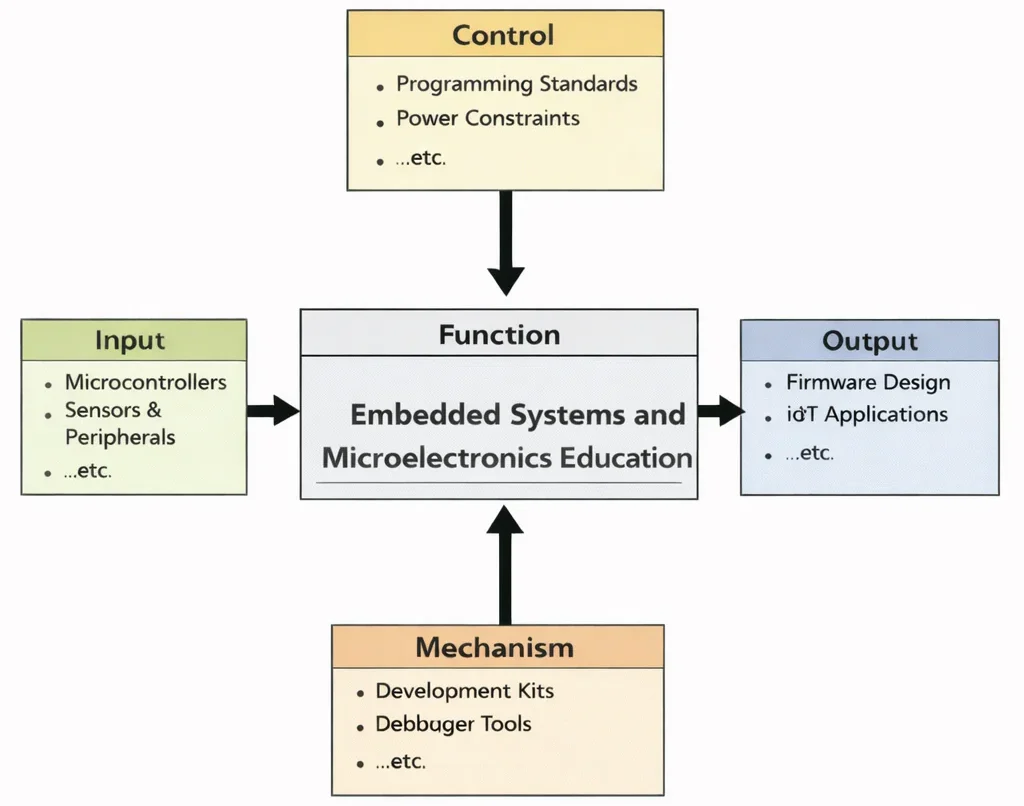
Embedded Systems and Microelectronics Education is, at its heart, training the mind to make tiny machines behave with reliability and purpose. The “Input” side reminds us that learning begins with real components—microcontrollers, sensors, and the everyday peripherals that give devices their senses and reach. Yet the craft is never “anything goes”: the “Control” box highlights the quiet discipline of standards and power limits, the rules that separate a clever prototype from something that can survive in the real world. The “Mechanism” box grounds the whole process in practice—development kits, debugger tools, and hands-on workflows that teach students to observe, diagnose, and iterate rather than guess. When these streams meet in the central function, the outcome is not merely knowledge, but capability: students leave able to design firmware that behaves predictably, and to assemble those designs into useful IoT applications—small systems that feel almost alive because they respond, conserve energy, and keep promises under constraints.
Embedded Systems and Microelectronics are at the core of modern intelligent technologies, enabling the functionality of everything from mobile phones to industrial automation and medical devices. Situated within the broader field of Electrical and Electronic Engineering, this domain combines hardware design, low-level programming, and systems integration to produce compact, efficient, and responsive computing solutions.
Foundational knowledge in Electronics Engineering is essential, as it underpins circuit design and component selection. Equally important is Signal Processing, which supports real-time data handling and digital control in embedded applications. Systems that rely on precise control algorithms also draw from Control Systems Engineering, allowing devices to react dynamically to environmental changes.
For monitoring and diagnostics, Instrumentation and Measurement technologies are integrated with microcontrollers and sensors. These are crucial for data acquisition in settings ranging from industrial automation to Biomedical Electronics. The resulting devices can be found in wearables, implantable health monitors, and smart diagnostics.
As embedded systems become increasingly connected, they play a vital role in the Internet of Things (IoT) and Smart Technologies, forming the fabric of smart cities, homes, and infrastructure. Applications also extend to Robotics and Automation in E&E, where microelectronic circuits serve as the brain and nervous system of autonomous machines.
Breakthroughs in Quantum Electronics are beginning to influence microelectronics by promising ultra-compact and efficient architectures. Embedded systems are also pivotal in managing Renewable Energy and Energy Storage technologies and coordinating grid operations in Power Systems Engineering.
In sustainability and environmental contexts, embedded systems are applied in Environmental Monitoring and Data Analysis, allowing real-time detection of pollutants and efficient resource management. Examples include applications in Air Quality Engineering and Water Resources Engineering, where sensor networks provide critical feedback for decision-making.
The integration of embedded systems with sustainability goals extends to Green Building and Sustainable Design, enabling smart energy management, lighting, and HVAC systems. Innovations in Renewable Energy Systems Engineering further benefit from embedded control and diagnostics, enhancing reliability and efficiency.
At the intersection of technology and policy, embedded systems inform urban and industrial strategies through integration in Environmental Policy and Management and implementations within Industrial Ecology and Circular Economy. Systems engineers also find roles in Industrial and Manufacturing Technologies, designing automation tools, sensors, and diagnostics to increase productivity and quality.
Students pursuing Embedded Systems and Microelectronics acquire not only technical expertise but also a multidisciplinary perspective that spans energy, healthcare, environmental stewardship, and intelligent infrastructure. Their skillset is critical to the development of compact, efficient, and interconnected solutions in an increasingly digital and sustainable world.

This illustration shows a futuristic embedded-systems lab built around a central integrated circuit on a circuit-board “table,” surrounded by smaller chips and components. Robotic arms suggest automated assembly, testing, or precision handling, while translucent overlays display a chip blueprint, waveform-like charts, and IoT/network icons—hinting at firmware development, sensor integration, and real-time performance constraints. The engineer’s focus on a small part symbolizes microelectronics detail work (packaging, pins, interfaces), while the connected visuals emphasize embedded devices operating inside larger systems such as smart products, industrial equipment, and networked sensors.
Embedded Systems and Microelectronics – Invisible FAQ
- How is an embedded system different from a general-purpose computer?
- An embedded system is built for one or a small set of specific tasks inside a larger product, often with real-time constraints and strict limits on power, memory, and cost. A general-purpose computer is designed to run many different applications and uses a more flexible operating system with far greater resources.
- What is the difference between a microcontroller and a microprocessor?
- A microcontroller integrates CPU, memory, and peripherals on a single chip and typically runs one focused application. A microprocessor is mostly just the CPU core and relies on external memory and peripherals, making it more suitable for complex systems like PCs, smartphones, or high-end embedded boards.
- Why is real-time performance important in many embedded systems?
- Real-time performance ensures that the system responds to inputs or events within guaranteed deadlines. Missing these timing requirements can cause functional failures or safety hazards in applications such as automotive control, industrial automation, and medical devices.
- How do power and energy constraints shape embedded system design?
- Many embedded devices run on batteries or energy harvesting, so designers use low-power microcontrollers, sleep modes, efficient regulators, and optimised firmware to reduce energy use and prolong operating life without sacrificing reliability.
- What advantages do system-on-chip (SoC) designs offer?
- SoCs place CPU cores, memory, interfaces, and hardware accelerators on a single die, reducing board space, power consumption, latency, and design complexity. This integration is key in smartphones, wearables, and other compact embedded platforms.
- What are common challenges when interfacing sensors and actuators?
- Sensors may produce small or noisy analog signals, or voltages outside the microcontroller range, while actuators may require higher currents or voltages. Engineers address these issues with ADCs, signal conditioning, level shifting, driver circuits, and careful PCB layout to control noise and timing.
- Why is the choice of embedded operating system so important?
- The operating system determines how tasks are scheduled, how resources are shared, and what real-time guarantees can be made. Choosing between bare-metal code, a lightweight RTOS, or embedded Linux affects complexity, responsiveness, memory use, and available features such as networking and security.
- How do communication protocols like I²C, SPI, UART, and CAN support embedded designs?
- These protocols provide structured ways for chips to exchange data. I²C and SPI are widely used for short-range peripheral connections, UART supports simple serial links, and CAN supports robust communication in noisy, distributed systems like vehicles and industrial networks.
- Why is memory management critical to long-term reliability in embedded products?
- Embedded systems often have limited RAM and flash and may run continuously for years. Poor memory management can cause fragmentation, overflows, or premature flash wear, leading to crashes or corrupted data. Careful allocation strategies and wear-leveling techniques mitigate these risks.
- What trends are shaping the future of embedded systems and microelectronics?
- Key trends include the rise of IoT and edge AI, more powerful but energy-efficient SoCs, flexible and wearable electronics, and new packaging and fabrication technologies. Together they enable smarter, smaller, and more connected devices in everyday environments.
- Electrical & Electronic Engineering topics:
- Electrical & Electronic Engineering – Overview
- Electronics Engineering
- Power Systems Engineering
- Renewable Energy & Energy Storage
- Communication Engineering
- Control Systems Engineering
- Signal Processing
- Instrumentation & Measurement
- Embedded Systems & Microelectronics
- Robotics & Automation in EE
- IoT & Smart Technologies
- Biomedical Electronics
- Quantum Electronics
Table of Contents
Key Concepts in Embedded Systems and Microelectronics
The domains of embedded systems and microelectronics form a tightly intertwined foundation of modern computing and electronic design. Their principles define how everyday objects—from industrial robots to wearable health monitors—are turned into intelligent, responsive, and efficient devices. Below is a detailed expansion of these core concepts.
Embedded Systems
Embedded systems are computing units crafted for specific tasks rather than general-purpose use. These systems are discreetly embedded within devices ranging from home appliances to aerospace controls. Their key characteristics include:
- Integration of Hardware and Software: At the heart of every embedded system is the symbiosis between microcontrollers or microprocessors and specialized software. The hardware executes precise instructions, while software orchestrates real-time logic, data handling, and communication with sensors and actuators.
- Real-Time Operation: Many embedded systems serve critical tasks—like controlling vehicle braking or regulating medical device dosage—that demand deterministic execution. These systems rely on real-time operating systems (RTOS) to enforce timely response and priority-based scheduling.
- Resource Constraints: Engineers design these systems within tight constraints: low clock speeds, minimal memory (RAM/ROM), restricted energy budgets, and constrained physical size. Solutions such as bare-metal programming, code optimization, and low-power sleep modes are essential.
- Robustness and Reliability: Because embedded systems often operate in inhospitable environments—extreme temperatures, electromagnetic interference, or mechanical vibration—they must be designed for high reliability using watchdog timers, error-correcting memory, and fault-tolerant code structures.
- Low Latency I/O: Embedded systems interact frequently with external devices—ADC sensors, pulse counters, communication buses—necessitating low-latency, interrupt-driven I/O with efficient hardware interfaces like SPI, I²C, and UART.
- Power Efficiency: Battery-operated or energy-harvested devices need advanced power management. Techniques like dynamic voltage scaling, peripheral gating, sleep modes, and ultra-low-power sensor circuits extend operational lifespan.
- Security Considerations: As embedded devices become increasingly connected (IoT), they must be secured against tampering. Hardware-based security modules, secure boot, encryption accelerators, and over-the-air (OTA) update mechanisms protect against vulnerabilities.
- Certification and Standards: In regulated domains like automotive, aerospace, and healthcare, embedded systems must conform to standards (e.g., ISO 26262, DO-178C, IEC 60601). This requires rigorous testing, traceability, and documentation.
Microelectronics
Microelectronics is the science and engineering behind the fabrication of miniaturized electronic components. It enables mass production of compact, energy‑efficient, and high-performance integrated circuits—pivotal for modern embedded devices. Key elements include:
- Microprocessors: These are general-purpose CPUs fabricated using semiconductor processes. They support complex operating systems and multitasking applications. Advancements in architecture—pipeline design, multiple cores, and instruction-level parallelism—drive higher performance.
- Microcontrollers: Combining CPU, memory, and I/O peripherals on one chip, microcontrollers offer a compact, economical solution for embedded applications. They support both interrupt-driven tasks and polling loops, and operate under constraints of clock cycles, power, and footprint.
- Integrated Circuits (ICs): ICs integrate transistors, capacitors, resistors, and interconnects at microscopic scales. Scaling driven by Moore’s Law enables billions of transistors per chip, facilitating high-density systems-in-package (SiP), multi-core microcontrollers, and system-on-chip (SoC) architectures tailored for specific applications.
- Analog and Mixed‑Signal ICs: Many digital systems require real-world interaction via ADCs, DACs, amplifiers, and voltage regulators. Mixed-signal ICs combine these with digital logic to support precision measurement, RF communication, and sensor interfacing.
- Nano-fabrication Techniques: Fabrication methods like photolithography, ion implantation, and chemical vapor deposition now operate at sub-10nm process nodes. These cutting-edge techniques demand precision to ensure performance, yield, and long-term reliability.
- Packaging and Testing: IC packaging—BGA, QFN, wire-bonding—ensures electrical performance and thermal dissipation. In-package testing and failure analysis reveal defects in ICs. System-level tests (burn-in, ATE) certify product quality in embedded modules.
- Design Automation: Electronic Design Automation (EDA) tools like Verilog, VHDL, SPICE, and layout suites enable engineers to design, simulate, and verify microelectronic circuits before fabrication. Automated Design Rule Checks (DRC) and Layout vs. Schematic (LVS) flow ensure manufacturability and accuracy.
Embedded systems and microelectronics drive innovation across sectors—from industrial IoT to healthcare sensors, autonomous vehicles to consumer gadgets. Their ongoing evolution relies on new materials, heterogeneous integration, and scalable manufacturing processes. To explore frontiers in embedded design, semiconductor fabrication, and EDA tools, visit the insightful resources on Embedded.com.
Key Concepts in Embedded Systems and Microelectronics
The domains of embedded systems and microelectronics form a tightly intertwined foundation of modern computing and electronic design. Their principles define how everyday objects—from industrial robots to wearable health monitors—are turned into intelligent, responsive, and efficient devices. Below is a detailed expansion of these core concepts.
Embedded Systems
Embedded systems are computing units crafted for specific tasks rather than general-purpose use. These systems are discreetly embedded within devices ranging from home appliances to aerospace controls. Their key characteristics include:
- Integration of Hardware and Software: At the heart of every embedded system is the symbiosis between microcontrollers or microprocessors and specialized software. The hardware executes precise instructions, while software orchestrates real-time logic, data handling, and communication with sensors and actuators.
- Real-Time Operation: Many embedded systems serve critical tasks—like controlling vehicle braking or regulating medical device dosage—that demand deterministic execution. These systems rely on real-time operating systems (RTOS) to enforce timely response and priority-based scheduling.
- Resource Constraints: Engineers design these systems within tight constraints: low clock speeds, minimal memory (RAM/ROM), restricted energy budgets, and constrained physical size. Solutions such as bare-metal programming, code optimization, and low-power sleep modes are essential.
- Robustness and Reliability: Because embedded systems often operate in inhospitable environments—extreme temperatures, electromagnetic interference, or mechanical vibration—they must be designed for high reliability using watchdog timers, error-correcting memory, and fault-tolerant code structures.
- Low Latency I/O: Embedded systems interact frequently with external devices—ADC sensors, pulse counters, communication buses—necessitating low-latency, interrupt-driven I/O with efficient hardware interfaces like SPI, I²C, and UART.
- Power Efficiency: Battery-operated or energy-harvested devices need advanced power management. Techniques like dynamic voltage scaling, peripheral gating, sleep modes, and ultra-low-power sensor circuits extend operational lifespan.
- Security Considerations: As embedded devices become increasingly connected (IoT), they must be secured against tampering. Hardware-based security modules, secure boot, encryption accelerators, and over-the-air (OTA) update mechanisms protect against vulnerabilities.
- Certification and Standards: In regulated domains like automotive, aerospace, and healthcare, embedded systems must conform to standards (e.g., ISO 26262, DO-178C, IEC 60601). This requires rigorous testing, traceability, and documentation.
Microelectronics
Microelectronics is the science and engineering behind the fabrication of miniaturized electronic components. It enables mass production of compact, energy‑efficient, and high-performance integrated circuits—pivotal for modern embedded devices. Key elements include:
- Microprocessors: These are general-purpose CPUs fabricated using semiconductor processes. They support complex operating systems and multitasking applications. Advancements in architecture—pipeline design, multiple cores, and instruction-level parallelism—drive higher performance.
- Microcontrollers: Combining CPU, memory, and I/O peripherals on one chip, microcontrollers offer a compact, economical solution for embedded applications. They support both interrupt-driven tasks and polling loops, and operate under constraints of clock cycles, power, and footprint.
- Integrated Circuits (ICs): ICs integrate transistors, capacitors, resistors, and interconnects at microscopic scales. Scaling driven by Moore’s Law enables billions of transistors per chip, facilitating high-density systems-in-package (SiP), multi-core microcontrollers, and system-on-chip (SoC) architectures tailored for specific applications.
- Analog and Mixed‑Signal ICs: Many digital systems require real-world interaction via ADCs, DACs, amplifiers, and voltage regulators. Mixed-signal ICs combine these with digital logic to support precision measurement, RF communication, and sensor interfacing.
- Nano-fabrication Techniques: Fabrication methods like photolithography, ion implantation, and chemical vapor deposition now operate at sub-10nm process nodes. These cutting-edge techniques demand precision to ensure performance, yield, and long-term reliability.
- Packaging and Testing: IC packaging—BGA, QFN, wire-bonding—ensures electrical performance and thermal dissipation. In-package testing and failure analysis reveal defects in ICs. System-level tests (burn-in, ATE) certify product quality in embedded modules.
- Design Automation: Electronic Design Automation (EDA) tools like Verilog, VHDL, SPICE, and layout suites enable engineers to design, simulate, and verify microelectronic circuits before fabrication. Automated Design Rule Checks (DRC) and Layout vs. Schematic (LVS) flow ensure manufacturability and accuracy.
Embedded systems and microelectronics drive innovation across sectors—from industrial IoT to healthcare sensors, autonomous vehicles to consumer gadgets. Their ongoing evolution relies on new materials, heterogeneous integration, and scalable manufacturing processes. To explore frontiers in embedded design, semiconductor fabrication, and EDA tools, visit the insightful resources on Embedded.com.
Applications of Embedded Systems and Microelectronics
Embedded systems and microelectronics have become the invisible engines powering modern life, seamlessly integrated into countless applications across industries. Their ability to combine compact processing, real-time responsiveness, sensing, communication, and low-power operation makes them indispensable in everything from transportation and healthcare to consumer gadgets and defense. Below, we explore how these technologies enable innovation in key sectors.
Automotive Systems
- Engine Control Units (ECUs): ECUs continuously monitor engine parameters such as fuel injection timing, air–fuel ratios, ignition scheduling, and throttle control. They rely on microelectronic sensors and embedded algorithms to optimize performance, reduce emissions, and improve fuel efficiency under varying conditions.
- Advanced Driver Assistance Systems (ADAS): ADAS features—adaptive cruise control, lane-keeping, collision avoidance, and automated parking—depend on embedded processors analyzing data from radar, LiDAR, cameras, and ultrasonic sensors in real time. These systems fuse data and execute control actions within milliseconds to ensure safe and precise vehicle operation.
- Infotainment Systems: Modern car infotainment integrates high-resolution displays, multimedia playback, navigation, voice control, and wireless connectivity (Bluetooth, Wi-Fi). Embedded systems manage user interfaces, audio processing, and secure connectivity while ensuring responsive performance and minimal latency.
- Electric Vehicles (EVs): EVs rely heavily on embedded microcontrollers for battery management systems (monitoring state-of-charge, thermal control, cell balancing), motor controllers (managing torque, efficiency, and regenerative braking), and onboard charging systems (grid communication, safety protocols, and power conversion).
Consumer Electronics
- Smartphones and Tablets: These devices pack multiple embedded processors responsible for touchscreen interfacing, camera systems, cellular and wireless networking, power management, and secure authentication—all working in harmony to deliver smooth user experiences.
- Wearable Devices: Fitness trackers, smartwatches, and health wearables use embedded electronics to monitor heart rate, steps, sleep, and other biometrics. They must balance continuous data capture with ultra-low-power operation and wireless data transmission.
- Smart Home Devices: Thermostats, security cameras, smart plugs, and voice assistants operate using embedded microcontrollers that manage sensor inputs, wireless protocols, cloud communication, and user interaction—all while maintaining energy efficiency and data security.
Healthcare
- Medical Devices: Pacemakers, insulin pumps, hearing aids, and infusion pumps integrate microelectronics and embedded firmware to deliver precise doses, monitor vitals, and correct physiological conditions in real time under strict safety regulations.
- Wearable Health Monitors: Continuous glucose monitors, ECG patches, and pulse oximeters collect physiological data throughout the day. Embedded algorithms filter noise, detect anomalies, and securely transmit data to medical providers.
- Imaging Systems: MRI, CT, and ultrasound machines incorporate complex embedded electronics that control imaging sequences, data reconstruction, signal filtering, and safety interlocks—enabling clear images and accurate diagnostics.
Industrial Automation
- Programmable Logic Controllers (PLCs): PLCs form the brain of factories, managing motors, conveyors, valves, and sensors in real time. They offer robust, deterministic control under harsh industrial conditions and interface seamlessly with supervisory systems and HMIs.
- Robotics: Robotic arms and autonomous platforms rely on embedded systems for motor control, vision processing, path planning, and safety monitoring. These systems integrate sensor arrays and control loops to execute precise tasks like welding, assembly, inspection, and logistics.
- IoT Sensors: Embedded microcontrollers in sensors monitor environmental factors such as temperature, humidity, vibration, and pressure. They process data locally, transmit summaries via wireless protocols, and integrate with cloud analytics for predictive maintenance and operational insights.
Aerospace and Defense
- Avionics Systems: Embedded electronics manage aircraft navigation, flight control, communication, display systems, and sensor integration. They operate under rigorous safety standards and ensure stable and secure flight operations.
- Drones and UAVs: Whether used for delivery, inspection, or surveillance, drones depend on embedded autopilots that process GPS, IMU, and camera data to manage flight stability, path tracking, and obstacle avoidance.
- Electronic Warfare Systems: Radar systems, signal jammers, secure radios, and surveillance modules rely on fast digital signal processing, RF front ends, and embedded control algorithms to detect, analyze, and counter threats.
Across all these industries, embedded systems and microelectronics deliver the intelligence, control, and responsiveness necessary for advanced functionality. To explore the latest developments, standards, and applications in embedded design, check out this comprehensive resource at Embedded.com, which offers insights into trends, tools, and expert analysis shaping the future of intelligent systems.
Tools and Techniques in Embedded Systems and Microelectronics
Embedded systems and microelectronics thrive on a rich ecosystem of development platforms, software tools, and fabrication techniques tailored for innovation, efficiency, and performance. These tools enable designers to prototype concepts quickly, refine functionality, test rigorously, and prepare products for mass production. Below, we explore the broad range of tools and techniques across the development lifecycle.
Development Platforms
- Arduino: The Arduino ecosystem provides boards like Uno, Nano, and Mega with Arduino IDE support. Engineers and hobbyists use them for rapid prototyping—testing sensors, actuators, communication modules, and control logic. Their open-source hardware and software licensing encourage community collaboration and code sharing.
- Raspberry Pi: This single-board computer runs Linux and supports high-level programming languages such as Python, C, and Node.js. It’s used in embedded applications requiring more computing power or multimedia (e.g., camera streaming, IoT gateways, edge AI). Integration with GPIO pins, camera interfaces, and Ethernet makes it ideal for interactive and networked projects.
- ESP32/ESP8266: These ultra-low-cost Wi-Fi and Bluetooth-enabled microcontroller modules are popular in IoT development. With dual-core processing (ESP32), built-in ADCs, DACs, and power-saving modes, they support home automation, environmental sensors, wearable devices, and remote telemetry. The Arduino core or ESP-IDF environments enable versatile firmware deployment.
Integrated Development Environments (IDEs)
- Keil (MDK-ARM): A professional IDE for ARM Cortex-M microcontrollers. It combines compilers, debugging tools, RTOS integration, and real-time trace capabilities—ideal for industrial and safety-critical projects.
- MPLAB X: Microchip’s integrated environment supports PIC, dsPIC, and AVR microcontrollers with graphical configuration, code generation, debugging, and peripheral simulation.
- STM32CubeIDE: STMicroelectronics’ official IDE for STM32 microcontroller family. It includes CubeMX for automated peripheral configuration and code generation, combined with Eclipse-based editing, compilation, and debugging.
- Other notable IDEs include IAR Embedded Workbench, Atmel Studio, TI’s Code Composer, and Visual Studio Code with embedded extensions—providing language support, version control integration, and GUI plugins.
Programming Languages
- C: The backbone of embedded development. Its efficiency, memory control, and direct hardware access make it ideal for low-level firmware design. MISRA C guidelines enhance code safety in critical systems.
- C++: Offers object-oriented structuring, templates, and abstraction layers—useful for complex, modular embedded architectures. Real-time-safe subsets are used in robotics, automotive, and IoT frameworks.
- Python: Often used on Linux-based embedded devices (e.g., Raspberry Pi) for scripting, rapid prototyping, and edge processing driven by frameworks like MicroPython and CircuitPython on constrained boards.
- Assembly Language: Used sparingly for performance-critical or size-restricted routines—such as startup code, interrupt handlers, and tight loops requiring cycle-accurate control.
Simulation and Testing Tools
- Proteus: Combines schematic capture with virtual microcontroller simulation. Users can test firmware on a software model of the circuit, including peripherals and display modules—streamlining early-stage validation.
- MATLAB/Simulink: Supports embedded code generation for control algorithms, signal processing, and multi-domain simulations. Integrates with ARM Cortex and FPGA targets for hardware-in-the-loop (HIL) testing.
- Debuggers: Tools like GDB, JTAG, SWD, and emulator probes (Segger J-Link, ST-Link) support hardware breakpoints, step-through execution, and memory inspection to identify runtime issues.
- Logic Analyzers: Capture digital signals from GPIOs, SPI, I²C, and UART buses. Offer visual timing diagrams and protocol decoding—critical for validating communication and synchronization.
- Oscilloscopes: Inexpensive digital scopes enable time-domain waveform analysis to ensure signal integrity, detect EMI, and check timing margins in high-speed or mixed-signal circuits.
- Unit Testing Frameworks: Tools like Unity, CMock, and Ceedling in C/C++ environments support automated regression testing—critical for code quality and compliance standards.
Fabrication and Prototyping
- PCB Design Tools: KiCad (open-source) and Altium Designer support schematic capture, multi-layer layouts, design-for-manufacturing (DFM) checks, BOM handling, and Gerber export for fabrication.
- Soldering Techniques: SMT reflow processes and through-hole soldering allow for both prototype development and scalable production. Techniques such as hot-air rework and selective soldering enhance reliability.
- 3D Printing & Enclosures: With tools like Fusion 360 or OpenSCAD, engineers design mechanical housings and mounts that integrate with electronics—testing fit, function, and thermal properties before manufacturing.
- Pick-and-Place & Reflow Ovens: Desktop reflow ovens and pick-and-place machines enable production of small-series boards with precise component placement—supporting iterative design refinement.
Together, these tools constitute a comprehensive development pipeline—from concept and simulation to testing and production. Staying informed on platforms, IDEs, languages, and fabrication trends is essential for innovative and efficient design. For up-to-date guidance on embedded toolchains, hardware trends, and best practices, explore this curated resource on Embedded.com.
Challenges in Embedded Systems and Microelectronics
Miniaturization
- Reducing the size of components while maintaining performance and reliability remains one of the most persistent challenges in embedded systems and microelectronics. As consumer demand grows for compact, multifunctional devices—from smartphones to medical implants—engineers must innovate new ways to pack greater functionality into ever-smaller spaces. Miniaturization also leads to increased signal interference and reduced mechanical tolerances, requiring advanced materials, precision manufacturing techniques, and rigorous testing protocols to ensure product quality and durability. Shrinking component sizes also strain traditional PCB design and assembly processes, necessitating finer trace widths, tighter component spacing, and more complex multi-layer routing, all of which increase design complexity and fabrication cost.
Power Efficiency
- Designing low-power systems, especially for battery-operated devices, is critical to extending operational life and improving user experience. Power efficiency must be achieved at multiple levels, including hardware selection (e.g., low-leakage transistors), firmware design (e.g., sleep modes and interrupt-driven execution), and energy harvesting where feasible. Battery technology itself presents limitations, so engineers often focus on optimizing duty cycles, sensor sampling rates, and wireless communication intervals. Efficient power management ICs, dynamic voltage and frequency scaling (DVFS), and machine learning-based power profiling are among the techniques used to tackle this challenge in wearable electronics, remote sensors, and mobile platforms.
Real-Time Constraints
- Ensuring deterministic responses for critical applications like medical devices or automotive systems is a non-negotiable requirement. Real-time embedded systems must guarantee that tasks execute within strict time bounds, which is especially vital in safety-critical environments such as anti-lock braking systems or insulin pumps. This requires careful operating system selection (e.g., FreeRTOS, VxWorks), priority-driven task scheduling, and interrupt latency optimization. Additionally, real-time performance is constrained by hardware limitations such as bus contention, memory access delays, and CPU processing load. Comprehensive profiling, testing under worst-case scenarios, and formal verification techniques are often needed to assure reliability in mission-critical operations.
Integration with IoT
- Seamlessly connecting embedded systems to the Internet for data collection and remote control introduces multiple design layers, including communication protocols (MQTT, CoAP), cloud platforms (AWS IoT, Azure IoT Hub), and security frameworks (TLS/SSL). IoT integration demands that devices remain responsive under intermittent connectivity while conserving energy and maintaining data integrity. Interfacing with heterogeneous networks, maintaining interoperability between vendors, and updating firmware over-the-air (OTA) present significant implementation hurdles. Moreover, engineers must balance trade-offs between local vs. cloud processing and real-time responsiveness vs. data synchronization latency. Practical guidance on overcoming these integration issues is explored in detail at Embedded.com’s IoT integration guide.
Security
- Protecting embedded devices from cyber threats and unauthorized access has become increasingly urgent as more devices become connected and remotely accessible. Embedded systems, often deployed in public or unmonitored environments, are vulnerable to attacks like firmware tampering, man-in-the-middle interception, buffer overflows, and hardware-level side-channel exploits. Implementing security features such as secure boot, encrypted communication, device authentication, and hardware-based root of trust (e.g., TPMs) adds complexity and overhead. Limited processing resources and strict power budgets further complicate the implementation of robust encryption or intrusion detection mechanisms. Engineers must incorporate security from the outset—”security by design”—and conduct periodic updates and vulnerability testing throughout the device lifecycle.
Thermal Management
- Dissipating heat effectively in compact systems to avoid performance degradation is essential for reliability and safety. As device dimensions shrink and integration density increases, heat generated by processors, voltage regulators, and high-frequency switching components becomes harder to manage. Poor thermal control can lead to signal distortion, premature component aging, or outright failure. Techniques such as thermal vias, heat sinks, copper pours, and phase-change materials are commonly employed in PCB layouts. For systems operating in harsh environments—like automotive control units or industrial gateways—passive and active cooling mechanisms must be carefully designed to withstand extreme temperatures and ensure uninterrupted performance.
Future Trends in Embedded Systems and Microelectronics
Edge Computing
- Shifting data processing from the cloud to local embedded systems delivers drastically faster response times and reduced latency. Instead of sending raw sensor data to remote servers, edge devices—equipped with microcontrollers or small SoCs—can run pre-trained models, perform local filtering, detect anomalies, and even execute closed‑loop control without relying on network connectivity. This approach enhances privacy (by keeping sensitive data on-device), conserves bandwidth, and supports applications such as autonomous drones, real-time industrial control, and responsive smart home systems. Edge computing also enables hybrid matchmaking where local inference is combined with cloud analytics for updates, model training, or long-term data storage.
AI Integration
- Embedding artificial intelligence and machine learning capabilities into microcontrollers and microprocessors is revolutionizing devices with intelligence at the edge. TinyML frameworks allow neural networks to run on chips with limited memory, performing speech recognition, gesture detection, predictive maintenance, and anomaly detection in real time. This integration reduces power consumption and dependency on remote servers while accelerating decisions. It also supports intelligent IoT nodes that can adapt behavior dynamically, learn usage patterns, or collaborate with nearby devices in decentralized networks.
Flexible and Wearable Electronics
- Developing flexible circuits and stretchable substrates is enabling new classes of devices such as electronic skin, smart bandages, foldable gadgets, and conformal sensors. These ultra-thin, bendable electronics use materials like conductive elastomers, printed metallic inks, and organic semiconductors. They are integrated with soft microcontrollers and energy-harvesting modules to monitor physiology, motion, environmental factors, or structural strain. Custom architectures allow devices to conform to curved surfaces without compromising performance, making them ideal for next-generation healthcare monitoring and wearable human–machine interfaces.
RISC‑V Architecture
- The open-source RISC‑V processor architecture is rapidly gaining momentum for custom embedded applications. Its extensible instruction set allows designers to build tailored CPUs that balance performance, energy efficiency, and silicon cost. RISC‑V cores are being embedded in application-specific microcontrollers, edge AI accelerators, sensor fusion units, and real-time controllers. This architectural freedom empowers chip designers to create competitive solutions without licensing fees, fostering innovation in academic, industrial, and open-hardware communities.
Energy Harvesting
- Harvesting ambient energy from sources such as solar cells, piezoelectric vibrations, thermoelectric gradients, and RF waves is becoming increasingly viable for powering low-energy embedded systems. Combined with ultra-efficient power management units and energy-aware firmware, these devices can operate autonomously with minimal maintenance—ideal for remote sensors, structural health monitors, and wearable health trackers. Energy harvesting reduces reliance on batteries, cuts environmental waste, and supports deployment in inaccessible locations.
Quantum Microelectronics
- Exploring quantum effects at the microelectronic scale is opening paths toward ultra-small, high-performance computing and sensing. Quantum dots, single-electron transistors, and superconducting nanocircuits offer new ways to process data at near-zero power or enable quantum communication. Though still experimental, this research promises transformative breakthroughs in computing power, sensor sensitivity, and secure information transfer, potentially paving the way for hybrid classical-quantum embedded platforms.
These emerging trends signal a future where embedded systems are not just smart—they are intelligent, adaptive, and self‑sustaining. Harnessing advances in edge AI, flexible electronics, open‑source architectures, energy harvesting, and quantum microelectronics will lead to devices that are more autonomous, secure, and capable than ever before. To stay informed on cutting-edge developments and best practices in embedded design and microelectronics, explore this in‑depth comparative analysis at Embedded.com.
Case Studies in Embedded Systems and Microelectronics
Automotive Applications
The development of Tesla’s Autopilot system offers a compelling example of how embedded systems and microelectronics are driving the next generation of transportation technology. At its core, Autopilot depends on a sophisticated network of embedded microcontrollers and real-time processors to analyze vast streams of data from an array of onboard sensors—including multiple cameras, radar units, ultrasonic detectors, and GPS modules. Each sensor’s input is processed and fused using advanced embedded algorithms that enable real-time perception of lane markings, nearby vehicles, traffic signs, and obstacles. These insights feed into a decision-making engine that executes adaptive cruise control, lane centering, auto lane change, and even automatic parking. Tesla’s full self-driving (FSD) computer includes custom-designed chips with high-performance AI accelerators integrated directly on-board—replacing reliance on external servers and exemplifying the shift toward powerful, localized embedded intelligence. The system must also handle redundancy, real-time constraints, and fail-safe mechanisms, making it a benchmark for autonomous embedded engineering. Further insights into how embedded architectures shape modern transport can be found at Autonomous Vehicle Technology.
Healthcare Devices
Fitbit’s wearable health monitors provide an excellent case study in the role of embedded systems and microelectronics in personal healthcare innovation. These compact devices incorporate embedded microcontrollers that manage power consumption, data acquisition, storage, wireless communication, and display interfaces. A suite of miniaturized sensors—including photoplethysmography (PPG) for heart rate, accelerometers for motion detection, gyroscopes for posture monitoring, and SpO₂ sensors—are seamlessly integrated into the device’s architecture. Real-time operating systems (RTOS) coordinate multiple processes simultaneously, enabling continuous data collection without draining the battery. Algorithms within the embedded firmware interpret activity levels, classify sleep stages, detect anomalies, and trigger notifications. Fitbit devices also transmit data via Bluetooth Low Energy (BLE) to mobile apps and cloud servers for deeper analytics and long-term health tracking. The integration of embedded systems has not only made fitness tracking accessible and affordable but also contributed to preventive care by alerting users to irregular heart rhythms or sudden health changes—an increasingly vital function as digital health technologies expand.
IoT Devices
Nest smart thermostats illustrate the powerful capabilities of embedded systems and microelectronics in the Internet of Things (IoT) domain. Designed to optimize energy consumption while providing comfort and convenience, Nest devices incorporate microcontrollers that gather inputs from multiple sensors, such as temperature, humidity, ambient light, and motion detectors. These inputs are processed by onboard embedded software to determine user presence, preferred settings, and energy-saving opportunities. The thermostat adapts over time using machine learning algorithms that run locally, creating schedules that reflect user behavior. Communication modules embedded within the system allow for seamless control through Wi-Fi and integration with smartphone apps or home automation hubs. In addition to local intelligence, Nest thermostats communicate with cloud platforms for software updates and broader optimization strategies. Energy reports, usage trends, and remote diagnostics are made possible through this hybrid embedded–cloud architecture. As part of Google’s broader ecosystem, Nest also supports integration with voice assistants and other smart home devices, demonstrating how embedded systems form the nerve center of intelligent living environments.
Why Study Embedded Systems and Microelectronics
Integrating Hardware and Software
Embedded systems engineering focuses on designing devices where hardware and software work together. Students learn to create systems for real-time control in applications like medical devices and smart appliances. This combination drives much of today’s innovation.
Microprocessors and System Architecture
Students study the architecture of microprocessors and how they interact with memory and I/O. They learn how to write firmware that controls hardware behavior. This knowledge is essential for developing responsive and efficient systems.
Low Power and Compact System Design
Designing for energy efficiency and small form factors is crucial in embedded systems. Students explore techniques for minimizing power consumption and maximizing performance. These principles are key for wearable tech and IoT devices.
Real-Time Operating Systems (RTOS)
The course introduces RTOS concepts like task scheduling, interrupt handling, and synchronization. Students learn to build systems that respond reliably under strict timing constraints. These skills are necessary for safety-critical applications.
Industry Applications and Emerging Trends
Embedded systems and microelectronics are used in automotive systems, robotics, and industrial automation. Students explore trends like edge AI, sensor fusion, and secure computing. This prepares them for roles in advanced electronics and intelligent systems.
Embedded Systems and Microelectronics: Conclusion
Embedded systems and microelectronics serve as invisible yet indispensable pillars of today’s technological fabric. These subfields make it possible to embed sophisticated computational intelligence, sensing, actuation, and communication capabilities into ultra‑compact devices, transforming not only industries but also daily life. Whether we’re using wearables to monitor our health, driving vehicles that navigate themselves, or managing smart homes with a voice command, these technologies are at the core.
At the heart of smart home ecosystems are embedded microcontrollers that manage lighting, climate, security, and entertainment. These controllers coordinate via wireless IoT protocols, learn usage patterns, and balance energy consumption intelligently—delivering comfort and efficiency. The same principles extend to industrial automation, where embedded controllers monitor equipment, execute real‑time adjustments, and interface with predictive maintenance platforms to prevent costly downtime.
In the automotive sector, embedded systems are key to the rise of connected and autonomous vehicles. Networked electronic control units (ECUs) handle tasks from engine optimization to infotainment, while advanced sensor fusion (radar, lidar, cameras) enables situational awareness and automated driving. Rigorous microelectronic design ensures these systems are reliable, resilient, and responsive to safety standards and user needs.
The impact on healthcare is equally profound. Miniaturized implantable devices—such as pacemakers, neural stimulators, and continuous glucose monitors—rely on microelectronics for ultra‑low‑power operation, biocompatible packaging, and secure telemetry. Wearable sensors continuously capture physiological data while embedded edge computing ensures on‑device analysis, privacy, and rapid response to clinical events.
Further advancing these domains are innovations in microelectronics, which are pushing circuit densities, power efficiency, and functional integration to unprecedented levels. Embedded processors, memory blocks, and analog interfaces are all being condensed into single system‑on‑chip (SoC) designs, enabling more intelligent, battery‑powered devices with edge AI capabilities. This is essential for applications requiring immediate inference—such as drones, smart sensors, and robotics.
Looking forward, embedded systems and microelectronics stand ready to enable next‑gen AIoT ecosystems—where devices not only sense and react but also learn and adapt. Edge‑AI chips will empower robotics, AR/VR platforms, smart wearables, and autonomous systems to operate with lower latency, higher energy efficiency, and greater contextual awareness.
Energy efficiency remains an ongoing challenge and priority. Engineers are leveraging techniques such as sub‑threshold logic, energy‑harvesting circuits, asynchronous design, and dynamic voltage / frequency scaling to stretch the capabilities of battery‑powered or self‑powered systems. Combined with microelectronic packaging advances and novel materials, these developments promise longer-lasting devices and expanded deployment in remote or wearable contexts.
Looking to the future, custom silicon designs are being tailored for specific applications—like neuromorphic processors modeled on neural architectures, security‑hardened chips with hardware root of trust, and ultra‑secure modules for cryptographic operations. These purpose‑built microelectronic platforms will support intelligent edge‑computing systems—fueling innovations in robotics, medical devices, retail, transportation, and environmental monitoring.
To stay on the leading edge of these converging technologies—from embedded AI to ultra‑efficient microcontrollers—explore the latest engineering insights in this comprehensive guide on Embedded.com. These resources track trends, standards, and best practices that shape the next wave of smart, autonomous, and energy-aware devices.
In conclusion, embedded systems and microelectronics aren’t just technical disciplines—they are the engine of a smarter, more connected future. Their combined strengths enable devices to perceive, compute, and act with intelligence and efficiency. As AI, IoT, energy harvesting, and autonomous systems advance, these domains will continue to serve as the foundational hardware intelligence that powers modern innovation and societal transformation.
Embedded Systems and Microelectronics – Frequently Asked Questions (FAQ)
1. What makes an embedded system different from a normal computer?
A normal computer is built to run many different applications, from word processing to video editing. An embedded system is usually hidden inside a product and focuses on one main job, such as controlling a washing machine cycle or managing an engine. Because its job is well defined, its hardware and software can be tightly optimised for cost, power, and reliability.
2. When would an engineer choose a microcontroller instead of a microprocessor?
Microcontrollers are ideal when you need a compact, low-cost chip to read sensors, drive simple displays, and control actuators with modest processing demands. Microprocessors are chosen when the system needs a high-performance CPU, a rich operating system, and lots of external memory, such as in smartphones, routers, or complex industrial controllers.
3. Why are real-time deadlines so important in many embedded applications?
In a real-time system, it is not enough to get the right answer; it must arrive on time. For example, a braking controller in a car or a motor drive in a robot arm must react within milliseconds. Missing such deadlines can cause instability, damage, or safety risks, so timing is treated as a core design requirement.
4. How do power constraints influence the design of embedded devices?
If a device is battery powered or deployed in a remote location, every milliamp counts. Engineers therefore select low-power chips, make aggressive use of sleep modes, reduce clock speeds when possible, and design firmware to wake up briefly, do useful work, and go back to sleep. These strategies dramatically extend battery life and reduce heat.
5. What is a System-on-Chip (SoC), and why is it common in modern embedded products?
A System-on-Chip integrates processor cores, memory, peripheral interfaces, and sometimes radio and accelerators on a single piece of silicon. This high level of integration reduces the PCB area, lowers power consumption, and simplifies design, which is essential in smartphones, wearables, and smart home devices where space is limited and performance expectations are high.
6. What practical challenges arise when connecting sensors and actuators to a controller?
Sensors may output tiny analog signals that need amplification and filtering, or voltages that do not match the controller’s input range. Actuators such as motors and relays often require higher currents or voltages than the controller can provide directly. Engineers solve these issues with signal conditioning circuits, driver stages, suitable converters, and careful PCB layout to control noise and interference.
7. How do engineers decide which embedded operating system or firmware approach to use?
For very simple tasks, “bare-metal” code without an OS may be enough. If the system needs multiple time-critical tasks, an RTOS can provide deterministic scheduling. For more complex devices that need networking, file systems, and user interfaces, embedded Linux or similar platforms may be appropriate. The choice depends on timing needs, memory budget, security, and development effort.
8. Why are communication buses like I²C, SPI, UART, and CAN so widely used?
These buses provide convenient ways for chips to talk to each other. I²C and SPI are efficient on-board buses for sensors, memory, and converters. UART offers simple point-to-point serial links. CAN is designed for noisy, distributed environments, such as vehicles, where many nodes must share reliable communication. Choosing the right bus ensures robust, efficient data exchange in the final system.
9. How can poor memory management affect the reliability of an embedded product?
If memory is used carelessly, the system may suffer from buffer overflows, memory leaks, or flash wear-out over time. These issues can cause random crashes, data corruption, or premature hardware failure. Good memory management, including static allocation, careful stack usage, and flash wear-leveling, is essential for products that may run continuously for years.
10. What future developments are likely to influence embedded systems and microelectronics?
Growing use of on-device AI, more energy-efficient SoCs, ultra-low-power wireless connectivity, and flexible or wearable electronics are all reshaping embedded design. As these technologies mature, everyday objects—from clothing to infrastructure—will gain more sensing, processing, and communication capabilities, making embedded intelligence a normal part of daily life.
Embedded Systems and Microelectronics: Review Questions with Answers
Embedded systems and microelectronics bring computing power into everyday objects, from household appliances and cars to industrial robots and medical devices. The questions below help you review how dedicated hardware, real-time software, and tightly integrated chips come together to build reliable, low-power systems that quietly run the modern world.
-
What is an embedded system, and how does it differ from a general-purpose computing system?
Answer: An embedded system is a computing unit designed to perform a clearly defined set of tasks within a larger product, such as controlling a washing machine cycle or managing the engine in a car. Its hardware and software are tuned to meet specific functional and timing requirements, usually with strict limits on power, memory, and cost. A general-purpose computing system, like a laptop or desktop, is built to support a wide variety of applications and user needs. It runs a flexible operating system, offers larger memory and storage, and is less constrained by real-time deadlines. Understanding this distinction explains why embedded designs can be highly optimised and robust, but usually less flexible than full-scale computers. -
How do microcontrollers and microprocessors differ, and in what kinds of applications is each typically used?
Answer: A microcontroller integrates a CPU, non-volatile program memory, RAM, and peripheral interfaces (such as timers, GPIO, ADCs, and communication ports) on a single chip. This high level of integration makes microcontrollers compact, energy-efficient, and cost-effective for dedicated tasks, including appliance control, simple IoT nodes, and automotive subsystems. A microprocessor, by contrast, mainly contains the CPU core and relies on external memory chips and peripheral controllers. It offers greater processing performance and flexibility, so it is used in more complex systems such as smartphones, tablets, industrial PCs, and high-end embedded boards that must support rich operating systems, large applications, and sophisticated user interfaces. -
Why is real-time performance often critical in embedded systems, and how do engineers achieve predictable timing?
Answer: Real-time performance means that the system must not only produce correct outputs but do so within guaranteed time bounds. In many embedded contexts—such as controlling a motor, managing an airbag system, or operating a medical infusion pump—missing a deadline can lead to equipment damage, poor performance, or safety risks. Engineers achieve predictable timing using real-time operating systems (RTOS) with deterministic schedulers, priority-based task management, and carefully designed interrupt routines. They may also use dedicated hardware timers, direct memory access (DMA), and watchdog timers to offload time-sensitive operations from the CPU and to detect and recover from software faults. Together, these techniques ensure that critical tasks execute reliably and on time. -
In what ways do power and energy constraints shape embedded system and microelectronic design?
Answer: Many embedded systems are battery powered, energy-harvesting, or expected to operate for long periods without maintenance. As a result, designers treat power consumption as a core design parameter rather than an afterthought. They choose microcontrollers with low-power modes, minimise clock speeds when full performance is not required, and use techniques such as duty cycling, where the device wakes briefly to perform work and then returns to sleep. On the hardware side, efficient voltage regulators, careful selection of components with low leakage currents, and thoughtful PCB layout help reduce energy loss. These combined hardware–software strategies extend battery life, reduce heat generation, and enable compact, fanless designs in consumer, industrial, and wearable applications. -
What is a System-on-Chip (SoC), and how does SoC integration benefit embedded platforms?
Answer: A System-on-Chip is an integrated circuit that brings together processor cores, on-chip memory, peripheral interfaces, and often specialised accelerators—such as graphics processors, cryptographic engines, or AI accelerators—onto a single silicon die. SoCs shorten signal paths and reduce the need for external components, which lowers power consumption, board area, and system cost. They also improve performance by reducing latency between functional units. For embedded platforms such as smartphones, smart TVs, drones, and advanced IoT gateways, this integration makes it possible to deliver high processing power and rich multimedia features within tight size, weight, and power budgets. -
What challenges arise when interfacing sensors and actuators with a microcontroller, and how are they addressed?
Answer: Sensors often provide analog signals that can be small, noisy, or outside the microcontroller’s safe input range. Actuators such as motors, relays, or solenoids may require much higher voltages or currents than the controller can supply directly. Engineers handle these challenges by adding signal conditioning circuits—amplifiers, filters, level shifters—and using ADCs to digitise sensor outputs. For actuators, they employ driver stages, such as transistors, MOSFETs, or dedicated motor drivers, which can safely handle higher power levels. Good PCB layout, grounding, and shielding help limit electromagnetic interference and ensure that sensor readings remain reliable even when actuators are switching. -
How do engineers choose between bare-metal programming, an RTOS, and embedded Linux for a given project?
Answer: Bare-metal programming—running code directly on the hardware without an operating system—is suitable for very simple, time-critical applications with limited functionality. It offers minimal overhead and maximum control, but can become difficult to manage as complexity grows. An RTOS provides task scheduling, inter-task communication, and timing services while still keeping the system relatively lightweight and deterministic, making it a good fit for medium-complexity, real-time systems. Embedded Linux or similar platforms are chosen when the product requires advanced features such as networking stacks, file systems, and support for many processes or libraries. The choice depends on timing constraints, memory resources, security needs, and development effort. -
How do communication protocols like I²C, SPI, UART, and CAN support embedded systems, and what guides protocol selection?
Answer: Embedded systems rarely operate as a single chip; they rely on communication buses to connect sensors, memory, converters, and other controllers. I²C is a simple two-wire bus ideal for low-speed communication with multiple peripherals on the same board. SPI offers higher speeds and full-duplex communication at the cost of additional pins. UART supports straightforward point-to-point serial links, useful for debugging and simple external interfaces. CAN is designed for robust, distributed communication in noisy environments such as vehicles and industrial systems. Engineers choose a protocol based on required data rate, distance, noise tolerance, number of nodes, and available pins, balancing performance with hardware complexity. -
Why is memory management particularly important for long-lived embedded and microelectronic systems?
Answer: Embedded systems often run continuously for years with limited RAM and finite write endurance in non-volatile memory. Poor memory management can cause subtle bugs such as memory leaks, fragmentation, buffer overflows, or premature flash wear, leading to random resets, corrupted data, or total failure after long operation. To maintain reliability, engineers use static or carefully controlled dynamic allocation, design bounded buffers and stacks, and adopt file systems or wear-leveling algorithms that distribute writes evenly across flash or EEPROM. Robust memory management is especially critical in safety-related applications like medical devices or industrial control systems where unexpected crashes are unacceptable. -
What emerging trends are shaping the future of embedded systems and microelectronics, and how might they affect everyday life?
Answer: Several trends are converging to make embedded systems smaller, smarter, and more pervasive. Advances in semiconductor fabrication allow more powerful processors and accelerators to fit into energy-efficient SoCs, while edge AI enables local data processing for tasks such as voice recognition, anomaly detection, or predictive maintenance without always relying on the cloud. Ultra-low-power radios and energy-harvesting techniques support dense sensor networks that monitor buildings, farms, and infrastructure. Flexible and wearable electronics make it possible to embed computing directly into clothing, medical patches, or everyday objects. These developments promise more responsive, personalised, and automated environments, but they also raise new challenges in security, privacy, and long-term maintainability that engineers must address thoughtfully.
Embedded Systems and Microelectronics: Thought-Provoking Questions
1. How do embedded systems blur the line between hardware and software design, and why is this integration vital for modern products?
Answer:
Embedded systems intertwine hardware (microcontrollers, peripherals, sensors) and software (firmware, drivers, real-time operating systems) to address specific tasks. This close coupling ensures that each hardware component is driven optimally by software routines, making the product efficient in power usage, performance, and reliability. Modern devices demand rapid responses to real-world inputs, which means that hardware must be tuned precisely to the software’s timing and data requirements. Such synergy also shortens development cycles: a hardware tweak can be balanced with quick software modifications, and vice versa. This holistic approach drives innovation in fields like wearables, automotive control units, and smart appliances, where physical constraints and user experience merge.
2. What factors drive the selection of a microcontroller in an embedded design, and how can these choices impact overall performance and cost?
Answer:
Key factors include the processing speed required by the application, power constraints (especially if battery-powered), available memory, and the types and numbers of interfaces (e.g., UART, SPI, I²C, USB). Additionally, cost considerations, including component pricing and any licensing fees for development tools, can influence microcontroller selection. The chosen microcontroller’s architecture also affects software complexity and potential future scalability. For instance, using a 32-bit core might be more expensive initially but can handle more advanced computations or expansions compared to an 8-bit core. Balancing current application needs with potential feature updates helps ensure the final device meets performance targets without overspending on unnecessary capabilities.
3. Why is power management so crucial in many embedded applications, and what design strategies help optimize energy usage?
Answer:
Many embedded devices operate on batteries or energy-harvesting systems, making every milliwatt vital for device longevity. Strategies include choosing low-power microcontrollers with built-in sleep modes, implementing efficient switching regulators, and scheduling tasks intelligently so the system remains idle when possible. Firmware can minimize active CPU time and shut down unused peripherals during low-demand periods. Designers also pay attention to voltage levels: running at a lower voltage reduces consumption if the application still meets performance goals. By optimizing software routines and hardware configurations together, engineers can drastically extend operating time, a critical requirement in wearables, remote sensors, and portable medical instruments.
4. How does real-time operation differ from general-purpose computing, and what challenges must designers overcome to guarantee timely responses?
Answer:
Real-time systems must respond within strict deadlines, often measured in microseconds. Unlike general-purpose systems, which can tolerate delays while multitasking or running complex OS operations, real-time devices cannot miss these deadlines without compromising functionality or safety. Challenges include scheduling tasks so critical ones always have priority, minimizing interrupt latency, and ensuring deterministic hardware behaviors. Designers also need robust error handling so unexpected conditions do not stall the system. Selecting a real-time operating system (RTOS) or using bare-metal coding with precise interrupt handling ensures predictability, forming the backbone of mission-critical applications like aerospace controls, industrial robotics, and medical devices.
5. What role does embedded connectivity (such as Wi-Fi, Bluetooth, or Ethernet) play, and how do networked devices drive the concept of the Internet of Things (IoT)?
Answer:
Embedded connectivity allows devices to communicate data wirelessly or over wired links, enabling remote monitoring, firmware updates, and integration with larger systems or cloud services. This connectivity turns discrete gadgets into networked nodes, sharing sensor readings, receiving commands, or coordinating operations. As more devices join these networks, the Internet of Things emerges: a vast ecosystem of sensors, actuators, and controllers exchanging data in real time. This opens new possibilities for smart homes, industrial automation, and telemedicine, but also raises questions about security, scalability, and bandwidth management. Engineers must design secure and efficient communication protocols while maintaining the low-power and resource constraints that define embedded systems.
6. How do system-on-chip (SoC) solutions compare with traditional microcontroller-based systems, and what drives the trend toward higher integration?
Answer:
SoCs integrate a CPU core, memory, and various specialized components—like graphics processors, machine learning accelerators, or high-speed interfaces—on one silicon die. This level of integration can significantly reduce board space, power consumption, and costs associated with external components. Traditional designs might combine a microcontroller with discrete parts like DSPs or external RAM. Although this approach can offer flexibility in component choices, it often demands more interconnects and larger PCBs. The push toward higher integration arises from consumer demand for sleek, feature-rich devices (e.g., smartphones, wearable electronics) that require substantial computing power and connectivity in small, efficient form factors.
7. In what ways do embedded systems handle sensor inputs and actuator outputs, and why is signal conditioning often necessary?
Answer:
Sensors produce raw signals—voltages, currents, or data streams—that may be small, noisy, or outside the microcontroller’s input voltage range. Signal conditioning steps like amplification, filtering, and level shifting ensure the microcontroller receives clean, usable signals that accurately represent real-world measurements. Conversely, actuators (motors, solenoids, LEDs) may require higher currents or voltages than the microcontroller can directly provide, prompting engineers to design driver circuits or use transistors and relays. Proper signal conditioning bridges the gap between micro-scale digital logic and macro-scale physical processes, enabling the embedded system to interact reliably with its environment.
8. Why is firmware reliability vital for embedded devices, and how do error handling and update mechanisms maintain system stability?
Answer:
Embedded firmware governs core system behavior and often runs continuously with minimal user interaction. A firmware bug or crash can disrupt operations, compromise safety (in critical systems), or lead to costly recalls. By implementing robust error-handling routines, such as watchdog timers that reset the device when a fault is detected, engineers guard against lockups. Update mechanisms (e.g., over-the-air updates) allow developers to patch security flaws or add features without dismantling devices. Ensuring these updates are authenticated and recoverable in case of interruption is crucial. Ultimately, reliable firmware bolsters user confidence and reduces long-term support costs, reflecting best practices in agile development and thorough testing.
9. How does hardware-software partitioning influence embedded system design, and what factors guide which tasks go into hardware vs. software?
Answer:
Certain tasks—like high-speed signal processing—can benefit from dedicated hardware accelerators or specialized peripherals, leaving the microcontroller free for overall coordination. Conversely, software-based solutions can be more flexible and easier to update, making them ideal for control logic or data handling routines. Engineers consider performance requirements, power budgets, and the likelihood of future changes when deciding whether to implement functions in hardware (e.g., FPGA blocks, ASIC) or in firmware. This partitioning becomes pivotal when constraints are tight—choosing hardware acceleration for time-critical operations can free the main processor to manage complex tasks, striking a balance between efficiency and adaptability.
10. What distinguishes embedded systems that operate in harsh or safety-critical environments, and how do engineers ensure dependable performance?
Answer:
Devices in aerospace, automotive, or industrial settings must endure extreme temperatures, vibration, or chemical exposure, all while maintaining fail-safe operations. Engineers use ruggedized enclosures, extended-temperature-rated components, and redundancy in design. For instance, multiple sensors might measure the same parameter, cross-checking for anomalies. Error-correcting codes protect data in memory, and rigorous testing under stress conditions identifies vulnerabilities before deployment. Additionally, certifications in certain industries (e.g., ISO 26262 in automotive) outline strict design and testing procedures that guarantee reliability. These measures let embedded systems remain operational and trustworthy when human lives or large-scale processes are at stake.
11. Why is embedded security emerging as a top priority, and what measures protect devices from firmware tampering or data breaches?
Answer:
As embedded systems connect to networks or integrate into critical infrastructures, they become targets for malicious attacks. A compromised embedded device might leak private data, disrupt essential services, or act as a pivot point into larger networks. Security measures involve secure boot (verifying firmware integrity on startup), hardware-accelerated encryption, and secure key storage to prevent unauthorized code execution. Regular patching and secure over-the-air updates address newly discovered vulnerabilities. Engineers design systems with layered security—securing hardware, firmware, and network communication channels—to limit the scope of potential attacks and maintain user trust.
12. What future trends in embedded systems and microelectronics might transform daily life, and how can students prepare to harness these opportunities?
Answer:
Areas like artificial intelligence at the edge, flexible electronics, and advanced sensor fusion are already reshaping how embedded systems interact with the physical world. Devices will increasingly learn user behavior, adapt autonomously, and communicate seamlessly—think smart homes that reduce energy usage or wearable health monitors offering real-time diagnostics. Integration of bio-sensing and energy harvesting might fuel a new generation of implantable or autonomous devices. To leverage these trends, students should build strong foundations in digital design, embedded programming, and systems integration, while staying curious about emerging fields like machine learning hardware or nanotechnology. Embracing interdisciplinary thinking ensures they can design novel solutions that reshape industries and daily life alike.