
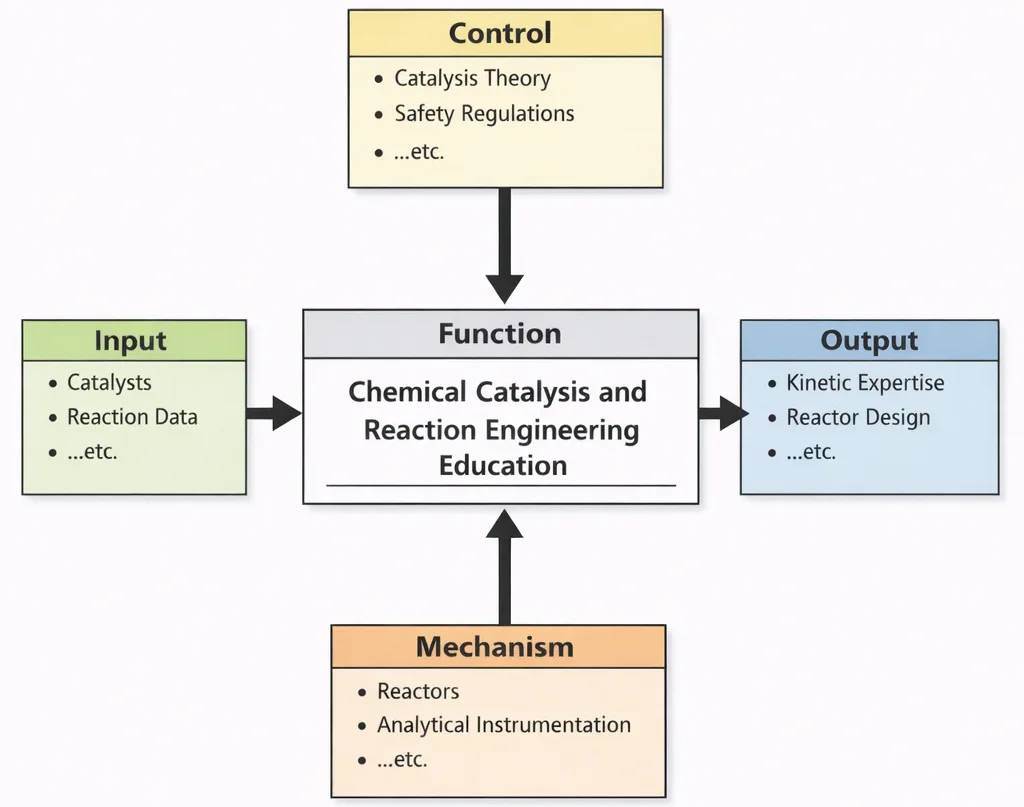
Chemical Catalysis and Reaction Engineering Education, viewed through this diagram, teaches students how to move from “a reaction that happens” to “a reaction we can control.” The Inputs anchor learning in reality: the catalyst itself (its surface, structure, and stability) and the reaction data that reveal what actually occurs under different conditions. The Controls provide the rules of interpretation and the rules of responsibility—catalysis theory explains mechanisms and rate behavior, while safety regulations prevent hazardous shortcuts and enforce disciplined operating boundaries. The Mechanisms are where knowledge becomes skill: students work with reactors and analytical tools to generate trustworthy data, fit kinetic models, identify bottlenecks such as mass transfer or deactivation, and test improvements. The Outputs are engineers who can predict and shape reaction behavior, and who can design reactors and operating strategies that deliver desired conversion and selectivity reliably—from the lab bench to industrial scale.
Chemical Catalysis and Reaction Engineering form the heart of modern chemical process industries, where transformation of raw materials into valuable products occurs with optimal efficiency and control. Students entering this field must build a firm foundation in Chemical Engineering, as it offers the basic principles of mass, heat, and momentum transfer essential to reactor design. Closely related areas such as Biochemical Engineering explore catalytic reactions driven by enzymes and microorganisms, blending biology with classical reaction engineering.
The ability to manage energy efficiently is essential in catalytic systems, linking this field with Chemical Energy Systems Engineering. The nature and durability of catalysts also demand expertise in Chemical Materials Engineering, where high-temperature behavior, surface area, and stability of materials are critical. To implement industrial-scale transformations, students need to master Chemical Process Engineering, which integrates reactors into plant-wide systems.
Modern chemical engineers increasingly rely on simulations and digital optimization, making Computational Chemical Engineering an indispensable tool for analyzing kinetics, modeling heat release, and minimizing by-products. Real-world applications extend to sectors like Food and Beverage Engineering, where enzymes or heterogeneous catalysts accelerate safe and consistent food processing. Research on surface reactions at the nano-level is advancing rapidly under Nanotechnology in Chemical Engineering.
Innovations in reactor lining, catalyst carriers, and polymers require knowledge of Polymer and Plastics Engineering. Large-scale chemical production facilities must work in harmony with structural elements planned by Civil Engineering experts, while execution logistics are typically coordinated through Construction Management. The safety of high-temperature or high-pressure catalytic operations also intersects with the knowledge found in Earthquake and Disaster Engineering.
Infrastructure planning for reactors must consider soil behavior, requiring collaboration with Geotechnical Engineering. Industrial reactor buildings are designed with principles from Structural Engineering to withstand mechanical loads and thermal expansion. Distribution and delivery of raw materials or products call on expertise in Transportation Engineering and broader layout designs informed by Urban and Regional Planning.
Water is a critical medium in many catalytic processes, whether as solvent or coolant, making Water Resources Engineering relevant for sustainability and environmental compliance. Electrical infrastructure for sensors, heaters, and mixers ties in closely with Electrical and Electronic Engineering. Emerging monitoring technologies from Biomedical Electronics can also be adapted for chemical safety systems.
Industrial communication protocols used in plant-wide process control stem from Communication Engineering. Control algorithms ensure that reactors operate under optimal temperature and concentration conditions, supported by Control Systems Engineering. Engineers deploy microcontrollers, actuators, and safety switches designed in Electronics Engineering and Embedded Systems and Microelectronics. Finally, the precision required in tracking reaction progress and maintaining compliance with regulatory bodies is made possible through Instrumentation and Measurement, cementing its importance in this discipline.
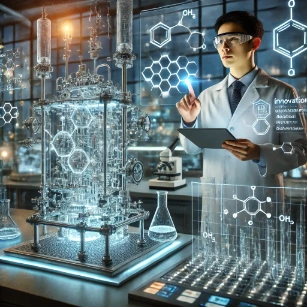
This image visualises the heart of catalysis and reaction engineering: guiding chemical change with precision. At the centre is a reactor-like apparatus rendered with a luminous, schematic glow, suggesting the controlled environment where reactions occur—temperature, pressure, mixing, and flow carefully managed. The scientist’s tablet and the floating molecular diagrams (rings, bonds, and symbolic formulas) represent the way reaction engineers connect theory to practice: using kinetics, mechanisms, and real-time measurements to understand how molecules transform and how catalysts speed up desired pathways while suppressing unwanted side reactions. The data-style overlays hint at key concerns such as conversion, selectivity, yield, heat release, mass transfer, and reactor safety. Overall, the scene communicates how catalysts and well-designed reactors make industrial chemistry cleaner, faster, and more economical—supporting the production of fuels, polymers, pharmaceuticals, and sustainable chemicals.
Controlling Chemical Transformations at the Core of Engineering
Chemical Catalysis & Reaction Engineering
Centres on directing how reactions proceed, using catalysts and conditions to shape conversion, selectivity, and efficiency across industrial pathways within the curriculum roadmap.
Computational Chemical Engineering
Predicts reaction behaviour and kinetic trends through mathematical modelling and CFD simulations before physical pilot systems are constructed.
Chemical Materials Engineering
Engineers solid catalytic surfaces, porous matrices, and support structures that directly influence active site dispersion, thermal stability, and operational lifespan.
Nanotechnology in Chemical Engineering
Refines targeted reaction environments by manipulating atomic and nanoscale interactions where surface area effects and quantum phenomena dominate activity.
Chemical Process Engineering
Embeds isolated chemical reactions into full continuous unit operation networks that maintain continuous throughput, heat integration, plant safety, and commercial reproducibility.
Chemical Energy Systems Engineering
Utilises specific reaction pathways to convert, store, and release energy efficiently across power generation, fuel cells, and large-scale industrial utilities.
Polymer & Plastics Engineering
Controls chain-growth, step-growth, and stereospecific catalytic mechanisms to engineer precise molecular weight distributions and physical polymer properties.
Biochemical Engineering
Adapts chemical reaction engineering principles to biological catalysts, optimizing biocatalytic transformations where enzymes and living cells dictate conversion.
Food & Beverage Engineering
Applies tightly controlled reaction environments and enzymatic processing to achieve targeted flavour profiles, desirable textures, and safe long-term preservation.
Chemical Engineering – Overview
Establishes the foundational umbrella discipline linking thermodynamics, transport phenomena, and reaction engineering to transform raw substances into high-value products.
Core Concepts in Chemical Catalysis and Reaction Engineering
Catalysis
- Definition: The process of increasing the rate of a chemical reaction by introducing a catalyst. Catalysts work by lowering the activation energy required for a reaction, allowing it to proceed more quickly and efficiently.
- Types of Catalysis:
- Homogeneous Catalysis: Catalysts and reactants are in the same phase (typically liquid).
- Heterogeneous Catalysis: Catalysts and reactants are in different phases (usually solid catalyst with gaseous or liquid reactants).
- Enzymatic (Biocatalysis): Biological catalysts (enzymes) are used for reactions under mild conditions.
- Catalyst Properties:
- Activity: Ability to accelerate reaction rates.
- Selectivity: Ability to direct the reaction toward a desired product.
- Stability: Resistance to deactivation over time.
Reaction Engineering
- Definition: The study and design of chemical reactors where chemical reactions occur. It involves analyzing reaction kinetics, thermodynamics, and transport processes to optimize production efficiency.
- Key Aspects:
- Reaction Kinetics: Study of reaction rates and mechanisms.
- Thermodynamics: Understanding energy changes and equilibrium.
- Mass and Heat Transfer: Ensuring efficient distribution of heat and reactants.
- Types of Reactors:
- Batch Reactors: Used for small-scale, high-value reactions.
- Continuous Stirred-Tank Reactors (CSTR): Well-mixed continuous processes.
- Plug Flow Reactors (PFR): High-efficiency continuous reactors for large-scale production.
- Packed Bed Reactors: Common in catalytic processes with solid catalysts.
Reaction Kinetics and Mechanisms
- Reaction Rate Laws: Mathematical expressions relating the rate of a reaction to the concentration of reactants.
- Catalytic Mechanisms:
- Adsorption: Reactants bind to the catalyst surface.
- Reaction: Transformation of adsorbed species into products.
- Desorption: Products detach from the catalyst surface.
Catalyst Design and Optimization
- Active Sites: Specific regions on the catalyst where reactions occur.
- Support Materials: Porous materials (e.g., alumina, silica) that disperse the active phase.
- Promoters and Inhibitors: Additives that enhance or suppress catalytic activity.
Process Integration and Scale-Up
- Lab-to-Plant Transition: Scaling up catalytic reactions from laboratory studies to industrial production.
- Process Intensification: Improving efficiency through novel reactor designs and heat integration.
Key Applications of Chemical Catalysis and Reaction Engineering
Petrochemical and Refining Industry
- Catalytic Cracking: Breaking down large hydrocarbon molecules into lighter fuels (e.g., gasoline, diesel) using zeolite catalysts.
- Hydrotreating: Removing sulfur and nitrogen compounds from fuels to meet environmental regulations.
- Catalytic Reforming: Converting low-octane hydrocarbons into high-octane gasoline components.
Chemical and Polymer Production
- Ammonia Synthesis (Haber-Bosch Process): Iron-based catalysts facilitate the production of ammonia for fertilizers.
- Ethylene Oxide Production: Silver catalysts oxidize ethylene to create a precursor for plastics and antifreeze.
- Polymerization Catalysts: Ziegler-Natta and metallocene catalysts for producing polyethylene and polypropylene.
Environmental and Emission Control
- Automotive Catalytic Converters: Platinum, palladium, and rhodium catalysts convert toxic gases (CO, \(\text{NO}_x\), hydrocarbons) into harmless emissions (\(\text{CO}_2\), \(\text{N}_2\), \(\text{H}_2\text{O}\)).
- Selective Catalytic Reduction (SCR): Converts nitrogen oxides (\(\text{NO}_x\)) into nitrogen and water using ammonia and catalysts.
- Carbon Capture and Utilization (CCU): Catalytic processes for converting captured \(\text{CO}_2\) into fuels and chemicals.
Renewable Energy and Sustainable Processes
- Hydrogen Production:
- Steam Methane Reforming (SMR): Uses nickel-based catalysts to produce hydrogen.
- Water Splitting: Photocatalysts and electrocatalysts split water into hydrogen and oxygen.
- Fuel Cells: Platinum-based catalysts drive electrochemical reactions to generate electricity.
- Biomass Conversion: Catalytic pyrolysis and hydroprocessing turn biomass into biofuels.
Fine Chemicals and Pharmaceuticals
- Asymmetric Catalysis: Producing chiral drugs with high purity using specialized catalysts.
- Green Chemistry: Catalytic reactions that minimize waste and energy consumption.
Interactive Tool: First-Order Catalytic PFR Concentration Profile Simulator
Adjust the rate constant (\(k\)), space time (\(\tau\)), and initial concentration (\(C_{A0}\)) to simulate the continuous concentration decay of Reactant A along the length of a Plug Flow Reactor (PFR).
Canonical Portal URL: https://prep4uni.online/stem/physical-technologies/chemical-engineering/chemical-catalysis-and-reaction-engineering/
Emerging Technologies in Chemical Catalysis and Reaction Engineering
Nanocatalysis
Definition: Nanocatalysis involves the use of nanoscale catalysts that possess high surface area-to-volume ratios, enhancing reaction rates and selectivity. These materials enable greater efficiency in chemical transformations due to quantum and surface effects unique to the nanoscale.
- Materials Used: Metal nanoparticles (e.g., Pt, Au, Pd), metal oxides, and carbon-based nanomaterials such as graphene.
- Applications:
- Hydrogen production via water splitting and reforming reactions.
- Emission control in automotive catalytic converters.
- Selective oxidation in the fine chemicals industry.
- Learn more about nanocatalysis
Photocatalysis
Definition: Photocatalysis leverages light to activate catalysts, enabling chemical reactions to occur with minimal external energy input. It is a sustainable approach for driving redox reactions using solar or artificial light sources.
- Mechanism: Absorbed light energy excites electrons, generating electron-hole pairs that initiate redox reactions with adsorbed molecules.
- Applications:
- Degradation of pollutants in water and air purification systems.
- Photocatalytic splitting of water for clean hydrogen production.
- \(\text{CO}_2\) conversion into value-added products using sunlight.
Electrocatalysis
Definition: Electrocatalysis involves the facilitation of electrochemical reactions at electrode surfaces, crucial for energy technologies like fuel cells, batteries, and electrolyzers.
- Key Reactions: Oxygen reduction reaction (ORR), hydrogen evolution reaction (HER), oxygen evolution reaction (OER), and \(\text{CO}_2\) electroreduction.
- Applications:
- Electrolytic water splitting for hydrogen generation.
- Carbon capture and conversion to alcohols or hydrocarbons.
- Rechargeable lithium-air and zinc-air batteries.
Single-Atom Catalysts (SACs)
Definition: SACs consist of isolated metal atoms dispersed on supports like graphene or metal oxides. They exhibit maximum atom efficiency, high catalytic activity, and unique selectivity.
- Advantages: Ultra-high dispersion of metal atoms, minimal waste, and tailored active sites for specific reactions.
- Applications:
- Low-temperature CO oxidation and \(\text{NO}_x\) reduction in emission control.
- Hydrogenation reactions in pharmaceutical synthesis.
- Electrochemical \(\text{CO}_2\) reduction and \(\text{N}_2\) fixation.
Artificial Intelligence (AI) in Catalyst Design
Overview: AI and machine learning (ML) algorithms are being used to model catalytic systems, screen materials, and predict reaction pathways. These tools accelerate discovery cycles and reduce experimental costs.
- Methods: Deep learning for pattern recognition in reaction kinetics, generative models for designing novel catalysts, and reinforcement learning for optimizing experimental protocols.
- Applications:
- Predicting catalyst activity, stability, and selectivity with ML models.
- Automating laboratory synthesis and testing via robotic systems guided by AI.
- Designing reaction networks for biomass conversion and sustainable chemistry.
- AI for catalyst discovery in chemical catalysis
Challenges in Chemical Catalysis and Reaction Engineering
Catalyst Deactivation
Gradual loss of performance via sintering, poisoning, fouling, and coking requires frequent catalyst replacement or thermal regeneration.
Selectivity Control
Maximizing desired product yield while suppressing undesired by-products requires precision active-site engineering and promoter tuning.
Scale-Up & Integration
Overcoming nonlinear heat/mass transfer limitations and thermal hot-spots when transitioning from bench scale to commercial plant scale.
Precious Metal Costs
High material expenses associated with platinum, rhodium, and palladium drive the development of non-precious and single-atom catalysts.
Future Directions in Chemical Catalysis and Reaction Engineering
The field of chemical catalysis and reaction engineering is undergoing a foundational paradigm shift driven by the imperative for industrial decarbonization, closed-loop circularity, and digital transformation. Modern reaction engineering extends far beyond empirical catalyst synthesis and steady-state design; it now integrates atomic-level surface science, multi-scale transport phenomena, non-thermal external energy driving forces, and real-time artificial intelligence to control molecular transformations with unprecedented selectivity and energy efficiency.
1. Sustainable Catalysis & Earth-Abundant Materials Engineering
Mechanistic Overview & Material Transition: Traditional industrial processes heavily rely on scarce, high-cost Platinum Group Metals (PGMs: \(\text{Pt}\), \(\text{Pd}\), \(\text{Rh}\), \(\text{Ru}\)) operating in energy-intensive thermal environments. Future sustainable catalysis pivots toward earth-abundant 3d transition metals (\(\text{Fe}\), \(\text{Co}\), \(\text{Ni}\), \(\text{Cu}\), \(\text{Mn}\)) and engineered carbon-based nanomaterials. By precisely tuning the ligand coordination sphere, active-site orbital hybridizations, and metal-support interactions (SMSI), researchers emulate the high selectivity of biological metalloenzymes within robust heterogeneous solid matrices.
Magnetic Separation & Immobilized Biocatalysts: In fine chemical and pharmaceutical synthesis, catalyst recovery without costly thermal distillation or solvent-heavy extraction is achieved via magnetically responsive nanocatalysts (e.g., core-shell \(\text{Fe}_3\text{O}_4@\text{SiO}_2\) nanoparticles functionalized with active organometallic or enzymatic complexes). Applying an external magnetic field gradient enables complete, rapid solid-liquid phase recovery (\(\gt 99.5\%\) retrieval) across dozens of consecutive reaction cycles without mechanical attrition or pore collapse.
Pyrolyzed lignocellulosic biomass yields high-surface-area porous carbon (biochar) rich in oxygen and nitrogen functional groups. Doping this conductive carbon lattice with dispersed nickel-iron active sites produces an ultra-low-cost, sulfur-tolerant catalyst for the hydrodeoxygenation (HDO) of fast-pyrolysis bio-oils at \(280\,^{\circ}\text{C}\), replacing expensive sulfided \(\text{CoMo}/\text{Al}_2\text{O}_3\) catalysts that suffer rapid deactivation and sulfur leaching.
2. Carbon Neutral Processes & Catalytic \(\text{CO}_2\) Valorization
Thermodynamic Challenges of Activation: Carbon dioxide is an exceptionally stable, fully oxidized carbon species (\(\Delta G_f^{\circ} = -394.4\text{ kJ/mol}\)). Catalytic valorization requires overcoming high kinetic activation barriers and unfavorable thermodynamic equilibrium constraints. Future reaction engineering focuses on coupling exothermic co-reactants (such as green hydrogen or epoxides) and developing tandem bifunctional catalysts to drive selective reduction pathways.
Thermocatalytic Hydrogenation to Fuels and Chemicals: Bifunctional metal/metal-oxide systems (e.g., \(\text{In}_2\text{O}_3/\text{ZrO}_2\) and \(\text{CuO}-\text{ZnO}-\text{ZrO}_2\)) direct \(\text{CO}_2\) hydrogenation toward methanol: $$\text{CO}_2 + 3\text{H}_2 \rightleftharpoons \text{CH}_3\text{OH} + \text{H}_2\text{O}, \quad \Delta H_{298\text{K}}^{\circ} = -49.5\text{ kJ/mol}$$ Simultaneously, spatial isolation of oxygen vacancies on zirconia supports suppresses the competing endothermic Reverse Water-Gas Shift (RWGS) reaction (\(\text{CO}_2 + \text{H}_2 \rightleftharpoons \text{CO} + \text{H}_2\text{O}\)), elevating methanol carbon selectivity beyond \(85\%\) at single-pass conversions exceeding \(20\%\).
Direct conversion of steel mill blast furnace flue gas (\(25\text{–}30\%\text{ CO}_2\)) into long-chain linear \(\alpha\)-olefins via combined RWGS and Fischer-Tropsch synthesis over an alkali-promoted \(\text{Fe}_5\text{C}_2\) (Hägg carbide) and zeolitic tandem bed, bypassing petroleum extraction entirely and directly fixing \(1.8\text{ metric tons of CO}_2\) per ton of manufactured polyolefin precursor.
3. Electrification & Integration with Renewable Energy (Power-to-X)
Electrocatalytic Overpotentials & Water Splitting: The transition from thermochemical combustion heating to green electrons demands reactors operating at room temperature and pressure. In water electrolysis for green hydrogen production, the bottleneck is the 4-electron Oxygen Evolution Reaction (OER) at the anode: $$2\text{H}_2\text{O} \to \text{O}_2 + 4\text{H}^+ + 4e^-, \quad E^{\circ} = 1.23\text{ V vs. RHE}$$ Advanced electrocatalysts replace scarce \(\text{IrO}_2\) with high-entropy spinel oxides (\(\text{Fe}-\text{Co}-\text{Ni}-\text{Mn}-\text{O}\)) engineered with lattice oxygen excitation mechanisms, slashing anodic overpotentials below \(200\text{ mV}\) at current densities exceeding \(1,000\text{ mA/cm}^2\) in Proton Exchange Membrane (PEM) and Anion Exchange Membrane (AEM) water electrolyzers.
Electrochemical \(\text{CO}_2\) Reduction (eCO2R): Gas Diffusion Electrodes (GDE) operating in Zero-Gap Flow Cells utilize surface-modified copper nanocubes to steer the multi-proton-coupled electron transfer pathway toward multicarbon (\(\text{C}_{2+}\)) oxygenates and hydrocarbons (ethylene, ethanol, propanol). Local alkaline microenvironments generated at high current densities suppress the competing Hydrogen Evolution Reaction (HER), driving Faradaic efficiencies for ethylene beyond \(70\%\).
4. Advanced Reactor Architectures: Microreactors, 3D Printing & Modularization
Mass & Heat Transfer Intensification: Conventional multi-ton industrial reactors exhibit severe volumetric heat transfer limitations (specific surface area \(a_v \sim 100\text{–}500\text{ m}^2/\text{m}^3\)), leading to internal temperature runaway in highly exothermic reactions (\(\Delta H_{\text{rxn}} \ll 0\)). Microchannel reactors increase specific surface area to \(10{,}000\text{–}50{,}000\text{ m}^2/\text{m}^3\), achieving overall heat transfer coefficients \(U \gt 10{,}000\text{ W/(m}^2\cdot\text{K)}\). This virtually eliminates axial and radial thermal gradients, keeping reactions strictly isothermal.
Additive Manufacturing (3D Printing) of Catalytic Packings: Selective Laser Melting (SLM) and Direct Ink Writing (DIW) enable the fabrication of complex Periodic Open Cellular Structures (POCS), gyroid lattices, and triply periodic minimal surface (TPMS) reactor internals. These computer-designed monoliths optimize radial fluid mixing, maximize gas-solid contact time, and drastically reduce the Ergun equation pressure drop (\(\Delta P/L\)) across the catalyst bed by up to \(70\%\) compared to random packed beds of spherical pellets.
Replacing massive Haber-Bosch central facilities with containerized modular microchannel reactors placed directly at remote wind/solar farms. Operating with high-activity ruthenium-promoted electride catalysts at lower pressures (\(20\text{–}30\text{ bar}\) vs. \(150\text{–}250\text{ bar}\)), these modular plants eliminate pipeline transportation logistics by producing green ammonia fertilizer on-site on demand.
5. Circular Economy Catalysis: Chemical Upcycling & Depolymerization
Selective C–C and C–O Bond Cleavage: Mechanical recycling degrades polymer molecular weight and physical properties. Circular catalytic engineering achieves closed-loop chemical recycling by selectively cleaving heteroatom bonds (in polyesters, polyamides, and polyurethanes) or direct carbon-carbon backbones (in polyolefins like polyethylene and polypropylene) under moderate conditions.
Hydrocracking and Solvolytic Deconstruction: Tandem dual-functional catalytic systems utilize metal nanoparticles (e.g., \(\text{Ru}\) or \(\text{Pt}\)) supported on solid acidic zeolites (\(\text{USY}\), \(\text{ZSM-5}\)) for the low-temperature hydrogenolytic deconstruction of polyolefins into liquid fuel fractions and virgin-grade chemical feedstocks (naphtha range). Solvolytic organocatalysis selectively breaks down poly(ethylene terephthalate) (PET) with bio-based diols into pure bis(2-hydroxyethyl) terephthalate (BHET) monomers at \(\gt 98\%\) yield within minutes, with infinite recyclability.
Systems Engineering Trade-Off Matrix: Advanced Reactor & Catalytic Paradigms
| Reactor / Catalytic Platform | Primary Engineering Advantage | Dominant Physical Constraint / Bottleneck | System Trade-Off & Industrial Reality |
|---|---|---|---|
| Conventional Fixed Bed (Pellet Packed) | Low capital cost; simple mechanical fabrication; established design codes. | Pore diffusion resistance (\(\eta \ll 1\)); high hydraulic pressure drop; severe radial thermal hot-spots. | Robust and scalable for low-heat reactions, but prone to catastrophic thermal runaway in highly exothermic kinetics. |
| Microchannel Reactor Modules | Ultra-high heat/mass transfer (\(a_v \gt 20{,}000\text{ m}^2/\text{m}^3\)); strictly isothermal control; inherently safe. | Fouling/clogging vulnerability; severe manifold flow distribution maldistribution across thousands of channels. | Eliminates safety hazards for explosive/runaway reactions, but multiplies capital numbering-up costs and demands ultra-pure feeds. |
| Zero-Gap Electrocatalytic Flow Cell | Direct electrification via ambient-temperature electrons; avoids fossil thermal utility combustion. | Ohmic \(IR\) losses across membranes; gas bubble blanketing at high current densities; GDE salt precipitation. | Zero direct carbon footprint during operation, but bounded by electrical efficiency and membrane lifespans under aggressive pH regimes. |
| Single-Atom Catalysts (SACs) | \(100\%\) atomic utilization efficiency; uniform active centers delivering enzyme-like selectivity. | High surface free energy drives irreversible sintering and agglomeration into inactive metal clusters at elevated \(T\). | Unlocks unprecedented atom economy for expensive metals, but requires complex chelating supports and lower operating temperatures. |
Modern Computational Paradigm: Physics-Informed Neural Networks (PINNs) in Catalytic Modeling
Traditional simulation of fixed-bed catalytic reactors requires solving stiff coupled systems of partial differential equations (PDEs) spanning Navier-Stokes flow, intraparticle Fickian pore diffusion, and non-isothermal energy balances. For multi-tubular geometries, 3D CFD meshes can require days of high-performance compute time, hindering real-time model predictive control (MPC).
Physics-Informed Neural Networks (PINNs) and Fourier Neural Operators (FNOs) resolve this computational bottleneck by embedding governing conservation laws directly into the neural network's loss function: $$\mathcal{L}_{\text{total}} = \mathcal{L}_{\text{data}} + \lambda_{\text{mass}}\|\mathcal{R}_{\text{species}}\|^2 + \lambda_{\text{energy}}\|\mathcal{R}_{\text{energy}}\|^2$$ where the differential residual operator \(\mathcal{R}_{\text{species}}\) enforces species continuity across the pellet boundary: $$\mathcal{R}_{\text{species}} = -u_z \frac{\partial C_A}{\partial z} + D_{er} \left(\frac{\partial^2 C_A}{\partial r^2} + \frac{1}{r}\frac{\partial C_A}{\partial r}\right) - \eta(r,z) \cdot k(T) C_A^n = 0$$
Once trained offline across generalized parametric operational ranges, the neural operator evaluates full 3D temperature and concentration fields in sub-millisecond runtimes. This enables real-time edge deployment on embedded microcontrollers for predictive hot-spot mitigation, automated catalyst health tracking, and millisecond-scale runaway prevention.
Why Study Chemical Catalysis and Reaction Engineering
Understanding Chemical Reactions
This field examines how reactions occur and how to control them efficiently. Students study kinetics, thermodynamics, and reactor design. This knowledge is vital for developing industrial-scale chemical processes.
Catalyst Design and Mechanism
Students learn how catalysts accelerate reactions and influence selectivity. They explore material properties, surface science, and catalyst deactivation. Designing effective catalysts improves yields and reduces costs.
Reactor Engineering and Scale-Up
The course covers different reactor types and scale-up considerations. Students analyze residence time, mixing, and heat transfer. These skills support safe and efficient chemical production.
Applications in Green Chemistry
Catalysis enables cleaner and more sustainable chemical reactions. Students explore how to reduce waste and use renewable feedstocks. This aligns chemical engineering with environmental goals.
Industrial and Research Opportunities
Reaction engineering is critical in petrochemicals, pharmaceuticals, and materials science. Students can pursue roles in process development, R&D, or plant operations. The field is central to industrial innovation and efficiency.
Chemical Catalysis and Reaction Engineering: Conclusion
Chemical Catalysis and Reaction Engineering serve as foundational pillars of modern chemical innovation and manufacturing. This dynamic field plays a crucial role in optimizing reaction pathways, increasing yields, reducing energy consumption, and promoting the shift toward environmentally conscious industrial processes. With catalysts acting as molecular facilitators, complex chemical transformations that would otherwise require extreme conditions can now occur under milder, more sustainable circumstances.
Driving Efficiency Across Industries
Catalysis enhances the efficiency of countless processes across sectors—from refining and petrochemicals to pharmaceuticals and food processing. Advances in reaction engineering, such as the development of fluidized bed reactors and membrane-assisted systems, allow for precise control over reaction parameters, ensuring maximum output and minimal resource input. These breakthroughs reduce operational costs and contribute to the broader goals of energy conservation.
Key to Clean Energy and Green Chemistry
The global pursuit of decarbonization and clean energy relies heavily on innovations in catalysis. Electrocatalysts and photocatalysts enable the conversion of water and carbon dioxide into valuable fuels using renewable electricity, such as in hydrogen fuel production and artificial photosynthesis. As the world transitions away from fossil fuels, these technologies are becoming increasingly vital. Read more about the role of hydrogen catalysis in clean energy.
Enabling a Circular Economy
Catalysis is essential to the development of circular chemical processes. Techniques like catalytic depolymerization of plastics and waste-to-fuel conversion offer pathways to reduce landfill use and recover valuable resources. Reaction engineering innovations further amplify these effects by enabling continuous processes that reduce emissions and improve process intensification.
Future Outlook: Smarter, Greener Systems
With the integration of artificial intelligence, machine learning, and IoT into catalytic research and reactor systems, the future of chemical manufacturing is becoming smarter and more autonomous. These digital enhancements support real-time monitoring, predictive maintenance, and optimization of reactions at scale. As we face mounting climate and resource challenges, the synergy of traditional catalysis with emerging technologies is expected to redefine industrial chemistry in the 21st century.
Ultimately, the convergence of sustainable catalyst development, advanced reactor design, and intelligent control systems underscores the transformative potential of Chemical Catalysis and Reaction Engineering. By enabling cleaner, faster, and more selective chemical processes, this field not only supports industrial innovation but also contributes decisively to global sustainability and resilience.
Is Chemical Catalysis & Reaction Engineering Right For You?
Explore career pathways, check your fit, and assess your skills — before you commit to a degree.
Online Assessment Portal: https://prep4uni.online/not-sure-which-field-to-study/?field=chemical-catalysis-and-reaction-engineering
Chemical Catalysis and Reaction Engineering – Frequently Asked Questions (FAQ)
1. Why do engineers invest so much effort in developing catalysts?
Catalysts allow reactions to run faster, at lower temperatures and with better selectivity toward useful products. This means plants can save energy, reduce waste and avoid costly separation of unwanted by-products, making processes both more profitable and more sustainable.
2. What is the practical difference between homogeneous and heterogeneous catalysts?
Homogeneous catalysts share the same phase as the reactants, often giving very uniform reaction conditions and high selectivity, but they can be difficult to separate and recycle. Heterogeneous catalysts are usually solids in contact with gases or liquids, which simplifies separation and reuse but requires careful attention to surface area, diffusion and contact time.
3. How do catalyst structure and surface area affect performance?
The number, type and arrangement of active sites on a catalyst surface determine how molecules adsorb and react. High surface area and well-dispersed active sites maximise contact between reactants and catalyst, while tailored pore structures and promoters can steer reactions toward desired products and away from undesired side reactions.
4. What does a reaction engineer actually do in a real plant?
A reaction engineer links lab-scale kinetics and catalyst data to full-scale reactor and process design. They select reactor types, specify operating conditions, design heat removal and mixing strategies, troubleshoot performance issues, and work with other specialists to ensure that the reaction section is safe, efficient and reliable.
5. How do I decide whether to use a CSTR, PFR or packed-bed reactor?
The choice depends on reaction order, heat effects, desired conversion, and whether a catalyst is present. CSTRs are good for strong heat effects and thorough mixing, PFRs for high conversions and plug-flow behaviour, and packed-bed reactors for heterogeneous catalysts where contact time and pressure drop must be balanced.
6. Why is mass transfer such a concern in catalytic systems?
Even if the surface reaction is fast, reactants must reach the catalyst surface and products must diffuse away. If diffusion is slow, it can “choke” the reaction and hide the true kinetics. Designing particles, supports and reactor flows that minimise diffusion limitations is essential to get the most from a catalyst.
7. What causes catalysts to lose activity over time?
Catalysts can deactivate through sintering at high temperatures, poisoning by impurities such as sulfur, coking by heavy carbon deposits or structural changes in the support. Monitoring these mechanisms and planning for regeneration or replacement is a key part of long-term plant operation.
8. How does understanding reaction kinetics help with process optimisation?
Kinetic models show how rate depends on temperature, pressure and composition. This allows engineers to identify operating windows that maximise conversion and selectivity, design reactors of appropriate size, and predict how changes in feed or conditions will affect plant performance before changes are implemented.
9. Where does computational modelling fit into catalysis and reaction engineering?
Modelling tools help test reactor designs, explore temperature and concentration profiles, and evaluate different operating strategies without running expensive or risky experiments. At smaller scales, molecular simulations can guide catalyst formulation by predicting how different surfaces interact with reactants and intermediates.
10. How does this topic connect to sustainability and green chemistry?
Catalysis and reaction engineering support green chemistry by improving atom economy, reducing energy use, and lowering emissions and waste. Well-designed catalytic processes enable cleaner production of fuels, chemicals and materials, and play a central role in technologies such as emissions control, greener solvents and \(\text{CO}_2\) utilisation.
Interactive Concept Quick-Toggle Review
1. Why are catalysts not consumed in a reaction, and how does this make them indispensable?
Catalysts participate in intermediate chemical complexes, lowering activation energy, but are fully regenerated at the end of each catalytic cycle. Because they are not permanently consumed, a tiny molar quantity of catalyst can convert millions of moles of reactants, making industrial processes economically viable and energy efficient.
2. What primary factors influence catalyst efficiency and how are they optimized?
Efficiency relies on active site density, surface dispersion, accessibility, and structural durability. Optimization involves nanostructuring active phases on porous alumina/silica supports, tuning pore diameter to reduce pore diffusion resistance, and adding electronic promoters to enhance selectivity.
3. How do homogeneous and heterogeneous catalysts compare regarding industrial scalability?
Homogeneous catalysts offer uniform single-site activity and superior selectivity but present severe liquid-liquid separation and recycling challenges. Heterogeneous catalysts, being solid phases in contact with fluids, simplify continuous post-reaction separation, making them the preferred choice for over 80% of industrial chemical processes.
4. What scale-up barriers occur when transitioning catalytic processes from lab to plant scale?
Lab units operate with negligible heat/mass transfer resistance. Scaling up increases vessel volume faster than surface cooling area (V/A ratio changes), creating non-uniform velocity distribution, heat transfer bottlenecks, and local thermal hot-spots. Multi-tubular reactor design and digital twin modeling help bridge this gap.
5. Why is reaction kinetics fundamental to preventing thermal runaway in reactors?
Reaction rate constants increase exponentially with temperature according to the Arrhenius equation, whereas cooling removal rates increase only linearly. Kinetic modeling determines the critical operating envelope, enabling engineers to design emergency quench systems and automated heat-removal controls.
6. How does reactor flow profile choice (CSTR vs. PFR) impact conversion efficiency?
CSTR operates at exit concentration throughout its volume, resulting in a lower average reaction rate for positive-order kinetics. A PFR maintains high reactant concentrations near the inlet, yielding higher conversion per unit volume than a single CSTR for identical space times.
7. What role does catalyst surface chemistry play in multi-step adsorption-reaction-desorption cycles?
According to Sabatier's principle, the interaction between catalyst surface and intermediates must be intermediate in strength. If adsorption is too weak, molecules fail to react; if too strong, product desorption is blocked, poisoning the active site.
8. How does catalytic reaction engineering drive circular economy initiatives?
Catalytic pyrolysis and depolymerization selectively break down polymer waste (e.g., PET) into monomer precursors. Catalytic upcycling transforms low-value bio-waste streams into high-value platform chemicals under sustainable operating conditions.
Comprehensive Catalysis & Reaction Engineering Practice Module
Section 1: Foundational Concept Review Questions
- What is chemical catalysis, and why is it so important in modern industry?
Answer: Chemical catalysis is the acceleration of a reaction by a substance—the catalyst—that participates in the reaction pathway but is regenerated at the end of the cycle. By lowering activation energy and steering reaction pathways, catalysts allow processes to run faster, at milder conditions, and with higher selectivity toward desired products. In modern industry this translates into lower energy consumption, fewer by-products, smaller equipment, and more sustainable production. - How do homogeneous and heterogeneous catalysis differ in practice?
Answer: In homogeneous catalysis, the catalyst and reactants share the same phase (typically liquid), enabling intimate molecular mixing and high selectivity, though catalyst separation is complex. In heterogeneous catalysis, the catalyst is in a different phase (typically solid catalyst with fluid reactants), simplifying catalyst separation and recovery in continuous processes, though mass transfer resistance must be managed. - How does catalyst design influence activity and selectivity of a reaction?
Answer: Catalyst design creates specific surface active site densities and structural environments. High surface area supports expose active sites, while tailored pore geometries control molecular diffusion. Modifying electronic properties or adding promoters alters adsorption energies of intermediates, favoring desired pathways and suppressing unwanted side reactions. - What is reaction engineering, and how does it connect with catalysis in real processes?
Answer: Reaction engineering applies kinetics, thermodynamics, and transport phenomena to design and optimize chemical reactors. Combined with catalysis, it bridges molecular-scale active site kinetics with industrial-scale reactor performance to maintain desired conversion, thermal management, and plant safety. - Which key factors must be considered when designing a chemical reactor?
Answer: Key factors include intrinsic reaction kinetics, heat generation/removal duty, mass transfer rates, fluid mixing, residence time distribution, catalyst pressure drop, and operational safety boundaries. - How do fixed-bed and fluidised-bed catalytic reactors differ in operation and typical use?
Answer: Fixed-bed reactors feature stationary catalyst pellets with fluid flowing through them, offering mechanical simplicity for stable gas-phase reactions. Fluidized-bed reactors suspend fine catalyst particles in upward fluid flow, providing superior mixing and heat transfer ideal for highly exothermic or rapidly deactivating catalytic reactions like fluid catalytic cracking (FCC). - Why is mass transfer a critical consideration in catalytic reaction engineering?
Answer: Reactants must diffuse from bulk fluid through external boundary layers and internal catalyst pores to active sites before reacting. If mass transfer is slower than reaction kinetics, it becomes rate-limiting, suppressing observed catalyst efficiency and altering selectivity. - How does knowledge of reaction kinetics support optimisation of industrial chemical processes?
Answer: Kinetic models quantify how reaction rates respond to changes in temperature, pressure, and concentration. Engineers use these expressions to optimize temperature profiles, select space velocities, size reactors, and prevent runaway conditions. - What are common mechanisms of catalyst deactivation, and how can they be managed?
Answer: Deactivation occurs via sintering (thermal crystal growth), poisoning (chemical binding of feed impurities), coking (carbon deposit buildup), or fouling. Management includes feed purification, thermal limit controls, and periodic regeneration (e.g., controlled coke burning). - How is computational modelling used in the development of catalytic processes and reactor design?
Answer: Computational modeling combines kinetic rate equations with Computational Fluid Dynamics (CFD) and energy balances to simulate flow patterns, heat transfer, and hot-spot formation, allowing fast optimization before hardware construction.
Section 3: Numerical Practice Problems with Detailed Solutions
A liquid reactant A undergoes a first-order catalytic reaction in a Plug Flow Reactor (PFR) with a rate constant \(k = 0.40\text{ min}^{-1}\). If the entering volumetric flow rate is \(v_0 = 2.5\text{ L/min}\) and the reactor volume is \(V = 12.5\text{ L}\), calculate the space time (\(\tau\)) and the exit fractional conversion (\(X_A\)).
Step-by-Step Solution:
- Calculate Space Time (\(\tau\)):
\(\tau = \frac{V}{v_0} = \frac{12.5\text{ L}}{2.5\text{ L/min}} = \mathbf{5.0\text{ min}}\) - Apply first-order PFR design equation:
\(C_{A,\text{exit}} = C_{A0} \cdot \exp(-k \cdot \tau)\) - Determine exit fraction (\(C_{A,\text{exit}} / C_{A0}\)):
\(\frac{C_{A,\text{exit}}}{C_{A0}} = \exp(-0.40\text{ min}^{-1} \cdot 5.0\text{ min}) = \exp(-2.0) \approx 0.1353\) - Calculate Fractional Conversion (\(X_A\)):
\(X_A = 1 - \left(\frac{C_{A,\text{exit}}}{C_{A0}}\right) = 1 - 0.1353 = \mathbf{0.8647\text{ (or }86.47\%}\)).
A catalytic reaction has an activation energy \(E_a = 50.0\text{ kJ/mol}\) and a pre-exponential factor \(A = 1.0 \times 10^8\text{ s}^{-1}\). Using the universal gas constant \(R = 8.314\text{ J/(mol}\cdot\text{K)}\), calculate the rate constant \(k\) at a reactor temperature of \(500\text{ K}\) (\(227\,^\circ\text{C}\)).
Step-by-Step Solution:
- Convert activation energy to \(\text{J/mol}\):
\(E_a = 50,000\text{ J/mol}\) - Evaluate the dimensionless exponential group (\(-E_a / (R \cdot T)\)):
\(\frac{-E_a}{R \cdot T} = \frac{-50,000}{8.314 \cdot 500} = \frac{-50,000}{4157} = -12.0279\) - Calculate \(\exp(-12.0279)\):
\(\exp(-12.0279) \approx 5.975 \times 10^{-6}\) - Compute rate constant \(k\):
\(k = A \cdot \exp\left(\frac{-E_a}{R \cdot T}\right) = (1.0 \times 10^8\text{ s}^{-1}) \cdot (5.975 \times 10^{-6}) = \mathbf{597.5\text{ s}^{-1}}\).
Determine the required reactor volume (\(V\)) for a CSTR to achieve \(80\%\) conversion (\(X_A = 0.80\)) of Reactant A. The feed concentration is \(C_{A0} = 2.0\text{ mol/L}\), volumetric flow rate is \(v_0 = 10.0\text{ L/min}\), and the first-order rate constant is \(k = 0.20\text{ min}^{-1}\).
Step-by-Step Solution:
- Determine exit reactant concentration (\(C_A\)):
\(C_A = C_{A0} \cdot (1 - X_A) = 2.0 \cdot (1 - 0.80) = 0.40\text{ mol/L}\) - Calculate reaction rate at exit condition (\(-r_A\)):
\(-r_A = k \cdot C_A = 0.20\text{ min}^{-1} \cdot 0.40\text{ mol/L} = 0.08\text{ mol/(L}\cdot\text{min)}\) - Apply CSTR performance equation \(V = \frac{F_{A0} \cdot X_A}{-r_A}\), where \(F_{A0} = v_0 \cdot C_{A0}\):
\(F_{A0} = 10.0\text{ L/min} \cdot 2.0\text{ mol/L} = 20.0\text{ mol/min}\) - Solve for Volume \(V\):
\(V = \frac{20.0\text{ mol/min} \cdot 0.80}{0.08\text{ mol/(L}\cdot\text{min)}} = \frac{16.0}{0.08} = \mathbf{200\text{ Liters}}\).
A porous spherical catalyst pellet exhibits an internal effectiveness factor \(\eta = 0.75\). If the intrinsic surface reaction rate is \(-r_{A,\text{surface}} = 1.60\text{ mol/(kg}_{\text{cat}}\cdot\text{h)}\), calculate the actual global reaction rate achieved within the pellet (\(-r_{A,\text{actual}}\)).
Step-by-Step Solution:
- State definition of effectiveness factor (\(\eta\)):
\(\eta = \frac{\text{Actual Reaction Rate}}{\text{Intrinsic Surface Reaction Rate}}\) - Rearrange formula for actual rate:
\(-r_{A,\text{actual}} = \eta \cdot (-r_{A,\text{surface}})\) - Calculate result:
\(-r_{A,\text{actual}} = 0.75 \cdot 1.60\text{ mol/(kg}_{\text{cat}}\cdot\text{h)} = \mathbf{1.20\text{ mol/(kg}_{\text{cat}}\cdot\text{h)}}\).
A packed bed reactor loaded with \(0.05\text{ moles}\) of active catalytic platinum sites processes a gas feed, generating \(0.25\text{ moles}\) of product per second. Calculate the Turnover Frequency (TOF) in \(\text{s}^{-1}\).
Step-by-Step Solution:
- Apply TOF equation:
\(\text{TOF} = \frac{\text{Moles of Product Formed per Unit Time}}{\text{Moles of Active Sites}}\) - Substitute values:
\(\text{TOF} = \frac{0.25\text{ mol/s}}{0.05\text{ mol}} = \mathbf{5.0\text{ s}^{-1}}\).
Interpretation: Each active catalyst site completes 5 catalytic cycles every second.
Reactant A decomposes via two parallel reactions:
Reaction 1 (Desired): \(A \to R\), rate \(-r_1 = k_1 \cdot C_A^2\) (\(k_1 = 0.5\text{ L/(mol}\cdot\text{min)}\))
Reaction 2 (Undesired): \(A \to S\), rate \(-r_2 = k_2 \cdot C_A\) (\(k_2 = 0.1\text{ min}^{-1}\))
Calculate the instantaneous selectivity ratio of desired product R to undesired product S (\(S_{R/S} = -r_1 / -r_2\)) at \(C_A = 1.0\text{ mol/L}\).
Step-by-Step Solution:
- Express selectivity ratio formula:
\(S_{R/S} = \frac{k_1 \cdot C_A^2}{k_2 \cdot C_A} = \left(\frac{k_1}{k_2}\right) \cdot C_A\) - Substitute kinetic parameters:
\(S_{R/S} = \left(\frac{0.5}{0.1}\right) \cdot 1.0 = 5.0 \cdot 1.0 = \mathbf{5.0}\).
Conclusion: At \(C_A = 1.0\text{ mol/L}\), desired product R is formed 5 times faster than undesired product S.
A catalyst deactivates according to a first-order decay equation: \(a(t) = \exp(-k_d \cdot t)\), where \(k_d = 0.02\text{ day}^{-1}\). Calculate the catalyst activity remaining after \(30\text{ days}\) of continuous plant operation.
Step-by-Step Solution:
- Calculate exponent (\(-k_d \cdot t\)):
\(-k_d \cdot t = -0.02\text{ day}^{-1} \cdot 30\text{ days} = -0.60\) - Compute remaining activity fraction \(a(30)\):
\(a(30) = \exp(-0.60) \approx 0.5488\) - Convert to percentage:
\(\text{Remaining Activity} = \mathbf{54.88\%}\text{ (a }45.12\%\text{ loss in original activity).}\)