Economics is the art and science of choice. It asks how we can best use what little we have—time, money, energy, land—to meet our endless desires and dreams. This discipline doesn’t just sit in textbooks; it plays out in every household budget, every government policy, every shop shelf and market stall. At its core, economics helps us understand how decisions are made when scarcity rules the game.
It influences the big picture and the personal one. When a nation adjusts its interest rates or a parent decides between groceries and school supplies, both are navigating economic terrain. Through Macroeconomics, we zoom out to explore inflation, unemployment, and national income. Through Microeconomics, we zoom in to understand pricing, consumer choices, and how companies compete. Each view adds depth to how we see the world.
The fingerprints of economics are everywhere—especially in careers built around money, planning, and market strategy. In Finance, economics helps us weigh risk and return. In Accounting, it guides how we track and manage value. And in Marketing, it reveals what drives people to buy, compare, and choose. These fields rely on clear economic thinking to make wise, forward-looking decisions.
Today’s economists work with tools that sharpen their vision. Data Analysis and Statistics are no longer optional—they are essential lenses to see tomorrow’s trends today. Yet numbers don’t tell the full story. History breathes life into data, revealing the roots of today’s economic systems. The study of Economic History and Financial History connects our present decisions to the echoes of past crises, innovations, and reforms.
Economics is not only about markets. It’s also about rules—about what’s fair, who’s accountable, and how systems function. That’s where law and governance enter the picture. In Corporate Governance, the focus is on ethics and accountability within businesses. Corporate Law defines legal structures that shape business decisions. And Compliance and Regulatory Adherence ensures organizations play by the rules. These areas reveal the deep, quiet structure behind the bustle of commerce.
But economics also soars beyond borders. In Trade and Globalization, we discover how goods, ideas, and services flow between nations. International Business shows how companies grow, merge, and adapt across cultures and continents. And when disputes arise, Conflict Resolution and Arbitration helps resolve them through negotiation, not war. In each domain, economics acts like a compass for global cooperation.
Technology has become economics’ newest frontier. Algorithms are now analyzing markets faster than any human mind. Artificial Intelligence and Machine Learning, once futuristic ideas, now drive business decisions in real time. Deep Machine Learning allows us to predict customer behavior or supply shortages with astonishing accuracy. Expert Systems turn complex economic rules into automated recommendations. The digital revolution doesn’t just speed up economics—it rewrites it.
With innovation comes responsibility. Economic policy must adapt, anticipate, and stay fair. This is the realm of Policy Analysis, where leaders weigh consequences before acting. Taxation and Fiscal Policy guides how governments raise and spend money wisely. Budgeting and Cost Management helps ensure that projects deliver value and accountability. These areas turn economic theory into public impact.
Economics also speaks to our collective good. It shapes how we fund schools, train teachers, and design learning paths. In Education and Curriculum Design, economic thinking asks: how can we teach more, reach more, and waste less? In Strategic Management, it aligns long-term goals with real-world limits. These practices turn abstract numbers into improved lives.
As we look back and forward, economics remains a bridge between ideals and action. The early philosophers of Economic Thoughts and Theory asked deep questions about justice, labor, and power. Today, we channel that legacy through data and technology. Business Analytics now helps leaders navigate uncertainty with confidence. And still, the heart of economics beats in the same place: a deep desire to understand how we live, what we value, and how we can make better choices—for ourselves and for others.
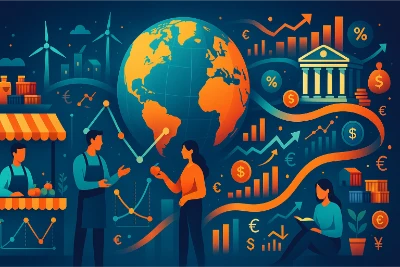
Economics: The Study of Resources, Choices, and Society
Economics is not just about money or markets—it’s about life itself. It is the study of how we make choices when there simply isn’t enough to go around. From the air we breathe to the food on our tables, from job markets to climate action, the principles of economics shape every corner of our daily existence. This social science is rooted in a simple yet powerful idea: resources are limited, but our desires are not. And in that tension lies a story worth understanding.
At its heart, economics asks: How do individuals, businesses, and governments decide what to do with their time, money, energy, and talents? The answers lie in the careful balancing act between needs and wants, scarcity and abundance, efficiency and fairness. By studying economics, we learn to see the invisible threads that bind people and systems together—how the price of coffee is connected to rainfall in Brazil, or how a new factory opening in one town ripples into wages and costs in another.
This discipline brings clarity to chaos. Through the lens of economics, decision-making becomes a map of motivations, constraints, and possible futures. It decodes the logic behind consumer behavior, explains why firms compete or collaborate, and helps us understand how policies like taxes or subsidies affect everyday choices. Supply and demand are not just curves on a graph—they are living forces shaping real-world actions, influencing what we buy, how we work, and what we value.
Zooming in, economics reveals the dynamics of individual decision-making. It explores why one family saves while another borrows, or why a student chooses to pursue one degree over another. These are the micro-level puzzles that speak to our hopes, risks, and trade-offs. Meanwhile, at the macro level, economics captures the big picture—how whole economies grow or shrink, why inflation rises, or how global trade links distant nations into a shared rhythm of exchange.
Economics is also the compass for navigating complex problems. Questions like “How can we reduce poverty?” or “What’s the fairest way to tax citizens?” require careful reasoning grounded in economic thinking. It’s a discipline that equips us not with answers, but with the tools to ask better questions. It empowers us to see multiple perspectives and weigh competing priorities—an essential skill in a world full of limited time, money, and resources.
Its power is most visible in the policy arena. Governments rely on economic insights to craft strategies for stability and growth. Whether it’s managing unemployment, setting interest rates, or responding to inflation, every decision made by a central bank or treasury department rests on economic analysis. In this way, economics becomes a silent partner in shaping society, guiding the hand that governs without always being seen.
In the business world, economics fuels smart strategy and long-term vision. Companies use economic models to forecast demand, optimize pricing, and allocate capital. Investors use economic indicators to assess risk and reward. And entrepreneurs lean on economic intuition to find gaps in the market, reduce waste, and generate value. These decisions—though grounded in numbers—reflect deeper truths about human behavior and motivation.
Even at the personal level, economics plays a quiet but profound role. When we budget for groceries, choose a career, or invest in education, we’re engaging in economic behavior. Understanding this helps us become more thoughtful decision-makers. It reminds us that behind every number is a story—of priorities, trade-offs, and aspirations.
As the world faces urgent challenges—climate change, inequality, pandemics, automation—economics becomes more relevant than ever. It gives us frameworks to assess sustainability, equity, and resilience. It teaches us how to evaluate policy impacts, measure social progress, and balance short-term needs with long-term goals. In this way, economics is not just a subject in school—it’s a mindset for navigating the future.
Ultimately, economics connects us. It shows how individual choices ripple outward, influencing communities, nations, and the planet. It reveals that no decision is made in isolation and that every action—however small—takes place within a web of interdependence. To study economics is to study ourselves: our hopes, our limitations, and the creative ways we seek to thrive despite them.
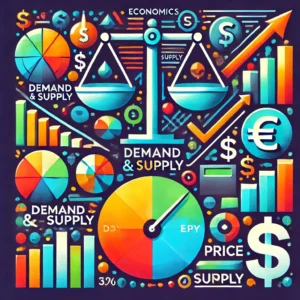
The Living Tapestry of Economics and Its Far-Reaching Currents
Economics, at its heart, is the study of how we choose. In a world where resources are limited but human desires are infinite, it asks a simple yet profound question: how do we allocate what we have to fulfill what we need? This journey begins with the recognition of scarcity and leads to the intricate dance of decisions that individuals, families, businesses, and nations make every day. It’s not just about numbers and graphs—it’s about lives, livelihoods, priorities, and dreams.
To navigate this landscape, economics draws upon four essential pillars: land, which provides the physical space and natural resources; labor, the human effort that transforms raw materials into value; capital, the tools and infrastructure we build; and entrepreneurship, the spark of initiative that drives innovation and change. These forces converge in markets, factories, governments, and households—shaping the way we live and interact.
The discipline is divided into two broad streams. Microeconomics zooms in on the world of individual actors. It studies the decisions made by consumers who weigh satisfaction against price, by businesses that decide how much to produce and what to charge, and by workers who choose how and where to offer their labor. These decisions unfold within markets, where supply meets demand, and prices emerge as silent yet powerful communicators of value and scarcity. Microeconomics also explores market failures, such as monopolies or pollution, and examines the role of government in correcting these imbalances.
Macroeconomics, in contrast, takes a broader view. It steps back to observe the economy as a whole, analyzing trends and patterns that stretch across entire nations or the global stage. Macroeconomists ask big questions: What causes inflation to rise? Why does unemployment persist? How can a country stimulate growth without igniting instability? These questions are not academic alone—they shape real-world policies that affect millions. From interest rate decisions by central banks to stimulus packages during crises, macroeconomics provides the compass for national economic health.
Interactive Market Equilibrium & Elasticity Simulator
Adjust market variables to dynamically observe how shifts in consumer demand, production costs, and tax policies alter market price (P*), quantity (Q*), and consumer price (Pc).
Beyond theory, economics is a toolkit for real-world decision-making. It includes the use of models to simulate outcomes, statistical techniques to measure performance, and policy analysis to assess the likely impact of proposed regulations or reforms. Governments use these tools to design tax systems, manage budgets, and steer the economy toward stable and inclusive growth. Businesses apply them to forecast demand, optimize production, and respond to shifting market conditions.
The reach of economics extends into the fabric of everyday life. When a student chooses between taking a part-time job or studying full-time, she is engaging in economic reasoning. When a city debates investing in public transportation or expanding highways, economics helps weigh long-term benefits against short-term costs. And when nations negotiate trade agreements or climate targets, economic models help predict consequences and guide compromise.
Economics also serves as a bridge between disciplines. It overlaps with Statistics and Data Analysis, enabling researchers to make informed decisions based on evidence rather than intuition. It intersects with Corporate Law and Regulatory Compliance, ensuring fair practices and ethical conduct in the business world. It even informs Education and Curriculum Design, guiding resource allocation in schools and universities.
In today’s digitized world, economics must also grapple with new frontiers. Fields like Artificial Intelligence and Machine Learning are altering labor markets and business models. Decisions that once relied on human instinct are now supported—or replaced—by algorithms. Meanwhile, the emergence of the gig economy, cryptocurrency, and digital platforms calls for updated economic models that capture the fluidity of modern work and value exchange.
Furthermore, global challenges such as climate change, pandemics, and inequality demand economic thinking with a conscience. Economics must balance growth with sustainability, efficiency with equity, and innovation with resilience. It invites us not only to ask “What works?” but also “What matters?” and “For whom?”
Ultimately, to study economics is to learn how to listen to the silent language of choices—how to recognize the patterns that underlie prosperity and hardship, how to challenge assumptions, and how to envision a more thoughtful distribution of wealth and opportunity. It equips students with analytical rigor, ethical perspective, and the imaginative flexibility to see beyond immediate gains toward long-term well-being.
In essence, economics is not just a science of efficiency—it is a philosophy of possibility. It reminds us that every dollar spent, every law passed, every career chosen is part of a grand and complex mosaic of human intent. And by studying that mosaic, we gain not only knowledge but the power to shape a better world.
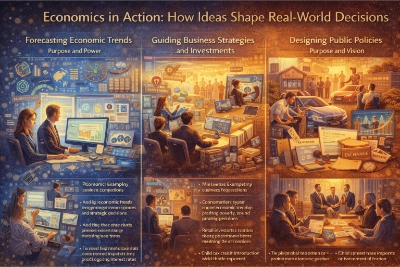
Economics in Action: How Ideas Shape Real-World Decisions
1. Forecasting Economic Trends
- Purpose and Power: At the heart of forecasting lies the economist’s role as a visionary navigator. By using historical patterns, advanced models, and statistical tools, economists attempt to foresee the shifting tides of the economy. These forecasts help stakeholders prepare for change—whether it’s a spike in inflation, a downturn in consumer confidence, or a global crisis rippling through markets. With clearer foresight, firms and nations gain a strategic edge, turning uncertainty into calculated possibility.
- Practical Applications:
- Anticipating how consumer spending might rise or fall during specific seasons to shape supply chain decisions.
- Analyzing demographic shifts and their potential impact on housing demand or education services.
- Projecting inflation rates to guide salary negotiations and pricing models in both public and private sectors.
- Predicting technological disruptions that might alter industry growth rates or create entirely new economic sectors.
- Illustrative Examples:
- A retail chain increasing winter stock based on projected consumer demand derived from past economic cycles.
- A government agency allocating emergency funds in anticipation of a recession signaled by falling manufacturing indices.
- Financial institutions adjusting mortgage interest rates in line with predicted monetary tightening by central banks.
- City planners timing infrastructure projects based on growth forecasts to prevent bottlenecks in transportation or utilities.
2. Guiding Business Strategies and Investments
- Purpose and Insight: Every business decision, from launching a product to entering a new market, carries risk. Economics equips decision-makers with the tools to minimize that risk by understanding trends, customer behavior, resource costs, and macroeconomic signals. It’s not just about numbers—it’s about reading the story the economy is telling and aligning strategy accordingly. When companies listen well, they innovate wisely and grow sustainably.
- Practical Applications:
- Pinpointing emerging economies with rising middle-class demand as fertile ground for expansion.
- Using exchange rate forecasts to time international acquisitions or exports.
- Aligning production scale with predicted changes in commodity prices or labor availability.
- Crafting resilient supply chains by mapping economic risks in partner countries.
- Illustrative Examples:
- A solar panel manufacturer increasing output after identifying policy trends favoring green technology investment.
- A digital startup choosing to delay an IPO during a predicted market downturn.
- A logistics company shifting operations closer to consumers based on economic migration data and fuel cost projections.
- Retail investors rebalancing portfolios based on macroeconomic signals like interest rate hikes or GDP contractions.
3. Designing Public Policies
- Purpose and Vision: Public policy without economic grounding is like a ship without a compass. Whether targeting poverty, climate change, or joblessness, effective policies require deep understanding of economic cause and effect. Economics turns abstract ideals into measurable action plans. It ensures that well-meaning interventions do not backfire and that scarce public funds are deployed for maximum benefit. When governments get it right, they don’t just fix problems—they create conditions for long-term societal flourishing.
- Practical Applications:
- Evaluating the likely outcomes of raising minimum wage in different industries and regions.
- Designing healthcare subsidies that balance affordability with fiscal sustainability.
- Modeling the environmental and economic impacts of carbon taxes to steer industries toward greener practices.
- Analyzing the ripple effects of free trade agreements on local manufacturing and employment rates.
- Illustrative Examples:
- Introducing child tax credits to reduce poverty while stimulating family-centered spending.
- Restructuring social security systems in aging societies to ensure generational equity.
- Using dynamic scoring to estimate how a change in tax policy might impact national revenue and investment behavior.
- Creating stimulus programs during pandemics or recessions that both preserve jobs and lay groundwork for recovery.
Real-World Journeys Shaped by Economic Thinking
1. Demand and Supply Analysis
- Scenario: A manufacturing company prepares to launch a sleek, eco-friendly appliance. Before setting the price, the firm turns to demand and supply analysis. Through detailed research, they explore consumer preferences, competitor pricing, and anticipated material costs. They graph supply and demand curves, study market elasticity, and model different price points to understand how consumers might respond.
- Outcome: Instead of relying on instinct or tradition, the firm chooses a price grounded in data and logic. The result is remarkable—sales take off, margins are healthy, and inventory turnover aligns with projections. Because the price reflects real-world behavior, the company avoids overproduction or waste. Competitors scramble to adjust, but the firm’s foresight gives it a lasting edge. Not only does it earn more—it builds a reputation for responsiveness and savvy strategy.
- Additional Reflections: This case reminds us that behind every successful product is not just a great design but a story of intelligent pricing. When businesses listen closely to what the market whispers—through data, trends, and signals—they can translate uncertainty into success. The invisible hand of the market becomes a guide, not a mystery.
2. Trade Policy Evaluation
- Scenario: A regional government is weighing whether to join a new trade pact. Economists are tasked with evaluating how reduced tariffs, harmonized regulations, and broader market access will influence domestic industries. They analyze sector-by-sector gains and losses, project the long-term impact on GDP, and assess how the agreement might reshape the labor market and supply chains.
- Outcome: The analysis uncovers surprising insights: while a few industries may face short-term competition, the broader economy stands to benefit from export growth, lower consumer prices, and more diverse supply networks. Based on this evidence, the trade agreement is signed. Within a few years, export volumes rise dramatically. Small manufacturers access new customers abroad. Job creation spreads through port cities and logistics hubs. Even foreign relations improve as economic ties deepen mutual understanding.
- Additional Reflections: Trade, often debated with emotion, is here illuminated by economics. It shows us that cooperation, when built on analysis and foresight, can yield dividends beyond profit—strengthening diplomacy, spurring innovation, and connecting lives across borders. Economic analysis becomes a bridge between policy and peace.
3. Economic Impact of Fiscal Policies
- Scenario: A nation stumbles into recession. Businesses close, unemployment climbs, and consumer confidence plummets. The government must act quickly—but wisely. Drawing on economic theory, it implements a mix of fiscal tools: tax relief for families, direct support for struggling businesses, and infrastructure investment to create jobs. The aim? To awaken demand, reignite production, and prevent long-term decline.
- Outcome: Within months, early indicators brighten. Retail sales rebound. Construction cranes return to skylines. Families with more disposable income begin to spend, and businesses cautiously hire again. Though challenges remain, the fiscal stimulus cushions the blow and sets a path toward recovery. Economic metrics improve, but more importantly, hope returns to daily life—through paychecks, new projects, and bustling main streets.
- Additional Reflections: This example shows how policy grounded in economic wisdom can do more than crunch numbers—it can ease suffering and rebuild confidence. When guided by evidence and empathy, governments can transform tools like taxation and spending into instruments of healing. Economics becomes not just a science of wealth, but a language of renewal.
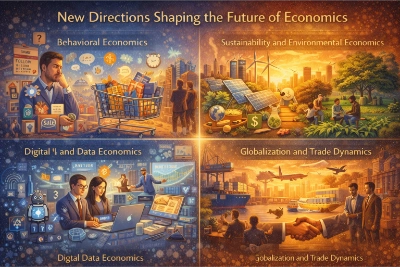
New Directions Shaping the Future of Economics
Behavioral Economics
- In the past, many economic theories assumed that humans always make rational choices—like perfect calculators of risk, reward, and cost. But life has shown us otherwise. People procrastinate, follow crowds, chase losses, and ignore logic. Behavioral economics steps in to bridge that gap between theory and reality. It explores how emotions, habits, and cognitive biases influence economic decisions.
- From why we overspend during sales to why people save less than they should, behavioral economics helps explain these everyday puzzles. Governments use these insights to design better policies—like “nudging” people to save for retirement by making it the default option. Businesses use it to build customer loyalty or reduce cart abandonment. It’s not just economics with a human touch—it’s economics that listens to our inner dialogue.
- This field invites economists to be part psychologist, part storyteller, and part detective—seeking out the unseen forces that shape our financial lives. As we continue to understand ourselves more deeply, so too does economics evolve from a cold science of numbers into a warm mirror of human nature.
Sustainability and Environmental Economics
- Economics is no longer just about profit margins and GDP growth. Today, it must ask: at what cost to the Earth? Environmental economics blends economic logic with ecological wisdom. It studies how policies, incentives, and markets can help preserve our planet while supporting development. It weighs the value of clean air, protected forests, and reduced carbon emissions—not just as ideals, but as essential resources.
- Carbon pricing, green subsidies, and pollution taxes are tools born of this branch. They signal to industries and consumers that environmental care carries economic weight. When done thoughtfully, these policies steer economies toward sustainability without sacrificing innovation or livelihoods. The goal is not to slow progress but to reshape its path—so future generations can inherit both wealth and wonder.
- In this age of climate urgency, sustainability economics offers hope. It calls on leaders, citizens, and businesses to act with foresight. To imagine cities powered by renewables, economies built on circular systems, and prosperity that does not deplete but replenishes. It’s a discipline where numbers grow green roots.
Digital and Data Economics
- The digital age has rewritten the rules of value, trade, and labor. Data, once ignored, is now called the “new oil.” Algorithms decide prices. Cryptocurrencies challenge traditional money. Artificial Intelligence forecasts markets in milliseconds. In this whirlwind, digital economics examines how technology reshapes economic activity at every level.
- Economists now study how data is monetized, how online platforms create “winner-takes-all” markets, and how privacy becomes a bargaining chip. The rise of gig work, online banking, and e-commerce also bring new patterns—fluid, fast-paced, and borderless. Inflation might behave differently in digital marketplaces. Labor may need new protections. Central banks now explore digital currencies to stay relevant.
- Digital economics doesn’t just observe these changes—it equips us to navigate them. It teaches tomorrow’s leaders to think critically about ethics in AI, fairness in algorithmic pricing, and the meaning of currency in a world without cash. Here, economics becomes a compass for the future.
Globalization and Trade Dynamics
- The modern world hums with global movement—of goods, services, people, and ideas. A mobile part made in Malaysia powers a car assembled in Germany and sold in Brazil. A sudden policy shift in one country sends ripples across oceans. Understanding this complex web is the heart of globalization economics.
- Economists study how open borders impact job markets, how trade agreements shift regional power, and how supply chains balance cost with resilience. They weigh the benefits of comparative advantage against the vulnerabilities of dependence. They also explore how technology and transport continue to shrink time and distance between nations.
- But this field also brings new tensions. How do we protect local workers while embracing global opportunities? How do we manage trade-offs between efficiency and security? Economists must now think like diplomats, engineers, and historians all at once.
- In this arena, economics becomes a dialogue—between nations, between values, and between generations. The challenge is not just to trade more, but to trade wisely, fairly, and with resilience in mind.
Ongoing Dilemmas in Modern Economic Practice
Forecasting Uncertainty in a Shifting World
- Economists strive to see ahead, to glimpse what the future holds. They build models, study patterns, and track data streams. Yet the world has grown more unpredictable. A pandemic can pause global commerce overnight. A single war can send oil prices soaring across continents. In these moments, even the best forecasts falter.
- The challenge isn’t just about data—it’s about the unknown. Economists must now blend science with intuition, logic with humility. They must learn to include “black swan” events—rare but powerful disruptions—into their models. This means embracing uncertainty, not just minimizing it.
- To plan for tomorrow, businesses and governments still need guidance. But instead of one fixed path, economists must provide flexible scenarios, helping decision-makers adapt as conditions change. Economics becomes not a crystal ball, but a compass in fog.
The Tightrope Between Growth and Sustainability
- For decades, growth was king. More production, more trade, more wealth—these were the signs of success. But today, the Earth’s voice grows louder. Forests disappear. Oceans rise. Inequality deepens. The pursuit of endless growth, without reflection, begins to fray at its edges.
- The new question is: how do we grow wisely? Can we boost GDP without draining rivers? Can we create jobs without exhausting the soil? This is the great balancing act of our time. Economists now work alongside ecologists, engineers, and activists to find harmony between markets and nature.
- Green investments, circular economies, and sustainable finance are emerging as bridges. They connect profit with preservation. In this new vision, success means more than numbers. It means leaving the world richer—not just in goods, but in goodness.
Confronting Inequality in All Its Forms
- In every nation, shadows of inequality stretch across the land. Some neighborhoods flourish; others struggle. Some children have libraries and mentors, while others face hunger and silence. The divide is not only in income, but in opportunity, dignity, and hope.
- Economists measure these gaps and trace their roots—historical, structural, systemic. But numbers are not enough. Solutions require empathy, imagination, and courage. Progressive tax reforms, social safety nets, and inclusive education policies are part of the answer. So are community-led initiatives and policies tailored to local needs.
- Bridging these gaps is not just moral—it’s practical. Economies thrive when everyone has a chance to contribute and flourish. True prosperity cannot exist alongside deep, persistent poverty. The task is immense, but the reward is a more just and vibrant society.
Keeping Pace with Rapid Technological Change
- The digital revolution moves at lightning speed. New technologies—artificial intelligence, robotics, blockchain—redraw the economic map. Old industries fade. New ones rise. Labor markets are jolted. Skills that were prized yesterday may be obsolete tomorrow.
- Automation, AI, and digital transformation bring both promise and peril. They raise productivity and open doors to innovation. But they also displace workers, deepen digital divides, and challenge old regulatory frameworks.
- Economists now face the task of rethinking education, labor protections, and welfare systems. How can we ensure that technological change uplifts rather than marginalizes? How do we build resilience into economies constantly being reshaped?
- The answers lie in foresight and flexibility. Lifelong learning, universal basic services, and agile economic policies may help economies not just survive disruption, but thrive within it. In this fast-moving era, the most important skill is the ability to adapt—and to help others adapt as well.
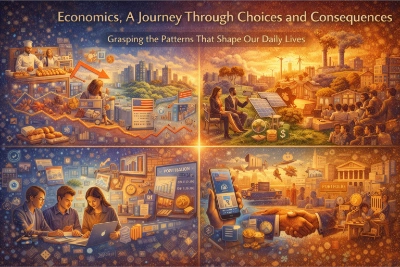
Economics: A Journey Through Choices and Consequences
Grasping the Patterns That Shape Our Daily Lives
Economics gives us a way to understand the hidden rhythms behind the world we see. Why does a loaf of bread cost more today than last year? What leads companies to hire or lay off workers? Why do some countries thrive while others struggle? These questions might seem complex, but economics helps us see the patterns and decisions behind them. It’s like learning to read the invisible threads that connect people, money, time, and priorities.
For students heading to university, this knowledge becomes more than academic. It’s practical. Whether you’re managing a household budget, watching global news, or preparing for a career in business or public service, economics helps you understand how decisions—small and large—shape outcomes. The subject empowers you to make sense of events, not just watch them happen. You’ll develop a deeper appreciation for how scarcity, incentives, and trade-offs influence the choices of individuals and societies alike.
Sharpening Minds with Logic and Numbers
Economics challenges students to think like detectives. You don’t just accept what you see—you ask why. You look for causes, consequences, and patterns. This process sharpens your ability to reason through problems clearly and make decisions based on facts rather than guesses. Through tables, graphs, equations, and data, you learn how to interpret the real world with clarity and precision.
As you dive into economic models and analyze statistics, you gain valuable experience in organizing information, spotting trends, and constructing arguments. These skills are prized in many university programs—from public policy to data science. But more importantly, they help you in life. You’ll be able to weigh pros and cons, challenge assumptions, and back up your ideas with logic. Whether you’re evaluating job offers or debating public policies, economics gives you tools to make smarter, more confident choices.
Engaging with the Challenges That Shape Our World
The study of economics is far from dry theory—it is alive with the urgent questions of our time. How do we tackle poverty without creating dependency? How can nations grow without polluting the planet? How do we reduce unemployment while controlling inflation? These are not abstract puzzles. They affect real people, in real places, every day.
When you study economics, you learn how to analyze policies, understand competing goals, and navigate trade-offs. You explore how governments decide where to invest, how businesses price goods, and how individuals respond to incentives. These explorations help you become a thoughtful, informed citizen—someone who can contribute to discussions about fairness, sustainability, and progress. If you’ve ever wondered how to make the world more just, efficient, or inclusive, economics gives you a place to start.
Seeing the Bridge Between Ideas and Real-World Impact
Economic theory isn’t locked away in textbooks—it shows up in everyday life. Think about how ride-sharing apps adjust prices during peak hours. Or how banks decide interest rates. Or how governments react during recessions. All these are practical expressions of economic ideas in motion.
By studying economics, students see how abstract principles—like opportunity cost or elasticity—play out in real decisions. You’ll learn to analyze case studies, run simulations, and critique policies. You’ll see how trade affects farmers and tech companies alike. And you’ll grasp how fiscal and monetary policies ripple through entire economies. This ability to connect theory with action equips you for university study where application is key. It also prepares you for a world where understanding how things work is essential to shaping what comes next.
Opening Doors to Meaningful and Versatile Careers
Economics isn’t just a subject—it’s a springboard. Whether your path leads to finance, international relations, law, entrepreneurship, or environmental policy, a background in economics provides a strong launchpad. The habits of mind you develop—curiosity, precision, adaptability—serve you well in any field.
Employers value the skills economists bring: clear communication, strategic thinking, and data literacy. Economists are problem-solvers who can think ahead and explain complex ideas in simple ways. Whether you’re advising on budgets, designing development programs, or analyzing market trends, your economics training will help you shine.
Even if your future role isn’t labeled “economist,” the perspective you gain will guide your choices, shape your ethics, and strengthen your leadership. In a world of rapid change and constant decision-making, economics offers not just answers—but a thoughtful way to seek them.
Reflecting on the Power and Promise of Economics
Economics is more than a subject taught in lecture halls. It is a living language that helps us understand how the world moves—why some markets soar while others fall, why prices shift with the seasons, and why people make the choices they do. It’s the study of everyday life viewed through the lens of decisions, trade-offs, and human behavior. Whether you’re buying a coffee, voting in an election, or launching a business, economics is always quietly at play in the background, shaping outcomes.
At its heart, economics gives us tools to solve real problems. It teaches us how to think in terms of costs and benefits, of cause and effect. When faced with scarcity—a challenge common to every individual and every nation—economics helps us choose wisely. It draws from both mathematical logic and social insight, connecting numbers with narratives. This dual strength makes it a bridge between the abstract and the practical, between theory and action.
By exploring both microeconomics and macroeconomics, students learn to see the economy at many levels. On the micro side, they analyze individual decisions—how consumers respond to changes in price, how firms compete, and how supply meets demand. On the macro side, they examine the broader picture—growth, inflation, unemployment, and national budgets. These perspectives together form a more complete understanding of how our world operates, from a single household to a global economy.
In today’s fast-changing world, the value of economics has never been greater. The forces shaping our future—climate change, technological disruption, population shifts, and economic inequality—require both clarity and compassion. Economics offers both. It helps us weigh urgent needs against long-term consequences. It allows us to assess trade-offs with fairness and to craft solutions that balance efficiency with equity.
Imagine the role of economics in solving the climate crisis: it evaluates carbon pricing, incentivizes green innovation, and guides policies that protect both the planet and people’s livelihoods. Or think of how it navigates digital transformation: it helps us manage automation, measure the impact of artificial intelligence, and adapt our labor markets with foresight. In every corner of society—from agriculture to healthcare, from finance to education—economics offers a guiding hand.
As students prepare for higher learning or their future careers, a grounding in economics opens up endless paths. It cultivates curiosity, strengthens reasoning, and builds confidence in decision-making. It doesn’t just teach you what to think—it teaches you how to think. This skill is timeless, valuable not only in boardrooms and government offices but also in everyday life.
Economics also nurtures empathy. By studying how people respond to incentives and constraints, students come to understand the diverse experiences and pressures that shape behavior. Why does someone accept a low-paying job? Why do some communities struggle to access clean water or affordable housing? Economics doesn’t offer easy answers, but it gives us the tools to ask better questions—and to design better systems.
Whether you dream of running a business, designing public policy, advising world leaders, or simply becoming a more informed citizen, economics provides a sturdy foundation. It is the engine beneath so many disciplines, quietly powering innovation, stability, and progress. As the global landscape continues to evolve, economics adapts—offering new insights, new models, and new ways to shape a better future.
In the end, economics is not just about money or markets. It is about choices, values, and the kind of world we want to build together. With its blend of analytical rigor and human insight, it remains a compass for navigating complexity—and a beacon for those who hope to make a meaningful difference.
Macroeconomics Subhub
Dive into systemic national policies, GDP metrics, interest rate levers, and inflation dynamics. Explore Macroeconomics →
Microeconomics Subhub
Analyze individual market structures, firm behavior, marginal utility, and elasticity models. Explore Microeconomics →
Policy Analysis Subhub
Learn how cost-benefit analysis and empirical modeling evaluate real-world governance decisions. Explore Policy Analysis →
Is Economics Right For You?
Explore career pathways, check your fit, and assess your skills — before you commit to a degree.
Frequently Asked Questions – Economics
What is economics?
Economics is the social science that studies how individuals, firms, governments, and societies make decisions about the production, distribution and consumption of scarce resources, and how these choices influence markets, wealth, growth, employment, prices and welfare.
Why is studying economics useful before university?
Studying economics gives you analytical and critical thinking skills as well as an understanding of how societies organise production and distribution, how markets and policies work, and how global events affect economies. This background helps you understand business, law, politics, public policy, and global issues — and makes you better prepared for many university programmes.
Which school-level subjects provide good preparation for economics?
Good preparatory subjects include mathematics (especially algebra, basic calculus, statistics), business studies, geography, history, social studies, and humanities. Maths helps with data and models. Social sciences help you understand institutions, history, and context. Literature or languages improve communication and argumentation skills.
How mathematical is economics at university level?
Economics involves a mix of theory, qualitative reasoning and quantitative methods. You will use basic mathematics such as algebra and statistics regularly. More advanced programmes may include calculus, econometrics and data analysis, but you don’t always need very advanced maths to start — many economics courses begin with intuitive explanations and build up gradually.
What are the main branches or topics in economics I should know about?
Key branches include microeconomics (how individuals and firms make decisions), macroeconomics (how economies work at the national or global level), development economics, international economics, labour economics, public economics (government policy and welfare), monetary economics, and behavioural economics. Many programmes also combine economics with law, politics or business for multidisciplinary study.
How does economics connect with business, finance, and law?
Economics provides a theoretical and analytical foundation for business strategies, finance, market analyses, policy evaluation and regulation. Understanding supply and demand, competition, incentives, institutional frameworks, market failures, and public policy helps you evaluate business decisions, legal frameworks, regulatory impacts, and global economic trends.
What careers can studying economics lead to?
Economics can lead to careers in finance, banking, consulting, public policy, government, international organisations, research, data analysis, business strategy, academia, journalism, and NGOs. Its quantitative and analytical focus also supports jobs in market research, economic analysis, regulation, and risk management.
Why is thinking about global economic issues useful today?
Because economies are interconnected through trade, finance, migration and technology. Global issues such as climate change, pandemics, supply-chain disruptions, inequality, and geopolitical conflict affect economies worldwide. Understanding economics helps you interpret these developments, anticipate risks, and consider policy or business responses.
How should I start preparing now if I am interested in studying economics at university?
Start by building strong maths skills (algebra, statistics), following global and local economic news, reading accessible economics books or articles, practising logical reasoning and data interpretation, and being curious about how governments, firms, and citizens make choices. Engaging in discussions, debates or model simulations can also help you build economic thinking.
What ethical and social issues arise in economics?
Economics raises questions about inequality, poverty, distribution of resources, environmental sustainability, public vs private goods, welfare, and trade-offs between growth and fairness. Students of economics often explore how policies affect different social groups and how to balance efficiency, equity and sustainability.
Do I need to decide now if I want to focus on macroeconomics, microeconomics or applied economics?
No. At the start of university, most economics programmes give a broad foundation covering both micro and macro. As you progress you can choose electives or specialisations depending on your interests — for example development economics, data analytics, environmental economics, or policy-oriented electives. Early curiosity and open-mindedness help you explore what you enjoy most.
How does the Economics page on Prep4Uni.online support my study decisions?
The Economics page on Prep4Uni.online offers an accessible introduction to key ideas such as supply and demand, markets, incentives, macroeconomic stability, and global economic issues, helping you build a foundation before reading university syllabuses. It also links economics to business, law, and public policy so you can compare and choose degree programmes that match your interests.
Comprehensive Practice Module
Section 1: Foundational Review Questions
- What is economics and why is it important in today’s society?Answer: Economics is the study of how people, businesses, and governments make choices about using limited resources to meet unlimited wants and needs. In today’s fast-paced world, where resources like time, money, and labor are always in short supply, economics helps us think carefully about trade-offs and priorities. Whether deciding how to spend a household budget or crafting national policy, economic thinking provides practical tools to make better decisions. It also helps us understand why markets rise or fall, why prices change, and how policies shape our communities and daily lives.
- How does microeconomics differ from macroeconomics?Answer: Microeconomics and macroeconomics are two sides of the same coin, each offering a unique lens to view the economy. Microeconomics looks closely at the small parts—how households choose what to buy, how businesses set prices, and how individual industries behave. Macroeconomics, on the other hand, zooms out to see the bigger picture—how the entire economy grows, how inflation is controlled, and how jobs are created or lost. Both are essential for understanding how our choices connect to the larger world and how national decisions affect our everyday lives.
- What role does supply and demand play in economic theory?Answer: Supply and demand form the heartbeat of every market. When many people want a product (high demand), but there’s not enough to go around (low supply), prices go up. When there’s more supply than demand, prices usually fall. This dance between buyers and sellers helps set prices, manage scarcity, and balance consumption. Learning how these forces work makes it easier to understand everything from grocery prices to housing markets and fuel costs.
- How can economic indicators influence public policy decisions?Answer: Economic indicators are like health checkups for a nation. Measures like GDP, inflation rates, job statistics, and consumer confidence offer clues about how well the economy is performing. Policymakers rely on these numbers to decide whether to spend more on public programs, raise or cut taxes, or adjust interest rates. For example, if unemployment rises, the government might create job training programs. If inflation climbs too fast, interest rates might be raised to cool things down. These indicators guide leaders in making decisions that touch every citizen’s life.
- What is the significance of opportunity cost in economic decision-making?Answer: Every choice has a cost—even if it’s not visible. Opportunity cost is what we give up when we choose one thing over another. If you spend money on a concert, that’s money you can’t save or use for dinner elsewhere. For businesses, it might mean choosing one project and forgoing another that might have been more profitable. For governments, it means funding education instead of defense—or vice versa. Recognizing opportunity costs sharpens our awareness of what truly matters and helps us make smarter, more informed decisions.
- How does international trade benefit economies?Answer: International trade allows countries to play to their strengths. When nations specialize in producing what they do best—like technology in one country and textiles in another—they can trade for mutual gain. This leads to greater efficiency, more innovation, and a wider variety of goods for consumers. Trade also encourages global cooperation, opens up new markets for businesses, and drives economic growth. Even though it may create some challenges, especially in shifting job markets, the overall effect tends to be more opportunities and better prices.
- What is the role of government intervention in the economy?Answer: Left to itself, a free market doesn’t always work perfectly. Sometimes, businesses pollute the environment, monopolies raise prices unfairly, or inequality becomes too wide. That’s where government steps in. It can set rules to protect the public, offer support to the vulnerable, and keep the economy stable during rough times. Through regulations, subsidies, taxes, and spending, governments aim to guide economic activity toward fairness, safety, and long-term stability without stifling innovation and growth.
- How do inflation and unemployment interact in an economy?Answer: Inflation and unemployment are like two sides of a seesaw—when one goes down, the other sometimes rises, at least in the short run. For instance, boosting the economy to reduce unemployment may cause prices to rise. But if inflation gets too high, controlling it might slow down growth and increase joblessness. Policymakers must find a careful balance, like walking a tightrope, where efforts to fix one problem don’t worsen another. Understanding this relationship helps governments craft smart, balanced strategies that support both price stability and job creation.
- What is fiscal policy, and how does it affect economic performance?Answer: Fiscal policy refers to how a government manages its money—how much it spends and how much it collects in taxes. During economic downturns, governments might spend more or cut taxes to encourage people to spend and invest, which can boost the economy. When the economy overheats, raising taxes or cutting spending can help cool things down. Think of fiscal policy as a steering wheel that helps guide the economy toward steady growth, avoiding sharp turns that might lead to crashes or inflation.
- How do monetary policy tools help manage economic stability?Answer: Monetary policy is like the central bank’s toolkit for keeping the economy on track. It includes adjusting interest rates, buying or selling government bonds, and changing how much money banks must keep in reserve. Lower interest rates can make borrowing cheaper, encouraging spending and investment. Raising rates can help control inflation. These tools help manage the flow of money, keep inflation in check, and support job growth. When used wisely, monetary policy can smooth out the ups and downs of the business cycle and keep the economy healthy over time.
Section 2: Analytical & Thought-Provoking Scenarios (Collapsible)
1. How might digitalization and big data analytics transform economic forecasting in the future?
2. In what ways can government policy influence the balance between economic growth and income inequality?
3. How does the concept of opportunity cost shape decision-making in both public and private sectors?
4. What are the implications of globalization for economic policy and national sovereignty?
5. How do fiscal and monetary policies interact to influence macroeconomic stability?
6. What are the potential economic consequences of a prolonged period of low interest rates?
7. How might international trade agreements shape national economic policies and domestic industries?
8. What is the role of government regulation in maintaining market stability and protecting consumers?
Section 3: Numerical Problems & Applied Calculation Solutions
- Problem 1: Price Elasticity of Demand (PED)
A local bakery sells 500 loaves of bread per week at a price of $4.00 per loaf. When the price increases to $4.50, sales drop to 420 loaves per week. Calculate the Price Elasticity of Demand using the midpoint method and interpret the result.Solution & Step-by-Step Calculation:Midpoint Formula: PED = [ (Q2 – Q1) / ((Q1 + Q2) / 2) ] / [ (P2 – P1) / ((P1 + P2) / 2) ]Step 1: Change in Quantity = 420 – 500 = -80. Average Quantity = (500 + 420) / 2 = 460. Percentage Change in Quantity = -80 / 460 = -0.1739 (-17.39%).Step 2: Change in Price = $4.50 – $4.00 = $0.50. Average Price = ($4.00 + $4.50) / 2 = $4.25. Percentage Change in Price = 0.50 / 4.25 = 0.1176 (11.76%).Step 3: PED = -17.39% / 11.76% = -1.48 (Absolute value = 1.48). Interpretation: Since |PED| > 1, demand for bread is elastic. A 10% price rise causes a 14.8% decrease in quantity demanded.
- Problem 2: Simple GDP Expenditure Calculation
An economy reports the following annual figures (in billions of dollars): Consumer Spending (C) = $8,000, Gross Investment (I) = $2,200, Government Spending (G) = $2,800, Exports (X) = $1,500, and Imports (M) = $1,900. Calculate Gross Domestic Product (GDP).Solution & Step-by-Step Calculation:GDP Formula: GDP = C + I + G + (X – M)Step 1: Calculate Net Exports (NX) = X – M = $1,500 – $1,900 = -$400 billion (Trade Deficit). Step 2: Aggregate components: GDP = $8,000 + $2,200 + $2,800 + (-$400). Result: GDP = $12,600 billion ($12.6 trillion).
- Problem 3: Inflation & Real Wage Adjustment
An employee earns an annual salary of $60,000 in Year 1. In Year 2, their salary increases by 3% to $61,800. However, the Consumer Price Index (CPI) increases from 100 to 105 (a 5% inflation rate). Calculate the worker’s real wage in Year 2 (in Year 1 dollars) and determine the percentage change in real purchasing power.Solution & Step-by-Step Calculation:Formula: Real Wage = Nominal Wage / (CPI / 100)Step 1: Real Wage in Year 2 = $61,800 / (105 / 100) = $61,800 / 1.05 = $58,857.14. Step 2: Change in Real Purchasing Power = ($58,857.14 – $60,000) / $60,000 = -$1,142.86 / $60,000 = -1.90%. Interpretation: Although nominal salary rose by 3%, inflation eroded purchasing power, leaving the worker 1.90% worse off in real terms.
- Problem 4: Keynsian Income Multiplier
If the Marginal Propensity to Consume (MPC) in an economy is 0.80, calculate the spending multiplier. If the government increases spending by $50 billion, what is the total predicted increase in national equilibrium GDP?Solution & Step-by-Step Calculation:Multiplier Formula: k = 1 / (1 – MPC)Step 1: Calculate Multiplier = 1 / (1 – 0.80) = 1 / 0.20 = 5. Step 2: Calculate Total Delta GDP = Initial Spending Change × Multiplier Delta GDP = $50 billion × 5 = $250 billion. Result: The total increase in national income is $250 billion.
- Problem 5: Market Equilibrium Calculation
Given a market demand equation P = 100 – 2Q and a supply equation P = 10 + 3Q, calculate the equilibrium price (P*) and equilibrium quantity (Q*).Solution & Step-by-Step Calculation:Step 1: Set Demand Price equal to Supply Price: 100 – 2Q = 10 + 3Q. Step 2: Solve for Q: 100 – 10 = 3Q + 2Q ⇒ 90 = 5Q ⇒ Q* = 18 units. Step 3: Substitute Q* = 18 into Demand equation: P* = 100 – 2(18) = 100 – 36 = $64. (Check with Supply equation: P* = 10 + 3(18) = 10 + 54 = $64). Result: Equilibrium Quantity = 18 units; Equilibrium Price = $64.
- Problem 6: Opportunity Cost in Production Possibilities
A worker can produce either 8 smartphones or 2 laptops per day. Calculate the opportunity cost of producing 1 laptop in terms of smartphones, and 1 smartphone in terms of laptops.Solution & Step-by-Step Calculation:Step 1: Opportunity Cost of 1 Laptop = Total Smartphones / Total Laptops = 8 / 2 = 4 smartphones. Step 2: Opportunity Cost of 1 Smartphone = Total Laptops / Total Smartphones = 2 / 8 = 0.25 laptops. Interpretation: Giving up 1 laptop frees up enough resources to manufacture 4 smartphones.
- Problem 7: Unemployment Rate Calculation
In a country with a total working-age population of 50 million, 30 million people are employed and 2 million people are actively seeking work (unemployed). The remaining 18 million are retired or not seeking work. Calculate the Labor Force Participation Rate and the Unemployment Rate.Solution & Step-by-Step Calculation:Step 1: Calculate Labor Force = Employed + Unemployed = 30M + 2M = 32 million. Step 2: Labor Force Participation Rate = (Labor Force / Population) × 100 Rate = (32M / 50M) × 100 = 64.0%. Step 3: Unemployment Rate = (Unemployed / Labor Force) × 100 Rate = (2M / 32M) × 100 = 6.25%.