
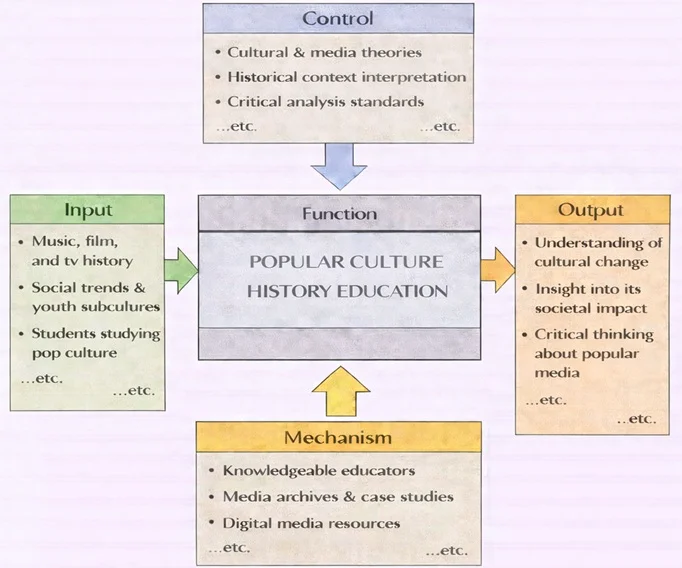
Popular Culture History Education treats everyday entertainment as a historical record. It shows students that songs, films, television, fashion, and youth trends are not “just fun”—they are clues about what a society feared, desired, celebrated, and tried to change. The inputs include music, film, and TV history that provide rich cultural artifacts, social trends and youth subcultures that reveal shifting identities and values, and students who want to understand how popular culture both reflects and drives change. The learning process is guided by controls such as cultural and media theories, historical context interpretation, and critical analysis standards, helping students connect a pop moment to its wider time—economics, politics, technology, and social movements—while reading images and narratives with care rather than nostalgia alone. The function is enabled by mechanisms like knowledgeable educators who frame discussion, media archives and case studies that offer concrete examples across decades, and digital media resources that widen access to global popular culture histories. When these elements work together, the outputs are clear: students develop a stronger understanding of cultural change, gain insight into popular culture’s societal impact, and sharpen critical thinking about popular media—learning to ask not only “What did people watch and listen to?” but also “What did it mean, and why did it matter?”
Popular culture offers an accessible lens through which societies understand themselves and their histories, often serving as both a mirror and a mold for public consciousness. It intersects deeply with political developments, making it essential to explore the history of political systems and how ideologies are reflected or resisted in mass media, music, fashion, and film. Through such channels, cultural narratives either support or challenge prevailing norms, including those encoded in revolutionary constitutions or shaped by post-colonial constitutionalism.
To understand how these narratives evolve, one must consider broader intellectual frameworks, such as those explored in the history of ideas. From philosophy to political theory, ideas influence popular content and determine what becomes mainstream. This intellectual backdrop is often negotiated within the socio-economic structures chronicled in the economic history of societies, and further analyzed through the development of economic thought and theory.
Cultural expression is also intricately linked to political events and struggles. The history of social movements shows how protest culture influences art, slogans, and public imagination. These movements often intersect with political crises and manipulations, as seen in case studies within electoral fraud and integrity and broader electoral history.
At the same time, popular culture reflects the human need for spirituality and meaning, evident in media portrayals and public rituals associated with religious and spiritual history. Education systems also play a role in shaping and transmitting cultural norms, highlighting the significance of education history. The shared memories and constructed identities often form part of broader cultural critiques developed within postcolonial cultural studies.
Diplomacy and conflict also shape cultural transmission. The role of diplomatic history and high-profile diplomatic personalities reflects how international relations influence cultural imports and exports. In periods of global tension, as examined in economic history of warfare or guerrilla warfare and insurgency studies, cultural output often becomes politicized or constrained. These dynamics are frequently driven by broader goals of economic diplomacy or cemented through strategic history of alliances.
Understanding popular culture also requires a return to economic foundations. Both the history of political economy and the history of economic thought provide insights into consumerism, labor, and class representations in mass media. Meanwhile, the dynamics of political economy affect who creates culture, for whom, and under what constraints. All these developments rest within the broader domain of history itself—a tapestry of interactions between politics, economics, and collective identity.
Finally, political representation through mass media cannot be fully understood without appreciating the structures of electoral systems and political parties, which frequently frame national narratives and inform public debates. In this sense, popular culture becomes not just entertainment but a powerful medium through which societies engage with their past, shape their present, and imagine their futures.

Interactive Pop Lab: Cultural Trend & Subcultural Diffusion Modeler
Select a pop culture medium, subcultural era, and commercialization mechanism to simulate how subcultural resistance turns into mainstream trends.
Simulated Cultural Matrix Output
Key Focus Areas in Popular Culture
1. Music and Its Cultural Influence
Music serves as both an expressive outlet and a reflection of broader societal shifts.
The Rise of Rock ‘n’ Roll
- Origins: Emerged in the 1950s US, blending African-American blues, gospel, and rhythm and blues with country music.
- Key Figures: Elvis Presley, Chuck Berry, and Little Richard became cultural icons shaping youth identity.
- Impact: Symbolized rebellion against post-war conservative norms and helped bridge racial divisions in mainstream media.
Hip-Hop and Rap
- Origins: Born in the Bronx during the 1970s, encompassing DJing, MCing, breakdancing, and graffiti.
- Key Figures: Grandmaster Flash, Tupac Shakur, and Kendrick Lamar used hip-hop for social commentary on race and inequality.
- Impact: Transformed global fashion, language, and youth activism worldwide.
Globalization of Music
- Examples: K-pop’s international expansion (e.g., BTS) and Latin music’s global prominence (e.g., Shakira, Bad Bunny, Reggaeton).
2. Fashion as Cultural Expression
Fashion acts as a visual barometer for economic conditions and social norms.
Trends Across Eras
- 1950s: Post-war tailoring and conservative modesty.
- 1960s–70s: Counterculture bohemian, tie-dye, and punk rebellion.
- 1980s: High consumerism, bold athletic wear, and MTV pop icons (Madonna, Michael Jackson).
- 21st Century: Streetwear subcultures (Supreme, Off-White) and sustainable eco-fashion movements.
3. Sports and National Identity
- Global Events: The Olympics and FIFA World Cup foster national pride and transnational fan communities.
- Cultural Icons: Athletes like Muhammad Ali, Serena Williams, and Lionel Messi transcend sports into civil rights and activism.
4. Film and Television
- Hollywood Era: The Golden Age (1920s–50s) established global cinematic conventions (*Casablanca*, *Gone with the Wind*).
- Television & Streaming: Network sitcoms (*Friends*) to global streaming hits (*Squid Game*) shape international leisure habits.
5. Social Media and Digital Trends
- Influencers & Creators: TikTok, YouTube, and Instagram creators monetize digital trends and short-form video.
- Internet Culture: Memes serve as rapid visual commentary on politics and social life.
- Digital Activism: Hashtag movements (#BlackLivesMatter, #FridaysForFuture) mobilize global youth.
Exemplars in Popular Culture History
1) The British Invasion (1964)
The Beatles’ arrival in the US transformed pop music marketing, youth fashion, and transatlantic cultural exchange.
2) Transnational Streaming (2021)
Netflix’s *Squid Game* demonstrated how non-English content can dominate global digital entertainment markets.
3) Viral Digital Mobilization
Phenomena like the “Ice Bucket Challenge” proved how viral video formats combine entertainment with philanthropic fundraising.
Why Study Popular Culture
- Analyzing Power & Representation: Teaches students to decode how mass media constructs ideas of race, class, gender, and nation.
- Connecting Theory to Daily Life: Applies semiotics and cultural hegemony to familiar films, music, and social media feeds.
- Developing Media Literacy: Equips learners to evaluate advertising incentives, viral algorithms, and image manipulation.
- Career Pathways: Prepares students for journalism, digital content strategy, public relations, media production, and policy.
Conclusion
Popular culture is far more than passive entertainment—it is a dynamic site where societal values, power structures, and youth subcultures are negotiated. Analyzing its history equips students to critically navigate modern media landscapes.
Frequently Asked Questions
What is Popular Culture in the context of cultural history?
In cultural history, Popular Culture refers to the everyday texts, practices, and experiences that appeal to broad audiences, such as music, film, television, social media, fashion, sports, and gaming. Instead of focusing only on elite artworks or political institutions, the study of popular culture asks how ordinary people make meaning, form identities, and negotiate power through the media and entertainment they consume and create.
Why is Popular Culture important for understanding society?
Popular culture matters because it is where many people encounter ideas about gender, race, class, nation, and the self on a daily basis. It reflects social tensions and aspirations while also shaping them, from the lyrics people sing to the memes they share. By analysing popular culture, students can uncover how values are normalised, how stereotypes are reinforced or challenged, and how audiences respond creatively to dominant narratives.
How has Popular Culture changed over time?
Popular culture has shifted from local, oral, and print-based forms, such as folk songs, cheap pamphlets, and popular theatre, to mass-mediated formats like cinema, radio, television, and global music industries, and now to digital platforms and user-generated content. Cultural historians trace how these changes in technology, distribution, and audience participation have transformed what counts as “popular”, who controls it, and how quickly trends and subcultures can spread.
What kinds of sources are used to study Popular Culture historically?
Historians of popular culture work with a wide variety of sources: songs and playlists, films and television series, comics and graphic novels, fashion magazines, advertising, posters, fan letters, zines, video games, sports coverage, social media posts, and online communities. They also use archives, industry reports, and audience research to understand both how popular texts were produced and how they were received.
How does Popular Culture relate to power and ideology?
Popular culture often carries powerful messages about what is normal, desirable, or acceptable. It can reproduce dominant ideologies by presenting certain lifestyles as aspirational or by repeating familiar stereotypes. At the same time, popular culture can provide spaces for resistance, satire, and alternative worldviews, as seen in protest music, countercultural movements, and fan reinterpretations that challenge official narratives.
What role do audiences play in Popular Culture?
Audiences are not passive recipients of popular culture; they interpret, adapt, and sometimes transform the meanings of texts. Cultural historians and media scholars look at fan cultures, remix practices, cosplay, online comments, and community screenings to understand how people use popular culture to build identities, forge friendships, express emotions, and negotiate their relationship to mainstream values and institutions.
How does Popular Culture interact with globalisation?
Popular culture is deeply entangled with globalisation. Films, music, sports, and digital platforms circulate across borders, creating shared global references while also generating debates about cultural imperialism, soft power, and cultural hybridity. Cultural history explores how global trends, such as Hollywood cinema or K-pop, are adapted in local contexts and how local scenes, in turn, influence global cultural flows.
How does Popular Culture represent gender, race, and identity?
Popular culture is a key site where ideas about gender, race, sexuality, age, and other identities are constructed and contested. Through characters, storylines, lyrics, and images, it can reinforce narrow stereotypes or open space for more complex and inclusive representations. Students learn to examine who is visible, who is marginalised or caricatured, and how audiences respond to these portrayals over time.
What methods are used to analyse Popular Culture academically?
Scholars combine historical research with methods from cultural studies, sociology, film and media studies, and anthropology. These include close textual analysis of songs, films, or games; archival research into production and reception; ethnographic approaches to fan communities; and theoretical perspectives such as Marxism, feminism, postcolonial studies, or queer theory to interpret how popular culture encodes power relations and possibilities for change.
How can studying Popular Culture support university and career pathways?
Analysing popular culture develops critical thinking, media literacy, and communication skills that are valuable in many fields. Students learn to interpret complex symbolic material, understand audience behaviour, and explain cultural trends clearly. These skills are relevant for degrees and careers in history, cultural studies, media and communication, journalism, advertising, creative industries, education, and policy work around media and culture.
What is the relationship between Popular Culture and digital media?
Digital media have transformed popular culture by making production and distribution more accessible. Users can now create videos, memes, podcasts, and fan fiction, contributing actively to cultural trends rather than only consuming professional content. Cultural history examines how this shift has changed the boundaries between producers and audiences, reshaped business models, and raised new questions about algorithms, virality, and platform power.
How can I start analysing Popular Culture in a more critical way?
You can begin by choosing a song, film, series, game, or meme you know well and asking structured questions: Who created it and for whom? What kinds of identities and lifestyles does it celebrate? What is left out or taken for granted? How do different audiences respond? How does its form (visual style, sound, humour, genre) support its message? Approaching familiar cultural texts with these questions is a good first step towards more systematic academic analysis.
Interactive Review Questions & Concept Explanations
Click on any question below to reveal detailed answers and cultural explanations:
1. What is popular culture?
Popular culture refers to the set of practices, beliefs, and objects that are dominant or ubiquitous in a society at a given time. It encompasses the everyday cultural expressions found in music, film, television, fashion, and social media that resonate with large segments of the population. This field of study examines how these elements are produced, consumed, and interpreted, reflecting the tastes and values of society. Understanding popular culture is essential as it provides insight into the shared experiences and collective identities of communities.
2. How does popular culture reflect societal values?
Popular culture reflects societal values by mirroring the beliefs, norms, and aspirations of a community through various media and cultural expressions. It acts as a lens through which the prevailing attitudes and social trends are observed and understood. Art, literature, music, and film often serve as vehicles for expressing collective concerns, hopes, and ideologies. Through these cultural artifacts, historians and social scientists gain insight into what is considered important or controversial in a society at a given time.
3. What role does media play in shaping popular culture?
Media plays a central role in shaping popular culture by serving as the primary channel for the dissemination of cultural content. It influences public opinion and cultural trends through the production and distribution of information and entertainment. Media platforms help in creating shared narratives that unify or divide audiences based on their content and messaging. As a result, the study of media is integral to understanding the dynamics of popular culture and its impact on social behavior.
4. How have historical trends shaped the evolution of popular culture?
Historical trends have shaped the evolution of popular culture by influencing the types of cultural products that are created and how they are received by society. Major historical events, technological advances, and social movements have all played significant roles in transforming cultural expressions over time. For example, the advent of mass media revolutionized the dissemination of popular culture, while social and political changes have redefined what is valued culturally. This evolution provides a framework for understanding how past influences continue to affect contemporary cultural trends.
5. In what ways do consumerism and mass media influence popular culture?
Consumerism and mass media influence popular culture by driving the production, marketing, and consumption of cultural goods on a large scale. They shape tastes and preferences through advertising, branding, and the commodification of cultural products. This process often leads to the standardization of cultural expressions, where certain trends become dominant due to widespread availability and market forces. As a result, popular culture is not only a reflection of societal values but also a product of economic and technological systems that shape how culture is produced and consumed.
6. How does popular culture contribute to the formation of collective identity?
Popular culture contributes to the formation of collective identity by creating shared symbols, narratives, and experiences that resonate with large groups of people. It provides a common language and set of references that help individuals define who they are in relation to others. Through the consumption of popular media, communities develop a sense of belonging and a collective memory that reinforces cultural unity. This shared identity is continually reinforced and reshaped by ongoing cultural production, making popular culture a dynamic force in society.
7. What methodologies do historians use to study popular culture?
Historians use a variety of methodologies to study popular culture, including textual analysis, visual analysis, oral histories, and quantitative data analysis. These approaches allow them to examine cultural artifacts, media texts, and public discourses in order to uncover underlying social trends and ideologies. By analyzing sources from different periods, historians can trace the evolution of cultural norms and the impact of popular culture on society. This multifaceted approach provides a comprehensive understanding of how cultural phenomena emerge and change over time.
8. How can popular culture serve as a form of resistance or critique?
Popular culture can serve as a form of resistance or critique by offering alternative narratives and challenging dominant cultural norms and power structures. Through music, art, literature, and film, creators often express dissent, highlight social injustices, and mobilize communities for change. These cultural expressions can undermine mainstream ideologies and provide a platform for marginalized voices to be heard. In doing so, popular culture becomes a powerful tool for social commentary, enabling individuals to question and contest established norms in creative and impactful ways.
9. What impact does globalization have on popular culture?
Globalization has a significant impact on popular culture by facilitating the cross-cultural exchange of ideas, styles, and media content. It leads to the blending of diverse cultural influences, resulting in hybrid forms of artistic expression that reflect both local traditions and global trends. While globalization can promote cultural diversity, it can also lead to the homogenization of cultural products as dominant global narratives overshadow local voices. This dynamic interplay influences how popular culture evolves, reshaping identities and altering the ways in which cultural meaning is constructed and disseminated.
10. How does the study of popular culture help us understand contemporary social change?
The study of popular culture helps us understand contemporary social change by revealing how cultural expressions reflect and influence societal attitudes and behaviors. By analyzing trends in music, fashion, film, and digital media, scholars can identify shifts in public values, emerging social issues, and evolving identities. This field of study provides critical insights into how cultural phenomena are both a product and a catalyst of broader social transformations. Consequently, understanding popular culture enables us to decipher the complex processes of change that shape modern society.
Comprehensive Popular Culture Practice Module
Part 1: Foundational Cultural Theories & Core Concepts
-
Define Stuart Hall’s “Encoding/Decoding” model of communication in popular culture.
Answer: Hall asserted that media producers encode preferred ideological meanings into cultural texts, but diverse audiences actively decode these texts through dominant-hegemonic, negotiated, or oppositional stances depending on their social position. -
What is Dick Hebdige’s core theory regarding youth subcultures and style?
Answer: Hebdige argued that working-class youth subcultures (e.g., punks, mods) use bricolage—recontextualizing everyday objects like safety pins or suits—as symbolic resistance to dominant class hegemony, which is eventually co-opted and commercialized by fashion industries. -
Define Theodor Adorno and Max Horkheimer’s concept of the “Culture Industry.”
Answer: The Frankfurt School theorists argued that capitalist mass entertainment produces standardized, predictable cultural products that pacify the public, replacing genuine art with consumer satisfaction and maintaining social conformity. -
Explain Laura Mulvey’s concept of the “Male Gaze” in cinematic popular culture.
Answer: Mulvey posited that classical Hollywood cinema structures visual narratives from the perspective of a heterosexual male subject, positioning female characters as passive erotic objects of gaze and male characters as active drivers of plot. -
What is “cultural omnivorousness” in contemporary sociology of taste?
Answer: Cultural omnivorousness describes a shift where high-status elites distinguish themselves not by exclusively consuming “high culture” (opera, fine art), but by displaying broad, eclectic tastes across both elite and popular media (hip-hop, reality TV, street food). -
Define “cultural imperialism” in global media flows.
Answer: Cultural imperialism is the theory that powerful nations (predominantly Western) dominate global media export markets, imposing consumer values and eroding local cultural traditions in developing recipient nations. -
Explain Henry Jenkins’ concept of “participatory culture” and fan remixing.
Answer: Participatory culture describes an environment where consumers do not passively absorb media, but actively rewrite, remix, and redistribute content (e.g., fan fiction, memes, cosplay), blurring the boundary between media producer and audience. -
What is “hyperreality” as defined by Jean Baudrillard?
Answer: Baudrillard defined hyperreality as a condition in which media simulations and symbols (simulacra) replace reality, making it impossible for consumers to distinguish real experience from media representation (e.g., theme parks, virtual worlds).
Part 2: Analytical & Scenario-Based Historiographical Inquiries
-
Analyze how 1950s American Rock ‘n’ Roll challenged post-war racial and social boundaries.
Answer: Rock ‘n’ roll synthesized African-American rhythm and blues with country music, bringing Black musical idioms to white suburban youth during racial segregation. While white performers like Elvis Presley commercialized the sound, radio play integrated youth audiences and catalyzed subcultural rebellion against post-war domestic conformity. -
Evaluate how the 1970s Bronx hip-hop movement served as an organic response to urban post-industrial decline.
Answer: Following urban renewal, cross-Bronx expressway construction, and municipal disinvestment, Black and Latino youth converted abandoned public spaces into block parties. DJing, breakdancing, and graffiti transformed urban decay into creative subcultural capital, giving voice to economic disenfranchisement. -
Examine how South Korean state policy and digital platforms facilitated the global “Hallyu” (K-Pop) wave.
Answer: Following the 1997 Asian financial crisis, the South Korean government designated cultural exports as a national development priority. Talent agencies structured idol groups for international markets, leveraging YouTube algorithms, social media fandoms, and multilingual choruses to achieve global soft power. -
How did the 1960s British Invasion transform transatlantic pop culture trade dynamics?
Answer: The Beatles and British rock groups re-exported American blues and rock idioms back to US markets with distinctive fashion, hairstyles, and songwriting autonomy, reversing historical US media dominance and establishing UK youth culture as a global style center. -
Discuss the cultural shift from appointment-based broadcast television to digital streaming “binge-watching.”
Answer: Broadcast TV created synchronized national schedules and water-cooler cultural moments. On-demand streaming platforms (e.g., Netflix) decentralized viewing schedules, encouraging serialized narrative complexity and algorithmic personalization while fragmenting shared national viewing experiences. -
Analyze how 1980s MTV music videos transformed the recording industry and pop star branding.
Answer: MTV prioritized visual choreography, fashion, and cinematic storytelling alongside audio recording. Artists like Madonna and Michael Jackson utilized visual spectacle to build global commercial brands, making music video production essential for record sales. -
Explain how internet memes function as units of rapid political satire and cultural discourse.
Answer: Memes utilize recognizable visual templates paired with altered text, enabling users to rapidly encode humor, political critique, or collective anxiety. Their viral, open-source nature allows decentralized digital publics to respond instantaneously to news events. -
Evaluate the social impact of sneaker culture from 1980s basketball subculture to global luxury markets.
Answer: Driven by Nike’s 1985 Air Jordan campaign and hip-hop endorsements (e.g., Run-DMC), athletic footwear shifted from utilitarian sports gear to subcultural status symbols. Commercial hype cycles and secondary resale markets eventually elevated sneakers into high-fashion luxury collaborations.
Part 3: Quantitative Box-Office, Streaming & Cultural Economics Calculations
A classic 1975 blockbuster generated $260 million at the domestic box office when the average ticket price was $2.05. A 2025 franchise film generates $850 million when the average ticket price is $11.50. Calculate the number of tickets sold for each film and determine which film achieved higher physical attendance.
Solution Steps:
1. 1975 tickets sold = $260,000,000 / $2.05 = 126,829,268 tickets.
2. 2025 tickets sold = $850,000,000 / $11.50 = 73,913,043 tickets.
3. Comparison = 126.83 million tickets (1975) vs. 73.91 million tickets (2025).
Conclusion: The 1975 film achieved higher physical attendance, selling 52.92 million more tickets despite a lower nominal revenue total.
A hit single generates 150,000,000 streams on a digital platform that pays an average gross royalty rate of $0.0038 per stream. The record label contract allocates a 18% royalty share to the recording artist. Calculate total gross platform royalties generated and the net payout received by the artist.
Solution Steps:
1. Gross royalties generated = 150,000,000 × $0.0038 = $570,000.
2. Artist net payout = $570,000 × 0.18 = $102,600.
Conclusion: Total royalties generated were $570,000, yielding a net payout of $102,600 to the recording artist.
A global film release generates $350 million in domestic theatrical revenue and $650 million in overseas theatrical revenue across 65 international markets. Calculate total global revenue, the percentage share of overseas markets, and the international-to-domestic box-office ratio.
Solution Steps:
1. Total global revenue = $350,000,000 + $650,000,000 = $1,000,000,000 ($1.0 billion).
2. Overseas revenue percentage = ($650,000,000 / $1,000,000,000) × 100 = 65.0%.
3. International-to-domestic ratio = $650M / $350M = 1.857.
Conclusion: Global revenue reached $1.0 billion, with overseas markets contributing 65% of earnings (1.86 times domestic revenue).
A pop culture influencer account with 1,200,000 followers publishes a promotional campaign post. The post receives 48,000 likes, 3,600 comments, and 8,400 shares. Calculate total engagement actions and the account’s engagement rate percentage.
Solution Steps:
1. Total engagement = 48,000 + 3,600 + 8,400 = 60,000 actions.
2. Engagement Rate = (60,000 / 1,200,000) × 100 = 5.0%.
Conclusion: The campaign achieved a 5.0% engagement rate across its follower base.
In 2000, physical CD sales generated $13.2 billion out of $14.3 billion total music industry revenue. By 2024, digital streaming generated $13.3 billion out of $17.1 billion total revenue. Calculate physical revenue share in 2000 and streaming revenue share in 2024.
Solution Steps:
1. 2000 Physical share = ($13.2B / $14.3B) × 100 = 92.31%.
2. 2024 Streaming share = ($13.3B / $17.1B) × 100 = 77.78%.
Conclusion: Physical CDs dominated 92.31% of revenue in 2000, whereas streaming captured 77.78% of total revenue in 2024.
A concert venue sells face-value tickets for a high-demand pop tour at $120 each. Due to automated scalping and high demand, tickets trade on secondary resale platforms for an average price of $660. Calculate the secondary market percentage markup.
Solution Steps:
1. Absolute price markup = $660 − $120 = $540.
2. Percentage markup = ($540 / $120) × 100 = 450.0%.
Conclusion: Secondary market resellers achieved a 450% price markup over original face value.
A digital streaming platform starts a quarter with 40,000,000 paid subscribers. During the quarter, it gains 3,200,000 new subscribers but loses 1,800,000 existing subscribers. Calculate the quarterly churn rate percentage and the net subscriber growth percentage.
Solution Steps:
1. Churn rate = (1,800,000 / 40,000,000) × 100 = 4.50%.
2. Net addition = 3,200,000 − 1,800,000 = 1,400,000 subscribers.
3. Net growth rate = (1,400,000 / 40,000,000) × 100 = 3.50%.
Conclusion: The platform experienced a 4.50% quarterly churn rate, while achieving a net subscriber base expansion of 3.50%.