
Interactive Cross-Border Capital & Risk Simulator
Model international expansion feasibility, exchange rate risk exposure, and Net Present Value (NPV) across global markets in real time.
Unhedged Volatility Risk Exposure: $0
Projected 6-Year International NPV: $0
Market Feasibility Status: Favorable
In today’s interconnected world, international business is more than just cross-border trade—it is a dynamic field that examines how organizations operate, compete, and thrive in diverse cultural, economic, and regulatory environments. It blends the principles of business administration with global perspectives to prepare future professionals for the complexities of multinational enterprise and international collaboration.
A solid foundation in economics, especially in areas like microeconomics, macroeconomics, and policy analysis, is crucial for understanding international markets and trade flows. Equally important is awareness of historical trends and institutional evolution, explored through economic history and its related fields like financial history and trade and commerce history.
Legal and regulatory frameworks vary significantly across borders, making it vital for students to study corporate law, including key areas like compliance and regulatory adherence, contract negotiation, and mergers and acquisitions. These intersect with corporate governance and intellectual property protection—key considerations in managing risk and sustaining innovation in foreign markets.
Effective financial management underpins successful global expansion. Fields like accounting, financial reporting, tax compliance and planning, and budgeting and cost management play a crucial role. These areas are reinforced by analytical tools from business analytics and data analysis, allowing firms to make data-informed global decisions.
Students are also encouraged to explore how globalization intersects with trade regulations, conflict resolution and arbitration, and international relations. Courses in emerging technologies, artificial intelligence and machine learning, and information technology also enrich one’s understanding of tech-enabled global operations.
Furthermore, strategic alignment between global marketing and branding is supported through studies in marketing and even advertising. Meanwhile, leadership capabilities are honed through disciplines like management, human resource management, and strategic management.
By drawing from these diverse yet interconnected domains, the study of international business equips students with the agility, cultural literacy, and technical acumen necessary to navigate the evolving global economy with confidence and purpose.

Global Expansion and Cross-Border Business Integration
The World as a Marketplace: International Business at a Glance
International business focuses on the planning, execution, and management of business activities in multiple countries. It involves understanding and adapting to different cultural norms, regulatory environments, and market dynamics to achieve organizational goals.

Primary Goals of Operating Across Borders
- Market Expansion: Identifying and entering new markets to increase revenue and global presence.
- Cultural Adaptation: Adapting business practices to align with local customs and expectations.
- Operational Efficiency: Streamlining global supply chains and managing resources effectively.
- Risk Management: Mitigating challenges like currency volatility, geopolitical tensions, and trade barriers.
International business is a dynamic field that combines strategic thinking with practical implementation, fostering growth and collaboration across borders.
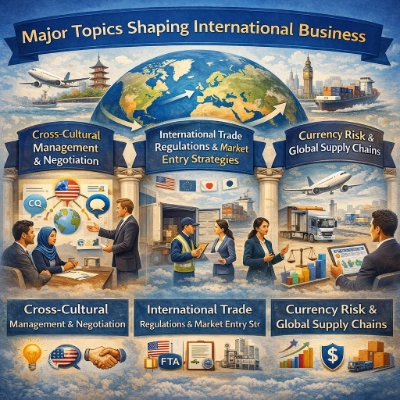
Major Topics Shaping International Business
1. Cross-Cultural Management and Negotiation
- Definition: Managing cultural differences to foster collaboration and build successful international relationships.
- Key Components:
- Cultural Intelligence (CQ): Understanding and adapting to cultural norms and values.
- Communication Styles: Navigating verbal and non-verbal communication differences.
- Negotiation Tactics: Adapting negotiation strategies to suit cultural preferences.
- Applications:
- Building diverse teams with effective communication and collaboration.
- Successfully closing deals with foreign partners by respecting cultural nuances.
- Examples:
- A tech firm adjusting its management style in Asia to align with hierarchical norms.
- A U.S. company employing high-context communication techniques in Japan.
2. International Trade Regulations and Market Entry Strategies
- Definition: Navigating trade laws and developing strategies to enter foreign markets effectively.
- Key Components:
- Trade Agreements: Understanding treaties like NAFTA, the EU Single Market, and CPTPP.
- Market Entry Modes: Exporting, licensing, franchising, joint ventures, and wholly-owned subsidiaries.
- Regulatory Compliance: Adhering to import/export laws, tariffs, and quotas.
- Applications:
- Choosing appropriate market entry strategies based on risk tolerance and resource availability.
- Complying with local regulations to avoid penalties and delays.
- Examples:
- A fashion brand using franchising to expand in the Middle East.
- A pharmaceutical company navigating patent regulations in Europe.
3. Currency Risk and Global Supply Chains
- Definition: Managing financial risks associated with currency fluctuations and optimizing supply chain operations across borders.
- Key Components:
- Currency Risk Management: Using hedging strategies and forward contracts to mitigate exchange rate volatility.
- Global Logistics: Coordinating transportation, warehousing, and inventory across multiple countries.
- Sustainability in Supply Chains: Incorporating eco-friendly practices and minimizing carbon footprints.
- Applications:
- Securing stable pricing for international contracts through currency hedging.
- Streamlining global supply chains to reduce costs and delivery times.
- Examples:
- A manufacturing company using just-in-time (JIT) inventory systems across continents.
- A global retailer managing currency exposure through financial derivatives.
International Business in Action: Real-World Applications
1. Expanding Businesses into International Markets
- Overview: International business enables companies to identify growth opportunities in foreign markets and tailor their strategies to local needs.
- Applications:
- Conducting market research to assess demand and competition.
- Localizing products and marketing campaigns to resonate with cultural preferences.
- Examples:
- A fast-food chain adapting its menu for vegetarian preferences in India.
- An electronics brand launching region-specific models based on local consumer needs.
2. Managing Multinational Operations and Global Partnerships
- Overview: Effective management of international operations ensures seamless collaboration across borders and strengthens global partnerships.
- Applications:
- Coordinating operations across subsidiaries in different countries.
- Building strategic alliances to enter new markets or access technology.
- Examples:
- A car manufacturer collaborating with local suppliers to meet regional production standards.
- An IT company partnering with a foreign firm to develop localized software solutions.
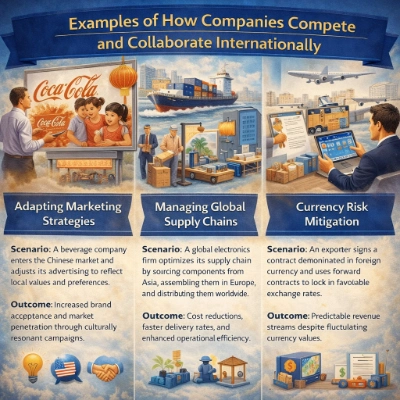
Examples of How Companies Compete and Collaborate Internationally
1. Adapting Marketing Strategies
- Scenario: A beverage company enters the Chinese market and adjusts its advertising to reflect local values and preferences.
- Outcome: Increased brand acceptance and market penetration through culturally resonant campaigns.
2. Managing Global Supply Chains
- Scenario: A global electronics firm optimizes its supply chain by sourcing components from Asia, assembling them in Europe, and distributing them worldwide.
- Outcome: Cost reductions, faster delivery times, and enhanced operational efficiency.
3. Currency Risk Mitigation
- Scenario: An exporter signs a contract denominated in foreign currency and uses forward contracts to lock in favorable exchange rates.
- Outcome: Predictable revenue streams despite fluctuating currency values.
New Frontiers in International Business
Digital Globalization
Leveraging e-commerce platforms and digital tools to reach international customers (e.g., cross-border online sales, virtual trade shows, and digital payments).
Sustainability and Ethical Practices
Emphasizing environmentally friendly and socially responsible practices in global operations (e.g., reducing carbon footprints in supply chains, fair trade certifications).
AI and Automation in Global Operations
Using AI for demand forecasting, risk assessment, and supply chain optimization (e.g., AI-driven logistics systems, automated customer service for multilingual markets).
Global Collaboration in Innovation
Partnering with international research institutions and firms for R&D (e.g., developing renewable energy technologies through global consortia).
Resilience in Global Supply Chains
Strengthening supply chains to withstand disruptions like pandemics or geopolitical tensions (e.g., diversifying suppliers, adopting regional manufacturing hubs).
Barriers in International Business
Cultural Differences
Managing cross-cultural misunderstandings and adapting business practices to local norms.
Regulatory Complexity
Navigating varying laws, tariffs, and statutory standards across countries.
Economic and Political Risks
Addressing currency volatility, trade wars, sanctions, and political instability.
Sustainability Demands
Balancing cost efficiency with environmental and social responsibilities globally.
Technological Adaptation
Staying competitive by integrating advanced technologies across global operations.
Preparing for a Career in International Business
Understanding Global Markets and Trade
International business explores how companies operate across national borders, adapt to different economic systems, and engage in global trade. Students preparing for university benefit from learning how goods, services, capital, and information flow around the world. This foundational knowledge enhances their understanding of global interdependence and sets the stage for further study in business, economics, finance, and international relations.
Developing Cultural Awareness and Communication Skills
Effective international business professionals must navigate diverse cultural norms, languages, and communication styles. By studying international business, students begin to develop intercultural competence—learning how to respect cultural differences, work with diverse teams, and adapt messaging for international audiences. These skills are valuable in university group work, study abroad programs, and globally focused careers.
Learning to Think Strategically in a Global Context
International business challenges students to analyze how political, legal, and social environments affect business decisions. They explore topics such as global supply chains, foreign investment, and market entry strategies. This global perspective sharpens students’ strategic thinking and prepares them to address complex business problems in international settings—both in university case studies and real-world scenarios.
Gaining Practical Insights into International Careers
Studying international business introduces students to practical skills such as global marketing, cross-border negotiation, risk analysis, and international logistics. These topics give students a preview of what it’s like to work in multinational companies, export-oriented firms, or global nonprofits. For students preparing for university, this exposure helps clarify academic and career interests while building readiness for internships and international opportunities.
Preparing for a Globalized and Interconnected Future
In today’s world, nearly every industry is influenced by global events, economic shifts, and international partnerships. A background in international business gives students the tools to understand these trends and adapt to changing global realities. Whether pursuing degrees in business, economics, law, or public policy, students who study international business enter university with a broad, future-ready mindset that will serve them well in an increasingly interconnected world.
Navigating International Business Concluding Thought
International business is the cornerstone of modern economic growth, enabling organizations to capitalize on global opportunities while managing the complexities of operating across borders. By focusing on areas such as cross-cultural management, trade regulations, and supply chain optimization, businesses can thrive in diverse and dynamic environments. As trends like digital globalization, sustainability, and technological innovation reshape global markets, the principles of international business remain essential for navigating challenges and achieving long-term success. Whether expanding into new markets, managing multinational operations, or mitigating risks, international business empowers organizations to create value, foster collaboration, and drive progress in an interconnected world.
Interactive Concept Warm-Ups & Case Reviews
Why do companies choose joint ventures over wholly-owned subsidiaries when entering high-risk foreign markets?
How does currency depreciation impact an export-oriented multinational enterprise?
Frequently Asked Questions – International Business
What is international business and how is it different from domestic business?
International business focuses on trade, investment, and management across national borders. It differs from domestic business because firms must deal with different legal systems, currencies, cultures, political risks, logistics challenges, and consumer preferences, rather than operating under one familiar home-country environment.
Why is international business important for students preparing for university and future careers?
International business is important because most organizations now source, produce, or sell across borders. Understanding global markets helps you make sense of trade disputes, supply chain disruptions, climate policies, and digital platforms. At university, it connects business knowledge with economics, politics, law, and culture, and in your career it prepares you for roles in multinational firms, regional companies, and global NGOs.
Which subjects in school provide a good foundation for studying international business?
Useful foundations include economics, geography, business studies, history, and mathematics. These subjects help you understand trade patterns, country risk, exchange rates, data interpretation, and how policy decisions shape global markets. Language subjects and humanities courses also matter, because they build your communication and cultural awareness skills.
How much mathematics and quantitative skills are needed for international business?
You do not need advanced pure mathematics, but you do need to be comfortable with percentages, indices, basic statistics, and reading charts and tables. At university, you will meet topics such as foreign exchange calculations, trade data analysis, and risk assessment, so a solid grounding in secondary-level mathematics and an openness to data analytics is very helpful.
What roles do culture and communication play in international business?
Culture and communication are central to international business. Managers must adapt negotiation styles, marketing messages, leadership approaches, and HR practices to local expectations. Misunderstandings about etiquette, time, hierarchy, or humour can damage deals and partnerships. Learning how to read cultural cues and communicate clearly across cultures is as important as understanding financial numbers.
How does international business connect with other business disciplines such as finance and supply chain management?
International business links closely to finance, marketing, operations, and human resource management. For example, international finance deals with exchange-rate risk and global investment; international marketing adapts products and campaigns to local markets; and global supply chain management coordinates sourcing, production, and distribution across countries. Studying international business helps you see how these disciplines work together in a cross-border setting.
What careers can international business lead to after university?
International business can lead to careers in multinational corporations, regional headquarters, export and import firms, logistics and shipping, international banking, consulting, development agencies, government trade promotion, and start-ups that scale across borders. Many graduates also build careers in roles such as country manager, regional analyst, supply chain coordinator, trade finance officer, or global marketing specialist.
How are global trade policies and geopolitics relevant to international business?
Global trade policies and geopolitics shape the rules and risks of international business. Tariffs, sanctions, trade agreements, investment treaties, and regional blocs influence where firms choose to locate production, how they design supply chains, and which markets they can enter. Students of international business learn to interpret these changes and to think about political risk, resilience, and ethical responsibility in global operations.
What skills should I start building now if I am interested in international business?
You can start building skills in critical reading, data interpretation, presentation, teamwork, and intercultural communication. Following international news, comparing how issues are reported in different countries, and joining activities with students from other cultures all help. Learning digital tools such as spreadsheets, simple data visualization, and collaboration platforms will also support your future international business studies.
Do I need to speak multiple languages to study or work in international business?
Speaking more than one language is a strong advantage but not always a strict requirement. English remains a major working language, yet regional languages can open doors in specific markets and help you build trust with partners and customers. Even if you only learn basic phrases, it signals respect and makes collaboration smoother in cross-border teams.
How does the International Business page on Prep4Uni.online support my learning?
The International Business page on Prep4Uni.online is designed as a bridge between school-level knowledge and university expectations. It introduces key ideas such as global strategy, trade patterns, cultural intelligence, and international regulation, and connects them to related pages on finance, supply chains, economics, and law. The aim is to help you see international business as an integrated field rather than isolated topics.
How should I use this page when exploring potential university programmes in international business?
You can use this page as a study guide before reading university prospectuses. First, review the key concepts and case illustrations to build your vocabulary and mental map of the subject. Then, compare degree outlines and course titles from different universities and ask how each programme treats strategy, finance, marketing, operations, and regional studies. This approach helps you choose programmes that align with your interests and long-term career goals in international business.
International Business Mastery & Application Module
Section 1: Core Knowledge & Essential Concepts
-
What is international business?
Answer: International business involves the exchange of goods, services, capital, and technology across national borders. It encompasses exporting, importing, joint ventures, and foreign direct investments, all of which require an understanding of global markets and cultural differences. -
How do global strategies impact business expansion?
Answer: Global strategies guide companies in entering new markets, managing cross-border operations, and adapting products and services to local preferences. They help firms achieve competitive advantages by leveraging economies of scale, mitigating risks, and capitalizing on diverse market opportunities. -
What challenges do companies face when operating internationally?
Answer: Companies face challenges such as regulatory differences, cultural diversity, currency fluctuations, and political instability. These challenges require robust risk management, localized strategies, and an in-depth understanding of international trade laws. -
How does cultural diversity influence international business operations?
Answer: Cultural diversity affects communication styles, consumer behavior, and management practices. Businesses must adapt their strategies to align with local customs and values, which can enhance market penetration and foster strong relationships with local stakeholders. -
What role do international trade agreements play in global business?
Answer: Trade agreements establish the legal framework for cross-border commerce by reducing tariffs, setting standards, and ensuring fair competition. They facilitate smoother market entry and help companies manage costs, thereby supporting international growth. -
How can companies manage currency risks in international transactions?
Answer: Companies manage currency risks by using hedging techniques such as forward contracts, options, and diversification of their currency exposure. These strategies help stabilize cash flows and protect profit margins against fluctuations in exchange rates. -
What is the significance of foreign direct investment (FDI) in international business?
Answer: FDI allows companies to establish a physical presence in foreign markets, gain access to local resources, and benefit from favorable tax regimes and incentives. It is a key driver of global expansion and technology transfer. -
How does global competition influence pricing strategies?
Answer: Global competition forces businesses to set competitive pricing while maintaining profitability. Companies must consider local market conditions, cost structures, and competitive pressures when determining pricing strategies to attract customers without eroding margins. -
What is the importance of market analysis in international business planning?
Answer: Market analysis provides critical insights into consumer behavior, competitor activities, and economic trends. It guides strategic decision-making, helping companies tailor their products and marketing efforts to meet the demands of diverse international markets. -
How can companies leverage technology to enhance their international business operations?
Answer: Technology, such as digital communication platforms, e-commerce systems, and data analytics, facilitates efficient cross-border operations. It improves real-time decision-making, enhances customer engagement, and streamlines global supply chains, thereby boosting overall performance.
Section 2: Deep Dives & Cross-Border Business Dilemmas
-
How might emerging digital technologies redefine the strategies of international business expansion?
Answer: Emerging digital technologies, such as big data analytics, artificial intelligence, and blockchain, are reshaping the landscape of international business expansion by providing deeper insights into global market trends and consumer behaviors. With advanced data analytics, companies can analyze vast amounts of market data to identify emerging opportunities, predict demand fluctuations, and optimize supply chain operations. Moreover, blockchain technology enhances transparency and trust in international transactions, moving expansion from reactive to proactive strategies. -
In what ways can multinational corporations leverage cultural intelligence to succeed in diverse international markets?
Answer: Cultural intelligence is essential for multinational corporations aiming to succeed in diverse international markets. By developing a deep understanding of cultural norms, values, and consumer behaviors, companies can tailor their products, marketing strategies, and management practices to align with local preferences. Cultural intelligence enables organizations to avoid costly missteps related to cultural insensitivity, building a competitive edge that drives innovation and long-term success. -
How does the volatility of international markets influence corporate risk management and strategic planning?
Answer: Volatility in international markets, driven by political instability, currency fluctuations, and economic downturns, poses significant risks for global firms. Companies must develop robust risk management strategies including diversification, hedging, and scenario analysis. A dynamic approach using real-time data analytics allows companies to remain agile and adjust investment strategies, protecting assets while capitalizing on emerging opportunities. -
What are the potential benefits and challenges of adopting a global standardized strategy versus a localized approach in international business?
Answer: Adopting a global standardized strategy offers uniformity across markets, leading to consistent brand identity, economies of scale, and reduced operational costs. However, standardization risks cultural insensitivity and mismatch with local consumer preferences. A localized strategy allows for flexibility and responsiveness to regional conditions, though it increases operational complexity and costs. Balancing efficiency with customization is critical. -
How might technological advancements in communication impact international business negotiations?
Answer: Video conferencing and instant collaboration platforms enable real-time interaction across time zones, lowering travel costs and accelerating negotiation cycles. These technologies help bridge cultural gaps through visual cues during virtual face-to-face meetings. However, virtual negotiations also present challenges regarding technical disruptions and missing subtle context, requiring structured protocols. -
What role does financial analysis play in international business strategy, particularly in assessing market entry opportunities?
Answer: Financial analysis evaluates market entry viability by evaluating projected revenues, profit margins, cost structures, and return on investment (ROI). It enables managers to benchmark performance against local competitors, set realistic financial targets, and determine whether potential returns outweigh entry risks and foreign capital outlay. -
How might geopolitical risks affect strategic planning in international business, and what measures can companies take to mitigate these risks?
Answer: Geopolitical risks such as trade disputes, tariffs, and regulatory shifts introduce market instability and supply chain disruptions. Companies mitigate these risks by diversifying market presence across multiple regions, conducting scenario planning, forming strategic joint ventures with local partners, and maintaining flexible supply chains. -
What is the significance of cross-cultural communication in international business, and how can companies enhance their cross-cultural capabilities?
Answer: Cross-cultural communication prevents misunderstandings, builds trust with foreign stakeholders, and strengthens internal multinational teams. Companies enhance capabilities by investing in language and cultural training, hiring diverse international talent, and promoting inclusive management practices. -
How does the concept of economies of scale influence international business strategy?
Answer: Expanding operations globally enables firms to achieve economies of scale, lowering per-unit production and logistics costs. Bulk purchasing and centralized manufacturing boost global price competitiveness, though firms must balance scale with local market flexibility. -
What are the challenges associated with managing global supply chains, and how can companies address these challenges through strategic planning?
Answer: Challenges include complex multi-border logistics, currency fluctuations, and trade policy disruptions. Strategic planning addresses these via risk assessments, digital tracking tools, supplier diversification, and establishing regional manufacturing hubs. -
How can companies leverage digital transformation to optimize international market entry strategies?
Answer: Digital tools gather real-time consumer data, enabling customized marketing and precise demand forecasting. Cloud collaboration centralizes global operations, ensuring brand consistency while accelerating cross-border market entry. -
How might evolving regulatory environments across different countries affect international business strategies, and what proactive measures can companies take?
Answer: Regulatory shifts in tax, labor, and import laws alter cost structures and operational compliance. Proactive measures include employing local legal experts, using regulatory monitoring software, and maintaining flexible governance structures.
Section 3: Cross-Border Quantitative Computations
-
A company’s international sales are $5,000,000 with a cost of goods sold of $3,200,000. Calculate the gross profit, gross margin, and determine the effect of a 6% increase in sales with a 4% increase in COGS.
Solution:
Step 1: Initial Gross Profit = $5,000,000 − $3,200,000 = $1,800,000.
Step 2: Gross Margin = ($1,800,000 / $5,000,000) × 100 = 36%.
Step 3: New Sales = $5,000,000 × 1.06 = $5,300,000.
Step 4: New COGS = $3,200,000 × 1.04 = $3,328,000.
Step 5: New Gross Profit = $5,300,000 − $3,328,000 = $1,972,000.
Gross profit increases by $172,000. -
A firm has a current ratio of 2.5 with current assets of $1,250,000. If current liabilities increase by 8%, calculate the new current ratio.
Solution:
Step 1: Initial Current Liabilities = $1,250,000 / 2.5 = $500,000.
Step 2: New Current Liabilities = $500,000 × 1.08 = $540,000.
Step 3: New Current Ratio = $1,250,000 / $540,000 ≈ 2.315. -
A company’s international branch has a debt-to-equity ratio of 0.65 with equity of $3,000,000. Calculate the total debt and the new debt-to-equity ratio if equity increases by $800,000 while debt remains constant.
Solution:
Step 1: Initial Debt = 0.65 × $3,000,000 = $1,950,000.
Step 2: New Equity = $3,000,000 + $800,000 = $3,800,000.
Step 3: New Debt-to-Equity Ratio = $1,950,000 / $3,800,000 ≈ 0.513. -
A project in an international market requires an initial investment of $1,500,000 and is expected to generate annual cash inflows of $350,000 for 6 years. Calculate the payback period and then determine the net present value (NPV) using a discount rate of 10%.
Solution:
Step 1: Payback Period = $1,500,000 / $350,000 ≈ 4.29 years.
Step 2: Present Value Factor for annuity at 10% for 6 years ≈ 4.35526.
Step 3: Total PV of Inflows = $350,000 × 4.35526 ≈ $1,524,341.
Step 4: NPV = $1,524,341 − $1,500,000 ≈ $24,341 (or $24,384 using rounded period-by-period discounting). -
A company’s return on assets (ROA) is 10% with total assets of $8,000,000. Calculate the net income, and then determine the new net income if assets grow by 15% while maintaining the same ROA.
Solution:
Step 1: Initial Net Income = 0.10 × $8,000,000 = $800,000.
Step 2: New Assets = $8,000,000 × 1.15 = $9,200,000.
Step 3: New Net Income = 0.10 × $9,200,000 = $920,000.
Net income increases by $120,000. -
A company’s earnings before taxes (EBT) is $1,200,000 and the tax rate is 30%. Calculate the net income and net profit margin if total sales are $6,000,000.
Solution:
Step 1: Taxes = 0.30 × $1,200,000 = $360,000.
Step 2: Net Income = $1,200,000 − $360,000 = $840,000.
Step 3: Net Profit Margin = ($840,000 / $6,000,000) × 100 = 14%. -
A firm plans to increase its international sales by 12% next year. If current sales are $4,500,000 and COGS is 65% of sales, calculate the new sales figure, new COGS, and the change in gross profit.
Solution:
Step 1: New Sales = $4,500,000 × 1.12 = $5,040,000.
Step 2: Current COGS = 0.65 × $4,500,000 = $2,925,000.
Step 3: New COGS = 0.65 × $5,040,000 = $3,276,000.
Step 4: Current Gross Profit = $4,500,000 − $2,925,000 = $1,575,000.
Step 5: New Gross Profit = $5,040,000 − $3,276,000 = $1,764,000.
Gross profit increases by $189,000. -
An international expansion project requires an initial investment of $2,000,000. If it is expected to generate cash inflows of $450,000 annually for 7 years, calculate the payback period and NPV using a discount rate of 9%.
Solution:
Step 1: Payback Period = $2,000,000 / $450,000 ≈ 4.44 years.
Step 2: PV Factor for annuity at 9% for 7 years ≈ 5.03295.
Step 3: Total PV of Inflows = $450,000 × 5.03295 ≈ $2,264,828.
Step 4: NPV = $2,264,828 − $2,000,000 = $264,828 (or ≈ $264,827). -
A firm’s free cash flow is $1,000,000. If capital expenditures are $200,000 and the increase in working capital is $50,000, calculate the cash flow from operations.
Solution:
Step 1: FCF = Cash Flow from Operations − CapEx − Increase in Working Capital.
Step 2: Cash Flow from Operations = $1,000,000 + $200,000 + $50,000 = $1,250,000. -
A company’s EPS is $5.00 with 500,000 shares outstanding. Calculate the net income, then determine the new EPS if net income increases by 15% and the number of shares increases to 525,000.
Solution:
Step 1: Initial Net Income = $5.00 × 500,000 = $2,500,000.
Step 2: New Net Income = $2,500,000 × 1.15 = $2,875,000.
Step 3: New EPS = $2,875,000 / 525,000 ≈ $5.48 per share. -
A firm’s cost of capital is 11%. If a project is expected to generate annual cash flows of $350,000 for 8 years, calculate the present value of these cash flows using the annuity formula and then determine the NPV for an initial investment of $2,200,000.
Solution:
Step 1: PV Factor for annuity at 11% for 8 years = [1 − (1.11)−8] / 0.11 ≈ 5.1461.
Step 2: PV of Inflows = $350,000 × 5.1461 = $1,801,135.
Step 3: NPV = $1,801,135 − $2,200,000 = −$398,865 (or ≈ −$398,900). -
A financial strategy reduces operating costs from $1,800,000 to $1,620,000. If this reduction leads to a 6% increase in net income, and the original net income was $400,000, calculate the absolute increase in net income and the new net income.
Solution:
Step 1: Cost Reduction = $1,800,000 − $1,620,000 = $180,000.
Step 2: Increase in Net Income = 0.06 × $400,000 = $24,000.
Step 3: New Net Income = $400,000 + $24,000 = $424,000.