
Budgeting and cost management are not mere mechanical calculations—they are expressions of foresight, discipline, and purpose. These processes embody the intentional design of an organization’s present and future, translating abstract goals into quantifiable action. Closely tied to the foundational practice of Accounting, they serve as a compass that guides enterprises through uncertainty, aligning daily expenditures with long-term vision and sustainable growth.
At the practical level, budgeting sets the financial blueprint: it defines constraints not to limit, but to liberate strategic thinking within boundaries of reason. It ensures that Financial Reporting does not operate in a vacuum, but reflects a coherent narrative of planned intentions and achieved outcomes. When reinforced by Tax Compliance and Planning as well as meticulous Auditing, it transforms from a static exercise into a living instrument of accountability, efficiency, and ethical stewardship.
Within the broader domain of Business, Economics and Law, budgeting represents a critical fulcrum connecting strategic intent with operational execution. It serves as a shared language across departments and disciplines. In Business Administration, it frames priorities and resource distribution. In Finance, it establishes capital thresholds and ROI expectations. In Operations Management, it steers productivity and efficiency. In Strategic Management, it converts visions into executable milestones and risk-calibrated timelines.
More than a ledger exercise, budgeting empowers emerging fields such as Marketing, Business Analytics, and International Business by offering a framework to balance creativity with constraints. It informs where campaigns should be launched, which markets are ripe for entry, and how data insights translate into measurable returns. Here, cost management becomes the silent architecture supporting bold experiments without destabilizing the core enterprise.
Effective cost control extends its ethical function into human resource management by ensuring that compensation, training, and benefits are not just competitive but sustainable. It intersects with Corporate Law via instruments such as Corporate Governance, Compliance and Regulatory Adherence, and contract negotiation, ensuring that every allocation is both legally sound and strategically aligned. It is equally vital in complex valuation exercises like Mergers and Acquisitions (M&A) and in protecting intangible assets through intellectual property protection.
In the broader currents of Economics, budgeting forms a microcosm of macroeconomic behavior. It reflects scarcity, choice, trade-offs, and opportunity cost—core principles that are mirrored in public Policy Analysis. In this context, a well-structured budget isn’t just a fiscal plan; it is an ethical proposition—how does an institution wish to use its resources, and what values guide those decisions?
As the digital age redefines what it means to manage, monitor, and model financial behavior, budgeting has become a data-intensive craft. Tools such as data visualization are revolutionizing how decisions are made, turning raw numbers into intuitive visual insights that enable faster, smarter action. These technologies allow for real-time adjustments, simulate best- and worst-case scenarios, and enhance communication across departments and hierarchies.
Finally, budgeting is not limited to the private sector. As a foundational competency in education and a vital planning tool in Public Health, it shapes curriculum development, healthcare delivery, and social interventions. From classrooms to clinics, from boardrooms to legislatures, budgeting embodies the human quest to live within limits, prioritize what matters, and turn intentions into action. In this way, budgeting and cost management are not just technical exercises—they are ethical acts of stewardship and strategic wisdom in motion.

This detailed image presents a visual metaphor for the budgeting process, featuring essential tools like financial charts, pie graphs, a clipboard with analytical reports, and a calculator. Stacked coins with dollar signs suggest the management of monetary resources, while various graphs indicate revenue forecasting, expense tracking, and performance evaluation. The composition reflects a data-driven approach to financial planning, offering a clean and organized representation of how individuals and organizations use budgeting to make informed decisions, control spending, and align financial goals with operational priorities.
Resource Allocation and Cost Control in Organisational Flow
Rethinking Budgeting and Cost Management: A Philosophy of Financial Stewardship
Budgeting and cost management are far more than numerical exercises or clerical obligations. They are deliberate acts of foresight, discipline, and prioritization. In a world where resources are finite and ambitions infinite, these practices offer not only balance sheets and forecasts but ethical clarity and strategic purpose. To budget is to envision a future and declare what matters; to manage costs is to protect that vision from erosion, distraction, and waste. These two processes together serve as both compass and constraint—a quiet dialogue between intention and action, between values and valuation.
Budgeting is often misunderstood as merely the drawing up of spreadsheets, yet at its core, it is a philosophy of choice. It demands that individuals, businesses, and governments pause to ask: What are we trying to achieve? What must we invest in, and what must we delay or relinquish? A well-crafted budget reflects a story about purpose, priorities, and proportionality. It compels institutions to anchor their ambitions in measurable reality while daring to stretch what seems possible. When done thoughtfully, budgeting becomes a method of aligning our available means with our highest ends.
Cost management, meanwhile, is not about stinginess or obsessive trimming; it is about wisdom in resource application. It asks: Where are we bleeding without knowing? Where are we overbuilding or underperforming? And most importantly, are we spending in accordance with our declared principles and expected outcomes? Accounting frameworks provide the numerical lens, but cost management goes further, requiring human judgment, organizational awareness, and continuous dialogue between departments, stakeholders, and external partners.
Together, these interwoven processes form the infrastructure of responsible action. In a startup burning venture capital, they represent existential survival. In a public institution accountable to taxpayers, they embody ethical duty. In a multinational corporation, they become a negotiation between global aspirations and local constraints. Regardless of setting, financial reporting becomes credible only when backed by coherent budgeting and vigilant cost control.
Both practices gain depth and resilience when reinforced by tax compliance and planning, internal controls, and strategic scenario planning. They also draw upon a cross-disciplinary convergence of fields—combining behavioral economics, managerial psychology, and decision science. In truth, budgeting and cost management are dynamic rituals, revisited regularly not because things went wrong, but because environments, goals, and constraints evolve continuously.
Technology, too, has redefined the contours of this domain. Modern platforms such as enterprise resource planning (ERP) systems, AI-powered forecasting tools, and integrated dashboards now enable real-time visibility into financial health and variances. This transformation turns budgeting from a backward-looking exercise into a forward-sensing instrument, capable of anticipating disruptions and responding with agility. According to Harvard Business Review, organizations that adopt dynamic budgeting models outperform those clinging to static annual forecasts—especially in volatile or uncertain industries.
Yet, even with the best tools, success in budgeting and cost management still rests upon human integrity and cultural coherence. Numbers do not act on their own; they reflect decisions made by people under pressure, within imperfect systems. Budgeting can become a shield for avoiding hard conversations, or worse, a weapon for political manipulation. Cost management can be twisted into austerity for its own sake. Hence, the greatest leaders view these processes not as technocratic burdens, but as moral opportunities—windows through which transparency, equity, and purpose may be illuminated.
In educational settings, especially within the broader field of Accounting, understanding budgeting and cost management is foundational. Students must not only learn how to prepare budgets and perform variance analysis, but also be trained to ask deeper questions: What is the ethical cost of cutting a line item? How do we balance short-term efficiency against long-term innovation? How can budgeting be participatory rather than top-down? These are not merely accounting concerns—they are civic and strategic imperatives.
To conclude, budgeting and cost management serve as mirrors to organizational intention. They are less about prediction and more about preparation—less about rigid control, more about strategic adaptability. In a rapidly shifting world filled with uncertainty, these financial disciplines offer both anchorage and momentum. And in their most enlightened form, they teach us how to be faithful stewards—not just of money, but of mission, meaning, and the possibilities we dare to shape.
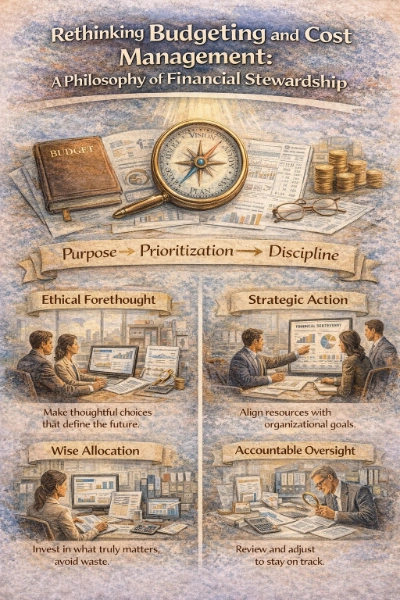
A watercolor-style infographic presenting budgeting and cost management as a form of financial stewardship. The title reads “Rethinking Budgeting and Cost Management: A Philosophy of Financial Stewardship.” At the top, a brass compass rests on financial documents beside a “Budget” book and stacks of coins, symbolizing direction, restraint, and purposeful choice. A banner highlights “Purpose → Prioritization → Discipline.” Four illustrated panels expand the theme: Ethical Foresight (teams weighing choices with dashboards and reports), Strategic Action (leaders aligning resources with goals using charts), Wise Allocation (careful planning across screens, documents, and calculators to invest in what matters and reduce waste), and Accountable Oversight (review and adjustment using checks and analysis tools). The overall design blends warm and cool tones to convey balance between ambition and responsibility.
Budgeting and Cost Management: The Essential Pillars
1. Thoughtful Budget Creation
Budget creation is not a mere clerical task—it is a deliberate act of visioning the future. It begins with forecasting revenues, operating costs, capital expenditures, and other core financial metrics over a chosen period—whether monthly, quarterly, or annually. But beyond the numbers lies something more profound: a philosophical exercise in prioritization.
At its core, budgeting draws on historical financial reporting, predictive analytics, and a deep understanding of operational context. Budgets are organized into operational, capital, and cash flow budgets to offer clarity and early warnings.
2. Variance Analysis
No budget, however meticulous, unfolds exactly as planned. Variance analysis compares actual financial outcomes to what was budgeted, illuminating the distance between expectation and reality to offer insight rather than blame.
The deeper purpose lies in learning. Paired with accounting best practices, variance analysis enables budgets to evolve from static documents into living tools for continuous improvement.
3. Cost Control
Cost control is about spending wisely, not cheaply. It integrates budgeting and cost management principles to evaluate both fixed and variable costs using lean management and digital tools.
For further reading on practical tools, review the CFO’s guide to digital cost control. Ultimately, true cost control rests on a culture of shared accountability.
4. Continuous Monitoring
Budgeting and cost management require constant vigilance as external environments shift. Continuous monitoring utilizes real-time data, rapid reviews, scenario planning, and contingency budgeting.
Rebalancing priorities reflects a capacity for strategic responsiveness, allowing organizations to live wisely within constraints while reaching for growth.
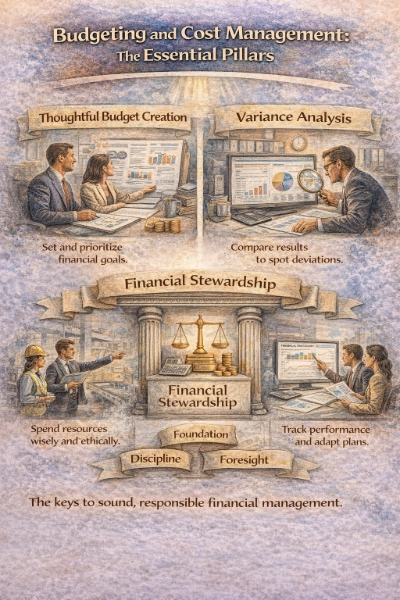
A watercolor-style educational infographic that presents budgeting and cost management as four interconnected pillars. The title reads “Budgeting and Cost Management: The Essential Pillars.” The top-left panel, Thoughtful Budget Creation, shows professionals discussing forecasts and charts, with coins and documents suggesting priority-setting and future planning. The top-right panel, Variance Analysis, depicts an analyst comparing results on a screen with a magnifying glass, representing the careful interpretation of deviations between plan and reality. In the center, a classical-column motif labeled Financial Stewardship features scales, a calculator, and stacked coins, symbolizing ethical responsibility and disciplined decision-making. Surrounding scenes suggest Cost Control (spending resources wisely across operations) and Continuous Monitoring & Adjustment (tracking performance on dashboards and adapting plans). Banners at the base emphasize “Foundation,” “Discipline,” and “Foresight,” reinforcing the philosophical theme of stewardship guiding sound financial management.
From Planning to Profitability: Real-World Applications of Budgeting Wisdom
Project Budgeting & Cost Optimization
In complex fields like engineering and construction, project budgeting acts as the operational nervous system. Utilizing Earned Value Management (EVM) and software tools helps track deadlines, cost thresholds, and quality compliance proactively.
Activity-Based Costing in Manufacturing
In the manufacturing sector, Activity-Based Costing (ABC) traces exact resource consumption across labor and machinery, eliminating subsidization of low-margin products and refining pricing.
Budgeting for Strategic Expansion
Expansion requires balancing ambition with anchors. Following core budgeting and cost management principles prevents new market entries from bleeding resources away from core enterprise operations.
Government & Nonprofit Stewardship
Nonprofits and governments measure success by public good. Adhering to standards set by institutions like the International Monetary Fund (IMF) ensures transparency and ethical stewardship in financial reporting.
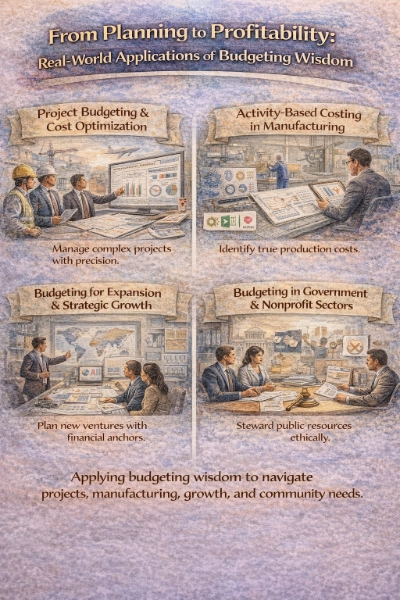
A watercolor-style educational infographic that illustrates how budgeting and cost management support decision-making across sectors. The title reads “From Planning to Profitability: Real-World Applications of Budgeting Wisdom.” Four illustrated panels present: Project Budgeting & Cost Optimization, showing engineers and project leaders coordinating around schedules and charts to manage complex timelines and costs; Activity-Based Costing in Manufacturing, featuring production equipment and dashboards that trace resource use to reveal true product costs; Budgeting for Expansion & Strategic Growth, depicting strategic planning with market maps, forecasts, and investment decisions; and Budgeting in Government & Nonprofit Sectors, showing stakeholders reviewing reports and civic priorities to emphasize transparency and ethical stewardship. A concluding message ties the panels together: budgeting wisdom helps navigate projects, manufacturing efficiency, expansion decisions, and community needs.
The Enduring Payoff of Strategic Budgeting and Cost Mastery
Enhanced Financial Control: The Power to Steer, Not Merely Float
Financial control is not simply the act of watching numbers move—it is the art of influencing direction. With robust budgeting frameworks and cost strategies in place, organizations gain more than just visibility into their financial reporting—they gain agency. Smart budgeting establishes guardrails, while real-time tracking of income and expenditures allows leaders to detect drift before it becomes disaster.
Control here does not imply rigidity. In fact, the most financially empowered organizations are those that remain fluid—able to pivot resources without derailing operations. Budget dashboards, variance analysis, and forecasting tools allow managers to not only follow the money, but anticipate where it must go next.
Informed Decision-Making: Data as the Compass of Strategy
In the absence of financial clarity, even the boldest strategic visions risk becoming castles in the air. Smart budgeting strategies ground decisions in evidence, not intuition. They provide leadership teams with access to clean, contextualized, and timely data—fueling confident choices at every level.
When data flows freely across budgeting, accounting, and operations, leaders can see with clarity, forecast with wisdom, and act with intention.
Increased Operational Efficiency: Precision Without Waste
Efficiency lies in matching effort with outcome, input with output. Through cost center analysis, activity-based costing, and lean budget practices, organizations can reclaim lost resources and reinvest them where they generate the most value—refining procurement, energy usage, and workflow productivity.
Risk Mitigation: Fortifying the Organization Against the Unknown
Budgeting and cost strategies render risk legible. Through scenario modeling, reserve allocations, and early-warning indicators, budgeting becomes the silent guardian of an organization’s resilience during economic turbulence or shifts in tax planning.
Alignment with Organizational Goals: Making Money Serve Meaning
At its highest expression, budgeting aligns financial choices with strategic priorities, making the abstract concrete. It transforms mission statements into line items and visions into actionable, purpose-driven investments.
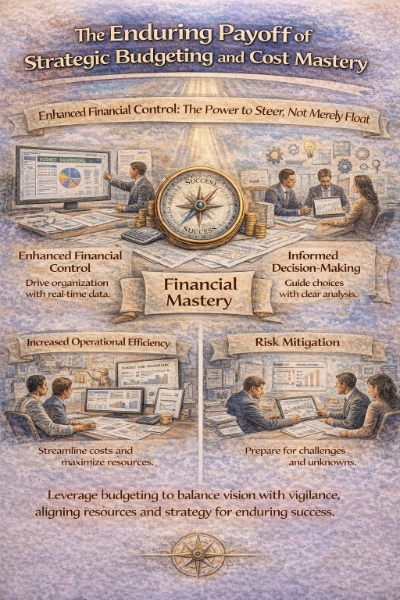
A watercolor-style infographic that visualizes the long-term benefits of strategic budgeting and cost mastery. The title reads “The Enduring Payoff of Strategic Budgeting and Cost Mastery.” At the center sits a brass compass symbolizing direction and stewardship, placed over financial documents and coins, and labeled “Financial Mastery.” Four surrounding panels illustrate key outcomes: Enhanced Financial Control (a budget dashboard and real-time tracking), Informed Decision-Making (a leadership discussion using clear financial analysis), Increased Operational Efficiency (teams streamlining work with cost and performance charts), and Risk Mitigation (scenario planning and preparation for uncertainty). The overall layout communicates that budgeting transforms money from a passive record into an active guide—aligning resources, strategy, and resilience for enduring success.
Navigating the Deeper Pitfalls of Budgeting and Cost Management
Uncertain Market Conditions: When the Map No Longer Matches the Terrain
Sudden economic downturns, geopolitical conflicts, or raw material shortages can render fixed budgets obsolete overnight. Agile enterprises build adaptive mechanisms into their budgeting and cost management processes—using rolling forecasts, scenario analysis, and dynamic reallocation strategies.
Data Accuracy: The Fragile Foundation Beneath Every Forecast
A budget is only as reliable as its data. Gathering accurate financial data demands well-integrated enterprise resource planning (ERP) systems, ethical accounting practices, and strict data literacy across departments.
Resistance to Cost Control Measures: The Human Heart of Every System
Behind every spreadsheet is a person. Perception of cost control often evokes fear of austerity. Cost management must be participatory, transparent, and empathetic to align company culture with organizational longevity.
Technological Integration: The Double-Edged Sword of Digital Progress
Advanced budgeting tools promise real-time insights, but implementation requires technical onboarding and proper alignment. Technology must serve strategic vision and human intelligence, rather than obscuring structural issues with complex dashboards.
Interactive Simulator: Break-Even & Variance Analysis Calculator
Adjust operational inputs below to simulate financial break-even volume, target revenue, and budget variance in real time.
Simulation Results
Sharpening the Tools of Budgeting and Cost Management
Building Financial Awareness and Responsibility
Budgeting and cost management are essential life skills that help students make informed decisions about how to allocate resources. By studying these subjects, students preparing for university develop a strong sense of financial awareness, learning how to plan, monitor, and control spending. This knowledge is valuable not only in business contexts but also for managing personal finances—skills that are especially important when budgeting for tuition, living expenses, and academic resources in university life.
Understanding How Organizations Make Decisions
In both public and private sectors, budgeting and cost control are crucial for strategic planning and decision-making. Students who study these topics gain insight into how organizations forecast expenses, prioritize investments, and evaluate performance. This understanding provides a valuable head start for university courses in business, economics, accounting, and public administration, where financial planning is often central to the curriculum.
Strengthening Analytical and Planning Skills
Budgeting and cost management require logical thinking, data interpretation, and scenario analysis. Students learn to compare actual results with projections, identify variances, and adjust future plans accordingly. These activities help build essential skills in analysis, organization, and problem-solving—skills that are critical for tackling complex university assignments, managing academic workloads, and working on group projects effectively.
Linking Costs to Performance and Efficiency
Effective cost management is about more than just cutting expenses—it’s about maximizing value and efficiency. Students are introduced to concepts like cost behavior, break-even analysis, and performance measurement, which are foundational in disciplines such as engineering, project management, logistics, and healthcare administration. This early exposure prepares students to think critically about how resources are used in both academic and professional environments.
Preparing for Diverse Career and Academic Pathways
A background in budgeting and cost management opens opportunities in fields such as accounting, finance, business strategy, operations management, and nonprofit administration. For students entering university, it provides a practical and versatile toolkit for academic success and long-term career growth. It also encourages a mindset of accountability, foresight, and resourcefulness—traits that are essential for thriving in today’s competitive and resource-conscious world.
Budgeting in Perspective: A Journey of Discipline, Vision, and Renewal
At first glance, budgeting and cost management may seem like exercises in arithmetic—detailed rows of numbers, forecasts, and balance sheets. Yet when examined more closely, they reveal themselves as profound acts of intention. They are not just tools to control money, but instruments through which organizations express their values, shape their futures, and navigate a world that is anything but predictable.
We have learned that budgeting is far more than a once-a-year ritual. It is a dynamic process of reflection and adaptation, a continuous dialogue between what an organization hopes to become and what its current resources will allow. In this sense, a budget is not a cage but a canvas—a structured space where vision meets feasibility, and purpose becomes actionable.
We have seen how financial reporting gains meaning when built upon a thoughtful budget. We’ve explored how informed decision-making emerges when cost data is accurate, timely, and ethically interpreted. We’ve recognized that resistance to cost control is often rooted not in stubbornness, but in a deep human need for understanding and dignity. We’ve acknowledged that technologies promise acceleration, but only serve when aligned with human intelligence and organizational context.
Whether in a small business navigating its first year of operation or in a multinational corporation planning across dozens of time zones, budgeting provides structure in uncertainty. It allows organizations to weather economic turbulence, reallocate resources when the unexpected arises, and align financial planning with both short-term agility and long-term aspirations. In times of prosperity, budgeting tempers excess with prudence. In times of crisis, it transforms fear into foresight.
Yet perhaps the most enduring lesson is that budgeting is a moral practice. It compels leaders to ask difficult but essential questions: Are we funding what truly matters? Are we transparent in how we allocate resources? Are we building systems that are fair, inclusive, and sustainable? In these moments, budgeting transcends financial strategy and enters the realm of institutional character.
Ultimately, budgeting and cost management are not just about sustainability—they are about stewardship. They offer a way for organizations to care for what they’ve built, honor those who contribute, and prepare for the unknown with both courage and clarity. When practiced with discipline, creativity, and empathy, they become quiet acts of leadership—setting in motion a chain of choices that ripple far beyond the numbers themselves.
As we step back and take budgeting in perspective, we see it not as a constraint, but as an enabling force—one that grounds dreams, aligns efforts, and makes enduring success not just possible, but purposeful.
Frequently Asked Questions — Budgeting and Cost Management
1. What is budgeting in accounting, and why is it important for organisations?
Budgeting is the process of planning future income, costs, and resource use over a specific period, usually a financial year. It is important because it turns strategy into numbers, helps managers allocate resources, coordinates activities across departments, and provides benchmarks to compare actual performance against planned targets.
2. What is cost management, and how does it relate to budgeting?
Cost management focuses on understanding, controlling, and optimising the costs of activities, products, and services so that resources are used efficiently. It is closely linked to budgeting because planned costs in the budget must be supported by realistic cost structures and ongoing efforts to monitor, reduce, or reconfigure costs without damaging quality or value.
3. What are the main types of budgets used in organisations?
Common types of budgets include the sales budget, production or service budget, operating expense budget, cash budget, capital expenditure budget, and the overall master budget. Some organisations also use flexible budgets and rolling forecasts to adjust more quickly when conditions change.
4. What is the difference between fixed budgets and flexible budgets?
A fixed budget is set for a single level of activity and does not change even if actual volume differs from the plan. A flexible budget adjusts revenues and costs to the actual level of activity, making it easier to analyse whether variances are due to efficiency or simply to changes in volume.
5. What is variance analysis in budgeting and cost management?
Variance analysis compares actual results with budgeted figures and investigates the reasons for differences. Managers may analyse sales price and volume variances, material price and usage variances, labour rate and efficiency variances, and overhead variances to understand performance and take corrective action.
6. What is standard costing, and how is it used in cost management?
Standard costing involves setting predetermined cost benchmarks for materials, labour, and overhead for each unit of output. These standards are used to prepare budgets, price products, and measure performance. Differences between standard costs and actual costs are analysed as variances to identify efficiency issues or price pressures.
7. How does activity-based costing (ABC) improve cost management?
Activity-based costing traces overhead and support costs to products, services, or customers based on the activities that drive those costs. By using cost drivers such as set-up hours, machine hours, or number of orders, ABC gives a more accurate picture of which products or segments are truly profitable and where process improvements will have the biggest impact.
8. What is the role of budgeting in performance evaluation and control?
Budgets provide targets for revenue, cost, and profit that managers are expected to achieve. Actual results are compared with these targets, and significant deviations are investigated. This helps senior management see which units are performing well, which need support, and whether strategies and assumptions need to be updated.
9. What behavioural issues can arise from budgeting systems?
Budgeting can create behavioural challenges such as budgetary slack (deliberately underestimating revenue or overestimating costs), short-termism (focusing on this year’s targets at the expense of long-term value), and gaming of performance measures. Good budgeting systems encourage participation, transparency, and learning instead of fear and blame.
10. How is technology changing budgeting and cost management practices?
Technology enables more frequent forecasting, scenario analysis, and real-time tracking of key cost drivers. Cloud-based planning tools, data analytics, and dashboards allow organisations to move from static annual budgets towards more dynamic planning and control, while still requiring human judgment to interpret patterns and trade-offs.
11. What skills are useful for students who want to specialise in budgeting and cost management?
Useful skills include strong numerical and Excel skills, a good understanding of financial and management accounting, comfort with data analysis, and the ability to interpret cost behaviour in different contexts. Equally important are communication skills, curiosity about how organisations actually operate, and the ability to explain numbers to non-accountants.
12. How can knowledge of budgeting and cost management help my future career even if I am not a finance specialist?
Understanding budgeting and cost management helps you plan resources, justify project proposals, and interpret performance reports in any role. Whether you work in marketing, operations, public policy, or start your own business, you will make better decisions if you understand how costs behave, how budgets are put together, and how financial constraints shape strategic choices.
Time for Reflection: Pivotal Questions in Budgeting and Cost Management
-
What is budgeting and why is it important for businesses?
Answer: Budgeting is the process of creating a financial plan that outlines expected income and expenses over a period. It is crucial for businesses as it helps allocate resources, monitor performance, and achieve financial goals. -
What is cost management, and how does it differ from budgeting?
Answer: Cost management focuses on controlling and reducing business expenses through analysis and strategic planning, while budgeting provides a forecast of revenues and expenditures. Together, they ensure financial stability and efficiency. -
How do variance analysis and performance reporting support budgeting efforts?
Answer: Variance analysis compares actual performance against budgeted figures, identifying discrepancies and helping management take corrective actions. This process is essential for tracking progress and improving financial decision-making. -
What are fixed and variable costs, and why is understanding them important in cost management?
Answer: Fixed costs remain constant regardless of production levels, while variable costs change with activity volume. Understanding both is critical for pricing, forecasting, and making informed cost-control decisions. -
How does break-even analysis assist in financial planning?
Answer: Break-even analysis determines the sales volume needed to cover all costs, indicating when a business becomes profitable. This analysis aids in pricing, cost control, and setting realistic financial targets. -
What role do standard costs play in budgeting and cost management?
Answer: Standard costs are predetermined expense estimates used to measure performance. They serve as benchmarks for comparing actual costs, facilitating variance analysis and helping identify areas for improvement. -
How can a company use activity-based costing to improve cost management?
Answer: Activity-based costing allocates overhead costs based on actual activities that drive costs. This method provides more accurate cost information, helping businesses identify inefficiencies and optimize resource allocation. -
What are the benefits of integrating budgeting with strategic planning?
Answer: Integrating budgeting with strategic planning aligns financial resources with long-term goals, ensuring that investment decisions support overall business strategy, enhance operational efficiency, and drive growth. -
How does cash flow forecasting complement budgeting in managing business finances?
Answer: Cash flow forecasting projects the timing of cash inflows and outflows, helping businesses manage liquidity, avoid shortfalls, and plan for future expenditures. It is a key component of effective financial management. -
What are some common challenges in budgeting and cost management, and how can they be addressed?
Answer: Challenges include inaccurate forecasts, unexpected expenses, and inefficient resource allocation. These can be addressed by using robust financial models, continuous monitoring, variance analysis, and adjusting strategies based on real-time performance data.
Thinking Strategically: Deeper Questions on Budgeting and Cost Management
-
How can companies leverage technology to enhance their budgeting processes?
Answer: Advanced software and data analytics tools can streamline budgeting by automating data collection, enabling real-time updates, and providing predictive insights. This allows companies to make agile adjustments and optimize resource allocation based on current market trends. -
In what ways does effective cost management influence long-term business sustainability?
Answer: Effective cost management reduces waste, improves profitability, and enables reinvestment in innovation. By continuously monitoring and controlling costs, businesses can adapt to market fluctuations, sustain growth, and remain competitive over the long term. -
How might the adoption of zero-based budgeting change traditional budgeting practices?
Answer: Zero-based budgeting requires justifying every expense from scratch rather than relying on historical data. This approach can lead to more efficient allocation of resources, reduce unnecessary costs, and foster a culture of accountability and innovation within an organization. -
What is the impact of external economic factors on a company’s budgeting process?
Answer: External factors such as inflation, interest rates, and market volatility can affect revenue projections and cost estimates. Companies must adapt their budgets to account for these uncertainties by incorporating flexible planning and scenario analysis. -
How can variance analysis be improved to provide more actionable insights for cost control?
Answer: Enhancing variance analysis involves integrating advanced analytics, real-time monitoring, and predictive modeling to quickly identify deviations and determine their root causes. This allows management to implement timely corrective measures and optimize operational efficiency. -
In what ways can cross-departmental collaboration improve the accuracy of budgeting forecasts?
Answer: Collaboration among departments ensures that budgets reflect realistic projections and comprehensive insights. By sharing data and aligning objectives, teams can identify interdependencies, reduce redundancies, and create more accurate and cohesive financial plans. -
How do fixed and variable costs affect pricing strategies in competitive markets?
Answer: Understanding fixed and variable costs helps businesses set prices that cover expenses while remaining competitive. Analyzing cost behavior allows companies to optimize pricing strategies, maintain profit margins, and respond effectively to market changes. -
What role does risk management play in the budgeting process?
Answer: Risk management identifies potential financial uncertainties and incorporates contingency plans into the budget. This proactive approach helps businesses mitigate risks, manage unexpected expenses, and maintain financial stability during downturns. -
How might emerging trends in environmental sustainability affect budgeting and cost management practices?
Answer: Sustainability trends may lead companies to invest in eco-friendly technologies and materials, altering cost structures. Budgets will need to account for these investments while balancing short-term expenses with long-term environmental and economic benefits. -
How can organizations use performance metrics to continuously improve their budgeting process?
Answer: Performance metrics such as variance, return on investment, and cost efficiency provide valuable feedback on budget execution. By regularly analyzing these metrics, organizations can identify areas for improvement, refine forecasting methods, and enhance overall financial management. -
What are the potential benefits of adopting agile budgeting in a rapidly changing market?
Answer: Agile budgeting allows organizations to quickly adjust their financial plans in response to market changes. This flexibility improves decision-making, ensures resource allocation aligns with current conditions, and enhances the organization’s ability to capitalize on emerging opportunities. -
How does the integration of financial and operational data improve budgeting accuracy and strategic decision-making?
Answer: Integrating financial data with operational metrics provides a holistic view of performance, enabling more precise forecasting and better alignment of budget allocations with business goals. This comprehensive approach fosters informed decisions that drive efficiency and growth.
Solving Budgeting and Cost Management Problems Step by Step
-
A company has a budget of $200,000 for the fiscal year. If 30% is allocated for research and development, how much is allocated for R&D?
Solution: R&D allocation = 0.30 × $200,000 = $60,000. -
A department’s monthly operating cost is $25,000. What is the annual operating cost?
Solution: Annual cost = $25,000 × 12 = $300,000. -
A firm aims to reduce its costs by 12% from $500,000. Calculate the amount of cost savings.
Solution: Cost savings = 0.12 × $500,000 = $60,000. -
A company’s break-even point is reached when it sells 10,000 units. If each unit sells for $50, what is the total revenue at break-even?
Solution: Break-even revenue = 10,000 × $50 = $500,000. -
If fixed costs are $150,000 and the variable cost per unit is $20, calculate the total cost for producing 8,000 units.
Solution: Total variable cost = 8,000 × $20 = $160,000Total Cost = Fixed Costs + Total Variable Cost
Total Cost = $150,000 + $160,000 = $310,000 -
A company’s sales increase by 18% from $1,000,000. What is the new sales figure?
Solution: Increase = 0.18 × $1,000,000 = $180,000
New sales = $1,000,000 + $180,000 = $1,180,000. -
If the cost per unit is $30 and the company wants to achieve a profit margin of 25% on sales, what should be the minimum selling price per unit?
Solution: Desired profit = 25% of selling price (P)
Cost + Profit = P30 + 0.25P = P
P – 0.25P = 30
0.75P = 30
P = 30 / 0.75 = $40 -
A project’s budget is $350,000. If 40% is spent on materials and the rest on labor, what is the labor budget?
Solution: Labor budget = 60% of $350,000 = 0.60 × $350,000 = $210,000. -
A company uses an overhead rate of 150% of direct labor cost. If the direct labor cost is $100,000, what is the total overhead cost?
Solution: Overhead cost = 1.50 × $100,000 = $150,000. -
If a budgeting error results in a 5% overspend on a project with a planned cost of $500,000, calculate the amount of the overspend.
Solution: Overspend = 0.05 × $500,000 = $25,000. -
A firm expects a 10% increase in production volume from 20,000 to 22,000 units. Calculate the percentage increase.
Solution:Percentage Increase = [(22,000 – 20,000) / 20,000] × 100 = (2,000 / 20,000) × 100 = 10% -
A cost management analysis shows that reducing variable costs by $5 per unit would improve profit margins by 8%. If current variable cost per unit is $25, what will be the new variable cost?
Solution: New variable cost = $25 – $5 = $20 per unit.