
Tax compliance and planning are not merely technical obligations buried in accounting departments—they are fundamental expressions of an organization’s ethical posture and strategic foresight. These dual pillars serve as both the shield and compass of modern financial management: compliance ensures that a business meets its legal obligations faithfully, while planning allows it to navigate complexity with prudence and intention. Together, they reflect the heart of responsible Accounting.
On the compliance side, organizations must align their operations with statutory requirements—accurately reporting income, expenses, liabilities, and deductions. This includes timely filing, transparent disclosures, and the maintenance of detailed records that stand up to scrutiny. Compliance is not optional; it is the boundary that separates lawful operation from legal exposure. It is supported by systems such as Auditing and Financial Reporting, which provide validation and public confidence. A clean audit trail, maintained through consistent and honest reporting, becomes a testament to an organization’s integrity.
Planning, however, is where tax becomes not a burden, but a strategic opportunity. Tax planning is not about evasion, nor about loopholes, but about foresight—structuring business decisions in a way that minimizes liabilities within the bounds of the law. Through frameworks grounded in Budgeting and Cost Management, organizations evaluate timing, jurisdiction, capital structure, and resource deployment to optimize their tax outcomes. A well-planned tax strategy can unlock resources for reinvestment, innovation, and long-term sustainability.
In the broader context of Business, Economics and Law, tax consciousness is not confined to the finance department—it permeates all organizational functions. In Business Administration, tax strategy determines whether to expand, consolidate, or restructure. In Finance, it influences capital budgeting, dividend policy, and risk profiles. In Operations Management, it affects supply chain costs and production location choices. In Strategic Management, tax insights feed directly into mergers, acquisitions, and long-term growth trajectories.
Tax also speaks to branding. Consider the influence of tax regimes on Marketing: decisions about pricing, product launch timing, and market entry are shaped in part by fiscal impact. In Business Analytics, tax-related data becomes an input for predictive modeling and KPI analysis. In International Business, differences in tax codes can spell the difference between opportunity and overreach—requiring deep understanding of treaties, withholding taxes, and cross-border compliance.
Managing tax risk is inseparable from strong Corporate Law frameworks. Effective Corporate Governance ensures that tax planning is aligned with company values and stakeholder expectations. Compliance and Regulatory Adherence prevent exposure to legal and reputational damage. Negotiated instruments—like contract negotiation or Mergers and Acquisitions (M&A)—often hinge on tax liabilities, deductions, or deferred credits. Even intellectual property protection carries tax implications in terms of amortization, international licensing, and R&D incentives.
To practice tax planning well, one must look beyond internal affairs and understand the world’s evolving fiscal topography. Knowledge of Economics is essential—not only for understanding macro-trends such as inflation or currency movements but for evaluating the tax environment across sectors. Policy Analysis informs whether legislative shifts are likely to favor capital, labor, or innovation. Meanwhile, Trade regulations dictate how cross-border value chains are taxed and monitored.
Technology plays a pivotal role. Sophisticated data visualization tools and integrated accounting systems enable real-time tracking of tax positions, risk flagging, and reporting accuracy. These platforms strengthen audit trails, highlight discrepancies, and support transparency across departments. In a world where tax authorities increasingly deploy AI and data analytics for enforcement, organizations must match this with digital vigilance and precision.
And finally, tax knowledge is not the exclusive domain of financial elites. It is increasingly taught in education, preparing future leaders in both public and private sectors to engage with tax not as a burden, but as a tool for just and sustainable governance. Tax affects healthcare budgets, educational grants, environmental policy, and more. A society’s tax strategy often reflects its moral vision—who pays, who benefits, and what the system encourages or disincentivizes.
In this light, tax compliance and planning are not mere ledger entries or legal hoops. They are reflections of vision and values—of how an organization, or a nation, chooses to fund its present and shape its future. They are quiet yet powerful forces, shaping decisions, protecting assets, and ensuring that financial ambition walks hand-in-hand with civic responsibility.

A clean, monochrome illustration represents tax compliance. At the center is a tax form with multiple checkmarks, surrounded by calculators, bar charts, upward arrows, a pen, and a business suit silhouette. The imagery conveys accurate calculations, documentation, and verification steps required for proper tax reporting and audit readiness. The overall tone emphasizes organization, transparency, and adherence to regulations.
Regulatory Alignment and Strategic Positioning of Financial Activities
Tax Compliance and Planning: Navigating the Fine Balance Between Duty and Strategy
Tax compliance and tax planning are two sides of the same ethical coin—deeply interwoven practices that define how an organization positions itself in relation to the state, society, and its own future. On the surface, these terms may appear procedural: filing forms, ticking boxes, balancing debits and credits. But beneath this lies a far richer narrative—one of stewardship, transparency, foresight, and adaptation.
To engage in tax compliance is to accept the social contract between enterprise and governance. It is a commitment to act within the boundaries of national and international law, reporting income faithfully and contributing to the shared economic infrastructure. It is a public act of accountability—one that supports public goods, maintains order, and upholds trust in the financial system. Supported by systems like Accounting, Auditing, and Financial Reporting, it ensures clarity in disclosures and integrity in process.
Tax planning, on the other hand, is the art of purposeful foresight. It asks: how might we structure our affairs—legally, ethically, and strategically—to preserve capital, reinvest wisely, and strengthen our financial foundation? It does not defy the law; it works respectfully within it, making full use of allowances, deductions, incentives, and jurisdictional frameworks to support long-term goals. Tax planning is not an evasion of duty, but an optimization of destiny. It is where compliance meets creativity, and where stewardship embraces strategy.
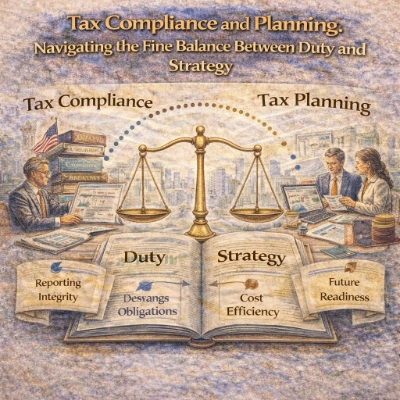
A watercolor-style educational infographic that visualizes tax practice as a balance between obligation and strategy. The composition is split into two halves: Tax Compliance on the left, where a professional reviews forms, records, and supporting documents to represent accurate filing, integrity, and adherence to law; and Tax Planning on the right, where a small team studies charts and projections to represent lawful optimization, reinvestment, and long-term preparation. At the center, golden balance scales sit above an open ledger, with banners emphasizing the twin themes of Duty and Strategy. A softly rendered city skyline in the background reinforces the connection between organizations, governance, and society, while the overall tone communicates stewardship, transparency, and forward-looking decision-making.
Guiding Objectives That Illuminate Ethical and Strategic Tax Practice
1. Adherence to Regulations
Honoring the rule of law requires timely and accurate filings, proper expense classification, and detailed recordkeeping to avoid fines, audits, and reputational damage.
Supported by Budgeting and Cost Management systems, regulatory adherence anchors strategic positioning in ethical governance.
2. Tax Liability Minimization
Reducing tax liabilities within statutory boundaries involves utilizing R&D incentives, capital gains provisions, deductions, and credit structures effectively.
Ethical planning ensures liability reduction balances wisdom in resource management with social responsibility and public contribution.
3. Strategic Financial Management
Integrating tax insights into core Business Administration disciplines—including Finance, Operations Management, and Strategic Management—builds resilient corporate architecture.
4. Risk Mitigation
Managing tax exposure requires internal controls, active documentation, and legal safeguards rooted in Corporate Governance, Compliance and Regulatory Adherence, and Corporate Law.
Proactive risk preparedness protects key transactions in contract negotiation, Mergers and Acquisitions (M&A), and intellectual property protection.
When these objectives are embraced—not simply as operational mandates, but as philosophical commitments—tax compliance and planning become instruments of stability, reputation, and wisdom. They allow an organization to walk a path of lawful integrity while advancing its strategic purpose. In an age of regulatory complexity and global interdependence, these practices remain indispensable not only for survival, but for principled and enduring success.

A watercolor-style educational infographic that presents ethical and strategic tax practice as four interconnected objectives. At the center, Lady Justice stands above an open book, symbolizing the rule of law and principled decision-making. Radiating outward are four panels: Adherence to Regulations (a professional reviewing filings and records beside legal scales), Tax Liability Minimization (advisors examining charts and incentives to reduce taxes within legal bounds), Strategic Financial Management (teams aligning tax considerations with finance and operations planning), and Risk Mitigation (a shield and governance cues representing documentation, controls, and audit readiness). Soft cityscape imagery in the background reinforces real-world complexity, while the glowing columns and warm highlights suggest that good tax practice balances duty with strategy through disciplined, ethical stewardship.
The Essential Architecture of Tax Compliance and Planning
Tax compliance and planning are not simply bureaucratic necessities—they are acts of clarity, responsibility, and intelligent foresight. Within these practices lie a deeper promise: to balance civic duty with strategic judgment, and to ensure that individuals and organizations not only survive within fiscal systems, but thrive through them. Below are the essential components that form the pillars of responsible tax conduct, each contributing to the stability, transparency, and ethical resilience of both enterprise and society.
Tax Filing
Definition: The formal reporting of income, deductions, and credits to governmental authorities based on verifiable records.
- Individual & Corporate: Covers wage earners, freelancers, and businesses submitting returns linked to Auditing and Financial Reporting.
- Guidance: See the IRS guide to self-employment taxes.
Tax Advisory Services
Definition: Guiding entities through strategic choices to minimize exposure through incentive programs, R&D credits, and risk controls.
- Applications: Aligning business structures with tax-advantaged accounts and clean technology credits to boost ROI.
International Taxation
Definition: Managing cross-border tax compliance, double taxation treaties, and transfer pricing across multiple sovereign jurisdictions.
- Frameworks: Adhering to the OECD’s Base Erosion and Profit Shifting (BEPS) initiative.
In sum, these essential components—tax filing, advisory, and international strategy—form a triad of ethical navigation within the financial world. They are not just tools for survival, but instruments of trust, clarity, and vision. To engage deeply in tax compliance and planning is to participate fully in the shared economic project of justice, growth, and sustainable prosperity.
Turning Regulations into Strategy: Transforming Tax Compliance into Purposeful Action
Tax is often perceived as a burden—a set of rules to follow, deadlines to meet, and numbers to calculate. But when approached wisely, tax becomes a tool of transformation. It is no longer merely about compliance; it becomes about strategy, about foresight, and about channeling legal obligations into opportunities for long-term growth. Below, we explore how tax planning is not just a response to regulation, but a conscious act of financial authorship for both businesses and individuals.
Guiding Businesses Toward Strategic Tax Planning
Businesses align entity structures and investments with fiscal regulations. Using budgeting and cost management tools helps project future taxable obligations.
Example: Manufacturing firms leverage the IRS’s accelerated depreciation provisions on equipment to reduce taxable income.
Supporting Individuals with Complex Tax Realities
High-income earners and global executives utilize trusts, tax-efficient investments, and double-taxation treaties to transform regulatory complexity into long-term financial clarity.
Example: Creating charitable remainder trusts to defer capital gains while securing income during retirement.
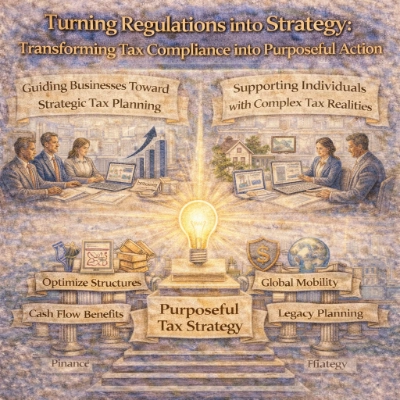
A watercolor-style educational infographic that frames tax compliance as a pathway to strategic action. The layout is divided into two mirrored halves. On the left, a business team reviews charts and growth projections, representing continuous corporate tax planning—entity structuring, timing of investments, and cash-flow optimization. On the right, advisors work with an individual client, representing complex personal tax realities—portfolio choices, estate and legacy planning, and cross-border obligations. A radiant lightbulb at the center symbolizes insight and foresight, connecting both halves under the theme of “purposeful tax strategy.” Supporting icons—such as a shield with a currency symbol, a globe, and planning documents—reinforce the idea that lawful compliance can be transformed into clarity, resilience, and long-term financial direction.
Scenarios Where Tax Compliance and Planning Come Alive
Corporate Restructuring
Scenario & Outcome: A firm expanding into Southeast Asia leverages regional Double Taxation Agreements (DTAs) to optimize effective tax rates in compliance with OECD BEPS standards.
Small Enterprise Deductions
Scenario & Outcome: Documenting vehicle mileage, home office usage, and startup equipment costs reduces net taxable income while maintaining accurate bookkeeping.
Expatriate Dual Taxation
Scenario & Outcome: A US citizen working in Germany applies foreign earned income exclusions and foreign tax credits to prevent dual taxation across borders.
Together, these examples illustrate that tax is more than a legal requirement—it is a canvas on which financial foresight, ethical judgment, and economic intelligence come together. When applied thoughtfully, tax planning becomes a vital instrument for protecting capital, advancing strategic goals, and contributing to a well-ordered global economy.
New Frontiers in Tax Compliance and Planning
- Digital Taxation Tools: Utilizing AI risk engines, real-time tax calculators, and automated filing software to process massive datasets error-free.
- ESG Integration & Green Tax Incentives: Capitalizing on clean energy investment credits and green building subsidies to align financial strategies with environmental goals.
- Global Minimum Tax Initiatives: Realigning multinational corporate structures to adhere to the OECD’s BEPS global minimum tax frameworks.
- Cryptocurrency Taxation: Implementing capital gains tracking and DeFi transaction accounting based on official cryptocurrency taxation guidelines.
- Personalized Tax Planning: Deploying predictive analytics to build tailored tax solutions for remote workers, high-net-worth individuals, and family offices.
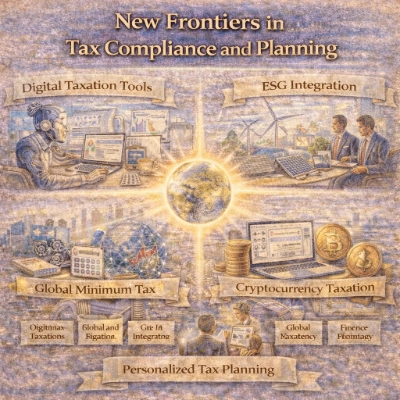
A watercolor-style educational infographic that shows how modern tax compliance and planning are evolving. A luminous globe at the center represents global interconnectedness and shared accountability. Around it, themed panels depict: Digital Taxation Tools (automation, AI dashboards, data-driven checks), ESG Integration (renewable energy imagery and sustainability-focused decision-making), Global Minimum Tax (cross-border coordination and fairer global rules), Cryptocurrency Taxation (digital assets and reporting challenges), and Personalized Tax Planning (tailored advisory using analytics to match life goals and complex realities). The overall design emphasizes that contemporary tax work blends technology, ethics, and global frameworks to turn compliance into forward-looking strategy.
Navigating the Complexities of Tax Laws and Policies
- Evolving Tax Laws: Continuously tracking statutory updates, reporting thresholds, and legislative revisions to avoid non-compliance penalties.
- Global Taxation Complexity: Managing multi-jurisdictional transfer pricing rules and permanent establishment risks.
- Documentation and Reporting Requirements: Maintaining an immutable audit paper trail of invoices, receipts, and intercompany contracts.
- Technological Adaptation: Transitioning from legacy spreadsheets to automated cloud compliance software.
- Audit Risk and Preparedness: Establishing robust internal controls to pass automated data-driven tax authority audits smoothly.
Interactive Tax Liability & Planning Simulator
Calculate net tax liability, tax savings from planning deductions, and effective tax rates based on custom revenues and expenses.
Tax Calculation & Optimization Breakdown
Why Tax Knowledge Matters in Business and Life
Understanding a Key Component of Financial Systems
Taxation plays a central role in how governments operate and how individuals and businesses manage their finances. Studying tax compliance and planning introduces students to the structure and purpose of tax systems, including how taxes are calculated, reported, and collected. For pre-university learners, this provides essential context for studying accounting, economics, business, and public policy at a deeper level.
Developing Real-World Financial Literacy
Tax compliance and planning help students understand how tax rules affect financial decisions in everyday life. By learning how to prepare tax filings, recognize allowable deductions, and plan income or expenses efficiently, students gain practical skills that will benefit them personally and professionally. This financial literacy is especially helpful for university-bound students who may begin managing their own income or dealing with part-time work and student expenses.
Building Analytical and Regulatory Awareness
Tax laws are complex and subject to change, requiring strong analytical thinking and attention to detail. Students studying tax compliance learn how to interpret legislation, apply rules to real-world scenarios, and recognize the importance of meeting legal obligations. These skills are directly applicable to coursework in law, accounting, and business ethics, where precision, logic, and critical evaluation are essential for success.
Exploring Ethical and Strategic Dimensions
Beyond following the rules, tax planning also involves making informed choices that align with long-term financial goals. Students are introduced to ethical considerations such as fairness, legal avoidance vs. evasion, and social responsibility. This fosters a mature understanding of how individuals and organizations balance compliance with strategy—an important theme in university studies and professional practice alike.
Preparing for Professional and Academic Opportunities
A foundation in tax compliance and planning supports future university coursework in accounting, finance, business law, and economics. It also opens doors to career paths in taxation, consulting, auditing, corporate finance, and government service. For students preparing for university, studying tax provides a clear and relevant introduction to financial systems, decision-making, and the regulatory environment they will encounter in more advanced studies.

A warm watercolor infographic that presents tax learning as a foundation for both business understanding and real-life decision-making. At the center, a radiant open book labeled “Tax Education” sits atop stacked volumes titled “Economics,” “Accounting,” and “Law,” symbolizing how tax connects these disciplines. Four illustrated corners expand the message: Understanding Financial Systems (a teacher and students studying taxation with civic and economic symbols), Developing Financial Literacy (people reviewing forms, budgets, and deductions), Building Analytical Skills (careful reading of rules with scales and documents suggesting legal precision), and Preparing for Career Opportunities (a mentorship or interview scene with professional cues). The overall composition emphasizes that tax knowledge builds practical capability, ethical awareness, and readiness for further study and careers.
Tax Compliance and Planning in Perspective: A Strategic Wrap-Up
In the grand theater of financial management, few roles are as foundational, misunderstood, or underestimated as Tax Compliance and Planning. To the casual observer, it may seem a dull recital of rules and figures—yet beneath the surface lies a symphony of logic, foresight, strategy, and moral reasoning. Far from being a mere checklist of filings and forms, tax compliance is the expression of civic accountability, while tax planning is the art of harmonizing growth with obligation. Together, they form the pulse that sustains responsible finance, enabling individuals and organizations to thrive within an increasingly complex legal and economic ecosystem.
The Cornerstones: Stability, Legality, and Strategic Intent
At its foundation, tax compliance ensures that one remains within the bounds of national and international laws. It involves the timely and accurate filing of returns, the documentation of income and deductions, and the maintenance of transparent records. This is not simply a matter of avoiding penalties—it is a demonstration of integrity. On the other hand, planning goes beyond compliance, seeking lawful pathways to optimize outcomes. It aligns taxation with broader financial goals, whether that means timing expenditures, leveraging credits, or structuring investments wisely.
Building Blocks of Tax Mastery
Effective tax strategy encompasses multiple domains. It begins with accurate financial reporting, which provides the factual bedrock upon which all tax determinations are made. From there, businesses and individuals engage in advisory services, interpreting the nuances of tax codes and applying them to context-specific challenges. This includes decisions about investment structures, charitable contributions, income deferrals, and use of tax-efficient vehicles such as trusts, pension plans, and tax havens—when appropriate and ethical.
In our globalized economy, international taxation emerges as a critical realm. Cross-border trade, remote work, intellectual property transfers, and multinational supply chains have all introduced new wrinkles into the compliance tapestry. Here, strategies like transfer pricing, treaty application, and the mitigation of double taxation come into play. The goal is not just to reduce burden but to manage exposure, safeguard reputations, and uphold fair contributions across jurisdictions.
Emerging Trends: The Future of Tax Is Already Here
Tax strategy is no longer static or reactive—it is being reshaped by sweeping global currents. Digital transformation, for instance, has introduced artificial intelligence tools that automate filing, detect anomalies, and optimize real-time tax planning scenarios. Compliance is becoming continuous rather than annual, embedded within enterprise systems and financial workflows.
Simultaneously, the rise of ESG (Environmental, Social, Governance) frameworks has woven moral accountability into the fabric of tax. Organizations are now rewarded with green tax incentives for investing in renewable energy, inclusive hiring, and sustainable infrastructure. The notion that taxation is merely an expense is giving way to a vision of tax as leverage—one that supports long-term ecological and social value.
Further, global tax reforms—such as the OECD’s Base Erosion and Profit Shifting (BEPS) initiative and the global minimum tax—are rewriting the rules for multinational corporations. These changes mark a philosophical shift toward fairness and transparency in a world where digital profits often transcend physical borders.
Tax as Strategic Foresight and Ethical Compass
Tax compliance and planning are not just tactical maneuvers. They are manifestations of corporate governance, personal responsibility, and societal trust. For businesses, they can affect investor confidence, customer loyalty, and brand reputation. For individuals, they reflect an understanding of one’s role as a contributor to the common good. At every level, tax choices carry both financial consequences and ethical undertones.
Meticulous tax planning is therefore a commitment to foresight—anticipating legislative changes, modeling scenarios, and adapting to risk. It is also a statement of intent, signaling whether one’s financial structure supports short-term gain or long-term stability. This is especially true for high-net-worth individuals, family-owned businesses, and international firms, where the margin for error is small and the scrutiny great.
The Power of Confidence in a Shifting Terrain
In a tax landscape shaped by uncertainty—economic shocks, regulatory revisions, technological disruption—the greatest asset is not clever loopholes, but confidence. Confidence born from accurate reporting, ethical guidance, strategic insight, and timely adaptation. With the right blend of professional expertise, technological tools, and principled planning, individuals and organizations can navigate even the most intricate tax terrains with assurance.
Final Thought: Beyond Compliance, Toward Contribution
In conclusion, tax compliance and planning are not the end goals—they are means to something greater. When viewed philosophically, tax is a dialogue between the self and the state, between profit and purpose. Those who master its intricacies become not just beneficiaries of financial efficiency but participants in a well-ordered society. Through diligence, creativity, and ethical clarity, tax transforms from burden to instrument—one that serves both personal success and the public good.
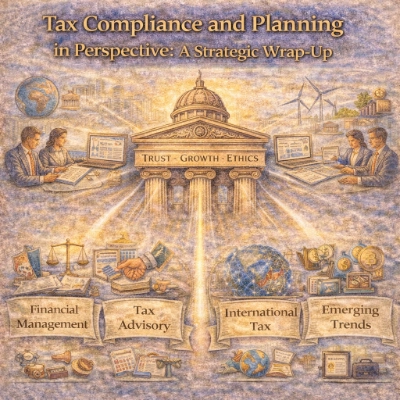
A watercolor-style infographic that frames tax compliance and planning as both civic duty and strategic foresight. At the center, a classical courthouse-like structure radiates light and carries the words “Trust • Growth • Ethics,” symbolizing lawful integrity and responsible governance. On the left and right, professionals review dashboards and documents on laptops, representing ongoing compliance, advisory planning, and decision-making. Along the bottom, four parchment banners label key domains—Financial Management, Tax Advisory, International Tax, and Emerging Trends—surrounded by icons such as legal scales, a handshake, a connected globe, digital symbols, and sustainability imagery. The overall scene conveys that modern tax practice integrates standards, ethics, technology, and cross-border awareness to turn regulation into purposeful action.
Frequently Asked Questions — Tax Compliance and Planning
1. What is tax compliance, and why is it important for individuals and businesses?
Tax compliance is the process of correctly registering with tax authorities, keeping required records, calculating taxes due, filing returns on time, and paying the correct amount of tax. It is important because it helps fund public services, reduces legal and financial risk, protects an organisation’s reputation, and supports long-term trust between taxpayers, governments, and society.
2. What is the difference between tax compliance and tax planning?
Tax compliance is about following tax laws and regulations as they stand, such as filing accurate returns and paying on time. Tax planning is about arranging affairs within the law to achieve tax-efficient outcomes—for example, choosing between different business structures, timing income and expenses, or using available reliefs and incentives. Both aim to work within the rules, but compliance is mandatory, while planning is strategic.
3. What is the difference between tax avoidance and tax evasion?
Tax avoidance involves arranging transactions within the law to reduce tax, for example by using allowances, deductions, and legitimate incentives. Tax evasion is illegal and involves deliberately hiding income, inflating expenses, or misrepresenting facts to reduce tax. Many tax systems now challenge aggressive avoidance schemes, so ethical judgment and a clear understanding of policy intent are increasingly important.
4. What are the main types of taxes that businesses typically deal with?
Typical business taxes include corporate income tax on profits, value-added tax or goods and services tax on sales, payroll-related taxes on salaries, withholding taxes on certain payments, and property or local business taxes. Depending on the jurisdiction and sector, businesses may also face excise duties, environmental taxes, or sector-specific levies that must be managed carefully.
5. What happens if a business fails to comply with tax laws?
Failure to comply with tax laws can lead to interest charges, financial penalties, back taxes, and in serious cases, criminal prosecution of responsible individuals. It can also damage relationships with investors, lenders, and customers, harm the organisation’s reputation, and distract management from core operations as they respond to audits, investigations, and disputes with tax authorities.
6. What does effective tax planning involve in practice?
Effective tax planning involves understanding the relevant tax rules, forecasting income and transactions, and choosing structures and timings that align commercial goals with tax efficiency. It may include making use of allowable deductions, reliefs, and incentives, selecting suitable business entities, managing cross-border transactions carefully, and documenting decisions so that they can be explained to tax authorities and other stakeholders.
7. How do international tax rules and double taxation agreements affect tax planning?
For cross-border activities, international tax rules and double taxation agreements help determine which country has taxing rights over income, how foreign tax credits work, and how to avoid taxing the same income twice. Tax planning must consider permanent establishments, transfer pricing rules, withholding taxes, and treaty benefits, while staying aligned with global initiatives that discourage profit shifting and abusive structures.
8. How is technology used in modern tax compliance and planning?
Technology supports tax compliance and planning through specialised tax software, e-filing systems, and data analytics tools. Organisations can automate routine calculations, reconcile large volumes of transaction data, monitor indirect tax exposures, and run scenario analyses. At the same time, tax authorities increasingly use digital reporting and data-matching tools, so clean data and robust systems are essential.
9. What is tax risk management, and why does documentation matter?
Tax risk management is the process of identifying, assessing, and controlling the uncertainties around tax positions. This includes understanding complex rules, designing controls over tax-sensitive processes, and deciding how much risk an organisation is willing to accept. Good documentation—such as memos, calculations, and board papers—helps show that positions are well-reasoned and supports the organisation in audits, disputes, or changes of management.
10. What skills are useful for students who want to specialise in tax compliance and planning?
Students who are interested in tax benefit from strong numerical skills, careful reading of legislation and guidance, and comfort with spreadsheets and tax software. Equally important are logical reasoning, curiosity about how businesses operate, clear written and oral communication, and an ethical mindset, because tax work often involves judgement and explaining complex rules to non-specialists.
11. What career paths are available in tax compliance and planning?
Graduates can start in tax departments within accounting and consulting firms, corporate in-house tax teams, or revenue authorities. Over time, they may move into specialist roles in international tax, indirect tax, transfer pricing, or tax technology, or progress into broader finance, risk, or policy roles where tax knowledge remains a key advantage.
12. How can learning about tax compliance and planning help my future career, even if I do not become a tax specialist?
Learning about tax compliance and planning helps you understand how governments raise revenue, how regulations shape business decisions, and how after-tax outcomes differ from simple profit figures. Whatever your field—management, entrepreneurship, public policy, law, or international business—you will make better decisions if you can recognise tax implications, ask informed questions, and work constructively with tax experts.
Essential Q&A for Mastering Tax Compliance and Planning
-
What is tax compliance, and why is it important for businesses?
Answer: Tax compliance involves adhering to all relevant tax laws and regulations by accurately reporting income, expenses, and other financial information. It is essential for avoiding penalties, ensuring legal operation, and maintaining a good reputation with tax authorities. -
What does tax planning entail?
Answer: Tax planning is the process of analyzing a company’s financial situation to arrange transactions in a way that minimizes tax liability while remaining compliant with legal requirements. It involves strategic decision-making to optimize after-tax income. -
How can businesses benefit from effective tax planning?
Answer: Effective tax planning helps businesses reduce their tax burden, free up cash for growth, and improve financial stability. It allows companies to take advantage of available deductions, credits, and incentives, leading to better overall financial management. -
What role do tax regulations play in tax compliance?
Answer: Tax regulations provide the framework within which businesses must operate, specifying reporting requirements, deadlines, and acceptable practices. Adherence to these rules is critical to avoid legal issues and maintain compliance. -
How does tax compliance contribute to corporate governance?
Answer: Maintaining tax compliance demonstrates an organization’s commitment to ethical practices and transparency. It is an integral part of corporate governance, ensuring accountability and fostering trust among stakeholders and regulatory bodies. -
What is the significance of maintaining accurate financial records in tax compliance?
Answer: Accurate financial records ensure that all taxable events are properly documented, facilitating correct tax reporting and reducing the risk of errors or audits. They provide the evidence needed to support claims for deductions and credits. -
How can businesses stay updated with changing tax laws and regulations?
Answer: Businesses can stay informed through regular training, subscribing to professional tax updates, consulting with tax advisors, and utilizing accounting software that integrates the latest regulatory changes. -
What is the impact of tax compliance on a company’s reputation?
Answer: A strong record of tax compliance enhances a company’s credibility with investors, customers, and regulators. It can improve public perception and provide a competitive edge by demonstrating financial responsibility and ethical behavior. -
How does strategic tax planning affect cash flow management?
Answer: Strategic tax planning helps manage cash flow by forecasting tax liabilities, scheduling payments, and identifying opportunities to defer taxes. This enables better budgeting and ensures that sufficient funds are available for operations and growth. -
What are some common challenges businesses face in tax compliance and planning?
Answer: Challenges include keeping up with frequent regulatory changes, managing complex international tax laws, and ensuring the accuracy of financial data. Overcoming these challenges requires effective systems, expert advice, and proactive management.
Exploring the Gray Areas: Reflective Tax Questions
-
How might the integration of advanced accounting software revolutionize tax compliance and planning in modern businesses?
Answer: The integration of advanced accounting software can significantly streamline tax compliance and planning by automating data entry, error-checking, and regulatory updates. This technology reduces the manual workload and minimizes human errors, ensuring that financial records are accurate and up-to-date. With automated reporting and real-time data analytics, businesses can quickly adapt to changing tax regulations and optimize their tax strategies accordingly.
Moreover, such software often includes modules for forecasting and scenario analysis, allowing companies to simulate various tax scenarios and plan strategically. This not only helps in minimizing tax liabilities but also improves cash flow management by predicting future tax obligations. Ultimately, the adoption of these technologies can lead to more efficient, compliant, and cost-effective tax management practices. -
What are the potential impacts of global tax reform on corporate tax planning strategies?
Answer: Global tax reform can have a profound impact on corporate tax planning strategies by altering the tax landscape in which businesses operate. Changes in international tax rules, such as modifications to transfer pricing regulations or the implementation of digital taxes, require companies to re-evaluate their existing strategies. These reforms may lead to restructuring of operations to optimize tax positions and mitigate increased liabilities. Companies must adapt by reassessing their intercompany transactions, supply chain logistics, and investment decisions to remain competitive.
Additionally, global tax reform can promote greater transparency and cooperation among countries, reducing opportunities for aggressive tax avoidance. This shift encourages companies to adopt more sustainable and ethical tax practices. The long-term impact includes not only a change in how taxes are managed but also an evolution in corporate governance and strategic decision-making, as businesses increasingly factor in regulatory risks when planning their operations. -
How does tax compliance contribute to the overall financial health and sustainability of a business?
Answer: Tax compliance is fundamental to maintaining the financial health and sustainability of a business. By ensuring accurate and timely tax payments, companies avoid legal penalties, fines, and interest charges that can strain financial resources. This adherence to tax regulations builds trust with investors, lenders, and regulators, contributing to a stable financial environment. When businesses consistently comply with tax laws, they also benefit from a smoother auditing process and a stronger reputation, which can lead to better financing terms and investment opportunities.
Furthermore, effective tax planning as part of compliance allows businesses to optimize cash flow and allocate resources more efficiently. It enables companies to forecast tax liabilities and make informed decisions about reinvestment and growth. In essence, tax compliance not only minimizes risk but also provides a strategic advantage by contributing to long-term financial stability and operational efficiency. -
What role do ethics and transparency play in effective tax planning and compliance?
Answer: Ethics and transparency are critical pillars of effective tax planning and compliance. Ethical tax practices ensure that businesses fulfill their legal obligations while contributing fairly to the economy. Transparency in tax reporting builds trust among stakeholders by providing a clear and honest picture of a company’s financial activities. When companies maintain ethical standards, they avoid aggressive tax avoidance schemes that can lead to reputational damage and regulatory scrutiny.
Transparency also facilitates better communication with tax authorities and investors, enabling smoother audits and more reliable financial forecasting. Companies that prioritize ethical tax practices are more likely to foster long-term relationships with stakeholders, which can lead to more sustainable business growth. In a global business environment, this commitment to ethics and transparency is increasingly important as consumers and regulators demand accountability and responsible corporate behavior. -
How can small businesses leverage tax planning to compete with larger corporations?
Answer: Small businesses can leverage tax planning to compete effectively with larger corporations by optimizing their tax positions and maximizing available deductions and credits. Unlike larger corporations that often have extensive tax planning departments, small businesses can benefit from targeted tax strategies that focus on reducing taxable income and improving cash flow. For instance, investing in technology for better record-keeping and seeking professional advice can help identify tax-saving opportunities that might otherwise be overlooked.
Moreover, small businesses can take advantage of incentives and grants designed to support entrepreneurship and innovation. By carefully planning their finances and staying informed about tax law changes, they can reduce their tax burden and reinvest the savings into growth initiatives. This strategic approach not only levels the playing field but also enhances their overall competitiveness in the market. -
What challenges do multinational companies face in tax compliance, and how can they overcome these challenges?
Answer: Multinational companies face numerous challenges in tax compliance, including varying tax regulations across countries, complex transfer pricing issues, and currency fluctuations. These challenges make it difficult to create a unified tax strategy that complies with all jurisdictions while minimizing liabilities. To overcome these issues, multinational corporations often invest in sophisticated accounting systems and hire tax experts who specialize in international tax law. They also adopt integrated tax management software to streamline compliance across borders and maintain real-time updates on regulatory changes.
In addition, multinational companies can use strategies such as tax treaties and transfer pricing adjustments to align their operations with local laws while optimizing their global tax burden. By continuously monitoring the international tax landscape and engaging in proactive tax planning, these companies can mitigate risks and ensure compliance, ultimately supporting their global growth and sustainability. -
How might the future evolution of digital currencies impact tax compliance and planning strategies?
Answer: The rise of digital currencies is poised to transform tax compliance and planning strategies significantly. As digital currencies become more widely adopted, tax authorities around the world are developing new regulations to track, report, and tax digital transactions. This evolution presents challenges such as tracking decentralized transactions, valuing digital assets, and ensuring transparency in cross-border transfers. Companies and individuals dealing with digital currencies will need to adopt new accounting practices and reporting standards to remain compliant.
Moreover, the integration of blockchain technology could improve transparency and accuracy in financial reporting, thereby aiding tax compliance. Blockchain’s immutable ledger can provide verifiable records of transactions, reducing fraud and ensuring that digital currency activities are properly recorded. As the regulatory framework evolves, businesses must stay informed and adapt their tax planning strategies to incorporate digital currencies, ensuring they maximize benefits while avoiding compliance pitfalls. -
What impact does tax policy uncertainty have on business planning and investment decisions?
Answer: Tax policy uncertainty can significantly disrupt business planning and investment decisions by creating unpredictability in future tax liabilities and financial outcomes. When tax laws are subject to frequent changes or unclear regulations, businesses may hesitate to make long-term investments or strategic financial decisions. This uncertainty can lead to conservative financial planning, reduced risk-taking, and potential delays in expansion or innovation initiatives. Companies often set aside additional reserves to account for potential tax fluctuations, which can affect cash flow and profitability.
On the other hand, some businesses may use uncertainty as an opportunity to hedge against risks by diversifying their operations or exploring tax-efficient investment strategies. To manage this uncertainty, companies typically engage in proactive tax planning and scenario analysis, allowing them to adapt quickly to regulatory changes. In the long term, stable and transparent tax policies are essential for fostering a favorable business environment that encourages growth and investment. -
How does effective tax compliance contribute to a company’s overall corporate governance?
Answer: Effective tax compliance is a key component of corporate governance as it reflects a company’s commitment to ethical practices, transparency, and accountability. By ensuring that all tax obligations are met accurately and on time, a company demonstrates integrity and builds trust with investors, regulators, and the public. Good tax practices also reduce the risk of financial penalties and reputational damage, which can have long-term negative effects on corporate performance and market perception.
Furthermore, a robust tax compliance system supports strategic decision-making by providing clear insights into the company’s financial obligations and tax planning opportunities. This, in turn, informs broader governance practices, ensuring that financial resources are managed prudently and in alignment with regulatory standards. Strong corporate governance, bolstered by effective tax compliance, is essential for sustainable growth and long-term success. -
What are the potential benefits of proactive tax planning for a company’s financial strategy?
Answer: Proactive tax planning can lead to significant benefits, including reduced tax liabilities, improved cash flow, and enhanced overall profitability. By forecasting tax obligations and identifying opportunities for deductions and credits, companies can optimize their financial strategies and allocate resources more effectively. This foresight enables businesses to invest in growth initiatives, reduce operating costs, and maintain a competitive edge in the market.
Additionally, proactive tax planning fosters a culture of compliance and transparency, which can improve relationships with tax authorities and investors. It minimizes the risk of audits and penalties while providing a strategic framework for navigating regulatory changes. Overall, proactive tax planning is a vital tool for achieving financial stability and supporting long-term business objectives. -
How can advances in accounting technology aid in real-time tax compliance monitoring?
Answer: Advances in accounting technology, such as cloud-based platforms and AI-powered analytics, enable real-time monitoring of financial transactions and tax obligations. These tools automate data collection and error-checking, ensuring that companies remain compliant with tax laws at all times. Real-time monitoring allows for immediate detection of discrepancies, facilitating prompt corrective action and reducing the risk of non-compliance.
Moreover, these technologies integrate seamlessly with existing financial systems, providing continuous updates on regulatory changes and tax codes. This level of automation not only enhances accuracy but also allows tax professionals to focus on strategic planning rather than manual data entry. Ultimately, such technological innovations improve operational efficiency and support proactive tax management. -
In what ways can effective tax compliance and planning enhance a company’s competitive advantage in the market?
Answer: Effective tax compliance and planning enhance a company’s competitive advantage by reducing its overall tax burden and freeing up capital for reinvestment. Through strategic planning, companies can optimize their tax positions, thereby lowering operating costs and improving profitability. This financial efficiency can then be reinvested in innovation, marketing, and expansion initiatives, helping the company stay ahead in competitive markets.
Furthermore, a strong reputation for tax compliance builds trust with investors, customers, and regulators, contributing to a positive corporate image. Transparent and ethical tax practices not only mitigate risks of legal issues but also position the company as a responsible and forward-thinking organization. This reputation can lead to better financing options, stronger stakeholder relationships, and ultimately, long-term sustainable growth.
Crunching the Numbers: Tax Planning in Practice
-
A company’s tax planning budget is $100,000. If 40% of this budget is allocated for tax software, how much is spent on tax software?
Solution: Tax software budget = 0.40 × $100,000 = $40,000. -
A firm reports taxable income of $500,000 and has an effective tax rate of 28%. Calculate the total tax liability.
Solution: Tax liability = 0.28 × $500,000 = $140,000. -
If a company implements tax strategies that save 10% of its tax liability and its initial tax liability is $200,000, how much is saved?
Solution: Savings = 0.10 × $200,000 = $20,000. -
A business earns $800,000 in revenue with expenses totaling $500,000. If the applicable tax rate is 25%, calculate the tax owed on the profit.
Solution: Profit = Revenue – Expenses = $800,000 – $500,000 = $300,000Tax Owed = Profit × Tax Rate
Tax Owed = $300,000 × 0.25 = $75,000 -
A company’s tax compliance cost is estimated to be 3% of its taxable income. If taxable income is $1,000,000, what is the tax compliance cost?
Solution: Tax compliance cost = 0.03 × $1,000,000 = $30,000. -
If a firm’s tax planning efforts result in a reduction of taxable income by $50,000, and the tax rate is 30%, calculate the tax savings.
Solution: Tax savings = 0.30 × $50,000 = $15,000. -
A multinational corporation has a tax liability of $2,000,000. If it operates in two countries with tax rates of 25% and 35%, and its income is split equally, what is the overall effective tax rate?
Solution: Tax liability in country A = 0.25 × (0.5 × Income)
Tax liability in country B = 0.35 × (0.5 × Income)Total Tax = 0.25(Income/2) + 0.35(Income/2) = (0.25 + 0.35) × (Income/2) = 0.60 × (Income/2) = 0.30 × Income
Effective Tax Rate = 0.30 × 100 = 30% -
A company’s financial reporting system processes 15,000 transactions per month. If each transaction takes 0.05 minutes to process, how many total minutes are spent processing transactions per month?
Solution: Total processing time = 15,000 × 0.05 = 750 minutes. -
If an accounting department reduces processing time by 20% from 750 minutes, how many minutes are saved?
Solution: Minutes saved = 0.20 × 750 = 150 minutes. -
A tax planning report is produced quarterly. If the report takes 120 hours to prepare each quarter, calculate the total hours spent in a year.
Solution: Total hours per year = 120 hours × 4 = 480 hours. -
A firm’s tax savings from planning are estimated at $35,000 annually. If these savings represent a 7% reduction in total tax liability, calculate the original tax liability.
Solution: Let original tax liability = X
0.07 × X = $35,000X = $35,000 / 0.07 = $500,000 -
An audit reveals that 2% of all financial transactions are in error. If 20,000 transactions occur in a year, how many transactions are expected to have errors?
Solution: Transactions with errors = 0.02 × 20,000 = 400 transactions.