
Interactive Business Analytics & Strategic Decision Simulator
Adjust operational revenue, tax optimization strategies, and operating expenses to model Net Income, Effective Tax Rates, and Return on Investment (ROI) in real time.
Optimized Tax Liability: $0 (Saved: $0)
Net Income After Tax: $0
Profitability Status: Strong
Business Administration shapes how modern organizations grow, adapt, and thrive. It blends clear thinking with practical action—helping people manage daily tasks and make smart long-term decisions. As part of the larger field of Business, Economics and Law, it provides the structure and vision needed for leadership across companies, governments, and nonprofits.
Strong management helps teams work well together. Thoughtful strategic planning helps organizations stay competitive. Areas like Finance and Marketing keep businesses on track—handling money wisely and shaping how they are seen. Behind the scenes, Operations Management ensures everything runs smoothly and efficiently.
In today’s connected world, International Business plays a big role. Leaders need to understand cultures, build global partnerships, and navigate complex trade. Inside organizations, Human Resource Management helps build strong teams and maintain a healthy work culture. Reliable decision-making also relies on Accounting, Auditing, Budgeting and Cost Management, and Financial Reporting, all grounded in solid Tax Compliance and Planning.
Technology is changing how decisions are made. Today’s professionals use Business Analytics and data analysis to uncover patterns and make smarter choices. New tools like Artificial Intelligence and Machine Learning and other emerging technologies help businesses stay agile in fast-changing markets.
Good leadership also means acting with integrity. This includes knowing Corporate Law and understanding key areas such as Corporate Governance, contract negotiation, and intellectual property protection. Leaders must also navigate Trade Regulations and consider the impact of Policy Analysis. With continued education, both students and professionals can deepen their knowledge and shape a future defined by excellence and ethics.

Organisational Strategy and Value Creation Across Business Functions
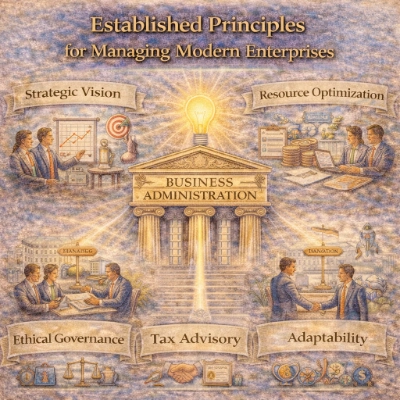
Established Principles for Managing Modern Enterprises
The core ideas of business administration help leaders manage people, resources, and processes with purpose and care. These principles include:
- Strategic Vision: Defining clear long-term goals and guiding everyone toward achieving them.
- Resource Optimization: Making the most of financial, human, and material resources.
- Adaptability: Staying flexible, embracing change, and welcoming new ideas.
- Ethical Governance: Acting with honesty, transparency, and social responsibility in every decision.
Business administration blends theory with action. It helps organizations compete, grow, and stay true to ethical and sustainable values.
Major Disciplines Within Business Administration
Business administration covers many important areas. Each one helps organizations run better and face real-world challenges with skill and insight.
Management
- Overview: Teaches how to plan, organize, lead, and guide resources to meet goals.
- Key Topics:
- How leaders inspire teams and build trust.
- The culture and behavior that shape workplaces.
- Solving problems and making decisions together.
- Applications:
- Leading teams on complex projects.
- Helping organizations grow and adapt to change.
Marketing
- Overview: Focuses on understanding what people want and creating ways to connect with them.
- Key Topics:
- Finding out what customers think and feel.
- Using digital platforms and social media wisely.
- Building strong brands through creative messaging.
- Applications:
- Launching new services that meet real needs.
- Reaching specific audiences with tailored campaigns.
Finance
- Overview: Focuses on how money is managed, invested, and protected from risk.
- Key Topics:
- How companies plan major spending and growth.
- Building smart investment portfolios.
- Weighing risks and using models to guide choices.
- Applications:
- Planning mergers between companies.
- Offering advice on personal and corporate finance.
Human Resource Management
- Overview: Builds strong teams by hiring, training, and supporting people.
- Key Topics:
- Finding and planning for future talent needs.
- Helping employees stay motivated and grow.
- Promoting fairness, safety, and diversity at work.
- Applications:
- Creating programs to train future leaders.
- Improving employee health and satisfaction.
Operations Management
- Overview: Keeps goods and services flowing smoothly from start to finish.
- Key Topics:
- Handling supply chains and deliveries.
- Making sure quality stays high.
- Balancing inventory with customer needs.
- Applications:
- Improving how things are made or delivered.
- Running global operations more efficiently.
Business Analytics
- Overview: Uses data to guide better choices and uncover trends.
- Key Topics:
- Making insights easy to see with graphs and charts.
- Using machines to help predict what might happen.
- Organizing and analyzing large sets of numbers.
- Applications:
- Predicting what customers will buy next.
- Improving marketing based on real-time data.
Strategic Management
- Overview: Guides big-picture thinking and positions businesses to succeed long-term.
- Key Topics:
- SWOT analysis and checking how the competition stacks up.
- Planning takeovers or company partnerships.
- Balancing profits with social and environmental values.
- Applications:
- Charting growth strategies in global markets.
- Aligning company goals with sustainable practices.
International Business
- Overview: Explores how companies operate across countries, cultures, and markets.
- Key Topics:
- Working with people from different cultures and backgrounds.
- Understanding global trade rules and how to enter new markets.
- Handling currency changes and managing global supply chains.
- Applications:
- Helping businesses grow into new countries and regions.
- Running international partnerships and global teams.
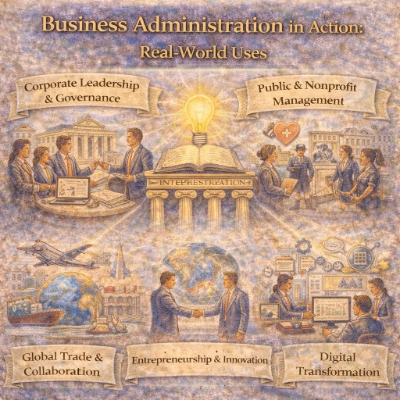
Business Administration in Action: Real-World Uses
Corporate Leadership and Governance
- Leading organizations with clear direction and thoughtful decisions.
- Setting up systems that promote responsibility, fairness, and ethical conduct.
Entrepreneurship and Innovation
- Spotting new ideas and turning them into successful ventures.
- Using creativity and technology to bring fresh solutions into the world.
Public and Nonprofit Management
- Using business strategies to improve services and boost the impact of public and nonprofit work.
Global Trade and Collaboration
- Building business relationships across borders in today’s connected world.
Digital Transformation
- Using digital tools to make work smoother, faster, and more effective.
Innovations and Trends Driving Business Transformation
Sustainability and Corporate Social Responsibility (CSR):
More businesses are weaving environmental care and social values into their core missions.
Data-Driven Decision-Making:
Smart use of data is shaping how companies plan, adapt, and grow.
Remote Work and Virtual Teams:
Firms are learning to stay connected and productive, even from afar.
Focus on Diversity, Equity, and Inclusion (DEI):
Creating workplaces where all voices are heard and valued.
Artificial Intelligence (AI) and Automation:
AI is helping businesses make faster decisions and uncover new possibilities.
The Many Obstacles Facing Today’s Business Leaders
Navigating Economic Uncertainty:
Making smart choices in a world where financial conditions shift quickly.
Maintaining Ethical Standards:
Balancing the drive for profit with fairness, honesty, and trust.
Adapting to Technological Disruption:
Staying ahead of rapid tech changes that can reshape industries overnight.
Global Competition:
Finding ways to thrive in a busy and borderless business world.
Preparing for Dynamic Careers in Business and Management
Gaining a Broad Foundation in Business Practices
Business administration gives students a well-rounded view of how companies run and grow. It introduces areas like management, marketing, finance, human resources, and operations. For those heading to university, this subject lays the groundwork for many academic paths. Students also get to understand ideas like how businesses are structured, how leaders guide teams, and how companies compete—topics they’ll meet again in higher studies.
Developing Leadership and Decision-Making Skills
A key aim of business administration is shaping tomorrow’s leaders. Students practice solving problems, weighing options, and making smart choices that help organizations succeed. These skills are useful far beyond the business world—in group projects, student clubs, and campus leadership. By gaining confidence in leading and communicating, students are better prepared for both school life and real-life roles.
Enhancing Analytical and Strategic Thinking
This subject trains students to think clearly in changing, often uncertain, situations. Whether working through a case study or analyzing trends, students learn to read data and apply proven strategies. These thinking skills are essential for university success and for jobs that call for careful planning, creative thinking, and the ability to adapt.
Learning How to Work Collaboratively
Working in teams is a central part of learning business. Students team up to build presentations, run simulations, and develop business plans—mirroring both university and workplace settings. Along the way, they grow their emotional intelligence, learn to listen well, and value different viewpoints. These experiences help them become strong, respectful team players.
Exploring Versatile Career and Academic Pathways
Studying business administration opens many doors. Students can continue in fields like business, economics, international affairs, entrepreneurship, or management. Career options range from marketing and finance to consulting and launching a startup. For students planning their future, business administration offers direction without locking them in—giving both focus and flexibility for what comes next.

The Roles of Business Administration in a Changing World – Summing Up
Business administration gives people the skills to guide organizations through today’s fast-changing, connected world. By blending areas like management, marketing, finance, and entrepreneurship, it offers a full set of tools for tackling new challenges and uncovering opportunities. As the business world keeps shifting, this field stays essential—for nurturing new ideas, protecting our future, and helping organizations thrive. Through a mix of theory and hands-on practice, it helps leaders and teams make a real difference.
Interactive Case Analysis & Concept Warm-Ups
How does operational efficiency directly influence bottom-line profit without altering sales volume?
Why must Strategic Management align closely with Human Resource Management?
Frequently Asked Questions — Business Administration
What is business administration, and how does it differ from general business studies?
Business administration focuses on how organisations are managed day to day and over the long term, covering areas such as strategy, operations, marketing, human resources, and finance. General business studies may be broader and more theoretical, while business administration is usually more applied and practice-oriented, emphasising how managers coordinate people, processes, and resources to achieve goals.
What core subjects are usually included in a business administration programme?
Typical core subjects include principles of management, organisational behaviour, marketing, accounting and finance, operations and supply chain management, business law, business analytics, and strategy. Many programmes also include modules on ethics, sustainability, entrepreneurship, and digital transformation so that students can connect management decisions with wider social and technological change.
How does studying business administration help me understand how organisations actually work?
Studying business administration helps you see how different functions—such as marketing, human resources, operations, and finance—are interdependent. You learn how decisions in one area affect cash flow, employee morale, customer experience, and long-term competitiveness. Case studies, group projects, and simulations give you a chance to practise analysing real situations rather than just learning abstract theories.
What analytical and quantitative skills are developed in business administration?
Students develop skills in interpreting financial statements, working with budgets and basic spreadsheets, analysing data from surveys and operations, and using simple forecasting or decision tools. While the maths is usually not as advanced as in specialised finance or analytics degrees, you are expected to be comfortable with percentages, ratios, graphs, and evidence-based comparison of options.
How important are communication and teamwork skills in business administration?
Communication and teamwork skills are central to business administration because managers rarely work alone. You are often required to write reports, deliver presentations, and collaborate in group projects, mirroring how managers negotiate with colleagues, motivate teams, and explain decisions to non-specialists. These interpersonal abilities are often what distinguish effective managers from technically competent but less influential ones.
What role do ethics and sustainability play in modern business administration?
Modern business administration recognises that decisions have ethical, environmental, and social consequences as well as financial effects. Many courses explore corporate social responsibility, stakeholder interests, climate risk, diversity and inclusion, and responsible leadership. Students are encouraged to think beyond short-term profit and to design policies and processes that create value in a fair and sustainable way.
How is digital technology changing the practice of business administration?
Digital technology has reshaped marketing, operations, human resources, finance, and customer service. Managers now draw on data analytics, cloud platforms, automation, and digital collaboration tools when making decisions and organising work. Studying business administration increasingly involves learning how digital processes change customer behaviour, business models, and the skills that organisations need.
What kinds of careers can a degree in business administration lead to?
Graduates in business administration can pursue careers in management trainee programmes, operations and project management, marketing and sales, human resources, banking and financial services, consulting, and public or non-profit management. Many also use their generalist training to start small businesses or to move into specialised postgraduate study in areas such as finance, logistics, or international business.
Is business administration suitable for students who are not sure which business specialisation to choose yet?
Yes. Business administration gives you a broad foundation across key business functions before you commit to a specialisation. As you progress, you can choose electives in areas that interest you—such as marketing, operations, HR, or entrepreneurship—while still keeping a wide view of how organisations work. This flexibility is helpful if you are still exploring your strengths and career goals.
How can pre-university students prepare for studying business administration?
Pre-university students can prepare by strengthening basic numeracy and writing skills, following business news, and reflecting on how organisations around them are managed. Part-time jobs, volunteering, student club leadership, or small projects can all provide practical insight into teamwork, customer service, and simple budgeting, which later connect directly with formal business administration concepts.
What is the difference between studying business administration and learning management purely on the job?
On-the-job learning provides valuable experience but can sometimes be narrow or shaped by one organisation’s habits. Studying business administration exposes you to a wide range of frameworks, case studies, and comparative examples, helping you recognise patterns across industries and countries. Formal study also gives you the vocabulary and analytical tools to describe and improve practices you encounter at work.
How can knowledge of business administration help me if I choose a non-business career?
Knowledge of business administration is useful in many non-business careers because most organisations, including hospitals, schools, NGOs, and public agencies, face management challenges. Understanding budgeting, people management, basic strategy, and process improvement can help you contribute more effectively, lead teams, and interpret organisational decisions, even if your main role is technical or professional rather than managerial.
Is Business Administration Right For You?
Explore career pathways, check your fit, and assess your skills — before you commit to a degree.
Business Administration Practice & Skill-Building Module
Section 1: Core Knowledge & Essential Concepts
-
What is business administration?
Answer: Business administration means guiding how a company runs day to day. It includes planning, organizing, leading, and using resources wisely to reach organizational goals. -
How does strategic management contribute to effective business administration?
Answer: Strategic management sets long-term goals and creates actionable plans to reach them. It helps match daily operations to a overarching corporate vision, keeping the business focused and competitive. -
What role does leadership play in business administration?
Answer: Leadership inspires workforce performance and aligns teams around a shared organizational purpose. Good leaders encourage collaboration, guide change, and drive innovation. -
How do financial management principles integrate into business administration?
Answer: Financial management involves budgeting, cost analysis, and capital allocation. These tools empower executives to make data-backed choices and maintain financial solvency. -
What is the significance of organizational behavior in business administration?
Answer: Organizational behavior examines how individuals and teams interact in workplaces. Understanding employee motivation improves communication, resolves workplace friction, and enhances productivity. -
How does effective communication impact business administration?
Answer: Clear communication aligns operational goals across departments, fosters trust among stakeholders, prevents operational errors, and ensures seamless execution. -
What is the importance of operational efficiency in business administration?
Answer: Operational efficiency maximizes output while minimizing resource consumption. Eliminating process waste lowers costs, improves profit margins, and elevates customer satisfaction. -
How do market analysis and competitive research inform business decision-making?
Answer: Market research reveals shifting customer preferences, competitor vulnerabilities, and market trends, allowing businesses to adapt offerings and capture market share strategically. -
What challenges do businesses face in implementing change management?
Answer: Employee resistance, legacy operational habits, and poor communication hinder organizational transformation. Overcoming this requires strong leadership, transparent messaging, and structured training. -
How can business administration practices improve overall corporate governance?
Answer: Structured administration enforces accountability, ethical standards, transparent financial reporting, and compliance with statutory regulations, building stakeholder trust.
Section 2: Strategic Scenarios & Applied Thinking
-
How might the rise of remote work and digital collaboration reshape business administration practices?
Answer: Remote work forces managers to shift from tracking hours to measuring output and key performance metrics (KPIs). Leaders must adopt digital project management platforms, re-engineer corporate culture for virtual environments, and mitigate cybersecurity risks across distributed networks. -
In what ways can business administration contribute to sustainable organizational growth in a volatile market?
Answer: Business administration builds resilience by integrating agile budgeting, continuous risk assessment, and operational flexibility. Diversifying supply chains and prioritizing Environmental, Social, and Governance (ESG) criteria ensures long-term viability during economic shifts. -
How does corporate culture influence the effectiveness of business administration, and what strategies can be used to cultivate a positive culture?
Answer: Corporate culture dictates employee engagement and strategy execution. A toxic culture causes high turnover and operational inertia, whereas an open culture drives innovation. Leaders cultivate positive culture by rewarding performance, maintaining transparent communication, and promoting work-life balance. -
What impact does ethical decision-making have on business administration and long-term corporate success?
Answer: Ethical administration builds brand equity and consumer loyalty while protecting organizations from legal liability and reputational damage. Stakeholders increasingly favor ethical enterprises, driving long-term investment and talent retention. -
How can data analytics transform decision-making processes in business administration?
Answer: Data analytics converts operational metrics into actionable intelligence. Predictive models allow managers to anticipate customer demand, optimize inventory replenishment, detect financial anomalies early, and replace subjective guesswork with empirical evidence. -
What challenges do businesses face in aligning tax compliance with strategic planning, and how can they overcome these challenges?
Answer: Aligning tax compliance with strategy is difficult due to changing international tax codes and complex cross-border transactions. Organizations overcome this by integrating enterprise resource planning (ERP) tax software and consulting international tax specialists during initial expansion planning. -
How might the increasing complexity of global markets affect corporate financial reporting and transparency?
Answer: Global expansion requires reconciling divergent accounting standards (e.g., GAAP vs. IFRS), managing currency conversion volatility, and reporting transfer pricing across jurisdictions. Transparency demands standardized multi-jurisdictional disclosures and independent audit verification. -
What role does innovation play in business administration, particularly in improving operational efficiency?
Answer: Process innovation replaces bottleneck-heavy workflows with automated or lean systems. Implementing automated inventory tracking or AI customer support slashes processing times and operating expenses, driving competitive advantage. -
How does effective budgeting and cost management influence a company’s strategic decision-making?
Answer: Budgeting establishes resource boundaries for strategic initiatives. Strict cost control frees liquidity, enabling firms to capitalize on unexpected market opportunities, invest in R&D, or absorb economic downturns safely. -
How can public-private partnerships influence tax planning and compliance strategies in large-scale projects?
Answer: Public-private partnerships (PPPs) often include tax incentives, subsidies, or specialized depreciation schedules granted by governments to stimulate infrastructure development. Private entities must ensure transparent compliance to retain public trust and political viability. -
What challenges do companies face when reconciling different international tax standards, and how can technology help?
Answer: Discrepancies between local tax authorities lead to double taxation risks and compliance overhead. Advanced automated tax compliance software normalizes financial data across international tax regimes in real time, reducing manual errors. -
How might the evolution of digital taxation policies affect corporate tax planning strategies in the coming years?
Answer: Digital service taxes targeting cross-border e-commerce compel multinational corporations to re-evaluate revenue attribution models. Strategic planning must incorporate evolving global minimum tax rules (e.g., OECD Pillar Two) to optimize international tax structures.
Section 3: Mathematical Business Computations
-
A company has a taxable income of $800,000 and an effective tax rate of 30%. Calculate the total tax liability.
Solution:
Step 1: Identify Taxable Income ($800,000) and Tax Rate (30% or 0.30).
Step 2: Multiply Taxable Income by Tax Rate:
Tax Liability = 0.30 × $800,000 = $240,000. -
A firm implements a tax planning strategy that reduces its tax liability by 12% on a $1,000,000 liability. How much is saved?
Solution:
Step 1: Identify Baseline Tax Liability ($1,000,000) and Savings Rate (12% or 0.12).
Step 2: Calculate total tax reduction:
Tax Savings = 0.12 × $1,000,000 = $120,000. -
A business allocates 40% of its annual budget of $500,000 to tax compliance. How much is allocated for tax compliance?
Solution:
Step 1: Total Annual Budget = $500,000; Allocation Percentage = 40% (0.40).
Step 2: Calculate dollar allocation:
Tax Compliance Budget = 0.40 × $500,000 = $200,000. -
If a multinational company’s taxable income is $2,500,000 and it pays taxes at an effective rate of 28%, calculate the tax expense.
Solution:
Step 1: Taxable Income = $2,500,000; Effective Rate = 28% (0.28).
Step 2: Calculate tax expense:
Tax Expense = 0.28 × $2,500,000 = $700,000. -
A company’s earnings before taxes (EBT) is $1,200,000. If its tax rate is 25%, what is its net income?
Solution:
Step 1: Compute Tax Amount = 0.25 × $1,200,000 = $300,000.
Step 2: Subtract Tax from EBT:
Net Income = $1,200,000 − $300,000 = $900,000. -
A tax planning report projects that a 10% reduction in taxable income will save $50,000 in taxes. Assuming a taxable income base of $2,000,000, what is the implied tax rate?
Solution:
Step 1: Compute reduction in taxable income: 10% of $2,000,000 = $200,000.
Step 2: Relate tax savings to taxable income reduction:
Tax Rate = Tax Savings / Income Reduction = $50,000 / $200,000 = 0.25 (or 25%). -
A firm’s debt-to-equity ratio is 0.6. If the equity is $4,000,000, what is the total debt?
Solution:
Step 1: Debt-to-Equity Ratio formula: Debt / Equity = 0.6.
Step 2: Calculate Debt:
Total Debt = 0.6 × $4,000,000 = $2,400,000. -
A company’s current ratio is 1.8, with current liabilities of $600,000. Calculate its current assets.
Solution:
Step 1: Current Ratio formula: Current Assets / Current Liabilities = 1.8.
Step 2: Solve for Current Assets:
Current Assets = 1.8 × $600,000 = $1,080,000. -
A company’s return on equity (ROE) is 18% with a net income of $360,000. What is its average equity?
Solution:
Step 1: ROE formula: Net Income / Average Equity = 0.18.
Step 2: Rearrange to solve for Average Equity:
Average Equity = $360,000 / 0.18 = $2,000,000. -
A tax planning initiative reduces a company’s tax liability from $500,000 to $425,000. Calculate the percentage reduction.
Solution:
Step 1: Compute absolute reduction: $500,000 − $425,000 = $75,000.
Step 2: Calculate percentage relative to original liability:
Percentage Reduction = ($75,000 / $500,000) × 100 = 15%. -
If a company’s operating expenses are 40% of its revenue and its revenue is $3,500,000, calculate the operating expenses.
Solution:
Step 1: Identify Revenue ($3,500,000) and Operating Expense Ratio (40% or 0.40).
Step 2: Multiply Revenue by Ratio:
Operating Expenses = 0.40 × $3,500,000 = $1,400,000. -
A firm plans to invest in tax planning strategies that cost $100,000 and expects this to reduce taxes by $25,000 annually. Calculate the payback period in years.
Solution:
Step 1: Payback Period formula: Initial Investment / Annual Cash Inflow (Savings).
Step 2: Compute payback period:
Payback Period = $100,000 / $25,000 = 4 years.