
Magnetic fields represent an essential, non-contact gateway within classical electromagnetism, mapping the spatial distribution of magnetic flux density across physical systems. While invisible to the naked eye, their mechanical consequences are highly measurable: they exert velocity-dependent forces on moving point charges, drive mechanical force distributions across current-carrying conductors, dictate the circular or helical trajectories of cosmic particles, and form the foundational operating basis for advanced electronic sensors.A magnetic field is far more than a simple region surrounding a permanent bar magnet; it is a mathematical vector field describing how magnetic forces propagate through the spatial domain. Unlike static electric fields, which exert constant forces parallel to field lines on stationary or moving charges alike, a magnetic field interacts exclusively with charges that possess a non-zero velocity vector. Because an electrical current is fundamentally a directed stream of moving charges, magnetism and electrical current loops are deeply interconnected properties of classical electrodynamics.
This comprehensive learning cluster breaks the magnetostatics curriculum into a structured, highly sequential academic progression. The pathway initiates with the study of the Magnetic Force on Moving Charges, where students analyze how a charged particle navigating an external field experiences a sideways deflection force. This establishes a core understanding of cross-product mechanics before moving to the Magnetic Force on Current-Carrying Wires, where individual microscopic interactions combine into macroscopic, usable force distributions—the physical backbone of the motor effect, modern loudspeakers, and industrial actuators.The progression advances to the Motion of Charges in Magnetic Fields, demonstrating how an exclusively perpendicular force vector balances centripetal constraints to force charged particles into precise circular or helical orbits. This geometry dictates the design of mass spectrometers, particle accelerators, and plasma fusion tokamaks. Finally, the pathway culminates in the Hall Effect and Magnetic Measurement, exploring how these cross-boundary forces become precision diagnostic tools, converting magnetic flux metrics directly into measurable electrical voltages for modern automotive and consumer systems.
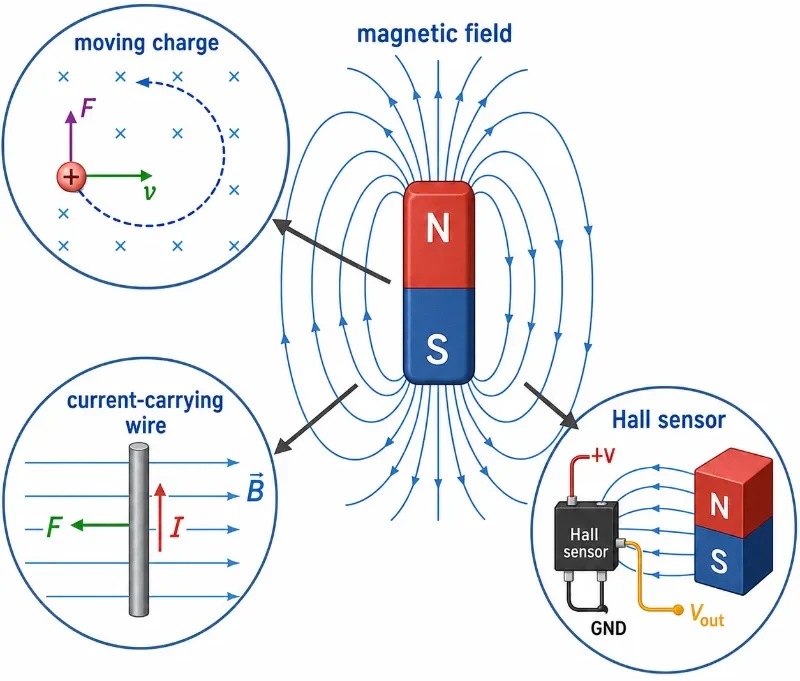 Magnetic fields can push moving charges, exert forces on current-carrying wires, and support magnetic field measurement through Hall sensors.
This introductory image presents the main ideas in the Magnetic Fields cluster. A central bar magnet shows magnetic field lines, while three linked examples show how magnetic fields affect a moving charge, act on a current-carrying wire, and enable Hall-effect sensing. The picture helps students see magnetic fields as more than invisible regions around magnets: they are physical fields that can guide charged particles, produce forces on currents, and provide measurable signals in practical sensor technologies.
Magnetic Fields Learning Pathway
This category hub maps the core magnetostatic topics into a clear, unified architecture. Use this navigational layout to transition systematically from fundamental particle interactions to advanced materials diagnostics and applied sensor technologies:
Electricity and Magnetism Context
Provides the global parent context for understanding electric fields, potential landscapes, circuit networks, magnetic fields, electromagnetic induction, and Maxwellian wave mechanics.Magnetic Fields – Overview Hub
Introduces how magnetic field vectors modify space to act on moving charges and currents, bend particle trajectories, and provide measurable signals for electronic instrumentation.Magnetic Force on Moving Charges
Quantifies the velocity-dependent mechanical force vectors experienced by point charges navigating external magnetic flux distributions.Magnetic Force on Current-Carrying Wires
Examines the macroscopic integration of microscopic particle forces along conductive wire elements, forming the physical foundation of the motor effect.Motion of Charges in Magnetic Fields
Models the orbital and helical trajectory mechanics that occur when a perpendicular magnetic deflection acts as a constant centripetal constraint.Hall Effect and Magnetic Measurement
Analyzes the cross-boundary charge separation that occurs inside solid-state conductors, converting magnetic field metrics into measurable Hall voltages.Vector Mechanics and Lorentz Field Interactions
To rigorously evaluate the mechanics governing moving charges, magnetostatics relies on cross-product vector formulations. Unlike static electric configurations where force vectors act strictly parallel to field lines, a magnetic flux density vector, B, exerts an exclusively perpendicular influence quantified by the magnetic component of the Lorentz force law:
$$\mathbf{F} = q(\mathbf{v} \times \mathbf{B})$$Because this force vector evaluates as orthogonal to the particle’s velocity vector v at every instantaneous coordinate point, the magnetic field performs zero net thermodynamic work on the isolated system ($W = \int \mathbf{F} \cdot d\mathbf{s} = 0$). It leaves the particle’s scalar kinetic energy unchanged, altering only the directional component of the velocity tensor. For university students, modeling these orthogonal relationships through right-hand rule frameworks transitions basic linear mechanics into complex, multi-dimensional particle steering dynamics across laboratory and cosmic horizons.
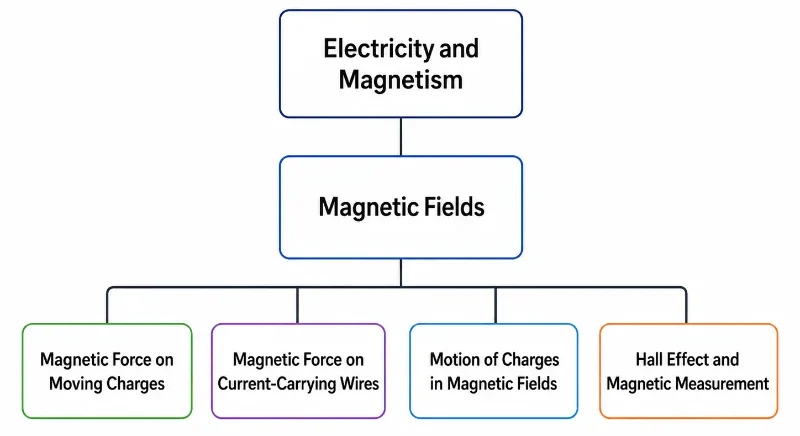 Magnetic Fields sits under Electricity and Magnetism and connects four learning pages on magnetic force, charged-particle motion, and Hall measurement.
This tree structure diagram presents the organization of the Magnetic Fields section. Electricity and Magnetism serves as the main parent node, leading directly to the Magnetic Fields category hub page. Beneath the category hub page, the framework branches horizontally into four distinct child pages: Magnetic Force on Moving Charges, Magnetic Force on Current-Carrying Wires, Motion of Charges in Magnetic Fields, and Hall Effect and Magnetic Measurement. The chart helps university students map the sequential progression from core concepts to practical application and sensor technologies.pre>
Core Physical Primitives at a Glance
The following data grid outlines the primary parameters and equations connecting point charges, currents, and flux geometries across the magnetostatic domain:
| Magnetic Primitive | Mathematical Expression | Physical Matrix Meaning |
|---|---|---|
| Magnetic Flux Density (B) | B (Measured in Tesla, T) | A vector field tracking the magnitude and direction of magnetic influence per unit velocity-charge. |
| Lorentz Charge Force | F = q(v × B) | Defines the orthogonal mechanical force acting on a point charge; force is zero if velocity is parallel to the field. |
| Conductor Wire Force | F = BIL sin(θ) | Integrates microscopic charge forces along a straight conductor wire of length L carrying current I. |
| Magnetic Field Lines | Continuous Closed Loops | Geometric visualization tool; drawn from North to South poles externally. Line density maps local field strength. |
| Magnetic Flux (Φ) | ΦB = ∫ B · dA | Quantifies the net amount of vector field passing through a surface area. Measured in Webers (Wb). |
| Hall Voltage Extraction | VH = I B / (n t e) | Measures the steady-state transverse potential difference produced across a material via magnetic charge separation. |
Magnetic Field Lines and Topology Symmetries
Magnetic field lines serve as a highly prescriptive visual language for mapping vector fields. They do not exist as physical threads or wires in space, but they outline direction and relative field strength across a spatial volume. Outside a permanent magnet or solenoid, these lines form continuous, closed loops that exit the north pole boundary and return through the south pole boundary.
The volumetric spacing of these lines provides critical data: highly crowded regions indicate intense magnetic flux densities, while widely separated line topologies chart rapid decay. This makes field-line mappings indispensable for analyzing the concentrated fields near pole faces, the circular fields encircling straight conductors, and the uniform fields stabilized inside helical coils.
Vector Tangent Direction
The vector magnetic field direction at any coordinate point is defined by the line tangent to the field loop at that exact location.Volumetric Line Density
Closer lines represent intense local magnetic fields. Wider line separation maps systemic attenuation as distance expands.Continuous Closed Loops
Magnetic field lines form continuous loops with no break points. Unlike electric fields, which originate and terminate on discrete charges, magnetic lines have no sources or sinks.Sources and Formulations of Magnetostatic Fields
Magnetic fields are generated by permanent magnetic domains or by macroscopic electric currents. On a subatomic level, all magnetism is an explicit consequence of moving charge configurations. The following structural card framework outlines the field expressions for common current geometries:
Straight Conductor Wires
A long straight wire carrying a steady current I establishes concentric, circular magnetic field loops around its axis. Field strength attenuates inversely with radial distance r:B = μ0 I / (2π r)
Helical Solenoid Coils
A solenoid consists of wire tightly wound into a long helical cylinder. When current flows, the interior field vectors align to form a highly concentrated, nearly uniform magnetic field:B = μ0 n I
where n represents the number of turns per unit length density (n = N/L).Ring-Shaped Toroids
A toroid is a solenoid coil curved into a closed circular ring. This geometry tightly confines the vector magnetic field entirely within the core interior loop:B = μ0 N I / (2π r)
where r tracks the target radial coordinate measured directly from the center node.Advanced Mathematical Rigor: The Differential and Integral Foundations
To satisfy university engineering standards, magnetic fields must be modeled using rigorous vector calculus. While electric fields can terminate on isolated point charges, the absolute non-existence of isolated magnetic poles (magnetic monopoles) requires that the divergence of the magnetic field vector vanishes identically everywhere in space. This principle is codified by Gauss’s Law for Magnetism in differential form:
$$\nabla \cdot \mathbf{B} = 0$$The universal mechanism for calculating the vector magnetic field generated by any arbitrary current-carrying configuration is defined by the Biot-Savart Law. This integral relates a differential current element I dl directly to the resulting differential magnetic field contribution dB at a displacement vector position r:
$$\mathbf{B}(\mathbf{r}) = \frac{\mu_0}{4\pi} \int_C \frac{I d\mathbf{l} \times \hat{\mathbf{r}}}{r^2}$$Where $\mu_0$ defines the permeability of free space constant ($\mu_0 = 4\pi \times 10^{-7}\text{ T}\cdot\text{m/A}$). For symmetric boundaries, this integrates into Ampère’s Circuital Law, which dictates that evaluating the closed line integral of the magnetic field along a path equals the net enclosed current:
$$\oint_C \mathbf{B} \cdot d\mathbf{s} = \mu_0 I_{\text{enclosed}}$$This line integral demonstrates that magnetostatic fields carry a non-zero curl ($\nabla \times \mathbf{B} = \mu_0 \mathbf{J}$), proving that steady currents act as the physical rotational vortices driving the continuous loops of the field through space. This mathematical framework allows the total energy stored by the system to be calculated by integrating the magnetic energy density across the field volume:
$$U_B = \int_V \frac{|\mathbf{B}|^2}{2\mu_0} \, dV$$Technical Case Studies: Magnetic Fields in Applied Engineering
Vector field control underpins modern medical diagnostics and high-energy environmental energy conversion plants. Two prominent technologies highlight this control:
Non-Invasive Medical Diagnostics: Magnetic Resonance Imaging (MRI)
MRI scanners deploy powerful superconducting electromagnets cooled by liquid helium to maintain extreme, highly uniform magnetic fields exceeding 1.5 Tesla. This uniform field aligns the net magnetic dipole moments of hydrogen protons inside the patient’s biological tissues. Pulsed radiofrequency fields then tip these moments out of alignment. When the radiofrequency pulse terminates, the protons precess back into alignment with the primary field, emitting weak electromagnetic signals that are digitized to reconstruct high-resolution, three-dimensional anatomical images.Macroscopic Kinetic Storage: Flywheel Energy Systems
Next-generation green electrical grids deploy flywheel energy storage systems that rely on magnetic fields to maximize efficiency. A massive carbon-fiber rotor is suspended in a absolute vacuum enclosure using active magnetic levitation bearings, eliminating friction completely. Integrated motor-generators use magnetic forces (F = B I L) to accelerate the flywheel to over 60,000 RPM during power surpluses. When the grid experiences high load demands, the system reverses, extracting the stored mechanical kinetic energy and converting it back into electrical electricity with minimal loss.Evolution of Magnetic Field Theory: History, Micro-Limits, and Frontiers
Historical Epochs: From Lodestone Mysticism to Vector Field Calculus
For millennia, magnetism remained restricted to qualitative observations of natural lodestones interacting over short distances. The field transitioned into an exact science in 1820 when Hans Christian Ørsted accidentally discovered that an active electric current deflected a nearby compass needle, revealing that electricity and magnetism are deeply linked. Within months, Jean-Baptiste Biot and Félix Savart mathematically formalized the field drop-off patterns near currents, while André-Marie Ampère derived the mechanical force equations between current-carrying loops. This rapid series of breakthroughs culminated in the 1860s when James Clerk Maxwell integrated these formulations into his definitive equations, establishing classical electromagnetism as a cornerstone of modern physics.
Contemporary Challenges: Magnetic Saturation and Flux Leakage in Nanocores
As industrial transformer and electric vehicle motor designs scale components down to maximize efficiency, engineers face severe material saturation challenges. Ferromagnetic core materials can only handle a limited amount of magnetic flux before their internal atomic domains align completely. Beyond this magnetic saturation threshold, the core material can no longer amplify the field, and additional current inputs trigger destructive heat generation and massive flux leakage. Managing these material limits requires developing advanced nanocrystalline alloy cores that handle steep magnetic flux densities safely.
Future Technological Horizons: Spintronic Memory Matrices
The future of high-speed data architecture centers on spintronic technologies that manipulate individual electron spin vectors rather than displacing bulk electrical charges. Spin-transfer torque magnetoresistive RAM (STT-MRAM) uses micro-scale magnetic tunnel junctions to store data bits near-instantaneously without needing continuous power. This allows spintronic devices to achieve near-infinite write endurance, operate with near-zero power dissipation, and store data permanently even if power is completely cut, bypassing the scaling limits of modern silicon flash memory.
Numerical Problems and Solutions
- Calculate the magnetic flux density B at a radial distance of 0.05 m from a long, straight conductor wire carrying a steady current of 10 A.Solution: Apply the long-wire straight Ampère configuration:$$B = \frac{\mu_0 I}{2\pi r}$$ $$B = \frac{(4\pi \times 10^{-7}\text{ T}\cdot\text{m/A})(10\text{ A})}{2\pi(0.05\text{ m})}$$ $$B = \frac{4\pi \times 10^{-6}}{0.10\pi} = 4.0 \times 10^{-5}\text{ T}$$Interpretation: The current-carrying wire alters its environment, generating a concentric magnetic field strength of exactly 4.0 × 10⁻⁵ Tesla at that 5 cm radial coordinate.
- A proton carrying an elementary charge q = 1.60 × 10⁻¹⁹ C enters a uniform 0.010 T magnetic field at a velocity of 1.0 × 10⁶ m/s. If the velocity vector is perpendicular to the field lines, calculate the force magnitude.Solution: Evaluate the perpendicular component of the Lorentz force vector relationship:$$F = qvB$$ $$F = (1.60 \times 10^{-19}\text{ C})(1.0 \times 10^6\text{ m/s})(0.010\text{ T}) = 1.60 \times 10^{-15}\text{ N}$$Interpretation: The field exerts a continuous mechanical force of 1.60 × 10⁻¹⁵ N on the moving proton. Because this force vector is exclusively perpendicular to its path, it changes only the particle’s direction, not its speed.
- Find the mechanical force acting on a straight 2.0 m wire carrying a current of 3.0 A inside a uniform magnetic field of 0.20 T, assuming the field lines cross the conductor at a right angle.Solution: Deploy the linear current force distribution equation:$$F = BIL\sin\theta \Rightarrow F = (0.20\text{ T})(3.0\text{ A})(2.0\text{ m})\sin(90^{\circ})$$ $$F = (0.20)(3.0)(2.0)(1.0) = 1.2\text{ N}$$Interpretation: The wire experiences a net macroscopic force of 1.2 N. This mechanical force forms the foundation of the motor effect, pushing the wire perpendicular to both the current and the field.
Common Conceptual Misconceptions
The Parallel Force Fallacy
Misconception: The magnetic force vector acts parallel to the direction of the magnetic field lines. Reality: The magnetic force is strictly orthogonal (F ∝ v × B). It acts entirely perpendicular to both the field lines and the particle’s velocity vector, running completely counter to how electric forces behave.The Stationary Charge Error
Misconception: Placing a highly charged particle into a powerful magnetic field will instantly cause it to experience a force. Reality: If the particle’s velocity is zero (v = 0), the magnetic force drops to exactly zero. Magnetic fields can only interact with charges that are actively moving through space.Bridge to University Thinking
Introdynamic physics often introduces magnetic fields through simple bar magnets and basic right-hand rule shortcuts. At the university level, magnetic fields expand into a rigorous vector field theory governed by partial differential equations. Because magnetic forces perform no work on isolated charges, tracking system dynamics requires analyzing vector cross-products (v × B) and continuous current path integrations (∮ B · ds). Mastering these vector mechanics under steady-state conditions forms the primary foundation for analyzing dynamic electromagnetic induction, Maxwell’s equations, and high-energy plasma physics.
Quick Interactive Check
Test your grasp of magnetostatic field structures using these conceptual checkpoints:
What specific condition must a charge meet to experience a force inside a magnetic field?
Thinking prompt: Consider the role of the velocity term inside the cross-product force formula.
Show answer
Suggested answer: The charge must be actively moving with a velocity vector that is not parallel to the magnetic field lines. Static charges v = 0 experience zero magnetic force.
Why does a uniform magnetic field change a particle’s trajectory without altering its speed?
Thinking prompt: Assess the vector dot product of a perpendicular force relative to instantaneous displacement.
Show answer
Suggested answer: Because the cross-product forces the magnetic force to act exclusively perpendicular to the velocity vector at every point. This perpendicular deflection changes the direction of motion without performing work or altering the particle’s scalar speed.
What physical parameter does the Hall effect convert into an electrical signal?
Thinking prompt: Review how transverse potential differences build up across solid-state materials.
Show answer
Suggested answer: It converts magnetic field strength into a measurable transverse voltage. The magnetic field pushes internal charge carriers sideways, producing an electrical signal proportional to the field intensity.
Review Questions and Answers
- What is a magnetic field?Answer: A magnetic field is a spatial region where moving charges, current loops, or permanent magnetic dipoles experience mechanical forces. It is quantified by the vector B and measured in Tesla (T).
- How do magnetic field lines represent field intensity?Answer: The relative density of the lines maps the field strength. Highly concentrated, tightly packed lines define an intense field, while widely separated loops chart rapid field decay.
- What is the core equation defining the magnetic force on a moving charge?Answer: The interaction is defined by the magnetic Lorentz cross-product equation: F = q(v × B).
- Why do magnetic field lines always form closed, unbroken loops?Answer: Because magnetic monopoles do not exist in classical physics. The divergence of any magnetic field vector is always zero (∇ · B = 0), forcing lines to form continuous, unbroken loops.
- State the formula for the magnetic force acting on a straight conductor wire.Answer: The force magnitude is calculated via the distribution relationship: F = BIL sin(θ), where θ tracks the angle between the current path and the field lines.
- What occurs when a current-carrying wire runs completely parallel to the external field lines?Answer: The resulting magnetic force drops to exactly zero, because the angle θ is 0 degrees, making sin(0°) = 0.
- What does magnetic flux quantify?Answer: Magnetic flux measures the total volume of the magnetic field passing through a defined surface area, calculated via the integral ΦB = ∫ B · dA and evaluated in Webers (Wb).
- What primary foundation does the Hall effect demonstrate?Answer: It proves that an external magnetic field separates moving charge carriers inside a material, creating a cross-boundary Hall voltage that reveals the charge parity of the current carriers.
Thought-Provoking Questions and Answers
- Why does the magnetic force vector feel less intuitive than the electric force vector?Suggested answer: Electric forces act simply and directly parallel to field lines, even on stationary particles. Magnetic forces require both particle motion and multi-dimensional spatial alignment, directing mechanical forces entirely perpendicular to the field lines and velocity vectors through cross-product mechanics.
- Why do electromechanical motors depend almost exclusively on magnetic forces rather than electric fields?Suggested answer: Generating high electric forces requires maintaining extreme, dangerous voltage drops that risk dielectric breakdown and arcing across air gaps. Magnetic fields allow high torque to be generated safely using dense current loops wound into solenoids, providing a highly reliable method for commercial energy conversion.
- Why does a changing magnetic flux induce an electrical voltage?Suggested answer: A changing magnetic flux generates a non-conservative, curling electric field (∇ × E = -∂B / ∂t) according to Faraday’s Law. This induced electric field produces an electromotive force that drives currents through nearby conductors, forming the physical foundation of modern power generators.
Summary
Magnetic fields describe how moving charges and electrical currents interact across space. Unlike static electric configurations, magnetic flux vectors interact exclusively with charges that possess non-zero velocity vectors, directing mechanical forces entirely perpendicular to motion through cross-product symmetries. This perpendicular deflection allows magnetic fields to guide charged particles, rotate current loops inside motors, and generate precise potential signals inside solid-state Hall sensors. Mastering these magnetostatic field equations forms the primary analytical foundation for exploring dynamic electromagnetic induction, Maxwell’s equations, and advanced electrical engineering.
Final takeaway: Magnetic fields connect moving charges, current-carrying wires, curved particle paths, flux, induction, and practical magnetic measurement.