
The Eye as an Optical System
Learn how the cornea, pupil, lens, retina, and optic nerve work together to form images and begin visual perception.
Vision Correction with Lenses
Understand how glasses, contact lenses, and lens power correct myopia, hyperopia, astigmatism, and presbyopia.
Colour Vision and Visual Perception
Explore how cones, wavelengths, colour mixing, contrast, adaptation, and the brain shape human colour vision and perception.
Displays, AR, and Human Vision
Discover how screens, pixels, refresh rates, contrast, AR optics, eye comfort, and human vision shape modern display design.
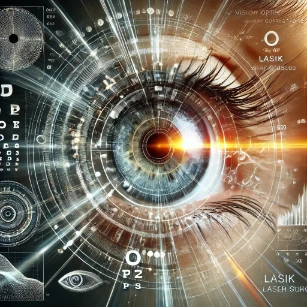
What Visual Optics Really Is
The Evolutionary Path: History, System Barriers, and Foundry Paradigms
The Historical Journey
Contemporary Technical Hurdles
Future Paradigms: Wavefront Customization and Liquid Lenses
- Dynamic Adaptive Liquid Lenses: To address presbyopia and the limitations of multi-focal glasses, eye-care engineers are designing fluidic liquid spectacles. These lenses enclose a conductive fluid layer that reacts to automated micro-current loops triggered by eye-tracking sensors, dynamically reshaping the curvature to change diopter powers instantly as a patient shifts focus from distant landscapes to near text blocks.
- Customized High-Order Aberration Corrections: Moving past standard sphere and cylinder modifications, clinical wavefront analysis map higher-order distortions like coma and spherical aberration. Industrial laser surgery tools apply this spatial data map to guide ultra-precise corneal ablation profiles, modifying the tissue surface at sub-micron scales to optimize visual clarity under low-contrast, wide-pupil night conditions.
Key Concepts in Visual Optics
The Eye as a Living Optical System
| Eye Structure | Optical Role | Why It Matters |
|---|---|---|
| Cornea | Strongly refracts incoming light | Provides much of the eye’s focusing power |
| Pupil | Acts as an adjustable aperture | Controls light entry and affects depth of focus |
| Iris | Changes pupil size | Adjusts the eye for bright and dim conditions |
| Lens | Changes shape to fine-tune focus | Allows accommodation for near and far objects |
| Retina | Detects the focused image | Converts light patterns into neural signals |
| Optic nerve | Carries visual information to the brain | Connects optical image formation with perception |
Image Formation on the Retina
Accommodation
| Viewing Situation | Lens Shape | Optical Meaning |
|---|---|---|
| Distant object | Flatter lens | Lower additional focusing power is needed |
| Near object | Rounder lens | Higher focusing power is needed |
| Reduced accommodation | Lens cannot change shape as effectively | Near focusing becomes harder, especially with age |
Refractive Errors
| Refractive Error | Basic Optical Problem | Common Correction |
|---|---|---|
| Myopia | Distant light focuses in front of the retina | Diverging lens |
| Hyperopia | Light tends to focus behind the retina | Converging lens |
| Astigmatism | Different directions focus differently | Cylindrical or toric correction |
| Presbyopia | Accommodation decreases with age | Reading addition, bifocal, progressive, or multifocal correction |
Diopters and Lens Power
Pupil Size and Visual Clarity
Visual Acuity and Resolution
Colour Vision and Perception
Applications of Visual Optics
Eyeglasses and Contact Lenses
Corrective lenses redirect light so that images form more sharply on the retina.
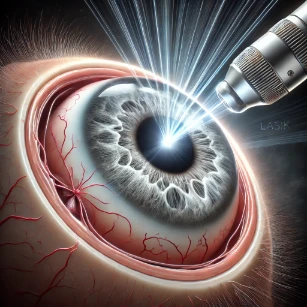
Refractive Surgery
Procedures such as LASIK reshape the cornea to change how the eye focuses light.
Ophthalmic Instruments
Ophthalmoscopes, retinoscopes, autorefractors, slit lamps, and retinal cameras use optical principles to examine eye structure and function.
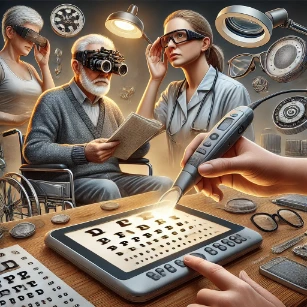
Low Vision Aids
Magnifiers, specialised lenses, contrast tools, and electronic aids help people use remaining vision more effectively.
Retinal Imaging
Optical imaging systems help observe the retina, blood vessels, optic nerve region, and retinal layers.
Visual Display Design
Screens must consider pixel density, brightness, contrast, colour, viewing distance, and human visual comfort.
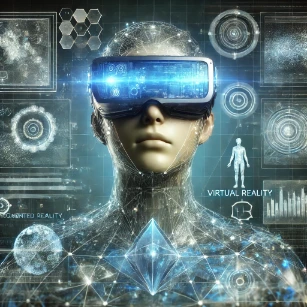
Virtual and Augmented Reality
VR and AR systems depend on how the eye focuses, perceives depth, tracks motion, and combines real and virtual information.
Human-Centred Technology
Visual optics supports better design in education, healthcare, accessibility, interface design, and visual communication.
Connections with Wider Physics and Technology
Geometrical Optics
Ray diagrams, lenses, focal length, magnification, and image formation explain the basic optical behaviour of the eye and corrective lenses.
Wave Optics
Diffraction, interference, resolution, and aberrations help explain the limits of sharp vision and optical instruments.
Electromagnetic Waves
Visible light is part of the electromagnetic spectrum, and its wavelength and energy influence vision and colour perception.
Bio-Optics
The eye is a biological optical system, linking visual optics with retinal imaging, OCT, fluorescence, and medical diagnostics.
Photonics
Photonics supports lasers, detectors, displays, retinal scanners, imaging sensors, and optical devices used in vision technology.
Laser Optics
Lasers are used in eye measurement, retinal imaging, refractive surgery, and some advanced visual technologies.
Atmospheric and Environmental Optics
Haze, glare, scattering, and lighting conditions affect contrast, visibility, and real-world visual performance.
Data Science and Analytics
Clinical data pipelines parse massive structural wavefront metrics to generate high-resolution surface maps for surgical planning loops.
Human-Computer Interaction and UX
Screen readability, visual hierarchy, contrast, accessibility, and comfort all depend on how human vision works.
Why Study Visual Optics?
It Explains Human Vision
Visual optics helps students understand how the cornea, lens, pupil, retina, and brain work together to create sight.
It Makes Lens Correction Understandable
Students can see why myopia, hyperopia, astigmatism, and presbyopia need different optical corrections.
It Connects Physics with Eye Care
Refraction, focal length, diopters, aberrations, and image formation become tools for improving real visual performance.
It Supports Diagnostic Technology
Retinal imaging, autorefractors, OCT, wavefront measurement, and ophthalmic instruments all depend on visual optics.
It Improves Display and AR Design
Screens and AR systems must respect focus, depth perception, colour vision, motion sensitivity, contrast, and eye comfort.
It Builds Interdisciplinary Thinking
Visual optics brings together physics, biology, neuroscience, medicine, engineering, computer graphics, and design.
Frequently Asked Questions: Visual Optics
What is visual optics?
Visual optics is the study of how light interacts with the eye and visual system to form images, support clear vision, correct refractive errors, and shape visual perception. It treats the eye as both an optical system and a living part of the nervous system.
How is the human eye modelled as an optical system?
The eye can be modelled as a set of refracting surfaces and transparent media, including the cornea, aqueous humour, crystalline lens, vitreous humour, and retina. The cornea provides much of the focusing power, while the lens fine-tunes focus through accommodation.
What are refractive errors?
Refractive errors occur when the eye does not focus light sharply on the retina. Myopia focuses distant light in front of the retina, hyperopia tends to focus light behind the retina, astigmatism focuses differently in different directions, and presbyopia reduces near focusing ability with age.
What is accommodation?
Accommodation is the eye’s ability to change lens shape and optical power so objects at different distances can be focused on the retina. It is strongest in youth and gradually decreases with age.
How do spectacles and contact lenses correct vision?
Spectacles and contact lenses adjust the path of light before or as it enters the eye. Diverging lenses correct myopia, converging lenses correct hyperopia, and cylindrical or toric lenses correct astigmatism.
What is visual acuity?
Visual acuity is the ability to resolve fine detail. It depends on optical focus, retinal structure, contrast, lighting, pupil size, and neural processing. It is commonly measured using letter or symbol charts.
How do pupil size and depth of focus affect vision?
A smaller pupil can increase depth of focus and reduce some blur, but it also reduces light entry and may increase diffraction effects. A larger pupil admits more light but can make aberrations and glare more noticeable.
What is presbyopia?
Presbyopia is the age-related reduction in accommodation. It makes near focusing harder and is commonly managed with reading glasses, bifocals, progressive lenses, multifocal contact lenses, or other professionally guided solutions.
What are optical aberrations in the eye?
Optical aberrations are imperfections in image formation. They include defocus, astigmatism, spherical aberration, coma, and other higher-order effects. They can reduce sharpness, contrast, and visual comfort, especially in low-light conditions with larger pupils.
How do lighting, contrast, and glare affect visual performance?
Lighting and contrast affect how easily details can be seen. Glare and scattered light can reduce visibility, wash out images, and make visual tasks more difficult. Visual optics helps explain why real-world vision changes with environment.
Why does visual optics matter for displays and AR?
Displays and AR systems must send light to the eye in ways that appear sharp, comfortable, readable, and meaningful. Pixel density, viewing distance, colour, brightness, contrast, depth cues, and latency all depend on human vision.
Why is visual optics important for students?
Visual optics turns physics into a personal and practical subject. It helps students understand eyesight, corrective lenses, eye instruments, medical imaging, display technology, AR systems, accessibility, and human-centred design.
Review Questions and Answers
- What is visual optics?Answer: Visual optics is the study of how light interacts with the eye and visual system to form images, support vision, and guide technologies such as corrective lenses, eye instruments, displays, and AR systems.
- How does the human eye focus light?Answer: The cornea and lens refract light so that it forms an image on the retina. The cornea provides much of the focusing power, while the lens fine-tunes focus through accommodation.
- What is accommodation?Answer: Accommodation is the process by which the eye changes lens shape and optical power to focus on objects at different distances.
- What role does refraction play in vision?Answer: Refraction bends light as it passes through the eye’s optical media, allowing rays to converge and form an image on the retina.
- How do refractive errors cause blurred vision?Answer: Refractive errors cause light to focus in front of the retina, behind the retina, or unevenly across different directions, leading to blurred or distorted images.
- Why is the retina important in visual optics?Answer: The retina receives the focused optical image and converts light into neural signals that travel toward the brain.
- Why does pupil size affect visual clarity?Answer: Pupil size controls light entry and affects depth of focus, diffraction, glare, and the influence of optical aberrations.
- How does visual optics improve vision correction technologies?Answer: By understanding how the eye focuses light, scientists and clinicians can design better glasses, contact lenses, intraocular lenses, refractive procedures, and diagnostic instruments.
Thought-Provoking Questions and Answers
- Why is vision both a physics problem and a neuroscience problem?Answer: Physics explains how light is focused on the retina, while neuroscience explains how retinal signals are interpreted as colour, depth, motion, shape, and meaning.
- How might future visual optics technologies change human perception?Answer: Future technologies may improve correction, support low vision, enhance retinal imaging, create more comfortable AR systems, and help people access visual information in new ways.
- What ethical questions arise from visual enhancement technologies?Answer: Important questions include who can access advanced visual technologies, how visual data are protected, and whether enhancement tools create new inequalities.
- How can visual optics help explain optical illusions?Answer: Visual optics explains the retinal image, while perception explains how the brain interprets that image. Illusions often arise when interpretation differs from the physical stimulus.
- Why must display designers understand visual optics?Answer: Display designers must account for focus, contrast, colour vision, pixel angular size, motion, glare, viewing distance, and visual comfort.
- Why is interdisciplinary collaboration important in visual optics?Answer: Visual optics involves physics, biology, eye care, engineering, neuroscience, computing, design, and accessibility. No single field can fully explain or improve human vision alone.
Comprehensive Numerical Problems with Solutions
- A simplified eye model uses a converging lens. An object is placed 25 cm from the lens and a real image forms 2 cm behind the lens. Find the focal length.Solution:Apply the thin lens coordinate formula:$$\frac{1}{f} = \frac{1}{d_o} + \frac{1}{d_i}$$Substitute $d_o = 25\text{ cm}$ and $d_i = 2\text{ cm}$:$$\frac{1}{f} = \frac{1}{25} + \frac{1}{2} = 0.04 + 0.50 = 0.54\text{ cm}^{-1}$$$$f = \frac{1}{0.54} \approx 1.8518\text{ cm}$$Answer: The effective focal length is approximately 1.85 cm.
- A person with hyperopia has a near point of 50 cm. What lens power is required to see objects clearly at a comfortable distance of 25 cm?Solution:1. The corrective lens must redirect light originating from an object at $d_o = 25\text{ cm}$ so that it appears to diverge from the patient’s natural near point as a virtual image ($d_i = -50\text{ cm}$).2. Compute reciprocal focal tracking lengths:$$\frac{1}{f} = \frac{1}{25} – \frac{1}{50} = \frac{2}{50} – \frac{1}{50} = \frac{1}{50}\text{ cm}^{-1} \implies f = 50\text{ cm} = 0.50\text{ m}$$3. Extract optical refractive power parameters in diopters:$$P = \frac{1}{f_{\text{meters}}} = \frac{1}{0.50\text{ m}} = +2.0\text{ D}$$Answer: A +2.0 D converging lens is required.
- A corrective lens for a myopic person has a focal length of −5 cm. If a target tracking object is positioned 25 cm away, find the calculated image distance.Solution:Use the thin lens equation:$$\frac{1}{f} = \frac{1}{d_o} + \frac{1}{d_i}$$Substitute $f = -5\text{ cm}$ and $d_o = 25\text{ cm}$:$$\frac{1}{-5} = \frac{1}{25} + \frac{1}{d_i} \implies -0.20 = 0.04 + \frac{1}{d_i}$$$$\frac{1}{d_i} = -0.20 – 0.04 = -0.24\text{ cm}^{-1} \implies d_i = \frac{1}{-0.24} \approx -4.1667\text{ cm}$$Answer: The image is virtual and forms precisely 4.17 cm in front of the lens matrix (on the same side as the object).
- A clinical model dictates that an eye has an effective structural focal length of 1.8 cm. Find its absolute optical power.Solution:1. Scale the focal parameters from centimeters to standard meters:$$1.8\text{ cm} = 0.018\text{ m}$$2. Take the reciprocal quotient to isolate diopters:$$P = \frac{1}{f} = \frac{1}{0.018\text{ m}} \approx 55.5556\text{ D}$$Answer: The absolute optical baseline power measures approximately 55.6 D.
- A person has an uncorrected far point of 100 cm. What lens power is needed to establish comfortable distant vision at infinity?Solution:For parallel rays from infinity to focus properly, the corrective lens must project incoming light back to form a virtual image at the patient’s far point. The lens focal length must equal $f = -100\text{ cm} = -1.0\text{ m}$.$$P = \frac{1}{f} = \frac{1}{-1.0\text{ m}} = -1.0\text{ D}$$Answer: A −1.0 D diverging lens is required.
- An iris contracts so that the pupil aperture diameter increases from 2 mm up to 6 mm. By what factor does the total light collection area increase?Solution:Ocular aperture area scales proportionally to the square of the diameter parameter ($A \propto d^2$):$$\text{Area Factor} = \left(\frac{d_{\text{final}}}{d_{\text{initial}}}\right)^2 = \left(\frac{6\text{ mm}}{2\text{ mm}}\right)^2 = (3)^2 = 9$$Answer: The complete pupil collection area increases by a factor of 9.
- A display font stroke features a physical height parameter of 3 mm and is viewed from a distance coordinate of 0.60 m. Estimate its angular height in radians using the small-angle approximation.Solution:1. First convert the text stroke dimension to uniform meters:$$3\text{ mm} = 0.003\text{ m}$$2. Apply the arc-length approximation ratio ($\theta \approx \frac{s}{d}$):$$\theta \approx \frac{0.003\text{ m}}{0.60\text{ m}} = 0.005\text{ rad}$$Answer: The target angular height measures exactly 0.005 radians.
- Two thin converging ophthalmic lenses are placed in direct contact, featuring separate focal lengths of 10 cm and 15 cm. Find the effective focal length of the combined array.Solution:The cumulative power of lenses in contact equals the sum of their individual diopters:$$\frac{1}{f_{\text{eff}}} = \frac{1}{f_1} + \frac{1}{f_2} = \frac{1}{10} + \frac{1}{15} = \frac{3}{30} + \frac{2}{30} = \frac{5}{30} = \frac{1}{6}\text{ cm}^{-1}$$$$f_{\text{eff}} = 6\text{ cm}$$Answer: The net effective focal length of the combined system is exactly 6 cm.