Prepare for University Studies & Career Advancement
Atmospheric and Environmental Optic
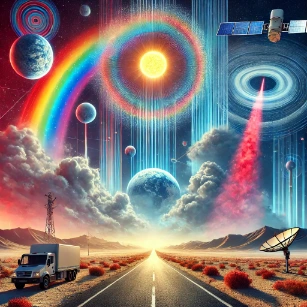
Atmospheric and environmental optics studies how light travels through the atmosphere and how it interacts with air molecules, aerosols, clouds, water droplets, ice crystals, pollution, vegetation, land, and water. It explains familiar sights such as the blue sky, red sunsets, rainbows, halos, mirages, glare, haze, and changing visibility. At the same time, it supports modern environmental tools such as lidar, satellite imaging, optical remote sensing, air-quality monitoring, and climate observation.
This page sits within the wider field of Physics and belongs to the Light and Optics cluster. It shows how everyday atmospheric phenomena can be understood through scattering, refraction, reflection, dispersion, absorption, polarisation, and the behaviour of Electromagnetic Waves. The atmosphere is not empty space through which light simply passes. It is an optical medium that bends, filters, scatters, absorbs, and redirects light in ways that reveal hidden environmental conditions.
The first step in this cluster is understanding Rayleigh Scattering and the Blue Sky. This explains why short-wavelength blue light is scattered strongly by air molecules, why the daytime sky appears blue, and why sunrise and sunset light often turns red or orange after travelling through a longer atmospheric path.
The next step is Rainbows, Halos, and Mirages. These effects show how light can be refracted, reflected, dispersed, or gradually bent by water droplets, ice crystals, and temperature-layered air. A rainbow is not simply colour in the sky; it is sunlight following a precise path through raindrops. A halo reveals ice-crystal optics. A mirage shows that light can curve through air whose refractive index changes with temperature.
Atmospheric and environmental optics also becomes a measurement science. In Lidar and Atmospheric Sensing, laser pulses are sent into the atmosphere and returning light is analysed to measure aerosols, smoke, dust, clouds, wind, and atmospheric layers. This turns scattering from a visual effect into a source of environmental data.
The cluster then expands to Optical Remote Sensing of the Environment. Satellites, aircraft, drones, and ground-based sensors use reflected and scattered light to monitor forests, crops, rivers, coasts, cities, snow, ice, fires, floods, pollution, and climate-related change. A remote-sensing image is not only a picture; it is a measurement of how Earth and the atmosphere interact with different wavelengths of light.
This hub also connects with several supporting areas of optics. Geometrical Optics helps explain ray paths in droplets, ice crystals, lenses, and mirages. Wave Optics helps students understand wavelength, interference, diffraction, scattering, and polarisation. Laser Optics and Photonics provide the technologies behind lidar, optical sensors, imaging systems, and environmental monitoring instruments.
Environmental applications make this subject especially important. Light scattering affects air quality, visibility, solar radiation, and climate modelling. Optical sensors help detect pollution, smoke, aerosols, clouds, water quality, vegetation stress, land-cover change, and urban heat patterns. These links connect atmospheric optics with Environmental Engineering, Data Science and Analytics, and modern climate observation.
For students, atmospheric and environmental optics is valuable because it begins with sights they already know and leads toward technologies that help society understand the planet. A blue sky, a rainbow, a halo, a smoky horizon, or a satellite image all carry information. The deeper lesson is that light does not only illuminate the world; it also records how the world is changing.
Atmospheric and environmental optics connects natural sky phenomena such as blue skies, rainbows, halos, and mirages with modern optical tools for monitoring air, clouds, pollution, land, water, and climate change.
Frequently Asked Questions: Atmospheric and Environmental Optics
What is atmospheric and environmental optics?
Atmospheric and environmental optics is the study of how light interacts with Earth’s atmosphere and environment. It explains visible phenomena such as blue skies, red sunsets, rainbows, halos, mirages, haze, clouds, and glare. It also supports technologies used to monitor air quality, aerosols, clouds, pollution, vegetation, land cover, water, and climate-related environmental change.
Why is the sky blue?
The sky appears blue mainly because of Rayleigh scattering. Air molecules scatter shorter-wavelength blue light more strongly than longer-wavelength red light. This scattered blue light reaches our eyes from many directions across the sky, making a clear daytime sky appear blue.
Why do sunsets often look red or orange?
At sunrise and sunset, sunlight travels through a much longer path in the atmosphere. Along that path, much of the blue light is scattered out of the direct beam. The remaining direct sunlight is richer in longer wavelengths such as red, orange, and yellow, which is why the low Sun and nearby sky often appear warm-coloured.
What is the difference between Rayleigh scattering and Mie scattering?
Rayleigh scattering occurs when light interacts with particles much smaller than the wavelength of light, such as air molecules. It strongly favours shorter wavelengths and explains the blue sky. Mie scattering occurs when light interacts with larger particles such as dust, smoke, haze, aerosols, or water droplets. It is less strongly colour-selective and often produces whitish haze, glare, or reduced visibility.
What causes rainbows?
Rainbows form when sunlight enters water droplets, refracts, reflects internally, and refracts again as it leaves. Because different wavelengths bend by different amounts, white sunlight separates into colours. A primary rainbow appears opposite the Sun, with red usually on the outer edge and violet on the inner edge.
What causes halos, sun dogs, and light pillars?
Halos, sun dogs, and light pillars are usually caused by sunlight or moonlight interacting with ice crystals in the atmosphere. Refraction through hexagonal crystals can produce rings or bright spots, while reflection from falling ice crystals can create vertical light pillars. The exact pattern depends on crystal shape, orientation, and the position of the light source.
What are mirages?
Mirages are real optical effects caused by light bending through layers of air with different temperatures and refractive indices. A common road mirage occurs when very hot air near the ground bends light from the sky upward toward the observer, creating the appearance of water or reflection on a dry surface.
How do clouds and aerosols affect light?
Cloud droplets and aerosols scatter, absorb, and redirect light. Clouds often look white because their droplets scatter many visible wavelengths together. Aerosols such as dust, smoke, sea salt, and pollution can reduce visibility, change sky colour, affect sunsets, and influence how much sunlight reaches Earth’s surface.
Why is light pollution an environmental optics problem?
Light pollution occurs when excessive or poorly directed artificial light brightens the night sky. It is an optical problem because scattered light reduces visibility of stars and astronomical objects. It is also an environmental issue because it can disrupt ecosystems, affect human sleep, waste energy, and reduce the natural darkness of night environments.
How do atmospheric optics affect climate and Earth’s energy balance?
Clouds, aerosols, gases, and surfaces all affect how sunlight is reflected, scattered, absorbed, and transmitted. Bright clouds and some aerosols can reflect sunlight back to space, while other particles and gases can absorb radiation and warm parts of the atmosphere. These optical effects influence Earth’s energy budget and are important in climate studies.
How is lidar used in atmospheric sensing?
Lidar sends laser pulses into the atmosphere and measures the light scattered back from molecules, aerosols, clouds, smoke, dust, or other particles. By measuring the return time and signal strength, lidar can build vertical profiles of atmospheric layers, cloud height, pollution, smoke plumes, wind, and aerosol distribution.
How does optical remote sensing help environmental monitoring?
Optical remote sensing uses sensors on satellites, aircraft, drones, or ground platforms to measure reflected and scattered light. Different surfaces and atmospheric features have different spectral signatures, so remote sensing can help monitor vegetation, water quality, land cover, fires, floods, urban expansion, snow, ice, pollution, and climate-related change.
How do atmospheric optical effects influence astronomy?
Earth’s atmosphere affects astronomical observations by scattering light, absorbing selected wavelengths, and causing turbulence that blurs or distorts starlight. This is why stars twinkle and why ground-based telescopes often use high, dry, dark sites or adaptive optics. Space telescopes avoid many of these atmospheric limitations.
Why should students study atmospheric and environmental optics?
Students should study atmospheric and environmental optics because it connects everyday sky phenomena with real environmental measurement. It strengthens understanding of scattering, refraction, reflection, dispersion, absorption, polarisation, sensors, and remote sensing. It also opens pathways into meteorology, climate science, environmental engineering, Earth observation, photonics, optical instrumentation, and data analysis.
Key Concepts in Atmospheric and Environmental Optics
Atmospheric and environmental optics is built on a small set of powerful ideas: scattering, refraction, reflection, dispersion, absorption, polarisation, and remote sensing. These ideas explain both everyday sky phenomena and advanced environmental measurement systems.
Scattering of Light
Scattering occurs when light interacts with molecules, droplets, aerosols, dust, smoke, or other particles and is redirected from its original path. Scattering explains why the sky is blue, why haze reduces visibility, why clouds often look white, and why optical sensors must account for the atmosphere when observing Earth.
Rayleigh Scattering
Rayleigh scattering occurs when light interacts with particles much smaller than the wavelength of light, such as air molecules. It is strongly wavelength-dependent and scatters shorter wavelengths more efficiently than longer wavelengths.
The structural mathematical proportion is derived as:
$$I_s \propto \frac{1}{\lambda^4}$$
This inverse-fourth-power relationship helps explain why blue light is scattered more strongly than red light. It is the main reason the clear daytime sky appears blue and why sunsets often appear red or orange.
Mie Scattering
Mie scattering occurs when particles are comparable in size to the wavelength of light. Dust, smoke, haze, sea salt, pollution aerosols, and water droplets can all produce Mie scattering. Unlike Rayleigh scattering, Mie scattering is less strongly selective by wavelength, so it often produces whitish haze, glare, or reduced contrast.
Non-Selective Scattering
Non-selective scattering occurs when particles are much larger than visible wavelengths. Large droplets in clouds and fog can scatter many visible wavelengths together, making clouds and fog appear white or grey. This is why a cloud does not usually look blue even though the surrounding clear sky may appear blue.
Refraction of Light in the Atmosphere
Refraction occurs when light bends because it travels through regions with different refractive indices. In the atmosphere, refractive index can vary with temperature, pressure, and density. These changes can bend light gradually, producing effects such as mirages and the twinkling of stars.
Mirages
A mirage is a real optical effect caused by light bending through temperature-layered air. In an inferior mirage, hot air near the ground bends light so that a dry road may appear wet. In a superior mirage, cold air near the surface and warmer air above can make distant objects appear lifted, stretched, or distorted.
Twinkling of Stars
Stars twinkle because their light passes through turbulent layers of Earth’s atmosphere. These layers have slightly different temperatures and densities, so they refract starlight in changing ways. The result is rapid variation in apparent brightness and position.
Atmospheric refraction explains mirages, distorted distant images, and the twinkling of stars as light bends through air layers with changing temperature and density.
Dispersion and Spectra
Dispersion occurs when different wavelengths of light bend by different amounts. In the atmosphere, dispersion is especially visible in rainbows and some halo effects. It separates white sunlight into colours because red, green, blue, and violet light do not refract equally in water or ice.
Rainbows
Rainbows form when sunlight enters water droplets, refracts, reflects internally, and refracts again as it leaves. Because different wavelengths bend by different amounts, sunlight separates into colours. The primary rainbow appears at an angular radius of about 42°, with red on the outer edge and violet on the inner edge.
Halos
Halos are caused by sunlight or moonlight interacting with ice crystals in the atmosphere. Common halo features include the 22° halo, sun dogs, light pillars, and arcs. Their shapes depend on the geometry and orientation of ice crystals.
Absorption of Light
Absorption occurs when gases, aerosols, droplets, or surfaces take in light energy instead of scattering or transmitting it. Ozone absorbs much harmful ultraviolet radiation. Water vapour and carbon dioxide absorb infrared radiation and influence Earth’s radiation balance. Aerosols may also absorb sunlight, depending on their composition.
Polarisation of Atmospheric Light
Atmospheric scattering can polarise light. Rayleigh-scattered skylight is partly polarised, especially at directions around 90° from the Sun. Polarisation measurements can help scientists infer information about aerosols, cloud droplets, surface reflection, and atmospheric conditions.
Optical Depth
Optical depth describes how much light is weakened as it travels through the atmosphere due to scattering and absorption. A low optical depth means the atmosphere is relatively transparent. A high optical depth means more light is removed from the direct path.
A simple exponential transmission model is stated as:
$$I = I_0 e^{-\tau}$$
Here, I0 is the original intensity, I is the transmitted intensity, and τ is the optical depth parameter.
Atmospheric Optical Phenomena
Atmospheric optical phenomena are visible signs of light interacting with air, water droplets, ice crystals, aerosols, and charged particles. They are beautiful, but they are also scientific clues.
Glory
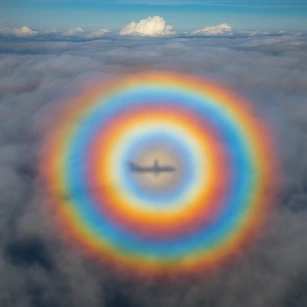
A glory is a set of coloured rings surrounding the shadow of an observer, often seen from an aircraft looking down at clouds. It is caused by complex scattering and diffraction of light by small water droplets.
A glory forms when light is scattered by cloud droplets, producing coloured rings around the observer’s shadow, often visible from aircraft above clouds.
Green Flash
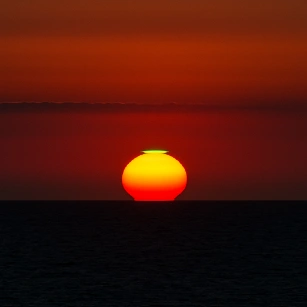
A green flash is a brief green spot sometimes visible at the upper edge of the Sun near sunrise or sunset. It is caused by atmospheric refraction and dispersion when conditions near the horizon are favourable.
The green flash is a rare atmospheric optical effect caused by refraction and dispersion near the horizon during sunrise or sunset.
Aurora
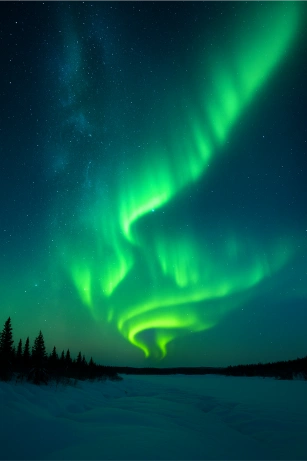
Auroras occur when charged particles from space interact with gases in Earth’s upper atmosphere, causing those gases to emit light. Although auroras involve charged-particle physics as well as optics, they are important atmospheric light phenomena because they reveal interactions between the solar wind, Earth’s magnetic field, and atmospheric gases.
Auroras reveal how charged particles guided by Earth’s magnetic field can excite atmospheric gases and produce glowing curtains of light.
Applications of Atmospheric and Environmental Optics
Atmospheric and environmental optics is useful because light carries information about the state of the atmosphere and the surface below it. By measuring how light is scattered, absorbed, reflected, transmitted, or polarised, scientists can study weather, climate, pollution, clouds, land, water, and ecosystems.
Weather Observation
Clouds, halos, visibility, haze, and optical distortions can provide clues about moisture, ice crystals, temperature gradients, and changing weather conditions.
Air Quality Monitoring
Scattering and absorption measurements help detect aerosols, smoke, dust, haze, and pollution particles that affect visibility and health.
Climate Studies
Clouds, aerosols, snow, ice, vegetation, and surface reflectivity affect Earth’s energy balance and must be measured for climate research.
Lidar and Atmospheric Sensing
Laser pulses can reveal aerosol layers, cloud height, smoke plumes, wind patterns, and atmospheric structure.
Optical Remote Sensing
Satellites, aircraft, and drones use reflected and scattered light to monitor vegetation, land cover, water quality, fires, floods, and environmental change.
Astronomy and Telescope Correction
Atmospheric turbulence, scattering, and light pollution affect astronomical observations, leading to methods such as adaptive optics and space telescopes.
Solar Energy Planning
Atmospheric optical depth, cloud cover, haze, and aerosols influence how much sunlight reaches solar panels and concentrators.
Public Communication
Visible sky phenomena such as rainbows, red sunsets, haze, and auroras help communicate physics, weather, climate, and environmental change to the public.
Learning Pathway: Atmospheric and Environmental Optics Cluster
This hub organises Atmospheric and Environmental Optics into four focused subpages. The learning path begins with sky colour, moves to dramatic optical phenomena, then develops into sensing and environmental monitoring.
Understand how satellites, aircraft, drones, and optical sensors monitor land, water, vegetation, pollution, disasters, and climate change.
Why Study Atmospheric and Environmental Optics?
Atmospheric and environmental optics is worth studying because it connects visible beauty with measurable science. It begins with phenomena students can see — blue skies, sunsets, rainbows, halos, mirages, haze, and auroras — and leads toward advanced tools used in environmental monitoring and Earth observation.
It Explains Everyday Sky Phenomena
Students learn why the sky is blue, why sunsets glow red, why clouds look white, and why rainbows, halos, and mirages appear under specific conditions.
It Connects Optics with Weather and Climate
Scattering, absorption, clouds, aerosols, and surface reflection influence visibility, radiation balance, and climate modelling.
It Supports Environmental Monitoring
Optical measurements help detect pollution, smoke, dust, haze, clouds, vegetation stress, water quality, snow, ice, and land-cover change.
It Builds Remote Sensing Literacy
Students learn that satellite images are not just pictures. They are wavelength-based measurements that need correction, interpretation, and validation.
It Develops Quantitative Thinking
Concepts such as optical depth, wavelength, scattering ratios, photon energy, and sensor resolution help students connect observation with calculation.
It Links Physics with Public Decisions
Atmospheric optics supports decisions in air quality, climate adaptation, renewable energy, disaster response, aviation, urban planning, and environmental protection.
Review Questions and Answers
What is atmospheric optics?
Answer: Atmospheric optics is the study of how light interacts with Earth’s atmosphere, including scattering, absorption, refraction, reflection, dispersion, and optical phenomena such as blue skies, rainbows, halos, and mirages.
How does light scattering affect the colour of the sky?
Answer: Rayleigh scattering causes shorter blue wavelengths to scatter more strongly than longer red wavelengths. This scattered blue light reaches our eyes from many directions, making the sky appear blue.
What is Rayleigh scattering?
Answer: Rayleigh scattering occurs when light interacts with particles much smaller than its wavelength, such as air molecules. It is strongly wavelength-dependent and explains the blue sky and reddened sunsets.
What is Mie scattering?
Answer: Mie scattering occurs when light interacts with particles comparable to or larger than the wavelength of light, such as dust, smoke, aerosols, or water droplets. It often produces haze, glare, and whitish skies.
How does absorption influence light in the atmosphere?
Answer: Absorption removes selected wavelengths from a light beam. Atmospheric gases such as ozone, water vapour, and carbon dioxide absorb particular wavelength ranges and influence radiation balance.
What role does remote sensing play in atmospheric and environmental optics?
Answer: Remote sensing uses optical measurements from satellites, aircraft, drones, lidar, or ground instruments to study clouds, aerosols, land cover, vegetation, water, pollution, and environmental change.
How are optical sensors used to monitor pollutants?
Answer: Optical sensors measure how pollutants scatter, absorb, or reflect light at specific wavelengths. These measurements can help identify aerosols, smoke, gases, and water-quality changes.
What is optical depth?
Answer: Optical depth measures how much light is attenuated by scattering and absorption as it passes through a medium such as the atmosphere.
How do aerosols affect light propagation?
Answer: Aerosols scatter and absorb light, reducing visibility, changing sky colour, affecting remote sensing signals, and influencing Earth’s radiation balance.
Why are polarisation measurements useful?
Answer: Polarisation measurements can reveal information about scattering processes and particle properties such as size, shape, and composition.
Thought-Provoking Questions and Answers
How does atmospheric scattering contribute to Earth’s climate system?
Answer: Scattering redistributes sunlight by sending some radiation back to space and some in different directions within the atmosphere. This affects albedo, surface illumination, and energy balance.
Why do aerosols have complex effects on climate?
Answer: Some aerosols reflect sunlight and can cool the surface, while others absorb sunlight and warm the atmosphere. Their effects depend on composition, altitude, particle size, and interaction with clouds.
How can remote sensing improve air-quality monitoring?
Answer: Remote sensing can reveal aerosol layers, smoke plumes, dust transport, cloud interactions, and pollution patterns across large areas, complementing ground-based monitoring stations.
Why does optical depth matter for solar energy systems?
Answer: Optical depth affects how much sunlight reaches the surface. Haze, clouds, dust, and aerosols can reduce the sunlight available to solar panels and concentrators.
How can changes in atmospheric optical properties signal environmental change?
Answer: Changes in haze, aerosol loading, cloud cover, surface reflectivity, snow cover, or vegetation colour can indicate shifts in pollution, climate, land use, or ecosystem health.
Why is modelling light propagation in the atmosphere difficult?
Answer: The atmosphere is heterogeneous. It contains changing mixtures of gases, aerosols, clouds, droplets, ice crystals, and temperature layers, causing multiple scattering, absorption, and refraction.
How do natural optical phenomena reveal particle properties?
Answer: Rainbows reveal water-droplet optics, halos reveal ice-crystal geometry, haze reveals aerosol scattering, and glories reveal droplet-size effects through diffraction and scattering.
Why combine satellite, aircraft, drone, and ground-based optical measurements?
Answer: Different platforms provide different strengths. Satellites cover wide areas, aircraft and drones provide regional detail, and ground instruments give continuous local measurements for validation.
How can atmospheric optics support renewable energy planning?
Answer: Understanding sunlight transmission, cloud cover, aerosol effects, haze, and surface reflectivity helps estimate solar energy availability and system performance.
How can better optical modelling influence environmental policy?
Answer: Better modelling can improve estimates of pollution, aerosol effects, climate forcing, visibility, solar radiation, and environmental risk, helping policymakers make more evidence-based decisions.
Numerical Problems and Solutions
A beam of sunlight has intensity 1.0 × 10³ W m−2 and passes through an atmosphere with optical depth 0.5. Calculate the transmitted intensity.
Solution:
Use the transmission expression: $I = I_0 e^{-\tau}$
Substitute $I_0 = 1.0 \times 10^3\text{ W m}^{-2}$ and $\tau = 0.5$.
$I = (1.0 \times 10^3) \times e^{-0.5}$
Since $e^{-0.5} \approx 0.6065$, $I \approx 606.5\text{ W m}^{-2}$.
Answer: The transmitted intensity is approximately 606.5 W m−2.
A sensor detects light of wavelength 550 nm. Calculate the energy of one photon.
Blue light has a wavelength of 450 nm and red light has a wavelength of 650 nm. Using Rayleigh scattering formulas, how much more strongly is blue light scattered than red light?
Solution:
Rayleigh scattering follows the inverse fourth-power relationship: $I_s \propto \frac{1}{\lambda^4}$
The proportionality ratio matches: $\left(\frac{650}{450}\right)^4$
Calculate the quotient base: $\frac{650}{450} \approx 1.4444$
Raise to the fourth power: $1.4444^4 \approx 4.35$
Answer: Blue light is scattered approximately 4.3 times more strongly than red light.
A prism has refractive indices of 1.55 for blue light and 1.50 for red light, with an apex angle of 60°. Estimate the angular separation using the thin prism approximation δ ≈ (n − 1)A.
Solution:
For blue light: $\delta_b = (1.55 – 1) \times 60^\circ = 33^\circ$
For red light: $\delta_r = (1.50 – 1) \times 60^\circ = 30^\circ$
Answer: The scattering target layer is approximately 1800 m away (1.8 km).
A satellite imaging pixel maps out a side length of 30 m. What total ground area does one square pixel capture?
Solution:
Calculate area parameters: $\text{Area} = 30\text{ m} \times 30\text{ m}$
$\text{Area} = 900\text{ m}^2$
Answer: One satellite pixel represents a ground area footprint of 900 m².
Conclusion
Atmospheric and environmental optics explains how light interacts with Earth’s atmosphere, clouds, aerosols, water droplets, ice crystals, pollution, land, water, vegetation, and environmental systems. It helps students understand blue skies, red sunsets, rainbows, halos, mirages, haze, glories, green flashes, auroras, and the optical signals used in environmental monitoring.
The field also supports practical technologies. Lidar measures atmospheric layers, smoke, clouds, aerosols, and wind. Optical remote sensing monitors forests, crops, water, cities, ice, fires, floods, and climate-related changes. Photonics, laser optics, sensors, satellites, and data analysis all turn light into environmental knowledge.
The deeper message is that light is not only something we see by. It is something we learn from. Every scattered beam, coloured sky, hazy horizon, or satellite image can reveal something about the physical state of the atmosphere and the changing condition of Earth.
Reflection Question
If light can reveal invisible information about air, clouds, pollution, water, vegetation, and climate, how should we use atmospheric and environmental optics to understand and care for the planet more responsibly?