Prepare for University Studies & Career Advancement
Plasma Physics
Plasma physics studies matter in an ionised state, where electrons have been separated from atoms and the material contains a mixture of free electrons and positive ions. This makes plasma very different from an ordinary gas. Because its particles are electrically charged, plasma responds strongly to electric fields, magnetic fields, currents, and electromagnetic waves.
Plasma appears across an enormous range of settings. It forms stars, lightning, auroras, the solar wind, planetary magnetospheres, laboratory discharges, plasma displays, semiconductor-processing tools, and fusion-research devices. In each case, the key idea is not only that plasma contains charged particles, but that those particles can move collectively. A small disturbance can be screened, amplified, guided, trapped, or turned into a wave.
This hub introduces three foundational ideas in plasma physics. Debye shielding explains how plasma screens electric disturbances. Plasma oscillations show how displaced electrons can move collectively against the ion background. Magnetic confinement shows how magnetic fields can guide charged particles and help hold plasma in controlled regions. Together, these ideas prepare students to understand space plasma, fusion energy, plasma diagnostics, and advanced electromagnetic technologies.
The image illustrates Plasma Physics, showcasing swirling, high-energy plasma streams influenced by electromagnetic fields, with dynamic interactions resembling cosmic and nuclear fusion processes.
Electric Disturbances, Plasma Rhythms, and Magnetic Control
Plasma physics studies how free electrons and ions respond collectively to electric and magnetic fields. This cluster introduces three core ideas: how plasma screens electric fields, how charged particles oscillate together, and how magnetic fields can guide plasma motion.
Plasma Physics – Overview
Introduces plasma as an ionised state of matter whose charged particles respond collectively to electric fields, magnetic fields, waves, and confinement methods.
Explores how magnetic fields guide charged-particle motion and help hold plasma in controlled regions for fusion research and laboratory studies.
The Plasma Physics cluster introduces Debye Shielding, Plasma Oscillations, and Magnetic Confinement as three connected ideas in the study of ionised matter.
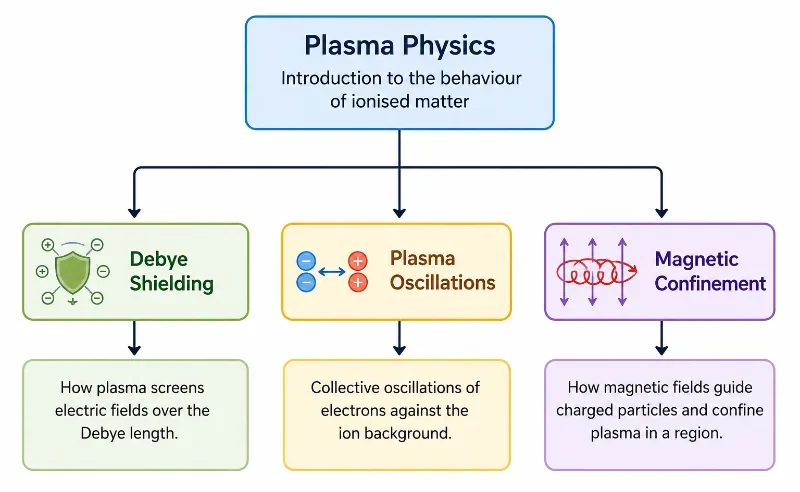
This tree chart shows the structure of the Plasma Physics cluster. Plasma Physics appears as the main topic, with three connected subtopics below it: Debye Shielding, Plasma Oscillations, and Magnetic Confinement. Debye Shielding explains how plasma screens electric fields, Plasma Oscillations describes collective electron motion against the ion background, and Magnetic Confinement shows how magnetic fields guide charged particles and help confine plasma. The chart helps students see the learning pathway before entering the individual pages.
What Makes Plasma Different?
Plasma is often called the fourth state of matter, but that phrase is only the beginning. A plasma is not simply a very hot gas. It is an ionised system containing free electrons, positive ions, and sometimes neutral particles. Because many of its particles carry electric charge, plasma responds strongly to electric fields, magnetic fields, and electromagnetic waves.
The most important feature of plasma is collective behaviour. In an ordinary gas, particles often act mainly through local collisions. In plasma, charged particles can influence one another over longer distances through electric and magnetic fields. This allows plasma to screen electric disturbances, support waves, form currents, become unstable, and interact with magnetic fields in ways ordinary gases cannot.
Ionisation
Plasma forms when enough energy is supplied to a gas for some electrons to separate from atoms or molecules. The result is a mixture of free electrons and positive ions. Some plasmas are almost fully ionised, while others remain partly ionised with many neutral particles still present.
Quasi-Neutrality
On large scales, most plasmas are nearly neutral because the number of negative charges and positive charges is almost balanced. This condition is often written as ne ≈ ni, meaning that electron density is approximately equal to ion density.
Collective Behaviour
Plasma particles do not only respond as isolated particles. They respond to shared electric and magnetic fields created by many particles together. This collective behaviour is what makes plasma physics different from ordinary gas physics.
Debye Shielding State
When an electric disturbance appears inside a plasma, mobile charges rearrange themselves to reduce its effect over distance. This shielding occurs over a characteristic distance called the Debye length (λD).
Important Types of Plasma
Plasma appears in many forms, from the extremely hot interiors of stars to cooler technological plasmas used in laboratories and industry. Classifying plasma helps students see that the same basic ideas can appear in very different physical environments.
Natural Plasma
Natural plasma appears in stars, the solar wind, auroras, lightning, planetary magnetospheres, and parts of the upper atmosphere. Space plasma is especially important because much of the visible universe exists in ionised form.
Laboratory Plasma
Laboratory plasmas are created in controlled devices for experiments, diagnostics, materials processing, lighting, plasma medicine, and fusion research. They allow scientists to study plasma behaviour under carefully chosen conditions.
High-Temperature Plasma
High-temperature plasmas appear in stars and fusion experiments. In devices such as tokamaks and stellarators, plasma must be heated to extremely high temperatures and guided by magnetic fields.
Low-Temperature Plasma
Low-temperature plasmas are widely used in industrial and technological applications, including plasma etching, surface treatment, sterilisation, displays, and some medical technologies.
Key Plasma Parameters
Plasma physicists use several important quantities to describe how plasma behaves. These parameters tell us how quickly plasma responds to disturbances, how strongly magnetic fields control particle motion, and whether pressure or magnetic forces dominate the system.
Plasma Frequency
The electron plasma frequency describes the natural angular frequency at which electrons can oscillate collectively against the heavier ion background:
Here, ne is electron density, e is the elementary charge, ε0 is the permittivity of free space, and me is the electron mass. A denser plasma has a higher plasma frequency because more electrons respond collectively to an electric disturbance.
Debye Length
The Debye length describes how far an electric disturbance can significantly extend into a plasma before mobile charges screen it:
A shorter Debye length means the plasma screens electric fields over a smaller distance. This idea is central to understanding why plasma can remain nearly neutral on large scales while still allowing small local charge separations.
Cyclotron Frequency
When a charged particle moves in a magnetic field, it can spiral around the magnetic field direction. The angular cyclotron frequency is:
$$\omega_c=\frac{|q|B}{m}$$
This quantity tells us how rapidly a charged particle circles around a magnetic field line. It is especially important in magnetised plasma, fusion devices, space plasma, and charged-particle diagnostics.
Plasma Beta
Plasma beta compares plasma pressure with magnetic pressure:
$$\beta=\frac{n k_B T}{B^2/(2\mu_0)}$$
A high-beta plasma is strongly influenced by its own pressure, while a low-beta plasma is more strongly controlled by external magnetic fields. This comparison is useful in fusion research, solar physics, and magnetospheric plasma modeling.
Evolution of Plasma Electrodynamics: History, Challenges, and Frontiers
To understand the mechanics of the ionized state, we must examine its historical path from laboratory observations to high-value industrial and cosmic frontiers.
Historical Epochs: From Crookes’ Radiant Matter to Langmuir’s Coining
The systematic study of ionized gases began in 1879 when Sir William Crookes experimented with electrical discharges inside high-vacuum tubes, describing the luminous streams he observed as a unique “radiant matter.” However, the modern field was truly established in 1928 by American chemist and physicist Irving Langmuir. While studying electrical discharges at General Electric, Langmuir noticed that the collective, fluid-like transport of electrons and ions resembled the way blood plasma transports organic particles. He coined the term plasma to describe this collective behavior, establishing it formally as the fourth state of matter. Langmuir, along with his colleague Lewi Tonks, went on to derive the math behind rapid collective electron oscillations, showing that ionized matter is fundamentally different from a neutral gas.
Contemporary Engineering Challenges: Turbulent Transport and Plasma Disruption
While the basic laws of single-particle motion are simple, controlling millions of interacting charges inside high-energy systems reveals massive engineering challenges. In magnetic confinement fusion devices like tokamaks, scientists struggle with turbulent transport. Micro-instabilities driven by localized temperature and pressure gradients cause heat and particles to bleed across magnetic containment lines, cooling the core plasma. If these instabilities grow too large, they can trigger a sudden plasma disruption, instantly dumping megawatts of thermal energy onto the container walls, which causes severe material erosion and structural stress. Managing these volatile multi-scale dynamics requires advanced active stabilization systems and robust wall materials.
Future Technological Horizons: Fusion Reactors and Plasma Space Propulsion
Today, plasma physics is at the absolute frontier of clean energy and deep-space exploration. Global research initiatives like the ITER project are working to achieve sustained, net-positive energy via controlled nuclear fusion, attempting to lock a burning plasma core inside a stable magnetic bottle. Beyond terrestrial energy, plasma is revolutionizing space technology through Helicon and Hall-Effect Thrusters. By using electromagnetic waves to ionize noble gases and magnetic fields to accelerate the resulting ions to extreme exhaust velocities, these advanced engines provide high-efficiency propulsion for long-duration interplanetary missions, paving the way for next-generation space exploration.
How Plasma Can Be Described
Plasma can be described at different levels depending on the problem. Sometimes it is useful to treat plasma like a conducting fluid. At other times, especially when particle speeds and distributions matter, plasma must be described using kinetic theory.
Single-Particle Picture
This approach focuses on how individual charged particles move in electric and magnetic fields. It is useful for understanding spiral motion, Larmor radius, magnetic mirrors, and particle confinement.
Fluid Picture
This approach treats plasma as one or more charged fluids. It is useful when studying large-scale motion, pressure, waves, currents, and magnetohydrodynamic behaviour.
Kinetic Picture
This approach describes how particles are distributed in position and velocity. It is useful when particle speeds, wave-particle interactions, and non-equilibrium effects are important.
Electromagnetic Picture
Plasma behaviour is closely tied to Maxwell’s equations because electric and magnetic fields shape particle motion, while moving charged particles also create fields and currents.
Plasma Waves and Instabilities
Plasma can support many types of waves because its charged particles respond collectively to electric and magnetic fields. These waves can carry energy, transfer momentum, heat plasma, and sometimes grow into instabilities.
Plasma Oscillations
Electrons can oscillate collectively against the heavier ion background at the plasma frequency. This is one of the simplest examples of collective plasma behaviour.
Alfvén Waves
In magnetised plasma, low-frequency waves can travel along magnetic field lines. These waves are important in space plasma, solar physics, and magnetohydrodynamics.
MHD Waves
Magnetohydrodynamic waves combine fluid motion with magnetic-field behaviour. They help explain large-scale plasma motion in stars, fusion devices, and space environments.
Plasma Instabilities
Some disturbances grow instead of fading away. Instabilities can produce turbulence, disrupt confinement, or reorganise plasma motion in both laboratory and natural systems.
Applications of Plasma Physics
Plasma physics connects fundamental science with many real-world applications. The same ideas used to understand stars and auroras also appear in fusion energy, spacecraft propulsion, semiconductor manufacturing, medical sterilisation, and advanced materials processing.
Controlled Nuclear Fusion
Fusion research uses high-temperature plasma confined by magnetic fields. Devices such as tokamaks and stellarators aim to hold plasma long enough and hot enough for fusion reactions to become useful.
Space and Astrophysics
Plasma physics helps explain solar flares, coronal mass ejections, auroras, the solar wind, planetary magnetospheres, and the behaviour of stars and interstellar matter.
Plasma Propulsion
Ion thrusters and Hall-effect thrusters use charged particles to produce efficient spacecraft propulsion, especially for long-duration space missions.
Semiconductor Manufacturing
Plasma etching and deposition are used to pattern and modify materials at very small scales, making plasma important in modern electronics and chip fabrication.
Industrial Processing
Plasma cutting, welding, coating, and surface treatment use energetic ionised gases to process materials with precision and control.
Medical and Biological Uses
Low-temperature plasma can be used for sterilisation, surface cleaning, wound-related research, and emerging plasma medicine applications.
Plasma physics connects fusion energy, space science, propulsion, microchip fabrication, industrial processing, and medical technologies.
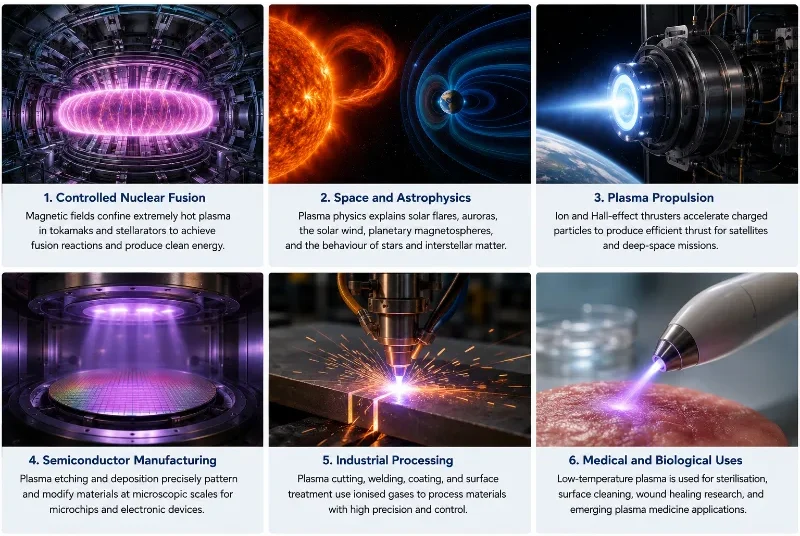
This artist’s-impression infographic introduces six major applications of plasma physics. It shows how ionised matter is used or studied in controlled nuclear fusion, space and astrophysics, plasma propulsion, semiconductor manufacturing, industrial processing, and medical or biological applications. The image is intended as a broad visual overview rather than a technical diagram, helping students see that plasma physics connects natural phenomena, advanced energy research, space technology, modern electronics, precision manufacturing, and emerging biomedical uses.
Two Simple Numerical Examples
Example 1: Estimating Plasma Frequency Problem: Find the electron plasma angular frequency for an electron density of ne = 1018 m-3. Solution: Apply the electron plasma frequency parameter relationship:
Answer: The electron plasma angular frequency is approximately 5.64 × 10¹⁰ rad/s.
Example 2: Estimating Debye Length Problem: Estimate the Debye shielding length for a plasma containing an electron temperature Te = 104 K and density ne = 1018 m-3. Solution: Apply the Debye thermal shielding expression:
Answer: The characteristic Debye length is approximately 7.43 × 10⁻⁵ m (or 74.3 microns).
Why Study Plasma Physics?
To Understand the Most Widespread Visible Form of Matter: Plasma appears throughout the visible universe, from stars and nebulae to the solar wind and planetary magnetospheres. Studying plasma physics helps students understand why space is not empty in a simple sense, but filled with charged matter shaped by electromagnetic fields.
To Connect Electricity, Magnetism, Fluids, and Waves: Plasma physics brings together many parts of physics. Students use electric fields, magnetic fields, waves, thermodynamics, particle motion, and fluid ideas in one connected subject. This makes plasma physics a powerful bridge between classroom theory and complex natural systems.
To Explore Fusion Energy and Space Technology: Fusion energy research depends on understanding how hot plasma can be heated, confined, diagnosed, and stabilised. Plasma physics is also important in spacecraft propulsion, space weather, satellite environments, and the study of charged particles in space.
To Develop Modelling and Computational Thinking: Plasma systems are often nonlinear and dynamic. Students who study plasma physics encounter models, simulations, and approximations that build strong problem-solving skills. These skills are useful not only in physics, but also in engineering, data science, materials science, and computational research.
To See How Modern Technology Uses Ionised Matter: Plasma is used in semiconductor fabrication, lighting, surface treatment, sterilisation, cutting, welding, and advanced laboratory diagnostics. Learning plasma physics helps students see how abstract electromagnetic ideas become practical tools in modern technology.
Summary
Plasma physics studies ionised matter whose charged particles respond collectively to electric and magnetic fields. Its core ideas include ionisation, quasi-neutrality, Debye shielding, plasma oscillations, magnetic confinement, plasma waves, and instabilities.
This subject links the small-scale motion of charged particles with large-scale systems such as stars, auroras, fusion devices, industrial plasma tools, and spacecraft propulsion. For students, plasma physics is a powerful way to see how electricity, magnetism, waves, and matter come together in some of the most energetic and technologically important systems in science.
Plasma Physics — FAQ
What is plasma in physics?
Plasma is an ionised state of matter made of free electrons, positive ions, and sometimes neutral particles. Because many of its particles carry electric charge, plasma conducts electricity, responds strongly to electric and magnetic fields, and can support waves and collective motion. This is why plasma is often called the fourth state of matter.
Why is plasma different from an ordinary gas?
In an ordinary gas, most particles are neutral, and their behaviour is mainly shaped by collisions. In a plasma, many particles are charged, so they can influence one another through long-range electric and magnetic forces. This allows plasma to screen electric fields, carry currents, form waves, and develop instabilities that ordinary neutral gases do not show in the same way.
Where does plasma occur naturally?
Plasma occurs naturally in stars, lightning, auroras, the solar wind, planetary magnetospheres, the ionosphere, and much of interstellar space. Although plasma may seem unfamiliar in everyday life, it is one of the most common visible forms of matter in the universe.
Where is plasma used in technology?
Plasma is used in fluorescent lamps, neon signs, plasma displays, welding arcs, semiconductor manufacturing, plasma cutting, surface treatment, sterilisation, spacecraft thrusters, and fusion research devices. These applications depend on the ability of ionised matter to conduct electricity, respond to fields, emit light, or transfer energy efficiently.
What does ionisation mean?
Ionisation occurs when atoms or molecules lose or gain electrons and become charged particles. A gas can become ionised by high temperature, strong electric fields, radiation, or collisions with energetic particles. When enough charged particles are present and they respond collectively to electromagnetic fields, the gas behaves as a plasma.
What is quasineutrality in plasma?
Quasineutrality means that, over sufficiently large distances, the positive and negative charges in plasma nearly balance. In simple terms, the electron density is approximately equal to the ion density. However, small local charge separations can still occur, and these local imbalances can produce electric fields, oscillations, and waves.
What is Debye shielding?
Debye shielding is the process by which plasma rearranges its mobile charged particles to reduce the effect of an electric disturbance. If a charge is placed inside a plasma, nearby electrons and ions shift slightly so that the electric field is weakened over distance. The characteristic distance for this screening is called the Debye length.
What are plasma oscillations?
Plasma oscillations are collective back-and-forth motions of charged particles. In the simplest case, electrons are displaced slightly from the heavier ion background. The resulting charge separation creates a restoring electric field, which pulls the electrons back and can make them oscillate at a natural plasma frequency.
How do magnetic fields affect plasma?
Magnetic fields bend the paths of moving charged particles, making them spiral around magnetic field lines. This behaviour is important in space plasma, laboratory plasma experiments, and fusion research. In magnetic confinement devices, magnetic fields help guide hot plasma and reduce contact with material walls.
What is magnetic confinement in fusion research?
Magnetic confinement is a method for holding very hot plasma using magnetic fields rather than solid walls. Devices such as tokamaks and stellarators use carefully shaped magnetic fields to guide charged particles and keep the plasma confined long enough for fusion reactions to be studied.
What are plasma waves and instabilities?
Plasma can support many kinds of waves because its charged particles respond collectively to electric and magnetic fields. Examples include electron plasma waves, ion-acoustic waves, and Alfvén waves. Plasma can also develop instabilities, where small disturbances grow over time and may lead to turbulence, energy transfer, or loss of confinement.
What mathematics is useful for learning plasma physics?
At university level, plasma physics uses calculus, vector calculus, differential equations, electromagnetism, and numerical modelling. Students may meet fluid models, which treat plasma as a conducting fluid, and kinetic models, which describe how particles are distributed in position and velocity.
Why is plasma physics important for future science and technology?
At university level, plasma physics uses calculus, vector calculus, differential equations, electromagnetism, and numerical modelling. Students may meet fluid models, which treat plasma as a conducting fluid, and kinetic models, which describe how particles are distributed in position and velocity.
How can the Plasma Physics section on Prep4Uni help students?
The Plasma Physics section on Prep4Uni introduces key ideas such as ionisation, collective behaviour, Debye shielding, plasma oscillations, waves, and magnetic confinement in an accessible way. It helps students prepare for university topics in electromagnetism, space science, fusion research, advanced materials, and engineering physics.
Review Questions and Answers
Review Questions: Plasma Physics
1. What is plasma, and how is it different from the other states of matter?
Plasma is an ionised form of matter containing free electrons and positive ions. Unlike ordinary gases, plasma conducts electricity, responds strongly to electric and magnetic fields, and can show collective behaviour such as Debye shielding, oscillations, waves, and instabilities.
2. How does a gas become plasma?
A gas becomes plasma when enough energy is supplied to separate electrons from atoms or molecules. This energy may come from heat, strong electric fields, radiation, or collisions with energetic particles.
3. What is the Debye length, and why is it important?
The Debye length is the characteristic distance over which an electric disturbance is screened in plasma. It is important because it shows how far local charge imbalances can strongly affect the surrounding plasma before mobile charges reduce the field.
4. What is plasma frequency?
Plasma frequency is the natural frequency at which electrons oscillate collectively when displaced from the ion background. It tells us how quickly the electron population can respond to an electric disturbance.
5. How do electric and magnetic fields influence plasma?
Electric fields accelerate charged particles, while magnetic fields bend their paths and can make them spiral around magnetic field lines. These field-particle interactions produce currents, waves, confinement effects, and complex plasma motion.
6. What role does temperature play in plasma behaviour?
Temperature measures the average kinetic energy of particles. Higher temperatures can increase ionisation, change particle speeds, affect collision rates, and influence important quantities such as Debye length, pressure, and plasma stability.
7. How is plasma used in controlled nuclear fusion experiments?
Fusion experiments heat plasma to extremely high temperatures so that light nuclei can fuse. Because no material wall can directly contain such hot plasma, devices such as tokamaks and stellarators use magnetic fields to guide and confine the charged particles.
8. Why are plasma instabilities important?
Plasma instabilities are disturbances that grow over time. They can cause turbulence, energy loss, poor confinement, or sudden changes in plasma behaviour. Understanding them is essential in fusion research, space physics, and laboratory plasma control.
9. How do laboratory plasmas differ from astrophysical plasmas?
Laboratory plasmas are created under controlled conditions and are usually smaller in size. Astrophysical plasmas occur naturally in vast environments such as stars, solar wind, nebulae, and planetary magnetospheres, often with large-scale magnetic structures and extreme conditions.
10. What techniques are used to diagnose plasma properties?
Common plasma diagnostics include Langmuir probes, spectroscopy, interferometry, magnetic probes, microwave diagnostics, and imaging methods. These techniques help measure quantities such as electron density, temperature, electric fields, magnetic fields, and plasma motion.
Thought-Provoking Questions and Answers
Thinking More Deeply About Plasma Physics
1. Why does Debye shielding matter in both laboratory and space plasmas?
Debye shielding limits how far electric disturbances can strongly affect a plasma. In laboratories, it helps explain sheath formation near probes and walls. In space, it helps explain why large plasma regions can remain nearly neutral even though local electric fields and charge separations still occur.
2. How could better magnetic confinement contribute to practical fusion energy?
Better magnetic confinement could reduce heat and particle losses, allowing plasma to remain hot and dense for longer periods. This is one of the major requirements for making controlled fusion a practical energy source.
3. How can plasma instabilities help us understand space weather?
Many space-weather events involve unstable plasma motion in the Sun, solar wind, or Earth’s magnetosphere. Studying instabilities helps scientists understand solar flares, coronal mass ejections, auroras, and disturbances that can affect satellites and power systems.
4. Why must plasma diagnostic tools be adapted to different plasma conditions?
Different plasmas may vary greatly in density, temperature, magnetic field strength, collision rate, and size. A tool that works well in a low-temperature laboratory plasma may not work safely or accurately in a fusion plasma or space plasma environment.
5. How do computer simulations help plasma physics?
Plasma systems are often nonlinear, fast-changing, and difficult to measure completely. Simulations allow scientists to test models, study turbulence, predict instabilities, compare designs, and interpret experiments that would be difficult to understand from measurement alone.
6. How can plasma physics support future spacecraft propulsion?
Plasma propulsion systems use electric and magnetic fields to accelerate charged particles and produce thrust. Because they can be highly efficient, they are useful for long-duration missions where fuel economy is more important than very large thrust.
7. Why do electromagnetic waves behave differently in plasma than in empty space?
In plasma, free electrons can respond collectively to electromagnetic waves. Depending on the wave frequency and plasma density, waves may be reflected, absorbed, refracted, delayed, or modified. This is especially important in radio communication, space plasma, and diagnostics.
8. How might plasma technology contribute to environmental applications?
Some plasmas can produce reactive particles that break down pollutants, sterilise surfaces, or treat water. The challenge is to control the reactions efficiently, safely, and economically at useful scales.
9. Why is turbulence a major challenge in fusion plasma?
Turbulence can move heat and particles across magnetic field lines, reducing confinement quality. Even if the plasma is magnetically confined in principle, turbulent transport can still allow energy to escape too quickly.
10. Why is plasma physics naturally interdisciplinary?
Plasma physics combines electromagnetism, thermodynamics, fluid mechanics, statistical physics, materials science, computation, and engineering. It appears in topics as different as stars, fusion energy, microchip manufacturing, spacecraft propulsion, and medical sterilisation.
Numerical Problems and Solutions
Numerical Practice: Plasma Physics
1. A plasma has electron density 1.0 × 10¹⁸ m-3 and electron temperature 10 eV. Calculate the Debye length.