
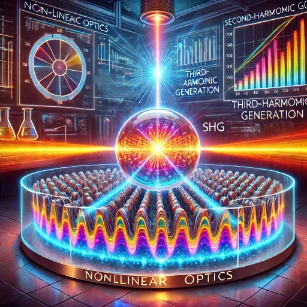
What Nonlinear Optics Really Is
Learning Pathway: Nonlinear Optics Cluster
Second-Harmonic Generation
Learn how intense light in nonlinear materials can produce light at twice the original frequency and half the vacuum wavelength.
Frequency Mixing and Optical Parametric Processes
Understand how nonlinear optical media generate sum frequencies, difference frequencies, signal-idler pairs, tunable light, and amplified optical waves.
Self-Focusing and Optical Solitons
See how intense light can change a material’s refractive index, focus itself, and form stable optical solitons.
Nonlinear Optics in Lasers and Photonics
Discover how nonlinear optics supports ultrafast lasers, wavelength conversion, optical fibres, photonic devices, frequency combs, and quantum technologies.
The Evolutionary Timeline: History, Scientific Hurdles, and Material Paradigms
The Historical Journey
Contemporary Scientific Challenges
Future Paradigms: Meta-Surfaces and Extreme Harmonics
- Nonlinear Metasurfaces: By pattern-engineering sub-wavelength optical antennas out of materials like lithium niobate or silicon, researchers can generate harmonic frequencies within flat surfaces less than a micron thick, removing the requirement for bulky macroscopic crystals.
- High-Harmonic Generation (HHG) in Gases: Focusing intense femtosecond pulses into noble gas jets allows scientists to drive electronic responses far into the extreme ultraviolet and soft X-ray bands. This technique produces attosecond laser pulses, which are fast enough to freeze-frame electron motion inside molecular bonds.
Key Concepts in Nonlinear Optics
Nonlinear Polarisation
| Term | Meaning | Example Effects |
|---|---|---|
| \(\chi^{(1)}E\) | Linear response | Ordinary refraction, transmission, and linear polarisation |
| \(\chi^{(2)}E^2\) | Second-order nonlinear response | Second-harmonic generation, sum-frequency generation, difference-frequency generation, optical parametric processes |
| \(\chi^{(3)}E^3\) | Third-order nonlinear response | Kerr effect, self-focusing, self-phase modulation, four-wave mixing, optical solitons |
Harmonic Generation
| Process | Frequency Relationship | Student-Friendly Meaning |
|---|---|---|
| Second-harmonic generation | \(\omega + \omega \rightarrow 2\omega\) | Two fundamental photons combine into one photon at twice the frequency |
| Third-harmonic generation | \(\omega + \omega + \omega \rightarrow 3\omega\) | Light is converted to three times the original frequency |
| Higher-harmonic generation | \(n\omega\) | Light is converted to higher multiples of the original frequency |
Frequency Mixing and Parametric Processes
| Process | Frequency Relationship | Use |
|---|---|---|
| Sum-frequency generation | \(\omega_3 = \omega_1 + \omega_2\) | Generating higher-frequency light from two inputs |
| Difference-frequency generation | \(\omega_3 = |\omega_1 – \omega_2|\) | Generating lower-frequency or infrared light |
| Optical parametric oscillation | \(\omega_p = \omega_s + \omega_i\) | Producing tunable signal and idler waves from a pump |
| Four-wave mixing | Often \(2\omega_p = \omega_s + \omega_i\) | Wavelength conversion in fibres, waveguides, and resonators |
Phase Matching
Intensity-Dependent Refractive Index
Self-Focusing and Optical Solitons
Stimulated Scattering Effects
| Effect | Physical Interaction | Why It Matters |
|---|---|---|
| Stimulated Raman scattering | Light interacts with molecular or lattice vibrations | Useful in Raman amplification, spectroscopy, and wavelength shifting |
| Stimulated Brillouin scattering | Light interacts with acoustic waves in the medium | Important in fibres, sensing, narrowband amplification, and power limits |
Applications of Nonlinear Optics
Laser Wavelength Conversion
Nonlinear crystals can convert laser output into visible, ultraviolet, infrared, or tunable wavelengths that may not be available directly from the laser gain medium.
Ultrafast Laser Systems
Self-phase modulation, optical parametric amplification, Kerr lensing, and nonlinear pulse compression support femtosecond and picosecond laser technology.
Optical Fibre Communication
Nonlinear effects influence signal distortion, wavelength conversion, soliton propagation, Raman amplification, and high-capacity fibre design.
Quantum Optics
Parametric down-conversion and four-wave mixing can generate photon pairs, entangled states, and wavelength conversion tools for quantum photonics.
Microscopy and Bio-Optics
Second-harmonic generation, third-harmonic generation, multiphoton excitation, and nonlinear Raman methods support advanced biological imaging.
Optical Signal Processing
Nonlinear effects can enable wavelength conversion, all-optical switching, pulse reshaping, and signal regeneration.
Supercontinuum Sources
Intense pulses in nonlinear fibres or waveguides can generate broad spectra for spectroscopy, imaging, sensing, and metrology.
Integrated Photonics
Nonlinear waveguides and microresonators support compact wavelength converters, frequency combs, quantum sources, and chip-scale photonic systems.
Challenges and Practical Limitations
| Challenge | Why It Matters | Typical Design Response |
|---|---|---|
| Weak nonlinear response | Many materials produce only small nonlinear effects | Use strong fields, resonators, long fibres, tight waveguides, or high-nonlinearity materials |
| Phase mismatch | Generated waves can cancel instead of building up | Use birefringent phase matching, quasi-phase matching, angle tuning, temperature tuning, or dispersion engineering |
| Material damage | High-intensity light can damage crystals, fibres, coatings, and chips | Manage beam size, pulse duration, power, cooling, and material choice |
| Absorption and heating | Loss reduces efficiency and can disturb phase matching | Select transparent materials and improve thermal design |
| Competing nonlinear effects | Unwanted processes may steal energy or distort signals | Optimise wavelength, polarisation, geometry, and power level |
| Alignment sensitivity | Small angle or position errors can reduce efficiency | Use stable mounts, integrated designs, and robust phase-matching schemes |
| Fabrication limits | Photonic chips require precise dimensions and low loss | Improve nanofabrication, packaging, trimming, and quality control |
| Safety concerns | High-power and invisible laser beams can be hazardous | Use strict professional laser safety procedures and controlled environments |
Future Directions and Emerging Trends
Integrated Nonlinear Photonics
Compact waveguides and resonators may bring frequency conversion, comb generation, and nonlinear signal processing onto photonic chips.
Microresonator Frequency Combs
Tiny resonators can use nonlinear effects to generate precise combs of optical frequencies for timing, spectroscopy, communication, and measurement.
Quantum Light Sources
Nonlinear processes can generate photon pairs and wavelength-converted photons for quantum communication, quantum sensing, and quantum information systems.
Mid-Infrared and Terahertz Sources
Difference-frequency generation and parametric processes can help produce wavelengths useful for molecular sensing and environmental monitoring.
Ultrafast and Attosecond Science
Nonlinear optics supports pulse compression, high-harmonic generation, and time-resolved studies of extremely fast physical and chemical processes.
Advanced Bio-Imaging
Multiphoton and harmonic-generation microscopy can reveal biological structure with improved contrast and reduced reliance on external labels.
AI-Assisted Photonic Design
Computational optimisation may help design nonlinear waveguides, resonators, dispersion profiles, and material stacks that are difficult to discover manually.
Lower-Power Nonlinear Devices
Better confinement, resonant enhancement, and material engineering may reduce the power required for useful nonlinear effects.
Connections with Wider Physics and Technology
Geometrical Optics
Although nonlinear optics goes beyond simple ray models, lenses, focusing, beam paths, apertures, and optical alignment remain essential in real systems.
Wave Optics
Phase, interference, diffraction, coherence, dispersion, and wave-vector matching are central to efficient nonlinear conversion.
Laser Optics
Lasers provide the intensity and coherence that make nonlinear effects strong enough to use in laboratories and technologies.
Photonics
Photonics uses nonlinear effects for wavelength conversion, optical switching, frequency combs, quantum light sources, and integrated devices.
Fiber Optics
Optical fibres provide long interaction lengths where self-phase modulation, four-wave mixing, Raman scattering, and soliton effects become important.
Quantum Optics
Nonlinear processes can generate photon pairs, squeezed light, and wavelength conversion tools for quantum experiments.
Electromagnetic Waves
Nonlinear optics is rooted in how the electric field of light drives material polarisation beyond the linear approximation.
Bio-Optics
Nonlinear microscopy and laser-tissue interactions connect nonlinear optics with biological imaging and medical research.
Frequently Asked Questions: Nonlinear Optics
What is nonlinear optics?
How does nonlinear optics differ from linear optics?
Why are lasers so important in nonlinear optics?
What is second-harmonic generation?
What is frequency mixing?
What is the Kerr effect?
What are optical solitons?
Why is phase matching important?
What materials are used in nonlinear optics?
How is nonlinear optics used in ultrafast lasers?
How is nonlinear optics used in optical communication?
Why should students learn nonlinear optics?
Review Questions and Answers
- What is nonlinear optics?Answer: Nonlinear optics is the study of optical effects that occur when a material’s response is not directly proportional to the electric field of light.
- What are common nonlinear optical phenomena?Answer: Common examples include second-harmonic generation, third-harmonic generation, sum-frequency generation, difference-frequency generation, self-focusing, self-phase modulation, four-wave mixing, and optical solitons.
- How does second-harmonic generation occur?Answer: Two photons at the same frequency interact in a suitable nonlinear material to produce one photon at twice the frequency.
- What is the optical Kerr effect?Answer: The optical Kerr effect is an intensity-dependent refractive-index effect, often described by n = n0 + n2I.
- What role do solitons play in nonlinear optics?Answer: Solitons are stable wave packets that maintain their shape because nonlinear effects balance spreading effects such as dispersion or diffraction.
- Why is phase matching important?Answer: Phase matching allows generated waves to add constructively as they travel through a nonlinear material, increasing conversion efficiency.
- What is self-phase modulation?Answer: Self-phase modulation occurs when an optical pulse changes its own phase through the intensity-dependent refractive index of the medium, often broadening its spectrum.
- How do nonlinear effects support ultrafast lasers?Answer: They support pulse shaping, spectral broadening, pulse compression, Kerr lens mode locking, optical parametric amplification, and ultrashort pulse measurement.
Thought-Provoking Questions and Answers
- How does nonlinear optics challenge the idea that light simply passes through matter?Answer: Nonlinear optics shows that intense light can change the material response, and that changed response can generate new light, reshape pulses, or alter beam propagation.
- Why can the same nonlinear effect be useful in one system and harmful in another?Answer: A nonlinear effect may help generate a new wavelength or shape a pulse, but in a communication fibre it may distort signals or create crosstalk. Usefulness depends on the design goal.
- Why is phase matching a good example of cooperation in physics?Answer: It shows that energy conservation alone is not enough. Waves must also remain in the correct phase relationship so their contributions build rather than cancel.
- How could better materials improve nonlinear optical technologies?Answer: Materials with stronger nonlinear response, lower loss, better transparency, higher damage threshold, and easier integration could make devices more efficient and compact.
- Why are optical solitons useful for thinking about stability?Answer: Solitons show that stability can arise from balance. A pulse can preserve its shape because dispersion and nonlinearity continuously compensate each other.
- How might nonlinear optics contribute to quantum communication?Answer: Nonlinear processes can generate photon pairs, entangled photons, and wavelength-converted photons needed for quantum networks and quantum optical experiments.
Comprehensive Numerical Problems with Solutions
- A laser beam of wavelength 800 nm undergoes second-harmonic generation. Find the new wavelength in vacuum.Solution:Using the fundamental second-harmonic generation wavelength parameter relationship:$$\lambda_{\mathrm{SHG}} = \frac{\lambda}{2}$$Substitute the structural wavelength constant:$$\lambda_{\mathrm{SHG}} = \frac{800\text{ nm}}{2} = 400\text{ nm}$$Answer: The second-harmonic wavelength is exactly 400 nm.
- A laser at 1064 nm produces third-harmonic generation. Find the third-harmonic wavelength in vacuum.Solution:Using the third-harmonic formulation:$$\lambda_{\mathrm{THG}} = \frac{\lambda}{3}$$Substitute the values:$$\lambda_{\mathrm{THG}} = \frac{1064\text{ nm}}{3} \approx 354.667\text{ nm}$$Answer: The third-harmonic wavelength is approximately 355 nm.
- A beam of intensity 1.0 × 10¹⁰ W/m2 passes through a medium with n2 = 3.0 × 10⁻²⁰ m2/W. Find the nonlinear change in refractive index.Solution:Using the optical Kerr index equation:$$\Delta n = n_2 \cdot I$$Substitute metrics directly into the calculation:$$\Delta n = (3.0 \times 10^{-20}\text{ m}^2\text{/W}) \times (1.0 \times 10^{10}\text{ W/m}^2) = 3.0 \times 10^{-10}$$Answer: The nonlinear refractive-index change is exactly 3.0 × 10⁻¹⁰.
- A nonlinear crystal has 20% conversion efficiency for an input power of 500 mW. Find the converted output power.Solution:Convert the efficiency percentage parameter to a fraction: 20% = 0.20. Apply the power formula:$$P_{\mathrm{out}} = \eta \cdot P_{\mathrm{in}}$$$$P_{\mathrm{out}} = 0.20 \times 500\text{ mW} = 100\text{ mW}$$Answer: The converted output power is exactly 100 mW.
- A pulse has peak power 10 kW and duration 100 fs. Estimate the pulse energy using the kinetic energy relationship.Solution:Convert metrics into base metric units: 10 kW = 1.0 × 10⁴ W and 100 fs = 1.0 × 10⁻¹³ s. Use the formulation:$$E = P \cdot t$$$$E = (1.0 \times 10^4\text{ W}) \times (1.0 \times 10^{-13}\text{ s}) = 1.0 \times 10^{-9}\text{ J}$$Answer: The pulse energy is exactly 1.0 × 10⁻⁹ J (or 1.0 nJ).
- A nonlinear optical fibre has an index value γ = 1.2 W−1km−1. A pulse of power 0.5 W travels 2 km. Find the nonlinear phase shift.Solution:Using the nonlinear phase equation:$$\Delta \phi = \gamma \cdot P \cdot L$$Substitute values:$$\Delta \phi = (1.2\text{ W}^{-1}\text{km}^{-1}) \times 0.5\text{ W} \times 2\text{ km} = 1.2\text{ rad}$$Answer: The nonlinear phase shift evaluates to exactly 1.2 rad.
- A mode-locked laser has a repetition rate of 80 MHz and an average power of 2 W. Find the energy per individual pulse.Solution:The pulse energy is the quotient of average power and repetition frequency:$$E = \frac{P}{f}$$Substitute values:$$E = \frac{2\text{ W}}{80 \times 10^6\text{ s}^{-1}} = 2.5 \times 10^{-8}\text{ J}$$Answer: The energy per pulse is exactly 2.5 × 10⁻⁸ J (or 25 nJ).
- The critical power for self-focusing inside a medium is 2.0 MW. A laser system operates with a peak power of 2.5 MW. Is this power level above the critical threshold?Solution:Compare the system peak power with the critical threshold power constant:$$2.5\text{ MW} > 2.0\text{ MW}$$$$\Delta P = 2.5\text{ MW} – 2.0\text{ MW} = 0.5\text{ MW}$$Answer: Yes. The peak power level is above the critical value by exactly 0.5 MW, indicating that self-focusing profiles may structurally develop under valid configuration states.