
Thermodynamics is the foundational science that explores the relationships between heat, work, energy, and matter. It serves as a bridge between macroscopic observations and microscopic phenomena, offering a rigorous framework for understanding how physical systems respond to changes in temperature, pressure, and volume. Students engaging with physics will quickly discover that thermodynamics is essential not only in theoretical studies but also in practical applications across science and engineering.
Beginning with classical thermodynamics, learners explore the fundamental laws that govern energy conservation and entropy, developing an intuitive grasp of equilibrium states. The laws of thermodynamics are among the most universally applicable principles in science, influencing everything from the operation of heat engines to the fate of the universe. For those interested in practical applications, engineering thermodynamics extends these ideas into the design and analysis of real-world energy systems, including engines, power plants, and refrigeration cycles.
The study of heat transfer is another key dimension, revealing how thermal energy moves through conduction, convection, and radiation. These concepts are critical not only in mechanical systems but also in areas like climate modeling and electronics. Students also examine thermodynamic cycles, which form the basis of all energy conversion devices, and phase transitions, essential for understanding phenomena such as melting, boiling, and sublimation.
Moving beyond equilibrium systems, non-equilibrium thermodynamics explores the behavior of systems in flux, a critical area for modern research in chemical reactions, biological processes, and transport phenomena. Statistical thermodynamics builds on this by using probabilistic models to relate the properties of individual particles to macroscopic variables like temperature and entropy. This microscopic perspective complements ideas in modern physics and supports more advanced treatments of complex systems.
Understanding thermodynamics also enriches perspectives on related topics such as atomic physics and the structure of the atom, where thermal excitation plays a role in spectroscopy and radiation. Likewise, concepts like nuclear reactions, including fusion and fission, are deeply connected to thermodynamic principles. The idea of energy quantization further bridges quantum theory with thermodynamic behavior, especially in the context of radiation and low-temperature phenomena.
Thermodynamics also has a significant role in sustainable development. The study of renewable and sustainable energy systems draws heavily on thermodynamic laws to evaluate and optimize clean energy technologies like solar panels, geothermal systems, and hydrogen fuel cells. Tools from computational thermodynamics enable precise modeling of complex materials and reactions, while materials thermodynamics helps predict phase stability and transformation kinetics.
In synergy with subjects like wave-particle duality, relativity, and even radioactivity, thermodynamics equips students with a unified framework for analyzing the physical world. Whether through theoretical exploration or real-world application, it remains a vital field for those pursuing careers in science, engineering, and environmental studies.
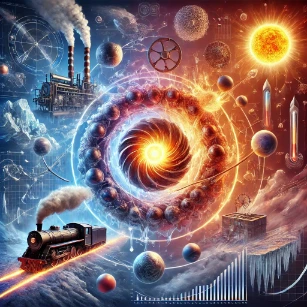
- Thermodynamics topics:
- Thermodynamics – Overview
- Classical Thermodynamics
- Laws of Thermodynamics
- Statistical Thermodynamics
- Engineering Thermodynamics
- Heat Transfer
- Thermodynamic Cycles
- Non-Equilibrium Thermodynamics
- Phase Equilibria & Phase Transitions
- Chemical Thermodynamics
- Thermodynamics of Materials
- Renewable & Sustainable Energy Thermodynamics
- Computational Thermodynamics
Exploring Thermodynamics – Energy, Heat, and the Direction of Change
Thermodynamics studies how energy moves, transforms, and limits what is possible in physical and engineered systems. From steam engines and refrigeration to batteries, climate systems, and materials processing, thermodynamic ideas explain why some processes are spontaneous, how efficient machines can be, and how microscopic motion produces macroscopic quantities like temperature and pressure. On Prep4Uni.Online, the Thermodynamics hub links school-level ideas about heat and work to university study in physics, engineering, chemistry, and materials science.
Thermodynamics – Overview
Use this page as your starting point for energy and heat. It introduces core quantities (temperature, internal energy, work, heat, entropy) and shows how the laws of thermodynamics organise them. You will also see how the subpages below connect to further study in physics, engineering design, power generation, climate science, and materials engineering.
Classical Thermodynamics
Focuses on macroscopic descriptions of systems using state variables, equations of state, and the first and second laws. This subpage develops the tools you need to analyse closed and open systems, reversible and irreversible processes, and simple power and refrigeration cycles without yet invoking molecular models.
Laws of Thermodynamics
Presents the zeroth, first, second, and third laws as the organising principles of the subject. You will see how they formalise ideas of temperature, energy conservation, entropy, and absolute zero, and how these laws constrain engine efficiency, heat flow, and the direction of natural processes in all physical systems.
Statistical Thermodynamics
Connects macroscopic thermodynamic quantities to microscopic models of atoms and molecules. This page explores probability distributions, microstates, and partition functions, helping you understand entropy, temperature, and free energy from a statistical viewpoint – preparation for advanced physics, chemistry, and materials courses.
Engineering Thermodynamics
Applies thermodynamic principles to practical devices and systems: compressors, turbines, internal combustion engines, gas turbines, refrigeration plants, and power stations. You will practise energy and exergy balances and performance calculations that are central in mechanical, chemical, and energy engineering programmes.
Heat Transfer
Studies how thermal energy moves via conduction, convection, and radiation. This subpage introduces differential equations and dimensionless numbers used to design heat exchangers, insulation, cooling systems, and thermal management solutions in electronics, buildings, and industrial processes.
Thermodynamic Cycles
Focuses on ideal and real cycles such as Otto, Diesel, Brayton, Rankine, and refrigeration cycles. You will learn to interpret P–V and T–s diagrams, compute efficiencies and work outputs, and see how cycle choices shape the design of engines, turbines, and power plants you meet in engineering degrees.
Non-Equilibrium Thermodynamics
Explores systems away from equilibrium where gradients drive transport and irreversible processes. Topics include linear flux–force relations, transport coefficients, and entropy production, providing a conceptual gateway to advanced study of chemical reactors, biological systems, and climate dynamics.
Phase Equilibria & Phase Transitions
Examines how substances change between solid, liquid, and vapour and how multiple phases coexist. This page introduces phase diagrams, Clapeyron relations, critical points, and nucleation, linking directly to materials engineering, metallurgy, geoscience, and chemical-process design topics on Prep4Uni.Online.
Chemical Thermodynamics
Applies thermodynamic tools to chemical reactions and mixtures. You will work with chemical potentials, Gibbs energy, equilibrium constants, and reaction spontaneity, building foundations for physical chemistry, electrochemistry, and chemical engineering modules focused on reactors and process design.
Thermodynamics of Materials
Looks at how thermodynamic driving forces shape material structures and properties. This subpage connects free-energy landscapes to phase stability, phase transformations, alloy design, defects, and microstructure evolution – key ideas in materials science and solid-state physics courses.
Renewable & Sustainable Energy Thermodynamics
Examines thermodynamic limits and performance metrics for renewable and low-carbon technologies: solar thermal systems, heat pumps, biomass, geothermal, and next-generation power cycles. This page links energy analysis to sustainability indicators and policy-relevant questions about efficiency, waste heat, and decarbonisation pathways.
Computational Thermodynamics
Introduces numerical and software-based approaches for calculating phase diagrams, equilibria, and thermodynamic properties (for example using CALPHAD methods or equation-of-state modelling). It prepares you for project work where coding, simulation, and databases are used to design materials and processes virtually before experimentation.
Table of Contents
Key Concepts in Thermodynamics
Laws of Thermodynamics
The laws of thermodynamics form the foundation of this field, describing the behavior of energy in various systems:
- First Law (Law of Energy Conservation): Energy cannot be created or destroyed; it can only be transferred or transformed. This principle ensures energy balance in processes such as combustion and electricity generation.
- Second Law: The entropy (disorder) of an isolated system tends to increase over time, explaining why energy transformations are never 100% efficient.
- Third Law: As the temperature of a system approaches absolute zero, its entropy approaches a constant minimum.
- Zeroth Law: If two systems are each in thermal equilibrium with a third system, they are also in equilibrium with each other, forming the basis for temperature measurement.
Heat Transfer
Heat transfer describes the movement of thermal energy between systems and occurs through three primary mechanisms:
- Conduction: Transfer of heat through direct contact between materials, such as the warming of a metal rod when one end is heated.
- Convection: Movement of heat through fluids (liquids or gases), driven by the circulation of warmer and cooler regions, such as in boiling water or atmospheric currents.
- Radiation: Transfer of energy through electromagnetic waves, such as heat from the sun reaching the Earth.
Thermodynamic Cycles
Thermodynamic cycles involve a sequence of processes that return a system to its initial state, often used in engines and power generation:
- Carnot Cycle: A theoretical cycle that defines the maximum efficiency achievable by a heat engine.
- Rankine Cycle: The basis for steam power plants, where water is heated to produce steam that drives turbines.
- Refrigeration Cycle: Used in air conditioners and refrigerators to transfer heat from a cooler space to a warmer one.
- Otto and Diesel Cycles: Governing the operation of internal combustion engines in cars and trucks.
Relevance of Thermodynamics in Modern Science and Engineering
Thermodynamics remains a critical field in addressing the global energy crisis and transitioning to sustainable energy systems. Its principles guide innovations in energy storage, transportation, and renewable energy technologies. Moreover, the integration of thermodynamics with other disciplines, such as nanotechnology and computational modeling, is paving the way for breakthroughs in advanced materials and efficient energy systems.
Sub-Areas of Studies in Thermodynamics
Thermodynamics encompasses a wide range of specialized sub-areas that focus on various aspects of heat, energy, and their transformations. Below are the key sub-areas of study within thermodynamics:
Classical Thermodynamics
- Focus: The macroscopic study of energy, heat, and work without considering molecular or atomic details.
- Key Topics:
- Laws of thermodynamics (First, Second, Third, and Zeroth Laws).
- Thermodynamic processes such as isothermal, adiabatic, and isobaric processes.
- Thermodynamic cycles (e.g., Carnot, Rankine, Refrigeration and Diesel cycles).
- Applications:
- Design of engines, power plants, and HVAC systems.
Statistical Thermodynamics
- Focus: The microscopic study of thermodynamic systems using statistical methods to relate molecular behavior to macroscopic properties.
- Key Topics:
- Probability distributions and partition functions.
- Kinetic theory of gases.
- Microscopic interpretation of entropy and energy.
- Applications:
- Explaining phenomena like phase transitions and chemical reactions.
- Understanding the thermodynamic behavior of nanoscale systems.
Chemical Thermodynamics
- Focus: The study of energy changes and equilibrium in chemical reactions and processes.
- Key Topics:
- Gibbs free energy and Helmholtz free energy.
- Chemical potential and reaction equilibria.
- Thermodynamic properties of mixtures and solutions.
- Applications:
- Designing industrial chemical processes.
- Predicting reaction feasibility and product yields.
Engineering Thermodynamics
- Focus: The application of thermodynamic principles to practical engineering systems.
- Key Topics:
- Energy conversion systems like turbines, compressors, and heat exchangers.
- Thermodynamic efficiency of engines and power plants.
- Analysis of refrigeration and air conditioning systems.
- Applications:
- Improving the performance of engines and energy systems.
- Designing sustainable energy solutions.
Heat Transfer
- Focus: The study of heat energy transfer mechanisms in various systems.
- Key Topics:
- Conduction, convection, and radiation.
- Heat transfer in steady-state and transient conditions.
- Heat exchanger design and optimization.
- Applications:
- Developing efficient cooling and heating systems.
- Enhancing thermal management in electronics.
Phase Equilibria and Phase Transitions
- Focus: The study of energy and entropy changes during phase changes and the equilibrium between different phases of matter.
- Key Topics:
- Vapor-liquid equilibrium and boiling/condensation.
- Solid-liquid and solid-gas phase transitions.
- Thermodynamics of supercritical fluids.
- Applications:
- Designing distillation and separation processes.
- Developing materials with specific phase properties.
Non-Equilibrium Thermodynamics
- Focus: The study of thermodynamic systems far from equilibrium, where gradients in temperature, pressure, or concentration exist.
- Key Topics:
- Irreversible processes and entropy generation.
- Thermodynamics of transport phenomena (heat, mass, and momentum transfer).
- Linear and nonlinear thermodynamics of complex systems.
- Applications:
- Understanding biological systems and chemical reactors.
- Optimizing processes in nonequilibrium environments.
Thermodynamics of Materials
- Focus: The study of thermodynamic properties of materials and their behavior under various conditions.
- Key Topics:
- Thermal expansion, heat capacity, and phase stability.
- Thermodynamic properties of alloys, polymers, and ceramics.
- Material performance at high temperatures.
- Applications:
- Designing high-performance materials for aerospace and energy applications.
- Understanding the thermodynamics of corrosion and material degradation.
Renewable and Sustainable Energy Thermodynamics
- Focus: The study of thermodynamics applied to renewable and sustainable energy systems.
- Key Topics:
- Solar, wind, and geothermal energy conversion.
- Thermodynamics of fuel cells and batteries.
- Energy efficiency in sustainable systems.
- Applications:
- Developing energy-efficient renewable technologies.
- Reducing environmental impact through sustainable energy use.
Computational Thermodynamics
- Focus: Using computational methods to analyze and predict thermodynamic behavior in complex systems.
- Key Topics:
- Thermodynamic modeling and simulation of processes.
- Computational tools for phase diagrams and reaction kinetics.
- Molecular dynamics and Monte Carlo simulations.
- Applications:
- Designing advanced energy systems and materials.
- Simulating chemical and physical processes at the atomic scale.
The Motivations to Study Thermodynamics
Understanding Energy, Heat, and Work
Thermodynamics explores how energy is transferred and transformed within physical systems. Students learn to quantify heat, work, and internal energy across various processes. These principles govern everything from engines to biological organisms. They provide a foundation for interpreting real-world systems across science and engineering.
The Laws of Thermodynamics
Students master the zeroth through third laws, which define temperature, energy conservation, entropy, and absolute zero. These laws form the backbone of classical thermodynamics and its applications. They are essential for evaluating efficiency and feasibility of processes. They offer universal rules for understanding equilibrium and spontaneity.
Applications in Engineering and Science
Thermodynamics applies to chemical reactions, power cycles, environmental systems, and more. Students explore how to model and optimize devices like engines, refrigerators, and heat pumps. This practical knowledge supports innovation and sustainability. It connects theory with industrial and environmental challenges.
Analytical and Visual Tools
Students use tools like P-V and T-S diagrams, equations of state, and thermodynamic cycles. These help interpret and visualize changes in system state. They foster critical thinking and communication of complex ideas. They prepare students for further study and professional applications.
Foundation for Energy Science
Thermodynamics is essential for careers in energy, aerospace, chemical processing, and environmental design. It underpins emerging technologies in renewable energy, fuel cells, and climate modeling. Students build a robust foundation for addressing global energy needs. It supports interdisciplinary understanding and leadership in energy science.
Thermodynamics: Conclusion
Thermodynamics is a dynamic and essential field that governs the principles of energy and heat transformation. Its foundational laws, mechanisms of heat transfer, and role in thermodynamic cycles enable innovations across various industries. By optimizing energy use, enhancing system efficiency, and promoting sustainability, thermodynamics plays a pivotal role in shaping a cleaner, more energy-efficient future.
Frequently Asked Questions: Thermodynamics
1. What is thermodynamics?
Thermodynamics is the branch of physics that studies the relationships between heat, work, energy, and the physical properties of matter. It provides general laws that describe how energy is transferred and transformed in systems, without needing to follow every particle individually.
2. What is meant by a thermodynamic system and its surroundings?
A thermodynamic system is the specific part of the universe we choose to study, such as a gas in a cylinder or water in a boiler. Everything outside the system is called the surroundings. The boundary between them can allow energy and/or matter to be exchanged, depending on the type of system.
3. What are open, closed, and isolated systems?
An open system can exchange both energy and matter with its surroundings (like an open pot of boiling water). A closed system can exchange energy but not matter (like a sealed, movable piston with gas inside). An isolated system ideally exchanges neither energy nor matter with its surroundings (like a perfectly insulated container).
4. What does the Zeroth Law of Thermodynamics state?
The Zeroth Law of Thermodynamics states that if two systems are each in thermal equilibrium with a third system, then they are in thermal equilibrium with each other. This simple idea underpins the concept of temperature and allows thermometers to work.
5. What is the First Law of Thermodynamics?
The First Law of Thermodynamics is a statement of energy conservation for thermodynamic systems. It says that the change in internal energy of a system equals the heat added to the system minus the work done by the system. Energy can change form, but the total is conserved.
6. What is the Second Law of Thermodynamics?
The Second Law of Thermodynamics states that natural processes tend to move in the direction of increasing entropy, and that heat cannot spontaneously flow from a colder body to a hotter one. It explains the arrow of time, irreversibility, and the fundamental limits of heat engines and refrigerators.
7. What is entropy in thermodynamics?
Entropy is a thermodynamic quantity that measures the degree of energy spread or disorder in a system. In simple terms, it indicates how many microscopic arrangements correspond to the same macroscopic state. In isolated systems, entropy tends to increase until equilibrium is reached.
8. What is the Third Law of Thermodynamics?
The Third Law of Thermodynamics states that as the temperature of a perfect crystalline substance approaches absolute zero, its entropy approaches a minimum value, often taken as zero. This law sets a reference point for entropy and implies that absolute zero cannot be reached in a finite number of steps.
9. What are state variables and equations of state?
State variables, such as pressure, volume, temperature, and internal energy, describe the condition of a thermodynamic system at a given moment. An equation of state is a relationship among state variables (for example, the ideal gas law) that characterises the properties of a specific substance or model.
10. What is the difference between reversible and irreversible processes?
A reversible process is an idealised, infinitely slow process that can be reversed without leaving any net change in the system and surroundings; it represents a limiting case with maximum efficiency. Real processes are irreversible, involving friction, heat losses, and entropy production, so they cannot be reversed without additional effects.
11. What are common thermodynamic processes like isothermal and adiabatic changes?
Common thermodynamic processes include isothermal (constant temperature), adiabatic (no heat exchange), isobaric (constant pressure), and isochoric or isometric (constant volume) changes. Each type of process follows specific relationships between pressure, volume, temperature, and internal energy.
12. Why is thermodynamics important for science and engineering students?
Thermodynamics is essential because it underlies how engines, refrigerators, power plants, and many industrial processes work. It also explains phase changes, chemical reactions, and energy efficiency. A solid grasp of thermodynamics helps students analyse real systems, design more sustainable technologies, and connect microscopic physics with macroscopic behaviour.
Thermodynamics: Review Questions and Answers
1. What is thermodynamics?
Answer: Thermodynamics is the branch of physics that studies the relationships between heat, work, temperature, and energy. It describes how energy is transferred and transformed in physical systems.
2. What is the First Law of Thermodynamics?
Answer: The First Law of Thermodynamics states that energy cannot be created or destroyed, only transformed. It is expressed as ΔU = Q – W, where ΔU is the change in internal energy, Q is the heat added to the system, and W is the work done by the system.
3. How does the Second Law of Thermodynamics define entropy?
Answer: The Second Law states that in any energy transfer or transformation, the total entropy of an isolated system always increases or remains constant. Entropy is a measure of disorder, and this law explains why processes are irreversible.
4. What is meant by a thermodynamic process?
Answer: A thermodynamic process is a series of changes in a system’s state, such as changes in pressure, volume, or temperature. Processes can be reversible or irreversible and include isothermal, adiabatic, isobaric, and isochoric changes.
5. How is heat defined in the context of thermodynamics?
Answer: Heat is energy transferred between systems or a system and its surroundings due to a temperature difference. It flows from hotter to cooler bodies until thermal equilibrium is reached.
6. What is a heat engine, and how is its efficiency determined?
Answer: A heat engine is a device that converts heat into work. Its efficiency is determined by the ratio of work output to the heat input, often limited by the Carnot efficiency, which depends on the temperatures of the heat source and sink.
7. What is the concept of a reversible process in thermodynamics?
Answer: A reversible process is an idealized process that can be reversed without leaving any net change in either the system or its surroundings. In reality, all processes have some irreversibility due to friction, unrestrained expansion, or other factors.
8. How does the concept of internal energy relate to thermodynamic systems?
Answer: Internal energy is the total energy contained within a system, including kinetic and potential energies at the molecular level. It changes through heat transfer and work, as described by the First Law of Thermodynamics.
9. What role does temperature play in thermodynamic processes?
Answer: Temperature is a measure of the average kinetic energy of particles in a system and drives the direction of heat flow. It is a key parameter in defining the state of a system and influences processes such as expansion, phase transitions, and chemical reactions.
10. How do the laws of thermodynamics apply to everyday phenomena?
Answer: The laws explain why refrigerators work, why engines have limited efficiency, and why natural processes such as melting ice or burning fuel occur. They provide a framework for understanding energy conservation, transformation, and the inherent tendency toward increased disorder.
Thermodynamics: Thought-Provoking Questions and Answers
1. How might advancements in thermodynamic theory influence the design of more efficient energy systems?
Answer: Improved theoretical models could lead to the development of engines and power plants that better minimize energy losses. By optimizing cycles and reducing entropy production, future technologies may achieve higher efficiencies and lower environmental impact.
2. In what ways does entropy shape our understanding of the arrow of time?
Answer: Entropy provides a direction to time; as entropy increases, time seems to flow forward. This concept challenges the idea of time symmetry in fundamental physics and prompts philosophical questions about the nature of time and the evolution of the universe.
3. How can the principles of thermodynamics be applied to biological systems and life processes?
Answer: Thermodynamics explains energy transfer in biological systems, from cellular respiration to metabolism. Understanding these principles can lead to insights into how organisms maintain order, grow, and reproduce despite the universal tendency toward increased entropy.
4. What might be the implications of achieving near-reversible processes in practical applications?
Answer: Near-reversible processes would maximize efficiency by minimizing energy losses. This could revolutionize industries such as power generation and refrigeration, leading to sustainable technologies that approach the theoretical limits set by Carnot efficiency.
5. How does the concept of thermal equilibrium impact our understanding of environmental systems?
Answer: Thermal equilibrium explains how energy is distributed in the environment, influencing climate, weather patterns, and the balance between various ecosystems. It highlights the importance of energy transfer in maintaining ecological stability.
6. What are the potential consequences of entropy increase in large-scale industrial processes?
Answer: Increased entropy in industrial processes often means greater energy waste and inefficiencies. Addressing these issues could lead to innovations that reduce waste heat, improve resource utilization, and minimize environmental impacts, driving sustainable development.
7. How might emerging technologies in nanothermodynamics change our approach to material science?
Answer: At the nanoscale, thermodynamic properties can differ significantly from bulk behavior. Advancements in nanothermodynamics could lead to the design of materials with unique thermal properties, such as enhanced heat conduction or insulation, with applications in electronics, energy, and medicine.
8. In what ways do phase transitions in thermodynamic systems provide insights into critical phenomena?
Answer: Phase transitions, such as from liquid to gas, involve dramatic changes in properties and are governed by critical phenomena. Studying these transitions helps us understand universality, scaling laws, and the behavior of systems near critical points, with implications for both physics and material science.
9. How can statistical mechanics and thermodynamics be integrated to predict the behavior of complex systems?
Answer: By combining statistical mechanics with thermodynamic principles, scientists can predict macroscopic properties based on microscopic interactions. This integration is crucial for modeling complex systems such as plasmas, biological networks, and financial markets.
10. What role does thermodynamics play in the development of renewable energy technologies?
Answer: Thermodynamics governs energy conversion processes in renewable energy systems like solar cells, wind turbines, and geothermal plants. Understanding these principles is key to optimizing performance, improving efficiency, and reducing losses in sustainable energy solutions.
11. How might the second law of thermodynamics inform our strategies for addressing global energy challenges?
Answer: The second law highlights the inevitable increase of entropy, which in energy systems translates to energy loss. By designing processes that minimize entropy production, we can develop more efficient energy systems that conserve resources and reduce environmental impact.
12. What philosophical questions does the interplay between order and disorder in thermodynamics raise about the nature of the universe?
Answer: The balance between order and disorder prompts questions about the origin of structure in the universe, the fate of cosmic evolution, and the emergence of complexity from simple laws. It challenges us to consider whether the universe tends toward chaos or if underlying principles drive the formation of ordered structures.
Thermodynamics: Numerical Problems and Solutions
1. Calculate the energy (in joules) of a photon with a wavelength of 600 nm using E = hc/λ. (h = 6.626×10⁻³⁴ J·s, c = 3.0×10⁸ m/s)
Solution:
λ = 600 nm = 600×10⁻⁹ m
E = (6.626×10⁻³⁴ J·s × 3.0×10⁸ m/s) / (600×10⁻⁹ m)
= (1.9878×10⁻²⁵ J·m) / (600×10⁻⁹ m)
≈ 3.313×10⁻¹⁹ J.
2. Determine the number of microstates for a system with 4 distinguishable particles that can each occupy 3 energy levels.
Solution:
Total microstates = 3⁴ = 81.
3. If a system has an entropy S = k_B ln(Ω) and the number of microstates Ω = 1.0×10⁵, calculate S. (k_B = 1.38×10⁻²³ J/K)
Solution:
S = 1.38×10⁻²³ J/K × ln(1.0×10⁵)
≈ 1.38×10⁻²³ × 11.51
≈ 1.59×10⁻²² J/K.
4. A Carnot engine operates between temperatures 600 K and 300 K. Calculate its maximum efficiency.
Solution:
Efficiency, η = 1 – T_c/T_h = 1 – 300/600 = 1 – 0.5 = 0.5 or 50%.
5. Calculate the work done by an ideal gas that expands isothermally at 400 K from a volume of 1.0 L to 3.0 L. (R = 8.314 J/(mol·K), assume 1 mol of gas, 1 L = 0.001 m³)
Solution:
W = nRT ln(V_f/V_i)
= 1×8.314×400×ln(3.0/1.0)
= 3325.6×ln(3)
≈ 3325.6×1.0986
≈ 3653 J.
6. An ideal gas at 2 atm pressure and 300 K occupies 0.02 m³. Using the ideal gas law, calculate the number of moles n. (1 atm = 101325 Pa)
Solution:
Pressure, P = 2 atm = 2×101325 = 202650 Pa
Ideal gas law: PV = nRT
n = PV/(RT) = (202650×0.02)/(8.314×300)
= 4053/2494.2
≈ 1.625 moles.
7. For a reversible adiabatic process of an ideal gas, express the relation between temperature and volume.
Solution:
For an adiabatic process, TV^(γ–1) = constant, where γ = C_p/C_v.
8. A refrigerator removes 500 J of heat from its interior and expels 1500 J of heat to its surroundings. Calculate the work done by the refrigerator.
Solution:
By energy conservation, W = Q_out – Q_in = 1500 J – 500 J = 1000 J.
9. Calculate the change in entropy ΔS when 200 J of heat is added reversibly to a system at 350 K.
Solution:
ΔS = Q/T = 200 J / 350 K ≈ 0.571 J/K.
10. A system undergoes an isochoric process (constant volume) where its temperature increases from 250 K to 500 K. If the heat capacity at constant volume is 20 J/(K·mol) and there is 1 mol of gas, calculate the change in internal energy.
Solution:
ΔU = nC_vΔT = 1×20×(500–250) = 20×250 = 5000 J.
11. For a system with a partition function Z = 10, calculate the Helmholtz free energy F at temperature T, using F = –k_BT ln(Z). (k_B = 1.38×10⁻²³ J/K, T = 300 K)
Solution:
F = –1.38×10⁻²³×300×ln(10)
= –(4.14×10⁻²¹)×2.3026
≈ –9.53×10⁻²¹ J.
12. In a phase transition, if the latent heat of fusion for a substance is 6.01×10⁴ J/kg and 2 kg of the substance melts at a constant temperature, calculate the total heat absorbed.
Solution:
Total heat absorbed = latent heat × mass = 6.01×10⁴ J/kg × 2 kg = 1.202×10⁵ J.