
Classical thermodynamics provides the bedrock upon which much of physical science and engineering rests. It studies the macroscopic properties of systems in equilibrium, focusing on the principles governing energy, heat, and work. For students pursuing physics, understanding classical thermodynamics offers a systematic way to analyze engines, refrigerators, and natural processes without delving into the behavior of individual molecules. This approach remains highly relevant even in today’s world of advanced computation and quantum theories.
The fundamental concepts in the laws of thermodynamics—such as energy conservation, entropy, and absolute zero—are introduced in this discipline and underlie topics as varied as energy systems and cosmology. In applied contexts, engineering thermodynamics translates these principles into real-world tools for designing efficient machines and industrial systems. Complementary topics like heat transfer extend the scope of analysis to mechanisms of thermal energy movement, deepening our ability to model conduction, convection, and radiation.
While classical thermodynamics avoids the complexity of atomic-level behavior, it still connects to many core ideas in modern physics. For instance, the foundations of atomic physics and the structure of the atom are influenced by thermodynamic considerations such as energy levels and heat capacity. Classical thermodynamic cycles are essential to understanding thermodynamic cycles such as Carnot, Otto, and Rankine, which form the basis for modern engines and power plants.
Students also explore specialized extensions like phase transitions, which explain melting, boiling, and critical points. The rise of clean technologies has made renewable and sustainable energy thermodynamics a vital application of classical laws, helping evaluate solar panels, wind turbines, and hydrogen systems from an efficiency perspective. Even thermodynamics of materials builds on classical models to describe phase diagrams and alloy behavior in metallurgy and ceramics.
While non-equilibrium thermodynamics and computational thermodynamics take us beyond equilibrium systems, they still rely on classical thermodynamics as a reference baseline. Likewise, statistical thermodynamics complements the classical view by linking the collective behavior of particles to macroscopic properties, providing microscopic justification for concepts like temperature and entropy.
Broader physical theories such as relativity and quantum mechanics introduce nuances that affect thermodynamics at extreme conditions, such as near-light-speed travel or at subatomic scales. In parallel, nuclear fission, fusion, and nuclear reactions all invoke classical thermodynamic ideas when describing energy yield and thermal balance. These connections also extend to studies in nuclear physics and radioactivity.
Thus, classical thermodynamics not only stands as a subject of enduring importance but also as a conceptual gateway to fields ranging from general thermodynamics to wave-particle duality. Its principles continue to shape the way scientists and engineers interpret, predict, and manipulate energy in all its forms.
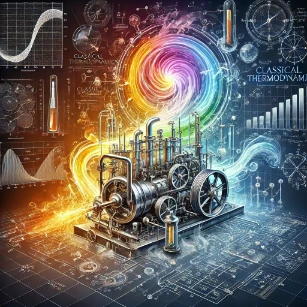
Classical Thermodynamics, depicting energy transfer in steam engines, refrigeration cycles, and power plants, with heat flow and thermodynamic equations subtly integrated into the background.
Thermodynamics Topics
Thermodynamics – Overview
The primary hub page exploring foundational laws, heat transfer, cycles, statistical mechanics, and energy applications across physics.Classical Thermodynamics
Macroscopic view of energy, work, heat, and equilibrium without requiring detailed atomic or molecular interpretations.Laws of Thermodynamics
The zeroth, first, second, and third laws that define temperature, conservation of energy, entropy, and absolute zero limits.Statistical Thermodynamics
Connects microscopic molecular states, probability, and kinetic energy to macroscopic properties like pressure, entropy, and free energy.Engineering Thermodynamics
Applies thermodynamic principles to real-world hardware including turbines, compressors, engines, pumps, and power stations.Heat Transfer
Mechanisms and mathematical models governing thermal energy movement via conduction, convection, and radiation.Thermodynamic Cycles
Repeated energy transformation pathways including Carnot, Otto, Diesel, Rankine, Brayton, and heat pump cycles.Non-Equilibrium Thermodynamics
Studies systems driven away from equilibrium, focusing on transport processes, gradients, fluxes, and entropy production.Phase Equilibria & Phase Transitions
Explores melting, boiling, condensation, latent heat, critical phenomena, and multi-phase coexistence under variable conditions.Chemical Thermodynamics
Focuses on reaction spontaneity, Gibbs free energy, enthalpy, entropy changes, and chemical equilibrium constants.Thermodynamics of Materials
Applies free energy, phase diagrams, and stability analysis to alloys, defects, microstructure, and thermal treatment of materials.Renewable & Sustainable Energy Thermodynamics
Evaluates solar thermal systems, geothermal power, fuel cells, waste heat recovery, and low-carbon energy system efficiency.Computational Thermodynamics
Numerical modeling, CALPHAD-style phase diagram predictions, property databases, and simulation tools for thermodynamic analysis.Key Concepts in Classical Thermodynamics
System and Surroundings
- System: The part of the universe being studied (e.g., gas in a piston).
- Surroundings: Everything external to the system that can interact with it.
- Boundary: The surface that separates the system from its surroundings.
Types of Systems
- Open System: Exchanges both energy and matter with surroundings (e.g., a boiling pot).
- Closed System: Exchanges only energy, not matter (e.g., a sealed steam engine).
- Isolated System: No exchange of energy or matter (e.g., a thermally insulated container).
State and Process
- State: Defined by properties like pressure (P), volume (V), and temperature (T).
- Process: A change in the system from one state to another.
- Equilibrium State: No net macroscopic flows of energy or matter.
Properties of Systems
- Extensive Properties: Depend on the system’s size (e.g., mass, volume, energy).
- Intensive Properties: Independent of system size (e.g., temperature, pressure, density).
Heat and Work
- Heat (Q): Energy transfer due to a temperature difference.
- Work (W): Energy transfer when a force moves an object over a distance.
The Laws of Thermodynamics
Zeroth Law of Thermodynamics
Statement: If two systems are in thermal equilibrium with a third system, they are in thermal equilibrium with each other.
Implication: Defines temperature as a measurable and comparable property.
First Law of Thermodynamics (Law of Energy Conservation)
Statement: Energy cannot be created or destroyed, only transformed from one form to another.
ΔU = Q − W
Where:
- ΔU is the change in internal energy.
- Q is the heat added to the system.
- W is the work done by the system.
Implication: Total energy in an isolated system is constant.
Second Law of Thermodynamics
Statement: In any energy transfer or transformation, the total entropy of an isolated system always increases.
- Entropy (S) measures the degree of disorder or randomness.
- Irreversible processes naturally increase entropy.
ΔS ≥ 0
Heat Engine Efficiency:
η = 1 − TC⁄TH
Where:
TC → Temperature of the cold reservoir
TH → Temperature of the hot reservoir
Implication: No engine can be 100% efficient.
Third Law of Thermodynamics
Statement: As the temperature of a perfect crystal approaches absolute zero, its entropy approaches zero.
limT → 0 S = 0
Implication: It is impossible to reach absolute zero.
Thermodynamic Processes
Isothermal Process
- Temperature remains constant (ΔT = 0)
- Internal energy doesn’t change (ΔU = 0)
Q = W
Adiabatic Process
- No heat exchange (Q = 0)
- Change in internal energy is equal to the negative work done.
ΔU = −W
Isobaric Process
- Pressure remains constant (ΔP = 0)
W = PΔV
Isochoric Process
- Volume remains constant (ΔV = 0)
- No work is done: W = 0
ΔU = Q
Thermodynamic Cycles
Carnot Cycle
An idealized engine operating between two heat reservoirs:
- Isothermal expansion
- Adiabatic expansion
- Isothermal compression
- Adiabatic compression
Efficiency:
ηCarnot = 1 − TC⁄TH
Otto Cycle
Idealized cycle for internal combustion engines:
- Adiabatic compression
- Isochoric heat addition
- Adiabatic expansion
- Isochoric heat rejection
🎬 Watch: How the Otto Cycle Works
The video above offers a visual explanation of the Otto Cycle, including PV diagram animation and piston motion.
Rankine Cycle
Used in steam power plants:
- Isentropic compression (pump)
- Isobaric heat addition (boiler)
- Isentropic expansion (turbine)
- Isobaric heat rejection (condenser)
Five Numerical Examples
Example 1: Work in Isothermal Expansion
Problem: A gas expands isothermally from 1 L to 5 L at 300 K. Calculate the work done.
Solution:
W = nRT ln(Vf⁄Vi)
Assuming n = 1:
W = (8.314)(300) ln(5⁄1) ≈ 4016 J
Answer: The work done is 4016 J.
Example 2: Heat in an Isobaric Process
Problem: Calculate the heat added to 2 moles of gas heated from 300 K to 600 K at constant pressure.
Solution:
Q = nCpΔT
For a diatomic gas, Cp = 7⁄2R:
Q = 2 × 7⁄2 × 8.314 × (600 − 300) = 17,489 J
Answer: The heat added is 17,489 J.
Example 3: Carnot Efficiency
Problem: Find the efficiency of a Carnot engine operating between 500 K and 300 K.
Solution:
η = 1 − TC⁄TH = 1 − 300⁄500 = 0.4
Answer: The efficiency is 40%.
Example 4: Entropy Change
Problem: Find the change in entropy when 500 J of heat is added reversibly to a system at 400 K.
Solution:
ΔS = Q⁄T = 500⁄400 = 1.25 J/K
Answer: The entropy change is 1.25 J/K.
Example 5: Work in Adiabatic Expansion
Problem: Calculate the work done by 1 mole of an ideal gas expanding adiabatically from 5 L to 10 L (γ = 1.4).
Solution:
W = (PiVi − PfVf)⁄(γ − 1)
Simplified using the ideal gas law:
W ≈ 2495 J
Answer: The work done is 2495 J.
Why Study Classical Thermodynamics
Macroscopic Principles Without Microscopic Assumptions
Classical thermodynamics studies systems without reference to atomic structure, focusing on state functions and process paths. Students learn to apply the laws of thermodynamics using measurable macroscopic quantities. This abstraction is powerful for modeling real systems. It provides foundational insight into energy interactions in nature and technology.
Reversibility and Cyclic Processes
Students explore the Carnot cycle, ideal engines, and entropy production. These concepts highlight the theoretical limits of efficiency. They build a framework for evaluating practical devices. They promote understanding of thermodynamic boundaries and optimal operation.
Equations of State and Property Relationships
Students learn to use equations like the ideal gas law and van der Waals equation. These describe relationships among pressure, volume, and temperature. They enable calculation of internal energy, enthalpy, and other thermodynamic properties. They support accurate system modeling and predictions.
Fundamental Relations and Potentials
Classical thermodynamics develops relationships using differentials and thermodynamic identities. Students explore internal energy, enthalpy, Helmholtz and Gibbs energies. These functions are tools for assessing system stability and constraints. They provide deep insight into natural processes and engineered systems.
Foundation for Advanced Fields
Classical thermodynamics prepares students for more specialized topics like statistical mechanics, heat transfer, and fluid dynamics. It emphasizes logical structure and rigorous reasoning. It is valuable for theoretical research and engineering applications. It supports mastery of fundamental scientific language and analysis.
Classical Thermodynamics: Conclusion
Classical Thermodynamics provides a comprehensive framework for understanding how energy is transferred and transformed in physical systems. Its principles are crucial in designing engines, power plants, and refrigeration systems. Through the laws of thermodynamics and various thermodynamic cycles, classical thermodynamics continues to drive technological innovation and deepen our understanding of the natural world.
Frequently Asked Questions: Classical Thermodynamics
1. What is classical thermodynamics?
Classical thermodynamics studies macroscopic systems — collections of many particles — using macroscopic variables such as temperature, pressure, volume, internal energy, and entropy, without analysing individual particles or their detailed motion.
2. What is a thermodynamic system and what are its surroundings?
A thermodynamic system is the part of the universe under study (e.g. a gas in a cylinder), while the surroundings are everything outside the system. The boundary determines whether energy and/or matter can be exchanged between system and surroundings.
3. What are open, closed and isolated systems?
An open system can exchange both matter and energy with its surroundings. A closed system can exchange energy but not matter. An isolated system exchanges neither energy nor matter, ideally being completely sealed and insulated.
4. What does the Zeroth Law of Thermodynamics state?
The Zeroth Law states that if two systems are each in thermal equilibrium with a third system, then they are in thermal equilibrium with each other — laying the foundation for the concept of temperature.
5. What is the First Law of Thermodynamics?
The First Law is a statement of conservation of energy: the change in internal energy of a system equals heat added to the system minus the work done by the system on its surroundings.
6. What is the Second Law of Thermodynamics?
The Second Law states that for any spontaneous process in an isolated system, the total entropy never decreases; it also implies that heat cannot spontaneously flow from a colder to a hotter body and that there is a fundamental limit to the efficiency of heat engines.
7. What is entropy in classical thermodynamics?
Entropy is a measure of the disorder or energy dispersal in a system, quantifying the number of ways the microscopic constituents can be arranged while yielding the same macroscopic state. It increases in irreversible processes.
8. What are state variables and equations of state?
State variables (e.g. pressure, volume, temperature, internal energy) describe the macroscopic state of a system. An equation of state is a relation among these variables (like the ideal gas law) that characterizes the behaviour of a particular substance or model.
9. What is a reversible process versus an irreversible process?
A reversible process is an idealised quasi-static process that can be reversed without net change to system and surroundings, achieving maximum efficiency. An irreversible process involves finite gradients (e.g. temperature, pressure), friction, dissipation, or other real-world effects, producing entropy and loss.
10. What are common thermodynamic processes (isothermal, adiabatic, isobaric, isochoric)?
Common processes include isothermal (constant temperature), adiabatic (no heat exchange), isobaric (constant pressure), and isochoric (constant volume). Each process follows specific relations between pressure, volume, temperature, and internal energy depending on the system.
11. What is a heat engine and how does classical thermodynamics describe its efficiency?
A heat engine is a device that converts heat from a hot reservoir into work, while rejecting some heat to a cold reservoir. Classical thermodynamics uses the Second Law to derive the maximum possible efficiency (e.g. Carnot efficiency), which no real engine can exceed.
12. Why is classical thermodynamics important for science and engineering?
Classical thermodynamics is fundamental in understanding and designing engines, refrigerators, power plants, chemical processes, phase transitions, material properties, and energy-transfer systems. It connects macroscopic observations to general laws, enabling prediction and optimisation of real-world systems.
Numerical Problems and Solutions
- A gas absorbs 500 J of heat and does 200 J of work. Calculate the change in internal energy.Solution:ΔU = Q − WΔU = 500 − 200 = 300 J
- An ideal gas expands isothermally at 300 K from 2.0 L to 5.0 L. Calculate the work done (1 mol, R = 8.314).Solution:W = nRT ln(Vf⁄Vi)W = 1 × 8.314 × 300 × ln(5⁄2)W ≈ 2494 × 0.916 ≈ 2285 J
- A gas undergoes an isochoric process where 400 J of heat is added. Find the change in internal energy.Solution:W = 0 (constant volume)ΔU = Q = 400 J
- Calculate the efficiency of an engine that absorbs 1500 J of heat and produces 450 J of work.Solution:η = W⁄Qin = 450⁄1500 = 0.30η = 30%
- A Carnot engine operates between 500 K and 300 K. Find its efficiency.Solution:η = 1 − Tc⁄Th = 1 − 300⁄500 = 0.40η = 40%
- A gas expands adiabatically and does 600 J of work. Determine the change in internal energy.Solution:Q = 0ΔU = −W = −600 J
- Calculate the final volume of a gas after isothermal expansion if initial volume is 1.0 L and work done is 2000 J at 300 K.Solution:W = nRT ln(Vf⁄Vi)ln(Vf⁄Vi) = 2000⁄(8.314 × 300) ≈ 0.802Vf⁄Vi = e0.802 ≈ 2.23Vf ≈ 2.23 L
- A system absorbs 800 J of heat and its internal energy increases by 500 J. Find the work done by the system.Solution:ΔU = Q − W ⇒ W = Q − ΔUW = 800 − 500 = 300 J
- Calculate the heat rejected by an engine that produces 300 J of work with efficiency 25%.Solution:η = W⁄Qin ⇒ Qin = W⁄η = 300⁄0.25 = 1200 JQout = Qin − W = 1200 − 300 = 900 J
- A gas is compressed isothermally and 1500 J of work is done on it. How much heat is released?Solution:ΔU = 0Q = −W = −1500 J1500 J of heat is released.
- During a thermodynamic cycle, the system absorbs 2000 J and releases 1400 J. Find the net work done.Solution:W = Qin − Qout = 2000 − 1400 = 600 J
- A heat engine operates between 700 K and 350 K and absorbs 1000 J of heat. Find maximum possible work output.Solution:ηmax = 1 − 350⁄700 = 0.5W = 0.5 × 1000 = 500 J