
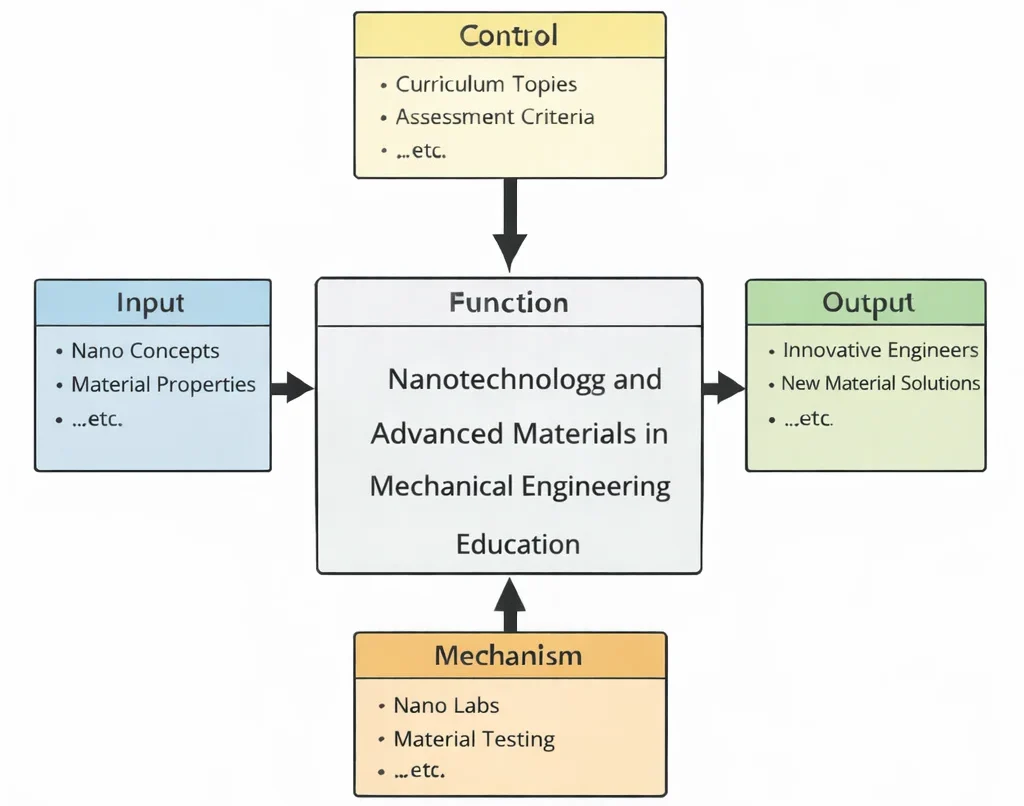
This IDEF0 (Input–Control–Output–Mechanism) diagram presents Nanotechnology and Advanced Materials in Mechanical Engineering Education as a clear learning system. Inputs on the left—nano concepts and material properties—represent the foundational ideas students must grasp, from nanoscale effects to the behavior of advanced materials. Controls at the top—curriculum topics and assessment criteria—define learning scope, sequence, and the standards used to evaluate mastery. The central function, Nanotechnology and Advanced Materials in Mechanical Engineering Education, organizes these elements into structured instruction and applied learning. Outputs on the right—innovative engineers and new material solutions—represent the intended outcomes: graduates who can think beyond conventional materials and propose feasible, performance-driven alternatives. Mechanisms at the bottom—nano labs and material testing—provide the enabling infrastructure for experiments, measurements, and validation, allowing students to connect theory with observable evidence.
Nanotechnology and advanced materials are reshaping the future of mechanical engineering by enabling the design and fabrication of components at the atomic and molecular scale. These innovations enhance strength-to-weight ratios, thermal stability, electrical conductivity, and corrosion resistance, making them invaluable in fields like automotive engineering and biomechanical engineering. By integrating breakthroughs in advanced materials and manufacturing technologies, engineers can develop products that are lighter, stronger, and more durable than ever before.
At the heart of these developments are technologies like 3D printing, which allow for the fabrication of complex geometries using nanocomposites and functionally graded materials. Simultaneously, digital twin technology supports real-time monitoring and virtual testing of nano-enabled systems. Engineers must also master fundamental subjects such as solid mechanics and thermodynamics to effectively harness the properties of advanced materials under various loading and environmental conditions.
The integration of nanomaterials into systems involving fluid mechanics and vibrational analysis has opened new avenues in acoustic damping and thermal management. In mechanical design, CAD tools are increasingly capable of simulating nanoscale effects, informing the design of microelectromechanical systems (MEMS) and nanoactuators. These tools also interface seamlessly with advances in smart manufacturing and robotics, where precision and miniaturization are key.
As industries strive to balance innovation with sustainability, knowledge of energy efficiency and sustainable manufacturing becomes vital. Advanced materials often reduce the need for heavy resource consumption while extending product life cycles. Engineers in this domain are expected to engage with lean manufacturing practices and understand supply chain dynamics to ensure responsible sourcing and deployment of high-performance materials.
This field is inherently interdisciplinary. A comprehensive education in mechanical engineering is essential, along with applied experience in manufacturing systems and control systems. Incorporating ergonomic design principles from human factors engineering ensures safety and usability. As we move toward next-generation technologies, nanotechnology and advanced materials will remain at the forefront, making it a compelling and essential area of study for aspiring engineers.

Mechanical Engineering – Overview
Connects material science advancements with overall mechanical system performance to drive next-generation engineering solutions across the curriculum roadmap.
Nanotechnology & Advanced Materials (Current Module)
Explores quantum and interfacial material behavior at micro and nano scales to drastically enhance structural strength, thermal efficiency, and overall component functionality.
Solid Mechanics
Evaluates mechanical properties, grain-boundary dislocation barriers, and stress-strain performance of nanostructured metals and advanced alloys under extreme loading.
Thermodynamics & Heat Transfer
Examines phononic thermal transport, ultra-high thermal conductivity coatings, and energy conversion kinetics at nanoscale interfaces.
Fluid Mechanics & Hydraulics
Investigates microfluidic boundary layer slip, colloidal suspension stability, and heat transfer enhancement using engineered nanofluids.
Mechanical Design & CAD
Incorporates specialized nanomaterial constitutive models into digital CAD environments to optimize lightweight multi-functional structural assemblies.
Manufacturing Engineering
Develops precise atomic layer deposition, nanocomposite mixing, and specialized additive manufacturing processes for scalable component production.
Robotics & Automation
Utilizes carbon nanotube fibers and piezoelectric nanostructures to construct high-speed, lightweight robotic linkages and ultra-sensitive tactile sensors.
Automotive Engineering
Applies high-strength nanocomposites and anti-wear nanocoatings to reduce vehicle curb weight, boost fuel efficiency, and protect powertrain components.
Vibrations & Acoustics
Engineers smart viscoelastic nanocomposites with embedded particulate damping to absorb structural acoustic noise and suppress resonant vibration.
Control Systems
Integrates responsive shape-memory alloys and electroactive nanostructures into closed-loop control schemes for self-adapting structural systems.
Biomechanical Engineering
Develops biocompatible nanofiber scaffolds, bioactive titanium surface coatings, and targeted drug delivery vehicles tailored for medical implants.
Core Concepts in Nanotechnology and Advanced Materials
Nanotechnology Basics
- Nanoscale Definition:
- A nanometer is one-billionth of a meter (10-9 m), a scale so small that it lies between the size of individual atoms and large biomolecules like DNA. At this dimension, materials begin to behave in fundamentally different ways compared to their bulk counterparts, making nanotechnology a transformative area in science and engineering.
- At the nanoscale, quantum mechanical effects dominate over classical physics. This results in unique optical, magnetic, and electrical properties. For example, gold nanoparticles exhibit red or purple colors due to surface plasmon resonance, a phenomenon invisible in larger gold particles.
- Surface-to-volume ratios also increase dramatically, making nanomaterials more reactive and enhancing their interaction with surrounding media. This opens doors to new applications in catalysis, drug delivery, and sensor technologies.
- Nanostructures:
- Nanostructures are meticulously engineered architectures at the molecular or atomic scale, designed to harness nanoscale phenomena for real-world benefits. Common types include:
- Nanoparticles: Typically spherical, nanoparticles are used in diverse fields from medicine to environmental science. In targeted drug delivery, for example, nanoparticles are coated with ligands that recognize and bind to cancer cells, ensuring precise therapeutic delivery with minimal side effects.
- Nanotubes: Carbon nanotubes (CNTs) are among the most researched nanomaterials due to their incredible tensile strength and electrical conductivity. They are employed in developing flexible electronics, high-strength fibers, and even experimental space elevator materials.
- Nanowires: With diameters in the nanometer range and lengths up to several micrometers, nanowires are used in nanoelectronics, photovoltaics, and nanosensors. Their size makes them ideal for developing ultra-dense memory and logic circuits.
- 2D Materials: Single-layered materials like graphene, molybdenum disulfide (MoS2), and boron nitride exhibit exceptional electrical, thermal, and mechanical performance. Graphene, for instance, is 200 times stronger than steel and conducts electricity better than copper.
- These nanostructures are at the forefront of emerging fields such as nano-medicine, nano-optics, and nano-energy, forming the building blocks for next-generation technologies.
- Nanostructures are meticulously engineered architectures at the molecular or atomic scale, designed to harness nanoscale phenomena for real-world benefits. Common types include:
Advanced Materials
- High-Strength Alloys:
- High-strength alloys are designed by manipulating their microstructure at the nanoscale, such as grain refinement or the addition of nanoprecipitates. These alloys are vital for structural applications where weight reduction and strength are essential, like in aerospace fuselage construction or lightweight automotive parts.
- The integration of nanostructured phases improves fatigue resistance and impact toughness, offering a competitive advantage over traditional alloys in harsh environments such as deep-sea drilling or space missions.
- Composites:
- Advanced composites incorporate nanoscale fillers—like carbon nanotubes, silica nanoparticles, or graphene sheets—into a matrix material to enhance mechanical strength, thermal conductivity, and electrical properties.
- In aerospace engineering, carbon-fiber-reinforced polymers are widely used for aircraft bodies and interiors, contributing to weight reduction and improved fuel efficiency. These composites also provide excellent corrosion resistance and durability under extreme temperature changes.
- Functional Materials:
- Functional materials exhibit specific physical or chemical responses that make them ideal for niche applications. Examples include thermoelectric materials that convert heat to electricity, piezoelectric materials that generate voltage under mechanical stress, and shape memory alloys that revert to a preset shape when heated.
- These materials are commonly found in medical implants, aerospace actuators, and energy harvesting systems. Ongoing research continues to expand their roles in cutting-edge applications such as wearables and adaptive materials.
- Smart Materials:
- Smart materials dynamically respond to environmental stimuli like light, temperature, pH, or electric fields. For example, polymers that change color in response to UV exposure are used in sun-protective clothing and smart windows.
- Shape memory polymers and alloys, which “remember” and return to their original shapes after deformation, are revolutionizing fields such as biomedical devices and deployable aerospace structures.
- Smart coatings embedded with nanomaterials are being developed for self-cleaning, self-healing, or antimicrobial surfaces. Some research even explores the use of bio-inspired smart materials that mimic living organisms’ responses to external stimuli, a frontier actively explored by institutions like the Nature Smart Materials Collection.
Unique Properties of Nanoscale Materials
Enhanced Mechanical Strength
Nanoscale materials often possess dramatically enhanced mechanical properties compared to their bulk counterparts. One key reason is the reduction or elimination of internal defects such as dislocations and grain boundaries, which are common failure points in traditional materials.
For example, nanocrystalline metals are composed of ultra-small grains that inhibit dislocation motion, resulting in yield strengths up to five times greater than conventional coarse-grained materials. These metals are finding applications in aerospace structures, body armor, and microscale actuators.
Similarly, ceramic nanocomposites exhibit both high strength and toughness, overcoming the brittle nature traditionally associated with ceramics, making them ideal for extreme environment applications.
Lightweight Structures
One of the most remarkable characteristics of nanomaterials like carbon nanotubes and graphene is their outstanding strength-to-weight ratio. These materials are significantly stronger than steel but have densities only a fraction as high, enabling transformative advancements in lightweight structural components.
This property has revolutionized material selection in industries where reducing weight is critical to performance, such as aerospace, automotive, and wearable technologies. Ultralight composites incorporating these nanomaterials help improve fuel efficiency and payload capacity while maintaining structural integrity.
Improved Thermal Conductivity
Many nanomaterials, such as graphene, exhibit extraordinary thermal conductivity—measured at over 5000 W/m·K, far exceeding that of copper. This property is pivotal in thermal management for high-performance electronics, where heat dissipation is a primary concern.
In aerospace, where thermal stresses from high-speed flight or space reentry can degrade material performance, incorporating nanomaterials into thermal barrier coatings enhances reliability and safety.
Moreover, nanocomposites with tailored thermal pathways are increasingly used in advanced battery technologies and flexible electronics to prevent overheating and prolong component life.
Electrical Properties
Electrical properties of nanomaterials can be precisely engineered due to quantum confinement and high carrier mobility. For instance, carbon nanotubes can behave either as conductors or semiconductors depending on their chirality and diameter, making them versatile components in nanoelectronic devices.
Nanowires are another promising candidate for applications in transistors, sensors, and flexible displays. Their small size allows for extreme miniaturization, a key requirement for next-generation electronics and Internet of Things (IoT) devices.
Innovations in nanostructured semiconductors also pave the way for ultra-sensitive biosensors and high-efficiency photovoltaic cells, which are reshaping the landscape of clean energy and healthcare diagnostics.
Surface-to-Volume Ratio
As particle size decreases to the nanoscale, the surface area relative to volume increases significantly. This increased surface area results in higher reactivity and more available surface sites for interactions—making nanomaterials ideal for applications in catalysis, energy storage, and medicine.
For example, platinum nanoparticles are used in catalytic converters to enhance the conversion of harmful emissions in vehicles. Similarly, nanoscale drug carriers are designed to have optimal surface properties for targeting specific cells or tissues in the human body.
This property is also exploited in supercapacitors and batteries, where the increased electrode surface area enables higher charge storage capacity and faster energy transfer.
Quantum Effects
At the nanoscale, quantum mechanical effects begin to dominate the behavior of materials, leading to unique optical, electrical, and magnetic phenomena. Quantum confinement in semiconductor nanocrystals, or quantum dots, results in size-dependent color emission, which is utilized in display technologies and biomedical imaging.
These effects also underpin the emerging field of quantum computing, where materials such as quantum dots and superconducting circuits act as qubits—the fundamental units of quantum information. Their ability to exist in multiple states simultaneously (superposition) allows for exponentially greater computing power.
Quantum tunneling and entanglement phenomena observed in nanostructures are being harnessed for secure communications and advanced sensors. Research institutions, such as the IBM Quantum Lab, are actively exploring how nanoscale materials can drive the future of quantum technologies.
About This Interactive Simulator:
This interactive Nanocomposite Volume Fraction & Young’s Modulus Simulator visualizes the Rule of Mixtures predicting bulk elastic modulus enhancement as nanoscale filler content increases. Students observe non-linear reinforcement behavior across matrix phase boundaries.
- Solid Blue Line: Composite bulk Elastic Modulus (Ec) curve plotted against nanoparticle volume fraction (Vf).
- Dashed Red Line: Baseline unreinforced polymer matrix modulus reference value.
- Interactive Sliders: Dynamically adjust Matrix Modulus (Em), Nanofiller Modulus (Ef), and Volume Fraction (Vf) to analyze composite stiffness scaling.
Interactive Nanocomposite Stiffness & Reinforcement Simulator
Simulate bulk Young’s modulus enhancement in nanocomposite materials using the modified Voigt-Reuss Rule of Mixtures model.
Applications of Nanotechnology and Advanced Materials
Aerospace Industry
Nanotechnology is playing a pivotal role in redefining aerospace engineering by introducing materials that meet extreme performance criteria. These include superior mechanical strength, thermal resistance, and reduced weight—vital in aviation and space exploration.
-
Nanocomposites:
- Nanocomposites combine traditional polymers with reinforcements such as carbon nanotubes or graphene. This integration produces materials with exceptional stiffness and resilience while significantly reducing mass.
- These materials are increasingly employed in structural components like fuselages, wing elements, and even satellite frameworks to enhance payload capacity and fuel efficiency while maintaining safety.
-
Thermal Barrier Coatings (TBCs):
- Nanostructured ceramics in coatings shield engine components from extreme temperatures and oxidative damage. Jet engine turbine blades coated with these nanomaterials endure higher operational temperatures, allowing more efficient propulsion systems.
-
Self-Healing Materials:
- By embedding microscopic capsules within aerospace composites, engineers enable these materials to autonomously repair microcracks—essential for prolonging service life and preventing catastrophic failures during long-duration space missions.
-
Lightweight Alloys:
- Nanoparticle-reinforced aluminum-lithium alloys offer unmatched strength-to-weight ratios, improving spacecraft fuel efficiency and maneuverability while withstanding mechanical and thermal stresses encountered during launch and reentry.
Automotive Industry
Nanotechnology innovations are shaping the next generation of vehicles, emphasizing energy efficiency, emission reduction, and material longevity.
- High-Performance Coatings:
- Nanocoatings offer excellent resistance to wear, corrosion, and thermal degradation, especially in high-friction engine components. These coatings also improve fuel efficiency by reducing internal mechanical losses.
- Fuel Efficiency:
- Nanostructured catalysts and membranes enhance fuel cell performance and battery charge cycles. They are crucial in hybrid and electric vehicle systems, extending driving range and durability.
- Composite Materials:
- Using carbon nanotube-infused polymers allows manufacturers to fabricate lighter vehicle frames without compromising safety. This has contributed to a measurable improvement in overall vehicle fuel economy.
- Catalysts:
- Nanoparticles in catalytic converters increase the active surface area, improving the efficiency of emission control systems. They enable more complete conversion of harmful gases like NOx and CO into less hazardous substances.
Electronics and Semiconductors
Nanotechnology has radically transformed electronics by enabling unprecedented miniaturization, efficiency, and integration.
- Transistors:
- As traditional silicon transistors reach their scaling limits, nanoscale alternatives like FinFETs and carbon nanotube FETs are emerging as faster, energy-efficient solutions. These form the foundation of modern high-speed microprocessors.
- Heat Dissipation:
- Graphene’s high thermal conductivity helps dissipate heat in densely packed chips, preventing performance degradation and extending device lifespan. It's now used in mobile phones, processors, and flexible devices.
- Flexible Electronics:
- Nanomaterials enable screens and circuits that can bend, fold, or stretch, powering next-gen wearables, foldable phones, and biomedical sensors. These developments support growing demands for portable and adaptive technology.
- Quantum Dots:
- Quantum dots, or semiconductor nanocrystals, provide high-resolution imaging and energy-efficient display technologies. They are central to OLED displays, solar energy harvesting, and biological tagging.
Energy Sector
Nanomaterials are revolutionizing how we generate, store, and utilize energy.
- Solar Cells:
- Perovskite solar cells enhanced with nanostructures offer exceptional efficiency at lower manufacturing costs. They also allow integration into lightweight, flexible panels suited for urban and off-grid applications.
- Energy Storage:
- Nanostructured battery components like silicon nanowire anodes dramatically improve energy density, charge speed, and thermal stability. These technologies support fast-charging electric vehicles and portable devices.
- Hydrogen Storage:
- Nanoporous materials such as metal-organic frameworks (MOFs) offer safe and compact hydrogen storage, supporting the development of clean hydrogen fuel cell vehicles and power systems.
- Thermoelectric Materials:
- Nanostructured materials convert waste heat into electricity by exploiting the Seebeck effect. These are now being used in automotive exhaust systems and industrial machinery to improve overall energy utilization.
Healthcare and Medicine
Nanotechnology is enabling personalized, precision medicine and advancing diagnostics, therapy, and monitoring.
- Drug Delivery Systems:
- Nanocarriers such as liposomes, dendrimers, and gold nanoparticles allow drugs to be delivered directly to targeted tissues or cancer cells, minimizing side effects and enhancing therapeutic outcomes.
- Imaging:
- Quantum dots and magnetic nanoparticles improve contrast in MRI and fluorescence imaging, enabling earlier and more accurate diagnosis of diseases, including cancer and neurological disorders.
- Tissue Engineering:
- Biocompatible nanofibers and scaffolds promote stem cell attachment, growth, and differentiation, helping repair or regenerate damaged tissues such as bone, cartilage, and skin.
- Wearable Sensors:
- Flexible nanosensors integrated into smartwatches or patches can continuously monitor vital signs, hydration levels, or glucose concentrations, allowing real-time health monitoring for chronic disease management.
Environmental Applications
Nanotechnology supports sustainability through cleaner production processes and more effective environmental protection solutions.
- Water Purification:
- Nanomaterials such as silver nanoparticles and carbon-based membranes effectively remove pathogens, heavy metals, and organic pollutants from water, providing clean drinking water in disaster zones and remote areas.
- Air Pollution Control:
- Nanocatalysts are used to break down toxic gases like nitrogen oxides and volatile organic compounds in industrial emissions, contributing to cleaner air and better public health.
- Energy Efficiency:
- Advanced nanostructured insulation materials used in building envelopes significantly reduce heat loss and energy consumption. Many of these materials have been developed through research supported by the U.S. Department of Energy.
Defense and Security
Nanotechnology has numerous military and security applications, enhancing performance and safety in defense systems.
- Body Armor:
- Nanocomposite fibers and coatings are used in bulletproof vests and helmets, combining extreme toughness with low weight to protect soldiers without impairing mobility.
- Stealth Technology:
- Nanoscale radar-absorbing materials reduce the visibility of military vehicles and aircraft to enemy detection systems, improving tactical advantage.
- Sensors:
- Nanosensors can detect minuscule traces of chemical, biological, or radiological agents, enabling early warning systems against terrorist attacks or battlefield threats.
Emerging Trends in Nanotechnology and Advanced Materials
2D Materials Beyond Graphene
While graphene remains a superstar in the world of nanomaterials, a new generation of two-dimensional (2D) materials is emerging with complementary and sometimes superior properties for specific applications. These include borophene, a single-atom-thick sheet of boron; molybdenum disulfide (MoS2), a semiconductor with a natural bandgap; and phosphorene, a monolayer of black phosphorus offering excellent charge mobility.
- Examples:
- Borophene: Known for its flexibility, electrical conductivity, and potential in hydrogen storage and battery electrodes.
- Molybdenum disulfide: Exhibits semiconducting properties valuable for transistors, photodetectors, and logic circuits.
- Phosphorene: Offers anisotropic electronic properties and is being explored for optoelectronics and thermoelectric devices.
- Applications:
- Advanced semiconductors used in next-generation computing architectures, including field-effect transistors.
- Flexible and transparent electronics for wearable technology, foldable displays, and biomedical patches.
- Energy storage components such as supercapacitors and lithium-sulfur batteries leveraging high surface area and fast ion transport.
Self-Assembling Materials
Self-assembly refers to the ability of molecules and nanostructures to autonomously organize into predefined architectures without human intervention. This phenomenon draws inspiration from biological systems and is expected to revolutionize manufacturing in nanotechnology.
- By controlling molecular interactions—such as hydrogen bonding, van der Waals forces, and electrostatics—engineers can guide nanoparticles, polymers, or DNA strands into complex structures.
- Applications include fabrication of photonic crystals, drug delivery capsules, and nanoelectronic circuits where traditional lithography is limited by resolution and cost.
- Self-assembled monolayers (SAMs) are also widely used in sensors and biosurfaces, where uniform coverage and precision are crucial.
Smart Materials
Smart materials exhibit dynamic responses to external stimuli, such as temperature, pressure, electric field, or magnetic field. These materials enable systems that can sense, adapt, and react to changing environments without manual intervention.
- Shape memory alloys (SMAs), such as nickel-titanium (Nitinol), return to their original shape when heated, making them valuable in actuators and deployable aerospace structures.
- Piezoelectric nanostructures generate electrical charge in response to mechanical deformation. This property is being harnessed in energy harvesters, medical ultrasound devices, and precision actuators.
- Electrochromic nanomaterials change color or transparency in response to electric stimuli, used in smart windows and adaptive camouflage.
- The integration of smart nanomaterials into wearable devices allows real-time health monitoring and responsive therapeutic systems.
Nanomanufacturing
Nanomanufacturing involves the controlled manipulation and assembly of matter at the atomic and molecular level to create structures with nanometer precision. As device miniaturization accelerates, advanced manufacturing approaches are becoming essential for scaling production while ensuring reproducibility and reliability.
- Atomic Layer Deposition (ALD) is a vapor-phase technique that allows for the creation of ultra-thin, conformal coatings on complex 3D structures. It is widely used in semiconductor fabrication and surface engineering.
- Molecular Beam Epitaxy (MBE) enables precise layering of atoms on substrates under ultra-high vacuum, essential for quantum devices and optoelectronic materials.
- Other emerging tools include nanoimprint lithography, dip-pen nanolithography, and DNA-based assembly methods that promise scalable and cost-effective production of nanoscale devices.
- Nanomanufacturing advancements are closely tied to progress in NIST-supported nanotechnology programs aimed at standardizing measurements and improving process reliability.
Biodegradable Nanomaterials
In response to growing concerns about environmental sustainability, researchers are developing biodegradable nanomaterials that break down naturally without leaving harmful residues. These materials are gaining popularity across sectors from consumer goods to medicine.
- In packaging, biodegradable nanocomposites made from cellulose, polylactic acid (PLA), or chitosan offer excellent barrier properties while minimizing long-term pollution.
- In biomedical applications, nanocarriers and scaffolds are designed to degrade safely after delivering drugs or supporting tissue regeneration, eliminating the need for surgical removal.
- Biodegradable nanoparticles are also explored in agricultural formulations to deliver nutrients and pesticides with controlled release, reducing ecological impact.
- Advances in green synthesis methods and life-cycle analysis tools are enabling a new generation of nanomaterials that balance performance with environmental responsibility.
Challenges in Nanotechnology and Advanced Materials
Scalability
One of the most pressing challenges in nanotechnology is scaling up the production of nanoscale materials from laboratory settings to industrial manufacturing without compromising their structural integrity, functionality, or consistency. The difficulty lies in maintaining control over critical features like particle size distribution, morphology, and dispersion uniformity, all of which can drastically influence performance.
Traditional synthesis methods, such as sol-gel or chemical vapor deposition, may not be cost-effective or practical at mass production levels. As a result, there is significant interest in developing scalable techniques such as roll-to-roll processing, flame spray pyrolysis, and high-throughput synthesis reactors. However, translating bench-scale innovations to high-volume production remains resource-intensive and technologically demanding.
Researchers and engineers are also grappling with scale-induced variability, where nanoscale properties observed in small batches are lost or altered during scale-up due to aggregation, contamination, or uncontrolled reaction kinetics.
Cost
The cost of developing and deploying nanotechnology-based solutions is often prohibitively high, especially in the early phases of research and development. This includes not only the raw materials but also the specialized equipment required for synthesis, characterization, and processing.
For example, techniques like atomic force microscopy (AFM), transmission electron microscopy (TEM), and spectroscopic methods used to monitor nanoscale features are expensive and labor-intensive. These tools are necessary to ensure quality control, but they contribute significantly to overall production costs.
Moreover, since many nanomaterials are still emerging technologies, there is a lack of large-scale demand that would drive down prices through economies of scale. This cost barrier limits adoption in sectors where price sensitivity is high, such as packaging, agriculture, or consumer goods.
Health and Safety
The potential health and environmental risks associated with nanomaterials are a major concern. Due to their small size and high surface reactivity, nanoparticles may interact with biological systems in unpredictable ways. They can enter the human body through inhalation, ingestion, or dermal absorption and accumulate in organs or tissues.
Studies have shown that certain nanomaterials, like carbon nanotubes and metal oxide nanoparticles, may trigger inflammation, oxidative stress, or even genotoxicity. These risks are compounded by the fact that traditional toxicity assessment frameworks are often inadequate for nanoscale substances.
Environmental risks also emerge when nanoparticles are released into soil or water systems during manufacturing, usage, or disposal. Without proper containment and treatment protocols, these materials can disrupt ecosystems or contaminate resources.
As emphasized in reports by agencies such as the OECD Working Party on Manufactured Nanomaterials, a concerted effort is required to assess and mitigate these potential risks through long-term studies, exposure monitoring, and robust safety standards.
Standardization
The lack of global standards and regulatory frameworks for nanotechnology poses a barrier to widespread adoption. There is currently no universally accepted method for characterizing, testing, or labeling nanomaterials, making it difficult to compare data across laboratories or ensure consistent product quality.
This gap creates challenges in cross-border trade, legal compliance, and consumer confidence. For instance, two seemingly identical batches of nanoparticles may behave differently due to variations in synthesis methods, surface treatments, or dispersibility, complicating supply chain management and certification processes.
Organizations such as ISO and ASTM International are working toward creating standard test methods and nomenclatures, but widespread industry adoption remains uneven. Without cohesive standards, the commercialization of advanced materials remains fragmented and uncertain.
Integration
Even when high-performance nanomaterials are successfully developed, integrating them into existing manufacturing processes and products can be technically complex. Compatibility issues may arise with current equipment, adhesives, substrates, or thermal processing steps.
For example, incorporating nanomaterials into electronic circuits, biomedical devices, or construction materials often requires new joining methods, surface treatments, or packaging techniques. Without proper integration strategies, the functional benefits of nanotechnology may be lost in real-world applications.
Furthermore, industries must retrain personnel, reconfigure workflows, and potentially redesign legacy systems to accommodate these new materials—posing logistical and financial challenges. This integration difficulty can delay adoption timelines and reduce the return on investment for nanotechnology innovations.
Future Directions in Nanotechnology and Advanced Materials
Quantum Materials
The development of quantum materials represents a groundbreaking frontier in both theoretical and applied science. These materials exhibit quantum mechanical properties—such as entanglement, superposition, and topological states—at a macroscopic scale. Their unique behaviors hold promise for revolutionizing fields like quantum computing, spintronics, and high-efficiency energy transport.
One major category includes topological insulators, which conduct electricity only on their surface while remaining insulating inside. Such properties enable ultra-low power consumption in circuits and improved data storage technologies. Superconductors, another class of quantum materials, allow electrical current to flow without resistance and are already being explored for applications in quantum circuits, MRI systems, and maglev transportation.
As fabrication techniques become more precise, researchers can now manipulate atomic lattices and electron interactions to engineer quantum phases that did not naturally exist. These advancements are driving efforts to create error-resistant quantum bits (qubits), critical for scalable quantum computers. Institutions around the world, such as the Centre for Quantum Technologies, are actively exploring the synthesis and applications of such materials.
Bioinspired Materials
Nature has evolved highly optimized materials over millions of years, offering a rich source of inspiration for next-generation nanomaterials. Bioinspired materials seek to replicate the structural, mechanical, or functional properties of biological systems to achieve superior performance.
For example, nacre (mother of pearl) exhibits remarkable toughness due to its layered nanostructure, and scientists have mimicked this architecture to create impact-resistant coatings and composites. Similarly, synthetic spider silk is being engineered to match the combination of elasticity and tensile strength found in natural silk, with potential applications in biomedical sutures and lightweight armor.
Other examples include lotus leaf-inspired superhydrophobic surfaces that repel water and dirt, and gecko-inspired adhesives that enable climbing robots or reusable tapes. The convergence of nanotechnology, biology, and materials science enables designers to go beyond conventional material limits by emulating life’s most elegant solutions.
Advanced Battery Technologies
As the world accelerates its transition to electric vehicles and renewable energy, the demand for safer, more powerful, and longer-lasting batteries is surging. Nanotechnology plays a pivotal role in the development of advanced battery technologies that outperform traditional lithium-ion cells.
Solid-state batteries, which replace flammable liquid electrolytes with solid ones, offer enhanced safety and higher energy density. Nanostructured materials enable the development of stable interfaces and improved ionic conductivity in these systems. Meanwhile, graphene-enhanced batteries are gaining attention for their exceptional charge/discharge rates, flexibility, and durability.
Engineers are also exploring lithium-sulfur, lithium-air, and zinc-ion batteries, which leverage nanoscale cathode and anode materials to overcome limitations like dendrite formation and capacity fading. These innovations are essential for creating energy storage systems that can power electric vehicles for extended ranges or stabilize renewable energy grids over longer durations.
Nanotechnology in Space
Space exploration poses extreme challenges in terms of weight, durability, radiation resistance, and temperature tolerance. Nanotechnology is being harnessed to develop ultra-lightweight materials and coatings that can withstand these harsh conditions, reducing payload mass and improving spacecraft performance.
Carbon nanotube composites and aerogels are used to construct insulating panels, shielding systems, and structural components for satellites and probes. These materials not only reduce weight but also offer improved mechanical stability and resistance to micrometeoroid impacts.
Moreover, nanosensors integrated into spacecraft systems can monitor radiation levels, microcracks, and component health in real time. This ability enhances mission safety and enables predictive maintenance. Ongoing research is also exploring in-situ resource utilization (ISRU) using nanomaterials to construct habitats or tools directly from Martian or lunar soil.
Circular Economy
The integration of nanotechnology into the circular economy framework is fostering the design of recyclable, repairable, and biodegradable materials that reduce waste and environmental impact. Traditional materials often present challenges for reuse due to contamination, degradation, or composite complexity, but nanoscale innovations can offer modularity and reversibility at the chemical bond level.
For instance, researchers are developing self-healing polymers that can restore structural integrity after damage, thus extending product life cycles. Nanostructured coatings that repel grime or microbes reduce cleaning costs and extend durability, enabling more sustainable product use.
On the recycling front, magnetic nanomaterials are being used to separate rare earth elements or toxic metals from electronic waste efficiently. Biodegradable nanocomposites are also emerging for packaging, medical devices, and consumer electronics, ensuring that materials return to nature or can be reprocessed at the end of life without harmful residues.
These developments align closely with circular design principles and support global sustainability goals across industry sectors.
Why Study Nanotechnology and Advanced Materials in Mech Eng
Exploring Materials at the Nanoscale
Nanotechnology involves manipulating matter at the atomic and molecular levels. Students learn how nanoscale properties differ from bulk materials. This enables the design of materials with unique strength, conductivity, or reactivity.
Developing High-Performance and Multifunctional Materials
Students study advanced materials such as composites, shape-memory alloys, and ceramics. These materials are engineered for high strength-to-weight ratios, thermal resistance, and durability. They are used in aerospace, automotive, and biomedical applications.
Applications in Mechanical Engineering Systems
Advanced materials improve the performance and efficiency of mechanical systems. Students explore how nanocoatings, sensors, and actuators are integrated into products. This supports innovation in smart and adaptive technologies.
Characterization and Fabrication Techniques
The course introduces tools like electron microscopy, X-ray diffraction, and nanoindentation. Students learn how to analyze material structure and properties. They also explore methods for fabricating and processing nanoscale materials.
Sustainability and Future Opportunities
Advanced materials and nanotechnology support lightweight structures, energy efficiency, and environmental sustainability. Students gain skills that align with emerging technologies. This prepares them for cutting-edge careers in research and industry.
Nanotechnology and Advanced Materials: Conclusion
Nanotechnology and advanced materials represent a paradigm shift in our ability to understand, manipulate, and engineer matter at its most fundamental levels. These innovations are not merely incremental improvements over existing materials but open entirely new dimensions of performance and functionality across industries. As we delve deeper into the nanoscale, we unlock access to quantum mechanical effects, extreme surface-to-volume ratios, and tailored properties that enable transformative advances in how we design products and systems.
In the aerospace sector, nanostructured materials allow for ultra-lightweight components with high thermal stability, directly enhancing fuel efficiency and payload capacities. In the automotive industry, nanocomposites and coatings extend vehicle lifespan while reducing environmental impact. The electronics world has been revolutionized by nanoscale transistors, quantum dots, and flexible circuits, enabling smaller, faster, and more energy-efficient devices. Healthcare has seen remarkable progress through nanoparticle-based drug delivery systems, implantable sensors, and tissue scaffolds that mimic biological environments.
Perhaps one of the most impactful areas is in the energy sector, where nanotechnology is enabling breakthroughs in solar cell efficiency, battery capacity, hydrogen storage, and thermoelectric energy conversion. These technologies hold the potential to mitigate global energy challenges and reduce dependence on fossil fuels. As seen in platforms like Nano.gov, national and international collaborations are now fostering policy, research funding, and standardization efforts to drive responsible innovation in this rapidly evolving field.
Yet, with these opportunities come substantial challenges. The production of high-quality nanomaterials at scale, the cost of fabrication, and concerns about long-term environmental and biological impacts remain key hurdles. To overcome these, continued interdisciplinary research, open data exchange, and the development of global regulatory frameworks are essential. Addressing the safety of nanomaterials through life-cycle assessments and investing in sustainable, circular economy approaches will ensure that these technologies not only drive innovation but do so responsibly.
Looking ahead, the fusion of nanotechnology with artificial intelligence, biotechnology, and quantum computing will further accelerate the convergence of disciplines, leading to systems that are self-healing, adaptive, and capable of functioning under extreme conditions. As educational curricula and industrial R&D continue to adapt to this new materials frontier, the next generation of engineers and scientists will be better equipped to harness the full potential of nanotechnology.
Ultimately, nanotechnology and advanced materials stand at the forefront of global innovation. They are essential to solving some of humanity's most pressing challenges—from clean energy and climate change to advanced healthcare and sustainable manufacturing. By fostering responsible development and integrating these technologies into core industrial ecosystems, we are laying the foundation for a smarter, cleaner, and more resilient future.
Frequently Asked Questions
1. What is nanotechnology in mechanical engineering?
In mechanical engineering, nanotechnology involves designing and using materials, coatings and devices whose key features are on the nanometre scale (typically 1–100 nm). At these dimensions, materials can show very different mechanical, thermal, electrical and surface properties compared with their bulk form. Engineers exploit these nanoscale effects to create components that are lighter, stronger, more wear-resistant, more heat-tolerant or more responsive to stimuli, improving the performance and reliability of mechanical systems.
2. What are advanced materials, and why are they important for mechanical design?
Advanced materials are engineered materials whose composition and structure are tailored to deliver superior properties or specific functions. Examples include high-performance composites, shape memory alloys, nanostructured metals, advanced polymers and smart materials that respond to temperature, stress or electric fields. They are important in mechanical design because they enable parts that are lighter yet stronger, more fatigue-resistant, better at dissipating or insulating heat, and more durable in demanding environments, expanding what mechanical engineers can achieve in sectors such as aerospace, automotive, energy and healthcare.
3. How do nanomaterials improve strength and wear resistance in mechanical components?
Nanomaterials improve strength and wear resistance by manipulating structure at very small scales, where grain boundaries, interfaces and particles strongly influence mechanical behaviour. For example, metals with ultrafine grains or nanoscale precipitates can resist plastic deformation more effectively, leading to higher strength. Nanoparticles or nanotubes dispersed in a matrix can block crack propagation, enhance hardness and reduce abrasion. Thin nanostructured coatings on surfaces can provide low-friction, anti-scratch or corrosion-resistant layers, significantly extending the service life of bearings, cutting tools and other mechanical components.
4. What are some examples of nanotechnology applications in mechanical engineering?
Nanotechnology is applied in mechanical engineering in areas such as surface engineering, lubrication and lightweight design. Examples include nano-coatings for cutting tools that extend tool life, low-friction tribological coatings on pistons and bearings, nanostructured thermal barrier coatings in turbines, and carbon nanotube or graphene reinforcements in composites for aircraft or automotive structures. Micro- and nano-electromechanical systems (MEMS and NEMS) are also used in sensors and actuators for vibration control, condition monitoring and precision positioning in mechanical systems.
5. How do advanced materials support lightweight and energy-efficient designs?
Advanced materials support lightweight and energy-efficient designs by providing high strength or stiffness at lower density compared with conventional metals. Fibre-reinforced composites and nanostructured alloys, for example, allow engineers to reduce mass while maintaining or improving performance. Lightweight structures require less energy to move, which is critical in transport applications such as cars, aircraft, trains and wind turbine blades. In addition, advanced thermal materials and nano-enhanced insulation help manage heat more effectively, improving overall system efficiency and reducing energy losses.
6. What role do smart materials play in mechanical systems?
Smart materials change one or more of their properties in response to external stimuli such as temperature, stress, electric or magnetic fields. In mechanical systems, shape memory alloys can be used for compact actuators and self-deploying structures, piezoelectric materials for vibration control and precision motion, and magnetorheological fluids for adaptive damping. At the nanoscale, smart materials can be engineered to sense damage, self-heal microcracks or adapt their stiffness, helping mechanical systems become more resilient, self-monitoring and easier to maintain.
7. What are the main challenges and risks of using nanotechnology in mechanical engineering?
Challenges and risks include controlling nanostructure consistently during large-scale manufacturing, ensuring long-term stability of nanoscale features under real service conditions, and understanding how nanoscale defects affect fatigue and failure. There are also health, safety and environmental concerns related to the production, handling and disposal of free nanoparticles or nano-enabled products. Engineers must work with materials scientists and safety specialists to develop robust processing routes, reliable characterisation methods, clear standards and responsible use policies when introducing nanotechnology into mechanical applications.
8. What should students learn if they want to work with nanotechnology and advanced materials in mechanical engineering?
Students should build strong foundations in mechanics, materials science, thermodynamics and manufacturing processes, then deepen their knowledge of microstructure–property relationships, fracture and fatigue, and modern characterisation techniques. Courses in nanotechnology, surface engineering, composites, biomaterials or smart materials are valuable, as are laboratory experiences that involve microscopy, mechanical testing and processing of advanced materials. Familiarity with modelling and simulation tools, plus awareness of safety, sustainability and ethics, will help them contribute to multidisciplinary teams that design and deploy nano-enabled mechanical systems.
9. What career opportunities exist in nanotechnology and advanced materials for mechanical engineers?
Mechanical engineers with skills in nanotechnology and advanced materials can work in sectors such as aerospace, automotive, energy, electronics, medical devices, additive manufacturing and research and development. Career paths include roles like materials and process engineer, surface and coatings engineer, tribology specialist, composite design engineer, reliability engineer, and R&D scientist in advanced materials. Some engineers move into technical sales, consulting or policy roles where understanding of advanced materials helps organisations adopt new technologies responsibly and competitively.
End-of-Page Practice & Knowledge Assessment
Part 1: Foundational Review Questions
-
Definition of Nanoscale Phenomena: What defines nanotechnology, and how is it practically applied within mechanical engineering?
Answer: Nanotechnology operates at the 1–100 nm scale, manipulating atomic structure where quantum mechanics and high surface area dominate. In mechanical engineering, it enhances bulk strength via grain refinement, enables MEMS/NEMS micro-sensors, reduces tribological friction via nanocoatings, and increases thermal conductivity in cooling systems. -
Advanced vs. Traditional Materials: How do advanced materials differ from conventional engineering metals?
Answer: Advanced materials are engineered at the micro/nano scale to exhibit tailored multi-functional properties (e.g., carbon-fiber polymer composites, shape memory alloys). They offer superior strength-to-weight ratios, extreme temperature stability, and self-healing or adaptive capabilities unattainable in standard isotropic steels or aluminum alloys. -
Carbon Nanotubes (CNTs) in Composites: What unique mechanical properties do CNTs impart to matrix composites?
Answer: CNTs possess tensile strengths up to 60–100 GPa and Young's Moduli around 1 TPa. Dispersed in polymer or ceramic matrices, they bridge microcracks, dramatically increase fatigue life, enhance fracture toughness, and provide electrical and thermal dissipation channels. -
Role of MEMS Devices: What are Micro-Electromechanical Systems (MEMS), and how do they rely on mechanical principles?
Answer: MEMS integrate micro-scale mechanical sensors, actuators, and electronic circuits on single silicon chips (1–100 μm features). They utilize mechanical beam bending, capacitive gap shifts, and piezoelectric deformation to operate accelerometers, pressure sensors, and gyroscopes. -
Biomimetic Engineering Concepts: How do bioinspired materials influence structural mechanical design?
Answer: Biomimetic design mimics biological structures—such as nacre's layered brick-and-mortar aragonite layout or lotus leaf superhydrophobicity—to create crack-resistant ceramics, self-cleaning surfaces, and flexible, high-toughness protective armors. -
Nanomaterial Integration Challenges: What are the primary manufacturing hurdles when scaling up nanocomposites?
Answer: Key challenges include preventing nanoparticle agglomeration caused by strong van der Waals forces, achieving uniform dispersion in viscous matrices, avoiding scale-induced property degradation, and mitigating high synthesis costs during mass production. -
Properties of Graphene: What structural feature gives graphene its extreme mechanical strength and electrical conductivity?
Answer: Graphene consists of a 2D single-atom-thick planar sheet of sp2-bonded carbon atoms arranged in a hexagonal honeycomb lattice. The strong covalent in-plane bonds yield 130 GPa tensile strength, while delocalized π-electrons enable ballistic electron transport. -
Shape-Memory Alloys (SMAs): How does the phase transformation in Nitinol generate the shape-memory effect?
Answer: Nitinol transitions between a low-temperature twinned Martensite phase (easily deformed) and a high-temperature rigid Austenite phase. Heating above the transformation temperature (As to Af) forces the crystal lattice back into its parent shape, producing significant recovery force. -
Self-Healing Mechanisms: How do intrinsic and extrinsic self-healing materials repair microcracks?
Answer: Extrinsic systems utilize embedded microcapsules or vascular networks filled with liquid monomer resins that rupture upon crack propagation to polymerize locally. Intrinsic systems utilize dynamic reversible chemical bonds (e.g., Diels-Alder reactions or hydrogen bonding) that reform under thermal or UV stimulus. -
Nanofluid Thermal Management: How do colloidal nanoparticle suspensions enhance convective heat transfer?
Answer: Suspending high-conductivity nanoparticles (e.g., Al2O3, CuO, CNTs) in base fluids increases static thermal conductivity, disrupts thermal boundary layers, promotes micro-convective Brownian motion, and enhances heat transfer coefficients in compact heat exchangers.
Part 2: Analytical & Scenario-Based Thought-Provoking Questions
1. Resolving Nanoparticle Agglomeration in Epoxy Composites
Scenario: An aerospace manufacturer blending 2% carbon nanotubes into epoxy resin notices severe clumping, resulting in tensile strength lower than unreinforced resin.
Analysis & Solution: Strong van der Waals attraction causes CNT agglomeration, creating stress concentration voids. The engineering team should introduce covalent surface functionalization (e.g., acid-treating CNTs with silane or carboxyl groups) combined with high-intensity ultrasonication and three-roll calendering. Functionalization lowers surface energy, promoting chemical bonding with the epoxy matrix for uniform dispersion and full stress transfer.
2. Thermal Expansion Mismatch in Nano-Coated Engine Components
Scenario: A nanostructured Yttria-Stabilized Zirconia (YSZ) thermal barrier coating spalls off gas turbine blades during thermal cycling.
Analysis & Solution: Mismatch between the thermal expansion coefficient of the metallic superalloy substrate (α ≈ 15 × 10-6 /°C) and ceramic YSZ coating (α ≈ 10 × 10-6 /°C) induces interfacial shear stresses. Implementing a Functionally Graded Material (FGM) transition layer—gradually shifting from 100% metal bond-coat to 100% nanoceramic over a 100 μm thickness—alleviates stress spikes and prevents spallation.
3. Designing Deployable Satellite Solar Arrays via Nitinol SMAs
Scenario: A CubeSat mission requires a compact, motorless mechanism to deploy solar panels once in orbit.
Analysis & Solution: Design a Nitinol shape-memory hinge pre-strained in the cold Martensitic state prior to launch. Once in orbit, direct solar thermal radiation or embedded electrical resistive heaters warm the hinge past its Austenite Finish temperature (Af = 65°C), triggering phase transformation and deploying the panel with high force density while eliminating heavy electric motors.
4. Environmental Safety & Lifecycle Containment of Free Carbon Nanotubes
Scenario: A factory machining CNT-reinforced composite automotive bumpers generates fine airborne dust containing free carbon fibers.
Analysis & Solution: Inhaled free CNTs pose pulmonary toxicity risks similar to asbestos fibers. Mitigate risks by performing all machining under wet suppression mist systems, deploying HEPA-filtered localized exhaust ventilation (LEV), establishing sealed closed-loop waste recycling, and mandating N95/P100 respirators for technicians per NIOSH nanoscale handling guidelines.
5. Optimizing Cooling Performance with Graphene Nanofluids
Scenario: A high-performance EV inverter cooling loop experiences localized boiling despite using standard 50/50 water-glycol coolant.
Analysis & Solution: Formulate a stable nanofluid by dispersing 0.1 vol% surfactant-stabilized graphene nanoplatelets into the water-glycol mixture. The high thermal conductivity of graphene (3,000+ W/m·K) elevates fluid thermal conductivity by 25% and boosts the Critical Heat Flux (CHF), preventing localized boiling without increasing pumping pressure drop.
6. Mitigating Friction & Wear in Extreme High-Load Tribological Pairs
Scenario: Heavy industrial gearbox journal bearings suffer frequent boundary-lubrication galling during startup zero-velocity conditions.
Analysis & Solution: Apply a 2 μm Diamond-Like Carbon (DLC) nanocoat featuring an amorphous carbon structure with high sp3 bonding via Plasma-Enhanced Chemical Vapor Deposition (PECVD). The nanocoat lowers dry friction coefficient (μ < 0.05) and increases surface hardness to 30 GPa, eliminating startup galling.
7. Self-Healing Composite Pipeline Inspection & Integrity
Scenario: Subsea composite oil pipelines develop internal fatigue microcracks caused by cyclic wave pressure surges.
Analysis & Solution: Embed dicyclopentadiene (DCPD) microcapsules alongside Grubbs' ruthenium catalyst within the composite matrix. When fatigue cracks open, microcapsules rupture, releasing liquid DCPD that contacts the catalyst, rapidly polymerizing into a crosslinked network that seals the crack and restores up to 85% of initial fracture toughness.
8. Real-Time Structural Health Monitoring via Piezoresistive Nanocomposites
Scenario: Wind turbine composite blades require continuous monitoring for internal delamination without adding heavy wired sensors.
Analysis & Solution: Disperse a percolation network of conductive carbon black nanoparticles (1.5 vol%) throughout the resin. The entire composite acts as a piezoresistive sensor; micro-cracking disrupts internal nanoparticle contact pathways, altering electrical resistance, which is measured remotely to pinpoint structural damage in real time.
Part 3: Quantitative & Numerical Engineering Problems
Problem 1: Rule of Mixtures for Carbon Nanotube Composite Stiffness
A nanocomposite structural rod is fabricated by reinforcing an epoxy matrix (Young's Modulus Em = 3.5 GPa) with aligned multi-walled carbon nanotubes (Ef = 650 GPa). Calculate the theoretical axial Young's modulus of the composite (Ec) for a nanoparticle volume fraction Vf = 0.04 (4%), assuming an orientation efficiency factor η = 0.80. Also determine the percentage stiffness increase over the pure epoxy matrix.
Step-by-Step Solution:
1. Apply Modified Rule of Mixtures formula: Ec = η × Ef × Vf + Em × (1 - Vf)
2. Substitute material parameters:
Ec = (0.80 × 650 GPa × 0.04) + (3.5 GPa × (1 - 0.04))
Ec = (20.80 GPa) + (3.5 GPa × 0.96) = 20.80 GPa + 3.36 GPa = 24.16 GPa
3. Calculate Percentage Stiffness Increase:
Increase = ((Ec - Em) / Em) × 100 = ((24.16 - 3.5) / 3.5) × 100 = (20.66 / 3.5) × 100 = 590.29% increase
Problem 2: Specific Surface Area Scaling of Spherical Nanoparticles
Compare the specific surface area (SSA in m2/g) of coarse spherical titanium dioxide (TiO2, density ρ = 4,230 kg/m3) microparticles having a diameter D1 = 10 μm (10-5 m) against nanoscale TiO2 particles having a diameter D2 = 20 nm (20 × 10-9 m). Calculate the ratio of SSAnano to SSAmicro.
Step-by-Step Solution:
1. Derive Specific Surface Area formula for a sphere: SSA = Surface Area / Mass = (π·D2) / (ρ·(π/6)·D3) = 6 / (ρ·D)
2. Calculate SSA for 10 μm microparticle:
SSAmicro = 6 / (4230 kg/m3 × 10 × 10-6 m) = 6 / 0.0423 = 141.84 m2/kg = 0.1418 m2/g
3. Calculate SSA for 20 nm nanoparticle:
SSAnano = 6 / (4230 kg/m3 × 20 × 10-9 m) = 6 / 8.46 × 10-5 = 70,921.98 m2/kg = 70.92 m2/g
4. Calculate ratio SSAnano / SSAmicro:
Ratio = D1 / D2 = (10 × 10-6 m) / (20 × 10-9 m) = 500-fold increase
Problem 3: Nanofluid Convective Heat Transfer Enhancement
A liquid cooling channel utilizes a nanofluid consisting of water (thermal conductivity kb = 0.60 W/m·K) loaded with 1.5 vol% (φ = 0.015) alumina nanoparticles (kp = 36 W/m·K). Using Maxwell's classical model for spherical particles, calculate the effective thermal conductivity of the nanofluid (knf) and determine the percentage thermal conductivity enhancement.
Step-by-Step Solution:
1. Apply Maxwell's Equation: knf = kb × [ (kp + 2kb + 2φ(kp - kb)) / (kp + 2kb - φ(kp - kb)) ]
2. Compute intermediate terms:
kp + 2kb = 36 + 2(0.60) = 37.20
kp - kb = 36 - 0.60 = 35.40
Numerator term = 37.20 + 2(0.015)(35.40) = 37.20 + 1.062 = 38.262
Denominator term = 37.20 - (0.015)(35.40) = 37.20 - 0.531 = 36.669
3. Calculate knf:
knf = 0.60 × (38.262 / 36.669) = 0.60 × 1.04344 = 0.6261 W/m·K
4. Calculate Percentage Thermal Enhancement:
Enhancement = ((0.6261 - 0.60) / 0.60) × 100 = (0.0261 / 0.60) × 100 = 4.35% increase