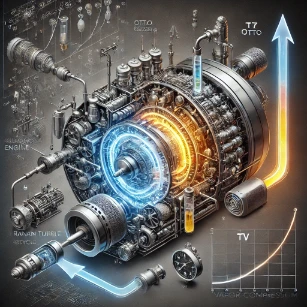
Thermodynamic cycles are repeated energy-conversion pathways used to understand engines, power plants, refrigerators, air conditioners, heat pumps, and many other energy systems. A working substance such as air, steam, combustion gas, or refrigerant goes through a sequence of processes and eventually returns to its initial thermodynamic state. Because the state is restored, the system can repeat the same cycle again and again.
This sub-hub belongs to the wider study of
thermodynamics. It shows how heat, work, temperature, pressure, volume, entropy, phase change, and efficiency come together in practical machines. The ideas are grounded in the
laws of thermodynamics, especially the first law, which accounts for energy conservation, and the second law, which explains why perfect heat-to-work conversion is impossible.
Thermodynamic cycles are especially important in
engineering thermodynamics, where ideal models are used to analyse real machines. The Carnot, Otto, Diesel, Rankine, Brayton, refrigeration, and heat pump cycles are not just names to memorise. They are simplified maps of how energy enters a system, how useful work or useful heat movement is produced, and why losses always appear in practice.

Thermodynamic cycles connect engines, turbines, power plants, refrigerators, and heat pumps through repeated pathways of heat transfer, work transfer, and energy conversion.
What Thermodynamic Cycles Really Are
A thermodynamic cycle is best understood as a controlled journey through energy states. The working substance is compressed, heated, expanded, cooled, condensed, evaporated, or throttled depending on the type of machine. At the end of the cycle, the working substance returns to its starting state, but heat and work have crossed the system boundary during the loop.
For a heat engine, the cycle receives heat from a high-temperature source, converts part of that heat into useful work, and rejects the remaining heat to a lower-temperature sink. For a refrigerator or heat pump, the cycle operates in the opposite spirit: it uses work input to move heat from one region to another. This difference explains why engines are judged by thermal efficiency, while refrigeration and heat pump systems are judged by coefficient of performance.
The theoretical underpinnings of thermodynamic cycles are closely connected with
classical thermodynamics. Many ideal cycles use simplified processes such as isothermal expansion, adiabatic compression, isobaric heat addition, or isochoric heat rejection. These simplifications remove some real-world complexity so that students can see the main energy pattern clearly.
How This Sub-Hub Connects with the Thermodynamics Cluster
Thermodynamic cycles sit between basic thermodynamic laws and practical engineering systems. To understand them well, students should connect this sub-hub with nearby topics in the wider Thermodynamics cluster.
The parent page introduces the broad study of heat, work, temperature, internal energy, entropy, and energy transfer in physical systems.
The laws explain energy conservation, entropy increase, heat-engine limits, and why real energy conversion can never be perfectly efficient.
Classical thermodynamics provides the macroscopic language of states, processes, heat, work, temperature, pressure, and entropy.
Engineering thermodynamics applies ideal models to turbines, engines, compressors, pumps, boilers, condensers, heat exchangers, and refrigeration systems.
Heat transfer explains how energy moves by conduction, convection, radiation, and combined mechanisms inside real cycle components.
Thermodynamic Cycles
This current sub-hub organises the main repeated energy-conversion pathways used in engines, power plants, gas turbines, refrigerators, and heat pumps.
Basic Concepts Students Should Know First
Working Substance
The working substance is the medium that undergoes the thermodynamic processes in a cycle. It may be air in an ideal gas model, steam in a power plant, combustion gas in a turbine, or refrigerant in a cooling system. The choice of working substance affects pressure range, temperature range, heat transfer behaviour, phase change, safety, cost, and environmental impact.
Heat Reservoirs
A heat reservoir is an idealised body that can supply or absorb heat without a significant change in its own temperature. In heat-engine analysis, the hot reservoir supplies heat to the system, while the cold reservoir absorbs rejected heat. This distinction is central to understanding why no heat engine can convert all heat input into useful work.
Common Processes in Cycles
Thermodynamic cycles are built from idealised processes. These process names describe what stays constant or what kind of energy exchange is absent.
- Isothermal process: temperature remains constant.
- Adiabatic process: no heat transfer occurs across the system boundary.
- Isobaric process: pressure remains constant.
- Isochoric process: volume remains constant.
- Isentropic process: entropy remains constant in an ideal reversible adiabatic process.

Visual comparison of four key thermodynamic processes: isothermal, adiabatic, isobaric, and isochoric. These process types appear repeatedly in ideal thermodynamic cycle models.
Net Work, Heat Input, Efficiency, and COP
For a complete cycle, the working substance returns to its initial state. Therefore, its net change in internal energy over one cycle is zero:
ΔUcycle = 0
For a heat engine, the net work output over a cycle is related to the heat supplied and the heat rejected:
Wnet = Qin − Qout
The thermal efficiency of a heat engine is:
η = Wnet / Qin = 1 − (Qout / Qin)
For refrigerators and heat pumps, the useful result is not work output. The useful result is heat moved. Therefore, their performance is described using coefficient of performance:
COPR = Qcold / Win
COPHP = Qhot / Win
A COP greater than 1 does not violate energy conservation. It simply means the device uses work input to move heat, rather than converting work directly into heat alone.
Learning Pathway Through the Six Cycle Pages
The six terminal pages in this sub-hub should be studied as a connected pathway. The Carnot Cycle introduces the ideal limit. The Otto and Diesel cycles model internal combustion engines. The Rankine Cycle explains steam power plants. The Brayton Cycle explains gas turbines and jet engines. Refrigeration and heat pump cycles show how work input can move heat for cooling and heating.
Start here to understand the ideal reversible heat engine and the maximum possible efficiency between two temperature reservoirs.
Study this cycle to see how spark-ignition petrol engines are modelled through compression, heat addition, expansion, and heat rejection.
Use this page to understand compression-ignition engines and why the Diesel model uses constant-pressure heat addition.
Explore how steam power plants use boilers, turbines, condensers, pumps, and phase change to convert heat into work.
Learn how gas turbines and jet engines use compression, combustion, and expansion in continuous-flow power and propulsion systems.
Finish the pathway by studying reversed cycles that use work input to move heat for cooling, heating, food storage, air conditioning, and climate control.
How the Main Thermodynamic Cycles Compare
Thermodynamic cycles can be grouped by purpose. Some define theoretical limits. Some model internal combustion engines. Some describe steam power plants. Some describe gas turbines. Others operate in reverse to move heat from a colder region to a warmer region.
| Cycle Group | Main Purpose | Typical Working Substance | Key Examples | Main Learning Focus |
|---|
| Ideal heat-engine limit | Define the maximum possible efficiency between two reservoirs | Idealised reversible working substance | Carnot Cycle | Reversibility, entropy, temperature reservoirs, and theoretical efficiency limits |
| Internal combustion engine cycles | Model engines where fuel combustion occurs inside the working chamber | Air or air-fuel mixture, often approximated as an ideal gas | Otto Cycle and Diesel Cycle | Compression ratio, heat addition, expansion work, and engine efficiency |
| Vapour power cycles | Generate power using boiling, expansion, condensation, and pumping | Water and steam | Rankine Cycle | Phase change, turbines, boilers, condensers, pumps, and steam power generation |
| Gas turbine cycles | Produce shaft power or jet thrust using high-temperature gas flow | Air and combustion gases | Brayton Cycle | Compressors, combustors, turbines, pressure ratio, and continuous-flow operation |
| Reversed cycles | Move heat from a colder region to a warmer region using work input | Refrigerants or suitable working fluids | Refrigeration and Heat Pump Cycles | COP, evaporators, condensers, compressors, expansion valves, and heat pumps |
Ideal Cycles and Real Cycles
An ideal cycle is a simplified model. It may assume reversible processes, no friction, no pressure drop, no heat leakage, perfect insulation, ideal gas behaviour, or idealised heat transfer. These assumptions are not fully realistic, but they help students see the main structure of energy conversion without being overwhelmed by machine details.
A real cycle includes losses. Pistons have friction. Turbines and compressors are not perfectly isentropic. Heat exchangers need finite temperature differences. Pipes and ducts have pressure drops. Combustion is not perfectly reversible. Materials cannot withstand unlimited temperatures. Working fluids may not behave ideally. These real effects reduce efficiency and increase entropy generation.
This is why the
Carnot Cycle remains important. It is not a practical commercial engine design. Instead, it sets the theoretical upper limit for heat-engine efficiency between two reservoir temperatures:
ηCarnot = 1 − (TC / TH)
No real heat engine operating between the same two temperature reservoirs can exceed this limit. Real cycles are judged partly by how closely they approach their ideal reference model and partly by how well they satisfy practical requirements such as cost, reliability, safety, emissions, size, and durability.
Power Cycles: Heat Converted into Work
Power cycles are thermodynamic cycles designed to produce useful work. In internal combustion engines, the cycle occurs inside cylinders. In steam power plants, the working substance moves through separate components such as the pump, boiler, turbine, and condenser. In gas turbines, air and combustion gases flow continuously through the compressor, combustor, and turbine.
These cycles differ in design, but their purpose is similar: receive energy at a relatively high temperature, produce useful work, and reject unavoidable waste heat. The second law explains why some heat rejection is unavoidable in any cyclic heat engine.
Refrigeration and Heat Pump Cycles: Work Used to Move Heat
Refrigeration and heat pump cycles operate differently from power cycles. They do not aim to produce net work. Instead, they use work input to move heat from a colder region to a warmer region. This is why refrigerators cool food compartments, air conditioners cool rooms, and heat pumps warm buildings by transferring heat rather than simply generating heat from electricity.
A refrigeration cycle is usually judged by how much heat it removes from the cold space per unit work input. A heat pump is judged by how much heat it delivers to the warm space per unit work input. Both are examples of reversed thermodynamic cycles, and both are essential for modern climate control, food preservation, industrial cooling, and energy-efficient heating.
Heat Transfer Inside Thermodynamic Cycles
Thermodynamic cycles cannot be separated from
heat transfer. Heat must enter the working substance, leave the working substance, or be moved from one place to another. In real machines, heat transfer occurs through boilers, condensers, evaporators, radiators, cooling jackets, combustors, turbine blades, heat exchangers, and exhaust systems.
A cycle may look efficient on paper, but if heat cannot be added or removed at a practical rate, the machine may become too large, too expensive, too slow, or too inefficient. This is why real cycle performance depends not only on thermodynamic equations, but also on heat exchanger design, material selection, fluid flow, surface area, temperature difference, and operating conditions.
Phase Change and Working Fluids
Some thermodynamic cycles depend strongly on
phase equilibria and phase transitions. The Rankine Cycle uses liquid water and steam. Refrigeration cycles commonly use refrigerants that evaporate and condense at useful temperatures. Phase change is valuable because large amounts of heat can be absorbed or released during boiling and condensation.
The choice of working fluid is therefore not a minor detail. Water is suitable for many steam power plants because it is abundant, stable, and has favourable thermal properties. Refrigerants must be selected with attention to boiling point, pressure range, toxicity, flammability, ozone depletion potential, global warming potential, and system compatibility. Advanced power cycles may use organic fluids, ammonia-water mixtures, carbon dioxide, helium, or other specialised working substances.
Irreversibility and Non-Equilibrium Effects
Ideal cycles often assume reversible processes, but real systems are shaped by
non-equilibrium thermodynamics. Heat transfer across a finite temperature difference, friction, turbulence, mixing, pressure drop, combustion, throttling, and unrestrained expansion all generate entropy. This entropy generation reduces the useful work potential of energy.
In a heat engine, irreversibility lowers the net work obtained from a given heat input. In a refrigerator or heat pump, irreversibility increases the work input required to achieve the same cooling or heating effect. This is why engineers try to reduce pressure losses, improve turbine and compressor efficiency, use better insulation, design more effective heat exchangers, and recover waste heat where possible.
Computational, Statistical, and Materials Connections
Modern cycle analysis increasingly uses
computational thermodynamics to simulate complex systems. Software tools can model transient operation, changing fluid properties, pressure-volume relationships, heat exchanger behaviour, combustion effects, and coupled fluid dynamics. This is especially useful when a cycle does not operate under simple steady-state conditions.
At a deeper level,
statistical thermodynamics explains how macroscopic quantities such as temperature, pressure, and entropy emerge from molecular behaviour. This connection becomes especially important in advanced systems such as micro-scale engines, nanoscale thermal devices, cryogenic systems, and research on quantum heat engines.
Real cycle performance also depends on
thermodynamics of materials. Materials determine how hot a turbine blade can safely become, how much pressure a boiler tube can withstand, how a heat exchanger corrodes, and how a refrigerant interacts with seals, lubricants, and metals. The thermodynamic model may be elegant, but the real machine survives only if the materials can endure the operating conditions.
Sustainable Energy and Advanced Cycle Development
Thermodynamic cycles are central to
renewable and sustainable energy thermodynamics. Waste heat recovery, geothermal power, biomass systems, solar thermal systems, combined-cycle gas turbines, heat pumps, and industrial energy recovery all depend on improving how cycles use available energy.
For example, organic Rankine cycles use organic working fluids to recover energy from low-temperature heat sources where ordinary steam cycles may be inefficient. Combined-cycle power plants use the exhaust heat from a gas turbine to produce steam for a Rankine bottoming cycle. Heat pumps reduce direct fuel use in buildings by moving heat rather than generating all heat through combustion or resistance heating.
Thermodynamic cycle ideas also appear in advanced energy systems involving
nuclear reactions,
nuclear fusion,
plasma physics, and high-temperature energy conversion. These connections do not replace basic cycle analysis; they show how widely the same energy-conversion principles can appear across science and technology.
Common Misunderstandings About Thermodynamic Cycles
- Misunderstanding 1: A cycle diagram is a picture of the machine itself. A cycle diagram is not a mechanical drawing. It is a thermodynamic map showing how state variables and energy transfers change during operation.
- Misunderstanding 2: All cycles produce work. Power cycles produce net work, but refrigeration and heat pump cycles require work input to move heat.
- Misunderstanding 3: Efficiency and COP are the same thing. Efficiency describes heat-to-work conversion, while COP describes useful heat movement per unit work input.
- Misunderstanding 4: The Carnot Cycle is a practical engine blueprint. The Carnot Cycle is mainly a theoretical benchmark, not a practical commercial engine design.
- Misunderstanding 5: Ideal cycles are useless because real machines are different. Ideal cycles are useful because they reveal the main energy pathway before losses and complications are added.
- Misunderstanding 6: A cycle returning to its initial state means no energy was exchanged. The system state returns to its starting point, but heat and work may still have crossed the boundary during the cycle.
- Misunderstanding 7: Higher temperature is always better. Higher temperature can improve performance, but materials, safety, emissions, lubrication, cooling, and cost impose limits.
Why Study Thermodynamic Cycles?
Modelling Practical Energy Systems
Thermodynamic cycles help students model practical energy systems in a structured way. Instead of seeing engines, turbines, refrigerators, and heat pumps as unrelated machines, students learn to recognise repeated patterns of compression, expansion, heat addition, heat rejection, phase change, and work transfer.
Understanding Ideal Limits
Ideal cycles clarify the upper limits of performance. The Carnot Cycle shows the best possible heat-engine efficiency between two temperature reservoirs. The Otto, Diesel, Rankine, and Brayton cycles provide ideal reference models for real engines, steam plants, and gas turbines.
Connecting Theory with Real Losses
Real systems include friction, pressure drops, heat leakage, combustion irreversibility, turbine losses, compressor losses, and material limits. Studying cycles helps students understand where these losses occur and why real performance is lower than ideal performance.
Supporting Cooling and Heating Technologies
Refrigeration and heat pump cycles are essential in food preservation, medicine, buildings, electronics cooling, transport, and industrial processes. Understanding these cycles helps students see why cooling requires work input and why heat pumps can provide efficient heating.
Preparing for Clean Energy and Sustainability
Thermodynamic cycles are central to power generation, waste heat recovery, geothermal energy, solar thermal systems, combined-cycle plants, heat pumps, desalination, and industrial energy efficiency. Students who understand cycles are better prepared to think about clean energy and sustainable engineering.
Key Terms
- Thermodynamic cycle
- A repeated sequence of thermodynamic processes that returns the working substance to its initial state.
- Working substance
- The material that undergoes changes in pressure, temperature, volume, phase, or energy during a cycle.
- Heat reservoir
- An idealised source or sink that supplies or absorbs heat while remaining at nearly constant temperature.
- Heat engine
- A device that receives heat from a high-temperature source and converts part of it into useful work.
- Power cycle
- A thermodynamic cycle designed to produce net work output, commonly used in engines, turbines, and power plants.
- Refrigeration cycle
- A reversed cycle that uses work input to remove heat from a cold region and reject it to a warmer region.
- Heat pump
- A device that uses work input to deliver heat to a warm region by extracting heat from a colder source.
- Thermal efficiency
- The ratio of net work output to heat input for a heat engine or power cycle.
- Coefficient of performance
- A performance measure for refrigerators and heat pumps that compares useful heat transfer with work input.
- Entropy generation
- The increase in entropy caused by irreversibilities such as friction, mixing, pressure drop, and heat transfer across finite temperature differences.
- Carnot limit
- The maximum theoretical efficiency possible for a reversible heat engine operating between two temperature reservoirs.
- Compression ratio
- The ratio of maximum to minimum volume in reciprocating engine cycle models such as the Otto and Diesel cycles.
- Pressure ratio
- The ratio of compressor outlet pressure to inlet pressure, especially important in Brayton cycle analysis.
- Regeneration
- A method of improving cycle performance by recovering heat from one part of the system and using it elsewhere.
Interactive Learning Tool: Heat Engine vs. Heat Pump Calculator
Use this calculator to explore how efficiency and Coefficient of Performance (COP) vary with reservoir temperatures for ideal Carnot cycles. Adjust the hot and cold reservoir temperatures to see the maximum theoretical limits for both power generation and thermal management.
Carnot Efficiency & COP Calculator
Error: Hot reservoir temperature (TH) must be strictly greater than cold reservoir temperature (TC).
Carnot Engine Efficiency (η):
—
Refrigerator COP (COPR):
—
Quick Check: Thermodynamic Cycles
Quick Check: Energy Pathways in Cycles
Frequently Asked Questions: Thermodynamic Cycles
1. What is a thermodynamic cycle?
A thermodynamic cycle is a sequence of processes that returns a working substance, such as gas, steam, or refrigerant, to its initial state. This allows the same energy-conversion pattern to repeat continuously.
2. Why are thermodynamic cycles important in engineering systems?
They form the basis of engines, power plants, refrigeration systems, air conditioners, and heat pumps. They help engineers analyse how heat and work are exchanged, how efficiency is limited, and how real systems can be improved.
3. What is the difference between ideal and real cycles?
Ideal cycles assume simplified reversible processes with no losses. Real cycles include irreversibilities such as friction, pressure drops, imperfect heat transfer, heat leakage, non-ideal fluid behaviour, and material limitations.
4. What is the Carnot Cycle?
The Carnot Cycle is an ideal reversible cycle made of two isothermal and two adiabatic processes. It defines the maximum possible efficiency for a heat engine operating between two temperature reservoirs.
5. What is the Rankine Cycle used for?
The Rankine Cycle is used to model steam power plants. It involves pumping water, heating it in a boiler, expanding steam through a turbine, condensing it, and repeating the process.
6. What is the Brayton Cycle used for?
The Brayton Cycle models gas turbines and jet engines. It involves air compression, heat addition through combustion, expansion through a turbine, and heat rejection or exhaust flow.
7. What is a refrigeration or heat pump cycle?
A refrigeration or heat pump cycle uses work input to move heat from a colder region to a warmer region. Refrigerators, freezers, air conditioners, and heat pumps use this principle.
8. What determines the efficiency of a thermodynamic cycle?
Efficiency depends on temperature limits, pressure ratios, compression ratios, working fluid properties, component design, and irreversibilities such as friction, heat loss, and pressure drop.
9. Why is understanding thermodynamic cycles useful for students?
It helps students connect abstract thermodynamic laws with real machines. It also supports later study in mechanical engineering, aerospace engineering, energy systems, chemical engineering, environmental technology, and sustainable design.
10. How do engineers improve real cycle performance?
Engineers improve performance by reducing losses, improving heat transfer, increasing safe operating temperature and pressure, using regeneration or reheating, selecting better working fluids, improving materials, and optimising component design.
Review Questions and Answers
What is a thermodynamic cycle, and why is it important?
Answer: A thermodynamic cycle is a sequence of processes that returns the working substance to its initial state. It is important because it models repeated energy conversion in engines, turbines, power plants, refrigerators, and heat pumps.
What are the main types of thermodynamic cycles?
Answer: The main types include heat-engine cycles, internal combustion cycles, vapour power cycles, gas turbine cycles, and reversed refrigeration or heat pump cycles.
How does the Carnot Cycle set an upper efficiency limit?
Answer: The Carnot Cycle assumes completely reversible operation between two temperature reservoirs. Its efficiency depends only on the hot and cold reservoir temperatures, so it gives the maximum possible efficiency for any heat engine operating between those temperatures.
How do the Otto and Diesel cycles differ?
Answer: The Otto Cycle models spark-ignition engines and uses idealised constant-volume heat addition. The Diesel Cycle models compression-ignition engines and uses idealised constant-pressure heat addition.
Why is the Rankine Cycle important in power generation?
Answer: The Rankine Cycle models steam power plants. It uses boiling, turbine expansion, condensation, and pumping to convert heat into mechanical work and then electricity.
Why is the Brayton Cycle suitable for gas turbines and jet engines?
Answer: The Brayton Cycle uses continuous-flow compression, heat addition, and expansion. This makes it suitable for gas turbines, aircraft engines, and high-power continuous operation.
Why do refrigeration cycles operate in reverse compared with power cycles?
Answer: Power cycles convert heat into work. Refrigeration cycles use work input to move heat from a colder region to a warmer region, which is the reverse direction of natural heat flow.
What role does entropy generation play in real cycles?
Answer: Entropy generation measures irreversibility. It reduces the useful work that can be extracted from energy and lowers the performance of engines, turbines, refrigeration systems, and heat pumps.
Why are regeneration and reheating used in some cycles?
Answer: Regeneration recovers heat that would otherwise be wasted, while reheating can increase work output and reduce moisture problems in turbines. Both methods can improve real cycle performance.
Why are thermodynamic cycles relevant to sustainable energy?
Answer: They are used in power generation, waste heat recovery, geothermal systems, solar thermal systems, combined-cycle plants, heat pumps, and industrial energy efficiency. Improving cycles can reduce fuel use and environmental impact.
Thought-Provoking Questions and Answers
If a working substance returns to its original state after one cycle, where does the useful work come from?
Answer: The useful work comes from net energy transfer during the cycle. Although the working substance returns to its original state, heat has entered and left the system. In a heat engine, the difference between heat input and heat rejection appears as net work output.
Why does the second law make 100% heat-engine efficiency impossible?
Answer: The second law requires that a cyclic heat engine reject some heat to a lower-temperature sink. Without heat rejection, the engine could not complete a cycle while converting all supplied heat into work.
Why might a less efficient cycle still be chosen in real engineering?
Answer: Engineering design is not based on efficiency alone. Cost, reliability, safety, size, weight, fuel availability, emissions, maintenance, response time, and material limits may make one cycle more practical than another.
Why do combined-cycle power plants achieve higher efficiency than single-cycle systems?
Answer: A combined-cycle plant uses the hot exhaust from a Brayton gas turbine to produce steam for a Rankine steam turbine. This recovers energy that would otherwise be wasted, increasing total power output from the same fuel input.
Why are heat pumps important in a low-carbon energy future?
Answer: Heat pumps can deliver more heating energy than the electrical work they consume because they move heat rather than create all heat directly. When powered by low-carbon electricity, they can reduce dependence on direct fuel combustion for heating.
Summary
Thermodynamic cycles describe repeated energy-conversion pathways. A working substance passes through a sequence of processes and returns to its initial state, allowing the cycle to repeat. During the loop, heat and work cross the system boundary, enabling machines to produce work, consume work, move heat, or recover energy.
The six pages in this sub-hub form a connected learning pathway. The Carnot Cycle explains the ideal efficiency limit. The Otto and Diesel cycles model internal combustion engines. The Rankine Cycle explains steam power. The Brayton Cycle explains gas turbines and jet propulsion. Refrigeration and heat pump cycles explain cooling and heating through reversed operation.
Together, these cycles show how thermodynamic laws become practical technology. They also reveal a deeper lesson: energy is conserved, but useful energy is limited by irreversibility, entropy generation, heat transfer constraints, material limits, and real engineering design choices.
Reflection Question
If every real thermodynamic cycle loses useful energy through irreversibilities, why do ideal cycles remain so important in physics and engineering education?