
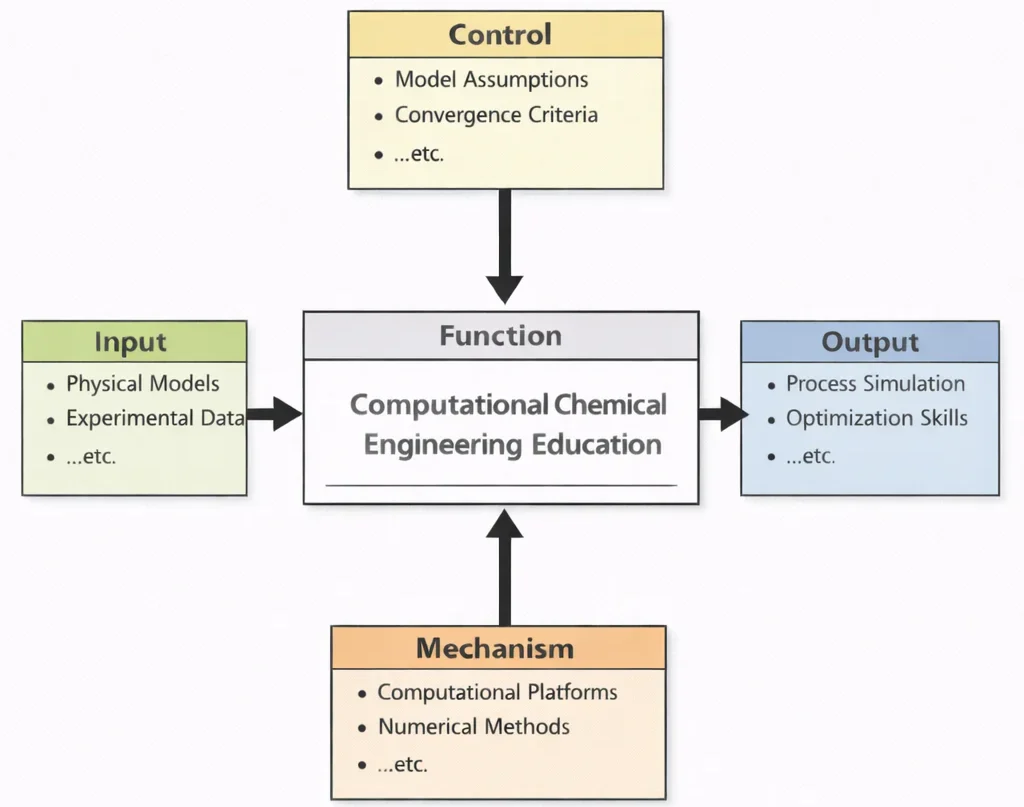
Computational Chemical Engineering Education, viewed through this diagram, teaches students to build “thinking laboratories” inside a computer. The Inputs remind learners that computation is not magic: it starts from physical models that describe reality, and experimental data that anchors those models to what actually happens. The Controls enforce intellectual honesty—assumptions must be stated, justified, and tested, while convergence criteria ensure that a numerical answer is not merely produced, but earned. The Mechanisms turn the workflow into practice: students learn to use computational platforms and numerical methods to solve mass and energy balances, model transport and reaction behavior, and explore scenarios that would be expensive, slow, or unsafe to test directly. The Outputs are graduates who can simulate processes with confidence and optimize them with clarity—able to compare designs, quantify trade-offs, and improve performance while remaining aware of what the model does (and does not) claim.
Computational Chemical Engineering brings the power of numerical analysis, mathematical modeling, and simulation tools to solve complex problems in process design, control, and optimization. As a specialized domain within Chemical Engineering, it enhances predictive capabilities and facilitates data-driven decision-making. Whether simulating multiscale phenomena or optimizing chemical reactors, this field is central to modern process innovation.
Its applications intersect with fields such as Biochemical Engineering, where living systems require precise computational models for metabolic fluxes, and Chemical Catalysis and Reaction Engineering, which benefit from reaction kinetics modeling and reactor simulations. Similarly, the design of efficient energy systems is improved through collaboration with Chemical Energy Systems Engineering.
Material behavior modeling is a key component in Chemical Materials Engineering, allowing prediction of properties under different processing conditions. The modeling and control of plant-wide operations rely on insights from Chemical Process Engineering. Engineers also use computational platforms to simulate unit operations involved in Food and Beverage Engineering.
From quantum chemistry models to nanoscale simulation tools, Nanotechnology in Chemical Engineering depends heavily on computational accuracy. The development and analysis of synthetic materials are informed by simulation methods used in Polymer and Plastics Engineering. Interdisciplinary projects frequently draw on infrastructure principles from Civil Engineering.
Engineers working in Earthquake and Disaster Engineering or Geotechnical Engineering employ computational fluid dynamics and structural modeling similar to those used in chemical processes. Techniques for infrastructure layout and flow logistics intersect with Transportation Engineering and Urban and Regional Planning.
Simulating environmental treatment processes benefits from crossover knowledge from Water Resources Engineering. Control models for industrial chemical operations are closely linked to principles from Electrical and Electronic Engineering, particularly in fields such as Biomedical Electronics and Communication Engineering.
With the integration of advanced process control, Control Systems Engineering plays a vital role in real-time optimization. Physical device simulation and sensor integration are handled in conjunction with Electronics Engineering and Embedded Systems and Microelectronics. Data acquisition and automation are further enabled through Instrumentation and Measurement.

The image shows a modern research-control workspace where chemistry meets computation. A scientist in a lab coat stands at the left, interacting with a wall of transparent digital panels filled with molecular structures, network diagrams, and graph-like dashboards. In the foreground, a desk holds a computer monitor displaying clustered particle models and rising performance charts, suggesting optimization runs or process forecasting. Test tubes and lab glassware sit beside the workstation, hinting at the connection between simulation and real experiments. A glowing holographic sphere—like a digital “model world”—floats above the desk, reinforcing the central idea of computational chemical engineering: building virtual representations of reactions, materials, and industrial systems so engineers can test scenarios, improve efficiency, reduce risk, and design better processes before they are built in the real world.
Computational Chemical Engineering – Invisible FAQ
- How does computational chemical engineering differ from purely experimental approaches?
- Computational chemical engineering uses mathematical models, numerical methods and simulations to predict process and material behaviour before running full experiments. It complements laboratory work by narrowing design options, exploring extreme conditions safely and reducing the number of costly experimental trials needed.
- What kinds of problems can molecular dynamics simulations solve in chemical engineering?
- Molecular dynamics simulations help elucidate diffusion, adsorption, solvation, phase behaviour and reaction mechanisms at the atomic scale. They are especially useful when experimental observation is difficult, such as in extreme environments, confined pores, complex interfaces or very fast processes.
- Why is computational fluid dynamics (CFD) important for industrial reactor design?
- CFD reveals detailed flow, mixing, heat transfer and species distribution inside reactors and process equipment. This detail allows engineers to identify dead zones, short-circuiting, hot spots or maldistribution that cannot be seen from lumped models alone, and to redesign internals or operating conditions to improve performance.
- How do process simulators support whole-plant optimisation?
- Process simulators link individual unit models into an integrated flowsheet so material and energy balances are solved consistently across the entire plant. They enable engineers to test alternative process routes, evaluate energy-integration schemes, estimate utilities, and perform economic and sensitivity analyses at plant scale.
- What is the role of quantum chemical calculations in catalyst and material design?
- Quantum chemical methods provide electronic-structure information, predicting reaction pathways, adsorption energies and activation barriers on catalytic surfaces. This information helps screen candidate catalysts, understand selectivity trends and design materials with targeted chemical reactivity or stability.
- How are machine learning methods integrated into computational chemical engineering workflows?
- Machine learning can be used to build surrogate models for expensive simulations, to correlate structure and properties in materials design, and to analyse large experimental and plant datasets. These data-driven models accelerate optimisation and provide fast predictors for use within process simulators and control systems.
- What are common sources of error and uncertainty in computational chemical engineering?
- Sources include simplifications in model assumptions, inaccurate or sparse input data, numerical discretisation errors and parameter uncertainty. Engineers address them with model validation against experimental data, uncertainty quantification, sensitivity analysis and careful selection of model complexity.
- How does multi-scale modelling connect molecular-level and plant-level behaviour?
- Multi-scale modelling couples models at different length and time scales, such as quantum calculations, molecular simulations, kinetic models, CFD and flowsheet simulations. Information flows between scales—for example, molecular properties feeding into kinetic expressions and reactor models—providing a consistent description from atoms to equipment and plants.
- In what ways can computational tools accelerate the development of sustainable processes?
- Computational tools rapidly screen alternative reaction routes, solvents and separation schemes for energy use, emissions and waste. They can incorporate environmental metrics and life-cycle data directly into optimisation, allowing engineers to identify process designs that balance profitability with sustainability objectives.
- What core skills do students need to succeed in computational chemical engineering?
- Key skills include differential equations, numerical methods, programming, thermodynamics, transport phenomena, reaction engineering and statistical analysis. Familiarity with simulation software, scripting for automation and basic machine learning concepts is increasingly important for modern practice.
- Chemical Engineering topics:
- Chemical Engineering – Overview
- Chemical Process Engineering
- Chemical Catalysis & Reaction Engineering
- Chemical Materials Engineering
- Chemical Energy Systems Engineering
- Polymer & Plastics Engineering
- Nanotechnology in Chemical Engineering
- Biochemical Engineering
- Food & Beverage Engineering
- Computational Chemical Engineering
Table of Contents
Core Concepts in Computational Chemical Engineering
Mathematical Modeling of Chemical Processes
- Definition:
The formulation of mathematical equations to describe physical, chemical, and biological processes in chemical engineering systems. - Types of Models:
- Mechanistic Models: Based on fundamental physical and chemical laws (mass, momentum, energy balances).
- Empirical Models: Developed using experimental data to predict system behavior.
- Hybrid Models: Combine mechanistic understanding with data-driven models for better accuracy.
- Applications:
- Reaction kinetics modeling, heat and mass transfer, and process dynamics.
Process Simulation
- Definition:
Using computer-based tools to mimic real-world chemical processes for design, optimization, and troubleshooting. - Simulation Tools:
- ASPEN Plus, HYSYS: Widely used for steady-state and dynamic process simulations.
- COMSOL Multiphysics: For modeling heat transfer, fluid flow, and chemical reactions.
- CHEMCAD: Simulation software for chemical process design and optimization.
- Applications:
- Process design, energy integration, plant performance analysis, and safety evaluation.
Computational Fluid Dynamics (CFD)
- Definition:
A branch of fluid mechanics that uses numerical analysis to solve problems involving fluid flows, heat transfer, and chemical reactions. - Applications:
- Reactor design and scale-up.
- Mixing and separation processes.
- Heat exchanger optimization.
- Tools:
- ANSYS Fluent, OpenFOAM: CFD software for chemical process analysis.
Molecular Modeling and Simulation
- Definition:
Simulating molecular interactions to predict material properties and reaction mechanisms. - Techniques:
- Molecular Dynamics (MD): Analyzes the physical movements of atoms and molecules over time.
- Monte Carlo Simulations: Predicts thermodynamic and phase behavior.
- Quantum Chemistry Calculations: Models electronic structures and reaction mechanisms.
- Applications:
- Catalyst design, drug development, and polymer science.
Process Optimization
- Definition:
Improving chemical processes to maximize efficiency, reduce costs, and enhance product quality. - Optimization Techniques:
- Linear and Non-Linear Programming: Mathematical methods for process optimization.
- Genetic Algorithms (GAs): Evolutionary algorithms for solving complex optimization problems.
- Multi-Objective Optimization: Balancing competing objectives like cost, safety, and sustainability.
- Applications:
- Energy integration, raw material utilization, and waste reduction.
Process Control and Automation
- Definition:
Designing systems for real-time monitoring and control of chemical processes. - Control Strategies:
- PID Control (Proportional-Integral-Derivative): Common feedback control method.
- Model Predictive Control (MPC): Advanced control using predictive models.
- Real-Time Optimization (RTO): Dynamic process adjustments based on real-time data.
Data Analytics, Machine Learning, and Artificial Intelligence (AI)
- Definition:
Leveraging big data, machine learning, and AI to optimize chemical processes. - Applications:
- Predictive Maintenance: Using AI to forecast equipment failures.
- Process Optimization: Machine learning algorithms for optimizing reaction conditions.
- Fault Detection: AI systems for early detection of process deviations.
- Techniques:
- Supervised and Unsupervised Learning: For process modeling and pattern recognition.
- Neural Networks: Modeling nonlinear and complex processes.
Key Applications of Computational Chemical Engineering
Process Design and Scale‑Up
- Design Optimization:
Engineers use process simulation tools to create efficient chemical plants, maximizing throughput while minimizing energy use and cost. By iterating virtual models, minor adjustments—like altering pipe sizes or heat exchanger layouts—can yield huge improvements in overall plant performance.
- Scale‑Up Modeling:
When moving from bench‑scale reactors to full industrial units, predictive models help ensure consistent product quality. These models account for mixing, temperature gradients, and kinetics to prevent unforeseen issues like poor conversion or hot spots.
- Industrial Applications:
Computational approaches are essential in refining crude oil, producing polymers, and optimizing food processing systems, where simulation tools shorten development cycles and reduce physical prototyping costs.
Reactor Design and Optimization
- CFD Modeling:
Computational Fluid Dynamics (CFD) tools enable detailed visualization of flow patterns, temperature distributions, and reaction zones inside reactors. This allows engineers to improve mixing, reduce dead zones, and enhance reaction throughput.
- Process Optimization:
By simulating various designs—like multi‑inlet geometries or internal baffles—designers can maximize yield, minimize energy use, and ensure safe operation under all conditions.
- Reactor System Types:
Models are applied in catalytic fixed‑bed reactors, fluidized bed units, and bioreactors, ensuring optimal conversion and efficient mixing across industries.
Energy and Resource Efficiency
- Process Integration:
Using techniques like pinch analysis, engineers can identify heat recovery opportunities—digesting excess heat from one part of a process to warm another—by simulating whole‑plant energy flows.
- Renewable Energy Integration:
Simulation helps optimize biofuel plants and hydrogen generation systems by incorporating variable energy sources like solar or biomass, ensuring steady output and minimal wasted feedstock.
- Case Study:
For example, integrating a solar‑heated system with conventional biomass reactors improves overall efficiency by 20%, according to recent studies.
Environmental Impact Analysis
- Life Cycle Assessment (LCA):
Using tools like SimaPro or OpenLCA, environmental analysts simulate the full life cycle—from raw material extraction to disposal—to identify hotspots of emissions and resource use.
- Pollution Control:
By simulating reaction pathways for undesirable products (e.g., NOₓ, SO₂), engineers design mitigation strategies such as catalyst choices, scrubbers, or optimized combustion conditions.
- Carbon Capture Planning:
Computational models of absorption columns or cryogenic systems allow for the design of CO₂ capture units integrated seamlessly into existing plants.
Advanced Materials and Catalysis
- Molecular Modeling:
Using quantum chemistry and molecular dynamics, researchers model how catalyst surfaces interact with reactants, helping design catalysts with greater selectivity and longevity.
- New Materials Discovery:
High‑throughput computational methods predict properties of novel polymers, composites, and nano‑materials before synthesis, accelerating innovation from years to weeks.
Digital Twins and Real‑Time Monitoring
- Definition:
Digital twins are virtual replicas of operating plants that mirror real‑time conditions. They use sensor feeds to update simulations continuously and predict future states.
- Applications:
By comparing the digital twin with live data, engineers can detect drift, prevent failures, and optimize operations without disrupting production.
For a deeper dive into scenario modeling, you might explore this review on digital twins in process industries, while this overview of pinch analysis offers a foundational understanding of energy integration techniques.
Emerging Technologies in Computational Chemical Engineering
Digital Twins
- Definition:
A digital twin is a dynamic, data-driven virtual replica of a physical asset, process, or system. It is continuously updated with real-time data, enabling engineers to simulate, predict, and optimize performance under various conditions. - Applications:
- Predictive maintenance: Digital twins can forecast potential equipment failures before they occur, allowing for timely intervention.
- Process optimization: Engineers can test different operating strategies virtually to improve efficiency and yield without risking downtime.
- Scenario analysis: By adjusting input variables and environmental conditions in the twin, designers can evaluate how the real system might behave under unexpected disruptions or future market demands.
- Industry Example:
Digital twin platforms are now being deployed in refineries to model heat exchanger networks and predict fouling rates, reducing unplanned outages and improving heat recovery efficiency.
High-Performance Computing (HPC)
- Definition:
HPC involves using massive computational power—often across thousands of processors—to solve highly detailed simulations and optimization problems at unprecedented speeds. - Applications:
- Molecular simulations: HPC enables atomistic modeling of reaction mechanisms, including catalytic surface interactions and polymerization pathways.
- Multi-scale modeling: Integrating quantum chemistry, molecular dynamics, and continuum models offers insights from nanoscale to industrial scale.
- CFD analysis: Large-scale computational fluid dynamics allows detailed modeling of multiphase flows, combustion, and turbulence within complex reactors and pipelines.
- External Insight:
HPC is a pillar of modern process innovation, as shown in this NSF feature on high-performance computing, which explores its role in accelerating discovery.
Cloud Computing and IoT Integration
- Real-Time Monitoring:
- IoT sensors installed across production systems capture data on flow rates, pressures, and temperatures. This data is transmitted via the cloud for continuous monitoring and immediate analysis.
- Operators can visualize anomalies instantly and trigger alerts or automated responses to ensure consistent quality and safety.
- Remote Optimization:
- Engineers can access simulation tools from anywhere, allowing distributed teams to collaborate in real time on process adjustments, energy audits, or capacity scaling.
- Cloud-based dashboards streamline the integration of AI algorithms to adapt control systems based on predictive models.
- Use Case:
Companies like Siemens and Honeywell are leveraging cloud-IoT platforms to deliver virtual plant management solutions across continents.
Quantum Computing
- Potential Applications:
- Accelerated molecular simulations: Quantum computing holds the promise of solving quantum mechanical equations for large, complex molecules in minutes rather than weeks, revolutionizing catalyst design and drug discovery.
- Solving complex reaction networks: Quantum algorithms can analyze reaction pathways and kinetics with extreme precision, potentially unveiling new reaction mechanisms or optimizing pathways for energy production and emissions control.
- Future Outlook:
While quantum computing is still emerging, organizations like IBM and Google are actively developing chemical simulation platforms, as described in this IBM research article on quantum chemistry.
AI-Augmented Process Intelligence
- Definition:
Artificial intelligence is increasingly used to automate decision-making and discover hidden patterns in massive process data sets. - Applications:
- Reinforcement learning to fine-tune process control systems.
- Neural networks to detect anomalies or predict fouling, emissions spikes, or catalyst deactivation.
- Integration with Other Technologies:
AI algorithms are being embedded into digital twins and IoT platforms, enabling self-optimizing plants that adapt in real time to fluctuations in demand, energy cost, or feedstock availability.
Challenges in Computational Chemical Engineering
Model Validation and Accuracy
- Ensuring that computational models reflect the real-world behavior of chemical systems is a fundamental challenge. Even small discrepancies between simulations and actual plant data can lead to flawed design decisions or inefficient operations.
- Validation requires not only experimental benchmarks but also rigorous statistical methods to quantify uncertainty and sensitivity. Models must be updated regularly as new empirical data becomes available.
- Moreover, for complex multiphase systems—such as gas-liquid reactors or polymerization processes—modeling interactions at different scales (molecular to macro) is still a developing science.
- Initiatives like the NIST guidelines for model validation are helping standardize best practices across the industry.
Data Availability and Quality
- Machine learning and AI-driven models are only as good as the data they are trained on. In many industrial environments, critical data may be siloed, incomplete, unstructured, or even inaccurate due to sensor drift or operator error.
- Establishing consistent data governance policies and data cleaning protocols is essential to ensure reliability and usability. Metadata tagging, version control, and timestamping also help track the evolution of process behavior over time.
- Partnerships between industry and academia, such as open-access chemical engineering data platforms, are becoming vital sources for robust model training.
- For example, the Open Energy Information (OpenEI) database provides standardized datasets for modeling energy and chemical processes.
Computational Costs
- While high-performance computing (HPC) opens the door to previously impossible simulations, the cost of acquiring, maintaining, and operating such infrastructure can be prohibitive for many organizations.
- This includes not only the capital expense of hardware but also the need for skilled personnel to manage software environments, parallel computing frameworks, and workflow orchestration tools.
- As simulations become more granular—incorporating real-time sensor data, multi-scale modeling, and AI-based control—their demand for processing power scales exponentially.
- Cloud-based HPC and hybrid models are offering cost-effective alternatives, but concerns remain about latency, data security, and regulatory compliance when outsourcing simulation workloads.
Integration with Legacy Systems
- Many chemical manufacturing facilities operate with legacy systems that are not built to communicate with modern digital tools, creating significant integration challenges.
- Bridging the gap requires middleware, custom APIs, or edge computing devices that translate data formats and protocols. This adds technical complexity and may introduce vulnerabilities or bottlenecks.
- Moreover, organizational inertia and lack of training can hinder the adoption of advanced computational techniques. Engineers accustomed to empirical methods may be resistant to transitioning to model-based workflows unless clear value is demonstrated.
- Successful integration often depends on phased digital transformation strategies, aligning business goals with pilot projects that showcase tangible returns on investment.
Real-Time Implementation Constraints
- Deploying computational tools in real-time process control environments requires low-latency, fail-safe systems that can withstand harsh industrial conditions.
- Models must run fast enough to inform process decisions without causing delays that disrupt operations. This often necessitates a trade-off between accuracy and computational complexity.
- Developing lightweight surrogate models that approximate more detailed simulations is one active area of research. These models must be trained and validated with care to ensure reliability.
Cybersecurity Risks in Digital Environments
- As digitalization increases, so too does the risk of cyber threats targeting process control systems, cloud infrastructure, or sensitive proprietary models.
- Implementing robust cybersecurity protocols—including encrypted data streams, multi-factor authentication, and intrusion detection systems—is vital for ensuring operational safety and integrity.
Cross-Disciplinary Skill Gaps
- Combining expertise in chemical engineering with data science, computational modeling, and software development requires a rare skill set that is currently in short supply.
- Institutions are increasingly offering interdisciplinary programs and certifications to bridge this gap, but industry-wide upskilling remains a challenge.
Future Directions in Computational Chemical Engineering
Autonomous Process Optimization
- Autonomous systems powered by artificial intelligence are poised to revolutionize chemical engineering by enabling fully self-optimizing chemical plants. These systems continuously monitor variables such as temperature, pressure, and flow rate, and automatically adjust operations to improve efficiency and product quality without human intervention.
- Reinforcement learning algorithms are being used to dynamically test and learn from operational feedback in complex processes like polymerization, distillation, or catalytic cracking.
- Autonomous optimization also includes real-time anomaly detection, predictive maintenance, and safety monitoring, significantly reducing downtime and enhancing resilience.
- Platforms such as AVEVA’s Industrial AI offer integrated solutions for deploying AI within chemical production environments.
Sustainable Process Design
- Computational tools are essential for creating processes that are environmentally responsible, economically viable, and resource-efficient. Process simulators can evaluate alternatives in terms of emissions, energy intensity, and material circularity at the design phase itself.
- For example, life cycle assessment models integrated with process simulation help engineers compare the environmental impact of different process routes and select the most sustainable option.
- New design methodologies include modeling of closed-loop systems and using green solvents or renewable feedstocks. These tools also enable the integration of green chemistry principles into traditional production pipelines.
Multi-Scale Modeling
- One of the frontiers in computational chemical engineering is the integration of models at different spatial and temporal scales—from molecular dynamics to macro-scale process simulations.
- This approach enables more accurate predictions of system behavior by capturing microscopic interactions (e.g., catalyst active sites or polymer chain folding) and linking them to macroscopic outcomes (e.g., reactor yield or energy consumption).
- Techniques such as coarse-graining and surrogate modeling are used to bridge the gap between atomistic and continuum models. These advances are especially useful in designing novel materials and complex reaction networks.
- Multi-scale modeling also enables hybrid simulation environments, where computational fluid dynamics (CFD), finite element analysis (FEA), and kinetic Monte Carlo (kMC) simulations work in tandem.
AI-Augmented Process Control
- Machine learning models are being increasingly embedded in control architectures to enable real-time adaptive decision-making. These AI-based controllers learn from streaming process data and can dynamically adjust control parameters to optimize outcomes.
- Unlike traditional PID controllers, AI-augmented systems can handle nonlinearity, time delays, and process uncertainty more effectively. They can also anticipate disturbances before they occur and implement proactive corrective actions.
- Integration with cloud and edge computing platforms allows rapid deployment across distributed assets, enhancing visibility and coordination in multi-site operations.
- These developments are particularly promising for industries that demand high precision and flexibility, such as pharmaceutical manufacturing and specialty chemicals.
Circular Economy Modeling
- Simulation tools are increasingly being used to model systems that align with circular economy principles, where waste is minimized and materials are continuously reused and regenerated.
- This includes modeling of chemical recycling routes, energy recovery from waste streams, and integration of industrial symbiosis where by-products from one plant serve as raw materials for another.
- Computational frameworks can identify the most effective strategies for resource recovery, such as optimizing bio-based value chains or simulating the economics of waste-to-energy conversion technologies.
- Many of these approaches are guided by regulatory policies and sustainability frameworks such as the EU Circular Economy Action Plan, which further incentivizes the application of digital modeling in industrial transformation.
Why Study Computational Chemical Engineering
Modeling Complex Chemical Systems
Computational chemical engineering teaches students to simulate chemical reactions, transport phenomena, and thermodynamic behavior. These models help predict system performance without expensive experiments. This supports faster and more informed decision-making.
Process Simulation and Optimization
Students use software like Aspen Plus and COMSOL to model chemical plants and optimize performance. They learn to identify bottlenecks and improve energy efficiency. These tools are vital for process development and scale-up.
Data Analysis and Machine Learning
The course introduces data-driven approaches for predicting outcomes and optimizing control strategies. Students apply machine learning to improve product quality and troubleshoot problems. These skills are increasingly valuable in smart manufacturing.
Multiscale and Molecular Simulations
Students explore simulations at both the molecular and process levels. They learn how atomic interactions influence bulk properties and system behavior. This multi-scale understanding is key to material and process innovation.
Bridging Theory and Practice
Computational tools help validate experimental results and explore new process designs. Students gain the ability to integrate theory, simulation, and lab data. This makes them effective problem-solvers in research and industry.
Computational Chemical Engineering: Conclusion
Computational Chemical Engineering stands at the forefront of transforming how the chemical industry operates, enabling a paradigm shift from empirical design to simulation-driven innovation. By harnessing the power of advanced computational methods, this field offers unprecedented opportunities to model, predict, and optimize chemical processes with a level of precision and scalability that was once unattainable. Engineers now rely on integrated platforms that combine thermodynamic modeling, fluid dynamics, molecular simulations, and process control algorithms to craft safer, cleaner, and more economical production systems.
Driving Efficiency and Safety
At the heart of this transformation is the ability to digitally simulate entire chemical plants before a single piece of equipment is built. These simulations help identify process bottlenecks, predict equipment failure modes, and optimize resource use, contributing to safer plant designs and operational resilience. Through real-time monitoring tools and digital twins, plant operators can make informed decisions based on predictive data rather than reactive measures. Platforms such as Ansys Chem Solutions illustrate how simulation software enables industries to meet both performance and safety benchmarks.
Unlocking Sustainability and Environmental Stewardship
Computational tools empower engineers to minimize emissions, reduce waste, and transition to green energy sources. Life cycle assessments and carbon footprint models embedded in process simulators ensure that sustainability is factored into every stage of design and operation. Renewable feedstocks and circular economy strategies are also being evaluated through dynamic modeling systems. As regulations tighten and public demand for responsible production grows, computational chemical engineering provides essential pathways to align with global chemical safety goals set by organizations like UNEP.
Enabling Digital Transformation
The integration of artificial intelligence, cloud platforms, and high-performance computing has turned chemical engineering into a digital-first discipline. Data-driven methods like machine learning are revolutionizing predictive maintenance, anomaly detection, and process control, while quantum computing and autonomous systems promise breakthroughs in reaction pathway discovery and molecular engineering. Engineers today must not only understand chemical phenomena but also be fluent in data science and computational strategy to thrive in this increasingly digitized landscape.
Shaping the Future of Innovation
Looking ahead, the role of computational chemical engineers will extend beyond traditional process industries into areas such as pharmaceuticals, biotechnology, energy systems, and climate technology. They will design bioreactors for carbon sequestration, optimize fuel cell performance, and model synthetic biology circuits for sustainable chemical synthesis. As interdisciplinary collaboration grows, the digital tools developed in this field will continue to shape how humanity addresses global challenges—be it decarbonization, food security, or clean water access.
In essence, computational chemical engineering is not just enhancing existing practices—it is rewriting the rules of chemical production and innovation. With continuous advancements in modeling power, data integration, and intelligent automation, the field is well-positioned to lead the charge into a cleaner, smarter, and more adaptable industrial future.
Computational Chemical Engineering – Frequently Asked Questions (FAQ)
1. What makes computational chemical engineering different from just “doing simulations”?
Computational chemical engineering is not only about running software. It is about building physically sound models, choosing appropriate numerical methods, interpreting results critically and using simulations alongside experiments to design better processes, materials and equipment.
2. Do I need a strong programming background to study this area?
A basic comfort level with programming is very helpful. You do not need to be a professional software developer, but you should be able to write simple scripts, work with numerical libraries and understand how algorithms process data and solve equations.
3. How is molecular dynamics actually useful for an engineer working at plant scale?
Molecular dynamics reveals how molecules move and interact, which informs properties such as diffusion coefficients, solubilities and reaction pathways. These molecular-level insights feed into kinetic models, thermodynamic parameters and materials design choices that ultimately affect reactor and plant performance.
4. When should I use CFD instead of simpler reactor models?
CFD is most valuable when flow and mixing strongly influence performance—such as in complex reactor geometries, multiphase systems or equipment with internals. If a well-mixed assumption is clearly inadequate, CFD can reveal details that simpler models miss.
5. Are commercial process simulators enough, or do I still need custom models?
Commercial simulators are powerful for standard unit operations and typical chemistries. However, novel reactions, unconventional separations or advanced materials often require custom models or user-defined blocks that extend the simulator’s capabilities.
6. How is machine learning actually used in chemical engineering projects?
Machine learning can create fast surrogate models for expensive simulations, detect patterns in plant data, and predict properties or performance from structure or operating conditions. It is often used in combination with first-principles models rather than replacing them entirely.
7. What are the main limitations of computational methods I should be aware of?
Models are only as good as their assumptions and input data. Limited experimental data, oversimplified physics or numerical issues can lead to misleading predictions. Validation, sensitivity analysis and critical thinking are essential parts of any computational study.
8. Can computational tools really help make processes more sustainable?
Yes. Simulations allow you to test greener solvents, alternative reaction routes and energy-integration schemes quickly, and to evaluate their environmental impacts. This helps identify process designs that cut emissions and waste before any equipment is purchased or modified.
9. How important is high-performance computing (HPC) in this field?
For small models, a standard workstation is often sufficient. For large CFD grids, detailed molecular simulations or multi-scale models, access to HPC resources becomes critical to obtain results in a reasonable time frame.
10. What kinds of careers can computational chemical engineering lead to?
Graduates work in process design and optimisation, R&D for new materials and catalysts, digitalisation and data analytics groups, software development for engineering tools, and academic or industrial research focused on modelling and simulation.
Computational Chemical Engineering: Review Questions and Answers
These review questions highlight how modelling, simulation and data-driven tools extend classical chemical engineering. Work through them to connect molecular-scale insight, unit-level models and whole-plant simulations in the design of safer, more efficient and more sustainable processes.
-
What is computational chemical engineering, and how does it differ from traditional, experiment-centred approaches?
Answer: Computational chemical engineering uses mathematical models, numerical methods and computer simulations to describe and optimise chemical processes and materials. Whereas traditional approaches rely heavily on trial-and-error experiments and empirical correlations, computational methods allow engineers to predict behaviour under many conditions before going to the lab or plant, thereby narrowing design options, reducing experimental effort and accelerating innovation. -
How does molecular dynamics simulation deepen our understanding of chemical processes at the molecular level?
Answer: Molecular dynamics (MD) simulation tracks the motion and interactions of atoms and molecules over time according to physical force fields. By observing how molecules diffuse, aggregate, adsorb on surfaces or undergo elementary reactions, MD reveals mechanisms and properties—such as diffusion coefficients or local structure—that are difficult to measure directly. These insights inform the design of improved solvents, membranes, catalysts and other engineered materials. -
What role does computational fluid dynamics (CFD) play in analysing and optimising chemical reactors?
Answer: CFD numerically solves the governing equations for fluid flow, heat transfer and species transport inside reactors and process equipment. The resulting velocity fields, temperature distributions and concentration profiles help engineers identify problems such as dead zones, short-circuiting, maldistribution or hot spots. Using these results, they can refine reactor geometry, internals and operating conditions to improve mixing, heat removal and overall reaction performance. -
How can process simulation software improve the design and operation of chemical plants?
Answer: Process simulation software links models for reactors, separators and utilities into an integrated flowsheet, solving material and energy balances for the entire plant. Engineers use these simulations to test alternative process routes, perform sensitivity analyses, estimate energy use and costs, and identify bottlenecks. In operation, the same models can support debottlenecking, revamps and operator training, leading to more efficient and reliable plants. -
What advantages do quantum chemical calculations offer in computational chemical engineering?
Answer: Quantum chemical methods provide a detailed description of electronic structure, enabling the prediction of reaction pathways, activation energies, adsorption strengths and spectroscopic signatures. This level of detail is valuable for understanding complex reaction networks, screening candidate catalysts and designing molecules or materials with targeted reactivity or stability, often before any synthesis is attempted. -
How does the integration of machine learning techniques enhance computational chemical engineering workflows?
Answer: Machine learning can extract patterns from large datasets generated by simulations, experiments or plant historians. Trained models can rapidly predict properties, reaction outcomes or process performance, serve as surrogate models for expensive simulations, and assist with optimisation and control. By combining data-driven models with first-principles understanding, engineers can explore design spaces more efficiently and improve decision-making. -
What challenges are associated with applying computational methods in chemical engineering, and how can they be mitigated?
Answer: Key challenges include high computational cost for detailed simulations, limited or uncertain input data, and the difficulty of capturing phenomena that span molecular to plant scales. These issues can be mitigated by using multi-scale modelling strategies, employing high-performance computing resources, simplifying models where appropriate, and validating predictions against reliable experimental data with systematic uncertainty and sensitivity analyses. -
In what ways can computational tools support the development of more sustainable chemical processes?
Answer: Computational tools allow engineers to virtually test greener solvents, alternative reaction routes and energy-integration schemes without building full-scale pilots. They can quantify energy use, emissions and waste for different flowsheets and incorporate environmental metrics into optimisation. This makes it easier to identify process designs that reduce greenhouse-gas emissions, minimise waste and make more efficient use of raw materials and utilities. -
How do sensitivity analyses in computational simulations inform decisions about process design and operation?
Answer: Sensitivity analysis systematically varies input parameters—such as kinetic constants, feed compositions or operating temperatures—and tracks the resulting changes in model outputs. This helps identify which parameters have the greatest impact on yield, energy consumption or safety margins. Engineers can then focus measurement, control and design efforts on these critical variables to improve robustness and performance. -
What future trends are likely to shape the field of computational chemical engineering?
Answer: Future trends include deeper integration of artificial intelligence and machine learning with first-principles models, more advanced multi-scale and multi-physics simulations, and wider use of digital twins for monitoring and optimising operating plants. Growth in cloud computing and, eventually, practical quantum computing may further expand the size and complexity of problems that can be tackled routinely in computational chemical engineering.
Thought-Provoking Questions and Detailed Answers on Computational Chemical Engineering
How can computational chemical engineering contribute to the development of more efficient and sustainable industrial processes?
- Answer: Computational tools allow engineers to simulate and optimize chemical processes before implementation, reducing material waste, energy consumption, and emissions. By modeling different scenarios, engineers can identify the most sustainable options, such as using renewable feedstocks, designing energy-efficient equipment, and incorporating closed-loop systems. This approach saves resources and minimizes environmental impacts while maintaining productivity.
What challenges do engineers face when using multi-scale modeling in chemical processes, and how can these be overcome?
- Answer: Multi-scale modeling integrates molecular, mesoscale, and macroscopic models, each with unique data requirements and computational complexities. Challenges include aligning the time and spatial scales of different models and managing high computational costs. These issues can be addressed by using hybrid models, simplifying assumptions where possible, and employing high-performance computing resources to bridge scale gaps.
How can molecular dynamics simulations help in the discovery of novel catalysts for industrial reactions?
- Answer: Molecular dynamics simulations provide insights into how catalysts interact with reactants at the atomic level, revealing active sites, reaction mechanisms, and optimal operating conditions. This information helps engineers design catalysts with tailored properties, such as higher activity, selectivity, and stability. By testing various catalyst structures virtually, the discovery process becomes faster and more cost-effective compared to experimental approaches.
What role does artificial intelligence (AI) play in optimizing computational chemical engineering workflows?
- Answer: AI accelerates workflows by analyzing large datasets, identifying patterns, and making predictions about process performance or material properties. Machine learning models can optimize reaction conditions, forecast equipment failures, and even suggest new process configurations. By integrating AI, engineers can reduce trial-and-error efforts, improve accuracy, and adapt processes dynamically based on real-time data.
Why is it essential to consider fluid dynamics when designing large-scale reactors, and how does computational fluid dynamics (CFD) assist in this process?
- Answer: Fluid dynamics affect mixing, heat transfer, and reaction rates within reactors. Poor fluid dynamics can lead to inefficiencies, such as incomplete reactions or hotspots. CFD enables engineers to simulate fluid flow patterns and optimize reactor design for uniform mixing and heat distribution. This improves reaction efficiency, minimizes energy usage, and reduces the risk of safety hazards.
How can computational tools assist in mitigating risks associated with scaling up chemical processes?
- Answer: Computational simulations model process behaviors under scaled-up conditions, predicting potential issues like pressure drops, heat transfer inefficiencies, or uneven mixing. Engineers can identify and address these problems virtually, reducing costly physical testing and ensuring smoother scale-up. Sensitivity analyses performed in simulations also help identify critical parameters that require precise control during scaling.
What factors should be considered when choosing a computational method for analyzing chemical systems, and how do these choices impact results?
- Answer: Factors include the system’s complexity, required accuracy, computational resources, and time constraints. For example, quantum mechanical methods are highly accurate but computationally intensive, making them suitable for small-scale studies. Simplified approaches, such as empirical correlations, are faster but may sacrifice accuracy. Choosing the right method ensures a balance between precision and practicality.
How does process simulation software contribute to improving energy efficiency in chemical plants?
- Answer: Process simulation software identifies inefficiencies in energy usage, such as heat losses or suboptimal equipment operation. By modeling energy flows and testing alternative configurations, engineers can redesign processes to maximize energy recovery, optimize heat integration, and reduce fuel consumption. This contributes to cost savings and lowers the carbon footprint of chemical plants.
How can computational models be validated to ensure their accuracy and reliability in real-world applications?
- Answer: Validation involves comparing simulation results with experimental or field data. If discrepancies arise, models are refined by adjusting parameters or incorporating additional physical phenomena. Iterative validation ensures models accurately represent real-world behaviors, providing confidence in their predictions for process optimization or design.
What ethical considerations arise from the use of computational chemical engineering, particularly in industries with significant environmental impacts?
- Answer: Ethical considerations include ensuring simulations prioritize sustainability, minimizing harmful by-products, and protecting public safety. Engineers must avoid using computational tools solely to maximize profits if it compromises environmental or societal well-being. Transparent reporting and adherence to ethical guidelines are critical to maintaining trust and responsibility.
How can computational chemical engineering enhance the development of pharmaceuticals, especially in the context of personalized medicine?
- Answer: Computational models simulate drug interactions at the molecular level, allowing for the design of more effective and targeted therapies. By modeling individual variability, such as genetic differences or metabolism rates, engineers can optimize drug formulations for specific patient groups, advancing the field of personalized medicine.
What innovations in computational chemical engineering are likely to shape its future, and how might these impact industrial practices?
- Answer: Innovations like quantum computing, AI-driven process optimization, and real-time process monitoring will revolutionize computational chemical engineering. These technologies will enable faster simulations, more accurate predictions, and greater adaptability in chemical processes. Industries will benefit from increased efficiency, reduced costs, and more sustainable practices, transforming how chemical engineering challenges are addressed.
These thought-provoking questions and answers encourage critical thinking and exploration, highlighting the potential and challenges of computational chemical engineering.