
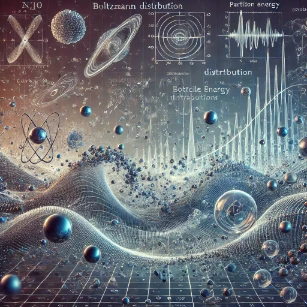
An illustration of Statistical Thermodynamics, depicting molecular motion, energy distributions, and particle interactions, with thermodynamic concepts such as entropy and partition functions subtly integrated.
Thermodynamics Learning Pathway
Thermodynamics – Overview
Master the foundational principles governing energy, work, heat, and equilibrium across physical systems.Classical Thermodynamics
Explore macroscopic state functions, pressure-volume behavior, and ideal/real gas relationships.Laws of Thermodynamics
Study the Zeroth, First, Second, and Third laws shaping energy conservation and directionality.Statistical Thermodynamics
Current page. Bridge microstates, partition functions, and quantum statistics with macroscopic observables.Engineering Thermodynamics
Apply thermal laws to power plants, refrigeration cycles, and real-world mechanical engines.Heat Transfer
Understand the core mechanisms of thermal energy movement: conduction, convection, and radiation.Thermodynamic Cycles
Analyze closed and open processes including Carnot, Rankine, Brayton, Otto, and Diesel cycles.Non-Equilibrium Thermodynamics
Analyze dynamic systems governed by gradients, fluxes, and entropy production.Phase Equilibria & Phase Transitions
Study Clausius-Clapeyron relations, triple points, latent heat, and phase stability.Chemical Thermodynamics
Examine reaction spontaneity, Gibbs free energy, and equilibrium constants in chemical systems.Thermodynamics of Materials
Explore phase diagrams, alloy solidification, defects, and thermal stability in material structures.Renewable & Sustainable Energy Thermodynamics
Apply exergy analysis to solar, wind, geothermal, and bioenergy system optimization.Computational Thermodynamics
Utilize CALPHAD methods and numerical simulations to model multi-component phase behavior.Principles of Statistical Thermodynamics
Microstates and Macrostates
- Microstates: The specific arrangements of particles and their associated energies in a system. Each unique configuration is a microstate.
- Macrostates: The overall state of a system defined by macroscopic properties like temperature, pressure, and volume. A macrostate corresponds to many microstates.
The Boltzmann Distribution
- kB: Boltzmann constant
- T: Absolute temperature
- Z: Partition function, normalizing the probability distribution
Partition Function
Entropy and Statistical Interpretation
Key Concepts in Statistical Thermodynamics
Ensembles
- Microcanonical Ensemble: Fixed energy, volume, and number of particles (E, V, N).
- Canonical Ensemble: Fixed temperature, volume, and number of particles (T, V, N).
- Grand Canonical Ensemble: Fixed temperature, volume, and chemical potential (T, V, μ).
Thermodynamic Potentials
- Internal Energy (U): Sum of all microscopic energy contributions.
- Helmholtz Free Energy (A):A = U − TS
- Gibbs Free Energy (G):G = H − TS
Fluctuations
Applications of Statistical Thermodynamics
Ideal Gases
- Pressure: Related to the momentum of particles.
- Temperature: A measure of the average kinetic energy of particles.
Heat Capacity
Phase Transitions
Chemical Reactions
Molecular Interactions
Mathematical Framework of Statistical Thermodynamics
Deriving Thermodynamic Quantities from Z
- Internal Energy (U):U = − ∂ ln Z / ∂ βWhere β = 1 / (kBT)
- Entropy (S):S = kB (ln Z + βU)
- Pressure (P):P = kBT (∂ ln Z / ∂ V)
- Helmholtz Free Energy (A):A = −kBT ln Z
Examples in Statistical Thermodynamics
Blackbody Radiation
Bose-Einstein and Fermi-Dirac Statistics
- Bosons: Particles that obey Bose-Einstein statistics (e.g., photons, helium-4).
- Fermions: Particles that obey Fermi-Dirac statistics (e.g., electrons, protons).
Distribution Functions
- Maxwell-Boltzmann Distribution: Classical particles.
- Fermi-Dirac Distribution: Quantum particles obeying the Pauli exclusion principle.
- Bose-Einstein Distribution: Particles that can occupy the same quantum state.
Challenges in Statistical Thermodynamics
- Complexity of Many-Body Systems: Accurate calculations for systems with strong interactions remain computationally intensive.
- Quantum Effects: Quantum systems introduce additional complexity, particularly at low temperatures.
- Non-Equilibrium Systems: Extending statistical thermodynamics to systems far from equilibrium remains an active area of research.
Importance and Future Directions of Statistical Thermodynamics
Advanced Materials and Statistical Thermodynamics

An illustration of advanced materials and statistical thermodynamics, depicting atomic structures of semiconductors, superconductors, and nanomaterials with energy flow and quantum effects.
Biophysics and Statistical Thermodynamics
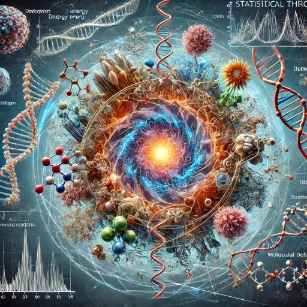
An illustration of biophysics and statistical thermodynamics, depicting molecular interactions such as protein folding, DNA hybridization, and molecular motors with dynamic energy landscapes.
Climate Science and Statistical Thermodynamics

An illustration of climate science and statistical thermodynamics, depicting atmospheric energy transfer, cloud formation, and greenhouse gas absorption.
Why Study Statistical Thermodynamics
Bridging Microscopic Mechanics and Macroscopic Laws
Partition Functions and State Probabilities
Quantum Statistics and Particle Behavior
Link to Molecular Simulation and Data Science
Interdisciplinary Relevance
Statistical Thermodynamics: Conclusion
Frequently Asked Questions: Statistical Thermodynamics
1. What is statistical thermodynamics?
Statistical thermodynamics is the branch of physics that uses the tools of probability and statistical mechanics to derive thermodynamic quantities such as internal energy, entropy, and free energy from the microscopic properties of atoms and molecules.
2. How does statistical thermodynamics connect microscopic and macroscopic properties?
Statistical thermodynamics links microscopic properties (such as energy levels, molecular speeds, and configurations) to macroscopic observables (such as pressure, temperature, and heat capacity) by averaging over huge numbers of possible microstates using probability distributions and partition functions.
3. What is a microstate and a macrostate in statistical thermodynamics?
A microstate is a specific detailed configuration of the system, specifying positions and momenta or quantum states of all particles. A macrostate is described by bulk variables like temperature, pressure, and volume. Many microstates can correspond to the same macrostate, and statistical thermodynamics counts and weighs these microstates.
4. What is the partition function and why is it central in statistical thermodynamics?
The partition function is a key mathematical quantity obtained by summing (or integrating) over all microstates, with each state weighted by its Boltzmann factor. Once the partition function is known, thermodynamic quantities such as internal energy, entropy, Helmholtz free energy, and heat capacity can be derived systematically.
5. What is the Boltzmann factor and what does it represent?
The Boltzmann factor is an exponential weighting term that depends on the energy of a microstate and the temperature of the system. It tells us how likely a state of a given energy is to be occupied in thermal equilibrium: lower energy states are more probable, but higher energy states still occur with a probability that decreases with energy.
6. How is entropy defined in statistical thermodynamics?
In statistical thermodynamics, entropy is linked to the number of accessible microstates. It can be expressed in terms of the probability distribution over microstates, showing that entropy measures the spread or disorder of those probabilities and connects directly to the Second Law of Thermodynamics.
7. What are the main statistical ensembles used in statistical thermodynamics?
Common ensembles include the microcanonical ensemble (fixed energy, volume, and number of particles), the canonical ensemble (fixed temperature, volume, and number of particles), and the grand canonical ensemble (fixed temperature, volume, and chemical potential). Each ensemble provides a different way of describing how microstates are sampled.
8. How does statistical thermodynamics explain temperature?
Statistical thermodynamics interprets temperature as a parameter controlling how energy is distributed among microstates. At higher temperatures, higher energy states become more strongly populated. Temperature emerges from the relationship between energy, entropy, and the number of accessible microstates.
9. How does statistical thermodynamics describe phase transitions?
Phase transitions, such as melting or boiling, arise when the statistical behaviour of microstates changes abruptly as parameters like temperature or pressure are varied. Statistical thermodynamics can show how collective behaviour, fluctuations, and changes in the partition function lead to jumps or singularities in macroscopic quantities.
10. What is the role of quantum mechanics in statistical thermodynamics?
Quantum mechanics determines the allowed energy levels and states for atoms, molecules, and solids. Statistical thermodynamics uses these quantum energy levels as the microstates over which probabilities are assigned, making it possible to calculate heat capacities, spectra, and other properties of real materials.
11. How is statistical thermodynamics applied in chemistry and materials science?
In chemistry and materials science, statistical thermodynamics is used to predict equilibrium constants, reaction spontaneity, heat capacities, phase diagrams, and the thermodynamic behaviour of gases, liquids, solids, and solutions based on molecular structure and intermolecular interactions.
12. Why is it useful for students to study statistical thermodynamics before university?
Studying statistical thermodynamics helps students see how macroscopic laws emerge from microscopic physics and probability. It builds intuition about entropy, temperature, and fluctuations, and prepares them for advanced courses in thermodynamics, physical chemistry, condensed matter physics, and many areas of engineering.
Statistical Thermodynamics: Review Questions and Answers
- What is statistical thermodynamics?Answer: Statistical thermodynamics uses probability theory to link the microscopic behavior of individual particles with macroscopic thermodynamic properties, explaining how collective behavior emerges from molecular interactions.
- How are microstates and macrostates defined?Answer: Microstates refer to the specific configurations of particles in a system, while macrostates describe the overall, observable properties such as temperature and pressure that result from averaging over many microstates.
- What is the Boltzmann formula and what does it represent?Answer: The Boltzmann formula, S = kB ln Ω, relates the entropy of a system to the number of microstates Ω accessible to it, with kB being the Boltzmann constant. It quantifies disorder and randomness.
- What role does the partition function play in statistical thermodynamics?Answer: The partition function Z sums the Boltzmann factors of all possible states, serving as a central quantity that enables the calculation of thermodynamic properties like free energy, entropy, and internal energy.
- How is entropy interpreted in statistical thermodynamics?Answer: Entropy is interpreted as a measure of the number of ways a system can be arranged through its microstates. Higher entropy indicates greater disorder and a higher probability of the system being in that state.
- What is the significance of Gibbs free energy in statistical thermodynamics?Answer: Gibbs free energy, defined as G = H − TS, determines the spontaneity of processes at constant temperature and pressure. It links microscopic interactions with macroscopic thermodynamic behavior.
- How do probability distributions influence thermodynamic predictions?Answer: Probability distributions, such as the Boltzmann distribution, describe the likelihood of a system occupying various energy states. These distributions allow predictions of average properties and fluctuations in the system.
- What is the connection between microscopic interactions and macroscopic observables in statistical thermodynamics?Answer: Microscopic interactions between particles determine the system’s energy levels and configurations. When these are statistically averaged, they give rise to macroscopic observables such as temperature, pressure, and entropy.
- How is the concept of equilibrium described in statistical thermodynamics?Answer: Equilibrium is achieved when the probability distribution of microstates remains constant over time, corresponding to maximum entropy for an isolated system and resulting in stable macroscopic properties.
- Why is statistical thermodynamics important for understanding complex systems?Answer: Statistical thermodynamics provides a framework for predicting the behavior of complex systems by connecting microscopic dynamics to macroscopic properties. This is essential in fields ranging from material science to biology and engineering.
Statistical Thermodynamics: Thought-Provoking Questions and Answers
- How might advances in statistical thermodynamics contribute to the development of new materials?Answer: A deeper understanding of microstate distributions and phase transitions can lead to the design of materials with tailored thermal and mechanical properties. This knowledge allows engineers to predict material behavior under various conditions, leading to innovations in high-performance and smart materials.
- What implications does the probabilistic nature of statistical thermodynamics have for our understanding of determinism in physical systems?Answer: The probabilistic approach challenges classical determinism by showing that macroscopic properties arise from random microscopic behavior. This shift in perspective invites new philosophical insights into causality and the inherent uncertainty in natural processes.
- In what ways can computational methods enhance the predictive power of statistical thermodynamics?Answer: Advanced simulations and numerical algorithms enable the modeling of complex systems, allowing for precise predictions of thermodynamic properties and phase behavior. These methods can handle large numbers of particles and intricate interactions, significantly improving our ability to design efficient processes.
- How does the concept of entropy extend beyond physical systems to other fields such as information theory or economics?Answer: Entropy quantifies disorder or uncertainty, which is a universal concept. In information theory, it measures data uncertainty, while in economics it can describe market randomness. This cross-disciplinary applicability underscores the fundamental nature of entropy.
- What are the potential benefits of integrating experimental data with statistical thermodynamics models?Answer: Integrating experimental data improves model accuracy and validation, leading to better predictions and optimized processes. This approach can accelerate the development of new technologies by bridging theory and practice, enhancing industrial and scientific outcomes.
- How might the study of fluctuations in statistical thermodynamics lead to innovations in sensor technology?Answer: By analyzing fluctuations at the microscopic level, researchers can design sensors that detect minute changes in temperature, pressure, or chemical composition. Such sensors could achieve unprecedented sensitivity, benefiting applications in environmental monitoring and medical diagnostics.
- What challenges do non-equilibrium systems pose to traditional statistical thermodynamics, and how can these challenges be addressed?Answer: Non-equilibrium systems exhibit time-dependent behavior and fluctuations that are difficult to model with equilibrium assumptions. Advanced mathematical techniques, such as non-equilibrium statistical mechanics and computational simulations, are needed to accurately describe these systems.
- How can the study of phase transitions in statistical thermodynamics inform our understanding of critical phenomena?Answer: Phase transitions involve abrupt changes in macroscopic properties and are characterized by critical exponents and scaling laws. Understanding these transitions provides insights into the universal behavior of systems near critical points, applicable to both physical and social phenomena.
- In what ways could advancements in statistical thermodynamics impact renewable energy technologies?Answer: Improved understanding of energy distributions and phase behavior can lead to optimized energy conversion processes in renewable systems, such as more efficient solar cells and batteries. This can enhance energy efficiency and reduce environmental impact, contributing to sustainable development.
- How does the concept of the partition function unify different thermodynamic properties in a system?Answer: The partition function serves as a generating function for thermodynamic quantities. By differentiating its logarithm with respect to temperature or other variables, one can derive properties such as internal energy, entropy, and free energy, unifying the description of a system’s behavior.
- What are the limitations of current statistical thermodynamics models in predicting the behavior of complex biological systems?Answer: Biological systems often involve non-equilibrium processes, multi-scale interactions, and heterogeneous components that are challenging to model accurately with traditional approaches. Advancements in computational power and interdisciplinary research are needed to refine these models for better predictions.
- How might the principles of statistical thermodynamics evolve with the advent of quantum computing?Answer: Quantum computing could revolutionize statistical thermodynamics by enabling the simulation of vast numbers of microstates and complex interactions that are currently computationally intractable. This would lead to more accurate models, deeper insights into phase transitions, and enhanced design of materials and processes.
Statistical Thermodynamics: Numerical Problems and Solutions
- A system has 3 particles, each with 2 accessible energy states. Calculate the total number of microstates.Solution:
- Use Ω = 23.
- Calculate: Ω = 8.
Answer: 8 microstates - If a system has Ω = 5.0 × 10⁶ microstates, calculate entropy using S = kB ln Ω, where kB = 1.38 × 10⁻²³ J/K.Solution:
- Use S = kB ln Ω.
- Substitute: S = (1.38 × 10⁻²³) × ln(5.0 × 10⁶).
- Calculate: ln(5.0 × 10⁶) ≈ 15.43.
- Evaluate: S ≈ 2.13 × 10⁻²² J/K.
Answer: 2.13 × 10⁻²² J/K - A two-level system has energies 0 and 1 eV. Calculate the partition function at T = 300 K, where kBT ≈ 0.02585 eV.Solution:
- Use Z = 1 + e−1 / 0.02585.
- Calculate: Z ≈ 1 + e−38.7.
- Since e−38.7 is extremely small, Z ≈ 1.
Answer: Z ≈ 1 - Calculate the probability of the excited state in Problem 3.Solution:
- Use P = e−1 / 0.02585 / Z.
- Since Z ≈ 1, P ≈ e−38.7.
- Calculate: P ≈ 1.6 × 10⁻¹⁷.
Answer: 1.6 × 10⁻¹⁷ - For a system with partition function Z = 20 at 300 K, calculate Helmholtz free energy using F = −kBT ln Z.Solution:
- Use F = −kBT ln Z.
- Substitute: F = −(1.38 × 10−23) × 300 × ln(20).
- Calculate: ln(20) ≈ 3.00.
- Evaluate: F ≈ −1.24 × 10⁻²⁰ J.
Answer: −1.24 × 10⁻²⁰ J - A system has energy levels 0 and 2 eV. Calculate average energy at T = 300 K.Solution:
- Calculate the partition function: Z = 1 + e−2 / 0.02585 ≈ 1.
- The excited state contribution is negligible at this temperature.
- Therefore, ⟨E⟩ ≈ 0 eV.
Answer: ⟨E⟩ ≈ 0 eV - At what temperature would the excited state probability become significant, around 0.1?Solution:
- The excited state probability becomes significant when kBT is comparable to the energy gap.
- For an energy gap of about 1 eV, use T ≈ 1 eV / (8.617 × 10⁻⁵ eV/K).
- Calculate: T ≈ 11600 K.
Answer: Approximately 11600 K - A system has 4 particles distributed among 2 energy levels with equal probability. Calculate entropy.Solution:
- Find the number of microstates: Ω = 24 = 16.
- Use S = kB ln 16.
- Substitute: S = (1.38 × 10−23) × 2.773.
- Calculate: S ≈ 3.83 × 10⁻²³ J/K.
Answer: 3.83 × 10⁻²³ J/K - Calculate the Boltzmann factor for energy 0.5 eV at 300 K.Solution:
- Use the Boltzmann factor: e−E / (kBT).
- Substitute: e−0.5 / 0.02585.
- Calculate: e−19.34 ≈ 4.0 × 10⁻⁹.
Answer: 4.0 × 10⁻⁹ - A system has Z = 5 and average energy ⟨E⟩ = 2.0 × 10⁻²¹ J. Estimate entropy using S ≈ (⟨E⟩ − F) / T.Solution:
- First calculate Helmholtz free energy: F = −kBT ln Z.
- Use ln 5 ≈ 1.609.
- Calculate: F ≈ −(1.38 × 10−23 × 300 × 1.609) ≈ −6.66 × 10⁻²¹ J.
- Use S ≈ (⟨E⟩ − F) / T.
- Substitute: S ≈ (2.0 × 10⁻²¹ − (−6.66 × 10⁻²¹)) / 300.
- Calculate: S ≈ 2.89 × 10⁻²³ J/K.
Answer: 2.89 × 10⁻²³ J/K - A system doubles its number of microstates. How does entropy change?Solution:
- Use ΔS = kB ln 2.
- Substitute: ΔS = (1.38 × 10−23) × 0.693.
- Calculate: ΔS ≈ 9.57 × 10⁻²⁴ J/K.
Answer: Entropy increases by 9.57 × 10⁻²⁴ J/K. - If temperature increases, explain qualitatively how population distribution changes.Solution:
- As temperature increases, particles have more thermal energy available.
- Higher energy states therefore become more populated.
Answer: Higher energy states become more populated as thermal energy increases.