Prepare for University Studies & Career Advancement
Relativity
Relativity is one of the great turning points in physics. It changed the way we understand space, time, motion, energy, and gravity. Before relativity, students could imagine space and time as fixed backgrounds: space was the stage, time was the clock, and objects moved through both according to Newton’s laws. Einstein’s theories showed that this picture is only an approximation. When speeds become very high, or when gravity becomes very strong, space and time no longer behave like separate and unchanging containers. They become part of the physical story itself.
This page serves as the main Relativity hub within modern physics. It introduces the central ideas of relativity and then guides students toward two deeper branches: Special Relativity and General Relativity. Special Relativity explains what happens when observers move at constant velocity, especially when speeds approach the speed of light. It leads to ideas such as time dilation, length contraction, relativity of simultaneity, relativistic momentum, and the famous mass-energy relation E = mc2. General Relativity extends the picture to gravity, showing that gravity can be understood not simply as a force pulling across space, but as the curvature of spacetime itself.
Relativity is important because it reveals that common sense is not always a reliable guide to nature. At everyday speeds, Newtonian mechanics works extremely well, and it remains essential for engineering, transport, machines, buildings, and ordinary motion. But near the speed of light, time measured by one observer may not match time measured by another. Distances may change depending on the observer’s motion. Energy and mass become deeply connected. In strong gravitational fields, clocks can run at different rates, light can bend, and the path of motion is shaped by the geometry of spacetime.
Although relativity is often associated with stars, galaxies, and black holes, this page focuses mainly on the underlying physical principles. Detailed astronomical applications are better explored through Astrophysics, including topics such as Black Holes and Dark Matter and Cosmology. Here, the emphasis is on the ideas that make those applications possible: the constancy of light speed, the flexibility of time and space, the connection between mass and energy, and the interpretation of gravity as spacetime curvature.
Relativity also connects naturally with other areas of modern physics. In Nuclear Physics, the relation between mass and energy helps explain why nuclear fission and nuclear fusion can release enormous amounts of energy. In Particle Physics, relativity is needed to describe particles moving close to light speed, including fermions, bosons, and the behaviour of matter in high-energy collisions. In Atomic Physics, relativistic corrections become important for heavy atoms and precise measurements.
Relativity also stands beside Quantum Mechanics as one of the two great revolutions that reshaped twentieth-century physics. Quantum mechanics challenges the idea that particles always have definite classical properties, as seen in topics such as Heisenberg’s Uncertainty Principle, Quantum Superposition, and Quantum Entanglement. Relativity challenges the idea that space and time are absolute. The effort to bring these two frameworks together leads naturally toward Quantum Field Theory, where particles, fields, energy, and spacetime are treated in a deeper mathematical language.
For students preparing for university-level science, engineering, or technology studies, relativity is valuable for two reasons. First, it gives practical tools for understanding high-speed particles, nuclear energy, precision timing, satellite navigation, and modern measurement systems. Second, it teaches a deeper intellectual lesson: nature is not required to obey the habits of human intuition. Space, time, and gravity are not merely background ideas. They are active parts of physical reality.
This hub page therefore introduces the big picture. Students who want to understand motion, light, time dilation, length contraction, and mass-energy equivalence should continue to the Special Relativity section. Students who want to understand gravity, spacetime curvature, gravitational time dilation, light bending, and the geometric meaning of gravity should continue to the General Relativity section. Together, these two branches show why relativity remains one of the most profound and useful ideas in modern science.
Key Idea
Relativity shows that space and time are not fixed backgrounds. Special Relativity explains motion near light speed, while General Relativity explains gravity as curved spacetime.
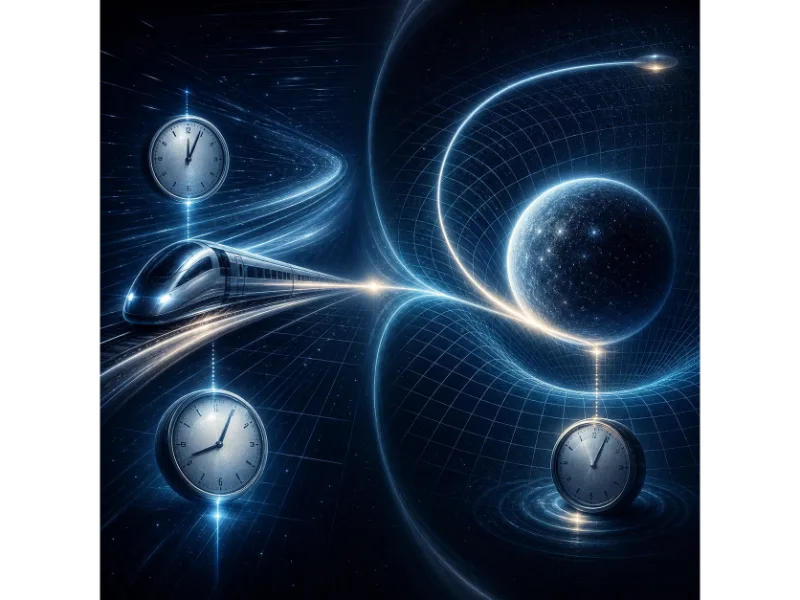
Relativity, showing Special Relativity through high-speed motion and time dilation, and General Relativity through spacetime curvature and light bending.
A conceptual illustration of Relativity as a bridge between Special Relativity and General Relativity. On the left, a high-speed train, light beam, and clocks represent motion-based time dilation and the constant speed of light. On the right, a massive spherical body curves a spacetime grid while a light path bends around it, representing gravity as spacetime curvature. The combined image shows how relativity reshaped the scientific understanding of time, space, motion, energy, and gravity.
Special Relativity Within the Modern Physics Framework
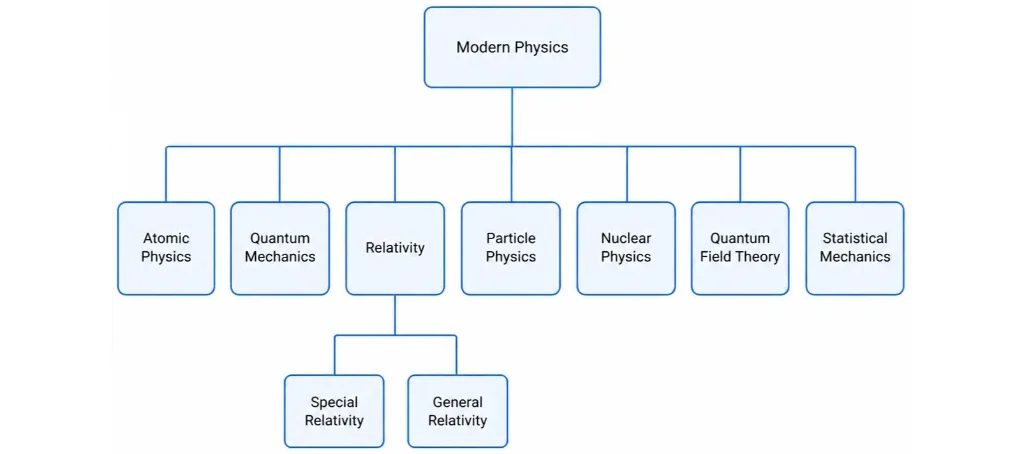
This navigation section places Relativity within the wider Modern Physics cluster. Relativity appears as one major branch of Modern Physics, alongside Atomic Physics, Quantum Mechanics, Particle Physics, Nuclear Physics, Quantum Field Theory, and Statistical Mechanics. Within Relativity, Special Relativity and General Relativity form the two main terminal subpages.
Introduces the major twentieth- and twenty-first-century frameworks that extend classical physics, including quantum theory, relativity, nuclear physics, particle physics, and modern theories of matter and energy.
Uses relativistic and quantum ideas to understand elementary particles, high-energy collisions, matter particles, force carriers, and fundamental interactions.
Connects microscopic particle behaviour with macroscopic properties such as temperature, entropy, equilibrium, probability, and collective physical behaviour.
Structure chart showing the Modern Physics cluster, including Relativity as a hub with Special Relativity and General Relativity as its two subpages.
A simple hierarchical diagram showing the structure of the Modern Physics cluster. The top node is Modern Physics. Beneath it are Atomic Physics, Quantum Mechanics, Relativity, Particle Physics, Nuclear Physics, Quantum Field Theory, and Statistical Mechanics. The Relativity node branches further into two terminal subpages: Special Relativity and General Relativity.
What Relativity Really Means
In everyday language, the word “relative” often means that something depends on viewpoint or comparison. In physics, relativity has a more precise meaning. It asks how measurements of time, distance, motion, and energy depend on the observer. Two observers may describe the same physical event differently, yet both descriptions can be valid if they obey the same laws of physics.
This does not mean that “anything goes.” Relativity is not a theory of personal opinion. It is a highly structured scientific theory built on measurement, mathematics, and experiment. It tells us which quantities may change from one observer to another, and which quantities remain fixed. For example, time intervals and lengths may differ between observers moving relative to one another, but the speed of light in vacuum remains the same for all inertial observers.
The central lesson is subtle but powerful: space and time are not independent containers. They are linked into a single structure called spacetime. Motion affects how time and distance are measured. Gravity affects the geometry of spacetime itself. Once students understand this shift, many strange ideas in modern physics begin to feel less like isolated facts and more like parts of one deeper pattern.
Pause and Think
If two observers measure time and distance differently, why does relativity still count as a precise scientific theory rather than a matter of personal opinion?
Why Classical Physics Needed Revision
Newtonian mechanics is one of the greatest achievements in science. It explains the motion of falling objects, projectiles, machines, planets, vehicles, and countless engineering systems. For everyday speeds and ordinary gravitational fields, it remains extremely accurate. However, by the late nineteenth and early twentieth centuries, physicists began to see that classical ideas could not explain everything.
One problem involved light. According to classical intuition, if a person runs toward a beam of light, the light should appear to approach faster. If the person runs away, the light should appear slower. But experiments showed that the speed of light in vacuum behaves differently from ordinary objects. It has the same value for all inertial observers, regardless of their relative motion.
Another problem involved gravity. Newton’s law describes gravitational attraction very successfully, but it treats gravity as a force acting across space. Einstein’s General Relativity gave a deeper interpretation: massive objects shape spacetime, and objects move by following the geometry of that curved spacetime. This new picture explained not only ordinary gravitational motion, but also subtle effects such as gravitational time dilation and the bending of light.
Big Question
If Newtonian physics works so well for everyday motion, why did physicists still need a new theory of space, time, light, and gravity?
The Two Main Branches of Relativity
Special Relativity: Motion, Light, Time, and Energy
Special Relativity deals with observers moving at constant velocity relative to one another. It is called “special” because it focuses on inertial frames, where no acceleration or gravitational field is being considered directly. Its two central ideas are that the laws of physics are the same in all inertial frames, and that the speed of light in vacuum is constant for all inertial observers.
From these two ideas come some of the most famous results in modern physics: time dilation, length contraction, relativity of simultaneity, relativistic momentum, and mass-energy equivalence. These effects are usually tiny at everyday speeds, but they become essential when particles move close to the speed of light. That is why Special Relativity is important in Particle Physics, accelerator experiments, nuclear processes, and high-precision timing systems.
General Relativity: Gravity, Geometry, and Spacetime
General Relativity extends relativity to include acceleration and gravity. Its central idea is that gravity is not merely a force in the Newtonian sense. Instead, mass and energy shape the geometry of spacetime, and objects move along paths determined by that geometry.
This theory explains why clocks run differently in different gravitational fields, why light bends near massive bodies, and why freely falling objects can be understood as following natural paths through curved spacetime. These ideas support many topics in Astrophysics, but on this page they are introduced mainly as physical principles rather than as detailed studies of stars, galaxies, or black holes.
Quick Check: Special or General Relativity?
Special Relativity and General Relativity are connected, but they answer different kinds of questions. Try each item before revealing the answer.
1. Which branch focuses mainly on observers moving at constant velocity?
A. Special RelativityB. General RelativityC. ThermodynamicsD. Quantum Chemistry
Answer: A. Special Relativity focuses on inertial frames, where observers move at constant velocity relative to one another.
2. Which branch explains gravity as curved spacetime?
A. Special RelativityB. General RelativityC. Classical OpticsD. Atomic Theory
Answer: B. General Relativity extends relativity to gravity by describing mass and energy as shaping the geometry of spacetime.
3. Time dilation, length contraction, and mass-energy equivalence mainly belong to which branch?
A. Special RelativityB. General Relativity onlyC. Fluid MechanicsD. Organic Chemistry
Answer: A. These are core results of Special Relativity, especially when objects move close to the speed of light.
4. Gravitational time dilation, light bending, and geodesics mainly belong to which branch?
A. Special Relativity onlyB. General RelativityC. Classical ElectricityD. Chemical Kinetics
Answer: B. These ideas belong mainly to General Relativity, where gravity is understood through curved spacetime.
Key takeaway: Special Relativity explains high-speed motion in flat spacetime, while General Relativity explains gravity through curved spacetime.
Key Differences Between Special and General Relativity
Aspect
Special Relativity
General Relativity
Main focus
Motion at constant velocity, especially near light speed
Gravity, acceleration, and curved spacetime
Core setting
Inertial frames
Accelerating frames and gravitational fields
Main ideas
Time dilation, length contraction, simultaneity, E = mc2
Equivalence principle, spacetime curvature, geodesics, gravitational time dilation
Typical examples
Fast particles, particle accelerators, moving clocks, nuclear energy
How do space and time change when motion becomes extremely fast?
How does gravity arise from the shape of spacetime?
Important Ideas Students Should Understand First
Students do not need advanced university mathematics before meeting the basic ideas of relativity, but several foundations are helpful. First, they should understand reference frames. A reference frame is a viewpoint or coordinate system from which motion is measured. A person standing on a platform and a person riding in a train may describe the same event differently because they are using different frames.
Second, students should be comfortable with speed, velocity, and acceleration from classical mechanics. Relativity does not destroy Newtonian mechanics; it shows where Newtonian mechanics is an approximation. At low speeds compared with the speed of light, relativistic formulas reduce very closely to classical results.
Third, students should understand that light is not just another moving object. The speed of light in vacuum, usually written as c, is a universal constant. Its value is approximately 3.00 × 10⁸ m/s. This constant links space, time, energy, and mass in a way that has no ordinary everyday parallel.
Quick Check: Are You Ready for Relativity?
Before studying Special and General Relativity, students should be clear about reference frames, speed, acceleration, and the special role of light.
1. What is a reference frame?
A. A type of forceB. A viewpoint or coordinate system used to describe motionC. A source of lightD. A unit of energy
Answer: B. A reference frame is the viewpoint or coordinate system from which motion is measured. Different observers may describe the same event differently because they use different frames.
2. Why does Newtonian mechanics still work well in everyday life?
A. Everyday speeds are usually much smaller than the speed of lightB. Relativity is only imaginaryC. Light has no role in physicsD. Time is always measured the same way by all observers
Answer: A. At speeds much smaller than c, relativistic effects are extremely small, so Newtonian mechanics remains an excellent approximation.
3. What makes the speed of light special in relativity?
A. It changes depending on the observer’s speedB. It is only important in astronomyC. It is a universal constant that links space, time, energy, and massD. It is slower than ordinary sound waves
Answer: C. The speed of light in vacuum, c, is a universal constant. It plays a central role in connecting space, time, energy, and mass in relativity.
Key takeaway: Relativity becomes easier to understand when students first grasp reference frames, classical motion, and the special role of the speed of light.
Why Study Relativity?
Relativity is worth studying because it changes the way students think about reality itself. In everyday life, time seems to pass at the same rate for everyone, distances seem fixed, and gravity feels like a simple pull. Relativity shows that these familiar ideas are only approximations. At high speeds and in strong gravitational fields, space, time, motion, energy, and gravity behave in deeper and more surprising ways.
It Reveals That Space and Time Are Connected
Before relativity, space and time were often treated as separate backgrounds. Space was where events happened, and time was the clock that measured when they happened. Relativity joins them into spacetime, a single physical structure. This helps students move beyond everyday intuition and begin thinking in the language of modern physics.
It Explains High-Speed Particles and Modern Experiments
Many particles studied in Particle Physics move at speeds close to the speed of light. At these speeds, Newtonian formulas are no longer enough. Relativity explains why particle lifetimes, momentum, and energy must be calculated differently in accelerators, detectors, and high-energy experiments.
It Connects Mass and Energy
The relation E = mc2 shows that mass and energy are not completely separate quantities. This idea helps explain why nuclear reactions can release large amounts of energy from very small changes in mass. It provides an essential foundation for understanding Nuclear Fission, Nuclear Fusion, and many processes in high-energy physics.
It Supports Precision Technologies
Relativity is not only a theory for distant galaxies or extreme situations. It is also part of modern technology. Satellite navigation, precision clocks, high-speed electronics, particle accelerators, and advanced measurement systems all rely on timing and energy calculations that may require relativistic corrections.
It Prepares Students for Deeper Physics
Relativity prepares students for advanced study in Quantum Field Theory, Atomic Physics, Nuclear Physics, and Astrophysics. It teaches students that nature is often more subtle than common sense suggests, and that mathematics can reveal patterns hidden from ordinary experience.
Relativity in Simple Mathematical Form
Relativity is not only a set of dramatic ideas. It is also a quantitative theory. Even a few simple equations can show why its predictions are so different from ordinary intuition.
The Lorentz Factor
In Special Relativity, many effects depend on the Lorentz factor:
γ = 1 / √[ 1 − (v2 / c2) ]
Here, v is the relative speed between observers, and c is the speed of light. When v is much smaller than c, γ is almost equal to 1, so relativistic effects are very small. But as v approaches c, γ grows larger, and time dilation, length contraction, and relativistic energy become important.
Mass-Energy Equivalence
The famous relation:
E = mc2
shows that mass and energy are deeply connected. Because c2 is an enormous number, even a small amount of mass corresponds to a very large amount of energy. This idea is central to understanding energy release in Nuclear Fission, Nuclear Fusion, and particle interactions.
Worked Examples in Relativity
The following worked examples show how relativity moves from abstract ideas into calculation and interpretation. They include examples from Special Relativity, mass-energy equivalence, and General Relativity, giving students a practical bridge between concepts and applications.
Worked Example 1: Time Dilation at High Speed
Suppose a spacecraft moves at 0.80c relative to Earth. A clock inside the spacecraft measures a time interval of 1.0 hour. How much time passes according to an observer on Earth?
So, when 1.0 hour passes on the spacecraft clock, about 1.67 hours pass according to the Earth observer. This does not mean the spacecraft clock is broken. It means that time itself is measured differently by observers in relative motion.
Worked Example 2: Length Contraction at High Speed
Suppose a spacecraft has a proper length of 100 m, measured by an observer at rest with the spacecraft. If the spacecraft moves past Earth at 0.80c, what length does an Earth observer measure along the direction of motion?
The length contraction formula is:
L = L0 / γ
From the previous example, for v = 0.80c, the Lorentz factor is γ = 1.67.
Therefore:
L = 100 m / 1.67 ≈ 59.9 m
The Earth observer measures the spacecraft length as about 60 m along its direction of motion. The spacecraft has not physically “shrunk” in its own rest frame. Instead, length is measured differently by observers in relative motion.
Worked Example 3: Mass-Energy Conversion
Suppose a nuclear process converts 1.0 × 10⁻⁶ kg of mass into energy. How much energy is released?
Using E = mc2 with m = 1.0 × 10⁻⁶ kg and c = 3.00 × 10⁸ m/s:
E = (1.0 × 10−6) × (3.00 × 108)2
E = (1.0 × 10−6) × (9.00 × 1016) = 9.00 × 10¹⁰ J
This is an enormous amount of energy from a very small amount of mass. The example shows why relativity is not only a theory about space and time. It also lies behind the energy scale of nuclear reactions and high-energy particle processes.
Worked Example 4: Gravitational Time Dilation for a Satellite Clock
In General Relativity, a clock farther from a massive body runs slightly faster than a clock closer to it. This matters for satellite navigation because satellites orbit high above Earth, where gravity is weaker than at the surface.
Suppose a navigation satellite orbits at an altitude of about 20,200 km above Earth’s surface. Estimate how much faster the satellite clock runs compared with a clock on Earth’s surface due to gravitational time dilation over one day.
For a weak gravitational field, the fractional difference in clock rate between Earth’s surface and a higher orbit may be approximated by:
Δt / t ≈ [ GM / c2 ] · [ (1 / RE) − (1 / r) ]
where:
GM = 3.986 × 10¹⁴ m3/s2 is Earth’s gravitational parameter.
c = 3.00 × 10⁸ m/s is the speed of light.
RE = 6.37 × 10⁶ m is Earth’s radius.
r = RE + h is the satellite’s distance from Earth’s centre.
The satellite altitude is h = 20,200 km = 2.02 × 10⁷ m.
So the orbital radius is r = 6.37 × 10⁶ + 2.02 × 107 = 2.657 × 10⁷ m.
Substitute into the gravitational time dilation approximation:
Δt = (5.3 × 10−10) × 86,400 s ≈ 4.6 × 10⁻⁵ s = 46 μs
So, due to General Relativity alone, the satellite clock runs about 46 μs faster per day than a similar clock on Earth’s surface.
However, the satellite is also moving rapidly relative to Earth. Special Relativity predicts that the moving satellite clock runs slightly slower. For GPS-like satellites, this effect is about 7 μs per day in the opposite direction.
The approximate net relativistic correction is therefore:
46 μs − 7 μs ≈ 39 μs
This means the satellite clock runs about 39 μs faster per day overall compared with a clock on Earth. Although this sounds tiny, navigation systems depend on extremely precise timing. Without relativistic corrections, satellite positioning errors would grow rapidly.
This example shows that relativity is not only about extreme science-fiction situations. It is part of real measurement technology, affecting how we measure time, position, speed, and distance in modern satellite systems.
Applications of Relativity in the Real World
Satellite Navigation and Precision Timing
Global navigation systems require accurate clocks. Because satellite clocks are affected by both motion and gravity, relativistic corrections are needed. Special Relativity accounts for the effect of satellite motion, while General Relativity accounts for the weaker gravitational field at satellite altitude. The result is a practical example of how abstract physics becomes engineering reality.
Nuclear Energy and Mass-Energy Equivalence
Relativity helps explain why nuclear reactions can release so much energy. In Nuclear Physics, the mass of the products of a reaction may be slightly different from the mass of the original particles or nuclei. The missing mass appears as released energy, following E = mc2.
Particle Accelerators and High-Speed Particles
In particle accelerators, particles can travel at speeds extremely close to the speed of light. At such speeds, classical formulas are no longer sufficient. Relativistic energy, momentum, and time dilation are necessary for predicting particle behaviour, interpreting collisions, and understanding experimental results.
Atomic Physics and Precision Measurement
In Atomic Physics, relativistic effects can influence the behaviour of electrons, especially in heavy atoms where inner electrons move at high speeds. These corrections help improve predictions about atomic structure, spectra, and the properties of materials.
Relativity and Astrophysics: Connected but Not Identical
Relativity and astrophysics are closely connected, but they are not the same subject. Relativity provides the theoretical language for understanding space, time, motion, energy, and gravity. Astrophysics uses that language to study stars, galaxies, black holes, dark matter, cosmic expansion, and the large-scale structure of the universe.
For this reason, the Relativity pages on Prep4Uni.online focus on the principles. They explain why time can dilate, why light speed is special, why mass and energy are connected, and why gravity can be interpreted geometrically. The Astrophysics cluster then develops the cosmic applications in more detail.
Relativity provides the physical principles of space, time, motion, energy, and gravity, while astrophysics applies those principles to stars, galaxies, black holes, cosmic expansion, and the structure of the universe.
Common Misconceptions About Relativity
Misconception 1: Relativity Means Everything Is Just a Matter of Opinion
Relativity does not mean that scientific truth is subjective. It means that some measurements depend on the observer’s frame of reference. The laws of physics remain consistent. Relativity is one of the most precise and experimentally supported frameworks in science.
Misconception 2: Relativity Only Matters Near Black Holes
Black holes are dramatic examples of strong gravity, but relativity is much broader. It matters in particle physics, nuclear energy, precision clocks, satellite navigation, atomic physics, and high-speed motion. The theory is useful not because it is exotic, but because it reveals how nature works when ordinary approximations are no longer enough.
Misconception 3: Time Dilation Is an Illusion
Time dilation is not a visual trick or psychological effect. It is a real physical difference in elapsed time between clocks following different paths through spacetime or experiencing different gravitational conditions. Experiments with particles and precision clocks support this result.
Misconception 4: E = mc2 Means Mass Can Simply Disappear
The equation E = mc2 does not mean that mass vanishes mysteriously. It means mass and energy are related forms of physical quantity. In nuclear and particle processes, changes in mass-energy balance appear as released or absorbed energy, always within the conservation laws of physics.
Quick Check: Spot the Misconception
Relativity often sounds strange at first, so misconceptions are common. Decide whether each statement is true or false before revealing the answer.
1. Relativity means that scientific truth is just a matter of personal opinion.
A. TrueB. False
Answer: B. False. Relativity does not make physics subjective. It gives precise rules for how different observers compare measurements of time, distance, motion, and energy.
2. Relativity is useful only for black holes and extreme astronomy.
A. TrueB. False
Answer: B. False. Relativity is also important in particle physics, nuclear energy, precision clocks, satellite navigation, atomic physics, and high-speed motion.
3. Time dilation is only a visual illusion caused by how something appears to an observer.
A. TrueB. False
Answer: B. False. Time dilation is a real physical effect. Clocks following different paths through spacetime or experiencing different gravitational conditions can record different elapsed times.
4. The equation E = mc2 means mass and energy are deeply related.
A. TrueB. False
Answer: A. True. The equation shows that mass and energy are connected within a larger conservation structure. It does not mean mass simply disappears mysteriously.
Key takeaway: Relativity is strange only because it challenges everyday intuition. It remains precise, testable, and deeply useful across modern physics.
Frequently Asked Questions About Relativity
What is relativity in simple terms?
Relativity is the study of how measurements of space, time, motion, energy, and gravity depend on the observer. It shows that time and distance are not always absolute, especially when objects move close to the speed of light or experience strong gravitational fields.
What is the difference between Special Relativity and General Relativity?
Special Relativity deals with observers moving at constant velocity, especially at speeds close to the speed of light. General Relativity extends the theory to acceleration and gravity, explaining gravity as the curvature of spacetime caused by mass and energy.
Why is the speed of light so important in relativity?
The speed of light in vacuum is important because it is the same for all inertial observers. This constant value forces measurements of time, length, and simultaneity to change between observers moving relative to one another.
Does relativity mean everything is subjective?
No. Relativity does not mean that science becomes a matter of opinion. It means that some measurements depend on the observer’s frame of reference, while the laws of physics remain consistent and precise.
What is time dilation?
Time dilation is the effect in which a clock is measured to run differently because of relative motion or gravity. In Special Relativity, fast-moving clocks are measured differently from stationary clocks. In General Relativity, clocks in stronger gravitational fields run differently from clocks in weaker gravitational fields.
What is length contraction?
Length contraction is the effect in which an object moving at very high speed is measured to be shorter along its direction of motion by an observer who sees it moving. The object has its normal length in its own rest frame.
Why is E = mc2 important?
The equation E = mc2 shows that mass and energy are connected. A small amount of mass corresponds to a very large amount of energy because the speed of light squared is enormous. This idea is important in nuclear physics, particle physics, and high-energy processes.
How is relativity used in real life?
Relativity is used in satellite navigation, precision timing, particle accelerators, nuclear energy calculations, atomic physics, and high-speed particle experiments. It is not only a theory for extreme cosmic situations; it also supports practical measurement technologies.
Is relativity only about black holes and space?
No. Black holes and cosmology are important applications of relativity, but relativity itself is broader. It explains the behaviour of space, time, motion, energy, light, and gravity, and it also appears in nuclear physics, particle physics, atomic physics, and modern technology.
Where should I study next after this Relativity page?
Students should continue with Special Relativity to understand high-speed motion and light speed, then move to General Relativity to understand gravity as spacetime curvature.
Review Questions
1. What does relativity mean in physics?
Relativity means that measurements such as time, distance, motion, and energy can depend on the observer’s frame of reference. However, this does not mean that physics becomes subjective. The laws of physics remain consistent, but different observers may measure certain quantities differently when they are moving relative to one another or are in different gravitational conditions.
2. Why did classical physics need revision at very high speeds?
Classical physics works very well at everyday speeds, but it assumes that time and space are absolute. Experiments involving light showed that the speed of light in vacuum remains the same for all inertial observers, even when they are moving relative to the source of light. This result could not be explained properly using ordinary Newtonian ideas, so a new framework was needed.
3. What is the difference between Special Relativity and General Relativity?
Special Relativity deals mainly with observers moving at constant velocity, especially at speeds close to the speed of light. It explains time dilation, length contraction, simultaneity, and mass-energy equivalence. General Relativity extends relativity to acceleration and gravity. It explains gravity as the curvature of spacetime caused by mass and energy.
4. Why is the speed of light central to Special Relativity?
The speed of light in vacuum, written as c, is central because it has the same value for all inertial observers. This constant speed forces space and time to adjust between observers in relative motion. As a result, measurements of time, length, and simultaneity can differ between observers, while the speed of light remains unchanged.
5. What is time dilation?
Time dilation is the effect in which a moving clock, or a clock in a stronger gravitational field, is measured to run differently compared with another clock. In Special Relativity, time dilation occurs because of relative motion. In General Relativity, it occurs because of differences in gravitational field strength.
6. What is length contraction?
Length contraction is the effect in which an object moving at very high speed is measured to be shorter along its direction of motion by an observer who sees it moving. The object does not shrink in its own rest frame. The measured length depends on the relative motion between the object and the observer.
7. What does the Lorentz factor measure?
The Lorentz factor, written as γ, measures how strongly relativistic effects appear at a given speed. When the speed v is much smaller than the speed of light c, γ is close to 1, so relativistic effects are small. As v approaches c, γ increases, making time dilation, length contraction, and relativistic energy more significant.
8. Why is E = mc2 important in nuclear physics?
The equation E = mc2 shows that mass and energy are deeply connected. In nuclear reactions, a small difference in mass between the starting particles and the final products can appear as a large amount of released energy. This helps explain the energy released in nuclear fission, nuclear fusion, radioactive decay, and particle interactions.
9. How does General Relativity reinterpret gravity?
General Relativity reinterprets gravity not simply as a force pulling objects across space, but as the curvature of spacetime caused by mass and energy. Objects moving under gravity follow natural paths through this curved spacetime. This explains gravitational time dilation, the bending of light, orbital motion, and other effects that go beyond Newtonian gravity.
10. Why does relativity matter in satellite navigation?
Satellite navigation depends on extremely accurate timing. Satellite clocks are affected by their high orbital speed and by the weaker gravitational field at their altitude. Special Relativity and General Relativity both produce timing corrections. Without these corrections, navigation calculations would gradually become inaccurate.
Reflective Questions
1. If two observers measure time differently, what does this suggest about the nature of time?
It suggests that time is not an absolute background flowing identically for everyone. Instead, time is part of the physical structure of spacetime and can depend on motion and gravity. This does not make time unreal. It means time is more deeply connected to physical conditions than everyday experience suggests.
2. Why might everyday intuition fail when speeds approach the speed of light?
Everyday intuition is built from slow-speed experience, where relativistic effects are too small to notice. Cars, trains, aircraft, and ordinary objects move at speeds far below the speed of light, so Newtonian ideas appear sufficient. Near light speed, however, time dilation, length contraction, and relativistic energy become large enough that ordinary intuition no longer gives reliable predictions.
3. How does the idea of spacetime change the way we think about gravity?
The idea of spacetime changes gravity from a simple pulling force into a geometric effect. In General Relativity, mass and energy shape spacetime, and objects move along paths determined by that shape. Gravity is therefore not only about attraction between masses; it is also about the structure through which motion takes place.
4. Why is it useful to keep Relativity and Astrophysics connected but distinct?
It is useful because relativity provides the physical principles, while astrophysics applies many of those principles to stars, galaxies, black holes, dark matter, and cosmology. Keeping them distinct helps students first understand the theory of space, time, motion, and gravity before applying it to large-scale astronomical systems.
5. How does relativity show that mathematics can reveal realities beyond ordinary experience?
Relativity shows that mathematical reasoning can uncover patterns that are not obvious from everyday life. People do not directly notice time dilation or length contraction in ordinary experience, but equations, experiments, and precise measurements reveal that these effects are real. This shows how mathematics can extend human understanding beyond common sense and direct perception.
Summary
Relativity reshaped physics by showing that space, time, motion, energy, and gravity are more deeply connected than classical physics had imagined. Special Relativity explains how measurements of time, length, and energy change when observers move at high speeds relative to one another. General Relativity extends this view to gravity, describing it as the curvature of spacetime rather than simply a force acting across distance.
For students, the enduring lesson is that nature is not limited by human habits of thought. Time is not always universal. Distance is not always absolute. Gravity is not merely a pull. Relativity invites us to see the physical universe not as a fixed stage, but as a dynamic structure where geometry, motion, matter, energy, and light belong to one connected story.
Study Next
Relativity is best studied in stages. Use the following pages to move from the core principles to deeper physical and cosmic applications.
Begin here if you want to understand light speed, inertial frames, time dilation, length contraction, simultaneity, relativistic momentum, and mass-energy equivalence.
Continue here if you want to understand gravity as spacetime curvature, the equivalence principle, gravitational time dilation, geodesics, and light bending.