Prepare for University Studies & Career Advancement
Cosmic Microwave Background (CMB)
The Cosmic Microwave Background, or CMB, represents the primary relic photon field of early-universe thermodynamics and stands as an irreplaceable empirical cornerstone in modern quantitative cosmology. It is formally modeled as the relic blackbody thermal afterglow of the early cosmos: a highly isotropic bath of ancient radiation that has propagated unimpeded across space since the primordial epoch when the universe first transitioned from an opaque plasma into a transparent neutral medium.
Approximately 380,000 years after the initial expansion coordinate (\(t = 0\)), the ambient background temperature dropped below the threshold required to sustain an ionized plasma state. This cooling enabled free electrons and light atomic nuclei to bind stably into neutral hydrogen and helium atoms. Prior to this specific structural transition, photons were tightly coupled to the baryonic matter fluid, unable to travel path lengths of significant distance because they were continuously scattered by high-density free electrons. Once neutral atoms formed, the background scattering cross-section plummeted, allowing photons to decouple from matter and stream freely across the expanding geometry. These ancient, un-scattered photons are what we record today across the celestial sphere as the Cosmic Microwave Background.
The structural properties of the CMB are bound directly to the foundational statements of the Big Bang Theory. It serves as uncompromised observational proof that the early universe evolved from an ultra-hot, ultra-dense primordial state dominated by extreme radiation fields. As cosmic expansion coordinates stretched the underlying fabric of space over a 13.8 billion-year timeline, the wavelengths of these decoupled photons were stretched proportionally, cooling the thermal signal down into the faint microwave band detected today.
Although the CMB presents an exceptional degree of isotropy across large scales, it is not perfectly homogeneous. High-resolution satellite arrays reveal tiny temperature variations—known as anisotropies—imprinted across the microwave sky. These minute temperature differences are highly valuable to theoretical physics because they map the initial baryonic density fluctuations of the early universe. Over deep cosmic time, gravitational instability amplified these minor density differences, pulling matter into the massive filaments, galaxy clusters, and expansive voids that construct the modern structure and evolution of the universe.
The statistical distribution of these temperature patterns provides a critical testing ground for models of cosmic inflation. Inflationary theory dictates that a phase of hyper-exponential expansion during the first fractions of a second stretched subatomic quantum fields into macroscopic structural coordinates. The unique angular scales of the temperature variations in the CMB map give cosmologists a precise mechanism to test inflationary physics against real-world observations.
Furthermore, meticulous parsing of the CMB power spectrum enables cosmologists to extract the exact mass-energy composition of the universe. By tracking how acoustic waves propagated through the primordial plasma, scientists can compute the relative mass densities of baryonic ordinary matter, cold non-baryonic dark matter, and the cosmological constant driving dark energy. In this manner, the CMB operates as a pristine cosmological archive, preserving the fundamental initial parameters that govern the macroscale lifecycle of reality.
For university-bound physics students, the core concept is simple: the Cosmic Microwave Background is the oldest observable light in existence. It is far more than a faint background noise; it is a premium geometric blueprint of the infant universe, a primary map of the seeds of cosmic structure, and the ultimate quantitative verification for modern evolutionary cosmology.
Cosmic Microwave Background (CMB): illustrating the faint temperature fluctuations of the early universe, with a futuristic satellite scanning the radiation.
Reflection: Why Is the CMB Called Ancient Light?
Use this prompt to connect the CMB with the early universe and the formation of cosmic structure.
If the CMB comes from a time before stars and galaxies existed, why is it so useful for understanding the universe we see today?
Your thinking prompt: Think about early radiation, tiny temperature variations, density fluctuations, gravity, and the later formation of galaxies.
Suggested reflection: The CMB preserves information from the early universe, before stars and galaxies formed. Its tiny temperature variations reveal small density differences. Over time, gravity amplified these differences, helping form galaxies, clusters, and the cosmic web. This makes the CMB a bridge between the young universe and the large-scale structure we observe today.
Key takeaway: The CMB is ancient light that helps explain how early cosmic conditions grew into today’s universe.
Radiation Signatures and Early Universe Evidence
The Cosmic Microwave Background provides one of the strongest observational links between the early universe and the large-scale cosmos we observe today. This navigation section connects the CMB with the wider Cosmology cluster, including the Big Bang, inflation, dark energy, and structure formation.
Explores how early inflation may have stretched tiny fluctuations into the large-scale patterns later observed in the CMB.
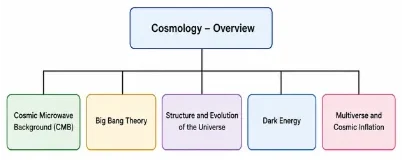
A simple structure chart showing how the Cosmic Microwave Background page fits within the wider Cosmology cluster.
This diagram presents the Cosmology cluster as a simple hierarchical structure. Cosmology Overview appears as the hub page, connected to five major child pages: Cosmic Microwave Background, Big Bang Theory, Structure and Evolution of the Universe, Dark Energy, and Multiverse and Cosmic Inflation. The chart helps students understand how the CMB page relates to early-universe evidence, the Big Bang framework, structure formation, dark energy, and inflationary cosmology.
The Origin of the Cosmic Microwave Background
The Cosmic Microwave Background began as a high-energy photon field locked in thermodynamic equilibrium with hot primordial matter. During the early cosmic epochs, ambient temperatures exceeded tens of thousands of Kelvin, maintaining the cosmic gas as a highly ionized plasma composed of free protons, alpha particles, and electrons.
In this high-density plasma state, photons could not propagate freely. They underwent continuous, rapid momentum exchanges via elastic electromagnetic interactions with free electrons, a process modeled via the Thomson Scattering Cross-Section, \( \sigma_T \). The mean free path of radiation was incredibly small, rendering the infant universe fully opaque—functioning mechanically as a dense, glowing radiative fluid.
The Recombination Era and Photon Decoupling
As the spatial scale factor expanded, the universe cooled according to strict thermodynamic relations. Approximately 380,000 years after the initial expansion phase, the average thermal kinetic energy dropped below the \(13.6\,\text{eV}\) ionization threshold of Hydrogen, cooling the background down to approximately \(3000\,\text{K}\). This drop allowed protons to capture free electrons to form stable, neutral atomic hydrogen gas. This structural shift is formally defined as the <strong>Recombination Era</strong>:
$$p^+ + e^- \rightarrow H + \gamma$$
As the population of free scattering electrons dropped to near-zero, the photon interaction rate fell far below the expansion rate of the universe. This critical milestone marks the Photon Decoupling Epoch. Matter and radiation separated permanently; the primordial photons escaped the gas structures, traveling outward into space in all directions as an invariant, free-streaming radiation field.
The Evolution of Thermal Redshift Tracking
When first released during decoupling, the CMB spectrum was centered in the short-wavelength visible and near-infrared bands, glowing with a temperature profile of \(T_{\text{decoupling}} \approx 3000\,\text{K}\). As these photons traveled through the expanding universe, their physical wavelengths were continuously stretched by the scale factor transformation, \(a(t)\). This metric elongation is tracked via the cosmological redshift parameter, \(z\):
Because photon energy scales inversely with wavelength, this ongoing metric stretching causes the absolute temperature profile of the radiation field to drop inversely with the scale factor. Over billions of years of cosmic expansion, this thermodynamic cooling has red-shifted the relic field by a scale factor of roughly \(1100\), lowering the ambient background temperature down to its modern peak value:
This modern peak places the relic radiation profile directly within the microwave band of the electromagnetic spectrum, filling the contemporary universe with a faint, uniform blackbody background.
Reflection: Why Could Light Finally Travel?
Use this prompt to connect recombination with the release of the CMB.
Why could photons travel freely after neutral atoms formed, but not before?
Your thinking prompt: Think about free electrons, Thomson scattering, neutral atoms, and the universe becoming transparent.
Suggested reflection: Before recombination, free electrons scattered photons repeatedly, so light could not travel freely. After electrons combined with nuclei to form neutral atoms, there were far fewer free electrons to shatter the photons. The universe became transparent, and the light that escaped became the CMB.
Key takeaway: The CMB exists because the early universe changed from opaque plasma to transparent neutral gas.
Importance of the CMB in Cosmology
The CMB is one of the most important sources of evidence in cosmology because it gives scientists a direct view of the early universe. It is often described as a cosmic photograph, not because it shows stars or galaxies, but because it preserves information from a time before those objects existed.
A Snapshot of the Early Universe
The CMB shows the universe when it was about 380,000 years old. At that time, there were no stars, galaxies, planets, or living systems. The universe was filled mainly with radiation, matter, and tiny density differences that would later grow into structure.
Evidence for the Big Bang Theory
The existence of the CMB strongly supports the Big Bang Theory. A universe that began hot, dense, and expanding should leave behind cooled radiation from its early stages. The CMB is exactly this kind of relic radiation.
Measuring the Universe’s Composition
CMB measurements help scientists estimate the relative amounts of ordinary matter, dark matter, and dark energy in the universe. This is possible because each component affects the pattern of CMB fluctuations and the expansion history of the cosmos.
Understanding Cosmic Structure
The CMB is almost uniform, but not perfectly uniform. Its tiny temperature variations reveal small density differences in the early universe. Over billions of years, gravity amplified these differences into galaxies, galaxy clusters, filaments, and voids.
Testing Cosmic Inflation
The pattern of CMB fluctuations also helps test ideas about cosmic inflation. Inflation suggests that tiny early fluctuations were stretched to cosmic scales during a brief period of extremely rapid expansion.
Anisotropy Multipoles and the Primordial Power Spectrum
To mathematically extract structural data from the microwave background sky, cosmologists decompose the raw temperature anisotropies into a spherical harmonic expansion, separating the map into independent angular multipole moments (\( l \)). The temperature fluctuation field is tracked via the angular power spectrum estimator \( C_l \), where low multipoles map large spatial horizons, and high multipoles capture fine-scale acoustic physical oscillations within the primordial plasma. The precise alignment of the acoustic peaks—especially the primary compression peak at \( l \approx 220 \)—proves with extreme precision that our spatial geometry is flat. By fitting these structural multipole spectra against the complete \(\Lambda\text{CDM}\) standard cosmological model parameters, research arrays extract precise values for baryonic matter density and dark matter distributions without relying on low-redshift local acceleration metrics.
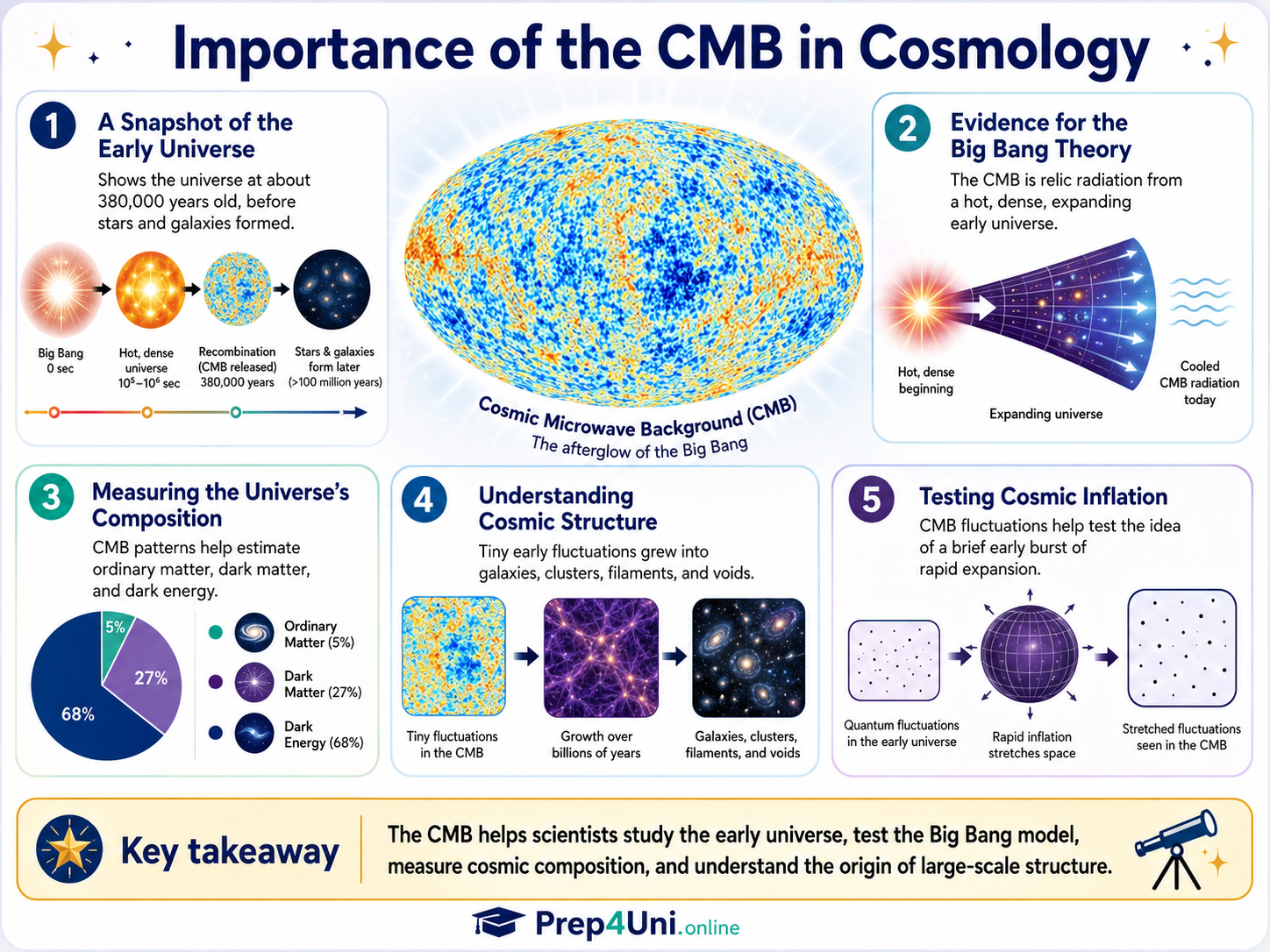
The cosmic microwave background helps scientists study the early universe, test the Big Bang model, measure cosmic composition, trace the origin of large-scale structure, and examine ideas about cosmic inflation.
This infographic explains why the cosmic microwave background is one of the most important sources of evidence in cosmology. It shows the CMB as a relic signal from the early universe, released when the universe was about 380,000 years old. The visual connects the CMB to the Big Bang model, the measurement of ordinary matter, dark matter and dark energy, the growth of galaxies and cosmic structure, and the testing of cosmic inflation. It helps students see the CMB not as an ordinary image of stars or galaxies, but as a preserved record of conditions from the young universe.
Anisotropies and Fluctuations in the CMB
The CMB is remarkably uniform across the sky, but it contains tiny variations in temperature. These variations are called anisotropies. They are extremely small, but scientifically powerful.
If the CMB were perfectly smooth, it would be difficult to explain how galaxies and clusters later formed. The small irregularities in the CMB reveal that the early universe was almost uniform, but not completely uniform.
Temperature Anisotropies and Baryon Acoustic Oscillations
The microscale fluctuations in CMB intensity correspond to localized temperature differences across the sky, defined by the variance ratio \( \frac{\Delta T}{T} \approx 10^{-5} \). These temperature anisotropies are not random noise; they trace the primordial gravitational potential wells established during inflation.
Before decoupling occurred, the universe was a tightly coupled plasma fluid where inward gravitational compression competed against the outward thermal radiation pressure of photons. This competition generated sound-like pressure waves that propagated through the plasma, known as Baryon Acoustic Oscillations (BAO). When decoupling occurred, it instantly froze these acoustic waves in place, leaving a visible geometric imprint in the CMB temperature distribution. The physical size of the primary frozen peak establishes a precise standard ruler that cosmologists use to measure the absolute spatial curvature and overall geometry of the universe.
Quick Check: Why Do Tiny Fluctuations Matter?
Use this prompt to connect CMB anisotropies with galaxy formation.
Why are tiny temperature differences in the CMB important for understanding galaxies and clusters?
Your thinking prompt: Think about early density differences, gravity, and the growth of structure over billions of years.
Suggested answer: Tiny temperature differences in the CMB reveal small density differences in the early universe. Gravity amplified these differences over time, causing matter to collect into galaxies, clusters, filaments, and the cosmic web.
Key takeaway: The CMB shows the seeds from which cosmic structure grew.
CMB Observations and Experiments
The CMB has been studied through increasingly precise observations. Each major experiment improved our ability to measure ancient radiation and understand the universe’s early conditions.
Discovery of the CMB (1965)
Discovered accidentally by Arno Penzias and Robert Wilson, who detected persistent microwave background noise matching theoretical expectations for leftover radiation from a hot early universe. This discovery provided strong support for the Big Bang model.
COBE Satellite (NASA)
Measured the CMB spectrum with high precision, confirming that it matches a perfect blackbody spectrum. It also detected the first tiny temperature variations (\( \Delta T/T \approx 10^{-5} \)) across the primordial sky.
WMAP Spacecraft (NASA)
Mapped the CMB temperature fluctuations with significantly improved angular resolution, refining calculations of the universe’s absolute age (\( 13.8\,\text{billion years} \)), spatial flatness, and dark matter ratios.
Planck Satellite (ESA)
Produced the definitive ultra-high-resolution map of the CMB, measuring fine-scale anisotropies to pinpoint the core cosmological parameters of the standard \( \Lambda\text{CDM} \) model with unprecedented precision.
CMB Challenges, Frontiers, and Open Questions
Although CMB observations have greatly strengthened modern cosmology, several questions remain open. These questions make the CMB an active research field rather than a finished topic.
The Physical Nature of Dark Sectors
While CMB data establishes that the universe’s mass-energy content is dominated by dark matter and dark energy, it cannot identify the physical particles or fields behind them.
B-mode Polarization Signatures
Cosmologists are actively searching for primordial B-mode polarization patterns—curl-like structures in the alignment of CMB light waves that would provide direct proof of primordial gravitational waves generated during inflation.
Large-Scale Anomalies
High-resolution maps contain unexpected anomalies on the largest spatial scales, including hemispherical power asymmetries and a prominent hemispherical “Cold Spot,” which spark debate over whether they represent data processing challenges or new physical principles.
Reflection: Why Be Careful with CMB Anomalies?
Use this prompt to think about evidence and interpretation.
Why should unusual features in CMB maps be interpreted carefully before claiming new physics?
Your thinking prompt: Think about measurement uncertainty, foreground contamination, statistical chance, and independent confirmation.
Suggested reflection: CMB measurements are extremely precise but also difficult. Foreground radiation, instrument effects, statistical chance, and data processing can all create or exaggerate unusual patterns. Strong claims need independent evidence and careful testing.
Key takeaway: Precision cosmology requires both curiosity and caution.
Future Observations and Missions
Future CMB research will focus especially on polarization, small-scale anisotropies, foreground removal, and possible signatures of inflation. Better measurements may help refine cosmological parameters and test early-universe models.
CMB-S4
A planned next-generation ground-based observatory programme designed to measure CMB polarization and small-scale structure with very high sensitivity.
LiteBIRD
A planned space mission led by JAXA to measure CMB polarization, especially signals that could relate to primordial gravitational waves from inflation.
Simons Observatory
Designed to measure CMB temperature and polarization from the ground with high precision, helping improve understanding of early-universe physics and cosmic structure.
Why Study Cosmic Microwave Background
The CMB is worth studying because it turns ancient light into evidence about the universe’s origin, structure, composition, and future research frontiers. It gives students a direct link to conditions before stars and galaxies existed, introducing them to data analysis, precision measurement, and scientific modelling.
Conclusion
The Cosmic Microwave Background is one of the most important discoveries in modern cosmology. It is ancient radiation from the young universe, released when matter and light decoupled and the universe first became transparent. Through the CMB, scientists can study the universe before stars and galaxies existed, turning a fossil light record into a precise tool for understanding how modern cosmology is built from evidence.
Frequently Asked Questions about the CMB
What is the cosmic microwave background (CMB)? The cosmic microwave background (CMB) is a faint glow of microwave radiation filling all of space. It is the leftover thermal radiation from the early hot universe, providing a snapshot of the universe when it was about 380,000 years old and had just become transparent to light.
How was the CMB formed? The CMB was formed when the early universe cooled enough for protons and electrons to combine into neutral hydrogen atoms. At that moment, called recombination, photons could travel freely instead of constantly scattering off charged particles. Those photons have been travelling ever since, gradually redshifted into microwaves by the expansion of the universe.
Why is the CMB considered strong evidence for the Big Bang? The CMB is strong evidence for the Big Bang because it matches the prediction that a hot early universe should leave behind a nearly uniform background of cooled radiation. Its blackbody spectrum and tiny temperature fluctuations agree closely with calculations from Big Bang cosmology and early-universe physics.
CMB Review Questions and Answers
What is the cosmic microwave background (CMB)?
Answer: The CMB is the relic radiation left over from the Big Bang, filling the universe almost uniformly with a temperature of about 2.7 Kelvin. It represents the cooling remnant of the early hot, dense phase of the cosmos.
How was the CMB discovered?
Answer: The CMB was discovered accidentally in 1965 by Arno Penzias and Robert Wilson while using a radio antenna. They detected a persistent, isotropic noise that was later identified as the afterglow of the Big Bang.
What does the temperature of the CMB tell us about the early universe?
Answer: The uniform temperature of approximately 2.7 K indicates that the early universe was once extremely hot and dense. The subsequent cooling as the universe expanded provides strong evidence for the Big Bang model.
Comprehensive 7-Problem End-of-Chapter Bank
Quantitative and Radiative Problems
Problem 1: Peak Emission Tracking via Wien’s Displacement Law
Using Wien’s Displacement Law, calculate the exact peak wavelength (\( \lambda_{\text{max}} \)) of the Cosmic Microwave Background radiation spectrum recorded in the modern epoch, assuming an ambient thermal blackbody profile value of \( T = 2.7\,\text{K} \). Use the invariant displacement constant \( \gamma \approx 2.898 \times 10^{-3}\,\text{m}\cdot\text{K} \).
Click to expand solution
Apply Wien’s law directly to isolate the peak wavelength property: \[ \lambda_{\text{max}} = \frac{2.898 \times 10^{-3}\,\text{m}\cdot\text{K}}{T} \] Substitute the recorded background temperature value: \[ \lambda_{\text{max}} = \frac{2.898 \times 10^{-3}\,\text{m}\cdot\text{K}}{2.7\,\text{K}} \approx 1.073 \times 10^{-3}\,\text{meters} \] The peak wavelength of the contemporary CMB spectrum sits at approximately \( 1.07 \times 10^{-3}\,\text{m} \) (or roughly \(1.07\,\text{mm}\)), anchoring the signal directly within the microwave band.
Problem 2: Characteristic Thermodynamic Energy of Relic Photons
Estimate the characteristic thermodynamic energy content (\( E \)) carried by a typical CMB photon in the current epoch using the basic microstate distribution relation \( E = k_B T \). Take Boltzmann’s constant \( k_B = 1.381 \times 10^{-23}\,\text{J/K} \) and assume \( T = 2.7\,\text{K} \).
Click to expand solution
Evaluate the product of the background temperature and the characteristic energy scalar: \[ E = k_B T \] Substitute the given thermodynamic variables: \[ E = (1.381 \times 10^{-23}\,\text{J/K}) \times 2.7\,\text{K} \approx 3.729 \times 10^{-23}\,\text{Joules} \] The individual characteristic kinetic energy profile of a modern relic photon is approximately \( 3.73 \times 10^{-23}\,\text{J} \).
Problem 3: Scaling Invariants of Cosmological Wavelength Metric Shifts
A primordial relic photon emitted during the early stages of cosmic history propagates through an expanding space coordinate grid that becomes exactly \( 1000 \) times larger in scale before hitting an observation array. Calculate the factor increase in the photon’s wave metric.
Click to expand solution
Cosmological kinematics dictate that as free photons travel through un-bound expanding space, their structural wavelengths expand in direct linear lockstep with the spatial scale factor transformation parameter, \( a(t) \): \[ \lambda \propto a(t) \] If the coordinate metric scales up such that \( a_{\text{final}} = 1000 \cdot a_{\text{initial}} \), the wave profile changes proportionally: \[ \lambda_{\text{final}} = 1000 \cdot \lambda_{\text{initial}} \] The photon’s wavelength increases by a factor of exactly \( 1000 \) due to metric cosmological expansion.
Problem 4: Recombination Boundary Limits and Wien Peak Alignments
Mechanisms demonstrate that the ambient background temperature during the exact decoupling epoch was approximately \( T = 3000\,\text{K} \). Compute the peak wavelength parameter (\( \lambda_{\text{max}} \)) of the radiation field at the moment it escaped the baryonic plasma.
Click to expand solution
Apply Wien’s Displacement Law using the primordial temperature boundary criteria: \[ \lambda_{\text{max}} = \frac{2.898 \times 10^{-3}\,\text{m}\cdot\text{K}}{T} \] Substitute the structural decoupling temperature variable: \[ \lambda_{\text{max}} = \frac{2.898 \times 10^{-3}\,\text{m}\cdot\text{K}}{3000\,\text{K}} \approx 9.66 \times 10^{-7}\,\text{meters} \] At the moment of decoupling, the peak wavelength was approximately \( 9.66 \times 10^{-7}\,\text{m} \) (or \(966\,\text{nm}\)), placing the infant CMB spectrum squarely inside the near-infrared band.
Problem 5: Frequency Extractions of Contemporary Electromagnetic Signals
Calculate the corresponding oscillation wave frequency (\( f \)) of a CMB photon possessing a modern measured wavelength coordinate of \( \lambda = 1.0 \times 10^{-3}\,\text{m} \). Assume the standard constant speed of light propagation parameter \( c = 3.00 \times 10^8\,\text{m/s} \).
Click to expand solution
Utilize the foundational wave equation to isolate the frequency parameter track: \[ c = \lambda f \quad \rightarrow \quad f = \frac{c}{\lambda} \] Substitute the recorded numerical values: \[ f = \frac{3.00 \times 10^8\,\text{m/s}}{1.0 \times 10^{-3}\,\text{m}} = 3.00 \times 10^{11}\,\text{Hz} \] The corresponding wave oscillation frequency profile is exactly \( 3.00 \times 10^{11}\,\text{Hz} \) (or \(300\,\text{GHz}\)).
Problem 6: Volumetric Radiation Densities and Stefan-Boltzmann Scaling
The total integrated energy density (\( u \)) of a blackbody radiation field scales proportionally with the fourth power of its absolute thermodynamic temperature according to the Stefan-Boltzmann relationship (\( u \propto T^4 \)). If an alternate early cosmic epoch model doubles the ambient temperature value, analyze the relative change in radiation energy density.
Click to expand solution
Set up the scaling ratio using the fourth-power temperature profile constraint: \[ u \propto T^4 \] Substitute the modified doubled temperature parameter (\(2T\)) into the functional proportion: \[ u_{\text{new}} \propto (2T)^4 = 16T^4 = 16u_{\text{initial}} \] Doubling the local absolute temperature causes the volumetric radiation energy density to increase by a factor of exactly \( 16 \) (or \(2^4\)).
Problem 7: Expansion Mechanics and Quantum Momentum Loss Profiles
Explain conceptually why individual photon energy states degrade continuously as a function of time within an expanding FLRW metric space model.
Click to expand solution
According to quantum wave mechanics, a photon’s structural energy content is tied to its oscillation frequency via the relationship \( E = hf = \frac{hc}{\lambda} \). As space coordinates expand uniformly over time, free-streaming light waves are cosmologically stretched along the expanding coordinate axis, causing the wavelength metric (\( \lambda \px ) to increase. Because energy shares an inverse proportion with wavelength, this continuous wave stretching forces individual photons to undergo a gradual, non-reversible loss of quantum energy and momentum over cosmic timelines.
Next Core Cosmological Cornerstone
Now that you have mapped the oldest thermal footprint of radiation, continue your journey to see how gravity pulled this matter together into the macroscale structures of the contemporary web.