Special Relativity is Einstein’s theory of motion, space, time, light, and energy when observers move at constant velocity relative to one another. It shows that time and distance are not always fixed in the simple everyday sense. When speeds become extremely high, especially close to the speed of light, different observers can measure time intervals and lengths differently, while the laws of physics remain consistent.
This page focuses on the Relativity branch known as Special Relativity. It prepares students to understand time dilation, length contraction, simultaneity, the Lorentz factor, relativistic momentum, and mass-energy equivalence. These ideas are essential in Particle Physics, Nuclear Physics, and modern precision technologies.
Special Relativity is called “special” because it deals mainly with inertial frames of reference: situations where observers move at constant velocity and are not accelerating. Gravity is not the main focus here. Gravity belongs to General Relativity, where spacetime curvature becomes central.

A conceptual illustration for a Special Relativity page. A high-speed train moves across a dark spacetime-like grid while a bright light beam travels forward. Two clocks and an observer suggest the comparison of time measurements between different frames of reference. The image represents motion-based time dilation and the constant speed of light without introducing gravity or curved spacetime.
Key Idea
Special Relativity shows that time, distance, and simultaneity depend on motion, while the laws of physics and the speed of light remain consistent for all inertial observers.
The Two Postulates of Special Relativity
Postulate 1: The Laws of Physics Are the Same in All Inertial Frames
An inertial frame is a frame of reference moving at constant velocity, without acceleration. Special Relativity states that the laws of physics are the same in all inertial frames. A student doing an experiment inside a smoothly moving train should obtain the same basic physical laws as a student doing the same experiment in a stationary laboratory.
This does not mean that all measurements are identical. Observers may measure different times, distances, or velocities. However, the underlying laws connecting those measurements remain the same.
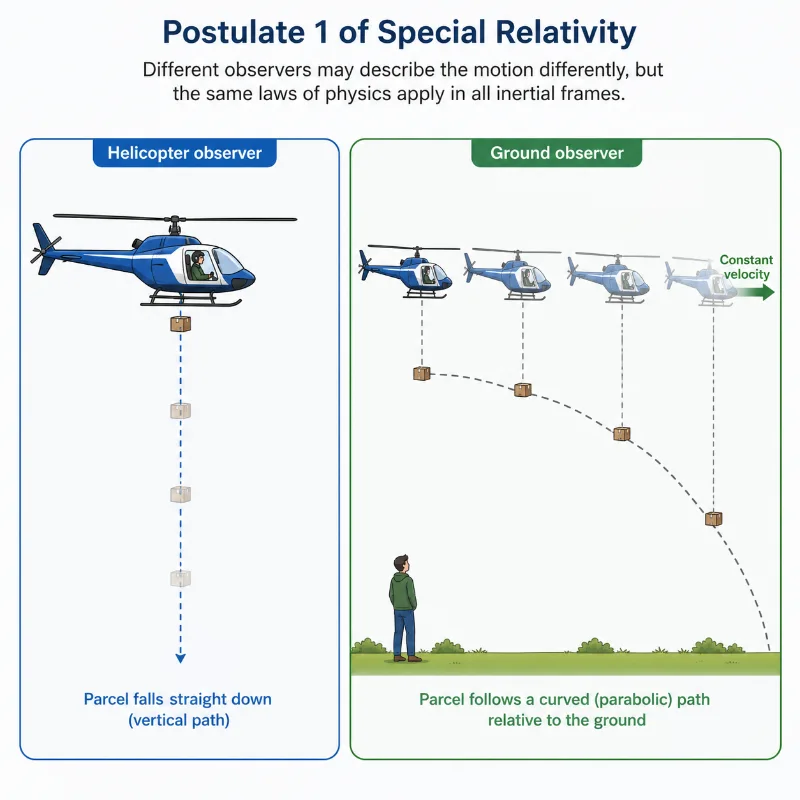
This diagram explains Postulate 1 of Special Relativity using a simple parcel-drop example. In the left panel, labelled for the helicopter observer, a helicopter moves at constant velocity and a released parcel is shown falling straight down along a vertical path relative to the helicopter. In the right panel, labelled for the ground observer, the same helicopter is shown at successive positions as it moves horizontally, while the parcel follows a curved parabolic path relative to the ground. A ground observer stands below watching the motion. The diagram demonstrates that different observers in different inertial frames may describe the same event differently, yet both use the same laws of motion under gravity.
Postulate 2: The Speed of Light in Vacuum Is Constant
The second postulate is more surprising. The speed of light in vacuum, written as \(c\), has the same value for all inertial observers, regardless of the motion of the light source or the observer.
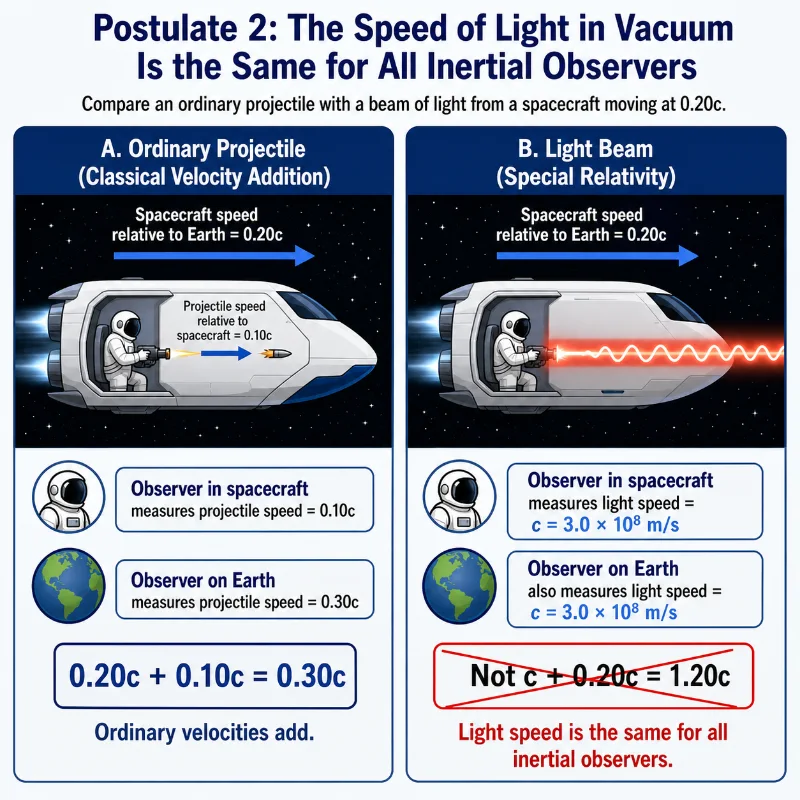
This instructional infographic explains Postulate 2 of Special Relativity using a spacecraft moving at 0.20c. The image is divided into two vertical panels. In the left panel, labelled as an ordinary projectile case, an astronaut inside the spacecraft fires a projectile at 0.10c relative to the spacecraft. The infographic shows that the observer inside the spacecraft measures the projectile speed as 0.10c, while an observer on Earth measures it as 0.30c, illustrating classical velocity addition. In the right panel, labelled as the light beam case, the astronaut fires a laser beam from the same spacecraft. The infographic shows that the observer inside the spacecraft measures the light speed as c = 3.0 × 10^8 m/s, and the observer on Earth also measures the light speed as c = 3.0 × 10^8 m/s. A crossed-out statement, “Not c + 0.20c = 1.20c,” emphasizes that light does not obey ordinary velocity addition. The diagram is designed to illustrate that while ordinary projectiles follow classical addition of velocities, the speed of light in vacuum is invariant for all inertial observers.
Guided Reflection Check: Understanding the Two Postulates
Check 1: Same Law, Different Description
A helicopter moves horizontally at constant velocity and releases a parcel. The helicopter observer sees the parcel fall straight down, while the ground observer sees a curved projectile path. What does this example show?This illustrates Postulate 1. Different observers may describe the same motion differently, but both still use the same laws of motion. The helicopter observer describes a vertical fall, while the ground observer describes projectile motion. The descriptions differ because the observers are in different frames, but the underlying law of motion under gravity remains the same.
Check 2: Ordinary Velocity Addition
A spacecraft moves past Earth at \(0.20c\). An astronaut fires a small projectile forward at \(0.10c\) relative to the spacecraft. In this simplified classical comparison, what speed does the Earth observer measure for the projectile?A. \(0.10c\)
B. \(0.20c\)
C. \(0.30c\)
D. \(c\)
The answer is C: \(0.30c\). For ordinary objects moving at speeds much lower than the speed of light, velocities approximately add in the familiar classical way:\[
0.20c + 0.10c = 0.30c
\]This example helps students see why the second postulate is surprising: light does not behave like an ordinary projectile.
Check 3: Light Does Not Add Like an Ordinary Projectile
The same spacecraft moves past Earth at \(0.20c\). This time, the astronaut shines a laser beam forward. What speed does the Earth observer measure for the laser light in vacuum?A. \(0.20c\)
B. \(c\)
C. \(1.20c\)
D. It depends on the speed of the spacecraft.
The answer is B: \(c\). According to Postulate 2, the speed of light in vacuum is the same for all inertial observers. The Earth observer does not measure the light beam as \(c + 0.20c = 1.20c\). The measured speed remains:\[
c = 3.0 \times 10^8 \text{ m/s}
\]This is the key difference between ordinary velocity addition and the behaviour of light in Special Relativity.
Check 4: Why the Two Postulates Matter
Why do these two postulates force physicists to rethink time and distance?If all inertial observers must use the same laws of physics, and if all of them must also measure the same speed of light in vacuum, then time and distance cannot remain absolute in the Newtonian sense. Measurements of time, length, and simultaneity must adjust so that the speed of light remains unchanged for every inertial observer.This is why the two postulates lead naturally to time dilation, length contraction, and the relativity of simultaneity. These effects are not separate inventions. They are consequences of taking the two postulates seriously.
Length Contraction: Moving Lengths and Direction of Motion
Length contraction means that an object moving at very high speed is measured to be shorter along its direction of motion by an observer who sees it moving. The object has its normal length in its own rest frame, but another observer in relative motion measures a contracted length.
The length contraction formula is:
\[
L = \frac{L_0}{\gamma}
\]
Here, \(L_0\) is the proper length measured in the object’s rest frame, \(L\) is the contracted length measured by another observer, and \(\gamma\) is the Lorentz factor.
Length contraction occurs only along the direction of motion. Dimensions perpendicular to the direction of motion are not contracted in the same way. This distinction is important when students imagine fast-moving spacecraft, particles, or measuring rods.
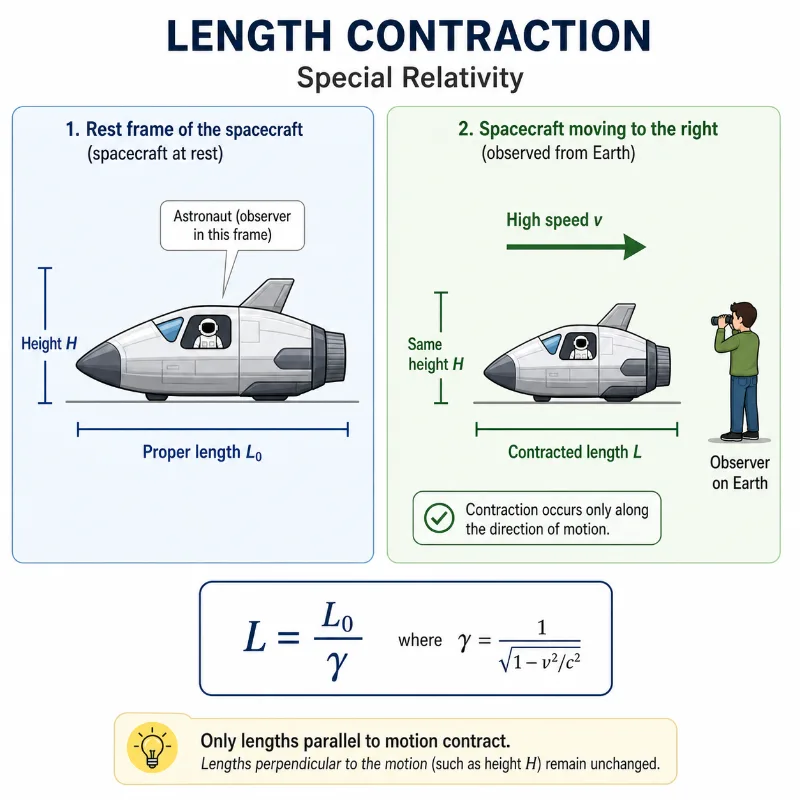
This instructional diagram explains length contraction using a spacecraft example. In the left panel, the spacecraft is shown in its own rest frame, where its proper length is labelled L₀ and its height is labelled H. In the right panel, the spacecraft is shown moving to the right at high speed as observed from Earth. Its measured length is shorter and labelled contracted length L, while its height remains the same, emphasizing that contraction occurs only along the direction of motion. An observer on Earth is shown watching the moving spacecraft. The lower part of the image includes the formula L = L₀ / γ together with the Lorentz factor, and a note explains that only lengths parallel to the motion contract, while perpendicular dimensions remain unchanged. The graphic is designed to help one visualize the meaning of length contraction in Special Relativity.
Quick Check: Understanding Length Contraction
Length contraction is not a general shrinking of the whole object. It depends on the observer’s frame of reference and occurs only along the direction of motion.
1. In the formula \(L = \frac{L_0}{\gamma}\), what does \(L_0\) represent?
A. The contracted length measured by Earth
B. The proper length measured in the object’s own rest frame
C. The speed of light
D. The height of the moving object
Answer: B. \(L_0\) is the proper length. It is measured in the frame where the object is at rest.
2. If \(\gamma > 1\), what does \(L = \frac{L_0}{\gamma}\) tell us?
A. \(L\) is greater than \(L_0\)
B. \(L\) is equal to \(L_0\)
C. \(L\) is smaller than \(L_0\)
D. \(L\) becomes zero for all moving objects
Answer: C. Since \(\gamma\) is greater than 1 at relativistic speeds, dividing \(L_0\) by \(\gamma\) gives a shorter measured length.
3. Which dimension contracts for a fast-moving spacecraft?
A. Only the dimension along the direction of motion
B. Only the height
C. All dimensions equally
D. No dimension changes in any frame
Answer: A. Length contraction occurs along the direction of motion. Dimensions perpendicular to the motion are not contracted in the same way.
Key takeaway: A moving object is measured to be shorter only along its direction of motion. Its proper length remains the length measured in its own rest frame.
Relativity of Simultaneity
One of the most subtle ideas in Special Relativity is the relativity of simultaneity. Two events that happen at the same time for one observer may not happen at the same time for another observer moving relative to the first.
This does not mean that observers are confused. It means that simultaneity depends on how time is measured across space. Because light speed is finite and constant, different observers may slice spacetime into “now” in different ways.
This idea is often harder to accept than time dilation or length contraction because it challenges the everyday belief that there is one universal present moment shared by the whole universe. Special Relativity replaces that belief with a more precise structure: events are real, but the ordering of widely separated events can depend on the observer’s frame of reference.
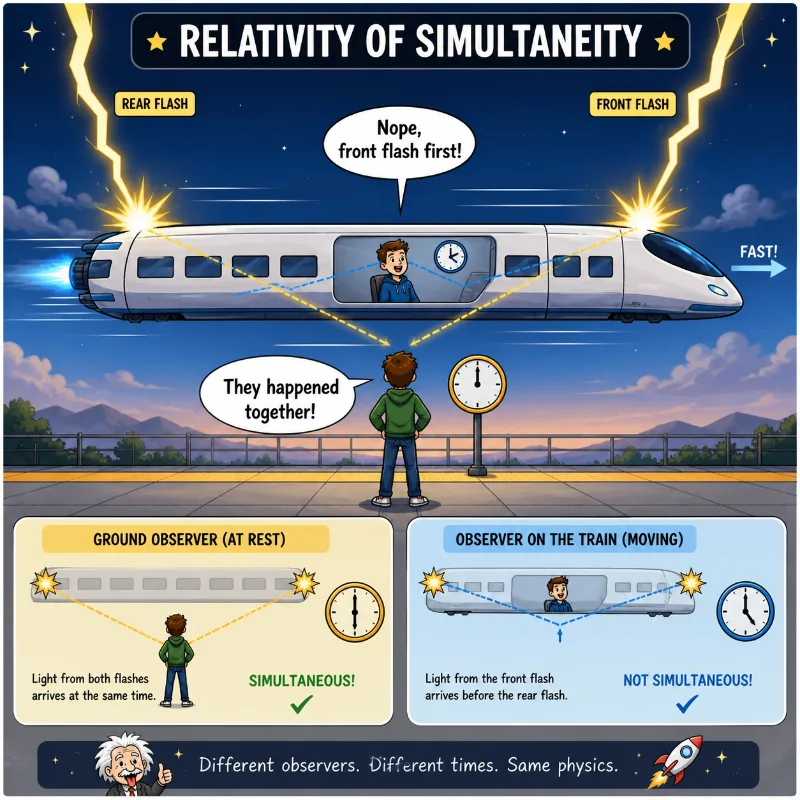
This infographic presents the relativity of simultaneity in a humorous and visually engaging way using a long flying train moving rapidly through the air. Lightning flashes strike the rear and front of the train. A ground observer standing below the train receives light from both flashes at the same time and concludes that the two events are simultaneous. An observer seated inside the moving train reaches a different conclusion and says that the front flash happened first. The lower panels compare the two viewpoints side by side, showing that simultaneity depends on the observer’s frame of reference. The picture is designed to make a subtle idea in Special Relativity more memorable by combining a clear train example with a playful tone.
Quick Check: Simultaneity Depends on the Observer
The relativity of simultaneity challenges the idea that the whole universe shares one single “now”. Try each question before revealing the answer.
1. What does the relativity of simultaneity mean?
A. Events are not real
B. Time stops for moving observers
C. Two events simultaneous in one frame may not be simultaneous in another
D. All observers must always agree on the order of every event
Answer: C. Two events that occur at the same time for one observer may occur at different times for another observer moving relative to the first.
2. Why can two observers disagree about whether distant events happened at the same time?
A. Because light speed is finite and constant
B. Because one observer must be wrong
C. Because clocks cannot measure time
D. Because simultaneity is only a psychological effect
Answer: A. Because light travels at a finite and constant speed, different moving observers can divide spacetime into “now” in different ways.
3. What everyday belief does this idea challenge?
A. That all objects have mass
B. That there is one universal present moment for the whole universe
C. That light can travel through space
D. That clocks can be compared
Answer: B. Special Relativity challenges the idea of one universal “now” shared everywhere. Simultaneity depends on the observer’s frame of reference.
Key takeaway: Events can be real, but whether distant events are judged to be simultaneous can depend on the observer’s motion.
The Lorentz Factor
The Lorentz factor, written as \(\gamma\), measures how strongly relativistic effects appear at a given speed. It appears in formulas for time dilation, length contraction, relativistic momentum, and relativistic energy.
\[
\gamma = \frac{1}{\sqrt{1 – \frac{v^2}{c^2}}}
\]
Here, \(v\) is the relative speed between observers, and \(c\) is the speed of light in vacuum. When \(v\) is much smaller than \(c\), \(\gamma\) is almost 1, so relativistic effects are very small. As \(v\) approaches \(c\), \(\gamma\) grows rapidly.
This explains why everyday motion feels Newtonian, while high-speed particle motion must be treated relativistically. The same universe contains both behaviours; the difference is the speed scale.
The value of \(\gamma\) depends only on the ratio \(v/c\). At low speeds, \(\gamma\) is very close to 1, so relativistic effects are almost invisible. At speeds close to \(c\), however, \(\gamma\) increases rapidly, making time dilation, length contraction, and relativistic momentum significant.
| Speed | Lorentz Factor \(\gamma\) | Meaning |
|---|---|---|
| \(0.10c\) | \(\approx 1.005\) | Relativistic effects are extremely small. |
| \(0.50c\) | \(\approx 1.155\) | Effects are measurable but still moderate. |
| \(0.80c\) | \(\approx 1.667\) | Time dilation and length contraction become important. |
| \(0.90c\) | \(\approx 2.294\) | Moving clocks are measured to run much slower. |
| \(0.99c\) | \(\approx 7.089\) | Relativistic effects become very large. |
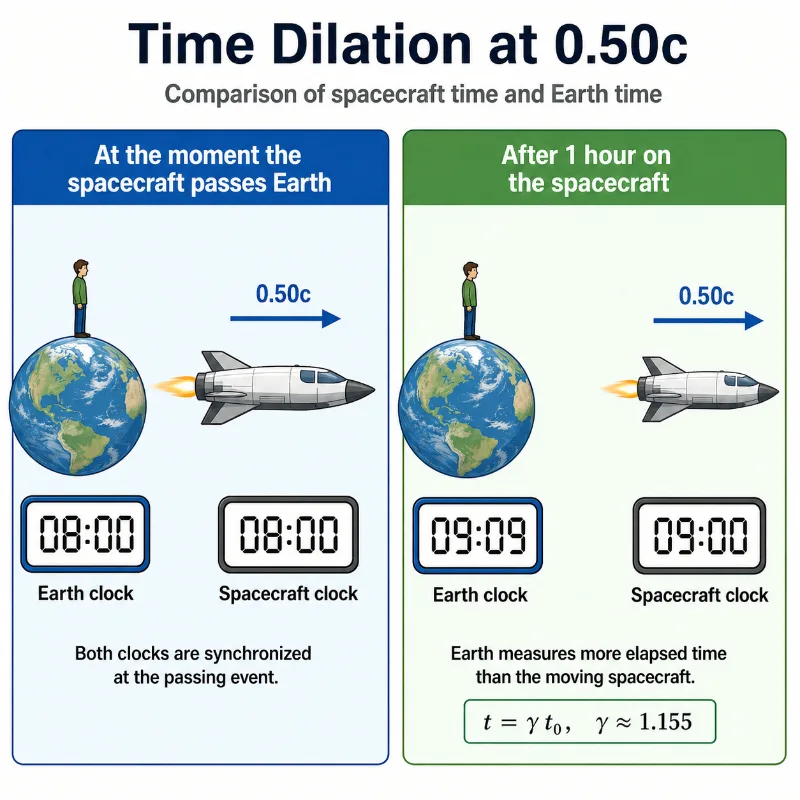
This educational infographic explains time dilation for a spacecraft travelling at 0.50c relative to Earth. The image is divided into two panels. In the left panel, the spacecraft passes an observer on Earth at 08:00, and both the Earth clock and the spacecraft clock are synchronized to show 08:00 at the passing event. In the right panel, the spacecraft has continued moving at 0.50c. After 1 hour has elapsed on the spacecraft clock, it reads 09:00, while the Earth clock reads 09:09. The diagram visually demonstrates that more time passes on Earth than on the moving spacecraft. A note at the bottom includes the time dilation relation t = γt₀ with γ ≈ 1.155, connecting the visual example to the formula.
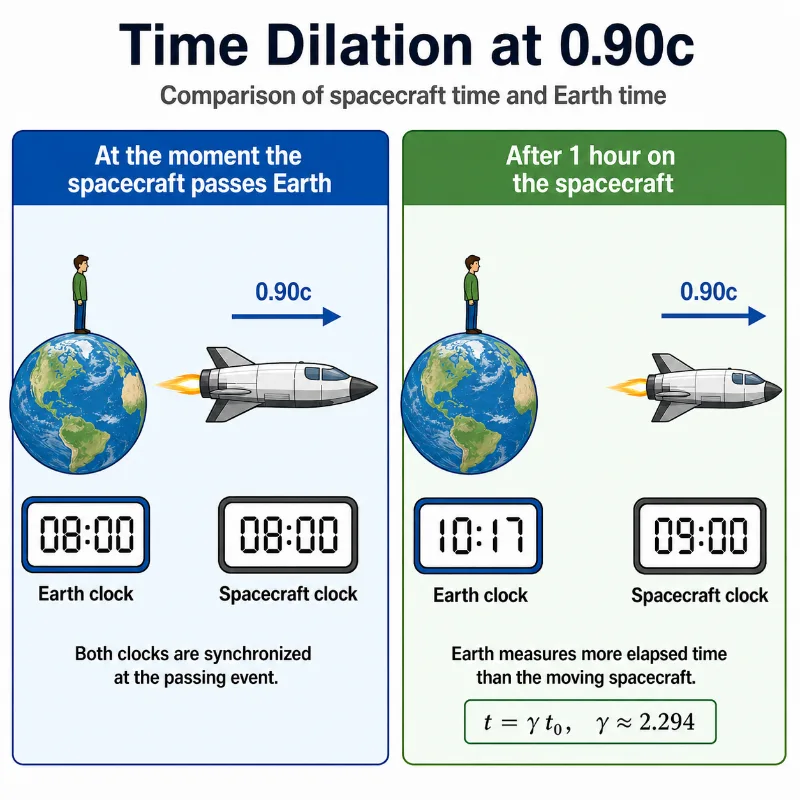
This educational infographic explains time dilation for a spacecraft travelling at \(0.90c\) relative to Earth. The image is divided into two panels. In the left panel, the spacecraft passes an observer on Earth at 08:00, and both the Earth clock and the spacecraft clock are synchronized at that passing event. In the right panel, after 1 hour has elapsed on the spacecraft clock, the spacecraft clock reads 09:00 while the Earth clock reads about 10:17. The diagram shows that more time passes on Earth than on the moving spacecraft. A note at the bottom includes the time dilation relation \(t = \gamma t_0\), with \(\gamma \approx 2.294\), connecting the visual example to the formula.
Quick Check: Reading the Lorentz Factor
The Lorentz factor \(\gamma\) tells us how strongly relativistic effects appear. The closer \(v\) gets to \(c\), the larger \(\gamma\) becomes.
1. What does it mean when \(\gamma\) is very close to 1?
A. Relativistic effects are very small
B. Time stops completely
C. The object has reached the speed of light
D. Length contraction becomes infinite
Answer: A. When \(\gamma\) is close to 1, relativistic effects are almost invisible. This is why everyday motion usually feels Newtonian.
2. At \(0.90c\), the Lorentz factor is approximately \(\gamma = 2.294\). If \(1\) hour passes on the moving spacecraft, about how much time does the Earth observer measure?
A. About 30 minutes
B. Exactly 1 hour
C. About 2.294 hours
D. About 9 hours
Answer: C. Using \(t = \gamma t_0\), we get \(t = 2.294 \times 1 = 2.294\) hours. This is about 2 hours and 17 minutes.
3. Why do relativistic effects become important for particle accelerators but not for ordinary cars?
A. Cars have no mass
B. Particle speeds can be close to \(c\)
C. Cars do not move through spacetime
D. The speed of light changes near particles
Answer: B. Ordinary speeds are tiny compared with \(c\), so \(\gamma\) stays almost equal to 1. In particle accelerators, particles can move close to \(c\), so \(\gamma\) becomes much larger.
Key takeaway: The Lorentz factor is the scale of relativity. Small \(\gamma\) means almost Newtonian behaviour; large \(\gamma\) means time dilation, length contraction, and relativistic momentum become significant.
Experimental Evidence for Special Relativity
Special Relativity may seem surprising at first, but it is not a speculative idea. Its predictions have been tested repeatedly through experiments involving light, high-speed particles, atomic clocks, nuclear processes, and particle accelerators. These tests show that time dilation, relativistic momentum, and mass-energy equivalence are not merely mathematical curiosities. They are measurable features of the physical world.
The Michelson–Morley Experiment and the Constancy of Light Speed
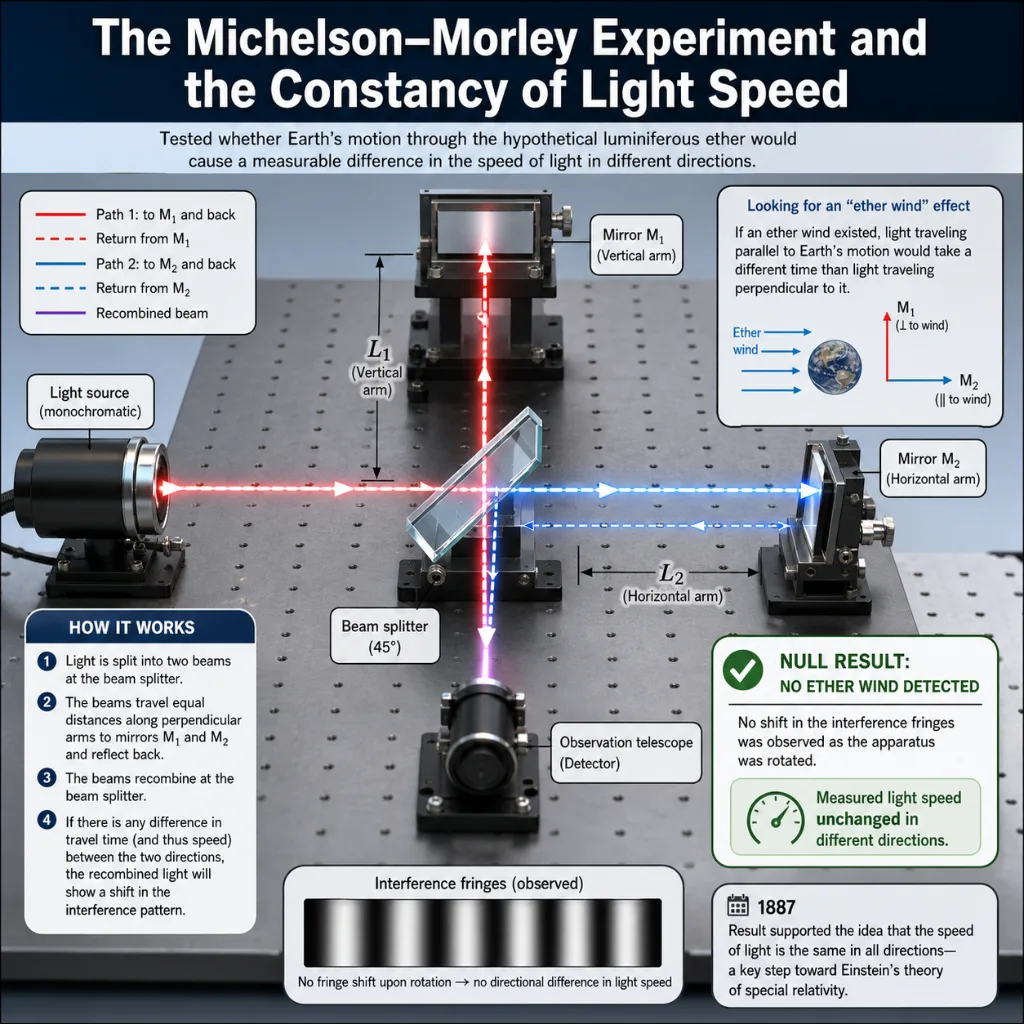
Before Special Relativity, many scientists thought that light waves might travel through an invisible medium called the ether. If Earth moved through this ether, the measured speed of light might change depending on direction. The Michelson–Morley experiment did not find the expected difference. This result helped weaken the ether idea and supported the later view that the speed of light in vacuum is constant for all inertial observers.
This experiment did not by itself prove all of Special Relativity, but it created one of the great puzzles that Einstein’s theory resolved. Instead of treating light speed as something that should vary like ordinary velocities, Special Relativity made the constancy of light speed a basic principle.
Cosmic-Ray Muons and Time Dilation
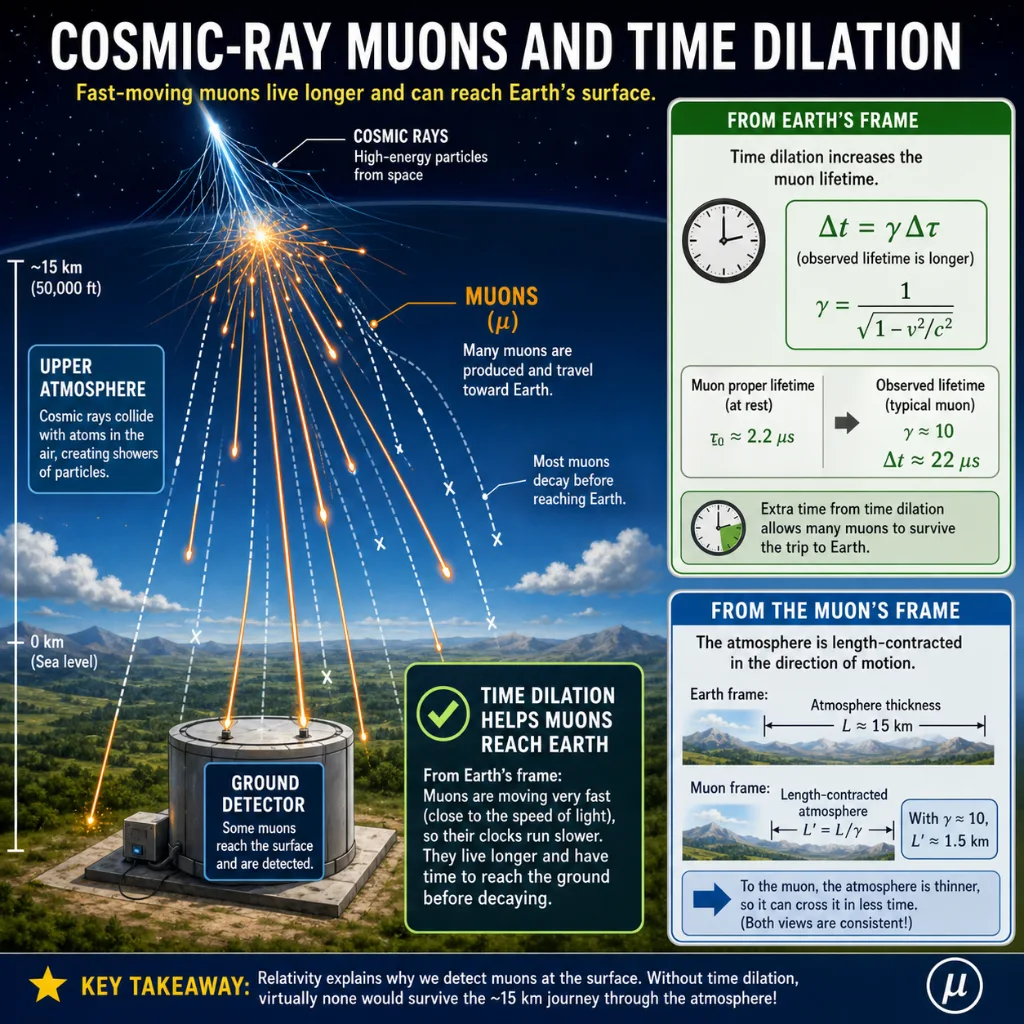
Cosmic rays striking Earth’s upper atmosphere produce unstable particles called muons. Muons have very short lifetimes, so using only classical reasoning, many of them should decay before reaching Earth’s surface. Yet many muons are detected at ground level.
Special Relativity explains this through time dilation. From the viewpoint of observers on Earth, fast-moving muons experience slower internal time, allowing more of them to reach the surface before decaying. From the muon’s own frame, the atmosphere is length-contracted, so the distance to the ground is shorter. Both explanations describe the same physical result from different frames of reference.
Particle Accelerators and Relativistic Energy
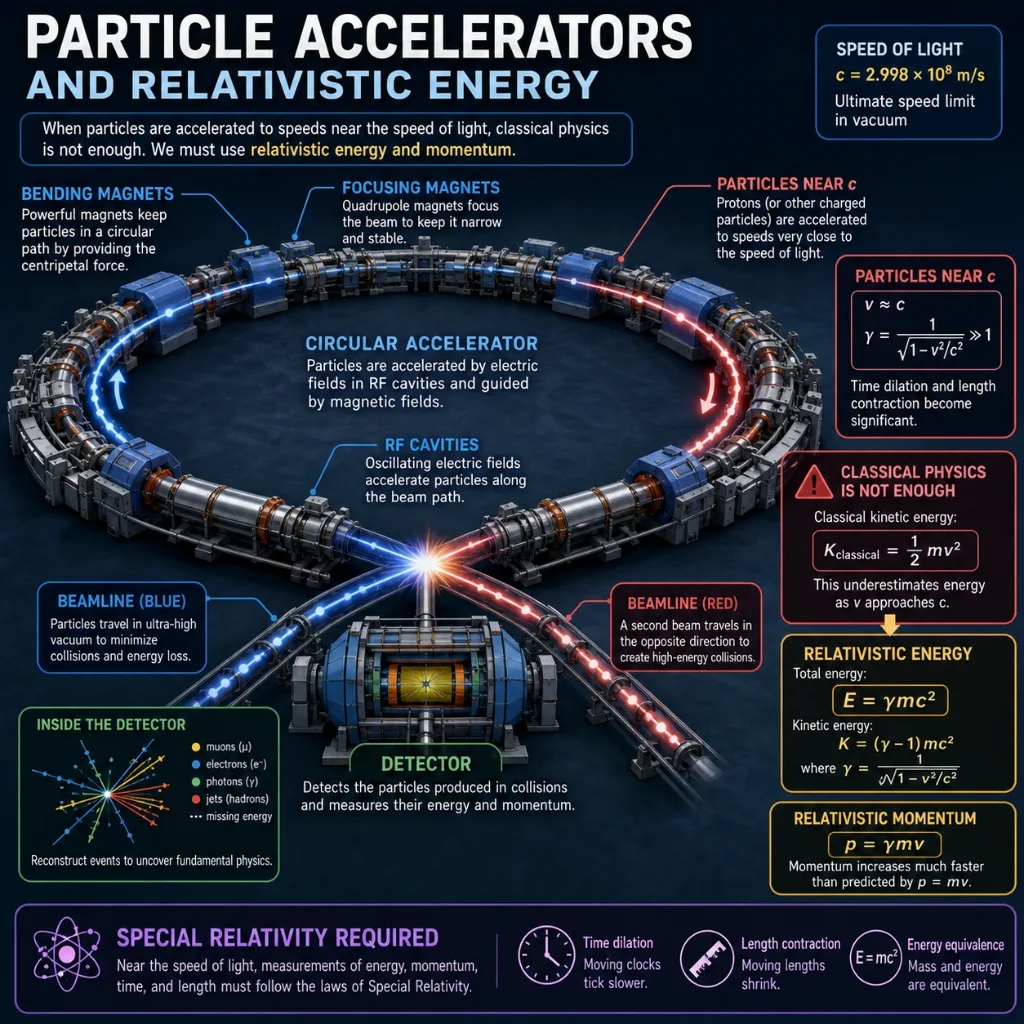
In particle accelerators, charged particles are pushed to speeds extremely close to the speed of light. As their speed increases, their relativistic energy and momentum must be calculated using Special Relativity. Classical formulas would give incorrect predictions for how the particles move, collide, and produce new particles.
Modern accelerator physics would not work without relativistic calculations. The behaviour of electrons, protons, muons, and other high-speed particles confirms that Special Relativity is essential whenever particle speeds become close to \(c\).
Atomic Clocks and High-Speed Motion
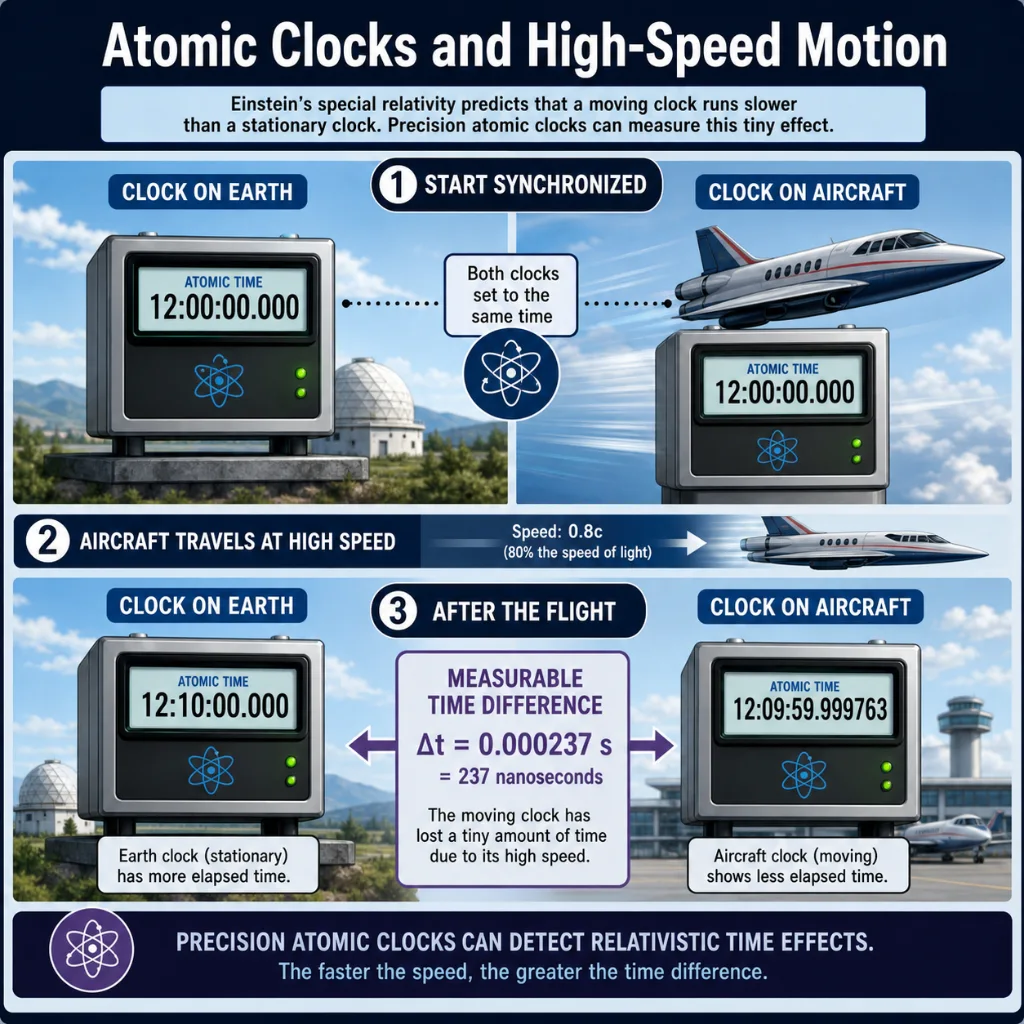
Precision clocks provide another way to test relativistic time effects. Atomic clocks can measure extremely small differences in elapsed time. When clocks move at high speed relative to one another, Special Relativity predicts small but measurable timing differences.
These effects are not noticeable with ordinary watches or everyday travel, but they become important in precision experiments and technologies that depend on very accurate timing. This is one reason relativity matters in modern measurement science.
Mass-Energy Equivalence in Nuclear and Particle Processes
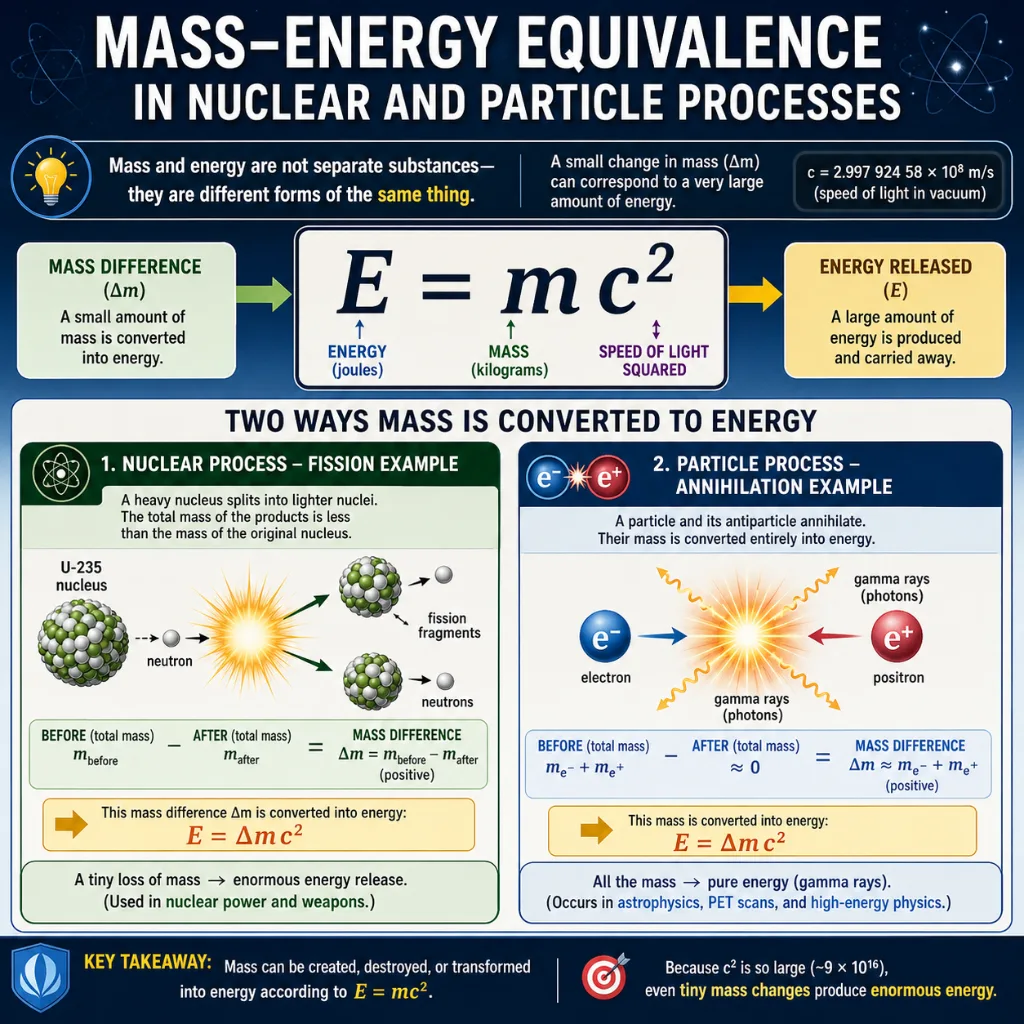
The relation \(E = mc^2\) is supported by nuclear and particle processes in which small changes in mass correspond to large changes in energy. In nuclear reactions, the total mass of the products may differ slightly from the mass of the starting nuclei, and the difference appears as released or absorbed energy.
This mass-energy relationship helps explain nuclear binding energy, radioactive decay, fission, fusion, and particle-antiparticle annihilation. These processes show that mass and energy are not separate substances, but related quantities within one conservation framework.