Prepare for University Studies & Career Advancement
Big Bang Theory
The Big Bang Theory is the primary quantitative scientific framework for modeling the early evolutionary history, thermal dynamics, and metric expansion of the universe. It does not describe a localized explosion of matter outward into a pre-existing empty vacuum. Instead, it details the continuous expansion and cooling of the spacetime metric itself from an ultra-hot, ultra-dense primordial state into the vast, homogeneous cosmos observed today.
This theory sits at the absolute center of modern cosmology because it establishes a causal thermodynamic timeline linking the universe’s earliest high-energy physics regimes with later astrophysical development. As the spatial coordinates expanded, the temperature profiles dropped according to strict laws of conservation. Fundamental fields decoupled, baryonic matter condensed, light elements appeared through nuclear channels, neutral atoms eventually formed, radiation began traveling freely across space, and self-gravity slowly shaped density perturbations into galaxies and macroscale cosmic webs.
The primary empirical cornerstone validating the Big Bang model is the uniform photon bath of the Cosmic Microwave Background (CMB). This ancient radiation serves as an isotropic snapshot of the universe dating from the exact recombination epoch—approximately 380,000 years after the initial expansion began—when free electron scattering dropped sufficiently for space to become transparent to light. It acts as a primordial thermal blueprint of the infant universe.
Another fundamental line of evidence is large-scale cosmic expansion. Light waves from distant galaxies are systematically stretched toward longer wavelengths as they propagate through expanding space. This isotropic recessional behavior does not imply that Earth sits at a privileged geometric coordinate center of the universe. Rather, it proves that the fabric of space itself is expanding uniformly between non-bound galactic clusters.
The classical Big Bang framework interfaces directly with the principles of cosmic inflation, a model proposing that the universe underwent a brief phase of hyper-exponential expansion during its earliest fractions of a second. Inflation explains the large-scale scale-invariant flatness and uniformity observed today, while providing a quantum mechanism for generating the microscale density fluctuations that seeded galaxies, clusters, and the wider structure and evolution of the universe.
The macroscale kinematics of late-time expansion are further governed by the properties of dark energy. While the Big Bang framework models the historical deceleration and initial cooling of the universe, dark energy explains why cosmic expansion has transitioned into a phase of accelerated expansion in the modern era.
For university-bound physics students, the core conclusion is unambiguous: the Big Bang Theory is not a speculative narrative regarding an initial origin point, but a rigorous mathematical model that unifies thermodynamics, nuclear physics, and general relativity against verifiable observational data.
Big Bang Theory: depicting the intense expansion of the singularity, cosmic inflation, the formation of subatomic particles, and the emergence of the first galaxies.
Reflection: What Does the Big Bang Theory Really Say?
Use this prompt to clarify a common misunderstanding about the Big Bang.
Why is it misleading to imagine the Big Bang as an explosion into empty space?
Your thinking prompt: Think about space itself expanding, galaxies moving apart on large scales, and the universe cooling over time.
Suggested reflection: The Big Bang Theory does not describe matter exploding into pre-existing empty space. It describes the expansion of space itself from a hot, dense early state. As space expanded, the universe cooled, allowing particles, atoms, radiation, stars, galaxies, and large-scale structure to develop over time.
Key takeaway: The Big Bang Theory is about the expansion and cooling of the universe, not an ordinary explosion in space.
Initial Conditions and Early Expansion
This section connects the Big Bang Theory with the wider Cosmology cluster, showing how the universe’s early hot, dense state relates to ancient radiation, cosmic structure, dark energy, and inflationary models.
Places the Big Bang model within the broader study of cosmic origin, expansion, structure, evidence, and long-term evolution.
Big Bang Theory
Describes the universe evolving from an extremely hot, dense early state through expansion, cooling, particle formation, radiation release, and later structure growth.
Explores rapid early expansion beyond the classical Big Bang model and considers speculative extensions such as multiverse scenarios.
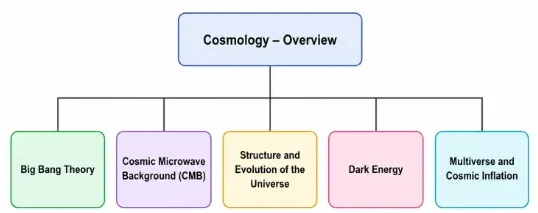
A simple structure chart showing how the Big Bang Theory page fits within the wider Cosmology cluster.
This diagram presents the Cosmology cluster as a simple hierarchical structure. Cosmology Overview appears as the hub page, connected to five major child pages: Big Bang Theory, Cosmic Microwave Background, Structure and Evolution of the Universe, Dark Energy, and Multiverse and Cosmic Inflation. The chart helps students understand how the Big Bang Theory page relates to early-universe evidence, cosmic structure, accelerated expansion, and inflationary cosmology.
Definition and Core Concepts of the Big Bang Theory
The Big Bang Theory describes how the universe transformed over a 13.8 billion-year timeline, changing from an ultra-compressed high-energy plasma state into a cool, structure-filled space.
The Primary Singularity and Energy Densities
Extrapolating the current FLRW metric backwards using general relativity guides the classical cosmological profile toward a mathematical boundary limit called the <strong>initial singularity</strong>. At the time coordinate \(t = 0\), the scale factor drops to zero (\(a = 0\)), forcing the temperature, mass density, and spacetime curvature terms to yield infinite mathematical values.
University physics students must treat this initial singularity as a theoretical boundary, not a confirmed physical structure. The convergence toward infinity indicates that modern classical field models become fundamentally incomplete when evaluated under extreme energy densities. To resolve what actually occurred at the true origin point, general relativity must be mathematically unified with quantum field dynamics.
The Scale Factor and Coordinate Expansion
Cosmological expansion is mathematically tracked using co-moving coordinate grids. The changing physical distance \(d(t)\) between two non-bound points is related to their constant co-moving coordinate separation \(x\) via the time-dependent scale factor \(a(t)\):
$$d(t) = a(t)x$$
Taking the time-derivative of this expression isolates the expansion kinematics, illustrating that the recession velocity \(v\) arises from the stretching of the scale factor over time (\(\dot{a}\)):
This formal derivation confirms that galaxies are not rushing through a static space; instead, the proper spatial distance separating coordinates is growing over time. This uniform scaling profile guarantees that an observer located at any arbitrary coordinate point within the universe will record identical isotropic recession dynamics.
Reflection: What Did the Big Bang Expand Into?
Use this prompt to clarify one of the most common misunderstandings about the Big Bang.
If the Big Bang was not an explosion into empty space, what does it mean to say that the universe expanded?
Your thinking prompt: Think about space itself stretching, galaxies becoming farther apart, and the universe cooling over time.
Suggested reflection: The Big Bang model describes the expansion of space itself. Galaxies are not simply flying through empty space from a central explosion. Instead, on large scales, space between galaxies is stretching, so distant galaxies become farther apart over time.
Key takeaway: The Big Bang is about expanding space, not an explosion from one location.
Key Phases of the Universe’s Evolution
The evolutionary profile of the universe follows a sequence of eras, with each transition driven by shifts in the dominant energy component and cooling thresholds.
The Planck Epoch (\(0\) to \(10^{-43}\) seconds)
During this initial era, the thermal energy scale exceeded \(10^{19}\,\text{GeV}\), compressing the entire observable universe within a radius smaller than the Planck length (\(\ell_P \approx 10^{-35}\,\text{m}\)). Under these conditions, the gravitational force was equal in strength to the gauge interactions, unifying all four fundamental forces into a single primary field.
The Inflationary Phase (\(10^{-36}\) to \(10^{-32}\) seconds)
As the unified grand fields decoupled, a vacuum energy component drove a phase of exponential expansion. The scale factor expanded by a factor of at least \(10^{26}\) within a tiny fraction of a second:
$$a(t) = a_0 e^{Ht}$$
This hyper-expansion stretched microscale quantum fluctuations out to macroscale dimensions, establishing the initial density perturbations that later seeded all large-scale structures.
Big Bang Nucleosynthesis (1 second to 20 minutes)
Once the thermal background cooled down to roughly \(10^9\,\text{K}\), protons and neutrons could bind without being instantly torn apart by high-energy ambient photons. This nuclear phase synthesized the primary light elements of the universe, producing roughly \(75\%\) Hydrogen-1, \(25\%\) Helium-4, and trace fractions of Deuterium, Helium-3, and Lithium-7.
Recombination and Particle Decoupling (\(\approx 380,000\) years)
The temperature dropped past the \(3000\,\text{K}\) threshold, enabling the background thermal kinetic energy to fall below the \(13.6\,\text{eV}\) ionization potential of Hydrogen. Free electrons were rapidly captured by protons to form stable, neutral atoms:
$$p^+ + e^- \rightarrow H + \gamma$$
With the free electron population removed, the photon scattering cross-section plummeted. Photons decoupled from the baryonic fluid, traveling freely across space to form the Cosmic Microwave Background observed today.
Quick Check: Put the Early Universe in Order
Use this prompt to check the broad sequence of cosmic evolution.
Which came first: Big Bang nucleosynthesis, the Cosmic Microwave Background, or the first stars?
Your thinking prompt: Think about light nuclei forming in the first few minutes, light travelling freely after about 380,000 years, and stars forming later.
Suggested answer: Big Bang nucleosynthesis came first, forming light nuclei within the first few minutes. The Cosmic Microwave Background came later, when light began travelling freely about 380,000 years after the Big Bang. The first stars formed later still, after the Dark Ages.
Key takeaway: Cosmic history has an order: light nuclei first, ancient radiation later, stars later still.
Key Evidence Supporting the Big Bang Theory
The validity of the Big Bang model is sustained by several independent observational cornerstones that cross-verify the thermodynamic history of the cosmos.
The Radiative Blackbody Spectrum
The CMB matches a near-perfect blackbody radiation curve with a modern peak temperature of \(T_0 = 2.7255\,\text{K}\), verifying a highly thermal, completely ionized early history.
Linear Cosmological Redshifts
Spectroscopic readings of distant galaxies show a redshift parameter \(z\) that scales linearly with distance, confirming continuous metric expansion.
Primordial Elemental Abundances
Spectroscopic measurements of pristine interstellar gas clouds match the elemental mass fractions predicted by early nuclear reaction networks.
Reflection: Why Is One Evidence Not Enough?
Use this prompt to understand why scientific confidence grows when different observations support the same model.
Why is the Big Bang Theory stronger because it is supported by several different kinds of evidence?
Your thinking prompt: Think about redshift, the CMB, light elements, and galaxy structure all pointing toward an expanding, cooling universe.
Suggested reflection: A model becomes stronger when independent observations support it. Galaxy redshift shows expansion, the CMB shows ancient radiation from a hot early universe, light element abundances match early nuclear reactions, and large-scale structure shows how early fluctuations grew. Together, these clues form a consistent picture.
Key takeaway: The Big Bang Theory is persuasive because multiple independent observations fit the same cosmic story.
Outstanding Questions and Alternative Frameworks
While the baseline Hot Big Bang model successfully tracks cosmic history from one second onward, several high-energy parameters remain active areas of study. Alternative historical perspectives, such as Fred Hoyle’s Steady State Model, attempted to explain cosmic expansion by proposing continuous matter generation to maintain a constant density profile over time. However, the discovery of the CMB blackbody spectrum systematically ruled out the Steady State model, securing the Big Bang framework as the primary scientific paradigm. Modern research focus has shifted toward refining the early parameters of cosmic inflation, diagnosing the quantum gravity mechanisms of the initial singularity, and resolving the Hubble tension mismatch in current expansion rate measurements.
Glossary of Key Big Bang Theory Terms
Big Bang Theory
The primary cosmological framework detailing how the universe expanded and cooled from an ultra-hot, ultra-dense primordial state.
Scale Factor \(a(t)\)
A dimensionless function parameter tracking the relative expansion scale of the spatial metric over cosmic time.
Initial Singularity
The mathematical boundary limit at \(t=0\) where classical relativity equations yield infinite mass-energy densities.
Cosmic Microwave Background
The isotropic relic photon field released during the recombination era, cooled by expansion down to a temperature of \(2.7255\,\text{K}\).
Big Bang Nucleosynthesis
The thermonuclear phase within the first twenty minutes of cosmic time that synthesized the primordial light element mass fractions.
Recombination
The specific epoch where ambient temperatures fell below the ionization potential of Hydrogen, allowing stable neutral atoms to form.
Frequently Asked Questions about the Big Bang Theory
What is the Big Bang Theory in cosmology?
The Big Bang Theory is the prevailing cosmological model that describes the universe as having begun about 13.8 billion years ago from a very hot, dense initial state, followed by expansion and cooling to form the cosmos we observe today.
What evidence supports the Big Bang Theory?
Key evidence includes the observed cosmic expansion (galaxies receding from each other), the cosmic microwave background radiation — relic radiation from shortly after the Big Bang — and the relative abundance of light elements such as hydrogen, helium and lithium, as predicted by Big Bang nucleosynthesis.
What is cosmic microwave background radiation (CMB)?
The cosmic microwave background is faint microwave radiation filling all of space, left over from an early hot phase of the universe. It provides a snapshot of the universe when it was only about 380,000 years old, showing tiny temperature fluctuations that later grew into galaxies and large-scale structure.
What is meant by expansion of space?
The expansion of space refers to the idea that the fabric of space itself is stretching, causing galaxies to move away from each other. This is not motion through space but an increase in distances across space; as a result, light from distant galaxies is redshifted.
Big Bang Theory: Review Questions and Answers
What is the Big Bang Theory and what does it propose about the universe’s origin? Answer: The Big Bang Theory proposes that the universe began as an extremely hot, dense point approximately 13.8 billion years ago and has since been expanding. It explains the evolution of cosmic structures and the cooling of the universe over time.
What key observational evidence supports the Big Bang Theory? Answer: Key evidence includes the cosmic microwave background radiation, the redshift of distant galaxies, and the abundance of light elements such as hydrogen and helium. These observations align with predictions from the Big Bang model.
How does the cosmic microwave background (CMB) provide evidence for the Big Bang? Answer: The CMB is the remnant thermal radiation from the early universe, uniformly detected in every direction. Its temperature fluctuations offer insights into the initial conditions of the universe, supporting the idea of a hot, dense origin.
What role does cosmic inflation play in the Big Bang Theory? Answer: Cosmic inflation refers to a brief period of rapid exponential expansion that occurred fractions of a second after the Big Bang. It explains the large-scale uniformity of the universe and the origin of density fluctuations that later led to galaxy formation.
Comprehensive 7-Problem End-of-Chapter Bank
Quantitative and Thermodynamic Problems
1. Recessional Velocity Determinations at Cosmological Scales
Calculate the recessional expansion velocity (\(v\)) of a galaxy located at a proper distance baseline of exactly \(50\,\text{Mpc}\) from our coordinate center. Assume a modern expansion constant value of \(H_0 = 70\,\text{km/s/Mpc}\).
Click to expand solution
Apply the first-order linear Hubble profile equation: $$v = H_0 d$$ Substitute the target parameters into the equation: $$v = 70\,\text{km/s/Mpc} \times 50\,\text{Mpc} = 3500\,\text{km/s}$$ The galaxy is moving away due to coordinate expansion at an apparent velocity of \(3500\,\text{km/s}\).
2. Cosmological Age Extraction via Constant Expansion Approximations
Determine the first-order age metric (\(t\)) of the expanding universe using the characteristic baseline equation \(t \approx \frac{1}{H_0}\). Assume the fundamental SI unit transformation value of \(H_0 = 2.27 \times 10^{-18}\,\text{s}^{-1}\).
Click to expand solution
Evaluate the inverse Hubble parameter expression: $$t \approx \frac{1}{H_0} = \frac{1}{2.27 \times 10^{-18}\,\text{s}^{-1}} \approx 4.405 \times 10^{17}\,\text{seconds}$$ Convert the time profile from fundamental seconds into solar years: $$t \approx \frac{4.405 \times 10^{17}\,\text{s}}{3.156 \times 10^7\,\text{s/yr}} \approx 1.396 \times 10^{10}\,\text{years}$$ The constant expansion model yields a characteristic age profile of approximately \(14\,\text{billion years}\).
3. Thermal Scaling and Thermodynamic Cosmic Evolution
The modern isotropic temperature profile of the Cosmic Microwave Background photon field is measured to be \(T_0 = 2.7\,\text{K}\). Calculate the background radiation temperature (\(T\)) during the early universe when the cosmic scale factor was exactly \(1000\) times smaller than it is today (\(a = 10^{-3}\)).
Click to expand solution
In an expanding FLRW cosmology, the absolute temperature profile of a decoupled photon field scales inversely with the cosmic scale factor parameter: $$T(a) \propto \frac{1}{a}$$ Set up the scaling ratio relative to modern parameters: $$T = T_0 \times \left(\frac{a_{\text{today}}}{a_{\text{early}}}\right) = 2.7\,\text{K} \times \left(\frac{1}{10^{-3}}\right) = 2.7 \times 1000 = 2700\,\text{K}$$ The temperature of the ambient background radiation field during that specific epoch was exactly \(2700\,\text{K}\).
4. Wave-Mechanical Energy Shifts of Propagating Relic Photons
A primordial photon emitted during the early universe has its structural wavelength (\(\lambda\)) stretched by an exact factor of \(1000\) due to metric space expansion before hitting a detector on Earth. Calculate the exact fractional shift in the photon’s energy profile (\(E\)).
Click to expand solution
The quantum energy carried by a single photon is governed by the Planck-Einstein relation, showing an inverse dependence on wavelength: $$E = \frac{hc}{\lambda} \quad \rightarrow \quad E \propto \frac{1}{\lambda}$$ If expansion stretches the wavelength parameter such that \(\lambda_{\text{observed}} = 1000 \cdot \lambda_{\text{emitted}}\), the relative energy scales down proportionally: $$E_{\text{observed}} = \frac{hc}{1000 \cdot \lambda_{\text{emitted}}} = \frac{E_{\text{emitted}}}{1000}$$ The photon’s total energy content decreases by a factor of exactly \(1000\) due to cosmological redshift.
5. Volumetric Scaling and Early Matter Densities
Modern observations show that the critical mass density of the flat space grid is \(\rho_0 \approx 9.2 \times 10^{-27}\,\text{kg/m}^3\). If the early universe was compressed such that the matter distribution was exactly \(10^6\) times denser than the modern baseline, compute the mass density (\(\rho\)) during that epoch.
Click to expand solution
Apply the linear density multiplication factor directly to the modern parameter baseline: $$\rho = \rho_0 \times 10^6 = (9.2 \times 10^{-27}\,\text{kg/m}^3) \times 10^6 = 9.2 \times 10^{-21}\,\text{kg/m}^3$$ The critical mass density metric during that high-density epoch was exactly \(9.2 \times 10^{-21}\,\text{kg/m}^3\).
6. Geometric Volumetric Transformations of Space Fluid
If the physical distance parameters between non-bound co-moving coordinate points double uniformly (\(d \rightarrow 2d\)) due to scale factor expansion, calculate the exact factor increase in the volume metric (\(V\)) of the spatial region.
Click to expand solution
The spatial volume metric of a three-dimensional coordinate region scales proportionally with the cube of its physical distance dimensions: $$V \propto d^3$$ Substitute the doubled distance modification parameter (\(2d\)) into the volume proportion: $$V_{\text{new}} \propto (2d)^3 = 8d^3 = 8V_{\text{initial}}$$ The total volume metric of the spatial region increases by a factor of exactly \(8\) (or \(2^3\)).
7. Integrated Mass Extraction within High-Density Boundaries
A localized spherical region of the early universe has a measured mass density profile of \(\rho = 1.0 \times 10^{-20}\,\text{kg/m}^3\) distributed across a physical volume boundary of \(V = 1.0 \times 10^{60}\,\text{m}^3\). Compute the total integrated mass (\(M\)) contained within this zone.
Click to expand solution
Use the definition of mass density for a uniformly distributed spatial volume region: $$M = \rho \times V$$ Substitute the given numerical scientific notations: $$M = (1.0 \times 10^{-20}\,\text{kg/m}^3) \times (1.0 \times 10^{60}\,\text{m}^3) = 1.0 \times 10^{40}\,\text{kg}$$ The total integrated mass contained within the boundary coordinates is exactly \(1.0 \times 10^{40}\,\text{kg}\).
Big Bang Theory: Advanced Conceptual Inquiries
These thought-provoking analytical problems explore the theoretical boundaries of the Big Bang model, high-energy particle physics, and quantum gravity frameworks.
1. The Cosmological Puzzles of the Classical Horizon
Explain why two diametrically opposite regions of the observable universe, separated by distances greater than the light-travel horizon since the singularity, possess identical temperatures in the CMB spectrum. State the mechanism that resolves this paradox.
Click to expand solution
This represents the classic Horizon Problem. In standard FLRW expansion configurations without inflation, these distant regions could never have been in causal thermal contact to exchange energy and equalize temperatures before decoupling. The mechanism of Cosmic Inflation resolves this by introducing a phase of hyper-exponential expansion in the early universe. This means the entire observable universe originated from a microscopic, causally connected patch that was completely thermalized before being rapidly stretched across vast distances.
2. Epistemological Implications of Pre-Singularity Eras
Analyze the physical meaning of a cosmological timeline where the scale factor approaches zero (\(a \rightarrow 0\)). Why is it scientifically inaccurate to treat the initial singularity as a confirmed physical point?
Click to expand solution
A mathematical singularity occurs when an analytical model yields infinite parameters (such as infinite mass density or infinite spacetime curvature) due to dividing by a zero scale factor value. In theoretical physics, a singularity represents an explicit breakdown of the boundary limits of General Relativity, signaling that our current classical equations are missing quantum variables. It indicates a limitation of our current modeling theories under high energy scales, rather than proving that a physical entity of infinite density actually existed.
3. Matter-Antimatter Baryon Asymmetry Dynamics
According to standard high-energy quantum field mechanics, equal parts of matter and antimatter should have been created out of pure energy during the early stages of cosmic expansion. Explain how this assumption contradicts modern observations and state the general conditions required to resolve it.
Click to expand solution
If equal distributions of matter and antimatter had been created, they would have completely annihilated into pure radiation during the cooling phase, leaving a universe with zero baryonic matter. Because our observed universe is entirely matter-dominated, a net imbalance must have been generated early on. Resolving this contradiction requires satisfying the Sakharov Conditions: baryon number violation, \(C\) and \(CP\) symmetry violation, and interactions occurring outside of thermal equilibrium during the rapid expansion phase.
Next Core Cosmological Cornerstone
Now that you have mastered expansion metrics and early timelines, take a deep dive into the oldest observable light in the universe.