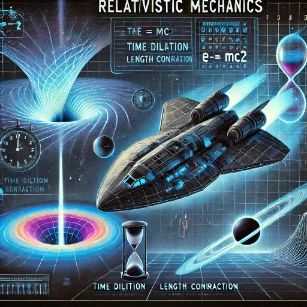
Relativistic mechanics emerged in the early 20th century as a revolutionary framework that extends classical Newtonian principles to regimes involving high velocities and strong gravitational fields. At the heart of this theory lies the principle that the laws of physics must remain consistent for all observers, regardless of their constant velocity or position in a gravitational field. This elegant shift in perspective, pioneered by Einstein, required a reevaluation of foundational ideas in classical mechanics and introduced concepts such as time dilation, length contraction, and the relativity of simultaneity.
Whereas kinematics and dynamics in the Newtonian framework treat time and space as absolute, relativistic mechanics merges them into a four-dimensional continuum known as spacetime. These ideas reshape how we understand motion and causality, especially when dealing with high-speed particles or astronomical objects, as in celestial mechanics. For instance, relativistic corrections are crucial for the accuracy of satellite-based systems like GPS.
Relativistic mechanics also complements and modifies other areas of mechanics, including rigid body dynamics, statics, and vibrations and oscillations. It bridges into more generalized treatments like analytical mechanics and continuum mechanics, especially in the context of relativistic fluids and stress-energy tensors. These principles are vital when analyzing phenomena in black holes, neutron stars, or relativistic jets in astronomy.
Understanding the interplay between force and motion in a relativistic framework necessitates revisiting Newton’s foundational laws. The first, second, and third laws of motion retain their relevance but must be interpreted with respect to inertial and non-inertial frames that account for relativistic transformations.
The impact of relativistic theory extends well beyond mechanics, permeating electromagnetism and field theory. For instance, Maxwell’s equations are naturally consistent with special relativity, tying together electrodynamics, electromagnetic waves, and magnetic fields into a unified framework. This realization led to deeper insights into electromagnetic induction and the behavior of electrostatics in moving frames.
Modern applications of relativistic mechanics include research in magnetohydrodynamics (MHD) and plasma physics, where high-energy particle flows must be modeled with relativistic corrections. This is particularly relevant in astrophysical contexts and fusion energy research. Even in traditional settings like electrical circuits or magnetostatics, relativistic formulations ensure consistency when charges move at significant fractions of light speed.
Relativistic mechanics not only enhances our theoretical understanding but also provides essential tools for practical technologies—from particle accelerators and high-energy astrophysics to next-generation satellite communication. By linking core ideas from mechanics, electromagnetism, and spacetime geometry, it empowers students to appreciate the unity and depth of physical laws across all scales and velocities.

Table of Contents
Key Topics in Relativistic Mechanics
Lorentz Transformations
The Lorentz transformations describe how space and time coordinates change between two inertial reference frames moving relative to each other at a constant velocity. They replace the Galilean transformations of classical mechanics.Lorentz Transformation Equations:
For two reference frames moving at relative velocity v along the x-axis.Where:- x, t are the space and time coordinates in the stationary frame
- x‘, t‘ are the space and time coordinates in the moving frame.
- v is the relative velocity between frames.
- c is the speed of light.
- γ is the Lorentz factor
Time Dilation
Time Dilation implies that a moving clock ticks slower compared to a stationary clock.Where:Length Contraction
Length Contraction states that the length of an object moving at relativistic speeds appears shorter along the direction of motion.Where:- L is the contracted length (measured by a moving observer).
Relativistic Energy and Momentum
Classical definitions of energy and momentum break down at high speeds. Relativistic mechanics introduces corrections.Relativistic Momentum:
Where:Rest Energy:
This iconic equation reveals that mass and energy are equivalent.Energy-Momentum Relation:
Newtonian Mechanics as a Low-Speed Approximation
At velocities much lower than the speed of light (v <<c ), relativistic mechanics reduces to Newtonian mechanics.In this limit, relativistic momentum and energy simplify to their classical counterparts:Applications of Relativistic Mechanics
- Particle Physics: Explains the behavior of subatomic particles in particle accelerators.
- Astrophysics: Describes high-energy cosmic phenomena (black holes, neutron stars, gamma-ray bursts).
- Global Positioning System (GPS): Accounts for time dilation in satellite clocks.
- Nuclear Reactions: Energy released in nuclear reactions follows
Five Numerical Examples
Example 1: Time Dilation for a Fast-Moving Spaceship
Problem: A spaceship travels at 0.8 c. If 10 years pass on Earth, how much time passes on the spacecraft?Solution:Answer: Only 6 years pass on the spaceship.Example 2: Length Contraction of a Moving Train
Problem: A train is 500 m long when at rest. What is its length if it moves at 0.9c?Solution:Answer: The train appears to be 218 meters long.Example 3: Relativistic Momentum of an Electron
Problem:Solution:Answer: The relativistic momentum is approximatelyExample 4: Energy of a Moving Proton
Problem:Solution:Answer:Example 5: Critical Speed for 10% Mass Increase
Problem: At what speed does an object’s mass increase by 10%?Solution:Answer: The speed is approximately 41.7% the speed of light.Why Study Relativistic Mechanics
Understanding High-Speed Physics
Relativistic mechanics describes motion near the speed of light, where classical mechanics breaks down. Students explore time dilation, length contraction, and relativistic momentum. This explains phenomena that cannot be addressed by Newtonian physics. It introduces new perspectives on space and time.
Einstein’s Theory of Special Relativity
Students study the principles of special relativity, including the constancy of light speed and the relativity of simultaneity. These principles revolutionize our understanding of motion and energy. They are essential for advanced physics and cosmology. They challenge intuition and deepen scientific insight.
Applications in Modern Technology
Relativistic effects are important in GPS systems, particle accelerators, and astrophysics. Students learn how time and motion affect real-world measurements. This makes relativity both theoretical and practically relevant. It connects science with space technology and communication systems.
Bridge to General Relativity and Quantum Theory
Relativistic mechanics prepares students for studying gravitation and quantum field theory. It introduces concepts like four-vectors and spacetime intervals. This forms a foundation for modern physics research. It supports exploration of the universe’s fundamental laws.
Scientific Philosophy and Insight
Studying relativity reshapes how students think about reality. It encourages questioning assumptions about time, simultaneity, and causality. This fosters a deeper appreciation for scientific progress. It inspires curiosity and intellectual rigor.
Conclusion on Relativistic Mechanics:
Relativistic Mechanics fundamentally reshapes our understanding of space, time, energy, and momentum at high speeds. It explains phenomena beyond the reach of classical mechanics and underpins modern physics, from particle accelerators to GPS technology.Relativistic Mechanics — FAQ
What is relativistic mechanics, and how does it extend classical mechanics?
Relativistic mechanics is the branch of physics that describes the motion of objects moving at speeds close to the speed of light or in very strong gravitational fields. It extends classical (Newtonian) mechanics by incorporating the principles of Einstein's special and general relativity, showing that time, length, mass, momentum, and energy behave differently at high speeds or in curved spacetime.
When do we need relativistic mechanics instead of Newtonian mechanics?
Newtonian mechanics works extremely well when speeds are much smaller than the speed of light and gravitational fields are weak. Relativistic mechanics becomes necessary when velocities are a significant fraction of the speed of light, when describing very high energy particles, or when strong gravity is involved, such as near neutron stars and black holes. In these regimes, classical formulas give noticeably wrong predictions.
What role does the speed of light play in relativistic mechanics?
In relativity, the speed of light in vacuum is a universal constant that acts as an ultimate speed limit for the transfer of information and for the motion of particles with mass. It appears in the Lorentz factor, which determines how time dilation, length contraction, and relativistic momentum and energy depend on velocity. No material object can be accelerated from rest to or beyond the speed of light using finite energy.
What are time dilation and length contraction?
Time dilation is the effect in special relativity where a moving clock is measured to tick more slowly compared with a clock at rest in a given frame. Length contraction is the effect where an object moving relative to an observer is measured to be shorter along the direction of motion. Both arise from the Lorentz transformations, which relate space and time coordinates between observers moving at constant velocity relative to each other.
How are momentum and energy defined in relativistic mechanics?
In relativistic mechanics, momentum and energy are modified by the Lorentz factor γ. The relativistic momentum is p = γmv, and the total energy is E = γmc², where m is the rest mass, v is the speed, c is the speed of light, and γ = 1/√(1 − v²/c²). At low speeds, these expressions reduce to the familiar Newtonian formulas.
What does the famous equation E = mc² mean?
The equation E = mc² states that mass and energy are equivalent. Even when an object is at rest, it has rest energy equal to its mass multiplied by the speed of light squared. This idea explains why tiny amounts of mass can be converted into huge amounts of energy in nuclear reactions and particle processes and is central to modern physics and technology, from nuclear power to particle accelerators.
What is spacetime, and how does it change our view of motion?
Spacetime is the four dimensional combination of three spatial dimensions and one time dimension into a single geometric framework. In relativity, events are located in spacetime rather than in separate space and time. Motion is described as world lines in spacetime, and the invariance of spacetime intervals under Lorentz transformations explains why different observers can disagree on distances and time intervals but still agree on the underlying physical laws.
How does general relativity modify the idea of gravity from Newton's theory?
In Newtonian mechanics, gravity is a force that acts at a distance between masses. In general relativity, gravity is reinterpreted as the curvature of spacetime caused by mass and energy. Objects follow the straightest possible paths, called geodesics, in this curved spacetime. This leads to effects such as the bending of light near massive bodies, gravitational time dilation, and the existence of black holes.
What experimental evidence supports relativistic mechanics?
Relativistic mechanics is supported by many experiments and observations. Examples include time dilation measured with fast moving particles and atomic clocks on aircraft and satellites, the correct prediction of Mercury's orbit, the bending of starlight near the Sun, and the behaviour of particles in accelerators. Technologies such as GPS systems also rely on relativistic corrections to function accurately.
What mathematics is helpful for studying relativistic mechanics?
To study relativistic mechanics, it is helpful to be comfortable with algebra, vectors, basic trigonometry, and introductory calculus. For deeper work, especially in general relativity, knowledge of differential equations, matrices, and some elements of linear algebra and tensor notation becomes important. The Prep4Uni materials highlight where each mathematical tool is used so you can build both mathematical and physical understanding together.
How does relativistic mechanics connect to astrophysics and particle physics?
Relativistic mechanics is essential in astrophysics for understanding neutron stars, black holes, gravitational waves, and the large scale structure of the universe. In particle physics, it is needed to interpret high energy collisions, particle creation and annihilation, and the behaviour of particles that move very close to the speed of light. Many modern research areas rely on relativistic ideas as a basic language.
How can the relativistic mechanics section on Prep4Uni help me prepare for future studies?
The relativistic mechanics section on Prep4Uni introduces the key ideas of special and general relativity in an accessible, pre-university-friendly way. By working through conceptual explanations, diagrams, thought experiments, and guided problems, you will develop intuition for time dilation, length contraction, relativistic energy, and curved spacetime, providing a strong foundation for later courses in modern physics, astrophysics, and high-energy physics.