Prepare for University Studies & Career Advancement

Kinematics

Kinematics is the branch of physics that deals with the description of motion without considering its causes. It provides the foundational vocabulary and mathematical tools needed to analyze how objects move through space and time. As an essential part of classical mechanics, kinematics sets the stage for deeper explorations into force, energy, and dynamics by focusing on quantities such as displacement, velocity, acceleration, and time.

To truly understand motion, students must be comfortable transitioning between different frames of reference, exploring both one-dimensional and multi-dimensional motion. These studies feed directly into more complex areas like dynamics, where forces that cause motion are considered, and rigid body dynamics, which applies kinematic principles to rotational and coupled translational movements.

Kinematics is also foundational for understanding Newton’s First Law of Motion, which describes the persistence of motion in the absence of net force, and the subsequent laws which quantify the interactions that change motion. These principles are essential for solving problems in statics and vibrations and oscillations, where motion is constrained or periodic.

In space and astronomy, the study of celestial mechanics draws heavily on kinematic principles to trace the trajectories of planets, comets, and satellites. More advanced perspectives are offered by analytical mechanics, where motion is described in terms of generalized coordinates, and by continuum mechanics, where fluid or solid deformation is considered within moving continua.

The study of motion also spans into the fluid domain, where fluid mechanics applies kinematic concepts to the flow of liquids and gases. For high-speed or astrophysical contexts, relativistic mechanics extends kinematic formulations to near-light-speed conditions, accounting for time dilation and length contraction.

Kinematics also finds synergy with the field of Electricity & Magnetism. The movement of charged particles in electrical circuits, the behavior of particles in magnetic fields, and the propagation of electromagnetic waves all require kinematic descriptions to understand motion, direction, and field interactions.

Kinematic analysis is essential in exploring phenomena such as electromagnetic induction and electrodynamics, where moving conductors and time-varying fields interact. At a more advanced level, concepts from magnetohydrodynamics and plasma physics incorporate fluid motion and electromagnetic forces, applying kinematics in complex environments such as solar flares and nuclear fusion reactors.

Kinematics even intersects with fundamental electrostatic principles, as seen in electrostatics and magnetostatics, where field line geometry and force direction determine motion in fields. From particle accelerators to space probes, mastering the description of motion is essential for success across physics and engineering disciplines.

By grasping the principles of kinematics, students build the conceptual and computational foundation needed to explore how objects move under various conditions. This understanding forms a bridge to more complex and realistic models of physical systems, making kinematics an indispensable part of a student’s journey into the physical sciences.

For students pursuing specialized technical tracks, these core geometric models expand directly into advanced computing and mechanical fields. The structural translation matrices, coordinate frames, and multi-joint velocity profiles used to navigate automated systems are mapped comprehensively in our guide on robot kinematics and dynamics under the artificial intelligence and robotics curriculum. This robotics pathway bridges foundational particle trajectories with real-world spatial transforms and multi-axis actuator control loops.

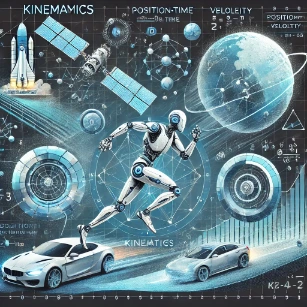
Kinematics illustration showing motion, position-time and velocity concepts with vehicles, robotics, and space applications
Illustration of kinematics, representing motion through position, velocity, and time relationships across applications such as vehicles, robotics, and space systems.

Mechanics Through the Lens of Geometry and Trajectory Tracking

Mechanics – Overview

Establishes the broad foundations of motion parameters across all physical configurations.

Kinematics

Maps the geometric paths, velocity profiles, and tracking vectors of motion without forces.

Dynamics

Investigates the unbalanced vector force fields that act to cause changes in motion states.

First Law of Motion

Defines the default inertial baseline of uniform velocity in zero-net-force space fields.

Second Law of Motion

Quantifies forced linear acceleration vectors by coupling applied loads to internal system mass.

Third Law of Motion

Establishes strict vector symmetry rules for simultaneous force exchanges between bodies.

Statics

Maps systems where velocity functions remain uniformly bounded at absolute static rest.

Rigid Body Dynamics

Applies spatial coordinates to multi-particle structures experiencing angular tracking paths.

Vibrations & Oscillations

Analyzes periodic, time-dependent variations around stable position coordinate indexes.

Fluid Mechanics

Tracks velocity vectors, streamlines, and flow geometries inside continuously deforming materials.

Continuum Mechanics

Defines continuous spatial field transformations across solid and fluid mediums.

Analytical Mechanics

Formulates system trajectories from scalar constraints using energy tracking equations.

Celestial Mechanics

Traces orbital pathways and planetary trajectories under macroscopic force interactions.

Relativistic Mechanics

Adapts coordinate matrices to account for high velocity transformations in spacetime.

Table of Contents

Key Concepts in Kinematics

Displacement

Displacement is defined as the net change in position of an object from its initial coordinate origin to its final destination point. It is a vector quantity, meaning it possesses both a scalar magnitude and a specific spatial direction.

$$\Delta x = x_f – x_i$$

Where variables map cleanly as:
  • Δx = Total linear displacement vector.
  • xf = Final position coordinate index.
  • xi = Initial position coordinate index.

Critical Distinction from Distance

  • Displacement can evaluate as positive, negative, or zero depending entirely on the direction of the travel vector relative to the reference frame axis.
  • Distance is a pure scalar property that accumulates the total path length covered by an object during its motion, completely independent of geometric orientation.

Velocity

Velocity represents the time rate of change of an object’s displacement vector field. It is a vector quantity coupling instantaneous speed with directional orientation.

Average Velocity

The average velocity tracks the net position displacement over a finite, discrete time interval:

$$v_{\text{avg}} = \frac{\Delta x}{\Delta t}$$

Instantaneous Velocity

The instantaneous velocity defines the exact rate of position shift at a single, infinitesimal moment in time, evaluated as the first derivative of position:

$$v = \frac{dx}{dt}$$

Critical Distinction from Speed

  • Linear speed is a scalar parameter mapping only the magnitude of motion.
  • An object traveling along a perfectly circular path at a constant speed experiences a continuously changing velocity vector field because its spatial direction vector updates at every position interval.

Acceleration

Acceleration measures the time rate of change of an object’s velocity vector field. Like position and velocity, it operates as a vector quantity.

Average Acceleration

Tracks the total net shift in velocity parameters across a discrete elapsed timeline:

$$a_{\text{avg}} = \frac{\Delta v}{\Delta t}$$

Instantaneous Acceleration

Evaluates the immediate acceleration rate at an isolated moment, defined as the derivative of velocity or the second derivative of spatial position:

$$a = \frac{dv}{dt} = \frac{d^2x}{dt^2}$$

Directional Dynamics

  • Positive acceleration implies the acceleration vector aligns in the same direction as the baseline velocity vector, increasing system speed.
  • Negative acceleration (deceleration) indicates the acceleration vector directly opposes the velocity path, acting to reduce system speed.

Primary Classifications of Motion Profiles

Uniform Motion Parameters

An object undergoing uniform motion travels with a perfectly constant velocity vector field, meaning its system acceleration remains identically zero $$a = 0$$ This profile results in equal linear displacements over equal time increments along a straight line tracking path:

$$x(t) = x_i + vt$$

Non-Uniform Motion Parameters

Non-uniform motion describes trajectories where the system velocity function varies continuously over time, meaning the object experiences an active, non-zero acceleration or deceleration profile $$a \neq 0$$ This condition creates unequal spatial displacements across equal time slices along linear or curvilinear pathways.

Equations of Motion (Linear Kinematics)

For physical systems moving along a straight coordinate axis under a constant, unchanging acceleration profile $$a = \text{Constant}$$, trajectories can be fully solved using the standard kinematic equations:

1. Velocity-Time Relation

$$v = v_i + at$$

2. Displacement-Time Relation

$$x = x_i + v_i t + \frac{1}{2}at^2$$

3. Velocity-Displacement Relation

$$v^2 = v_i^2 + 2a(x – x_i)$$

4. Average Velocity Balance

$$v_{\text{avg}} = \frac{v_i + v}{2}$$

Rotational Kinematics

When tracking systems moving through angular orbits rather than straight paths, linear metrics map directly onto rotational analogs:
  • Angular Displacement $$\theta$$: The net change in angular position coordinates, measured in radians.
  • Angular Velocity $$\omega$$: The instantaneous rate of change of angular displacement over time:
    $$\omega = \frac{d\theta}{dt}$$
  • Angular Acceleration $$\alpha$$: The instantaneous rate of change of the system’s angular velocity profile:
    $$\alpha = \frac{d\omega}{dt} = \frac{d^2\theta}{dt^2}$$

Rotational Kinematic Equations

Under a constant angular acceleration field $$\alpha = \text{Constant}$$, rotational mechanics are completely solved via the following equations:

$$\omega = \omega_i + \alpha t$$
$$\theta = \theta_i + \omega_i t + \frac{1}{2}\alpha t^2$$
$$\omega^2 = \omega_i^2 + 2\alpha(\theta – \theta_i)$$

Relativistic Kinematics: Spacetime Coordinate Transformations

The Geometry of Motion Near Light-Speed Limits

In classical Newtonian kinematics, space and time are treated as absolute, independent backdrops. A time interval $$\Delta t$$ or a spatial length $$\Delta x$$ measures identically for all observers, regardless of their relative velocity states. However, when an object accelerates to high cosmic speeds, classical Galilean transforms fail completely, and kinematics must be rewritten using the geometry of Minkowski Spacetime.
To transition from a stationary frame to a high-speed tracking frame moving at velocity $$v$$, positions must be mapped using the non-linear Lorentz Transformation Matrices:

$$x’ = \gamma (x – vt)$$
$$t’ = \gamma \left(t – \frac{vx}{c^2}\right)$$

Where the dynamic coordinate warping factor is determined strictly by the dimensionless Lorentz multiplier:

$$\gamma = \frac{1}{\sqrt{1 – \frac{v^2}{c^2}}}$$

This relativistic restructuring introduces two profound geometric distortions into kinematic analysis:
  • Kinematic Time Dilation: Moving clocks tick slower relative to a stationary observer. The time tracking interval expands non-linearly as velocity climbs.
  • Lorentz-FitzGerald Length Contraction: Moving objects physically contract along their exact vector axis of travel, altering spatial displacement profiles.
By mapping particle motion along continuous four-vector paths (worldlines) within a light-cone framework, relativistic kinematics forms the absolute operational basis for tracking particle trajectories inside high-energy particle accelerators and calibrating timing signals for global satellite GPS tracking networks.

Engineering Applications of Kinematics

Vehicle Motion and Safety Analysis

Tracking transient velocity changes and deceleration capacities forms the core framework for designing highway safety profiles, calculating minimum safe braking thresholds, and optimizing automated cruise control loops.

Two-Dimensional Projectile Motion

Projectile tracking isolates two-dimensional pathways for unpowered objects launching into fluid atmospheres under uniform gravitational fields, providing essential data models for sports mechanics, launch ballistic designs, and orbital insertion steps.

Machinery and Robotics Automation

Inverse and forward kinematics formulas compute the exact coordinate angles required for automated mechanical linkages and multi-axis robotic arms to guide end-effectors along precise trajectory lines with micro-scale repeatability.

Space Exploration and Orbitology

Kinematic tracking metrics map localized satellite orbital vectors, predict precise planetary flyby windows, and schedule telemetry tracking paths for interplanetary deep-space probes.

Biomechanical Sports Science

High-speed optical motion tracking filters joint angular velocities and linear foot acceleration patterns to maximize athletic efficiency while identifying structural loads that increase joint injury risks.

Numerical Problems and Solutions

Example 1: Linear Car Acceleration Metrics

Problem: A vehicle accelerates uniformly from an absolute resting index up to a target speed of 25 m/s over a time window of 5 seconds. Calculate its linear acceleration rate.

$$v_i = 0 \text{ m/s}, \quad v_f = 25 \text{ m/s}, \quad t = 5 \text{ s}$$

Solution:

Applying the linear velocity-time relation:
$$a = \frac{v_f – v_i}{t}$$
$$a = \frac{25 – 0}{5} = 5.0 \text{ m/s}^2$$
Answer: The car’s uniform acceleration rate is 5.0 m/s2.

Example 2: Gravitational Acceleration of a Falling Object

Problem: A research payload is released from rest from a high static altitude position. Determine the total vertical displacement drop accumulated after an elapsed duration of exactly 3 seconds.

$$v_i = 0 \text{ m/s}, \quad t = 3 \text{ s}, \quad g = 9.8 \text{ m/s}^2$$

Solution:

Applying the displacement-time equation from a zero initial velocity baseline:
$$x = \frac{1}{2}g \cdot t^2$$
$$x = \frac{1}{2} \times 9.8 \times (3)^2$$
$$x = 4.9 \times 9 = 44.1 \text{ meters}$$
Answer: The object drops a vertical distance of 44.1 meters.

Example 3: Peak Altitudes in Projectile Motion

Problem: A ball is launched vertically upward from ground level with an initial velocity vector of 20 m/s. Calculate the absolute peak vertical height reached by the ball before its trajectory reverses.

$$v_i = 20 \text{ m/s}, \quad v_f = 0 \text{ m/s (at peak apex)}, \quad a = -9.8 \text{ m/s}^2$$

Solution:

Utilizing the velocity-displacement kinematic equation:
$$v_f^2 = v_i^2 + 2a \cdot h$$
$$0 = (20)^2 + 2(-9.8) \cdot h Lights$$
$$0 = 400 – 19.6h$$
$$19.6h = 400$$
$$h = \frac{400}{19.6} \approx 20.41 \text{ meters}$$
Answer: The ball reaches a maximum vertical height of approximately 20.41 meters.

Why Study Kinematics

Describing Motion Without Forces

Kinematics focuses on the motion of objects without considering the forces that cause them. Students learn about displacement, velocity, acceleration, and time relationships. These concepts are foundational for all fields of mechanics. They support understanding of how objects move in space and time.

Graphical and Mathematical Analysis

Students use equations and graphs to analyze linear and angular motion. This helps interpret data and solve practical problems. It builds strong mathematical reasoning skills. It prepares students for deeper studies in dynamics and physics.

Real-World Applications

Kinematics applies to vehicle motion, projectile trajectories, and robotics. Students explore motion in sports, transportation, and natural systems. This makes the subject engaging and practically useful. It links physics to everyday experiences.

Foundation for Dynamics

Understanding kinematics is essential before learning the forces that cause motion. Students build a clear picture of how motion is measured and described. This supports success in studying Newton’s laws and mechanical systems. It lays the groundwork for advanced mechanics.

Visualization and Simulation

Kinematics concepts are often visualized using simulations and motion tracking tools. Students develop spatial awareness and data interpretation skills. These tools enhance conceptual understanding. They also provide a bridge to engineering and computer science applications.

Conclusion in Kinematics

Kinematics forms the bedrock of mechanics by providing a comprehensive framework to describe and analyze the motion of objects. It deals with the concepts of displacement, velocity, and acceleration for both linear and rotational systems. Its principles are widely applicable across various fields, from engineering and robotics to sports science and space exploration. Understanding kinematics is essential for solving real-world problems and advancing technology.

Kinematics — FAQ

What is kinematics in physics, and how is it different from dynamics?

Kinematics is the branch of mechanics that describes how objects move, using quantities such as displacement, velocity, and acceleration. It does not ask what causes the motion. Dynamics, on the other hand, explains why motion changes by relating forces and torques to acceleration through Newton's laws.

What is the difference between distance and displacement?

Distance is a scalar that measures how much ground an object has covered along its path, without regard to direction. Displacement is a vector that measures the straight-line change in position from the starting point to the ending point, including direction. An object can travel a large distance but have zero displacement if it returns to its starting point.

How do speed and velocity differ in kinematics?

Speed is a scalar quantity that describes how fast an object is moving, regardless of direction. Velocity is a vector that includes both speed and direction. For example, 10 m/s is a speed, while 10 m/s to the east is a velocity. Changing direction, even at constant speed, means the velocity has changed.

What does acceleration mean in kinematics?

Acceleration is the rate of change of velocity with respect to time. A body accelerates when its speed changes, its direction changes, or both. This means you can have acceleration even at constant speed, as in uniform circular motion, where the direction of the velocity is continually changing.

What are the standard equations of motion for constant acceleration?

For motion in a straight line with constant acceleration, the core kinematics equations are formulated as:

$$v_f = v_i + at$$ $$\Delta x = v_i t + \frac{1}{2}at^2$$ $$v_f^2 = v_i^2 + 2a\Delta x$$ $$v_{\text{avg}} = \frac{v_i + v_f}{2}$$

Where vi is the initial velocity, vf is the final velocity, Δx is the net displacement, t is the elapsed time tracking parameter, and a represents the uniform acceleration rate.

How are position–time and velocity–time graphs used in kinematics?

On a position–time graph, the slope at any point gives the velocity. A straight line means constant velocity, while a curved line indicates changing velocity. On a velocity–time graph, the slope gives the acceleration and the area under the graph between two times gives the displacement. Graphs are powerful tools for visualising and analysing motion without working only with equations.

What is projectile motion, and why is it studied in kinematics?

Projectile motion is the two-dimensional motion of an object that is launched and then moves under the influence of gravity alone, neglecting air resistance. Its horizontal motion has constant velocity, while its vertical motion has constant acceleration due to gravity. Studying projectile motion helps students practice resolving vectors into components and combining motions at right angles.

How do vectors and components help in solving kinematics problems?

In many problems, motion occurs in two or three dimensions. Representing displacement, velocity, and acceleration as vectors and resolving them into perpendicular components allows you to treat each direction separately. You can then apply one-dimensional kinematics equations to each component and recombine the results to find the overall motion.

What is relative motion, and why can two observers disagree on velocity?

Relative motion describes how the velocity of an object depends on the observer's frame of reference. Two observers moving at different velocities will measure different velocities for the same object, even though the underlying physics is consistent. Kinematics provides simple vector rules for adding and subtracting velocities to relate these different viewpoints.

What are common misconceptions students have about kinematics?

Common misconceptions include thinking that zero velocity implies zero acceleration, assuming acceleration must always be in the direction of motion, or confusing distance with displacement and speed with velocity. Another frequent error is reading graphs incorrectly, for example, mistaking the height of a position–time graph for speed rather than using the slope.

How does kinematics connect to other areas of physics and engineering?

Kinematics underpins dynamics, where forces are introduced, and feeds into topics such as mechanics of materials, robotics, biomechanics, and vehicle and aerospace engineering. Understanding how to describe motion accurately is essential before you analyse why it happens or how to control it in real systems.

How can the kinematics section on Prep4Uni help me prepare for university and careers?

The kinematics section on Prep4Uni is designed to build strong intuition and fluency with motion concepts before you encounter more advanced mathematics and dynamics. Through worked examples and practice questions, it helps you move beyond memorising formulas to understanding how to model real motion, a skill that is valuable in physics, engineering, data science, and many technical careers.

Kinematics: Review Questions and Answers

  1. What is kinematics and why is it important in physics?
    Answer: Kinematics is the branch of mechanics that describes the motion of objects without considering the forces that cause the motion. It is important because it provides the fundamental language and equations needed to analyze how objects move.
  2. How is displacement defined in kinematics?
    Answer: Displacement is the vector quantity representing the change in position of an object. It is defined by both magnitude and direction, distinguishing it from distance, which is a scalar.
  3. What is the difference between speed and velocity?
    Answer: Speed is a scalar quantity that measures how fast an object is moving, while velocity is a vector quantity that describes both the speed and the direction of motion.
  4. How do you calculate average velocity?
    Answer: Average velocity is calculated by dividing the total displacement by the total time taken. It reflects the overall change in position over a given time interval.
  5. What is acceleration in the context of kinematics?
    Answer: Acceleration is the rate at which an object’s velocity changes with time. It can be positive, meaning speeding up, or negative, meaning slowing down, and is a vector quantity.
  6. How is instantaneous velocity determined from a displacement-time graph?
    Answer: Instantaneous velocity is determined by calculating the slope of the tangent line to the displacement-time graph at a specific point in time.
  7. How do kinematic equations relate displacement, velocity, acceleration, and time?
    Answer: Kinematic equations provide mathematical relationships that connect displacement, initial and final velocity, acceleration, and time under conditions of constant acceleration, allowing the calculation of unknown variables.
  8. What information does a velocity-time graph provide in kinematics?
    Answer: A velocity-time graph shows how an object’s velocity changes over time. The slope of the graph represents acceleration, and the area under the curve represents the displacement.
  9. How can one determine the acceleration of an object using a velocity-time graph?
    Answer: The acceleration is found by determining the slope, or rise over run, of the velocity-time graph, which quantifies the rate of change of velocity.
  10. Why are vector quantities essential in the study of kinematics?
    Answer: Vector quantities are essential because they include both magnitude and direction, which are critical for accurately describing and analyzing the motion of objects in space.

Kinematics: Thought-Provoking Questions and Answers

  1. How does the concept of instantaneous velocity deepen our understanding of non-uniform motion?
    Answer: Instantaneous velocity captures the precise rate of change of displacement at any moment, allowing us to analyze and predict the behavior of objects undergoing non-uniform motion. This concept is fundamental in understanding complex motions where acceleration varies continuously.
  2. In what ways can graphical analysis enhance the study of kinematics compared to purely algebraic methods?
    Answer: Graphical analysis visually represents motion, making it easier to interpret changes in velocity, acceleration, and displacement over time. It also helps in identifying trends, inflection points, and the impact of variable acceleration, complementing algebraic methods for a more intuitive understanding.
  3. How might errors in measurement affect the determination of displacement and velocity in experimental kinematics?
    Answer: Measurement errors can lead to inaccuracies in the calculated displacement and velocity, which may affect the reliability of kinematic analysis. Understanding error propagation and employing precise instruments are crucial for minimizing these uncertainties in experimental studies.
  4. What are the limitations of classical kinematic equations when dealing with highly variable acceleration?
    Answer: Classical kinematic equations assume constant acceleration and may not accurately predict motion when acceleration varies over time. In such cases, calculus-based approaches that use derivatives and integrals are needed to accurately model the motion.
  5. How does the integration of calculus enhance the analysis of motion in kinematics?
    Answer: Calculus allows for the determination of instantaneous rates of change through derivatives and the calculation of displacement through integration. This integration provides a more flexible and accurate analysis of motion, especially in systems with non-constant acceleration.
  6. How can kinematics be applied to understand motion in sports and athletic performance?
    Answer: Kinematics helps in analyzing the movement patterns of athletes, optimizing techniques, and improving performance. By studying motion parameters such as velocity, acceleration, and displacement, coaches and scientists can develop training methods that enhance efficiency and reduce injury risks.
  7. In what ways can computer simulations and motion capture technology revolutionize kinematic analysis in modern research?
    Answer: Computer simulations and motion capture technology enable precise tracking of motion in real time, allowing for detailed kinematic analysis. These tools help researchers visualize complex movements, validate theoretical models, and improve designs in engineering, sports, and robotics.
  8. How might the principles of kinematics be extended to analyze motion in non-inertial reference frames?
    Answer: In non-inertial reference frames, fictitious forces such as the Coriolis and centrifugal forces must be considered. Extending kinematic analysis to these frames involves modifying the standard equations to account for these additional forces, thereby providing insights into phenomena observed in rotating or accelerating systems.
  9. What role does kinematics play in the development of autonomous vehicles and robotics?
    Answer: Kinematics is fundamental in programming the motion of autonomous vehicles and robots, enabling them to navigate, avoid obstacles, and perform tasks accurately. By applying kinematic principles, engineers can design algorithms that calculate optimal trajectories and ensure smooth, efficient motion.
  10. How do environmental factors like wind or surface irregularities influence kinematic measurements in real-world scenarios?
    Answer: Environmental factors can introduce external forces that alter an object’s motion, leading to deviations from ideal kinematic predictions. Accounting for these factors is essential for accurate modeling and can involve incorporating friction, drag, and other resistive forces into the analysis.
  11. How does the study of kinematics contribute to our understanding of planetary motion and orbital mechanics?
    Answer: Kinematics provides the tools to describe the motion of celestial bodies, including displacement, velocity, and acceleration. This understanding is crucial in predicting planetary orbits, calculating transfer trajectories, and planning space missions where precise motion analysis is required.
  12. What future advancements in technology could further refine our ability to measure and analyze motion in kinematics?
    Answer: Future advancements such as improved sensor technology, high-speed imaging, and enhanced computational models will allow for more precise measurements of motion. These developments could lead to breakthroughs in understanding complex dynamic systems and further integrate kinematic analysis with fields like artificial intelligence and biomechanics.

Numerical Problems and Solutions

  1. Problem: A car starts from rest and accelerates uniformly to 24 m/s in 8 seconds. Find the acceleration and distance travelled.

    Solution:

    Calculate the uniform acceleration rate:
    $$a = \frac{v_f – v_i}{t} = \frac{24 – 0}{8} = 3.0 \text{ m/s}^2$$

    Calculate the net displacement using the constant acceleration profile:
    $$\Delta x = v_i t + \frac{1}{2}at^2$$
    $$\Delta x = 0 + \left(\frac{1}{2} \times 3.0 \times 8^2\right) = 1.5 \times 64 = 96 \text{ meters}$$
    Answer: The acceleration is 3.0 m/s2 and the distance travelled is 96 meters.

  2. Problem: An object moves with constant velocity 15 m/s for 12 seconds. Find the displacement.

    Solution:

    For uniform velocity profiles with zero acceleration:
    $$\Delta x = v \cdot t$$
    $$\Delta x = 15 \times 12 = 180 \text{ meters}$$
    Answer: The net displacement is 180 meters.

  3. Problem: A runner increases speed from 4 m/s to 8 m/s in 5 seconds. Find the acceleration.

    Solution:

    Using the velocity tracking equation:
    $$a = \frac{v_f – v_i}{t}$$
    $$a = \frac{8 – 4}{5} = \frac{4}{5} = 0.8 \text{ m/s}^2$$
    Answer: The acceleration is 0.8 m/s2.

  4. Problem: A ball is thrown upward with initial velocity 20 m/s. Find the time to reach maximum height. Use gravity acceleration constant $$g = 9.8 \text{ m/s}^2$$

    Solution:

    At the absolute peak trajectory apex, instantaneous velocity hits zero $$v_f = 0$$
    $$v_f = v_i – gt$$
    $$0 = 20 – 9.8t$$
    $$9.8t = 20$$
    $$t = \frac{20}{9.8} \approx 2.04 \text{ seconds}$$
    Answer: The time taken to reach maximum height is approximately 2.04 seconds.

  5. Problem: A projectile is launched at 30 m/s at an angle of 45 degrees relative to the horizon. Find the horizontal velocity component.

    Solution:

    Isolating the vector component along the horizontal axis:
    $$v_x = v \cdot \cos(\theta)$$
    $$v_x = 30 \times \cos(45^{\circ})$$
    $$v_x = 30 \times \frac{\sqrt{2}}{2} \approx 21.21 \text{ m/s}$$
    Answer: The horizontal velocity component is approximately 21.21 m/s.

  6. Problem: A car moving at 20 m/s comes to a complete stop over a braking window of 4 seconds. Find the deceleration rate and total stopping distance.

    Solution:

    Calculate the uniform acceleration rate:
    $$a = \frac{v_f – v_i}{t} = \frac{0 – 20}{4} = -5.0 \text{ m/s}^2$$

    Determine the stopping displacement:
    $$\Delta x = v_i t + \frac{1}{2}at^2$$
    $$\Delta x = 20(4) + \left(\frac{1}{2} \times (-5.0) \times 4^2\right) = 80 – 40 = 40 \text{ meters}$$
    Answer: The deceleration magnitude is 5.0 m/s2 and the total stopping distance is 40 meters.

  7. Problem: An object travels 150 meters in 10 seconds starting from rest with constant acceleration. Find the acceleration and final velocity.

    Solution:

    Isolate the acceleration parameter from the kinematic equation:
    $$\Delta x = \frac{1}{2}at^2$$
    $$150 = \frac{1}{2} \cdot a \cdot (10)^2$$
    $$150 = 50a$$
    $$a = 3.0 \text{ m/s}^2$$

    Solve for the terminal final velocity:
    $$v_f = v_i + at = 0 + (3.0 \times 10) = 30 \text{ m/s}$$
    Answer: The acceleration is 3.0 m/s2 and the final velocity is 30 m/s.

  8. Problem: A cyclist accelerates uniformly from 5 m/s to 15 m/s in 6 seconds. Find the displacement.

    Solution:

    First evaluate the system average velocity:
    $$v_{\text{avg}} = \frac{v_i + v_f}{2} = \frac{5 + 15}{2} = 10 \text{ m/s}$$

    Calculate displacement using the average velocity window:
    $$\Delta x = v_{\text{avg}} \cdot t = 10 \times 6 = 60 \text{ meters}$$
    Answer: The total displacement is 60 meters.

  9. Problem: A stone is dropped from a stationary height of 80 meters. Find the time taken to reach the ground.

    Solution:

    Isolating the temporal duration parameter assuming zero initial velocity:
    $$\Delta x = \frac{1}{2}g \cdot t^2$$
    $$80 = \frac{1}{2} \times 9.8 \times t^2$$
    $$80 = 4.9t^2$$
    $$t^2 = \frac{80}{4.9} \approx 16.326$$
    $$t = \sqrt{16.326} \approx 4.04 \text{ seconds}$$
    Answer: The time taken to reach the ground is approximately 4.04 seconds.

  10. Problem: A train enters a segment at 25 m/s and accelerates at 0.5 m/s2 for 12 seconds. Find its final velocity and total distance covered.

    Solution:

    Calculate the final velocity:
    $$v_f = v_i + at = 25 + (0.5 \times 12) = 25 + 6 = 31 \text{ m/s}$$

    Calculate the distance traveled:
    $$\Delta x = v_i t + \frac{1}{2}at^2$$
    $$\Delta x = 25(12) + \left(\frac{1}{2} \times 0.5 \times 12^2\right)$$
    $$\Delta x = 300 + (0.25 \times 144) = 300 + 36 = 336 \text{ meters}$$
    Answer: The terminal velocity is 31 m/s and the distance covered is 336 meters.

Last updated: 06 Jul 2026