
The Third Law of Motion stands as a cornerstone principle in Physics, dictating that forces are fundamentally mutual interactions between distinct bodies. Symmetrical mechanics show that a single, isolated force cannot exist in nature. This structural rule underpins everything from aerospace propulsion matrices to contact mechanics, extending basic particle physics into advanced industrial modeling frameworks.
While introductory frameworks analyze these interactions within simple, idealized configurations, advanced structural tracking methods turn to analytical mechanics. There, generalized coordinates, constraints, and Lagrangian or Hamiltonian variations offer rigorous mathematical systems to map reactive forces. In orbital systems, celestial mechanics uses this physical reciprocity to track planet-moon orbits, while continuum mechanics applies these balancing stresses across continuous matter fields.
Practical engineering examples often emerge in fluid dynamics, where jet propulsion, propeller thrust vectors, and lift profiles are calculated as direct reactions to directed fluid momentum. Even under extreme relativistic conditions near cosmic speed limits, localized momentum conservation principles continue to rely on the underlying symmetry of physical interactions.
Specialized engineering scenarios, such as gear assemblies or torque transmissions, apply this law within rigid body dynamics. Conversely, static systems rely on it to ensure perfect static equilibrium. When dealing with structural vibrations, restoring force vectors and damping mechanics mirror this reciprocal balance across every time step.
Crucially, this symmetry extends far beyond mechanical contact. In the study of Electricity & Magnetism, electrostatic repulsion, magnetic field pairings, and radiation pressure all follow Newtonian reciprocity. In electrodynamics and electromagnetic induction, mutual induction profiles demonstrate this symmetry through predictable electrical fields. This structural balance anchors physical systems across both mechanical and electromagnetic domains.
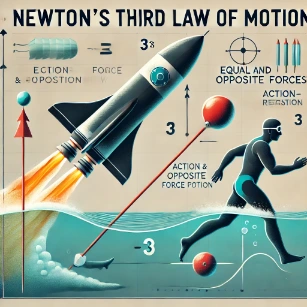
Mechanics Through the Lens of Interaction and Reciprocity
Mechanics – Overview
Frames all interactions across physical systems.Third Law of Motion
Defines mutual force exchange between interacting bodies.Second Law of Motion
Uses interaction forces to produce acceleration.Dynamics
Tracks how interactions evolve over time.First Law of Motion
Defines motion prior to interaction effects.Statics
Ensures balanced interactions in equilibrium.Rigid Body Dynamics
Applies interaction forces to rotational motion.Continuum Mechanics
Distributes interaction forces within materials.Fluid Mechanics
Models interaction through pressure and shear forces.Vibrations & Oscillations
Describes oscillations arising from interaction forces.Celestial Mechanics
Explains gravitational interaction between bodies.Analytical Mechanics
Encodes interactions through energy symmetry.Relativistic Mechanics
Reinterprets interactions under relativistic constraints.Kinematics
Observes motion resulting from interactions.Third Law of Motion: Mathematical Representation
- $$\mathbf{F}_{12}$$ The action force vector applied by the first object onto the second object.
- $$\mathbf{F}_{21}$$ The corresponding reaction force vector applied by the second object back onto the first object.
Key Mechanics Concepts
- Symmetrical Force Pairs: Forces never exist as isolated scalars. They are fundamentally reciprocal vector interactions that occur exclusively between pairs of objects.
- Equal Magnitude, Opposite Vector Sign: The interacting forces are identical in scalar strength but face exactly 180 degrees apart in geometric orientation.
- Action on Independent Bodies: Action and reaction vectors act on completely different objects. Because they map to different free-body diagrams, they can never cancel each other out to prevent systemic motion.
- Mass-Dependent Acceleration: While the interaction force is equal on both objects, the resulting acceleration profiles depend heavily on each object’s mass: $$a = \frac{F}{m}$$ Lighter masses experience much higher acceleration rates under the same force pair.
The Deep Foundations of Reciprocity
Noether’s Theorem and the Conservation of Linear Momentum
The Paradox of Non-Local Field Interactions
Where Classical Reciprocity Meets Electrodynamic Field Momentum
Numerical Problems and Solutions
- Problem: Two ice skaters push off from each other on a completely frictionless rink. Skater A accelerates away at a known rate. Find the resulting acceleration vector of Skater B given the mass parameters:$$m_A = 60 \text{ kg}, \quad a_A = 2.0 \text{ m/s}^2, \quad m_B = 80 \text{ kg}$$ Solution:First, calculate the scalar magnitude of the action force vector generated by Skater A: $$F_A = m_A \cdot a_A = 60 \times 2.0 = 120 \text{ Newtons}$$By Newton’s Third Law, Skater B experiences an identical reaction force magnitude acting in the opposite direction ($$F_B = 120 \text{ N}$$). Solve for Skater B’s acceleration: $$a_B = \frac{F_B}{m_B} = \frac{120}{80} = 1.5 \text{ m/s}^2$$ Answer: Skater B accelerates at 1.5 m/s2 in the exact opposite direction.
- Problem: A manual laborer applies a direct horizontal push force of 200 N against a solid concrete structural wall. Determine the exact force vector that the wall exerts back onto the laborer’s hands.Solution:According to the structural constraints of Newton’s Third Law, forces occur exclusively in symmetrical interacting pairs. The reaction force must share the exact scalar magnitude of the action force while facing the opposite direction. Answer: The wall exerts a reaction force of exactly 200 N directed straight back against the person.
- Problem: A heavy defense rifle fires a tactical bullet along a straight barrel track. Find the initial recoil velocity profile of the rifle assuming it started from a resting index:$$m_{\text{rifle}} = 5 \text{ kg}, \quad m_{\text{bullet}} = 0.01 \text{ kg}, \quad v_{\text{bullet}} = 400 \text{ m/s}$$ Solution:Because the system forms a closed momentum boundary, the total linear momentum before and after the firing event must equal zero: $$p_{\text{initial}} = p_{\text{final}} = 0$$ $$m_{\text{rifle}} \cdot v_{\text{recoil}} + m_{\text{bullet}} \cdot v_{\text{bullet}} = 0$$ $$5 \cdot v_{\text{recoil}} + (0.01 \times 400) = 0$$ $$5 \cdot v_{\text{recoil}} + 4 = 0$$ $$5 \cdot v_{\text{recoil}} = -4$$ $$v_{\text{recoil}} = -0.8 \text{ m/s}$$ Answer: The rifle recoils backward at a velocity of 0.8 m/s.
- Problem: An automated rocket engine expels combustion gas particles backward at a high velocity profile. Explain how this physical interaction generates forward structural thrust metrics under Newton’s Third Law.Solution:The rocket’s combustion chamber exerts a continuous high-pressure force vector pushing the gas particles out the exhaust nozzle (action). Simultaneously, the gas particles exert an identical reaction force vector forward against the engine wall housing (reaction). This internal mechanical reciprocity converts particle expansion into a forward thrust vector without requiring an external atmosphere to push against. Answer: The forward thrust vector field is the direct reaction to the engine pushing exhaust gases backward.
- Problem: During a collision event between two vehicles, Spacecraft A strikes Spacecraft B, exerting an instantaneous impact force vector of 50 N. Find the magnitude and direction of the force vector exerted by Spacecraft B back onto Spacecraft A.Solution:Applying the vector symmetry constraint of the Third Law $$\mathbf{F}_{21} = -\mathbf{F}_{12}$$, the internal reaction force matching the impact must be equal in scalar magnitude and perfectly opposite in directional alignment. Answer: Spacecraft B exerts an exact force of 50 N directed opposite to Spacecraft A’s impact velocity vector.
- Problem: A professional swimmer pushes back against the water mass inside a training lane with a measured force vector of 100 N. Calculate the forward propulsion force vector driving the swimmer through the water.Solution:The swimmer’s hands and feet apply a non-conservative action force vector pushing the fluid backward. By the laws of physical reciprocity, the surrounding water molecules immediately apply an identical reaction vector pushing the swimmer’s surface boundary forward. Answer: The forward propulsion force acting on the swimmer is exactly 100 N.
- Problem: A heavy equipment cargo housing sits flat on a solid concrete support track. If the container housing exerts a downward gravitational force vector of 500 N on the pad interface, what is the normal support force field magnitude pushing back onto the housing?Solution:Because the system satisfies static equilibrium requirements, the contact boundary creates a force interaction pair. The downward force applied by the housing onto the ground plane triggers a matching upward reaction force vector from the ground. Answer: The ground pad exerts an upward reaction force of exactly 500 N.
Interactive Laboratory: Action-Reaction Verifications
Quick Check: The Single Body Cancellation Misconception
Quick Check: Gravitational Scaling Reciprocity
Biomechanics: The Third Law in Human Athletic Performance
Ground Reaction Forces and Kinetic Chain Optimization
- Vertical GRF: The upward reaction force that counteracts gravity and launches the athlete’s center of mass into the airborne phase of a stride.
- Anteroposterior GRF: The horizontal force axis. During the initial braking phase of a foot strike, it acts backward; during the propulsion phase, it pushes the runner forward.
- Mediolateral GRF: The sideways reaction force profile that stabilizes the ankle and knee joints during high-speed cornering or sudden changes of direction.
Why Study the Third Law of Motion
Understanding Action-Reaction Forces
Applications in Mechanics and Engineering
Role in Momentum Conservation
Visualization and Experimentation
Foundation for Physical Intuition
Third Law of Motion — FAQ
What is the third law of motion?
The third law of motion states that for every action, there is an equal and opposite reaction. When one body exerts a force on another, the second body exerts an equal magnitude force in the opposite direction on the first body.How is the third law different from the first and second laws?
While the first law describes motion in absence of net force, and the second law relates force to acceleration, the third law concerns interactions between bodies: every force has a corresponding reaction force. It ensures that forces always come in pairs and that internal forces between parts of a system cancel out when considering the system as a whole.Do action and reaction forces act on the same object or different objects?
Action and reaction forces act on different objects. The action force acts on one body, and the reaction acts on the other body. They do not cancel each other out on a single object, which is why they can produce acceleration and motion when applied.Can the third law be applied in non-inertial frames or only inertial frames?
The third law holds generally in classical mechanics, independent of the frame choice. However, when using non-inertial (accelerating) frames, you must include fictitious forces; those fictitious forces do not necessarily obey the third law in the same way, so care is needed in applying the law correctly.How does the third law explain recoil when firing a gun or launching a rocket?
When a gun fires a bullet, the gun exerts a forward force on the bullet (action), and the bullet exerts an equal and opposite force on the gun (reaction), causing the gun to recoil backwards. In a rocket launch, expelling gas downward pushes the rocket upward — the downward force on the gas and the upward reaction on the rocket obey the third law.What are common misunderstandings about the third law of motion?
Typical misunderstandings include thinking that action and reaction cancel out on the same object (they don’t), or that the third law doesn’t apply in cases like objects pushing on a surface (it does). Some also forget that reaction forces occur even if there is no motion, such as a book resting on a table — the book pushes down on the table and the table pushes up on the book.How does the third law help in analysing systems of interacting bodies?
The third law ensures that internal forces between parts of a system come in equal-and-opposite pairs. When analysing the entire system, these internal forces cancel out, so only external forces determine the system’s motion. This helps simplify multi-body problems, such as linked masses, pulleys, or forces inside structures.Is there any limitation or subtlety when applying the third law in real-world scenarios?
In most classical contexts the third law holds well. However, when electromagnetic forces involve time delays, or in relativity, or when considering non-contact interactions mediated by fields, care is needed: the naive equal-and-opposite reaction may not manifest instantly or locally. Also, in non-inertial frames additional (fictitious) forces may appear that do not follow the third law directly.How does the third law complement conservation of momentum?
The third law implies that internal forces in a closed system come in equal and opposite pairs, so internal forces cannot change the total momentum of the system. This leads directly to the conservation of momentum, which is a fundamental principle in collision analysis, rocket motion, and many other physical processes.Conclusion on Third Law of Motion
Third Law of Motion: Review Questions and Answers
- What does Newton’s Third Law of Motion state?Answer: Newton’s Third Law states that for every action, there is an equal and opposite reaction. This means that if one object exerts a force on another, the second object exerts a force of equal magnitude but in the opposite direction on the first.
- How do action and reaction forces interact in a collision?Answer: During a collision, the interacting bodies exert forces on each other that are equal in magnitude and opposite in direction. These forces cause changes in momentum but do not cancel out because they act on different objects.
- In what way is the Third Law essential for propulsion systems?Answer: Propulsion systems, such as rockets, rely on the Third Law. The expulsion of exhaust gases in one direction produces an equal and opposite reaction force that propels the vehicle forward.
- How can Newton’s Third Law be observed in everyday activities?Answer: Everyday examples include walking, where pushing against the ground propels a person forward, and swimming, where pushing water backward results in forward motion. In both cases, the forces between the body and the medium are equal and opposite.
- What is the significance of the Third Law in understanding force pairs?Answer: The law highlights that forces always come in pairs, ensuring that interactions between objects are balanced. This symmetry is fundamental in analyzing systems and predicting how forces affect motion.
- How do reaction forces contribute to the stability of structures?Answer: Reaction forces, such as those provided by supports and anchors, counterbalance applied loads. They are critical for maintaining equilibrium in structures by ensuring that every applied force is met with an opposing force.
- How does the Third Law apply to the motion of a swimmer in water?Answer: When a swimmer pushes against the water, the water pushes back with an equal and opposite force, enabling the swimmer to move forward. This interaction of forces is a direct application of the Third Law.
- Why do action and reaction forces not cancel each other out?Answer: They do not cancel because they act on different objects. While the forces are equal in magnitude and opposite in direction, each force influences the motion of its respective object.
- How is the concept of momentum conservation related to Newton’s Third Law?Answer: Momentum conservation is a consequence of the Third Law. Since action and reaction forces are equal and opposite, they ensure that the total momentum of an isolated system remains constant when no external forces act.
- How does understanding the Third Law help in designing safer vehicles?Answer: Engineers use the principles of action and reaction to design safety features like crumple zones and airbags. These features help manage force distribution during collisions, reducing injury by controlling the impact forces on occupants.
Third Law of Motion: Thought-Provoking Questions and Answers
- How does the concept of equal and opposite forces challenge our everyday perceptions of motion?Answer: Our everyday experiences may mask the presence of equal and opposite forces because we often observe only the resulting motion. Understanding that every force has a counterpart deepens our insight into the symmetry of interactions, revealing that motion is the outcome of balanced exchanges rather than isolated forces.
- Can Newton’s Third Law be extended to explain interactions at the quantum level, where particles exhibit probabilistic behavior?Answer: While Newton’s Third Law is a classical concept, its principles inspire analogous conservation laws in quantum mechanics, such as the conservation of momentum in particle collisions. However, at quantum scales, uncertainty and wave-particle duality require a probabilistic interpretation that extends beyond the deterministic view of classical mechanics.
- How might the action-reaction principle be applied to design novel propulsion systems beyond conventional rockets?Answer: The principle could be exploited in alternative propulsion concepts such as ion drives, electromagnetic propulsion, or even solar sails. By harnessing interactions between charged particles or radiation pressure, engineers can create systems that provide continuous thrust with high efficiency for deep-space missions.
- What are the implications of the Third Law for interactions in complex multi-body systems, such as planetary systems or galaxies?Answer: In multi-body systems, the cumulative effect of countless action-reaction pairs governs the dynamics and stability of the system. These interactions lead to phenomena such as gravitational assists and orbital resonances, which are crucial for understanding the long-term evolution of planetary systems and galaxies.
- How does the concept of reaction force influence our understanding of friction and its role in motion?Answer: Friction itself is an example of a reaction force that arises from the interactions at the contact surfaces of objects. By analyzing friction through the lens of the Third Law, we better understand how energy is dissipated and how surfaces can be engineered to optimize or minimize friction depending on the application.
- In what ways can the Third Law be observed in fluid dynamics, and what role does it play in phenomena like lift and drag?Answer: In fluid dynamics, action-reaction pairs are seen in the interactions between a fluid and a solid surface, such as an airplane wing. The wing exerts a force on the air, and the air exerts an equal and opposite force, contributing to lift. Similarly, drag results from the reaction forces opposing the motion of objects through a fluid.
- How might understanding action-reaction pairs lead to improved designs for impact mitigation in sports equipment or protective gear?Answer: By analyzing how forces are transmitted and dissipated upon impact, designers can create equipment that spreads out the force over a larger area or longer time, reducing peak forces. This leads to improved protective gear that minimizes injury by leveraging the principles of action and reaction.
- What challenges arise when trying to measure reaction forces in dynamic systems, and how can modern technology help overcome them?Answer: Measuring reaction forces in dynamic systems can be challenging due to rapid changes and complex interactions. Advances in sensor technology, high-speed data acquisition, and computational modeling enable more precise measurements, allowing researchers to capture transient forces and analyze them in real time.
- How does the interplay between action and reaction forces influence the energy efficiency of mechanical systems?Answer: Efficient mechanical systems are designed to minimize energy losses by ensuring that forces are optimally transmitted and balanced. Understanding the interplay of action and reaction forces helps engineers reduce unwanted vibrations and dissipative losses, thereby improving overall energy efficiency.
- In what ways could a deeper understanding of Newton’s Third Law contribute to advancements in robotics and automated systems?Answer: In robotics, precise control of forces is essential for achieving smooth and accurate motion. By leveraging the principles of action and reaction, engineers can design robots that better balance forces during interaction with their environment, leading to improved stability, dexterity, and energy efficiency in automated systems.
- How might the Third Law inform our understanding of biological locomotion and the evolution of movement in living organisms?Answer: Biological locomotion relies on the exchange of forces between an organism and its environment. Studying these interactions through the lens of the Third Law can reveal how muscles, tendons, and skeletal structures evolved to optimize force transmission, enhance stability, and conserve energy during movement.
- What philosophical questions are raised by the symmetry of forces implied by Newton’s Third Law, particularly regarding the nature of interactions in the universe?Answer: The symmetry of forces challenges our perceptions of cause and effect, suggesting that interactions are inherently reciprocal. This raises philosophical questions about the nature of causality, the interdependence of objects, and whether the universe is fundamentally balanced. Such reflections can influence our understanding of physical laws and the underlying order of nature.