
Prepare for University Studies & Career Advancement

Quantum Superposition in Quantum Computing

Quantum superposition education, viewed through this diagram, is the careful act of translating an idea that resists everyday intuition into something students can use as a working mental tool. The inputs begin with the physics concepts that define what a quantum state is, and with probability theory that helps students speak clearly about amplitudes, likelihoods, and measurement outcomes—together with the practical needs of learners who may carry classical assumptions into a quantum topic. The controls above the function—standards, curriculum guidance, and assessment criteria—prevent the lesson from drifting into mystique: they shape what must be covered, what depth is expected, and how understanding should be demonstrated. The mechanisms below—teaching methods, technology tools (such as simple simulators or visual demonstrations), and instructor expertise—provide the means to build intuition step by step, showing how superposition appears in single-qubit states, gate actions, and measurement. When these parts work in harmony, the outputs include not only clearer student understanding, but also durable learning materials and workshop activities that let students practice “thinking in states” and connect superposition to real quantum computing tasks like interference, circuit behavior, and algorithmic advantage.
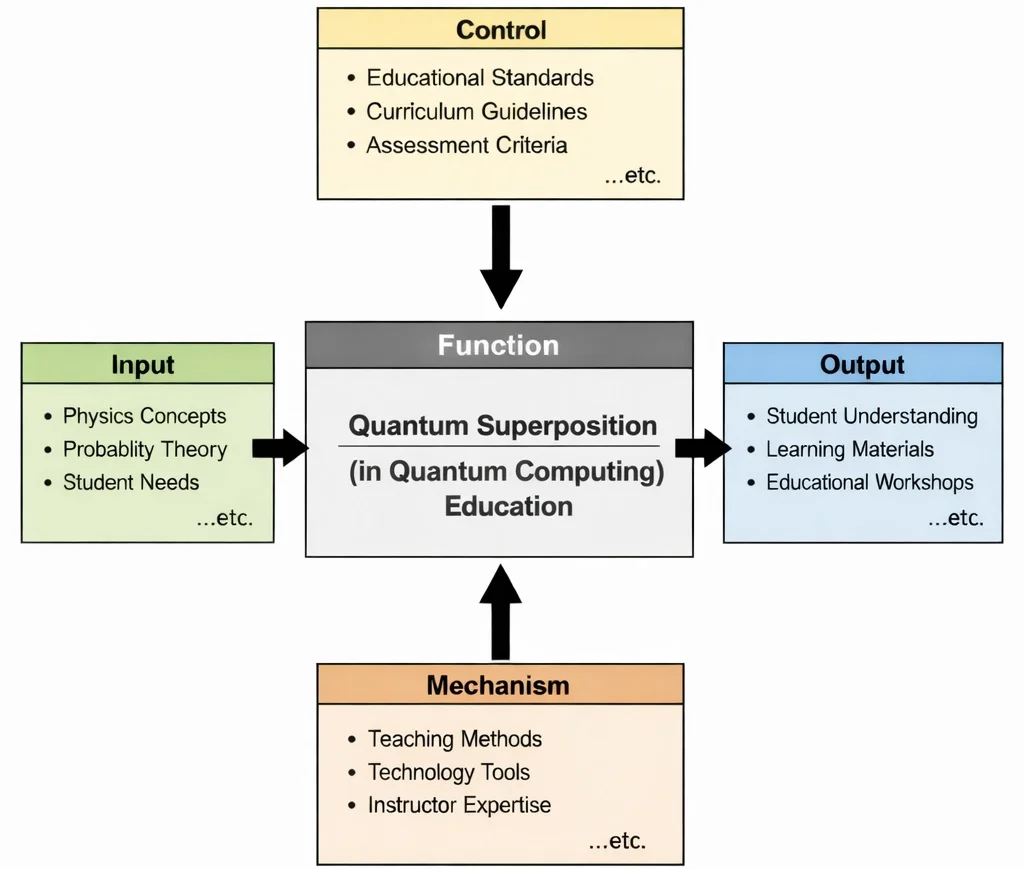
IDEF0 diagram of “Quantum Superposition (in Quantum Computing) Education” showing inputs, controls, mechanisms, and outputs connected to a central function box.
IDEF0 view of Quantum Superposition (in Quantum Computing) Education: concepts and learner needs guided by curriculum and assessment, enabled by teaching and tools, producing understanding and learning resources.


Quantum superposition lies at the heart of quantum computing, enabling quantum systems to represent and process information in fundamentally new ways. Unlike classical bits which exist in a state of 0 or 1, qubits can exist in a blend of both states simultaneously. This unique capability allows quantum algorithms to explore multiple computational paths in parallel, giving them exponential advantages in solving complex problems. Mastery of this concept requires a solid foundation in mathematics and statistics, particularly in linear algebra and probability theory.

The implications of quantum superposition are transformative across disciplines. In artificial intelligence and machine learning, superposition enhances search capabilities, pattern recognition, and optimization routines. For researchers in data science, it provides quantum-enhanced tools for analyzing large datasets with unprecedented speed. These techniques are also influencing innovations in internet technologies and IoT, where complex decision-making must occur in real time.

At the core of many quantum circuits are gates specifically designed to create and manipulate superposition. These quantum gates and circuits provide the building blocks for algorithms used in everything from encryption to simulation. Understanding the role of superposition in circuits also requires appreciating its interplay with quantum entanglement, which enables qubits to be correlated across vast distances.

Superposition is not limited to theoretical study—it has real-world implications. In autonomous systems and robotics, quantum control mechanisms influenced by superposition may lead to faster, more adaptive behavior in uncertain environments. Similarly, areas like biotechnology are exploring quantum models to simulate molecular interactions and drug discovery pathways more efficiently.

In the realm of infrastructure and sustainability, quantum superposition contributes to more refined simulations for environmental engineering, with applications extending to green building design and disaster mitigation. By enabling multi-path simulations in one operation, quantum superposition aids engineers in evaluating a broad range of risk scenarios within seconds.

Moreover, space-related applications are being revolutionized by quantum superposition. Algorithms developed using superposed states help improve navigation, control systems, and energy distribution aboard launch vehicles and satellites. These advancements are integral to projects led under space exploration technologies, where precision and reliability are non-negotiable.

Quantum superposition also supports the optimization processes found in smart manufacturing and energy storage systems. Combined with STEM innovation at large, this quantum concept facilitates breakthroughs in efficient production, grid balancing, and adaptive control frameworks.

In short, understanding quantum superposition is key to unlocking the potential of quantum computation. It intersects not only with pure computational logic but also with broader systems thinking across industries. As learners delve deeper into the quantum realm, they gain powerful tools to contribute to interdisciplinary solutions for future technological, scientific, and environmental challenges.
Quantum Superposition in Quantum Computing - Prep4Uni Online
Quantum Superposition in Quantum Computing Illustrated by Qubits at Multiple States

Need the theoretical foundation? See Quantum Superposition in Quantum Mechanics.

Table of Contents

Understanding Quantum Superposition

Basic Definition

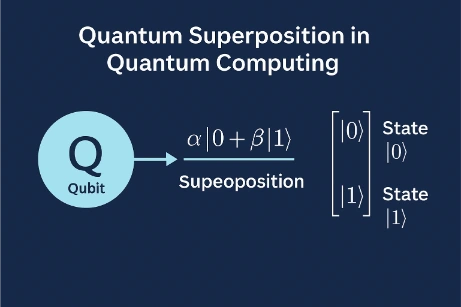
In classical mechanics, a particle exists in a single, well-defined state (e.g., a coin is either heads or tails). In quantum mechanics, a particle can exist in a superposition of states. For example, a quantum system described by a qubit can exist in a combination of the states |0〉 (logical 0) and |1〉 (logical 1):

ψ=α0+β1|\psi\rangle = \alpha|0\rangle + \beta|1\rangle

Here:

  • |ψ〉: Quantum state of the system.
  • α and β : Complex probability amplitudes. The squared magnitudes |α|2 and |β|2 represent the probabilities of the system being in states |0〉 and |1〉 respectively.
    α2+β2=1: Ensures that the probabilities are normalized.
A diagram illustrating quantum superposition in quantum computing, showing a qubit in a superposed state of 0 and 1, a Hadamard gate, and a quantum circuit with measurement.
Qubit Superposition in a Quantum Computing Circuit

Superposition in Multi-Qubit Systems

In systems with multiple qubits, superposition allows an exponential growth in the number of possible states. For qubits, the system can exist in a superposition of 2n states. For example, a 2-qubit system can exist in the superposition:

ψ=α00+β01+γ10+δ11 |\psi\rangle = \alpha|00\rangle + \beta|01\rangle + \gamma|10\rangle + \delta|11\rangle

This exponential scaling is the foundation of quantum computing’s power, enabling it to perform complex computations in parallel.


Measurement and Collapse

When a quantum system in superposition is measured, it “collapses” into one of its constituent states with a probability given by the squared magnitude of the corresponding amplitude. For example:


  • If ∣ψ=120+121|\psi\rangle = \frac{1}{\sqrt{2}}|0\rangle + \frac{1}{\sqrt{2}}|1\rangle


    measuring the qubit will yield |0〉 or |1〉 with equal probability (50%).


Mathematical Representation

State Vector

A quantum state in superposition is represented as a state vector in a complex vector space. For a single qubit:

ψ=[αβ]|\psi\rangle = \begin{bmatrix} \alpha \\ \beta \end{bmatrix}

Bloch Sphere Representation

The Bloch Sphere provides a geometric representation of a qubit’s superposition. A qubit state can be visualized as a point on the surface of the sphere:

ψ=cos(θ2)0+eiϕsin(θ2)1|\psi\rangle = \cos\left(\frac{\theta}{2}\right)|0\rangle + e^{i\phi}\sin\left(\frac{\theta}{2}\right)|1\rangle

    • θ: Angle between the state vector and the |0〉-axis
    • ∅: Phase angle.

Applications of Quantum Superposition

Quantum Computing

Superposition enables quantum computers to evaluate multiple possibilities simultaneously, significantly speeding up certain computations.

  • Parallelism: A quantum computer with n qubits can process 2n states in parallel.
  • Quantum Algorithms: Algorithms like Grover’s search and Shor’s factorization exploit superposition for exponential or quadratic speedups.

Quantum Cryptography

Superposition is leveraged in quantum key distribution (e.g., BB84 protocol) to detect eavesdropping. Any measurement by an eavesdropper disturbs the superposition, revealing their presence.


Quantum Simulation

Quantum systems in superposition can simulate other quantum systems more efficiently than classical computers, aiding research in materials science, chemistry, and particle physics.


Quantum Sensors

Superposition enhances the sensitivity of quantum sensors, enabling precise measurements in applications like gravitational wave detection and magnetic field mapping.


Examples of Quantum Superposition

Double-Slit Experiment

The classic double-slit experiment demonstrates superposition and quantum interference. A single particle, such as an electron, passes through two slits and behaves as if it traversed both simultaneously, producing an interference pattern on the screen.


Schrödinger’s Cat Thought Experiment

This illustrates the paradox of superposition on a macroscopic scale. A cat in a box is simultaneously alive and dead until observed, reflecting the probabilistic nature of superposition.


Challenges and Limitations

Decoherence

Quantum systems are sensitive to their environment, which can cause the collapse of superposition states (decoherence). Maintaining coherence is critical for quantum computing and other quantum technologies.


Measurement Disturbance

Measurement in quantum mechanics disrupts superposition, limiting the amount of information that can be extracted from a quantum system.


Experimental Realization

Creating and maintaining superposition states in large quantum systems remains challenging due to technological and physical constraints.


Future Directions in Quantum Superposition

Fault-Tolerant Quantum Computing

Developing error-correction techniques to preserve superposition in noisy quantum environments.


Enhanced Quantum Algorithms

Exploring new algorithms that further exploit superposition for optimization, machine learning, and cryptography.


Quantum Network Expansion

Harnessing superposition for large-scale quantum communication and distributed quantum computing.


Why Study Quantum Superposition

Understanding the Core Principle of Quantum Mechanics

Quantum superposition is the concept that a quantum system can exist in multiple states simultaneously until it is measured. This foundational idea distinguishes quantum mechanics from classical physics and lies at the heart of all quantum phenomena. For students preparing for university, studying quantum superposition introduces them to the fundamental nature of quantum reality and the non-intuitive behavior of particles at the smallest scales.

Exploring Applications in Quantum Computing and Information

In quantum computing, superposition allows qubits to represent both 0 and 1 at the same time, enabling quantum computers to perform many calculations in parallel. Students learn how superposition dramatically increases computational power and forms the basis for quantum algorithms like Deutsch-Jozsa, Grover’s search, and Shor’s factoring. Understanding this concept is essential for grasping how quantum systems process and encode information.

Visualizing Quantum States and Probabilistic Outcomes

Quantum superposition also introduces students to the idea of probabilistic measurement and state collapse. Learners explore how the wavefunction describes a superposed state, and how measurement affects the outcome. Through mathematical tools like Dirac notation and Bloch spheres, students build intuition about how quantum states evolve and how they differ from binary classical states.

Connecting Theory with Experiment and Technology

Superposition is not just a theoretical idea—it has been confirmed through countless experiments, such as the double-slit experiment and quantum interference studies. Students engage with these landmark demonstrations to see how superposition leads to observable effects that defy classical expectations. They also explore how emerging technologies like quantum sensors, quantum communication, and quantum simulations rely on this principle.

Preparing for Advanced Study and Quantum Innovation

A strong understanding of quantum superposition is crucial for further study in quantum mechanics, quantum information science, and quantum technology. As quantum systems become central to computation, cryptography, and fundamental research, students with knowledge of superposition will be well-positioned to contribute to groundbreaking discoveries. For university-bound learners, studying quantum superposition provides both a conceptual foundation and a gateway to a new era of science and engineering.

Frequently Asked Questions on Quantum Superposition

These FAQs help pre-university students build an intuitive feel for quantum superposition and see how it supports quantum computing and other technologies.

1. What is quantum superposition in simple terms?

Answer: Quantum superposition means that a quantum system can be in a combination of different states at the same time, rather than being in just one definite state. For a qubit, this means it is not simply 0 or 1, but in a state that contains both possibilities with certain weights. Only when we measure the qubit do we obtain a definite outcome.

2. How is superposition different from saying “we don’t know the state yet”?

Answer: In classical physics, a system is always in one definite state, even if we do not know which one. Our ignorance is described by ordinary probability. In quantum mechanics, a superposed state is not just unknown; it is a genuine combination of alternatives. This is revealed by interference effects, where different components of the superposition can enhance or cancel each other, something that classical probabilities cannot do.

3. What does a qubit in superposition actually look like mathematically?

Answer: A single qubit in superposition can be written as a|0⟩ + b|1⟩, where a and b are complex numbers called amplitudes. The squared magnitudes |a|² and |b|² give the probabilities of measuring 0 or 1. The relative phase between a and b is also important, because it affects interference when the qubit passes through further gates.

4. How do we create superposition in a quantum computer?

Answer: Superposition is created by applying suitable single-qubit gates, such as the Hadamard gate, to a qubit prepared in a definite state like |0⟩. The gate rotates the state on the Bloch sphere so that it becomes a balanced or unbalanced combination of |0⟩ and |1⟩. In many algorithms, the first step is to apply such gates to many qubits to spread amplitude over a large state space.

5. Why is superposition so important for quantum algorithms?

Answer: Superposition allows a small number of qubits to represent an extremely large number of basis states at once. Quantum gates then act on all these components simultaneously. When combined with entanglement and interference, this parallel evolution can give significant speed-ups for problems with the right structure, such as factoring or searching large spaces.

6. What is meant by interference in the context of superposition?

Answer: Interference occurs when different paths or components of a superposition combine. If their phases align, amplitudes add and the probability of some outcomes increases (constructive interference). If the phases oppose, amplitudes partially or completely cancel (destructive interference). Quantum algorithms are designed so that correct answers build up amplitude while incorrect ones are suppressed.

7. Why is it hard to keep superposition intact on real hardware?

Answer: Superposed states are extremely sensitive to disturbances from the environment. Any unwanted interaction with stray fields, vibrations, or thermal noise can cause decoherence, which effectively turns a quantum superposition into a classical mixture. Protecting superposition requires low temperatures, careful isolation, and precise control of the qubits and their surroundings.

8. Does superposition mean that “everything happens in many worlds”?

Answer: Some interpretations of quantum mechanics use “many worlds” language, but the mathematical formalism is the same regardless of interpretation. For practical purposes in computing, superposition is a tool that tells us how to predict measurement outcomes and how to design algorithms that harness interference. Questions about underlying reality belong to the philosophy of quantum theory and are still debated.

Quantum Superposition: Conclusion

Quantum superposition is a fundamental property of quantum mechanics that unlocks the power of quantum computing and quantum technologies. It allows systems to exist in multiple states simultaneously, enabling unparalleled computational capabilities and novel applications. Despite challenges like decoherence and environmental interference, advances in quantum engineering and research promise to harness the full potential of superposition, paving the way for transformative technological breakthroughs.

Quantum Superposition: Review Questions and Model Answers

These questions help you move from the basic definition of superposition to a more precise understanding of how it is represented, tested, and protected in real quantum systems.

1. A classical bit is either 0 or 1 at any instant. How would you describe a qubit in a superposition of 0 and 1 in a way that avoids the phrase “the qubit is both at once”?

Answer:
A clearer description is that the qubit is in a single quantum state that can be written as a combination of \( |0\rangle \) and \( |1\rangle \) with specific amplitudes. This state encodes the potential for different measurement outcomes, not a literal coexistence of two classical states. Only when we perform a measurement do we obtain a definite \( 0 \) or \( 1 \), with probabilities determined by those amplitudes.

2. A qubit is prepared in the state \( (|0\rangle + |1\rangle)/\sqrt{2} \). What probabilities do you obtain for measuring \( 0 \) and \( 1 \), and how do these relate to the amplitudes?

Answer:
The amplitudes of \( |0\rangle \) and \( |1\rangle \) are both \( 1/\sqrt{2} \). The measurement probabilities are the squared magnitudes of the amplitudes: \( |1/\sqrt{2}|^2 = 1/2 \) for \( |0\rangle \) and \( 1/2 \) for \( |1\rangle \).

3. How does a balanced superposition differ from an unbalanced one, and why might an algorithm use both types?

Answer:
In a balanced superposition, basis states have equal probabilities. In an unbalanced superposition, some outcomes are more likely than others. Algorithms often begin with balanced superpositions to explore many possibilities uniformly, then manipulate amplitudes so that correct answers become more probable.

4. How does the double-slit experiment support the idea of superposed paths?

Answer:
The interference pattern arises because each particle’s quantum state is a superposition of “went through slit A” and “went through slit B”. Constructive and destructive interference cannot be explained by a classical mixture.

5. Why is superposition alone insufficient for useful quantum computation?

Answer:
Superposition spreads amplitude but does not favour correct answers. Quantum algorithms must carefully control phase and interference so that desired outcomes are amplified.

6. How does decoherence destroy superposition, and why is this harmful?

Answer:
Environmental interaction entangles the system with its surroundings, eliminating phase coherence. The state becomes a classical mixture, preventing interference.

7. What does an improved coherence time mean for algorithms?

Answer:
Longer coherence time allows more gates to be applied before decoherence dominates, enabling deeper circuits and more complex algorithms.

8. After applying Hadamard gates to \( n \) qubits initially in \( |0\rangle \), how many basis states have non-zero amplitude?

Answer:
All \( 2^n \) basis states have non-zero amplitude, demonstrating exponential state-space representation.

9. Why can we not directly observe all components of a superposition?

Answer:
Measurement collapses the state to a single outcome, destroying the remaining components.

10. Which aspect of superposition do you find most challenging, and how might you improve?

Answer:
A strong response identifies a specific difficulty and a targeted strategy for improvement.

Quantum Superposition: Thought-Provoking Questions and Answers

1. How does quantum superposition challenge our conventional understanding of reality?

Answer:
Quantum superposition shows that physical systems do not possess definite properties prior to measurement, contradicting classical realism and determinism.

2. What are the philosophical implications of particles being in multiple states?

Answer:
Superposition challenges notions of identity, causality, and observer independence, raising deep questions in metaphysics and epistemology.

3. How could superposition revolutionize cryptography?

Answer:
Protocols such as quantum key distribution exploit superposition to ensure eavesdropping detection and provable security.

4. What role might superposition play in quantum artificial intelligence?

Answer:
Superposition enables parallel evaluation of large solution spaces, accelerating learning and optimisation.

5. How does precise control of superposition improve error correction?

Answer:
Improved coherence reduces error rates and lowers correction overhead, supporting scalable quantum computation.

6. How could superposition reshape computational complexity?

Answer:
Quantum algorithms can explore exponentially many states simultaneously, fundamentally altering complexity classes for certain problems.

7. Why is interdisciplinary research essential for maintaining superposition?

Answer:
Physics, engineering, and materials science jointly address decoherence, control, and scalability challenges.

8. What ethical issues arise from quantum decision-making algorithms?

Answer:
Opacity, accountability, and unequal access raise concerns requiring governance and oversight.

9. How might superposition transform communication and security?

Answer:
It enables ultra-secure key distribution and next-generation network architectures.

10. What new theories might emerge from deeper understanding of superposition?

Answer:
New models may clarify quantum–classical transitions and inspire novel physical frameworks.

11. How can superposition integrate into hybrid quantum–classical systems?

Answer:
Quantum processors handle parallel exploration while classical systems manage control and analysis.

12. What are the long-term global implications of mastering superposition?

Answer:
Breakthroughs across science, industry, security, and policy are expected, driving a new technological era.

Quantum Superposition: Numerical Problems and Solutions

1. A qubit is in the state \( |\psi\rangle = a|0\rangle + b|1\rangle \), where \( |a|^2 + |b|^2 = 1 \). If \( |a|^2 = 0.3 \), calculate \( |b|^2 \).

Solution:
\( |b|^2 = 1 - 0.3 = 0.7 \).

2. Five qubits are in equal superposition. Find the number of basis states and the probability of one state.

Solution:
\( 2^5 = 32 \) states, probability \( 1/32 = 3.125\% \).

3. A qubit in \( |0\rangle \) passes through a Hadamard gate and is measured 200 times.

Solution:
\( P(|0\rangle) = P(|1\rangle) = 0.5 \). Expected counts: \( 100 \) each.

4. Two amplitudes \( A = 0.6 \) and \( B = 0.8 e^{i45^\circ} \) interfere.

Solution:
Resultant amplitude \( \approx 1.296 \); probability \( \approx 1.68 \).

5. Probabilities are \( 0.2, 0.3, 0.5 \). Verify normalization and find the amplitude for \( 0.3 \).

Solution:
\( \sqrt{0.3} \approx 0.5477 \).

6. \( |\psi\rangle = (0.5+0.5i)|0\rangle + (0.5-0.5i)|1\rangle \). Find \( P(|0\rangle) \).

Solution:
\( |0.5+0.5i|^2 = 0.5 \).

7. Compute \( e^{i\pi/3} \).

Solution:
\( e^{i\pi/3} = 0.5 + 0.8660i \).

8. For \( n=8 \), find the probability of one outcome.

Solution:
\( 2^8 = 256 \); probability \( 1/256 \approx 0.39\% \).

9. For \( 2^{15} \) states, find the probability of one.

Solution:
\( 2^{15} = 32768 \); probability \( \approx 0.00305\% \).

10. If \( |b|^2 = 0.4 \), find \( |a|^2 \).

Solution:
\( |a|^2 = 1 - 0.4 = 0.6 \).

11. \( |\psi\rangle = 0.3|0\rangle + x|1\rangle \). Find \( x \).

Solution:
\( x = \sqrt{0.91} \approx 0.9539 \).

12. For \( n=12 \), compute total states and probability.

Solution:
\( 2^{12} = 4096 \); probability \( 1/4096 \approx 0.0244\% \).

Last updated: 04 Feb 2026