
Intellectual & Political History
Explores how foundational ideas from Aristotle to Keynes evolved alongside state structures, ideological frameworks, and political philosophy. Explore Intellectual History →
Political Ideologies
Examines the ideological frameworks—capitalism, socialism, liberalism, and mixed economies—that operationalize economic theory into governance models. Explore Political Ideologies →
Labor & Social Policy
Investigates the direct impact of economic doctrines on working conditions, welfare state design, social safety nets, and labor legislation. Explore Labor Policy →
Industrial & Technological History
Analyzes how technological shifts, mechanization, and production innovations reshaped definitions of capital, labor, and economic value. Explore Industrial History →
Economic thought is not a museum of old opinions—it is a living conversation that still shapes how we speak about work, prices, markets, and fairness. When students trace where ideas came from, they begin to notice that every theory carries assumptions, values, and a historical context. This kind of learning quietly changes the way one reads the news, interprets data, and judges policy claims.
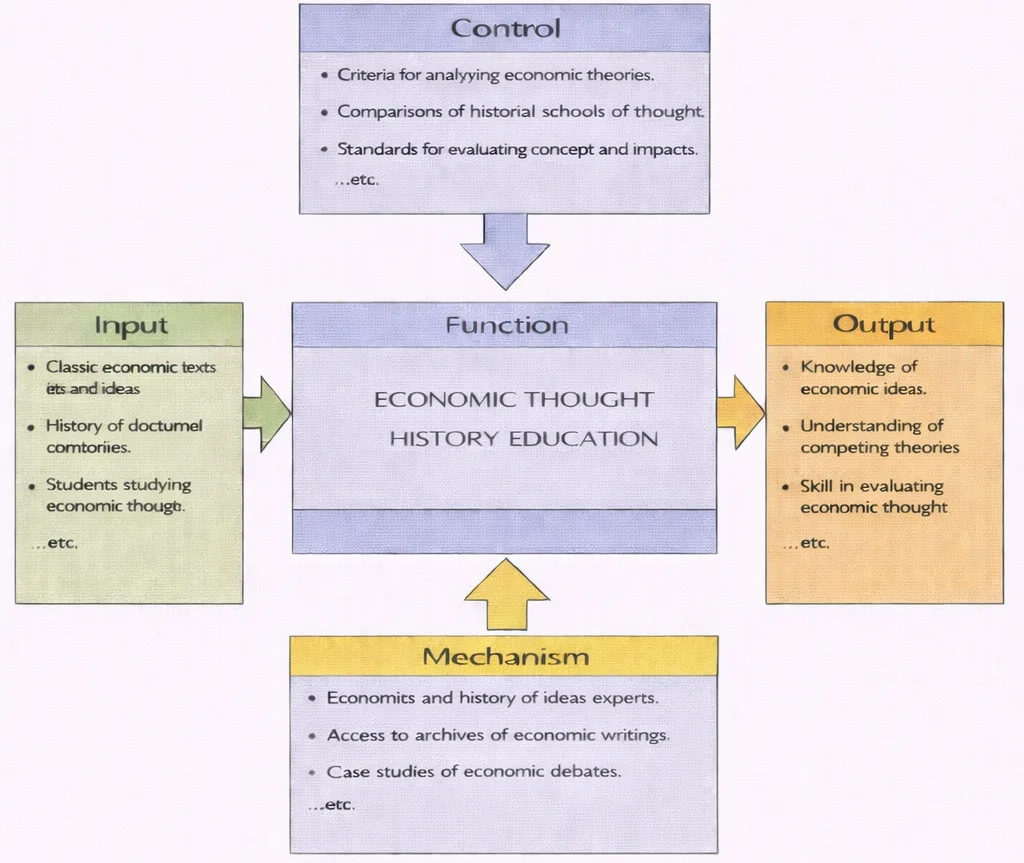
Using the IDEF0 structure in the diagram, the inputs are the foundational materials: classic texts, landmark ideas, and the historical pathways of major theories and controversies. The controls guide how students think rather than what they memorize—criteria for analysing theories, comparing schools of thought, and evaluating concepts and real-world impacts. The mechanisms make the learning possible: educators trained in economics and intellectual history, access to archives and primary sources, and case studies that reveal how debates evolved across time and place. The outputs are the habits of mind that matter most—sound knowledge of economic ideas, an ability to weigh competing explanations, and the skill to evaluate arguments carefully, rather than accepting them by authority or fashion.
The history of economic thought offers a compelling narrative of how societies have attempted to understand, manage, and theorize wealth, value, labor, and markets. Spanning from ancient philosophical reflections to complex modern theories, it reflects shifting intellectual climates and broader socio-political transformations. This field intersects deeply with intellectual political history, as thinkers from Aristotle to Keynes responded to the structures of their times with evolving models of economic behavior.
These models are not confined to economic theory alone but reflect developments in political ideologies and governance. The emergence of capitalism, socialism, and mixed economies was deeply entangled with electoral practices and the rise of electoral systems and political parties. At times, distortions in democratic expression—explored in electoral fraud and integrity—influenced the implementation of economic reforms.
Periods of social unrest or revolutionary change often catalyzed new economic perspectives. From the labor-centered policies detailed in labor and social policy to the grassroots upheavals captured in history of social movements, shifts in power frequently produced intellectual realignments. The same holds true for military disruptions; insights from the social and cultural history of warfare and the technological history of warfare reveal how conflict spurred innovation in economic thinking.
Historians of economic thought also explore how technological progress and industrial shifts influenced economic models. This is particularly evident in industrial and technological history, where transformations in production and labor reshaped notions of capital and value. The same applies to trade and commerce history, which reveals how global interaction demanded more sophisticated systems of economic explanation.
The dissemination and adoption of these ideas are closely tied to education history, which tracks the expansion of formal instruction in economics and its impact on public understanding. As economic ideas filtered into civic life, they influenced causes like the suffrage and civil rights movements, enabling marginalized groups to challenge economic exclusion. Similarly, gendered perspectives on labor and equity have enriched the field, with women’s history offering critical correctives to mainstream narratives.
The influence of economic thinking has not stopped at borders. Diplomatic negotiations, as examined in treaty analysis and history of alliances, often rest on assumptions derived from contemporary economic schools. These cross-border dimensions also surface in electoral history and the modern challenges posed by technologies in elections, such as those covered in role of technology in elections.
To trace the evolution of economic doctrines is also to uncover the lived experiences of different communities. Social history, including the study of labor history and urban and rural history, brings texture to these theories, showing how they were adopted, resisted, or adapted on the ground. Even unconventional resistance, as covered in guerrilla warfare and insurgency studies, offers insight into the economic conditions driving conflict.
Ultimately, the history of economic thought we inherit today is not a monolith but a vibrant mosaic shaped by centuries of debate, policy, rebellion, diplomacy, and pedagogy. As we examine these layers through the comprehensive lens of history, we gain a richer understanding of the world we inhabit—and the ideas that continue to shape its future.
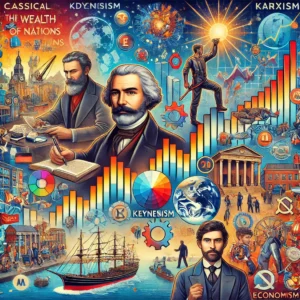
This richly detailed illustration presents the history of economic thought as a timeline of competing frameworks. Portraits of influential thinkers anchor the scene, while surrounding symbols—rising charts, coins, gears, ships, factories, and government buildings—connect theory to real-world change. References to classical economics suggest early focus on markets, trade, and wealth creation; Marxism highlights conflict, labor, and the critique of capitalism; Keynesianism points to macroeconomic management, demand, and the state’s role in stabilizing recessions. The blend of industry, finance, and social life imagery conveys a central theme: economic theories are not just abstract models, but evolving lenses shaped by historical events, institutions, technology, and debates about fairness, growth, and power.
Interactive Economic Policy & Equilibrium Simulator
Adjust macroeconomic parameters below to see how key variables align according to Keynesian demand-side equations versus Monetarist Quantity Theory dynamics.
Foundations of Fiscal Philosophy: A Tour of Economic Theories
Classical Economics
Classical economics (c. 1776–1870) framed the modern study of markets, production, and growth. It treated prices and quantities as the outcome of competitive exchange among self-interested agents, and it supplied the intellectual scaffolding for early industrial capitalism and free trade.
Key Figures and Contributions
- Adam Smith (1723–1790)
- The Wealth of Nations (1776): specialization, division of labor, and market exchange raise productivity via the “invisible hand.”
- Differentiated productive vs. unproductive labor; stressed the role of institutions (property rights, justice) for market order.
- David Ricardo (1772–1823)
- Formalized comparative advantage and supported unilateral tariff reduction (the Corn Laws debate).
- Developed the labor theory of value (for long-run relative prices under competition) and the theory of rent on scarce land.
- Thomas Robert Malthus (1766–1834)
- Essay on Population (1798): population dynamics create pressure on subsistence; warned of demand shortfalls and crises.
- John Stuart Mill (1806–1873)
- Separated the “laws of production” (technological) from the “laws of distribution” (institutional/political); supported social reforms and women’s rights.
Core Principles & Simple Mechanics
- Value and distribution: in long-run competitive equilibrium, prices gravitate to costs of production; income is split into wages (labor), profits (capital), and rents (land).
- Market adjustment: flexible prices and mobile factors align supply with demand; trade expands the “extent of the market,” enabling deeper specialization.
- Growth engine: capital accumulation → more division of labor → higher productivity; constrained by diminishing returns on land (Ricardo) and demographic pressure (Malthus).
- Limited government: provide public goods (defense, justice, infrastructure), enforce contracts, and avoid trade barriers.
Policy Legacy, Applications, and Critiques
- Legacy: intellectual foundation for 19th-century liberalism, repeal of the Corn Laws, and the gold-standard era of globalization.
- Applications: trade liberalization, antimonopoly thinking, and infrastructure as a public good.
- Critiques: underplays market failures (externalities, public goods), ignores involuntary unemployment, and relies on the labor theory of value later replaced by marginalism.
Marxist Economics
Marxist economics is both an analytic framework and a critique of capitalism. It explains profits as the monetary form of surplus labor, interprets crises as systemic, and links economic structures to power, ideology, and the state.
Key Figures and Contributions
- Karl Marx (1818–1883)
- Capital, Vol. I (1867): commodity production, value, money, exploitation (surplus value), and accumulation.
- Falling profit rate and crisis theory: competition forces mechanization; rising “organic composition of capital” compresses profits and breeds periodic overproduction.
- Historical materialism: changes in productive forces reshape class relations and institutions.
- Friedrich Engels (1820–1895)
- Co-authored the Communist Manifesto (1848); synthesized political program with economic critique.
- Later traditions: Lenin (imperialism), Rosa Luxemburg (accumulation and markets), Gramsci (hegemony), neo-Marxian and dependency/world-systems analysis.
Core Concepts & Mechanics
- Class struggle: conflict between capital (owners of means of production) and labor (sellers of labor power) shapes wages, technology, and the state.
- Surplus value: workers create more value than they receive in wages; the difference is captured as profit, interest, and rent.
- Accumulation and concentration: reinvested profits expand capital, intensify mechanization, and consolidate firms.
- Crises: rooted in underconsumption/overproduction, financial speculation, and contradictions between private production and social needs.
- Transition: socialism replaces private ownership with collective ownership and planning to align production with social priorities.
Historical Impact, Policy, and Critiques
- Impact: influenced revolutions (1917 Russia, 1949 China), welfare-state labor protections, and modern inequality debates.
- Policy instruments used by socialist states: five-year plans, public ownership of heavy industry, price controls, guaranteed employment.
- Critiques: planning inefficiencies, soft budget constraints, innovation disincentives, political repression in practice. Analytical debates center on value theory, transformation problem, and empirical profit-rate trends.
Neoclassical Economics
Neoclassical economics (c. 1870–present) shifted the focus from labor costs to marginal decisions by households and firms. It models how rational agents with preferences and constraints interact through prices to allocate scarce resources.
Key Figures and Contributions
- Marginal Revolution: W. S. Jevons, Carl Menger, Léon Walras independently introduced marginal utility.
- Alfred Marshall (1890) integrated supply–demand analysis, consumer/producer surplus, elasticity, and partial equilibrium tools.
- Vilfredo Pareto: efficiency concept; Edgeworth box for exchange; indifference curves.
- Hicks, Samuelson, Arrow/Debreu: formal choice theory, revealed preferences, and general-equilibrium existence theorems.
Core Principles, Models & Tools
- Optimization: consumers maximize utility subject to budget; firms maximize profits subject to technology (cost minimization).
- Marginal conditions: optimal choices equate marginal benefit with marginal cost; competitive prices equal marginal costs in equilibrium.
- Market equilibrium: prices adjust so that supply equals demand; under ideal conditions this allocation is Pareto efficient (First Welfare Theorem).
- Comparative statics: elasticities, tax incidence, deadweight loss, and welfare analysis of policy.
- Market failure extensions: externalities, public goods, information asymmetries (Akerlof), and strategic interaction (game theory).
Applications, Influence, and Critiques
- Applications: antitrust/merger review, auction design, tax design, environmental pricing, health and labor markets.
- Influence: foundation for modern microeconomics, public economics, and much of empirical policy evaluation.
- Critiques: strong rationality and equilibrium assumptions; weak realism in some contexts; difficulty with expectations, bubbles, and persistent unemployment—sparking behavioral and institutional alternatives.
Keynesian Economics
Keynesian economics explains recessions as failures of aggregate demand. Because prices and wages can be sticky, economies may settle below full employment, requiring active stabilization policy.
Key Ideas and Framework
- John Maynard Keynes: The General Theory (1936) rejects automatic full employment; expectations (“animal spirits”) drive investment.
- Income–expenditure model: output is determined where aggregate demand (C + I + G + NX) equals income; multipliers amplify fiscal changes.
- IS–LM & AD–AS: formalize goods–money market interactions; show how interest rates, prices, and output respond to policy.
- Stabilization tools: countercyclical fiscal policy (automatic stabilizers + discretionary stimulus), lender-of-last-resort central banking, and financial regulation to curb panics.
k = 1 / (1 – MPC)
Where MPC represents the Marginal Propensity to Consume. Total Output Impact: ΔY = k × ΔG
Historical Practice & Evidence
- Great Depression/New Deal: fiscal expansion and institutional reforms; later, post-war full-employment policies in advanced economies.
- 2008–09 and 2020 shocks: large fiscal/monetary responses; research documents sizable multipliers at the zero lower bound and during deep slumps.
Variants, Critiques, and Modern Synthesis
- Variants: New Keynesian models with microfoundations (price/wage rigidities, imperfect competition), Modern Monetary Theory (debated), and post-Keynesian emphasis on financial instability (Minsky).
- Critiques: time inconsistency, crowding out, inflation risks; Lucas critique spurred micro-founded DSGE modeling.
- Synthesis: many central banks use New Keynesian frameworks that integrate expectations with nominal rigidities and credible rules.
Monetarism
Monetarism re-centered macroeconomics on money, expectations, and stable policy rules. It argued that inflation is “always and everywhere a monetary phenomenon,” and that erratic policy is a major source of business-cycle volatility.
Key Figures and Contributions
- Milton Friedman and Anna Schwartz: monetary history linking money growth and inflation; critique of discretionary stabilization.
- Policy rules: constant money-growth rule as a benchmark; later inspired interest-rate rules (e.g., Taylor-type) and inflation targeting.
- Natural rate of unemployment / NAIRU: no long-run trade-off between inflation and unemployment; expectations shift the Phillips curve.
Core Principles & Mechanisms
- Quantity Theory:M × V = P × YSustained money growth above real output growth causes persistent inflation.
Where M = Money Supply, V = Velocity of Money, P = Price Level, and Y = Real Output. - Expectations: credible, rule-like policy anchors inflation expectations and reduces output costs of disinflation.
- Limited fiscal activism: fiscal attempts to fine-tune demand risk crowding out or inflation without lasting gains.
Historical Impact and Critiques
- Impact: guided disinflations in the late 1970s–1980s (U.S., UK); shaped modern central-bank independence and inflation targeting.
- Critiques: unstable money demand undermined simple money-growth targets; during crises, interest-rate policy and balance-sheet tools matter; ignores fiscal-monetary interactions highlighted by later research.
Contemporary Economic Theories
From the late 20th century onward, economists have broadened the toolkit well beyond the classical–Keynesian divide. Contemporary approaches integrate psychology, institutions, technology, the environment, data, and networks to explain real-world outcomes. Below are major strands, their core ideas, policy uses, and common critiques.
Behavioral Economics
- Core ideas:
- People are not perfectly rational. Heuristics (rules of thumb) and biases (loss aversion, present bias, overconfidence, anchoring) shape choices.
- Prospect Theory: individuals evaluate gains and losses relative to a reference point, with losses weighing more heavily than equivalent gains.
- Limited attention and self-control mean stated preferences can differ from experienced or revealed preferences.
- Methods & tools: randomized experiments, field trials, A/B testing, choice architecture, nudges, commitment devices, default options.
- Policy applications:
- Auto-enrollment in pensions and organ donation; simplified FAFSA/tax forms; reminders that reduce missed vaccine appointments or utility arrears.
- “Sin taxes” and graphic warnings that exploit salience to curb smoking, sugary drinks, or unsafe driving.
- Critiques: effects can be context-specific and sometimes small; ethical concerns about paternalism; nudges cannot substitute for structural reforms when incentives are misaligned.
Environmental & Ecological Economics
- Core ideas:
- Negative externalities (e.g., greenhouse gases) cause market prices to understate social costs; corrective pricing aligns private and social incentives.
- Natural capital and ecosystem services are productive assets; planetary boundaries can constrain long-run growth.
- Policy instruments: carbon taxes, cap-and-trade, clean-energy standards, feebates, congestion pricing, biodiversity credits, green industrial policy (subsidies, procurement).
- Measurement & finance: social cost of carbon; climate-stress tests for banks; disclosure standards (e.g., climate risk in balance sheets); green bonds.
- Debates: optimal carbon price vs. technology mandates; equity and “just transition”; discount rates and intergenerational ethics.
Development Economics
- Capabilities approach: human well-being depends on freedoms and opportunities (health, education, agency), not only income. Guides policy toward social protection, gender equity, and public goods.
- Micro-foundations & RCT revolution:
- Field experiments test what works: deworming and school attendance; unconditional vs. conditional cash transfers; microcredit; mobile-money and digital ID; fertilizer and irrigation adoption.
- Behavioral frictions—present bias, information gaps, risk—interact with poverty traps.
- Structural change & trade: industrial policy; global value chains; export diversification; “learning by doing” and infant-industry arguments.
- Governance & state capacity: corruption control, property rights, civil-service incentives, and local accountability shape growth paths.
- Cautions: external validity of RCTs; need to link micro-interventions to macro transformation and political economy realities.
New Institutional & Political Economy
- Core ideas: institutions (formal laws and informal norms) determine transaction costs, enforcement, and investment. Inclusive institutions encourage innovation; extractive ones entrench elites.
- Mechanisms: property rights, contract enforcement, credible commitment, checks and balances, regulatory quality, media freedom.
- Applications: privatization design, antitrust and competition policy, corruption control, fiscal rules, central-bank independence.
- Debates: causality runs both ways—growth can also reshape institutions; “one-size-fits-all” reforms can misfire without local context.
Endogenous Growth, Innovation & Digital/Platform Economics
- Endogenous growth: knowledge, R&D, and human capital create increasing returns and sustained growth; ideas are non-rival but partially excludable (IP rights).
- Innovation policy: patents, research subsidies, university–industry spillovers, mission-oriented programs (e.g., vaccines, clean tech), and immigration of high-skill talent.
- Platform economics: two-sided markets (users–advertisers, drivers–riders) exhibit network effects and tipping; pricing below cost on one side can be rational.
- Data & AI: data as an asset with non-rival attributes; algorithmic pricing; recommender systems; concerns about lock-in, privacy, and bias; calls for data portability and interoperability.
- Trade (the “new-new” theory): firm heterogeneity means the most productive firms self-select into exporting; trade shocks reallocate within industries, not just between them.
Complexity, Networks & Agent-Based Economics
- Core ideas: economies are complex adaptive systems—many interacting agents produce emergent patterns, fat tails, and cascades (e.g., financial crises).
- Tools: network maps of interbank lending or supply chains; agent-based simulations; stress-testing systemic risk; input-output shock propagation.
- Applications: pandemic supply-chain resilience, power-grid stability, macroprudential policy (capital buffers, liquidity ratios), and contagion modeling.
- Critiques: calibration can be hard; results sensitive to micro-assumptions; still complement rather than replace standard macro models in policy shops.
Feminist & Household Economics
- Core ideas: unpaid care work, time use, and bargaining power inside households matter for labor supply, fertility, and poverty dynamics.
- Evidence & policy: childcare and parental-leave design; pay-equity laws; inheritance and land-title reforms; safety and transport access that affect women’s labor-force participation.
- Measurement: satellite accounts for unpaid work; gender-disaggregated statistics to reveal gaps in income, assets, and credit.
Modern Monetary Theory (MMT) & Post-Keynesian Debates
- Claim: Sovereign currency issuers are not financially constrained like households; the true constraint is inflation, not solvency.
- Policy proposals: job guarantee as automatic stabilizer; monetary–fiscal coordination to maintain full employment while managing inflation via taxes/spending.
- Critiques: risks to central-bank credibility; political difficulty of tightening fiscally during inflation; applicability limited in small open economies or countries with debt in foreign currency.
Putting the Lenses Together
- Triangulation: combine behavioral insights (nudges) with institutional reforms (rules, enforcement) and price-based tools (carbon taxes) for durable impact.
- Evidence first: use RCTs and quasi-experiments for micro policies; employ models and scenario analysis for macro and climate risks.
- Equity and resilience: consider distributional effects, political feasibility, and systemic spillovers—not just average efficiency.
Political Implications of Economic Theories
Economic ideas rarely stay in lecture halls. They harden into laws, shape coalitions, and determine who pays, who benefits, and how authority is exercised. Below, we connect major schools of thought to the policy playbooks—and political trade-offs—that have steered governments across eras and regions.
Free-Market Policies
- Intellectual roots: Classical and neoclassical economics; price signals allocate resources efficiently, competition disciplines firms, and open trade lifts productivity.
- Typical policy instruments:
- Trade liberalization (tariff cuts, entry into WTO-style rules), mutual recognition/standards harmonization, and customs simplification.
- Deregulation in network industries (airlines, telecoms, energy retail) and product markets; competition law to prevent cartels and abuse of dominance.
- Privatization and public–private partnerships to reduce fiscal burdens and spur investment; price decontrol (e.g., fuel and foreign exchange markets).
- Tax broadening and rate cuts to reduce distortions and attract investment; independent regulators to credibly commit to rules.
- Political logic: Smaller, rule-bound states can be easier to govern; diffuse benefits (lower prices, more variety) versus concentrated losses (protected sectors) create reform battles.
- Illustrative cases: Post-1978 reform in China’s product markets; 1980s–90s deregulation in the U.S./UK; EU single-market program; Latin American tariff reductions.
- Risks & critiques: Dislocation for import-competing workers/regions; market power in concentrated sectors; regulatory capture; under-provision of public goods without complementary policies.
- Mitigations: Competition policy with ex-ante tools, trade-adjustment support, place-based development, and strong social insurance to preserve political consent.
Social Reforms
- Intellectual roots: Keynesian stabilization, welfare economics, and Marxian critiques of power and distribution.
- Typical policy instruments:
- Countercyclical fiscal policy (automatic stabilizers, discretionary stimulus), public employment programs, and investment in health, education, and housing.
- Progressive taxation; earned-income and child benefits; minimum wages, collective bargaining frameworks, and workplace safety rules.
- Universal/basic services (primary care, schooling), pensions and unemployment insurance; anti-poverty cash transfers (conditional/unconditional).
- Political logic: Insurance against shocks builds legitimacy; social compacts can reduce polarization and sustain market reforms.
- Illustrative cases: New Deal and post-war welfare states; Nordic “flexicurity”; expansion of cash-transfer systems in Latin America, South Asia, and Africa.
- Risks & critiques: Fiscal sustainability; benefit design that weakens work incentives; bureaucratic complexity; potential crowding-out of private provision.
- Mitigations: Targeted and time-bound measures, evidence-based program evaluation, digital delivery (ID, payments) to cut leakage, and growth-enhancing public investment.
Monetary Regimes & Central-Banking
- Ideas: Monetarism and New-Keynesian frameworks link inflation to expectations and policy credibility.
- Institutions: Independent central banks with clear mandates; inflation targeting; macro-prudential toolkits (capital buffers, liquidity rules).
- Politics: Tension between short-term growth and price stability; distributional effects of interest-rate changes across borrowers, savers, and regions.
Industrial Policy & Strategic Trade
- Ideas: Endogenous growth and learning-by-doing justify selective support for sectors with spillovers (R&D, clean tech, semiconductors).
- Tools: R&D subsidies, public procurement, export promotion, local-content rules, development banks, clusters.
- Trade-offs: Picking winners vs. capture; need for discipline—sunset clauses, performance metrics, and open competition for support.
Globalization, Development & Inequality
- Ideas: Comparative advantage raises average income; newer “firm-level” trade theory shows uneven gains within industries.
- North–South politics: debt sustainability, commodity dependence, special & differential treatment, and technology access (IP/licensing).
- Domestic distribution: migration, automation, and trade shocks can widen regional gaps; policy response blends mobility, skills, and place-based investment.
Climate & Environmental Political Economy
- Ideas: Externalities require carbon pricing or regulation; “just transition” links climate action to jobs and equity.
- Tools: carbon taxes/cap-and-trade, clean-energy standards, green industrial policy, climate finance and adaptation funds.
- Politics: Visible costs vs. diffuse long-run benefits; border adjustments and revenue recycling can build coalitions.
Behavioral Governance & “Nudge” Politics
- Ideas: Defaults, framing, and reminders alter choices at low fiscal cost.
- Applications: pension auto-enrollment, tax and benefit take-up, public-health adherence, energy conservation.
- Ethics: concerns about paternalism and transparency; best practice stresses disclosure, easy opt-out, and evidence from trials.
Data, Platforms & AI Regulation
- Ideas: Network effects and data advantages can entrench dominance; competition and privacy frameworks must adapt.
- Tools: data portability, interoperability mandates, merger scrutiny for nascent competitors, algorithmic accountability, AI safety/standards.
- Politics: balancing innovation with consumer protection and national security; coordination across jurisdictions to avoid regulatory arbitrage.
What Determines Reform Success?
- State capacity: credible institutions, implementation skill, and data systems.
- Coalitions & compensation: share gains and insure losses (e.g., adjustment assistance) to sustain consent.
- Sequencing: pair market opening with safety nets and competition policy; anchor macro stability before ambitious industrial programs.
- Evidence & iteration: pilots, randomized/quasi-experimental evaluation, and sunset clauses to learn and adjust.
When Theories Took the Stage: Historical Economic Milestones
Adam Smith’s The Wealth of Nations (1776)
Smith’s landmark treatise systematized political economy at the dawn of the Industrial Revolution, arguing that prosperity grows from voluntary exchange, specialization, and secure institutions. It offered a coherent alternative to mercantilism and became a blueprint for modern market economies.
Context & Intellectual Break
- From mercantilism to markets: Rejected hoarding bullion and restrictive trade monopolies, emphasizing consumer welfare over producer privileges.
- Industrial takeoff: Wrote amid mechanization and expanding Atlantic trade; sought principles to explain rising productivity and living standards.
- Rule of law and justice: Linked markets to moral sentiments and impartial legal institutions—preconditions for trust and contract enforcement.
Core Contributions
- Division of labor: Productivity rises when tasks are split and skills deepen; scale and market size (the “extent of the market”) enable specialization.
- Invisible hand & price signals: Decentralized decisions can coordinate resources; prices convey information about scarcity and demand.
- Trade & absolute advantage: Countries gain by selling what they’re relatively efficient at and buying the rest; later refined into comparative advantage.
- Public finance triad: Taxes should be proportional (equitable), certain (predictable), and convenient; state should fund public goods and basic infrastructure.
- Competition & rents: Warned against guilds, monopolies, and regulatory capture that raise prices and lower innovation.
Policy Legacy & Limits
- Liberalization playbook: Tariff reduction, open markets, and competition policy reshaped Britain and later global trade.
- Institutional bedrock: Property rights, impartial courts, and limited, competent government as complements to markets.
- Critiques: Underestimates externalities and inequality; assumes competition that in practice can be blocked by concentrated power.
Keynesian Responses to the Great Depression (1930s–1940s)
The collapse of output and employment in the 1930s discredited the view that economies self-correct quickly. The General Theory (1936) argued that deficient aggregate demand could trap economies at mass unemployment, requiring purposeful fiscal and monetary action.
Mechanisms & New Tools
- Demand shortfalls: Fear and uncertainty raise saving, cut investment, and entrench recession (“paradox of thrift”).
- Multiplier effects: Government spending and transfers ripple through incomes and consumption, amplifying impact.
- Sticky wages/prices: Downward rigidity and debt overhang prevent rapid real adjustments.
- Countercyclical policy: Use deficits in downturns; build surpluses in booms; central banks provide liquidity and stabilize expectations.
Historical Applications
- United States: New Deal public works (WPA, CCC), FDIC deposit insurance, Social Security; later, wartime mobilization eradicated unemployment.
- United Kingdom: Abandoned the gold standard (1931), cheap-money policy, rearmament stimulus before WWII.
- Postwar order: Bretton Woods institutions (IMF, World Bank) and capital controls backed domestic full-employment policies.
Evolution & Debates
- 1960s–1970s: Phillips Curve trade-offs challenged by stagflation; monetarist critique emphasized expectations and money growth.
- New Keynesian synthesis: Microfoundations (price/wage stickiness, expectations) reconciled stabilization policy with rational behavior.
- Global Financial Crisis & pandemic: Large-scale stimulus, unconventional monetary policy, and automatic stabilizers revived Keynesian playbooks.
- Critiques & guardrails: Risks of debt overhang, misallocated projects, and political cycles; stress on fiscal rules, independent institutions, and timely, targeted, temporary measures.
Marxism’s Global Influence (19th–20th Centuries)
Marxist political economy critiqued capitalism’s dynamics—profit, accumulation, and class power—arguing that exploitation of labor is structural. Beyond academia, Marxism fueled revolutionary movements and shaped state planning in the 20th century.
Core Analytical Themes
- Historical materialism: Economic structures (modes of production) drive social relations and political institutions.
- Labor theory of value & surplus: Profits arise from surplus labor extracted under wage contracts; competition pressures firms to mechanize, intensifying capital–labor conflict.
- Crisis tendencies: Overproduction, falling profit rates, and financial instability as recurrent features of capitalism.
- Class struggle: Politics reflects conflicts between capitalists (bourgeoisie) and workers (proletariat), mediated by the state.
Political Projects & Institutions
- Revolution & planning: Russia (1917) and later Eastern Europe adopted state ownership, central planning, and collectivization.
- Variants: China’s planned economy (1949–1978) followed by market reforms; Cuba, Vietnam, and others developed hybrid systems.
- Global labor movements: Unionization, labor rights, and social-democratic parties drew selectively on Marxist critiques to expand welfare and bargaining power in capitalist systems.
Outcomes, Revisions & Critiques
- Achievements: Rapid industrialization and literacy in some planned economies; strong focus on basic needs.
- Failures: Chronic shortages, innovation bottlenecks, weak incentives, political repression; eventual collapse of Soviet model (1989–1991).
- Neo-Marxist strands: Dependency and world-systems theories on core–periphery dynamics; contemporary work on financialization and inequality.
- Enduring influence: Frames debates on power, rents, corporate governance, and the social foundations of markets—even within mixed economies.
From Paper to Policy: Historical Economic Ideas at Work
Policy Development
Economic ideas act like toolkits for governments. They translate abstract models into concrete choices about taxes, spending, regulation, trade, finance, and climate action. Below are the main channels through which theory becomes policy—and how different schools point to different instruments.
- Stabilizing the business cycle:
- Keynesian: countercyclical fiscal stimulus (infrastructure, transfers), automatic stabilizers (unemployment insurance), and “timely, targeted, temporary” relief.
- New Keynesian/Monetarist: interest-rate rules (e.g., Taylor-type), forward guidance, inflation targeting, and lender-of-last-resort facilities.
- Macroprudential (post-2008): capital buffers, liquidity coverage ratios, stress tests, and borrower-based limits to curb credit booms.
- Inflation control & credibility:
- Independent central banks with clear mandates; transparent communication and data-dependent decisions to anchor expectations.
- Fiscal frameworks (debt anchors, medium-term expenditure rules) to avoid monetizing deficits.
- Growth & productivity:
- Endogenous growth: R&D tax credits, mission-driven innovation, university–industry links, skilled migration, IP with pro-competition safeguards.
- Market liberalization: entry/exit reform, competition policy, trade facilitation, digital markets interoperability.
- Place-based/skills: regional strategies, apprenticeships, reskilling for automation and trade shocks.
- Inequality & inclusion:
- Progressive taxation, earned-income credits, child benefits, minimum wages and wage floors tied to productivity or locality.
- Public goods & services: primary health, education, transit; social insurance to share risk and sustain reform coalitions.
- Feminist & household economics: childcare, parental leave, pay equity, formalization of care work, safe transport access.
- Climate & environment:
- Carbon pricing (tax or cap-and-trade) with revenue recycling; clean-energy standards; green industrial policy and public procurement.
- Adaptation funds, resilience planning, and disclosure of climate risks in finance (stress testing).
- Evidence into action:
- Randomized controlled trials and quasi-experiments for micro-policy; cost–benefit analysis with distributional weights.
- Sunset clauses, pilots, and scale-ups to iterate policies; open data for accountability.
Understanding Economic Systems
Economic theory helps explain why countries organize production and distribution differently—and how those systems evolve with technology, demographics, and politics.
- Capitalism (market-led):
- Logic: decentralized prices and competition allocate resources; private ownership and profit motives spur innovation.
- Institutions: property rights, contract enforcement, bankruptcy codes, antitrust, financial regulation, safety nets.
- Variations: liberal market economies (U.S., U.K.) vs. coordinated market economies (Germany, Japan) with stronger industry coordination and vocational systems.
- Tensions: inequality, market power, externalities, and boom–bust cycles require complementary policies.
- Socialism & state-led planning:
- Logic: collective/State ownership to align production with social needs; investment guided by plans rather than profits.
- Strengths: rapid mobilization of resources, universal basic services, reduction of extreme deprivation in some periods.
- Limits: information bottlenecks, weak incentives, innovation lags; political repression risks where checks-and-balances are weak.
- Transitions: many planned systems moved toward mixed economies with market mechanisms and social guarantees.
- Mixed economies (most of the world):
- Blend markets with regulation and redistribution; the mix shifts with shocks (wars, crises, pandemics) and values.
- Nordic model: open markets + strong unions + generous welfare + active labor policy (“flexicurity”).
- East Asian models: export orientation, industrial policy, high saving/investment, evolving social insurance.
- Why systems change:
- Technological waves (electrification, ICT, AI), demographic transitions, globalization and deglobalization cycles, resource/energy shifts.
- Institutional reform—constitutions, central-bank design, independent regulators—reshapes incentives and outcomes.
Economic Education
Studying economic thought trains students to connect ideas with evidence and policy. It sharpens quantitative reasoning, historical context, and ethical judgment—skills that travel well across careers.
- Conceptual foundations:
- Understand scarcity, opportunity cost, incentives, and equilibrium—then test where these break (behavioral biases, externalities, market power).
- Compare models (classical, Marxist, Keynesian, neoclassical, endogenous growth) to see what each highlights or misses.
- Methods & evidence:
- Data literacy: descriptive statistics, causal inference (RCTs, diff-in-diff, IV, RDD), and model estimation.
- Policy evaluation: cost–benefit analysis, distributional impact, and sensitivity to assumptions (e.g., discount rates in climate policy).
- Historical case analysis:
- Great Depression and Keynesian stabilization; stagflation and monetarist critique; post-1980s liberalization; post-2008 macroprudential turn.
- Development experiments (cash transfers, education/health interventions) and state-capacity reforms.
- Ethics & civic reasoning:
- Equity vs. efficiency; intergenerational justice in climate and debt; the politics of who gains and who pays.
- Transparency, evidence use, and public communication as components of trustworthy economic governance.
- Career pathways:
- Public policy, central banking, development agencies, impact evaluation, ESG/climate finance, consulting, tech/data science, journalism.
Frequently Asked Questions – History of Economic Thought
What is the history of economic thought?
The history of economic thought examines how people in different times and places have tried to understand production, exchange, value, money, work, and wealth. It traces the development of economic ideas from early moral and philosophical reflections to modern theories, showing how concepts and models emerged, changed, and were contested.
Why is it useful to study the history of economic thought?
Studying the history of economic thought helps students see that economic theories are not timeless truths but responses to specific problems, institutions, and crises. It clarifies where familiar ideas come from, what assumptions they rest on, and how alternative frameworks have been proposed. This perspective encourages more critical and reflective engagement with contemporary economics and policy debates.
How is the history of economic thought different from economic history?
Economic history focuses on how economies actually changed over time—output, trade, wages, crises, and institutions. The history of economic thought focuses on how people explained and debated those processes. Both fields overlap, but one looks mainly at material trends and structures, while the other examines the evolution of concepts, theories, and analytical tools used to make sense of those trends.
What major periods and schools are often discussed in the history of economic thought?
Common reference points include mercantilist writings, classical political economy, Marxian and socialist traditions, marginalist and neoclassical economics, Keynesian and post-Keynesian approaches, institutional and evolutionary schools, development economics, monetarism, and various heterodox currents. The field also examines older and non-Western traditions that do not fit neatly into these labels.
How does the history of economic thought connect ideas to historical context?
The history of economic thought asks why particular theories emerged when they did and how they related to issues like industrialisation, empire, financial crises, social conflict, and technological change. It explores how thinkers responded to the problems of their time, how they drew on philosophy, law, and the natural sciences, and how political and institutional settings shaped what counted as persuasive economic reasoning.
What role do mathematics and formal models play in the history of economic thought?
The history of economic thought tracks the increasing use of mathematics and formal models in economics, from early geometrical analogies to modern optimisation and game theory. It examines why economists adopted these tools, what they gained in precision or clarity, and what kinds of questions or dimensions of reality became harder to express within highly formalised frameworks.
How does the history of economic thought highlight neglected or alternative voices?
Recent work in the history of economic thought has recovered contributions by women, thinkers from the Global South, and scholars outside mainstream institutions, as well as heterodox traditions that were marginalised. This research shows that debates about gender, race, colonialism, ecology, and care work have long histories, even when they were not central to canonical textbooks.
What kinds of sources do historians of economic thought use?
Historians of economic thought study published books and articles, but also correspondence, lecture notes, teaching materials, drafts and revisions, archives of professional associations, policy memoranda, and records from central banks or international organisations. These sources reveal how ideas were developed, refined, communicated, and sometimes strategically presented to different audiences.
How do economic ideas travel across countries and disciplines?
The history of economic thought shows that ideas move through translation, teaching, expert networks, international organisations, and exchanges with other disciplines such as sociology, psychology, and ecology. As concepts travel, they may be reinterpreted, combined with local traditions, or used for new purposes, so the same term can carry different meanings in different intellectual and political settings.
How can the history of economic thought help students interpret current economic debates?
By revealing the historical origins and earlier controversies surrounding ideas such as free trade, austerity, industrial policy, or universal basic income, the history of economic thought helps students recognise that today’s debates have precedents. This makes it easier to see recurring arguments, understand long-standing criticisms, and evaluate whether current proposals are genuinely new or reworked versions of older positions.
What skills can students gain from studying the history of economic thought?
Students gain skills in close reading, argument analysis, and connecting abstract theory to historical evidence. They learn to interpret texts in context, compare competing frameworks, and reflect on how values and assumptions shape economic reasoning. These skills are valuable preparation for further study in economics, history, politics, philosophy, and public policy.
How can this History of Economic Thought page be used with other Prep4Uni resources?
Learners can link this History of Economic Thought page with resources on the history of political economy, economic history, intellectual history, development studies, and political theory. Exploring these materials together helps students build a richer picture of how economic ideas, institutions, and social conflicts have interacted across different periods and regions.
How Economic Thought Evolved—and Why It Still Informs Us
Understanding the Intellectual Foundations of Economics
Economics did not begin as a set of equations—it emerged from moral philosophy, law, and history. From Aristotle’s reflections on value and exchange to medieval doctrines on just price and usury, and later to Enlightenment debates about liberty and commerce, the field gradually shifted toward systematic analysis of production, trade, money, and institutions. By the 18th and 19th centuries, economists formalized core ideas—how prices coordinate activity, why specialization raises productivity, and how growth transforms living standards. Today’s “toolkit” blends theory with measurement: models to structure causal stories, and data to test whether those stories fit the world.
- Core questions that persist: What determines value and prices? How do markets allocate scarce resources? When do markets fail, and what should the state do? How do economies grow, and who benefits?
- From “political economy” to “economics”: The 19th-century push toward mathematical rigor reframed many qualitative insights as testable propositions, while modern empirics (experiments, causal inference) brought the field closer to the evidence.
Exploring the Contributions of Major Economic Thinkers
Rather than a single canon, economics is a conversation across centuries. Key voices include:
- Adam Smith: division of labor, price signals, public finance principles; moral sentiments as the social glue of markets.
- David Ricardo: comparative advantage; distribution between wages, profits, and rents.
- Karl Marx: surplus value, class conflict, accumulation dynamics, and crisis tendencies.
- Alfred Marshall: marginal analysis, supply–demand, elasticity—bridging classical insights with the marginalist revolution.
- John Maynard Keynes: demand shortfalls, multipliers, and active stabilization policy.
- Friedman & Monetarists: expectations, money growth, and rules-based macro policy.
- Hayek & Austrian tradition: knowledge problems, spontaneous order, and limits of planning.
- Samuelson, Solow, Arrow: formal foundations in welfare, growth, and general equilibrium.
- Amartya Sen: capabilities, welfare, and development beyond income.
- Kahneman, Thaler: behavioral biases, nudges, and bounded rationality.
Studying these thinkers reveals not just “what they said,” but why they argued as they did, which helps you trace how ideas evolve when confronted by new evidence and shocks.
Analyzing Competing Schools of Economic Theory
Schools highlight different mechanisms, methods, and policy logics:
- Classical & Neoclassical: price signals, competition, marginal decisions, and efficiency; cautions about intervention.
- Keynesian & New Keynesian: macro frictions (sticky prices/wages, expectations), demand management, stabilization.
- Marxist & Critical: power, distribution, and accumulation; structural explanations for crises and inequality.
- Institutional & Public Choice: rules, norms, incentives in the state; transaction costs, governance, and credible commitment.
- Austrian: decentralized knowledge, entrepreneurship, and limits of top-down control.
- Behavioral: heuristics, loss aversion, present bias; design of choice environments (defaults, frames).
- Endogenous Growth & Innovation: ideas as non-rival goods; R&D, human capital, and spillovers.
- Environmental/Ecological: externalities, natural capital, planetary boundaries, and intergenerational equity.
The strength of an economist is not allegiance to a single school, but knowing which lens clarifies which problem.
Recognizing the Role of Historical Context in Shaping Economic Ideas
Theories arise as responses to events—and are revised when the world surprises us.
- Industrial Revolution: sparked classical theories of growth and trade.
- Panics & the Great Depression: catalyzed Keynesian stabilization and the post-war order.
- Stagflation (1970s): advanced monetarist and expectations-based macro frameworks.
- Globalization & ICT (1990s–2000s): new trade theory, network/platform economics, endogenous growth.
- GFC & Pandemic: macroprudential policy, unconventional monetary tools, and renewed focus on resilience and inequality.
- Climate & energy transition: carbon pricing, green industrial policy, and adaptation finance reshape policy frontiers.
Seeing ideas in context teaches humility: models are maps, not the terrain.
Preparing for Critical Thinking and Interdisciplinary Study
The history of economic thought is a training ground for analysis, ethics, and evidence. It helps students:
- Interrogate assumptions: recognize what a model abstracts from—and why that matters for policy.
- Link ideas to data: use experiments and causal methods to test predictions; read statistics critically.
- Weigh trade-offs: efficiency vs. equity, growth vs. sustainability, short-run stabilization vs. long-run credibility.
- Work across fields: philosophy (welfare and justice), politics (institutions and power), history (paths and contingencies), and law (rules and rights).
Outcome: graduates who can move from first principles to real-world design, communicate uncertainty honestly, and revise views as evidence accumulates.
Suggested Study Roadmap & Key Texts
- Primary classics: Smith’s Wealth of Nations; Ricardo’s Principles; Marx’s Capital; Marshall’s Principles; Keynes’s General Theory.
- 20th-century foundations: Samuelson on synthesis; Friedman on monetary stability; Solow on growth; Arrow–Debreu on general equilibrium.
- Modern frontiers: Sen on capabilities; Romer & Aghion–Howitt on innovation; Kahneman & Thaler on behavior; Acemoglu & Robinson on institutions; climate economics primers.
- How to read: ask what problem the author faced, what assumptions were made, how the argument would be tested now, and where it fails.
Legacy of Logic: Economic Thought Across the Ages
The history of economic thought is not a museum of obsolete ideas—it is a living workshop. From Smith’s arguments for specialization and open markets, to Marx’s analysis of power and distribution, to Keynes’s case for stabilization, to contemporary lenses on behavior, institutions, innovation, and the environment, each school isolates mechanisms that still matter. Read together, they form a toolkit for diagnosing today’s problems—inflation and financial fragility, productivity slowdowns, inequality and social mobility, climate risk and technological disruption—and for designing credible, humane policies.
The enduring lesson is intellectual pluralism with empirical discipline: use the model that fits the problem; confront it with evidence; mind incentives and institutions; and weigh efficiency alongside equity and sustainability. Ideas become policy through institutions, and policy earns legitimacy when its trade-offs are transparent and its results measurable. Studying how theories emerged from concrete historical shocks—industrialization, depressions, stagflation, globalization, crises—teaches humility and adaptability: good economics updates as the world changes.
- What to carry forward: markets need rules; stabilization needs credibility; growth needs ideas and inclusion; climate policy needs prices and innovation; and all policy needs evaluation and feedback.
- What to avoid: one-size-fits-all prescriptions, neglect of distributional impacts, and reforms without state capacity.
For students and practitioners alike, the payoff is practical: a clearer map from first principles to institutional design and from values to measurable outcomes. Economics, at its best, is a civic craft—an evolving conversation about how to organize prosperity fairly and sustainably in a complex, uncertain world.
Interactive Conceptual Knowledge Check (Toggle Details)
1. What is the fundamental difference between how Classical and Keynesian economics view market self-correction?
2. How does Monetarism explain long-run inflation?
3. What is the primary focus of Behavioral Economics compared to Neoclassical Economics?
Section 1: Foundational Review Questions
-
What is the study of economic thought, and why is it significant in political economy?
Answer: The study of economic thought examines the evolution of economic theories and ideas over time, analyzing how these concepts have influenced public policy and societal development. It is significant in political economy because it provides the historical context that underpins current economic debates and policy decisions. By understanding the origins of ideas such as free markets, government intervention, and wealth distribution, we gain insight into the mechanisms that drive modern economies. This field also reveals how shifts in economic theory reflect broader social, political, and technological changes. -
Who are some of the key figures in the history of economic thought, and what contributions did they make?
Answer: Key figures in the history of economic thought include Adam Smith, David Ricardo, Karl Marx, and John Maynard Keynes. Adam Smith is renowned for his concept of the “invisible hand” and the foundation of free-market economics. David Ricardo advanced the theory of comparative advantage, which explains the benefits of international trade. Karl Marx provided a critical analysis of capitalism, focusing on class struggle and exploitation, while Keynes introduced ideas about government intervention to stabilize economies during downturns. Each of these figures contributed foundational theories that continue to influence economic policy and debate today. -
How did classical economic theories shape early economic policy?
Answer: Classical economic theories, as articulated by economists like Adam Smith and David Ricardo, shaped early economic policy by promoting ideas of laissez-faire capitalism, free trade, and minimal government intervention. These theories argued that free markets, guided by competition and the invisible hand, would naturally lead to efficient resource allocation and economic growth. This perspective influenced policies that reduced tariffs, deregulated industries, and encouraged entrepreneurship. As a result, classical economics laid the groundwork for modern capitalist economies and continues to serve as a benchmark for evaluating economic performance and policy effectiveness. -
What are some of the major shifts in economic thought that have occurred since the classical period?
Answer: Since the classical period, major shifts in economic thought include the emergence of neoclassical economics, which refined theories of supply and demand, and the development of Keynesian economics, which emphasized the role of government intervention in managing economic cycles. Later, Marxist theory offered a critical perspective on capitalism, focusing on class conflict and the exploitation of labor. More recent developments include behavioral economics, which incorporates psychological insights into economic decision-making, and institutional economics, which examines the role of social and political institutions. Each shift has expanded our understanding of economic behavior and influenced public policy in distinct ways. -
How did Keynesian economics transform public policy during economic downturns?
Answer: Keynesian economics transformed public policy during economic downturns by advocating for active government intervention to stimulate demand and mitigate recessions. John Maynard Keynes argued that during periods of low private sector spending, government expenditure could help jumpstart the economy by creating jobs and boosting consumer confidence. This approach led to the adoption of fiscal stimulus measures, such as increased public spending and tax cuts, to counteract economic contractions. Keynesian policies have since become a cornerstone of modern macroeconomic management, guiding responses to economic crises and shaping debates over the role of government in regulating the economy. -
How did Marxist economic theories challenge the prevailing ideas of capitalism in their time?
Answer: Marxist economic theories challenged prevailing capitalist ideas by critically analyzing the inherent contradictions and exploitative nature of the capitalist system. Karl Marx argued that capitalism was characterized by the exploitation of labor, where the value produced by workers was appropriated by capitalists as profit. He emphasized the inevitable conflict between the working class and the owners of capital, predicting that this struggle would eventually lead to systemic change. Marxist ideas spurred debates about wealth distribution, social justice, and the role of the state in mitigating inequality, influencing both academic discourse and political movements around the world. -
What role has the history of economic thought played in shaping modern public policy debates?
Answer: The history of economic thought has played a crucial role in shaping modern public policy debates by providing a theoretical foundation that informs discussions on market regulation, government intervention, and social welfare. Historical theories, from classical liberalism to Keynesian interventionism and Marxist critiques, offer diverse perspectives on how economies should be managed and regulated. These ideas continue to influence policy decisions on issues such as taxation, trade, and welfare programs. By drawing on historical insights, policymakers can evaluate the successes and shortcomings of past policies and design reforms that address contemporary economic challenges in a more informed and balanced manner. -
How did the transition from classical to neoclassical economic thought alter the understanding of market dynamics?
Answer: The transition from classical to neoclassical economic thought altered the understanding of market dynamics by introducing more rigorous mathematical modeling and a refined focus on individual decision-making. Neoclassical economists emphasized the concepts of marginal utility and equilibrium, which allowed for a more detailed analysis of how consumers and producers interact in markets. This shift led to a greater focus on the efficiency of markets and the allocation of resources based on supply and demand. As a result, neoclassical theories provided a more precise framework for predicting market behavior and informed policies aimed at promoting competitive markets and optimal resource allocation. -
In what ways have historical economic theories influenced debates on income distribution and inequality?
Answer: Historical economic theories have significantly influenced debates on income distribution and inequality by offering contrasting perspectives on the role of markets and the state in determining wealth distribution. Classical economists often argued that free markets lead to optimal outcomes, while critics like Marx highlighted the inherent inequalities and exploitation within capitalist systems. Keynesian economics introduced the idea that government intervention is necessary to manage demand and reduce disparities. These historical debates continue to inform contemporary discussions on tax policy, social welfare, and labor market regulations, providing a rich intellectual framework for addressing issues of inequality and promoting more equitable economic policies. -
How can the study of the history of economic thought help predict future trends in economic policy?
Answer: The study of the history of economic thought can help predict future trends in economic policy by revealing long-term patterns and shifts in economic theory and practice. By examining how past ideas evolved in response to changing economic conditions, researchers can identify factors that are likely to influence future policy directions. Historical analysis provides valuable context for understanding the successes and failures of different policy interventions, offering lessons that can be applied to current challenges. This perspective enables policymakers to anticipate emerging trends, such as technological disruption or globalization, and to design proactive strategies that promote sustainable growth and economic stability.
Section 2: Analytical & Scenario-Based Questions
-
How has the evolution of economic thought influenced the development of modern public policy?
Answer: The evolution of economic thought has significantly shaped modern public policy by providing the intellectual foundations that underpin debates over the role of government in the economy. Early classical economists championed the efficiency of free markets, a concept that has influenced policies promoting deregulation and privatization. Over time, the emergence of Keynesian economics introduced the idea that government intervention is necessary to manage economic cycles, leading to fiscal stimulus policies and social welfare programs. Today, the interplay between these theories continues to inform public policy, as governments balance market efficiency with measures aimed at promoting equity and stability.
Moreover, the evolution of economic thought has fostered a dynamic dialogue between theoretical models and practical policy implementation. As new challenges such as globalization, digital transformation, and environmental sustainability emerge, contemporary economic theories evolve to address these issues, thereby influencing policy reforms. This ongoing process ensures that public policy remains adaptable and responsive to the changing economic landscape, ultimately contributing to more resilient and inclusive governance. -
In what ways do historical debates on free markets versus government intervention continue to shape contemporary economic policy?
Answer: Historical debates on free markets versus government intervention have long influenced the framework within which modern economic policies are developed. Classical economic theories, which advocate for minimal government interference, laid the groundwork for policies centered around free-market principles and deregulation. However, the limitations of these approaches became apparent during economic downturns, leading to the development of Keynesian theories that argue for active government intervention to stabilize the economy. These debates remain relevant today as policymakers grapple with issues such as financial crises, income inequality, and regulatory oversight.
Contemporary economic policy reflects a blend of these historical perspectives, incorporating both market-driven solutions and government interventions to achieve stability and growth. For instance, policies related to monetary easing, fiscal stimulus, and social welfare are informed by Keynesian thought, while deregulation and privatization efforts draw on classical ideas. The tension between these approaches continues to drive public debates, influencing the direction of economic reforms and the overall balance between efficiency and equity in modern economies. -
How can the study of classical economic theories help us understand the roots of modern market structures?
Answer: The study of classical economic theories helps us understand the roots of modern market structures by providing insight into the fundamental principles that govern economic behavior and resource allocation. Classical economists such as Adam Smith and David Ricardo introduced concepts like the invisible hand, division of labor, and comparative advantage, which remain central to contemporary economic thought. These theories explain how markets operate, how resources are distributed, and why competition leads to efficiency in production and trade. By tracing the development of these ideas, we can see how they laid the groundwork for modern capitalist systems and continue to influence market structures today.
Furthermore, understanding classical economic theories offers a historical perspective on how market dynamics have evolved over time. It reveals the assumptions and limitations of early models, which have been refined and expanded upon by subsequent generations of economists. This historical context is crucial for analyzing current market phenomena and for developing policies that address the complexities of modern economies. By revisiting these foundational theories, policymakers and researchers can better appreciate the origins of contemporary market structures and the enduring relevance of classical economic principles. -
How did the transition from classical to neoclassical economics alter the interpretation of economic behavior?
Answer: The transition from classical to neoclassical economics marked a significant shift in the interpretation of economic behavior by introducing a more refined and mathematically rigorous analysis of market interactions. Neoclassical economists focused on the concepts of marginal utility, individual choice, and equilibrium, emphasizing how consumers and producers make decisions based on incremental changes. This approach allowed for a more precise understanding of supply and demand dynamics, pricing mechanisms, and resource allocation. The mathematical formalization of these concepts provided a clearer framework for predicting market outcomes and analyzing economic efficiency.
Additionally, the neoclassical shift led to a greater emphasis on individual rationality and the role of personal preferences in shaping economic decisions. This change in perspective not only refined economic theory but also influenced public policy by promoting market-oriented solutions and competitive practices. The evolution from classical to neoclassical economics thus represents a fundamental transformation in how economic behavior is understood, offering insights that continue to shape contemporary economic analysis and policy-making. -
In what ways did Marxist economic theories challenge and redefine traditional views of capitalism?
Answer: Marxist economic theories challenged and redefined traditional views of capitalism by offering a critical perspective on the inherent inequalities and exploitative dynamics of the capitalist system. Karl Marx argued that capitalism was characterized by the systematic exploitation of labor, where the surplus value generated by workers was appropriated by capitalists, leading to social and economic disparities. His analysis emphasized class struggle and the inherent contradictions within capitalist economies, suggesting that these conflicts would ultimately lead to the system’s transformation. Marxist theories introduced concepts such as alienation, exploitation, and the concentration of wealth, which have had a lasting impact on economic thought and public policy.
This critical perspective forced economists and policymakers to reconsider the fairness and sustainability of free-market capitalism. Marxist ideas have influenced a range of policy debates, from labor rights and income redistribution to social welfare and economic regulation. Although many aspects of Marxist theory have been contested, its enduring legacy continues to shape discussions about the role of the state, the dynamics of class conflict, and the need for reforms to address economic inequality. In this way, Marxist theories remain a vital part of the broader discourse on the evolution of economic systems. -
How can historical developments in political economy help explain current challenges in economic inequality?
Answer: Historical developments in political economy provide a critical context for understanding current challenges in economic inequality by tracing the evolution of wealth distribution and the factors that have contributed to persistent disparities. Over the centuries, shifts in economic theories and policies—from classical liberalism to Keynesian interventionism and beyond—have influenced the ways in which wealth is accumulated and redistributed. These historical trends reveal patterns of exploitation, power imbalances, and policy responses that have either mitigated or exacerbated inequality. By examining the roots of economic disparities, researchers can identify structural issues and historical precedents that continue to affect income distribution today.
This understanding is essential for designing policies aimed at reducing inequality, as it highlights both the successes and limitations of past reforms. Contemporary debates on issues such as progressive taxation, social welfare, and labor rights are informed by these historical insights, allowing policymakers to draw lessons from previous interventions. Ultimately, the study of political economy not only helps to explain the origins of current economic challenges but also guides the development of more effective strategies to promote a fairer and more balanced distribution of resources in modern societies. -
How have civil rights movements impacted the evolution of political economy and economic policies?
Answer: Civil rights movements have had a profound impact on the evolution of political economy and economic policies by challenging discriminatory practices and advocating for equal access to economic opportunities. These movements brought attention to the systemic barriers that marginalized groups faced, leading to significant reforms in voter rights, labor laws, and social welfare policies. The struggle for civil rights helped to shift public discourse towards issues of equity and social justice, influencing both academic debates and policy-making processes. As a result, economic policies have increasingly incorporated measures aimed at reducing inequality, such as progressive taxation, affirmative action, and enhanced public services, thereby reshaping the political economy in ways that promote greater inclusivity.
The legacy of civil rights movements is evident in the continued efforts to address disparities in wealth and opportunity, as well as in the ongoing debates about the role of government in ensuring social justice. By demanding accountability and systemic change, these movements have contributed to a more equitable economic framework that recognizes the importance of diverse voices in shaping policy. Their influence continues to drive reforms aimed at creating a more balanced and just economic system, reflecting the enduring impact of the civil rights struggle on modern political economy. -
How can the history of economic thought inform contemporary debates on globalization and national economic policy?
Answer: The history of economic thought informs contemporary debates on globalization and national economic policy by providing a rich theoretical background that explains the benefits and challenges of open markets and international trade. Classical economists like Adam Smith and David Ricardo laid the groundwork for the idea of free trade and comparative advantage, which continue to underpin arguments in favor of globalization. However, subsequent critiques—such as those from Marxist and Keynesian perspectives—have highlighted the potential downsides of globalization, including income inequality and the erosion of domestic industries. By understanding these historical debates, policymakers can better assess the trade-offs involved in pursuing open economic policies versus protectionist measures.
This historical perspective also helps to contextualize current challenges, such as the impact of digital globalization and the shifting balance of economic power. It provides insights into how past policy responses have shaped national economies and offers lessons on managing the interplay between domestic interests and global competition. Ultimately, the history of economic thought serves as a valuable resource for contemporary debates, guiding the development of policies that aim to balance the benefits of globalization with the need for economic stability and social equity. -
How might the evolution of political economy theories help explain the rise of modern economic challenges such as financial crises?
Answer: The evolution of political economy theories helps explain the rise of modern economic challenges, such as financial crises, by tracing the development of economic systems and regulatory frameworks over time. Early theories that emphasized the self-regulating nature of free markets, for instance, often overlooked the potential for systemic risks and market failures. As economic complexity increased, new theories emerged that acknowledged the limitations of these approaches, leading to the development of Keynesian economics and subsequent regulatory reforms aimed at stabilizing financial markets. These theoretical shifts illustrate how changes in economic thought have both contributed to and attempted to mitigate the causes of financial instability.
Historical analysis of political economy reveals patterns and systemic vulnerabilities—such as excessive speculation, inadequate regulation, and the concentration of financial power—that have repeatedly led to crises. By understanding these historical developments, policymakers can identify key factors that precipitate economic downturns and design proactive measures to prevent future crises. This comprehensive perspective is essential for addressing the root causes of modern financial challenges and for creating a more resilient economic system that can withstand shocks and promote sustainable growth. -
How might future research into the history of economic thought influence the formulation of public policy?
Answer: Future research into the history of economic thought can influence the formulation of public policy by providing a deep understanding of the theoretical foundations and historical contexts that have shaped economic decision-making. By analyzing how past economic theories evolved in response to changing social, political, and technological conditions, researchers can offer insights into which policy approaches have been most effective in promoting economic stability and growth. This historical perspective can help policymakers anticipate the potential outcomes of current policy proposals and design interventions that are informed by both historical successes and failures.
Additionally, this research can bridge the gap between theory and practice by translating complex economic ideas into practical policy recommendations. As new challenges emerge—such as digital disruption, climate change, and rising inequality—the insights gained from historical studies can guide the development of innovative and adaptive policies. Ultimately, the continuous study of economic thought enriches public policy by ensuring that economic decisions are grounded in a robust understanding of historical trends and their implications for the future.
Section 3: Numerical Problems & Step-by-Step Solutions
-
Calculating Keynesian Output Impact: An economy has a Marginal Propensity to Consume (MPC) of 0.75. If the government increases spending by $40 billion, calculate the Keynesian multiplier (k) and the total resulting increase in equilibrium national income (ΔY).
Answer:
Step 1: Calculate the Keynesian multiplier formula: k = 1 / (1 – MPC)
k = 1 / (1 – 0.75) = 1 / 0.25 = 4.
Step 2: Calculate total output change (ΔY): ΔY = k × ΔG
ΔY = 4 × $40 billion = $160 billion.
Solution: The Keynesian multiplier is 4, and the total increase in national income is $160 billion. -
Quantity Theory of Money Inflation Calculation: Suppose an economy’s money supply (M) grows by 8% per year, real GDP (Y) grows by 3% per year, and money velocity (V) remains constant (ΔV = 0%). Using the Monetarist Quantity Theory framework (M × V = P × Y), estimate the inflation rate (ΔP).
Answer:
Step 1: Express the Quantity Theory in percentage changes: ΔM % + ΔV % = ΔP % + ΔY %.
Step 2: Substitute given values: 8% + 0% = ΔP % + 3%.
Step 3: Solve for inflation (ΔP %): ΔP % = 8% – 3% = 5%.
Solution: The estimated annual inflation rate is 5%. -
David Ricardo’s Comparative Advantage Trade Ratio: Country A can produce 1 unit of Wine with 80 hours of labor and 1 unit of Cloth with 100 hours of labor. Country B can produce 1 unit of Wine with 120 hours of labor and 1 unit of Cloth with 90 hours of labor. Determine which country has the comparative advantage in Wine and calculate Country A’s internal opportunity cost of Wine.
Answer:
Step 1: Calculate Country A’s opportunity cost of Wine in terms of Cloth: 80 / 100 = 0.8 units of Cloth per unit of Wine.
Step 2: Calculate Country B’s opportunity cost of Wine in terms of Cloth: 120 / 90 = 1.33 units of Cloth per unit of Wine.
Step 3: Compare costs: Country A produces Wine at a lower opportunity cost (0.8 < 1.33).
Solution: Country A has a comparative advantage in Wine, with an internal opportunity cost of 0.8 units of Cloth per unit of Wine. -
Karl Marx’s Rate of Surplus Value Calculation: A worker produces $300 worth of commodities in a workday. The capitalist pays the worker $100 in wages (Variable Capital, v) and consumes $100 in raw materials and machinery depreciation (Constant Capital, c). Calculate the Surplus Value (s) and the Rate of Surplus Value / Exploitation (s / v).
Answer:
Step 1: Total Value = c + v + s. $300 = $100 + $100 + s → s = $100.
Step 2: Calculate Rate of Surplus Value: (s / v) = $100 / $100 = 1.0 (or 100%).
Solution: The surplus value generated is $100, resulting in a 100% rate of exploitation. -
Tax Incidence & Deadweight Loss (Neoclassical Tool): A $5 specific tax is placed on a market where price elasticity of demand is 1.0 and price elasticity of supply is 1.0. If the equilibrium quantity falls from 1,000 units to 800 units, calculate the Deadweight Loss (DWL) caused by the tax distortion.
Answer:
Step 1: Use the standard triangle area formula for DWL: DWL = 0.5 × Tax × ΔQ.
Step 2: ΔQ = 1,000 – 800 = 200 units.
Step 3: Calculate area: DWL = 0.5 × $5 × 200 = $500.
Solution: The resulting deadweight loss in welfare is $500. -
Malthusian vs. Exponential Growth Calculation: A agricultural region produces 1,000 bushels of grain growing arithmetically by 100 bushels per decade. Its population starts at 1,000 people and grows geometrically by doubling every decade. Calculate the food-per-capita ratio at decade 3.
Answer:
Step 1: Calculate Food at decade 3 (Arithmetic): 1,000 + (3 × 100) = 1,300 bushels.
Step 2: Calculate Population at decade 3 (Geometric): 1,000 × (23) = 8,000 people.
Step 3: Ratio = 1,300 / 8,000 = 0.1625 bushels per person.
Solution: At decade 3, the food supply per capita collapses to 0.1625 bushels/person, demonstrating Malthusian pressure. -
Calculating Consumer Surplus (Marginal Utility Concept): A consumer’s marginal willingness to pay for 3 successive units of an economic textbook is $150, $120, and $90. If the market competitive price is fixed at $90 per book, calculate the consumer’s total consumer surplus.
Answer:
Step 1: Calculate Surplus for Unit 1: $150 – $90 = $60.
Step 2: Calculate Surplus for Unit 2: $120 – $90 = $30.
Step 3: Calculate Surplus for Unit 3: $90 – $90 = $0.
Step 4: Total Consumer Surplus = $60 + $30 + $0 = $90.
Solution: Total consumer surplus derived is $90. -
Solow Growth Model Steady-State Investment: In a simplified Solow growth framework, real output per worker is given by y = k0.5, where k is capital per worker. If the savings rate (s) is 20% (0.20) and the capital depreciation rate (δ) is 5% (0.05), solve for the steady-state capital stock per worker (k*).
Answer:
Step 1: Set steady-state investment equal to depreciation: s × f(k) = δ × k.
Step 2: Substitute functions: 0.20 × k0.5 = 0.05 × k.
Step 3: Divide both sides by k0.5: 0.20 = 0.05 × k0.5.
Step 4: Solve for k0.5: k0.5 = 0.20 / 0.05 = 4.
Step 5: Square both sides: k* = 42 = 16.
Solution: The steady-state capital stock per worker (k*) is 16 units.