
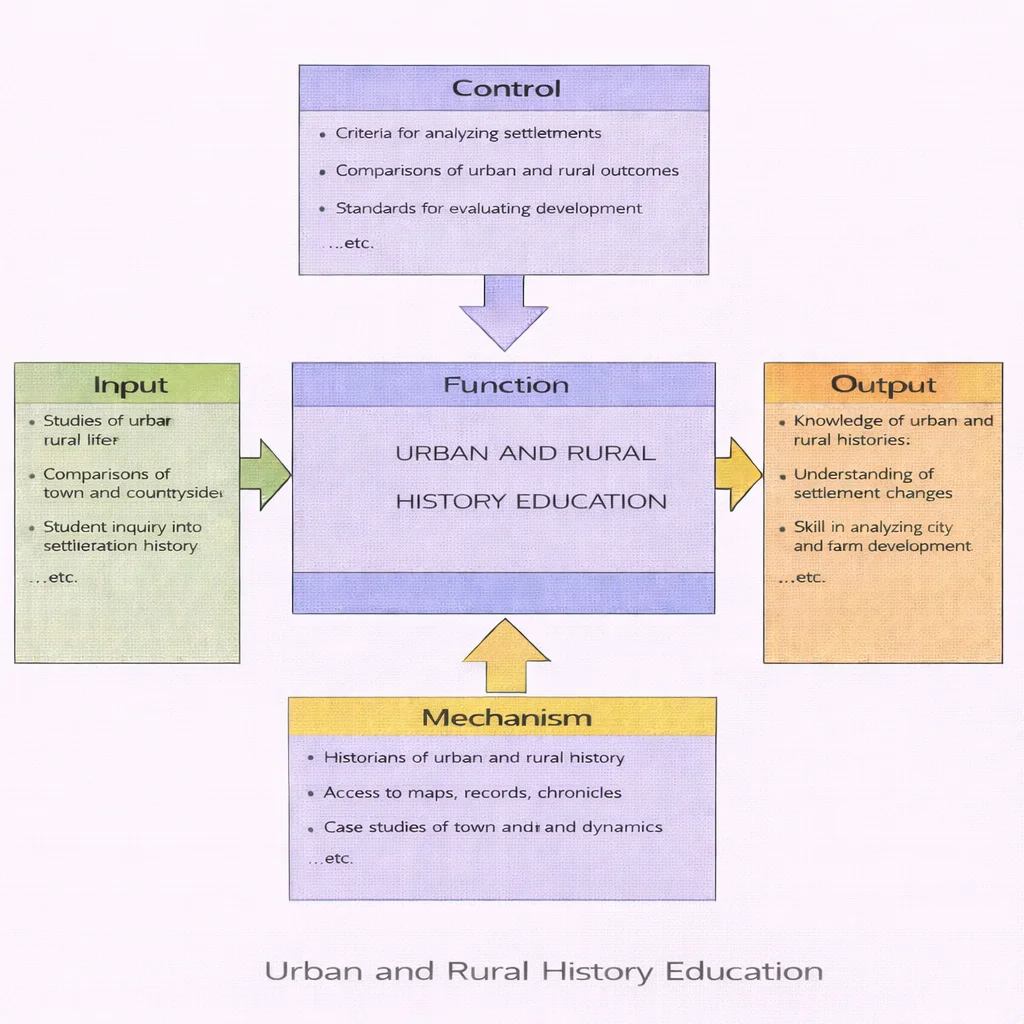

Spaces of Life: Cities, Countryside, and Social Organisation
Social History – Overview
Serves as the foundational umbrella examining how everyday life, labor relations, family structures, and community norms evolve across eras and physical settings.
Demographic History
Analyzes population distribution, birth/death rates, and density shifts that dictate spatial growth, suburban expansion, and rural depopulation dynamics.
Education History
Investigates how educational access, institutional infrastructure, and literacy programs historically diverged between urban centers and isolated agrarian communities.
History of Social Movements
Explores how spatial environments dictate activism—contrasting high-density urban public square protests with agrarian land revolts and peasant uprisings.
Migration and Diaspora Studies
Examines rural-to-urban domestic migration corridors alongside international immigrant arrivals that fundamentally reshape city demographics and labor markets.
Urban and Rural History (Current Focus)
Focuses directly on the built environment, agrarian systems, city planning, land tenure, and the evolving interdependence of metropolitan and rural landscapes.
Women’s History
Analyzes how spatial arrangements alter gender roles, domestic vs. industrial labor opportunities, and women’s participation in civic and agrarian life.
Urban History
The Development of Cities
Early Cities
- Mesopotamia (4th Millennium BCE): Cities like Ur and Uruk in Mesopotamia are among the earliest examples of urban settlements, driven by trade, agriculture, and centralized governance.
- Indus Valley Civilization (c. 2500 BCE): Harappa and Mohenjo-Daro featured advanced urban planning, with grid layouts, drainage systems, and public baths.
- Ancient Rome: Rome exemplified large-scale urbanization, with sophisticated infrastructure like aqueducts, amphitheaters, and roads.
Medieval Cities
- Cities in Europe during the Middle Ages became hubs for trade, religion, and craftsmanship.
- Examples: Venice as a center of maritime trade; Paris, which grew around Notre-Dame Cathedral, symbolizing the fusion of urban life and religion.
Industrialization and Urban Growth
- The Industrial Revolution (18th–19th centuries) accelerated urbanization, as rural populations moved to cities for factory work.
- Examples: Manchester and Birmingham in the UK became industrial powerhouses; the rapid growth of cities like Chicago and New York in the U.S. reflected the global trend of urbanization.
Urban Planning and Infrastructure
Historical Urban Planning
- Renaissance Urban Design: Cities like Florence and Rome emphasized symmetry, open squares, and monumental architecture.
- Haussmann’s Paris (1853–1870): Baron Haussmann redesigned Paris with wide boulevards, parks, and modern sewage systems, setting a model for urban renewal.
Modern Urban Planning
- The 20th century saw the rise of planned cities like Brasília (Brazil) and Chandigarh (India), designed to reflect modernist ideals.
- Impact: While these cities aimed for efficiency and order, many struggled with social inequality and inadequate infrastructure.
The Rise of Megacities
Drivers of Growth
- Economic opportunities in trade, manufacturing, and services attract rural migrants.
- Globalization has concentrated economic activity in urban hubs.
Examples:
- Tokyo: The world’s largest city, Tokyo exemplifies efficient urban planning, transportation systems, and economic power.
- Mumbai: Reflects the challenges of urbanization, including overcrowding, informal housing, and environmental degradation.
Gentrification and Urban Transformation
Impact of Gentrification
- Positive Effects: Revitalization of infrastructure, increased property values, and reduced crime rates.
- Negative Effects: Displacement of long-term residents, loss of cultural identity, and increased inequality.
Examples:
- Brooklyn, New York: Once an industrial hub, Brooklyn has undergone significant gentrification, transforming into a trendy, affluent area.
- London’s East End: Formerly working-class neighborhoods have seen rapid redevelopment, sparking debates about cultural erasure.
Rural History
The Evolution of Agrarian Societies
Early Agrarian Communities
- Neolithic Revolution (c. 10,000 BCE): The shift from hunter-gatherer societies to settled agriculture laid the foundation for rural communities. Fertile Crescent communities cultivated wheat and barley, domesticated animals, and established early village life.
Medieval Rural Economies
- Feudal Systems: In medieval Europe, rural life revolved around feudal estates, where peasants worked the land in exchange for protection. Manor systems in England and France structured rural economies and dictated social hierarchies.
Colonial Agriculture
- Colonial powers transformed rural landscapes through plantation economies.
- Examples: Sugarcane plantations in the Caribbean relied heavily on enslaved labor; tea and cotton cultivation in British India reoriented rural economies toward global markets.
Rural Economies and Challenges
Economic Characteristics
- Primary reliance on farming, fishing, and resource extraction.
- Limited access to industrial and service-based economic opportunities.
Challenges in Rural Development
- Depopulation: Rural-to-urban migration has led to shrinking populations in many rural areas, particularly in Europe and North America.
- Technological Disparities: Mechanization of agriculture has improved productivity but reduced rural employment.
- Infrastructure Deficits: Many rural regions lack access to healthcare, education, and transportation.
Rural Social Structures
Community and Culture
- Rural communities emphasize kinship ties, shared traditions, and local governance. Indigenous communities in rural Latin America maintain cultural practices tied to land and nature.
Inequality and Land Ownership
- Concentration of land ownership in the hands of elites has often exacerbated inequality (e.g., Latin America’s hacienda system created stark divides between landowners and laborers).
Rural and Urban Interconnections
Migration and Remittances
- Rural-to-urban migration has fueled urban growth, while remittances from urban workers support rural economies.
Food Supply Chains
- Urban centers rely on rural areas for food and raw materials, while rural regions depend on cities for markets and goods.
Examples in Urban and Rural History
Urbanization in Ancient Rome
- Rome’s sophisticated urban infrastructure, including aqueducts and amphitheaters, set a benchmark for urban planning.
Rural Societies in Colonial India
- The British colonial focus on cash crops disrupted traditional agrarian economies, leading to famine and rural impoverishment.
Gentrification in Global Cities
- Cities like San Francisco have experienced tech-driven gentrification, displacing working-class residents and reshaping neighborhoods.
Rural Electrification in the 20th Century
- Programs like the U.S. Rural Electrification Administration (1935) modernized rural life, improving productivity and quality of life.
Interactive Analysis: Urban Population Share & Agrarian Transition Model
Urban-Rural Spatial Transition Simulator
Simulate percentage urban population (U) and rural agricultural labor share (A) over a 100-year transition timeline.
Applications of Urban and Rural History
Policy Development
- Historical insights inform policies on urban planning, rural development, and equitable resource distribution.
Sustainable Development
- Lessons from urbanization and rural transformation guide efforts to balance development with environmental sustainability.
Cultural Preservation
- Understanding rural and urban history aids in preserving traditions, landscapes, and heritage in a rapidly modernizing world.
Why Study Urban and Rural History
Understanding How Communities and Landscapes Evolve
Exploring the Forces Behind Urbanization and Rural Life
Analyzing Social Structures, Economic Roles, and Daily Life
Recognizing the Environmental and Spatial Dimensions of History
Preparing for Interdisciplinary Study and Community Awareness
Urban and Rural History: Conclusion
Interactive Review: Core Concepts & Analytical Frameworks
How does Von Thünen’s Agricultural Land Use Model explain rural spatial organization?
What is the Rent-Gap Theory of Urban Gentrification?
Differentiate between Central Place Theory thresholds and range.
Frequently Asked Questions
What is urban and rural history?
Urban and rural history is the study of how cities, towns, villages, and countrysides have developed over time, and how people have lived, worked, and interacted in these different settings. It examines changing landscapes, social structures, economies, and cultures in both urban and rural environments and the relationships between them.
How does urban and rural history fit within social history?
Within social history, urban and rural history explores how everyday life is shaped by where people live. It looks at how housing, work, social networks, public services, and leisure differ between city and countryside, and how these differences are linked to broader processes such as industrialisation, state-building, migration, and globalisation.
What topics are commonly studied in urban history?
Common topics in urban history include the growth of towns and cities, housing and slums, public health and sanitation, transport systems, urban planning and zoning, neighbourhood segregation, policing and crime, civic institutions, and the cultural life of streets, markets, and public spaces.
What topics are commonly studied in rural history?
Rural history examines topics such as farming systems, land ownership and tenancy, commons and enclosures, village communities, seasonal labour, agricultural technology, food production, rural poverty, religious and cultural practices, and the impact of markets, states, and empires on countryside life.
What kinds of sources do historians use for urban and rural history?
Historians use sources such as maps, cadastral and land records, tax registers, census data, building plans, planning documents, court and police records, farm accounts, household budgets, newspapers, photographs, memoirs, oral histories, and archaeological evidence. These sources help reconstruct both physical landscapes and social relations.
How has urbanisation changed the relationship between city and countryside?
Urbanisation has transformed city–countryside relationships by concentrating population, industry, and services in urban centres, while linking them to rural areas through food supply, raw materials, labour migration, and transport networks. Urban and rural history studies how these connections created new opportunities and inequalities for both regions.
How do class, gender, and race or ethnicity appear in urban and rural history?
Class, gender, and race or ethnicity shape who has access to land, housing, work, and education in both urban and rural contexts. Urban and rural history investigates how elites, workers, peasants, migrants, and minority groups experienced space differently, and how patterns of segregation, mobility, and social control varied between city and countryside.
What is the environmental dimension of urban and rural history?
The environmental dimension focuses on how human activities have transformed landscapes, ecosystems, and resource use in both urban and rural settings. Historians study issues such as deforestation, soil exhaustion, irrigation, pollution, waste management, green spaces, and the environmental consequences of industrial and agricultural change.
How do historians study migration between urban and rural areas?
Historians study urban–rural migration by tracing movements of people seeking work, land, safety, or education. They use population registers, labour contracts, remittance records, and personal testimonies to understand why people moved, how they maintained ties with home communities, and how migration reshaped both origin and destination areas.
How have governments and planners influenced urban and rural spaces?
Governments and planners have influenced urban and rural spaces through policies on land use, housing, infrastructure, taxation, agricultural support, conservation, and redevelopment. Urban and rural history examines how planning visions were implemented or resisted, and how state interventions changed the everyday environments of residents.
Why is it useful to compare urban and rural experiences in history?
Comparing urban and rural experiences helps reveal how similar social processes—such as industrialisation, war, or welfare reform—played out differently in distinct settings. It prevents overgeneralising from city-centred narratives and highlights how city and countryside have been interdependent rather than isolated worlds.
What skills can students gain by studying urban and rural history?
Students gain skills in reading maps and spatial data, interpreting quantitative and qualitative sources, and thinking about how space, environment, and infrastructure shape social life. They learn to connect local landscapes to wider economic and political forces, an ability that is valuable for further study and careers in planning, heritage, policy, and research.
Comprehensive Practice Module
Section 1: Foundational Review Questions
- What is urban and rural history and what does it study?
Answer: Urban and rural history is the study of how different environments—cities and the countryside—have evolved over time and influenced the development of societies. It examines the growth, decline, and transformation of urban centers as well as rural areas, exploring factors such as migration, economic changes, and cultural shifts. This field highlights the distinct characteristics and interactions between urban and rural settings, offering insights into how these regions complement and contrast with each other. By analyzing these environments, historians gain a deeper understanding of societal development and the diverse experiences of various communities. - How do urban and rural histories differ in their focus and methodology?
Answer: Urban history tends to focus on the development of cities, industrialization, infrastructure, and the social dynamics of densely populated areas, while rural history emphasizes agriculture, community life, and the preservation of traditional lifestyles in the countryside. The methodologies also differ; urban historians often utilize census data, architectural analysis, and studies of economic activity, whereas rural historians may rely more on local records, oral histories, and ethnographic research. These distinct approaches allow for a comprehensive analysis of each environment’s unique contributions to social and cultural evolution. Together, they provide a balanced view of how diverse landscapes shape human experience. - What factors contributed to the rapid growth of urban centers historically?
Answer: The rapid growth of urban centers has historically been driven by factors such as industrialization, technological advancements, and economic opportunities. The migration of people from rural areas to cities in search of jobs and better living conditions played a significant role in urban expansion. Additionally, improvements in transportation and infrastructure facilitated the movement of goods and people, further accelerating urbanization. These combined factors transformed cities into vibrant hubs of innovation, culture, and commerce, influencing the overall development of modern society. - How have rural communities evolved in response to modernization?
Answer: Rural communities have evolved in response to modernization through changes in agricultural practices, technological integration, and shifts in social organization. The introduction of mechanized farming and improved transportation has transformed rural economies, leading to both increased productivity and challenges such as depopulation. Socially, rural areas have adapted by diversifying economic activities and preserving cultural traditions while incorporating modern practices. These adaptations illustrate the resilience of rural communities and their ability to negotiate between tradition and modernity. - What role does migration play in shaping the urban-rural dynamic?
Answer: Migration plays a crucial role in shaping the urban-rural dynamic by influencing population distribution, economic activity, and cultural exchange between regions. The movement of people from rural areas to cities often results in urban growth and changes in labor markets, while return migration or urban-to-rural trends can rejuvenate the countryside. Migration fosters cultural exchange and innovation, contributing to a more integrated societal development. This dynamic interplay between urban and rural areas is essential for understanding the broader social and economic transformations that occur over time. - How do social historians study the everyday lives of urban and rural populations?
Answer: Social historians study the everyday lives of urban and rural populations by examining a wide range of sources such as census records, diaries, oral histories, and local archives. They analyze these materials to uncover patterns in family structures, work routines, social interactions, and cultural practices. This approach allows historians to reconstruct the lived experiences of ordinary people, providing insights into how daily life shapes and is shaped by broader social and economic forces. Such detailed investigations help to create a more nuanced picture of historical development beyond political or military events. - What impact has industrialization had on the contrast between urban and rural areas?
Answer: Industrialization has had a profound impact on the contrast between urban and rural areas by dramatically shifting economic and social structures. Urban areas experienced rapid growth as factories and industries attracted large numbers of workers, leading to the development of dense, industrialized cities. In contrast, rural areas often faced depopulation and economic stagnation as traditional agricultural practices were disrupted by technological advances. This divergence has resulted in distinct lifestyles, economic opportunities, and social challenges, highlighting the transformative effects of industrialization on both regions. - How do historians use quantitative data to analyze urban and rural historical trends?
Answer: Historians use quantitative data, such as census records, economic statistics, and demographic surveys, to analyze trends in urban and rural areas over time. This data helps in identifying patterns of population growth, migration, employment, and economic development, which are critical for understanding the evolution of these regions. By applying statistical methods and data visualization techniques, historians can draw correlations between economic events and social changes. Quantitative analysis provides a solid empirical foundation that supports the broader narrative of historical transformation in both urban and rural contexts. - What challenges do historians encounter when researching urban versus rural history?
Answer: Historians researching urban versus rural history encounter challenges such as the availability and reliability of sources, differences in record-keeping practices, and the inherent diversity of experiences across regions. Urban records may be more systematically documented due to higher administrative oversight, while rural records can be sparse and fragmented. Additionally, the complexity of social dynamics in both settings requires a nuanced approach to interpret data accurately. These challenges necessitate the use of interdisciplinary methods and critical analysis to piece together a comprehensive and balanced historical narrative. - How can the study of urban and rural history contribute to contemporary policy-making?
Answer: The study of urban and rural history contributes to contemporary policy-making by providing insights into the long-term effects of social, economic, and cultural trends on different communities. By understanding historical successes and failures, policymakers can design more effective strategies for urban planning, rural development, and resource allocation. Historical analysis reveals patterns that help predict future challenges and opportunities, guiding decisions that promote sustainable growth and social equity. This perspective is invaluable for creating policies that address the needs of diverse populations and foster balanced regional development.
Section 2: Analytical & Scenario-Based Questions
- How do urban and rural historical trends inform our understanding of current regional disparities?
Answer: Historical patterns reveal that contemporary regional wealth disparities stem from path-dependent investments in industrial infrastructure, transportation corridors, and centralized state services. Urban hubs accumulated capital and talent, leaving agrarian hinterlands vulnerable to de-skilling and resource extraction. - What are the potential benefits and drawbacks of rapid urbanization as observed in historical contexts?
Answer: Benefits include rapid economic innovation, higher labor productivity, agglomeration economies, and dynamic cultural exchanges. Drawbacks historically included severe public health crises (cholera/typhoid epidemics), housing overcrowding, environmental pollution, and heightened social inequality. - How do changing social attitudes impact the development of educational systems in urban versus rural settings?
Answer: Urban settings historically embraced centralized, specialized, and technical educational models driven by industrial labor demand. Rural educational systems often emphasized agrarian calendars, vocational skills, and local community preservation, creating persistent divergences in institutional funding and literacy infrastructure. - What role does migration play in transforming urban and rural educational landscapes?
Answer: Influxes of rural-to-urban migrants created multilingual, culturally diverse metropolitan classrooms that spurred standardized public schooling. Conversely, rural out-migration resulted in school consolidations, shrinking tax bases, and diminished educational funding in countryside districts. - How can historical studies of rural education inform modern strategies to combat educational inequality?
Answer: History illustrates that top-down urban educational policies often fail when imposed on agrarian environments. Modern equity strategies must incorporate community-led governance, flexible seasonal scheduling, and targeted digital infrastructure investment to bridge geographic isolation. - How do demographic shifts influence the evolution of social institutions, particularly in education?
Answer: Youth bulges in expanding cities drive infrastructure expansion, teacher training programs, and political debates over curriculum standardization. In aging rural regions, demographic decline forces institutional mergers, regional transportation networks, and adult lifelong-learning adaptations. - What lessons can be learned from historical responses to educational crises in urban areas?
Answer: Historical urban educational crises (such as child labor during early industrialization) demonstrate that legal mandates (compulsory attendance laws) are ineffective without accompanying social welfare infrastructure, free school meals, and safe physical facilities. - How do global migration trends affect educational opportunities and outcomes?
Answer: Transnational migration enriches city school systems with global perspectives but strains language-support resources. Transnational remittances sent back to rural home districts often fund private schooling and higher education access previously unattainable under local agrarian economies. - How can the history of social movements in education guide modern reforms in teaching practices?
Answer: Historical grass-roots movements (such as civil rights school boycotts or agrarian literacy brigades) show that meaningful pedagogical reform requires active student and community engagement rather than passive administrative compliance. - How do historical patterns of urban and rural education contribute to our understanding of regional disparities?
Answer: Historical tax-funding models tied to local property values created structural funding gaps between wealthy urban/suburban centers and low-income agrarian zones, explaining long-term inter-generational mobility disparities across regions. - How do historical shifts in urbanization influence the development of educational systems?
Answer: Urban concentration necessitated standardized grade levels, professional teacher credentialing, and administrative superintendencies to manage vast student populations, establishing the modern bureaucratic school archetype. - What role does cultural diversity play in shaping educational reforms, and how can it be leveraged for better outcomes?
Answer: Multi-ethnic urban environments challenge Eurocentric curricula, pushing reforms toward multiculturalism, bilingual education, and critical pedagogy that improve cognitive flexibility and civic engagement across all student cohorts.
Section 3: Mathematical & Quantitative Analysis Problems
Apply quantitative models of urban growth, population density, and agrarian land efficiency using the standard HTML mathematical formats below.
- Urban Agglomeration Population Exponential Growth:
An industrializing city’s population expands according to P(t) = P0 · eg · t, where initial baseline population P0 = 150,000 residents, growth rate g = 0.042 per year, and t is time in years. Calculate the urban population after t = 25 years.
Solution:P(25) = 150,000 · e(0.042 × 25)The projected urban population after 25 years reaches approximately 428,648 residents.
P(25) = 150,000 · e1.05
Since e1.05 ≈ 2.85765:
P(25) = 150,000 × 2.85765 = 428,647.5 - Urban Population Density Gradient (Clark Model):
Colin Clark’s model predicts population density D(x) at distance x kilometers from the city center as D(x) = D0 · e–b · x, where central density D0 = 18,000 persons/km2 and density gradient b = 0.15 km-1. Calculate the predicted population density at distance x = 10 km from the core.
Solution:D(10) = 18,000 · e(-0.15 × 10)The population density at 10 km distance is 4,016 persons/km2.
D(10) = 18,000 · e-1.50
Since e-1.50 ≈ 0.22313:
D(10) = 18,000 × 0.22313 = 4,016.34 - Rural-to-Urban Migration Pull Ratio:
In a developing region, the annual rural out-migration volume MR→U is modeled as MR→U = 0.08 · Prural · (Wurban / Wrural), where rural population Prural = 500,000, average urban wage Wurban = $650/month, and rural wage Wrural = $250/month. Calculate the annual number of rural migrants moving to the city.
Solution:Wage Ratio = $650 / $250 = 2.60The annual rural-to-urban migration flow is 104,000 migrants.
MR→U = 0.08 × 500,000 × 2.60
MR→U = 40,000 × 2.60 = 104,000 - Agrarian Land-Labor Productivity Ratio:
An agricultural region containing 120,000 hectares of cultivated land produces 480,000 metric tons of grain annually with a workforce of 16,000 farmers. Following farm mechanization, the farming workforce decreases to 10,000 farmers while total yield increases to 550,000 metric tons. Calculate the percentage increase in grain yield per farmer (labor productivity).
Solution:Initial Productivity = 480,000 tons / 16,000 farmers = 30.0 tons/farmerLabor productivity per farmer increased by 83.3%.
Post-Mechanization Productivity = 550,000 tons / 10,000 farmers = 55.0 tons/farmer
Percentage Increase = [(55.0 – 30.0) / 30.0] × 100%
Percentage Increase = (25.0 / 30.0) × 100% ≈ 83.33% - Urban Slum Housing Expansion Index:
A metropolitan area’s informal housing settlement population grows from 80,000 to 210,000 over a 12-year period. Calculate the compound annual growth rate (CAGR) r of the informal settlement population.
Solution:CAGR Formula: r = (Pfinal / Pinitial)1/t – 1The informal settlement grew at a compound annual rate of 8.37%.
r = (210,000 / 80,000)1/12 – 1
r = (2.625)0.08333 – 1
Since 2.6250.08333 ≈ 1.0837:
r = 1.0837 – 1 = 0.0837 - Central Place Market Threshold Area:
A regional market town requires a minimum population threshold of 25,000 residents to economically support a specialized agricultural equipment dealership. If the surrounding rural hinterland has a uniform population density of 40 persons per square kilometer, calculate the minimum market area radius R in kilometers (assuming a circular hinterland area A = π · R2).
Solution:Required Area A = Threshold Population / Population DensityThe market town requires a minimum hinterland service radius of 14.1 km.
A = 25,000 / 40 = 625 km2
π · R2 = 625 ⇒ R2 = 625 / 3.14159 ≈ 198.94
R = √(198.94) ≈ 14.10 km - Gentrification Rent-Gap Potential Index:
A inner-city industrial district generates $12 per square meter in annual ground rent under current warehouse usage. Urban planning re-zoning projects that residential loft re-development could yield $68 per square meter. Calculate the absolute Rent-Gap per square meter and the ratio of potential to actual ground rent.
Solution:Rent-Gap = Potential Ground Rent – Actual Ground RentThe absolute Rent-Gap is $56/m2, representing a potential ground rent 5.67 times current utilization.
Rent-Gap = $68/m2 – $12/m2 = $56/m2
Rent Ratio = $68 / $12 ≈ 5.67