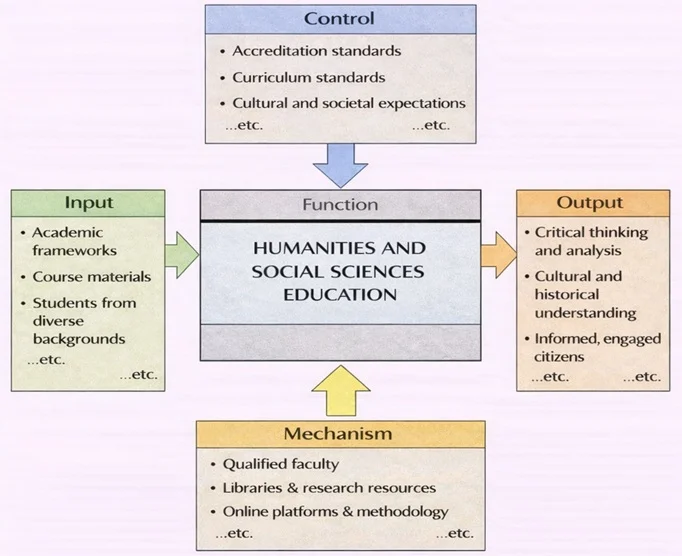
Humanities and Social Sciences form the living heart of our understanding of people, culture, and the shared spaces we call society. They invite us to explore how we think, feel, believe, create, and govern, weaving together lessons from history, art, ethics, and human interaction. Through these disciplines, we learn not only to interpret the past and understand the present, but also to imagine fairer, wiser futures.
In sociology, we uncover how families, communities, and nations shape identity and behavior. In psychology, we enter the intricate landscapes of thought, emotion, and motivation. Both perspectives deepen our grasp of what it means to live and act as part of a larger human story.
Belief systems and values come into focus through religious studies and philosophy. These fields sharpen our capacity to question, reason, and reflect on existence, morality, and purpose. Literature complements them by opening doors to empathy and cultural insight through storytelling and symbolic expression.
The political dimensions of life are explored in political science and international relations. These disciplines illuminate how governance, diplomacy, and global cooperation can resolve conflict, promote justice, and respond to crises — skills urgently needed in a rapidly changing world.
Today’s human-centered inquiry must also consider science and technology. Topics such as emerging technologies, information technology, robotics, cybersecurity, and data science are transforming economies, communities, and values — raising questions about ethics, equity, and human well-being.
The built environment links people with place through urban and regional planning and environmental engineering. These areas, along with satellite technology and disaster engineering, remind us that innovation must always account for cultural context and human needs.
New frontiers such as the Internet of Things and renewable energy connect technical progress with everyday life. When informed by statistics, behavioral understanding, and the humanistic lens, these advances can be harnessed for the greater good.
In a connected age, bridging the human and the technological has become a defining challenge. The integration of internet and web technologies, green building, and smart manufacturing with socially aware thinking ensures that progress remains sustainable, inclusive, and meaningful.

Choose a Doorway into the Humanities and Social Sciences
Step into a world of inquiry that unites the past, present, and future of human thought and society. Each doorway below opens to a second-level hub where you can explore further in a focused discipline.
- HistoryTrace the rise and fall of civilizations, the shaping of political systems, and the stories of people who transformed the world. History provides the context for understanding our shared journey.
- LiteratureStep into worlds both real and imagined through the voices of storytellers, poets, and playwrights. Literature reflects our deepest emotions, questions, and hopes.
- PhilosophyEngage with timeless questions about truth, justice, and meaning. Philosophy sharpens your reasoning while inviting you to see the world through different lenses.
- Religious StudiesExplore diverse beliefs, traditions, and spiritual practices. Understanding religion offers insight into cultures, values, and the forces that shape human identity.
- SociologyExamine the structure of societies, patterns of behavior, and the forces driving social change. Sociology helps us see the invisible connections shaping daily life.
- AnthropologyDiscover the rich diversity of human cultures, past and present. Anthropology bridges biology, history, and culture to tell the full story of humanity.
- PsychologyDelve into the mind, emotions, and behavior. Psychology reveals how we think, learn, and connect with others, offering pathways to personal growth and well-being.
- Internaltional Relation
- Cultural Studies
- Political ScienceStudy how power is organized and exercised. Political science examines governance, policy, and the strategies shaping collective decision-making.
- LinguisticsUnlock the science of language—its structure, evolution, and role in culture. Linguistics connects communication with human thought and identity.
See the Bigger Picture
The humanities and social sciences do not stand alone—they are threads woven through the broader fabric of knowledge. By exploring other hubs, you can connect insights across disciplines and uncover ideas that enrich your understanding from fresh angles.
Wander into related realms to see how art shapes politics, how science informs education, how economics affects culture, and how health connects to social well-being. Each link below is a gateway to another landscape of thought.
- Arts, Design & MediaExplore creative expression across visual arts, music, theatre, and design—where imagination meets cultural influence.
- Business, Economics & LawUnderstand how markets, policies, and legal frameworks shape societies and guide the flow of global exchange.
- EducationExamine how people learn, how knowledge is shared, and how education systems impact future generations.
- HealthDiscover how physical, mental, and social well-being are intertwined, shaping the quality of life for individuals and communities.
- STEMDive into science, technology, engineering, and mathematics—fields that drive innovation and transform the human experience.
- CoursesFind structured learning paths designed to strengthen your knowledge and skills across diverse academic areas.
Explore Humanities & Social Sciences topics:
Anthropology
Study human cultures, beliefs, and social structures across time and place.
Cultural Studies
Explore how power, identity, and media shape everyday life and cultural meanings.
History
Trace how past events, ideas, and institutions shaped today’s societies.
Literature
Read texts as windows into imagination, emotion, and social critique.
Philosophy
Ask fundamental questions about knowledge, ethics, reality, and meaning.
Political Science
Examine how power, institutions, and citizens interact in modern politics.
International Relations
Explore how states, organisations, and movements interact on the global stage.
Psychology
Investigate how humans think, feel, behave, and develop across the lifespan.
Religious Studies
Compare religious traditions, beliefs, and practices in historical context.
Sociology
Analyse how social groups, institutions, and inequalities shape everyday life.
Linguistics
Study how language is structured, learned, used, and changed over time.
Table of Contents
Key Areas of Focus of Humanities and Social Sciences
🔸 Understanding Human Culture:
Explore the richness of human expression through literature, visual and performing arts, religion, and philosophy. These disciplines offer insights into cultural identity, moral frameworks, and the creative spirit that shape civilizations.
🔸 Examining Societal Structures:
Analyze how societies are organized, governed, and transformed over time. Topics such as political systems, social institutions, economic frameworks, and historical movements help students understand the dynamics of collective human life.
🔸 Analyzing Human Relationships:
Investigate the nature of interpersonal, societal, and intercultural relationships. Disciplines like sociology, psychology, and anthropology help explain communication, behavior, social cohesion, and the pursuit of social progress.
Applications of Humanities and Social Sciences
🔸 Academic and Professional Relevance:
The humanities and social sciences provide essential foundations for careers in education, public policy, international relations, journalism, cultural heritage, and community development. These disciplines cultivate a deep understanding of human behavior, historical context, and societal challenges—skills highly valued across sectors.
🔸 Real-World Problem Solving:
From addressing social inequality to interpreting political events and designing inclusive policies, knowledge from the humanities and social sciences supports thoughtful analysis and ethical decision-making. It fosters a holistic view of complex issues, enriching public discourse and civic engagement.
Core Skills Developed by Studying Humanities and Social Sciences
🔸 Critical and Reflective Thinking:
Students learn to analyze arguments, assess evidence, and challenge assumptions. This strengthens independent thinking and intellectual curiosity—key qualities for academic success and informed citizenship.
🔸 Effective Communication:
Reading comprehension, essay writing, debate, and presentation skills are central. Students develop the ability to articulate complex ideas clearly and persuasively across diverse formats and audiences.
🔸 Cultural and Ethical Awareness:
Studying global cultures, belief systems, and historical perspectives nurtures empathy, tolerance, and intercultural understanding—crucial for today’s interconnected world.
How Humanities and Social Sciences Prepare You for University
The interdisciplinary and inquiry-based nature of humanities and social sciences aligns closely with university-level expectations. These subjects encourage independent research, interpretive analysis, academic writing, and evidence-based reasoning—forming a strong foundation for a wide range of university majors.
Moreover, early exposure to diverse disciplines allows students to refine their academic interests and career goals. It also strengthens their readiness for coursework in liberal arts, education, communication, and the social sciences.
Lifelong Relevance of Humanities and Social Sciences Beyond University
Humanities and social sciences don’t just prepare students for exams—they prepare them for life. The intellectual habits formed through studying human culture and society continue to guide lifelong learning, civic participation, and professional adaptability in a rapidly changing world.
Key Areas of Focus in Humanities and Social Sciences
🔸 Understanding Human Culture
Discover the breadth of human expression through literature, visual and performing arts, religion, and philosophy. These fields illuminate cultural identity, moral values, and creative traditions, offering timeless insight into how civilizations define themselves.
🔸 Examining Societal Structures
Explore how societies are built, governed, and reshaped over time. Through the study of political systems, social institutions, economic models, and historical movements, students gain a deeper grasp of the forces that shape collective human life.
🔸 Analyzing Human Relationships
Investigate the dynamics of interpersonal, societal, and intercultural interactions. Disciplines such as sociology, psychology, and anthropology reveal patterns of communication, behavior, and cooperation that underpin social cohesion and progress.
Applications of Humanities and Social Sciences
🔸 Academic and Professional Relevance
These disciplines provide strong foundations for careers in education, public policy, international relations, journalism, cultural heritage, and community development. They foster a nuanced understanding of human behavior, historical context, and societal challenges—skills valued across every sector.
🔸 Real-World Problem Solving
Whether addressing social inequality, interpreting political developments, or designing inclusive policies, the humanities and social sciences equip learners to analyze complex problems and make ethical, informed decisions. They encourage a holistic approach that strengthens public discourse and civic participation.
Core Skills Developed Through Humanities and Social Sciences
🔸 Critical and Reflective Thinking
Students sharpen their ability to evaluate evidence, question assumptions, and consider multiple perspectives. This habit of mind nurtures intellectual curiosity and independent judgment.
🔸 Effective Communication
From persuasive writing to confident public speaking, learners develop the skills to convey complex ideas with clarity and impact—essential in both academic and professional contexts.
🔸 Cultural and Ethical Awareness
By engaging with diverse cultures, belief systems, and historical viewpoints, students build empathy, tolerance, and the ability to navigate an interconnected world with respect and understanding.
How Humanities and Social Sciences Prepare You for University
Inquiry-based and interdisciplinary in nature, these subjects align closely with university expectations. They foster skills in independent research, analytical writing, and evidence-based reasoning, forming a solid foundation for a wide range of degree programs.
Early exposure to this diversity of disciplines also helps students clarify academic interests, explore career pathways, and build the intellectual resilience needed for higher education.
Lifelong Relevance Beyond University
The benefits of studying the humanities and social sciences extend far beyond graduation. They cultivate adaptability, civic responsibility, and a lifelong appetite for learning—qualities that remain valuable in a rapidly evolving world.
Why Study Humanities and Social Sciences
Understanding Human Experience Across Time and Cultures
Building Critical Thinking and Analytical Skills
Strengthening Communication and Persuasive Writing
Exploring Social Structures, Inequality, and Global Challenges
Preparing for Diverse and Interdisciplinary Career Paths
Conclusion: The Value of Humanities and Social Sciences
The humanities and social sciences offer more than just academic knowledge—they provide a deep, multidimensional understanding of human thought, behavior, culture, and societal systems. These disciplines equip learners with critical thinking, ethical reasoning, and intercultural awareness—skills that are essential in today’s rapidly changing and interconnected world.
By engaging with diverse perspectives and analyzing complex social realities, students are empowered to become thoughtful, informed individuals who can contribute meaningfully to their communities and global society. Whether addressing contemporary challenges or shaping future innovations, the insights gained through the humanities and social sciences remain enduringly relevant across all walks of life.
Humanities and Social Sciences – Frequently Asked Questions
What are the humanities and social sciences?
The humanities and social sciences are fields that study people, ideas, cultures, societies, and institutions. Humanities subjects such as history, philosophy, literature, and cultural studies explore how people make meaning through language, art, and belief. Social sciences such as sociology, economics, politics, geography, and anthropology analyse patterns in human behaviour and social structures using evidence, theory, and critical reasoning.
How does the Humanities and Social Sciences hub on Prep4Uni.online support university preparation?
The Humanities and Social Sciences hub brings together core concepts, case studies, and guiding questions from many disciplines, helping you see connections between history, politics, economics, culture, and media. It is designed to build skills that universities value: critical reading, structured argument, comparative thinking, and the ability to relate abstract theory to real-world examples.
What school subjects are most relevant if I want to study humanities or social sciences at university?
Subjects such as history, geography, literature, social studies, economics, and a second language are particularly relevant. However, mathematics and science can also be helpful for data analysis, research methods, and understanding contemporary issues like climate change or technology policy. Strong reading, writing, and communication skills are essential across all humanities and social science pathways.
What types of degrees and careers can grow out of humanities and social sciences?
Degrees might include history, political science, economics, sociology, psychology, international relations, cultural studies, media studies, philosophy, or area studies. Graduates work in education, public service, diplomacy, journalism, cultural institutions, non-governmental organisations, business and management, policy analysis, marketing, consulting, and many emerging roles that require strong analytical and communication skills.
Why are critical thinking and argumentation so central in these disciplines?
Humanities and social sciences often deal with complex questions that do not have a single correct answer. You are expected to evaluate sources, compare interpretations, and construct a reasoned argument supported by evidence. Critical thinking helps you spot assumptions, clarify concepts, weigh trade-offs, and explain why one explanation is stronger than another instead of just memorising facts or opinions.
How do humanities and social sciences help me understand current global issues?
Global issues such as inequality, climate change, migration, public health, technological disruption, and cultural conflicts are shaped by history, institutions, and ideas. Humanities and social science perspectives help you trace where these issues come from, whose voices are heard or ignored, how policies are made, and how media narratives shape public opinion. This gives you tools to interpret the news more critically and to imagine alternative futures.
How is evidence used in humanities compared with social sciences?
In the humanities, evidence may include texts, artworks, archival sources, and cultural practices, and the focus is often on close reading, interpretation, and context. In the social sciences, evidence may include surveys, statistics, interviews, field observations, and experiments, with more emphasis on patterns, models, and generalisations. The Humanities and Social Sciences hub helps you see how different disciplines ask questions and justify their claims.
What skills will I develop by exploring this Humanities and Social Sciences hub?
You will strengthen your skills in critical reading, summarising and paraphrasing complex texts, constructing arguments, evaluating evidence, comparing case studies, and writing clearly for different audiences. You will also practise connecting ideas across subjects, such as linking economic history to political institutions, or cultural geography to migration and urban planning.
How can I use the pages in this hub to prepare for essay-based assessments?
You can use the overview sections to identify key themes, then turn the guiding questions into practice essay prompts. Try planning short outlines, identifying relevant examples from history, politics, law, media, or culture, and drafting thesis statements with two or three supporting points. Reviewing feedback from your teachers alongside the material on Prep4Uni.online will help you refine structure, clarity, and use of evidence.
How do humanities and social sciences connect to quantitative skills and data analysis?
Many social science disciplines, such as economics, political science, and sociology, use data to test hypotheses and evaluate policies. Even in more text-focused subjects, you may encounter charts, survey findings, or demographic data. Learning basic statistics and data literacy helps you interpret evidence, question causal claims, and engage with research critically rather than accepting numbers at face value.
What if I enjoy both STEM subjects and humanities or social sciences?
Enjoying both areas can be a strength. Many real-world problems, such as climate adaptation, urban design, digital ethics, or health policy, require combined insights from STEM and the humanities and social sciences. You might consider interdisciplinary paths such as philosophy of science, science communication, environmental policy, digital humanities, or data science applied to social questions, and use this hub to explore those bridges.
How should I navigate the Humanities and Social Sciences hub on Prep4Uni.online?
Start with the main Humanities and Social Sciences overview, then explore linked pages such as history, cultural studies, media and communication, economics, law, and geography. For each page, skim the introduction, identify key concepts, and try a few review or reflection questions. Over time, you can build a personal map of how different topics connect, which will help you choose future courses and keep your learning coherent rather than scattered.
Review Questions and Answers on Humanities and Social Sciences:
1. What is the significance of studying humanities and social sciences?
Answer: Studying humanities and social sciences is significant because it provides a deep understanding of human culture, history, and social structures. It encourages critical thinking and the ability to analyze complex societal issues. This field also fosters empathy and an appreciation for diverse perspectives, enriching personal and intellectual growth. Additionally, the insights gained help inform public policies and contribute to a more informed citizenry.
2. How do humanities disciplines contribute to our understanding of culture and society?
Answer: Humanities disciplines such as literature, philosophy, and history offer valuable insights into the cultural and intellectual evolution of societies. They explore the narratives, beliefs, and values that shape human behavior and societal development. Through the study of texts, art, and historical events, these disciplines provide context for contemporary social issues. This understanding encourages a more nuanced view of cultural identity and societal progress.
3. What role does social science research play in addressing societal challenges?
Answer: Social science research plays a crucial role in addressing societal challenges by analyzing patterns of human behavior and social interactions. It uses empirical data to identify trends, inform policies, and propose solutions to issues such as inequality, conflict, and social change. The research findings help shape effective interventions and guide decision-making in both public and private sectors. As a result, social sciences contribute to building more resilient and equitable communities.
4. How does the study of philosophy enhance critical thinking skills?
Answer: The study of philosophy enhances critical thinking skills by challenging students to question assumptions and analyze arguments systematically. It encourages deep reflection on ethical, metaphysical, and epistemological questions, fostering intellectual rigor and the ability to reason logically. Philosophical inquiry pushes individuals to consider multiple viewpoints and the underlying principles of belief systems. This process ultimately strengthens the capacity for critical analysis and informed decision-making.
5. In what ways do history and literature complement each other in understanding human experiences?
Answer: History and literature complement each other by providing different lenses through which to view human experiences and societal changes. History offers factual accounts and analysis of events, while literature captures the emotional and subjective aspects of these experiences. Together, they create a richer, more comprehensive understanding of the past and its impact on contemporary life. This interdisciplinary approach enables a deeper appreciation of how narrative and context shape our interpretation of events.
6. How does cultural diversity influence the study of social sciences?
Answer: Cultural diversity enriches the study of social sciences by providing a variety of perspectives on human behavior and social organization. It challenges researchers to consider the impact of cultural factors on societal norms and values. This diversity leads to more comprehensive and inclusive analyses, fostering a better understanding of global social dynamics. By embracing multiple cultural viewpoints, social sciences contribute to more equitable and culturally sensitive policies and practices.
7. What impact does globalization have on the fields of humanities and social sciences?
Answer: Globalization has a profound impact on humanities and social sciences by creating interconnected societies and fostering the exchange of ideas across borders. It challenges traditional boundaries and encourages comparative studies of cultures, economies, and political systems. Globalization also brings new social issues to the forefront, such as migration, transnational identities, and digital communication. As a result, these fields adapt to analyze and address the complexities of an increasingly globalized world.
8. How can interdisciplinary studies within humanities and social sciences foster innovation in research and education?
Answer: Interdisciplinary studies foster innovation by combining methodologies and perspectives from various fields to tackle complex questions that cannot be addressed by a single discipline alone. This approach encourages collaborative research, leading to new insights and creative problem-solving strategies. It also enriches the educational experience by exposing students to a wide range of ideas and critical frameworks. Ultimately, interdisciplinary studies drive academic and practical advancements that contribute to a deeper understanding of human society.
9. What are the benefits of engaging with classical texts in modern humanities education?
Answer: Engaging with classical texts provides students with a foundation in the ideas and cultural heritage that have shaped modern societies. These texts offer timeless insights into human nature, ethics, and the evolution of thought, which remain relevant in contemporary discussions. Studying classical works also develops critical reading and analytical skills, encouraging students to engage deeply with complex material. This engagement not only broadens intellectual horizons but also fosters a deeper appreciation for the historical context of modern issues.
10. How do social theories contribute to our understanding of contemporary societal issues?
Answer: Social theories contribute to our understanding of contemporary societal issues by providing frameworks that explain patterns of behavior, power dynamics, and social change. These theories, developed through historical and empirical research, offer insights into the underlying forces that shape communities and institutions. They help analyze the impact of social, economic, and political factors on individual and collective behavior. Consequently, social theories enable policymakers and researchers to develop strategies that address current challenges and promote social justice.
Humanities and Social Sciences: Thought-Provoking Questions and Answers:
1. How might digital humanities transform research and scholarship in the humanities?
Answer:
Digital humanities is transforming research in the humanities by integrating computational methods with traditional scholarly inquiry. This field leverages digital tools, such as text mining, data visualization, and online archives, to analyze large corpora of literature, historical documents, and cultural artifacts in ways that were previously unimaginable. By enabling the processing of vast amounts of data, digital humanities can uncover patterns and insights that offer new perspectives on cultural and historical phenomena. This innovative approach not only broadens the scope of research but also enhances the reproducibility and accessibility of scholarly work, paving the way for collaborative projects that span global networks.
Moreover, digital humanities opens up new avenues for interdisciplinary collaboration, allowing scholars from different fields to work together and share methodologies. As digital platforms become more sophisticated, they facilitate a deeper engagement with cultural content and foster creative interpretations that challenge traditional paradigms. Ultimately, digital humanities is poised to redefine scholarship in the humanities by making research more dynamic, inclusive, and responsive to the complexities of modern society.
2. In what ways can interdisciplinary approaches within the social sciences address contemporary global challenges?
Answer:
Interdisciplinary approaches within the social sciences can address contemporary global challenges by merging insights from sociology, political science, economics, and anthropology to develop comprehensive solutions. This collaborative approach enables researchers to examine complex issues such as climate change, migration, and inequality from multiple perspectives, ensuring that interventions are both multifaceted and contextually appropriate. By integrating various theoretical frameworks and methodologies, interdisciplinary research can uncover the underlying causes of these challenges and propose innovative strategies for sustainable development.
Furthermore, such approaches foster dialogue between academics, policymakers, and practitioners, leading to more informed and effective decision-making. The blending of diverse disciplines encourages the sharing of best practices and the development of policies that are adaptable to different cultural and socio-economic contexts. Ultimately, interdisciplinary collaboration not only enriches our understanding of global challenges but also empowers stakeholders to implement solutions that are resilient, equitable, and impactful.
3. How might globalization reshape the study of humanities and social sciences in the coming decades?
Answer:
Globalization is likely to reshape the study of humanities and social sciences by intensifying the focus on cross-cultural interactions, transnational identities, and global socio-political dynamics. As the world becomes more interconnected, scholars will increasingly examine how global flows of information, people, and capital influence local cultures and social structures. This shift will encourage a more comparative and integrative approach to research, where scholars draw on both global and local perspectives to analyze cultural phenomena, historical events, and contemporary social issues.
Additionally, globalization will drive the incorporation of new theoretical frameworks that address the complexities of an interconnected world. This may include studies on digital globalization, the impact of global migration, and the role of international institutions in shaping social policies. As a result, the curriculum in humanities and social sciences will evolve to reflect the realities of global interconnectedness, preparing students to navigate and contribute to an increasingly globalized society. This evolution will not only enhance academic inquiry but also foster a more nuanced understanding of how global forces shape individual and collective experiences.
4. What is the impact of cultural diversity on the development of social theories and policies?
Answer:
Cultural diversity has a profound impact on the development of social theories and policies by providing a rich tapestry of perspectives and experiences that challenge homogenous viewpoints. It drives the evolution of theories that account for the complexities of identity, power, and social interaction in multicultural societies. As social scientists explore diverse cultural practices, they develop more inclusive frameworks that better reflect the realities of global populations. This diversity in theoretical development informs policies that are sensitive to the needs of various cultural groups, promoting social equity and justice.
Moreover, the influence of cultural diversity encourages policymakers to consider a wider range of factors when designing and implementing social programs. By understanding the unique challenges and strengths of different cultural communities, policies can be tailored to foster greater inclusivity and social cohesion. Ultimately, the integration of cultural diversity into social theories and policies enriches our understanding of societal dynamics and contributes to more effective and empathetic governance.
5. How can public discourse be shaped to bridge the gap between academic research in social sciences and everyday societal challenges?
Answer:
Shaping public discourse to bridge the gap between academic research in social sciences and everyday societal challenges involves translating complex theories and findings into accessible and engaging language. Scholars and practitioners can work together to create platforms such as public lectures, social media campaigns, and community forums that disseminate research insights in a relatable manner. By communicating research in clear, non-technical language, academics can help the general public understand the relevance of their work to pressing issues such as inequality, migration, and social justice.
In addition, partnerships between universities, think tanks, and media organizations can help amplify the impact of social science research on public policy and societal attitudes. When academic findings are effectively communicated, they can influence policy debates and inspire community-driven initiatives that address real-world challenges. This collaborative effort between researchers and the public not only democratizes knowledge but also empowers individuals to engage with and act upon the insights derived from social science research.
6. What role does historical context play in understanding contemporary social issues, and how can this be effectively taught in the classroom?
Answer:
Historical context is essential for understanding contemporary social issues because it provides the background and evolution of current societal structures, beliefs, and conflicts. By examining historical events and trends, students can gain insight into how past decisions, cultural movements, and economic shifts have shaped present-day challenges. Teaching history in relation to contemporary issues encourages critical thinking and helps students understand the continuity and change within societies. This approach allows learners to draw connections between historical events and modern phenomena, fostering a deeper and more nuanced understanding of social dynamics.
To effectively teach historical context in the classroom, educators can use a variety of methods such as primary source analysis, project-based learning, and interactive digital tools that bring historical events to life. These strategies enable students to explore multiple perspectives and engage in active discussions about the relevance of history to current events. Incorporating case studies and comparative analyses can also highlight the lessons learned from the past and their application to modern challenges. Ultimately, a well-rounded historical education provides a critical foundation for analyzing and addressing contemporary social issues.
7. How might the study of philosophy contribute to the development of ethical frameworks in public policy?
Answer:
The study of philosophy contributes significantly to the development of ethical frameworks in public policy by encouraging rigorous analysis and critical reflection on moral principles and values. Philosophical inquiry challenges policymakers to consider the ethical implications of their decisions, ensuring that policies are grounded in fairness, justice, and respect for human dignity. Through the exploration of various ethical theories—such as utilitarianism, deontology, and virtue ethics—students and policymakers can debate and refine the moral foundations that guide public decisions. This intellectual process fosters more thoughtful and balanced policy-making that prioritizes the well-being of all citizens.
In addition, the study of philosophy provides the tools to systematically evaluate the consequences of policy choices and to navigate complex ethical dilemmas. It encourages an open dialogue about rights, responsibilities, and the common good, which is essential for creating policies that are both effective and morally sound. By integrating philosophical perspectives into public policy education, future leaders are better prepared to address the ethical challenges of governance and to develop policies that promote a just and equitable society.
8. What impact does globalization have on the development and dissemination of cultural knowledge in the humanities?
Answer:
Globalization significantly impacts the development and dissemination of cultural knowledge by facilitating the exchange of ideas, traditions, and artistic expressions across international borders. This interconnectedness allows for a broader understanding of diverse cultural practices and fosters a more inclusive global dialogue about identity and heritage. Globalization also challenges traditional cultural boundaries, encouraging the blending of different perspectives and the evolution of new cultural forms. As a result, humanities research becomes more dynamic and interdisciplinary, reflecting the complex interactions between local and global influences.
Moreover, the widespread availability of digital media and online platforms has democratized access to cultural knowledge, allowing people from various backgrounds to share and engage with diverse cultural narratives. This increased accessibility not only enriches academic inquiry but also promotes a more interconnected and culturally aware society. The impact of globalization on cultural knowledge highlights the importance of embracing diversity and encourages the continuous evolution of the humanities to reflect the realities of our globalized world.
9. How can social media influence the public’s perception of issues studied in the social sciences?
Answer:
Social media has a profound influence on the public’s perception of issues studied in the social sciences by shaping the narrative and framing of contemporary social debates. Platforms like Twitter, Facebook, and Instagram enable rapid dissemination of information and allow diverse voices to contribute to public discourse. This democratization of information can lead to a more informed and engaged public, as well as facilitate the spread of both accurate and misleading information. Social media can amplify research findings, spark discussions, and mobilize communities around social issues, ultimately impacting policy and societal attitudes.
However, the influence of social media also comes with challenges such as the potential for echo chambers, misinformation, and superficial engagement with complex topics. To mitigate these effects, scholars and public intellectuals must actively engage with digital platforms to present evidence-based analyses in accessible formats. By leveraging social media effectively, the social sciences can broaden their impact, influence public opinion, and foster a more critical and reflective society.
10. How might advancements in artificial intelligence affect research methodologies in the humanities and social sciences?
Answer:
Advancements in artificial intelligence (AI) have the potential to revolutionize research methodologies in the humanities and social sciences by automating data analysis, enhancing pattern recognition, and enabling large-scale text and content analysis. AI tools can process vast amounts of data from historical texts, social media, and other sources, uncovering trends and insights that might not be apparent through traditional qualitative methods. This capability allows researchers to explore complex questions and generate new interpretations that are data-driven and empirically robust. AI can also facilitate interdisciplinary research by bridging gaps between quantitative and qualitative approaches, offering a more comprehensive understanding of social phenomena.
Furthermore, the use of AI in research promotes efficiency and accuracy in data collection and analysis, reducing the time and effort required for manual processing. However, integrating AI into research also raises questions about the interpretation of automated results and the potential for algorithmic bias. To address these challenges, researchers must combine AI-driven insights with critical theoretical analysis, ensuring that technological advancements enhance rather than replace human scholarship. This balance is essential for advancing the humanities and social sciences in a rapidly evolving digital landscape.
11. How can public policy be informed by social science research to address contemporary societal issues?
Answer:
Public policy can be significantly informed by social science research by providing empirical evidence and theoretical frameworks that elucidate the causes and consequences of contemporary societal issues. Social science research offers data-driven insights into areas such as inequality, social mobility, and community dynamics, which are essential for designing effective policies. By integrating research findings into policy-making, governments can develop targeted interventions that address the root causes of social problems and promote sustainable development. This evidence-based approach ensures that policies are not only theoretically sound but also practically effective in improving societal well-being.
Moreover, collaboration between researchers and policymakers can facilitate the translation of complex academic studies into actionable strategies. This partnership allows for the continuous evaluation and refinement of policies based on real-world outcomes, fostering a more responsive and adaptive governance framework. Ultimately, the integration of social science research into public policy contributes to more informed decision-making and the creation of policies that are better aligned with the needs and realities of society.
12. How might changes in educational paradigms influence the future direction of humanities and social sciences research?
Answer:
Changes in educational paradigms, such as the shift towards interdisciplinary and experiential learning, are likely to influence the future direction of humanities and social sciences research by promoting more integrated and collaborative approaches. As educational models evolve to emphasize critical thinking, creativity, and practical application, research in these fields will increasingly focus on real-world issues and the complex interplay of cultural, social, and technological factors. This shift encourages scholars to explore innovative methodologies that bridge traditional academic boundaries and address contemporary challenges in a holistic manner.
Additionally, the integration of technology in education, such as digital learning platforms and virtual classrooms, will facilitate broader access to research resources and collaborative opportunities. These advancements enable a more diverse range of voices to contribute to scholarly debates, enriching the quality and relevance of research. As a result, changes in educational paradigms are expected to drive a more dynamic, inclusive, and socially engaged research agenda in the humanities and social sciences, ultimately leading to insights that can inform policy, practice, and societal progress.