
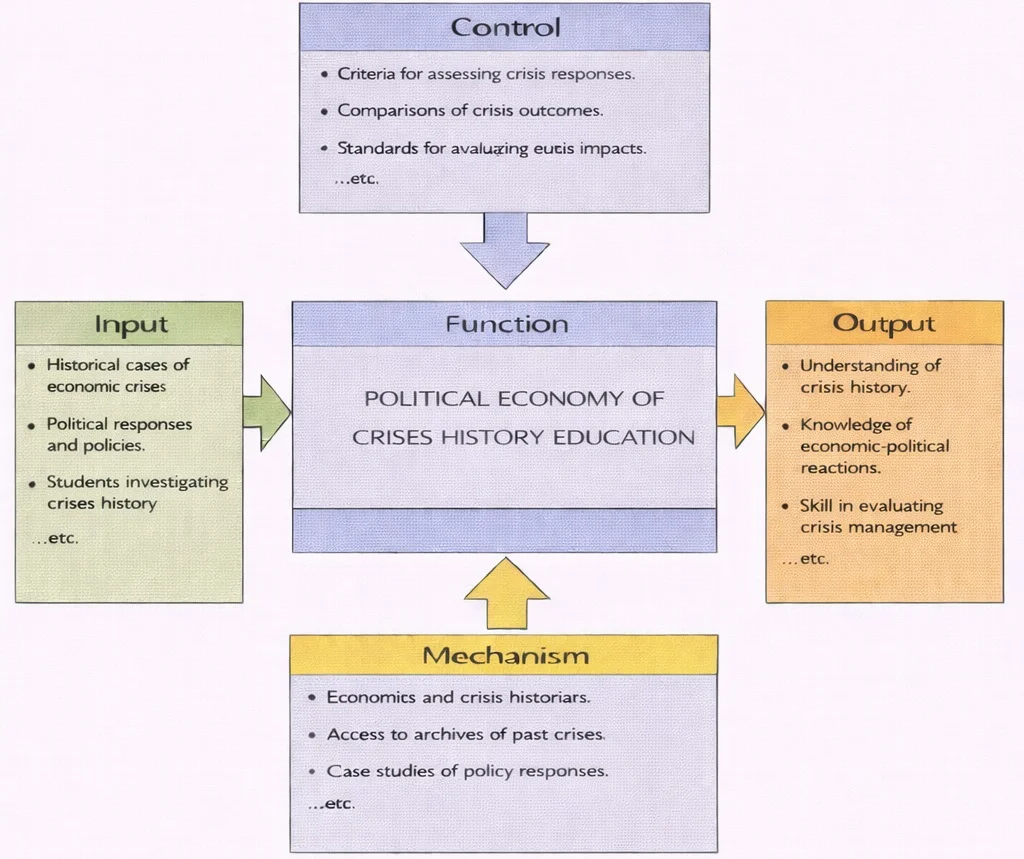
A crisis can look like chaos when you are living through it, yet it often follows patterns when you study it closely. This topic turns that confusion into a disciplined lens. Using historical cases of economic crises and the political choices made in response, students learn to compare outcomes across countries and eras, guided by clear criteria and standards for evaluating impacts. With support from economists and crisis historians, plus access to archives and carefully chosen case studies, learners practise tracing how policy decisions, institutions, and public pressures interact under stress. The result is a deeper understanding of crisis history, stronger insight into economic–political reactions, and a more confident ability to judge the strengths and limits of crisis management.
The political economy of crises examines how economic turmoil, social unrest, and institutional fragility intersect to reshape governance, ideology, and policy. At the heart of this field lies the recognition that crises—whether financial, political, or environmental—are not merely anomalies but recurring moments that test the resilience and distributional logic of societies. Historical precedents explored in economic thought and theory reveal long-standing tensions between state intervention and market autonomy during periods of instability.
Understanding how societies respond to crises also requires grappling with the intellectual frameworks that guide policy formation. The intellectual political history of different eras illustrates how competing ideologies—liberalism, socialism, nationalism—shape the meaning of crisis and the legitimacy of proposed solutions. As crises unfold, they often produce profound shifts in political ideologies and public expectations regarding the role of the state.
The political economy of crises cannot be fully understood without considering the lived experiences of ordinary people. Insights from social history and urban and rural history reveal how disruptions in livelihoods, housing, and social services become flashpoints for collective action. Events such as strikes, protests, and reform movements are documented in the history of social movements, showing how grassroots responses often pressure governments to rethink economic priorities.
Crises have frequently catalyzed changes in the structure of labor and welfare. The evolution of protections and entitlements, as seen in labor and social policy, reflects contested negotiations between states, employers, and workers during periods of austerity and recovery. Parallel shifts in education systems—explored in education history—have often aimed to prepare citizens for new economic realities while also managing dissent.
Global political economies are interlinked, and crises often spread across borders, as shown in trade and commerce history. Diplomatic responses, captured in studies like treaty analysis and the history of alliances, demonstrate how states attempt to contain or leverage crises for geopolitical advantage.
Crises often heighten scrutiny of institutional integrity. Investigations into electoral fraud and integrity tend to intensify when public trust erodes under economic stress. Similarly, patterns in electoral history and electoral systems and political parties provide insight into how political representation evolves amid demands for reform or emergency rule.
Military dimensions also play a role in the political economy of crises. Armed conflict and instability, analyzed in guerrilla warfare and insurgency studies and the social and cultural history of warfare, disrupt economies, provoke migration, and alter national priorities. The influence of innovation and logistics in these scenarios is captured in the industrial and technological history as well as the technological history of warfare.
Crises also bring previously marginalized issues to the fore. The women’s history perspective reminds us that crises affect genders differently, often intensifying inequalities while opening new political opportunities. Movements for enfranchisement and equity, such as those in suffrage and civil rights movements, gain momentum during times of upheaval when social orders are in flux.
Technological advancements also intersect with crises in profound ways. From financial markets to communication infrastructure, the role of technology in elections exemplifies how digital tools can either stabilize or destabilize democratic processes. Returning to foundational ideas in the history of economic thought reveals that each crisis is not just a breakdown—but also a critical juncture for innovation, redistribution, and political realignment.
The history of crisis responses across societies is essential to understanding why some recover with greater equity, while others spiral into prolonged instability. In examining these dynamics, the political economy of crises serves as a vital lens for interpreting both past ruptures and future uncertainties.
When Systems Break: Crises and the Reshaping of Political Economy
Economic crises expose the strengths and weaknesses of political systems. From financial collapses to resource shocks, crises force governments to respond, societies to adapt, and institutions to evolve. Studying crises reveals how economic stress reshapes policy, power, and public trust.
History of Political Economy – Overview
Trace how economic systems and political power have evolved together across history, serving as the core foundation for understanding systemic transformations.
Trade and Globalization
Explore how global economic integration can amplify both growth and vulnerability to international crisis contagion across trade networks.
Taxation and Fiscal Policy
Examine how governments use revenue generation and state expenditure to manage downturns, fund relief, and rebalance fiscal health.
Political Economy of Crises (Current Module)
Analyze how systemic economic breakdowns trigger intense political realignments, emergency state interventions, and ideological shifts.
Labor and Social Policy
Investigate how systemic shocks impact employment structures, prompt safety net expansions, and reshape worker-state relations.
History of Economic Thought
Explore the theoretical paradigms—from classical political economy to modern macroeconomics—that evolve in direct response to historical crises.
Theoretical Perspectives on Political Economic Crises
Keynesian Economics
- Advocates for government intervention during crises to stabilize aggregate demand.
- Example:
- Keynesian policies underpinned the New Deal and post-2008 stimulus programs.
Building on the insight that private-sector confidence can collapse in downturns, Keynesian theory argues that active fiscal policy is essential when households and businesses cut back on spending. Government outlays—whether through infrastructure projects, direct transfers, or temporary tax relief—can inject purchasing power into the economy and prevent a downward spiral. This approach relies on the concept of the fiscal multiplier, which suggests that each dollar of public spending can generate more than a dollar in GDP under certain conditions.
Keynesians highlight that during a severe slump, monetary policy alone may be ineffective if interest rates approach zero and liquidity traps emerge. In such scenarios, only fiscal expansion can close the output gap and restore full employment. This logic was fundamental to Roosevelt’s New Deal, which created public-works jobs to absorb the unemployed and kick‑start consumer demand. Decades later, similar reasoning guided the $787 billion American Recovery and Reinvestment Act of 2009.
ΔY = k × ΔG
Where ΔY is the change in total national output (GDP), ΔG is the change in government spending, and k = 1 / (1 – MPC) represents the Keynesian fiscal multiplier based on the Marginal Propensity to Consume (MPC).
Critics of Keynesian intervention often warn of the risks of ballooning deficits and long‑term debt burdens; however, proponents counter that deficits during crises are countercyclical and can be rolled back once growth resumes. The strategic withdrawal of stimulus, known as “fiscal consolidation,” is designed to restore balance without undermining the initial recovery. This dynamic interplay between stimulus and retrenchment remains central to modern macroeconomic policy debates.
Moreover, Keynesian models have incorporated automatic stabilizers—such as unemployment insurance and progressive taxation—that respond to economic conditions without new legislation. These built-in buffers smooth out fluctuations by increasing spending or cutting taxes when output falls, and doing the reverse in booms. In this way, Keynesian economics continues to inform both emergency measures and ongoing budget design.
Neoliberalism
- Emphasizes free markets and minimal government intervention.
- Criticism:
- The 2008 financial crisis revealed the shortcomings of market deregulation.
Neoliberal thought asserts that well‑functioning markets—unencumbered by excessive regulation—deliver the most efficient allocation of resources. Proponents argue that reducing barriers to trade, privatizing state-owned enterprises, and liberalizing capital flows spur competition, innovation, and long‑term growth. These policies became prominent under leaders like Margaret Thatcher and Ronald Reagan in the 1980s.
In practice, neoliberal reforms included deregulating financial markets, loosening restrictions on bank activities, and adopting flexible labor laws. Advocates claimed that such measures would foster dynamism by allowing capital to seek the highest returns and labor to move freely toward productive opportunities. Many emerging economies embraced these prescriptions in exchange for assistance from international institutions.
However, the global financial crisis of 2008 exposed vulnerabilities in lightly regulated banking systems. Complex financial instruments and excessive leverage triggered a cascade of bankruptcies and bailouts that required massive government intervention—the very antithesis of neoliberal principles. Critics argue that the crisis demonstrated how unregulated markets can generate systemic risk and moral hazard.
Despite these failings, elements of neoliberalism persist in calls for fiscal austerity, trade liberalization, and public‑private partnerships. The tension between market freedom and market stability animates ongoing policy debates: how to harness private initiative while safeguarding against boom‑and‑bust cycles. This dialectic remains a cornerstone of contemporary political economy.
Neoliberal ideology also reshaped global governance, leading to new institutions and agreements that prioritize investment protection and trade dispute resolution. Yet questions linger about social equity, environmental externalities, and the role of the state in crisis management. These unresolved issues ensure neoliberalism’s place at the heart of scholarly and policy contests.
Marxist Perspectives
- View crises as inherent to capitalism, driven by overproduction and exploitation.
- Example:
- Marxist theorists argue that the 2008 crisis exposed systemic contradictions in global capitalism.
Marxist analysis regards economic crises not as anomalies but as structural outcomes of capitalist competition. Because capitalists strive to maximize surplus value, they continually intensify production and lower labor costs, leading to overcapacity, underconsumption, and falling profit rates. This dynamic, Marxists contend, makes periodic downturns inevitable.
s / (c + v) = (s / v) / ((c / v) + 1)
Where s is surplus value, c is constant capital (machinery/materials), and v is variable capital (labor). As the organic composition of capital (c/v) increases due to technological competition, the rate of profit tends to fall over time unless offset by counteracting factors.
From this vantage point, the 2008 meltdown was not a freak accident but the culmination of long‑run tendencies toward concentration of capital, increasing debt burdens, and financial speculation. As production outstripped real purchasing power, markets seized up and asset bubbles burst—just as Marx predicted in his critiques of political economy.
Marxist scholars also emphasize the role of class struggle during crises. They view state bailouts and stimulus measures as efforts by ruling classes to preserve the system and suppress proletarian unrest. In this interpretation, economic interventions are not neutral technocratic fixes but episodes in the ongoing contest between labor and capital.
Critics of Marxist crisis theory challenge its deterministic outlook and point to instances of resilience in market economies. Yet contemporary proponents respond by highlighting new forms of precarity, such as gig‑economy exploitation and financialization of everyday life. These developments, they argue, represent updated permutations of the contradictions Marx identified.
In academic circles, neo‑Marxian frameworks now intersect with dependency theory and world‑systems analysis, extending crisis theory to colonial legacies and global supply chains. This broadened scope underscores the relevance of Marxist insights for understanding crises in a deeply interconnected world.
Real‑World Case Applications of Political Economy of Crises
Crisis Prevention
Identifying early warning signs, such as asset bubbles, is vital to implementing preventive measures before system-wide damage occurs.
Effective crisis prevention begins with robust surveillance of financial and real‐economy indicators. Regulators monitor credit growth, leverage ratios, and housing price indices to detect overheating sectors. Macroprudential tools—like countercyclical capital buffers and loan‐to‐value limits—can then be deployed to cool excesses before they spiral out of control.
Central banks and international bodies share data and coordinate policies through forums such as the Financial Stability Board, which issues guidelines for minimizing systemic risk. By integrating stress tests, scenario analysis, and cross‐border coordination, authorities aim to shore up defenses against contagion.
Prevention strategies also extend to transparency measures, such as requiring standardized reporting of derivatives positions and interbank exposures. Enhanced disclosure fosters market discipline by alerting investors to potential vulnerabilities. In this way, early detection systems become a collective public‐private endeavor.
Academic research on crisis prevention draws on case studies from the Asian financial crisis of 1997–98 and Latin America’s debt crises in the 1980s. These historical lessons inform current frameworks, emphasizing the need for flexible exchange‐rate regimes, prudent fiscal management, and strong financial supervision. Continuous learning from past episodes remains central to averting future meltdowns.
Policy Design
Crafting balanced responses requires addressing both short-term stabilization and long-term sustainability.
Designing crisis‐response policies involves striking a careful balance between immediate relief and structural reform. Short‐term measures—such as emergency liquidity provision, targeted unemployment benefits, and temporary tax deferrals—stabilize incomes and prevent social distress.
Simultaneously, governments must plan for medium‐term adjustments. These include fiscal consolidation once the recovery takes hold, reforms to improve public debt sustainability, and investments in resilience‐enhancing infrastructure. Such forward‐looking design mitigates moral hazard by signaling that support is temporary and conditional.
Integrated policy frameworks often adopt a “stabilize‐and‐transform” approach: first quell the crisis, then use the recovery phase to implement reforms that address underlying vulnerabilities. Examples include the post‐World War II rebuilding of Europe under the Marshall Plan, which combined aid with institutional redesign.
Scholars also stress the importance of policy coherence across monetary, fiscal, and structural domains. Coordination between central banks and treasuries, alongside labor and product‐market reforms, maximizes the efficacy of interventions. Such holistic design has become a hallmark of advanced crisis management strategies.
Understanding Political Dynamics
Analyzing how crises reshape public trust in institutions and influence political ideologies is essential for systemic stability.
Crisis events often trigger shifts in voter behavior, realigning party systems and policy priorities. As economic hardship deepens, citizens may withdraw support from incumbents and embrace alternatives promising swift change. This dynamic helps explain the rise of populist movements in the aftermath of major downturns.
Political economists study how narratives about blame and recovery strategies shape public opinion. Media frames that attribute crises to elite recklessness can fuel demands for stronger regulation, while narratives emphasizing individual responsibility may bolster calls for austerity. Understanding these discursive battles sheds light on policy trajectories.
Institutional trust metrics—such as confidence in central banks, parliaments, and supranational bodies—often wane during crises. Restoring credibility requires transparent decision‐making and accountability mechanisms. Comparative studies reveal that countries with higher pre-crisis trust levels tend to implement more coherent and accepted reforms.
Finally, crises can catalyze long-term ideological shifts. For example, the Great Depression paved the way for social welfare states in Western Europe, while the 2008 crisis reignited debates over market liberalism versus state intervention. Tracking these ideological currents helps explain the evolving contours of political economy.
Why Political Economy Matters for Analyzing Crises
Understanding How Economic Shocks Reshape Political and Social Systems
Exploring Historical and Contemporary Case Studies
Analyzing the Role of Power, Policy, and Institutions
Recognizing the Unequal Impact of Crises on Different Groups
Preparing for Critical Inquiry and Future Resilience
Interactive Tool: Macroeconomic Crisis & Policy Simulator
Simulate the political and economic trade-offs during a financial shock. Adjust the Fiscal Stimulus Level and Financial Deregulation Index to observe real-time trajectories for Gross Domestic Product (GDP), Public Debt-to-GDP Ratio, and Systemic Vulnerability Index over a 10-year cycle.
Interactive Review Questions
Test your understanding of the core concepts and policy dilemmas in the political economy of crises by expanding the toggles below.
What constitutes the 'Fiscal Multiplier' and why is it crucial during crisis intervention?
How does 'Moral Hazard' arise from state bailouts during financial panics?
Why do Marxist economic theories view crises as structural rather than accidental?
After the Storm: Synthesizing Crisis Insights
The political economy of crises provides a comprehensive framework for understanding how economic shocks emerge, how governments and institutions respond, and how these responses shape societies. From the sweeping reforms of the Great Depression to the global coordination during the 2008 financial crisis, these case studies highlight the profound interplay between economic systems and political decision-making. Studying this field equips policymakers and scholars to better anticipate, mitigate, and manage future crises in an increasingly interconnected world.
Frequently Asked Questions – Political Economy of Crises
What is meant by the political economy of crises?
The political economy of crises examines how economic breakdowns—such as financial crashes, debt defaults, inflationary spirals, and recessions—are produced, interpreted, and managed within specific political and institutional contexts. It looks at how interests, ideas, and power relations shape both the causes of crises and the responses to them.
Why are crises a central topic in the history of political economy?
Crises are central because they expose the underlying tensions and contradictions in economic systems. The history of political economy shows how major crises have prompted new theories, policy experiments, regulatory reforms, and political realignments. Studying crises helps students understand why economic orders change and why some reforms succeed while others fail.
What kinds of economic crises are typically studied in political economy?
Political economy examines a wide range of crises, including banking panics, stock market crashes, currency and sovereign debt crises, hyperinflation, prolonged unemployment, and sudden stops in capital flows. It also considers how supply shocks, wars, pandemics, and environmental disasters can trigger or deepen economic breakdowns.
How do ideas and theories about crises change over time?
Ideas about crises evolve as scholars and policymakers try to explain unexpected events. The history of political economy traces shifts from classical and Marxian views of cyclical instability, to Keynesian theories of demand management, to monetarist and neoliberal interpretations, and more recent debates about financialisation, behavioural biases, and systemic risk.
What role do financial institutions and markets play in the political economy of crises?
Financial institutions and markets play a central role because they channel credit, savings, and risk across the economy. The political economy of crises analyses how leverage, speculation, regulation, and global capital flows can create vulnerabilities, how financial actors influence policy, and how state interventions—such as bailouts or capital controls—redistribute losses and power.
How do crises reveal conflicts between different social groups?
Crises often trigger conflicts over who should bear the costs of adjustment. The political economy of crises studies how workers, employers, creditors, debtors, taxpayers, and recipients of public services are differently affected, and how these groups mobilise to defend their interests. It shows how austerity, stimulus, and restructuring programmes reflect political bargaining as much as economic necessity.
What kinds of sources do historians use to study the political economy of crises?
Historians use statistical series on output, trade, prices, and employment, along with central bank archives, government documents, parliamentary debates, bank and company records, media coverage, expert reports, and personal testimonies. These sources help reconstruct how crises unfolded, how they were perceived, and which policy options were considered or rejected.
How do international institutions and global power structures influence crises?
International institutions such as central banks, regional organisations, and global financial institutions shape how crises spread and are managed. The political economy of crises investigates how currency hierarchies, trade imbalances, cross-border lending, and conditionality programmes distribute risks and constrain national policy choices, especially for smaller or indebted economies.
Can crises lead to long-term institutional and policy change?
Yes. Many major reforms—such as new regulatory regimes, welfare state expansion, central bank independence, or shifts in development strategy—emerged in the aftermath of crises. The history of political economy examines why some crises become turning points while others result in more limited adjustments or a reassertion of previous policy approaches.
How do narratives and blame-shifting matter in the political economy of crises?
Narratives about what caused a crisis and who is responsible shape public opinion, electoral outcomes, and policy responses. The political economy of crises studies how governments, experts, and social movements compete to define crises as problems of discipline, demand, morality, speculation, or governance, and how these stories justify specific reforms or inaction.
What skills can students gain from studying the political economy of crises?
Students develop skills in interpreting economic data, analysing policy documents, and linking short-term events to long-term institutional and intellectual change. They learn to evaluate competing explanations for crises, understand trade-offs in crisis management, and think critically about how power, ideas, and interests shape seemingly technical decisions.
How can this Political Economy of Crises page be used with other Prep4Uni resources?
Learners can connect this Political Economy of Crises page with resources on economic history, the history of political economy, international political economy, financial history, and public policy. Studying these materials together helps students build a richer understanding of how crises emerge, how they are governed, and how they reshape economic and political orders over time.
Comprehensive Crisis Analysis & Assessment Suite
Section 1: Foundational Crisis Conundrums
- What is meant by the political economy of crises?
Answer: The political economy of crises examines the interplay between political forces and economic conditions during times of severe instability. It explores how governments, markets, and social institutions respond to economic shocks, and how these responses shape long-term policy and societal change. This field analyzes historical case studies to understand the causes, impacts, and resolutions of crises. By studying these dynamics, scholars gain insight into how political and economic systems evolve under pressure. - How have economic crises historically influenced political decision-making?
Answer: Economic crises have historically compelled governments to adopt emergency measures and long-term reforms to stabilize markets and protect citizens. During crises, political decision-making often shifts towards prioritizing immediate recovery through fiscal and monetary interventions. These decisions are influenced by prevailing economic theories and the urgency of addressing unemployment, inflation, or financial instability. Over time, the lessons learned from past crises help shape more resilient policy frameworks that guide future responses. - What role do political ideologies play in shaping responses to economic crises?
Answer: Political ideologies significantly shape responses to economic crises by influencing the extent and nature of government intervention in the economy. Ideologies that favor free markets tend to advocate for minimal intervention, relying on the self-correcting mechanisms of the market. In contrast, more interventionist ideologies support active fiscal and monetary policies to mitigate the adverse effects of crises. These ideological differences lead to varied policy responses, which in turn impact the recovery process and the distribution of economic resources. - How did classical economic theories address the causes of economic crises?
Answer: Classical economic theories often attributed economic crises to market imbalances and failures in supply and demand coordination. Proponents of these theories argued that free markets would naturally correct themselves over time, though they sometimes underestimated the severity and persistence of crises. These theories laid the groundwork for later debates on the need for government intervention. Over time, historical evidence of prolonged downturns led to modifications in classical thought, paving the way for alternative approaches such as Keynesian economics. - What impact did Keynesian economic thought have on crisis management policies?
Answer: Keynesian economic thought revolutionized crisis management policies by advocating for proactive government intervention during economic downturns. Keynes argued that insufficient aggregate demand could lead to prolonged periods of unemployment and underutilized resources, necessitating fiscal stimulus and monetary easing. This approach led to the implementation of policies that directly injected money into the economy to stimulate demand and restore confidence. As a result, Keynesian policies have been widely adopted to mitigate the impact of crises and promote economic recovery. - How do labor and social policies intersect with the political economy of crises?
Answer: Labor and social policies intersect with the political economy of crises by determining how economic shocks affect workers and vulnerable populations. During crises, these policies become critical for providing social safety nets, protecting employment, and ensuring that the burden of economic downturns does not fall disproportionately on the poor. They influence the distribution of economic relief and shape public support for broader policy measures. The effectiveness of these policies often determines the long-term social and political stability of a country during and after a crisis. - What lessons can be learned from historical crises in terms of regulatory reforms?
Answer: Historical crises provide important lessons on the need for robust regulatory reforms to prevent systemic failures and protect economic stability. Past crises, such as financial meltdowns, have exposed vulnerabilities in regulatory frameworks, leading to the implementation of stricter oversight and more comprehensive financial regulations. These lessons highlight the importance of proactive monitoring, transparency, and the timely adjustment of policies to mitigate risks. Learning from these experiences, modern regulators are better equipped to design reforms that ensure markets function smoothly and protect consumers. - How has the interplay between economic theory and policy responses evolved during times of crisis?
Answer: The interplay between economic theory and policy responses has evolved significantly during times of crisis, reflecting shifts in both academic thought and practical governance. Early responses were often guided by classical theories that emphasized minimal government intervention, but repeated crises demonstrated the limitations of this approach. As a result, theories like Keynesian economics emerged, advocating for active policy measures to stabilize the economy. This evolution has led to a more nuanced understanding of how economic theories can inform effective crisis management, resulting in a dynamic relationship between academic insights and policy actions. - How do social and political factors influence the effectiveness of crisis management strategies?
Answer: Social and political factors play a critical role in the effectiveness of crisis management strategies by shaping public perception, political will, and the overall implementation of policies. Societal trust in government and institutions can determine the success of interventions, as higher levels of public confidence often lead to greater compliance and smoother execution of policies. Political factors, such as leadership, party dynamics, and institutional stability, also influence the design and enforcement of crisis measures. Together, these factors determine how well a society can mobilize resources, implement reforms, and ultimately recover from economic shocks. - Why is it important to study the political economy of crises in a historical context?
Answer: Studying the political economy of crises in a historical context is important because it allows us to understand the underlying causes and long-term consequences of economic turmoil. Historical analysis reveals how past crises were managed, the effectiveness of various policy responses, and the socio-political impacts of economic instability. This understanding informs contemporary debates and helps policymakers design strategies that are better equipped to address current and future challenges. By learning from history, societies can avoid repeating past mistakes and build more resilient economic and political systems that are capable of withstanding future crises.
Section 2: Analytical & Systemic Crisis Inquiries
- How might the integration of digital technologies transform the management of economic crises in the future?
Answer: The integration of digital technologies such as big data analytics, artificial intelligence, and blockchain can transform crisis management by enabling real-time monitoring and rapid response to emerging indicators. These technologies facilitate the collection of vast data streams, allowing policymakers to detect early signs of financial instability. By providing a nuanced understanding of market trends, digital tools help tailor policies that mitigate shock impacts. Additionally, blockchain technology can enhance transparency in allocating public funds during emergency interventions. - In what ways can historical analyses of economic crises inform the design of proactive policy interventions today?
Answer: Historical analyses offer crucial insights into common vulnerability factors like regulatory gaps, leverage expansion, and speculative asset bubbles. By studying previous downturns, policymakers identify warning patterns and construct proactive measures such as countercyclical capital buffers and pre-planned liquidity mechanisms. Furthermore, comparative historical evidence highlights which intervention designs successfully minimize social harm versus those that prolong structural stagnation. - How might the interplay between political power and economic policy during crises shape future governance models?
Answer: Crises test state capacity and often lead to significant shifts in state authority. Governments may consolidate emergency administrative powers or, conversely, retreat toward market deregulation depending on prevailing political forces. In the future, this dynamic is driving hybrid governance models that pair open-market mechanisms with robust regulatory safety nets and active state industrial strategies to build long-term economic resilience. - How might current debates on income inequality be enriched by insights from the history of political economy during crises?
Answer: Historical studies demonstrate that unmitigated crises disproportionately burden lower-income households while asset-price recoveries often benefit capital owners. Analyzing historical recovery packages reveals how targeted fiscal measures, progressive taxation, and strong labor protections helped flatten inequality gaps post-crisis, providing crucial benchmarks for designing equitable modern recovery policies. - How might the legacy of past economic crises influence future debates on the role of government in economic recovery?
Answer: Historical episodes like the Great Depression and the 2008 financial crisis demonstrate that reliance on market self-correction during systemic panics can cause severe economic contraction. This empirical legacy reinforces arguments for decisive state fiscal intervention, automatic stabilizers, and public investment as vital components of modern macroeconomic stabilization policy. - How might the integration of financial regulation reforms, inspired by past crises, influence modern economic policy?
Answer: Historical financial panics repeatedly highlight the dangers of excessive leverage and shadow banking expansion. Regulatory frameworks derived from these lessons—such as Basel capital requirements and Dodd-Frank oversight—embed macroprudential surveillance into everyday economic policy, reducing the probability of systemic bank runs and protecting credit markets. - How might global economic integration affect the political economy of crises in a multipolar world?
Answer: Global economic integration increases cross-border shock transmission through trade networks and financial flows. In a multipolar world, managing international crises requires balancing competing national priorities with multilateral coordination. This necessitates stronger international financial safety nets and flexible currency exchange arrangements to prevent competitive devaluations and trade wars. - How might the application of behavioral economics reshape our understanding of crisis management and recovery policies?
Answer: Behavioral economics challenges traditional assumptions of rational market actors by showing how panic, herd behavior, and cognitive biases accelerate market panics. Policy design informed by behavioral insights utilizes targeted communication strategies, nudges, and confidence-building guarantees to counter credit freezes and restore market stability. - How might public-private partnerships enhance the capacity of governments to manage economic crises effectively?
Answer: Public-private partnerships combine public regulatory oversight with private sector operational efficiency and technical expertise. During crises, these collaborations enable rapid distribution of emergency relief, supply chain stabilization, and joint risk-sharing in critical infrastructure investments. - How might historical perspectives on political economy of crises inform the development of future economic stabilization policies?
Answer: Historical perspectives reveal recurring structural vulnerabilities across different technological eras. Understanding these long-wave patterns allows modern economists to build adaptive stabilization models that combine automatic fiscal buffers with swift monetary liquidity provisions tailored to specific supply or demand shocks. - How might international economic institutions contribute to the management of global crises, based on historical lessons?
Answer: Multilateral bodies like the IMF and World Bank provide crucial liquidity support and standardized policy frameworks to prevent sovereign debt defaults during global contagion. Lessons from past structural adjustment programs have encouraged these bodies to emphasize social safety nets alongside fiscal stability during crisis relief operations. - How might emerging political and economic challenges drive the evolution of labor and social policies in response to crises?
Answer: Technological automation, gig-economy precarity, and demographic shifts require modernizing social safety nets beyond traditional employer-based welfare. Crisis policy responses increasingly incorporate universal basic income experiments, portable benefits, and re-skilling programs to support displaced workers during systemic transitions.
Section 3: Applied Quantitative Crisis Calculations
- Keynesian Fiscal Multiplier Calculation: A government experiences a severe economic slump with an output gap of $400 billion. The economy's Marginal Propensity to Consume (MPC) is estimated at 0.75. Calculate the fiscal multiplier k and determine the required change in government spending (ΔG) to fully close the output gap.
Solution:
1. Calculate the fiscal multiplier formula: k = 1 / (1 - MPC)
2. Substitute MPC = 0.75: k = 1 / (1 - 0.75) = 1 / 0.25 = 4.0
3. Calculate required government spending using ΔY = k × ΔG
4. $400 billion = 4.0 × ΔG → ΔG = $400 billion / 4.0 = $100 billion.
Final Answer: The fiscal multiplier is 4.0, and a $100 billion increase in government spending is required. - Marxist Rate of Profit Evaluation: In a national economy, total constant capital (c) invested in production machinery is $600 million, variable capital (v) paid in wages is $200 million, and total surplus value (s) extracted is $100 million. Calculate: (a) the Rate of Surplus Value (s/v), (b) the Organic Composition of Capital (c/v), and (c) the overall Rate of Profit (P = s / (c + v)).
Solution:
1. Rate of Surplus Value = s / v = $100M / $200M = 0.50 or 50%.
2. Organic Composition of Capital = c / v = $600M / $200M = 3.0.
3. Rate of Profit = s / (c + v) = $100M / ($600M + $200M) = $100M / $800M = 0.125 or 12.5%.
Final Answer: (a) 50%, (b) 3.0, (c) 12.5%. - Impact of Organic Capital Growth on Profit Rate: Using the data from Question 2, suppose technological competition increases constant capital (c) to $900 million while wages (v) and surplus value (s) remain constant at $200 million and $100 million respectively. Calculate the new Rate of Profit and the percentage decline.
Solution:
1. New Rate of Profit = s / (c + v) = $100M / ($900M + $200M) = $100M / $1100M ≈ 0.0909 or 9.09%.
2. Calculate percentage decline from original 12.5%: ((12.5% - 9.09%) / 12.5%) × 100 = (3.41 / 12.5) × 100 ≈ 27.28%.
Final Answer: The new rate of profit falls to 9.09%, representing a 27.28% decline. - Public Debt Trajectory Calculation: A country enters a financial crisis with a nominal GDP of $1,000 billion and a total public debt of $600 billion (Debt-to-GDP ratio of 60%). During Year 1 of the crisis, nominal GDP contracts by 5% while the government runs a budget deficit of $80 billion funded entirely by new debt issuance. Calculate the new Debt-to-GDP ratio at the end of Year 1.
Solution:
1. Calculate Year 1 GDP after contraction: $1,000 billion × (1 - 0.05) = $950 billion.
2. Calculate Year 1 Total Debt: $600 billion + $80 billion = $680 billion.
3. Calculate Debt-to-GDP ratio: ($680 billion / $950 billion) × 100 ≈ 71.58%.
Final Answer: The Debt-to-GDP ratio increases to 71.58%. - Tax Revenue Loss Assessment: A government collects income tax using a flat rate of 20% on total national wage earnings. Prior to a recession, total wage earnings are $500 billion. During the crisis, unemployment increases, causing total wage earnings to drop by 12%. Calculate the absolute loss in tax revenue for the state.
Solution:
1. Pre-crisis tax revenue: $500 billion × 0.20 = $100 billion.
2. Post-crisis total wage earnings: $500 billion × (1 - 0.12) = $440 billion.
3. Post-crisis tax revenue: $440 billion × 0.20 = $88 billion.
4. Absolute loss in tax revenue: $100 billion - $88 billion = $12 billion.
Final Answer: The government loses $12 billion in tax revenue. - Banking System Liquidity Assessment: During a financial panic, a commercial banking sector holds $50 billion in total reserves against $500 billion in total deposits (Reserve Ratio = 10%). Regulators require a mandatory reserve ratio of 8%. If depositors withdraw $20 billion in cash, calculate the new reserve balance and determine if the banks satisfy the regulatory threshold.
Solution:
1. Post-withdrawal deposits: $500B - $20B = $480 billion.
2. Post-withdrawal reserves: $50B - $20B = $30 billion.
3. New reserve ratio: ($30B / $480B) × 100 ≈ 6.25%.
4. Required reserves at 8%: $480B × 0.08 = $38.4 billion.
Final Answer: The new reserve ratio is 6.25%, falling short of the required 8% ($38.4B required vs $30B actual reserve deficit of $8.4B). - Tax Multiplier Comparison: Consider an economy with an MPC of 0.80. The government is deciding between a $50 billion fiscal spending stimulus or a $50 billion tax cut. Calculate: (a) the Fiscal Spending Multiplier (kG), (b) the Tax Multiplier (kT), and (c) the difference in total output expansion between the two policies.
Solution:
1. Fiscal Spending Multiplier: kG = 1 / (1 - MPC) = 1 / (1 - 0.80) = 5.0. Total GDP expansion = $50B × 5 = $250 billion.
2. Tax Multiplier: kT = -MPC / (1 - MPC) = -0.80 / 0.20 = -4.0. Total GDP expansion = $50B × 4 = $200 billion.
3. Difference in expansion: $250B - $200B = $50 billion.
Final Answer: (a) 5.0, (b) -4.0, (c) Direct government spending generates $50 billion more in total economic expansion than the tax cut. - Sovereign Debt Interest Burden: A developing country holds $200 billion in external debt with an average interest rate of 4%. Following a global credit shock, international lenders increase the sovereign risk premium, raising the refinancing interest rate to 7% on all debt. Calculate the increase in annual interest service payments and its impact as a percentage of a $50 billion state budget.
Solution:
1. Initial interest burden: $200B × 0.04 = $8 billion/year.
2. New interest burden: $200B × 0.07 = $14 billion/year.
3. Absolute increase: $14B - $8B = $6 billion/year.
4. Percentage of budget: ($6B / $50B) × 100 = 12%.
Final Answer: Annual interest payments increase by $6 billion, consuming an additional 12% of the total state budget.