
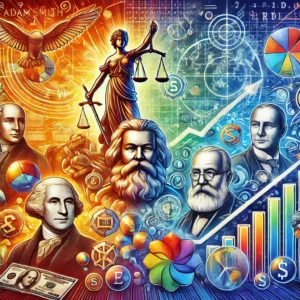
A vibrant, symbolic illustration that brings together the evolution of economic ideas. Several scholarly portraits surround a central figure holding balanced scales, suggesting judgment, trade-offs, and the search for fairness in economic systems. Around them swirl mathematical markings, diagrams, pie charts, and an upward trend line—visual shorthand for modeling, measurement, and competing explanations of growth and crises. Currency icons, coins, and market motifs hint at money, prices, and exchange, while abstract gears and geometric patterns suggest the underlying “machinery” of incentives and institutions. Overall, the image conveys how economic theory is built from arguments, data, and historical experience—constantly revised as societies change.
Interpreting Markets, Behaviour, and Value Through Economic Ideas
Comparative Economic History
Uses contrasting theoretical frameworks to explain why different regional institutional structures and economic systems diverge across periods.
Financial History
Applies monetary and macroeconomic models to evaluate how credit creation, central banking, and financial instability develop through time.
Trade and Commerce History
Connects classical trade theories like absolute and comparative advantage to real-world commercial expansion and global market integration.
Labor History
Interprets workforce dynamics through competing economic perspectives on labor theories of value, marginal productivity, and collective bargaining.
Industrial and Technological History
Explains innovation cycles, creative destruction, and industrial growth through evolving technological and capital-accumulation frameworks.
Environmental Economic History
Evaluates how theoretical models incorporate externalities, resource exhaustion limits, public goods, and long-term ecological sustainability.
Gender and Economic History
Questions traditional economic assumptions by analyzing unpaid household labor, reproductive work, and gendered disparities in resource distribution.
Economic History – Overview
Grounds theoretical economic perspectives within the broader historical evolution of real-world production systems and societal development.
Key Focus Areas in Economic Thought and Theory
Classical Economics
Classical economics, emerging in the 18th and 19th centuries, laid the foundation for modern economic thought.
Key Contributions
- Adam Smith (1723–1790):
- Often called the “Father of Economics,” Smith’s seminal work, The Wealth of Nations (1776), introduced the concept of the “invisible hand,” suggesting that self-interested actions in free markets lead to efficient outcomes.
- Advocated for specialization and division of labor as key drivers of productivity.
- David Ricardo (1772–1823):
- Developed the theory of comparative advantage, explaining how countries benefit from trade by specializing in goods they produce relatively more efficiently.
- Thomas Malthus (1766–1834):
- Known for his Essay on the Principle of Population (1798), which argued that population growth would outpace food production, leading to scarcity and hardship.
Core Principles
- Emphasis on free markets and minimal government intervention.
- Belief in natural economic laws governing supply, demand, and competition.
Marxist Economics
Marxist economics, developed in the 19th century, critiqued capitalism and proposed alternative systems.
Key Contributions
- Karl Marx (1818–1883):
- In Das Kapital (1867), Marx analyzed the capitalist system, focusing on the exploitation of labor and the accumulation of capital.
- Predicted that capitalism’s internal contradictions would lead to its collapse and the emergence of socialism.
- Friedrich Engels (1820–1895):
- Collaborated with Marx to develop the Communist Manifesto (1848), outlining the principles of class struggle and proletarian revolution.
Core Principles
- Focus on class struggle between the bourgeoisie (capitalists) and proletariat (workers).
- Advocacy for collective ownership of resources and central planning to address inequality and exploitation.
Impact
- Inspired socialist and communist movements worldwide, influencing policies in the Soviet Union, China, and other countries.
Marginalist Revolution and Neoclassical Economics
The late 19th century saw a shift toward neoclassical economics, emphasizing individual decision-making and marginal utility.
Key Contributions
- William Stanley Jevons, Carl Menger, and Léon Walras:
- Independently developed theories of marginal utility, which explain how consumers make choices based on the additional satisfaction (utility) derived from consuming one more unit of a good.
- Alfred Marshall (1842–1924):
- Combined classical and marginalist ideas in Principles of Economics (1890), formalizing concepts like supply and demand curves and elasticity.
Core Principles
- Focus on individual decision-making and utility maximization.
- Analysis of market equilibrium and efficiency.
Impact
- Provided the basis for modern microeconomics and tools like cost-benefit analysis.
Keynesian Economics
The Great Depression (1929–1939) challenged classical economic assumptions, leading to the development of Keynesian economics.
Key Contributions
- John Maynard Keynes (1883–1946):
- In The General Theory of Employment, Interest, and Money (1936), Keynes argued that aggregate demand drives economic performance.
- Advocated for government intervention through fiscal and monetary policies to stabilize economies during recessions.
Core Principles
- Rejection of the idea that markets always self-correct to full employment.
- Emphasis on the role of government spending and taxation in managing economic cycles.
Impact
- Influenced post-World War II economic policies, including the creation of welfare states and international institutions like the IMF and World Bank.
Monetarism
Monetarism, emerging in the mid-20th century, focused on the role of money supply in economic performance.
Key Contributions
- Milton Friedman (1212–2006):
- In A Monetary History of the United States (1963), Friedman argued that poor monetary policy, not inherent market failures, caused the Great Depression.
- Advocated for controlling inflation by regulating money supply growth.
Core Principles
- Emphasis on the long-term relationship between money supply and inflation.
- Preference for limited government intervention and free markets.
Impact
- Influenced economic policies in the 1970s and 1980s, including those of U.S. President Ronald Reagan and UK Prime Minister Margaret Thatcher.
Contemporary Economic Theories
Recent decades have seen the emergence of new schools of thought addressing globalization, inequality, and environmental challenges.
Behavioral Economics
- Combines psychology and economics to study how cognitive biases and emotions influence decision-making.
- Key Figures: Daniel Kahneman and Richard Thaler.
- Applications: Insights into consumer behavior, policymaking, and marketing.
Development Economics
- Focuses on economic growth and poverty reduction in developing countries.
- Key Figures: Amartya Sen’s work on human development and capabilities.
Environmental Economics
- Examines the relationship between economic activity and environmental sustainability.
- Applications: Policies for carbon pricing and green technologies.
Game Theory
- Studies strategic interactions among individuals or groups.
- Key Figures: John Nash, whose work on equilibrium strategies has applications in economics, politics, and negotiations.
Examples in Economic Thought and Theory
Adam Smith’s The Wealth of Nations
- Impact: Provided a foundational framework for understanding market mechanisms and economic growth.
Keynesian Economics During the Great Depression
- Impact: Led to policies like the New Deal, which focused on government spending to boost employment and demand.
Marxist Influence on 20th-Century Socialism
- Impact: Inspired movements and regimes advocating for state-controlled economies and resource redistribution.
Behavioral Economics and Public Policy
- Examples: Nudge theory applied to retirement savings and health initiatives.
Applications of Economic Thought and Theory
Policy Formulation
Economic theories guide policies on taxation, spending, trade, and regulation.
Addressing Inequality
Theories like Marxism and development economics inform strategies for reducing wealth and income disparities.
Crisis Management
Keynesian and monetarist approaches shape responses to economic downturns and financial crises.
Understanding Markets
Neoclassical and behavioral economics provide insights into consumer behavior and market dynamics.
Interactive Economic School Multiplier & Model Simulator
Compare how different theoretical schools predict national income outcomes by simulating Keynesian fiscal multipliers versus Classical/Monetarist crowding-out effects below.
Keynesian Multiplier vs. Classical Output Simulator
Calculate the predicted shift in equilibrium GDP ($Y$) resulting from an injection of government spending ($\Delta G$), based on the Marginal Propensity to Consume ($MPC$).
Why Study Economic Thought and Theory
Exploring the Origins of Economic Ideas
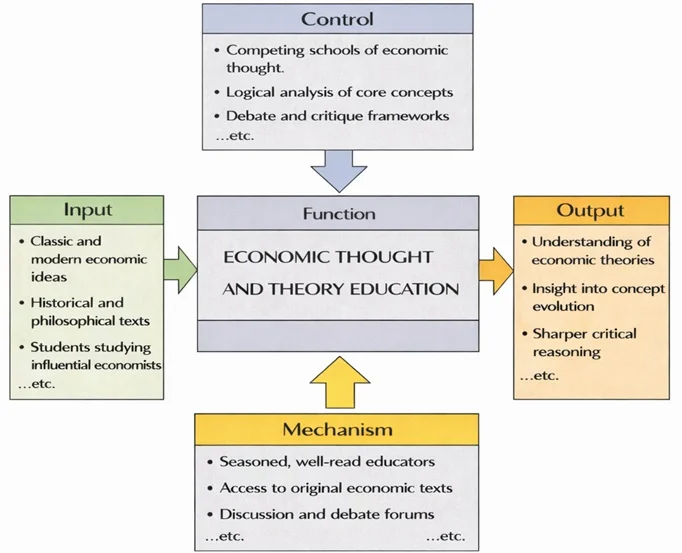
Economic thought and theory examine how people have understood and explained economic activity over time. For students preparing for university, studying this field provides a foundation in the evolution of economic ideas—from classical and neoclassical models to Keynesian, Marxist, and behavioral approaches. It allows students to trace how theories emerged in response to real-world challenges and debates, and how they have shaped policymaking and academic discourse.
Understanding Competing Perspectives on Markets and Society
Economic theory is not monolithic; it includes a range of competing viewpoints about how economies function and how they ought to be structured. Students learn to compare different schools of thought—such as Austrian, institutional, feminist, and ecological economics—and to consider their assumptions, values, and implications. This comparative approach fosters intellectual flexibility and critical awareness of economic decision-making in diverse contexts.
Building Conceptual Tools for Analyzing Economic Problems
Studying economic theory equips students with abstract models and conceptual frameworks to understand key issues like supply and demand, inflation, unemployment, taxation, and financial markets. These tools help students not only interpret economic data but also evaluate arguments, question assumptions, and formulate their own informed views. Such reasoning skills are crucial for engaging with both academic material and public economic debates.
Linking Theory to Historical and Policy Contexts
Economic ideas do not arise in a vacuum—they are shaped by the historical, political, and social circumstances in which they develop. Students explore how thinkers such as Adam Smith, Karl Marx, John Maynard Keynes, and Milton Friedman responded to the problems of their times. This historical grounding enables students to see the relevance of theory to real-world change and to approach contemporary challenges with a more nuanced perspective.
Preparing for Advanced Study and Thoughtful Careers
A strong grounding in economic thought and theory supports further study in economics, political economy, philosophy, public policy, and related fields. It also provides analytical, logical, and communication skills useful in careers such as research, consulting, law, teaching, finance, and government. For students entering university, this field offers both a deep intellectual tradition and a practical lens through which to examine economic life in a rapidly changing world.
Interactive Review Questions (Click to Reveal Explanations)
Why did the Great Depression discredit Classical economic assumptions regarding self-correcting markets?
Classical economics assumed that wages and prices were perfectly flexible, meaning market supply would automatically create its own demand (Say’s Law) to restore full employment. The decade-long high unemployment of the 1930s demonstrated that wage stickiness and deficient aggregate demand could trap economies in prolonged underemployment equilibrium, proving market self-correction insufficient without active fiscal policy.
How does Neoclassical economics differ fundamentally from Marxist labor theory of value?
Marxist economics argues that an item’s objective value is derived from the socially necessary labor time required to produce it. Neoclassical economics posits that value is subjective, determined by marginal utility—the additional satisfaction a consumer derives from consuming one extra unit of a good under conditions of scarcity.
What was Milton Friedman’s main critique of Keynesian discretionary fiscal policy?
Friedman argued that discretionary fiscal policy involves long and variable time lags (recognition, implementation, and operational lags) that often destabilize economies rather than smoothing business cycles. He advocated for predictable, rules-based monetary growth (Monetarism) to control inflation.
Frequently Asked Questions
What does “Economic Thought and Theory” cover in Economic History?
It studies how ideas about production, value, markets, money, and economic organisation have developed over time — from early moral-philosophical reflections to classical, neoclassical, Keynesian, Marxist and modern economic theories. It shows how theory evolved alongside social, political and economic changes.
Why is the history of economic thought important for understanding economies today?
Because modern economic systems rest on theoretical foundations developed throughout history. Knowing that history helps us understand why certain economic policies exist, what assumptions they rest on, and how they shaped institutions — revealing that economics isn’t value-free but historically contingent.
What are some major schools or phases in Economic Thought and Theory?
Major phases include Mercantilism and early modern thought; the Physiocrats; Classical economics (Adam Smith, Ricardo, Mill, etc.); Neoclassical economics; Marxist and socialist theories; and 20th-century developments such as Keynesian economics, welfare economics, institutional economics, and various modern heterodox approaches.
How do historians and economists study the history of economic thought?
They examine original texts, treatises and debates; situate ideas in their historical and social context; compare different schools; and trace how theories responded to economic crises, social change, and intellectual shifts — combining qualitative and quantitative analysis.
What is the relationship between Economic History and Economic Theory?
Economic History studies real economic events, institutions and data over time; Economic Theory deals with abstract models. The history of economic thought bridges both by showing how models emerged in response to past realities, and how they shaped future policies and institutions.
How did Classical economics contribute to modern economic theory?
Classical economics introduced foundational concepts — division of labour, theories of value and capital, free markets, and the idea that a nation’s wealth depends on real economic output rather than just bullion. These ideas laid the groundwork for later developments in neoclassical and modern economics.
How did the 20th-century Keynesian revolution change economic theory?
The Keynesian revolution emphasised demand, state intervention, fiscal policy and uncertainty — challenging classical/neoclassical ideas of self-regulating markets. This reshaped thinking about unemployment, business cycles, and the role of the state in economic stability.
What role does the history of economic thought play in understanding economic crises and long-term growth?
By studying past theories and their context, scholars can better understand why certain policies were adopted, why crises occurred, and how ideas about growth, inequality, labour and capital have changed. This historical perspective shows that crises and growth are shaped by both ideas and institutions.
Can study of economic thought include non-Western traditions?
Yes. While much focus has been on European traditions, global perspectives include economic ideas from Asia, Africa, Latin America, and indigenous economic philosophies, enriching understanding of how different societies theorised trade, value, labour and wealth.
What skills does studying Economic Thought and Theory build for students?
Students learn to read and interpret complex texts, compare and critique arguments, understand assumptions behind models, situate ideas historically, and relate theory to real-world economic developments.
How might a student begin exploring Economic Thought and Theory at pre-university level?
Start with accessible histories of economic thought, read introductions to major thinkers like Adam Smith or Keynes, compare competing explanations of issues like trade or inflation, and write short analytical reflections.
Why do some economists and historians criticise the dominance of particular economic theories?
Because certain dominant theories rely on unrealistic assumptions (e.g., perfect competition, perfect rationality) that do not hold across diverse historical or cultural contexts. Studying economic thought exposes these limits and encourages pluralism.
Economic Thought and Theory Practice Module
Section 1: Foundational Concept Review
-
What is economic thought and theory, and why is it important to study its history?
Answer: Economic thought and theory encompass the study of ideas and frameworks that explain how economies function and develop over time. This field examines the evolution of concepts from classical economics to contemporary theories, highlighting shifts in understanding regarding markets, production, and distribution. Studying its history provides insights into how past ideas have influenced current economic policies and practices while enabling us to critically analyze the strengths and weaknesses of competing models. -
How did classical economic theories shape early economic thought?
Answer: Classical economic theories laid the foundation for modern economic analysis by introducing key concepts such as free markets, competition, division of labor, and comparative advantage. Theorists like Adam Smith, David Ricardo, and Thomas Malthus established core principles emphasizing individual self-interest, natural laws of supply and demand, and minimal state intervention. -
What role did the marginal revolution play in the development of economic theory?
Answer: The marginal revolution shifted focus from cost-of-production theories of value to subjective utility and marginal decision-making. Pioneer economists like Jevons, Menger, and Walras demonstrated that value is derived from the incremental satisfaction gained from consuming one additional unit of a good, laying the groundwork for modern microeconomics. -
How have modern economic theories expanded upon classical ideas?
Answer: Modern economic theories incorporate mathematical modeling, empirical data, and interdisciplinary insights to address classical limitations. They incorporate market imperfections, informational asymmetries, behavioral cognitive biases, and non-equilibrium dynamics that traditional classical models ignored. -
In what ways do economic thought and theory influence public policy decisions?
Answer: Theoretical frameworks guide tax policy, government expenditure, central bank interest rate settings, and market regulation. Policymakers use theoretical models to project policy outcomes, manage recessions, and address structural market failures. -
What are the key differences between classical and neoclassical economic theories?
Answer: Classical economics focuses on macro-level wealth accumulation, labor production costs, and economic growth over time. Neoclassical economics emphasizes micro-level utility maximization by rational consumers, firm cost minimization, and mathematical market equilibrium using marginal analysis. -
How has the study of economic thought contributed to our understanding of market failures?
Answer: Analyzing historical economic paradigms demonstrated that real-world markets often violate theoretical assumptions of perfect information and perfect competition. This intellectual evolution enabled economists to identify negative externalities, public goods, and monopoly power, justifying targeted regulatory intervention. -
What are some criticisms of traditional economic theories that have emerged over time?
Answer: Traditional models face criticism for assuming perfect human rationality (homo economicus), ignoring environmental resource depletion, downplaying systemic wealth inequality, and failing to predict sudden financial crises. -
How do historical economic theories help us understand contemporary economic challenges?
Answer: Historical theories offer comparative models for tackling recurring phenomena like inflation, debt overhangs, trade disputes, and technological unemployment, providing empirical perspective on what policies succeeded or failed in past eras. -
In what ways have interdisciplinary approaches enriched the study of economic thought and theory?
Answer: Integrating insights from psychology, sociology, political science, and history has enriched economic theory by producing fields like behavioral economics, institutional economics, and political economy that reflect realistic human behavior and complex social structures.
Section 2: Analytical & Scenario-Based Inquiry
-
How might the integration of behavioral economics transform traditional economic theories in the future?
Answer: By replacing idealized assumptions of perfect rationality with empirically tested psychological biases (such as loss aversion and present bias), behavioral economics enables the design of ‘nudge’ policies and more accurate forecasting models for consumer and market choices. -
What challenges arise from reinterpreting classical economic theories through the lens of modern technological advancements?
Answer: Classical assumptions regarding diminishing marginal returns and physical labor inputs struggle to account for digital platform economics, zero-marginal-cost software replication, network effects, and automated artificial intelligence production. -
How can the evolution of economic thought inform our understanding of the impacts of globalization on national economies?
Answer: Tracing economic thought from mercantilist protectionism through Ricardian free trade to modern trade theory reveals both the aggregate efficiency gains of global market integration and the localized structural income disparities created among domestic labor forces. -
What potential does the study of economic thought have for addressing emerging issues like climate change and sustainability?
Answer: Revisiting economic concepts of externalities (Pigou), common pool resources (Ostrom), and ecological limits enables the formulation of carbon pricing mechanisms, cap-and-trade systems, and sustainable growth frameworks that internalize environmental costs. -
How might the reinterpretation of economic theory through historical lenses affect future educational curricula in economics?
Answer: It encourages a pluralistic curriculum that moves beyond teaching single neoclassical mathematical models, training students to evaluate competing heterodox frameworks and understand how historical crises shaped theoretical shifts. -
In what ways can interdisciplinary research enhance our understanding of the evolution of economic thought?
Answer: Interdisciplinary research contextualizes how economic ideas emerge from broader philosophical movements, political power shifts, and technological revolutions, revealing that economic doctrines are shaped by societal evolution rather than absolute mathematical laws. -
How do shifting paradigms in economic theory reflect broader social and political transformations over time?
Answer: Major social shocks prompt theoretical shifts: the rise of industrial capitalism birthed Classical economics, the Great Depression produced Keynesian macroeconomics, and 1970s stagflation catalyzed Monetarism and neoliberal market policy. -
What role does critical analysis of past economic theories play in shaping future economic innovations?
Answer: Identifying where past models failed empirical tests prevents repeated policy errors and drives intellectual innovation, leading to broader models incorporating systemic risk, inequality metrics, and digital market structures. -
How might emerging global challenges, such as pandemics or geopolitical tensions, influence future economic theories?
Answer: Crises shift focus away from pure cost-efficiency models toward theories prioritizing supply chain resilience, strategic industrial policy, economic statecraft, and state-backed safety nets during external shocks. -
In what ways can historical debates on economic policy inform current discussions about income inequality and wealth distribution?
Answer: Historical debates over land taxes (Henry George), marginal productivity theory, and welfare state design (Beveridge) provide concrete historical evidence on how progressive taxation, inheritance regulation, and labor institutions affect long-term wealth distribution. -
How can the evolution of economic thought contribute to the development of more resilient financial systems?
Answer: Synthesizing Minsky’s Financial Instability Hypothesis with modern monetary theory helps regulatory authorities design counter-cyclical capital buffers and lender-of-last-resort policies that prevent speculative debt bubbles from triggering systemic bank collapses. -
What future research directions could further deepen our understanding of the relationship between economic theory and societal well-being?
Answer: Research expanding metrics beyond aggregate GDP to include multidimensional capabilities (Sen), distribution-weighted national accounts, environmental capital accounting, and subjective happiness indices promises to align economic theory closer to human flourishing.
Section 3: Step-by-Step Quantitative & Numerical Calculations
-
Calculating Ricardian Comparative Advantage & Trade Gains:
Suppose Portugal and England produce Cloth and Wine using labor hours per unit as follows:
– England: 100 hours per unit of Cloth, 120 hours per unit of Wine.
– Portugal: 90 hours per unit of Cloth, 80 hours per unit of Wine.
Calculate the internal opportunity cost of producing 1 unit of Wine in terms of Cloth for both countries, state which country has the comparative advantage in Wine, and compute total labor hours saved if they specialize and trade 1 unit of Wine for 1.05 units of Cloth.
Solution & Calculation:
1. England Opportunity Cost of Wine = 120 / 100 = 1.20 units of Cloth.
2. Portugal Opportunity Cost of Wine = 80 / 90 = 0.889 units of Cloth.
3. Comparative Advantage: Portugal has a lower opportunity cost in Wine (0.889 < 1.20), so Portugal has the comparative advantage in Wine (England in Cloth).
4. Trade Gain Analysis:
– Portugal produces 1 unit of Wine (80 hrs) and trades for 1.05 units of Cloth (which would cost 1.05 × 90 = 94.5 hrs domestically). Net labor saved by Portugal = 94.5 – 80 = 14.5 labor hours saved.
– England gets 1 unit of Wine via trade giving up 1.05 units of Cloth (1.05 × 100 = 105 hrs labor), whereas making Wine domestically costs 120 hrs. Net labor saved by England = 120 – 105 = 15.0 labor hours saved. -
Neoclassical Consumer Utility & Marginal Utility Evaluation:
A consumer’s total utility $U$ from consuming $Q$ units of a commodity is given by the function:U(Q) = 40Q – 2Q2Find the expression for Marginal Utility ($MU = dU/dQ$), calculate $MU$ at $Q = 3$ and $Q = 6$, and determine the quantity $Q$ where total utility is maximized ($MU = 0$).
Solution & Calculation:
1. Marginal Utility Function $MU(Q) = d/dQ (40Q – 2Q^2) =$ 40 – 4Q.
2. $MU$ at $Q = 3$: 40 – 4(3) = 40 – 12 = 28 units of utility.
3. $MU$ at $Q = 6$: 40 – 4(6) = 40 – 24 = 16 units of utility (demonstrating diminishing marginal utility).
4. Utility Maximization Point: Set $MU = 0 \implies 40 – 4Q = 0 \implies 4Q = 40 \implies$ Q = 10 units. Total Utility at maximum = 40(10) – 2(10)2 = 400 – 200 = 200 utility units. -
Marxist Rate of Surplus Value & Rate of Profit Calculation:
In a capitalist manufacturing enterprise, the capital invested during a production cycle consists of Constant Capital $C = 500,000$ gold coins (raw materials & machinery depreciation) and Variable Capital $V = 200,000$ gold coins (worker wages). The total value of output produced $W = 900,000$ gold coins.
Calculate:
1. Surplus Value $S$ ($S = W – C – V$).
2. Rate of Surplus Value or Exploitation Rate $s’ = (S / V) \times 100$.
3. Rate of Profit $p’ = [S / (C + V)] \times 100$.
Solution & Calculation:
1. Surplus Value $S = 900,000 – 500,000 – 200,000 =$ 200,000 gold coins.
2. Rate of Surplus Value $s’ = (200,000 / 200,000) \times 100 =$ 100%.
3. Rate of Profit $p’ = [200,000 / (500,000 + 200,000)] \times 100 = (200,000 / 700,000) \times 100 =$ 28.57%. -
Keynesian Equilibrium Income & Tax Multiplier:
An economy is modeled by the following equations:
– Consumption: $C = 100 + 0.75 Y_d$ (where $Y_d = Y – T$)
– Investment: $I = 200$
– Government Spending: $G = 150$
– Taxes: $T = 100$
Calculate the equilibrium national income level $Y$, and determine the change in income ($\Delta Y$) if government spending increases by $\Delta G = 40$.
Solution & Calculation:
1. Disposable Income $Y_d = Y – 100$.
2. Aggregate Expenditure Equation: $Y = C + I + G = (100 + 0.75(Y – 100)) + 200 + 150$.
3. Simplify: $Y = 100 + 0.75Y – 75 + 200 + 150 \implies Y = 0.75Y + 375$.
4. Solve for $Y$: $Y – 0.75Y = 375 \implies 0.25Y = 375 \implies Y = 375 / 0.25 =$ 1,500 units.
5. Expenditure Multiplier $k = 1 / (1 – 0.75) = 1 / 0.25 = 4$.
6. Income Change $\Delta Y = k \times \Delta G = 4 \times 40 =$ +160 units (New Equilibrium $Y = 1,660$). -
Quantity Theory of Money (Fisher Equation) Calculation:
According to the classical Quantity Theory of Money:M × V = P × YIn a given economy, Money Supply $M = 500$ billion, Velocity of Money $V = 4$, and Real GDP $Y = 1,000$ billion units.
1. Calculate the Price Level $P$.
2. If the central bank increases $M$ by 10% to 550 billion while velocity $V$ and real output $Y$ remain fixed in the short run, calculate the new Price Level $P_{new}$ and the percentage inflation rate.
Solution & Calculation:
1. Initial Price Level $P = (M \times V) / Y = (500 \times 4) / 1,000 = 2,000 / 1,000 =$ 2.00.
2. New Money Supply $M_{new} = 550$.
3. New Price Level $P_{new} = (550 \times 4) / 1,000 = 2,200 / 1,000 =$ 2.20.
4. Inflation Rate = $[(2.20 – 2.00) / 2.00] \times 100 =$ 10.0% inflation (directly proportional to money supply growth). -
Malthusian Exponential Population vs. Linear Food Growth Model:
In a hypothetical region, initial Population $P_0 = 1,000$ individuals and grows exponentially at 3% per year ($P(t) = P_0 \times (1.03)^t$). Initial Food Production $F_0 = 1,000$ food units (sufficient for 1,000 people) and grows linearly by adding 50 food units per year ($F(t) = 1,000 + 50t$).
Calculate population $P(t)$ and food units $F(t)$ at $t = 20$ years and $t = 40$ years, and identify the year threshold where population outstrips food capacity.
Solution & Calculation:
1. At $t = 20$ years:
– Population $P(20) = 1,000 \times (1.03)^{20} = 1,000 \times 1.8061 =$ 1,806 people.
– Food $F(20) = 1,000 + 50(20) = 1,000 + 1,000 =$ 2,000 food units (Surplus of +194 units).
2. At $t = 40$ years:
– Population $P(40) = 1,000 \times (1.03)^{40} = 1,000 \times 3.2620 =$ 3,262 people.
– Food $F(40) = 1,000 + 50(40) = 1,000 + 2,000 =$ 3,000 food units (Deficit of -262 units).
3. Threshold Point: Testing $t = 35$ years $\implies P(35) = 1,000 \times 2.8138 = 2,814$; $F(35) = 1,000 + 1,750 = 2,750$. Malthusian deficit begins around Year 34-35. -
Cournot Oligopoly Equilibrium Game Theory Calculation:
Two competing firms in a duopoly face a market inverse demand function $P = 100 – (Q_1 + Q_2)$. Both firms operate with zero marginal cost ($MC = 0$).
Find the Cournot reaction functions for Firm 1 and Firm 2, calculate the Nash equilibrium quantities ($Q_1^*, Q_2^*$), total output $Q_{total}$, market price $P^*$, and total profit for each firm.
Solution & Calculation:
1. Firm 1 Revenue $TR_1 = P \times Q_1 = (100 – Q_1 – Q_2)Q_1 = 100Q_1 – Q_1^2 – Q_1 Q_2$.
2. Marginal Revenue $MR_1 = dTR_1/dQ_1 = 100 – 2Q_1 – Q_2$. Set $MR_1 = MC = 0 \implies 2Q_1 = 100 – Q_2 \implies$ Reaction Function 1: $Q_1 = 50 – 0.5 Q_2$.
3. By symmetry, Firm 2 Reaction Function: $Q_2 = 50 – 0.5 Q_1$.
4. Substitute Reaction Functions: $Q_1 = 50 – 0.5(50 – 0.5 Q_1) \implies Q_1 = 50 – 25 + 0.25 Q_1 \implies 0.75 Q_1 = 25 \implies$ $Q_1^* = 33.33$ units and $Q_2^* = 33.33$ units.
5. Total Output $Q_{total} = 33.33 + 33.33 =$ 66.67 units.
6. Equilibrium Price $P^* = 100 – 66.67 =$ $33.33.
7. Profit per firm $\pi_1 = \pi_2 = 33.33 \times 33.33 =$ $1,111.11.