
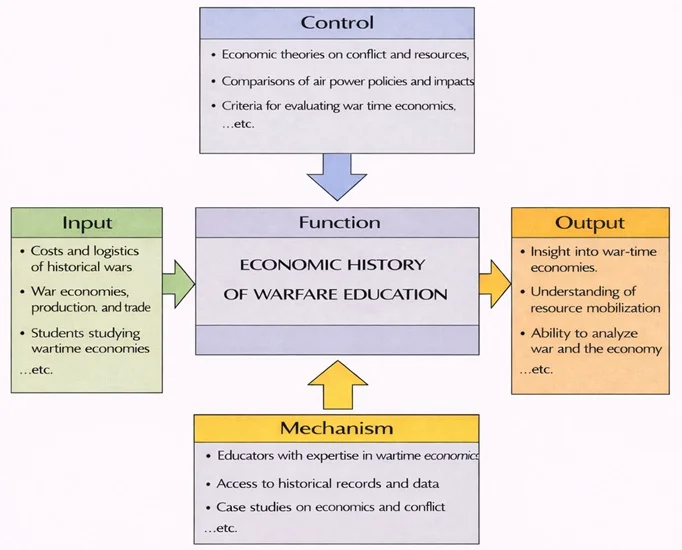
Economic History of Warfare Education begins with a plain question that changes how war is understood: how was it paid for, supplied, and sustained? It looks beneath strategies and speeches to the material engines—money, labor, logistics, production capacity, and trade—that make conflict possible and often determine its limits. By studying the costs and logistics of historical wars and the structure of war economies, students learn how societies mobilized resources, redirected industries, and managed scarcity under pressure. The learning process is guided by controls such as economic theories on conflict and resources, comparisons of war policies and impacts, and criteria for evaluating wartime economics, so learners can distinguish myths of “inevitable victory” from measurable constraints and choices. Supported by mechanisms like educators with expertise in wartime economics, access to historical records and data, and carefully chosen case studies, the subject stays anchored in evidence. The outputs are enduring: students gain insight into wartime economies, understand how resource mobilization works in practice, and develop the ability to analyze the two-way relationship between war and the economy—how conflict reshapes markets and institutions, and how economic capacity reshapes the course of conflict.
The economic history of warfare reveals how armed conflict has shaped—and been shaped by—financial systems, state budgets, resource allocation, and industrial policy throughout history. From ancient battle economies to modern military-industrial complexes, warfare has exerted transformative pressure on societies, making it vital to understand how these dynamics interact with broader frameworks like the economic history of nations and regions. Often, war catalyzed new forms of economic diplomacy, linking fiscal interests to strategic alliances and reshaping international order.
Warfare frequently pushed states to reformulate legal and political systems. Through the lens of constitutional history and constitutional law and interpretation, one can trace how wartime needs led to expanded executive powers, new taxation schemes, and emergency governance. These legal shifts sometimes endured, as seen in constitutional amendments and reforms that institutionalized wartime measures in peacetime.
To understand the global impact of warfare on economies, one must consider comparative economic history. Conflicts like the Napoleonic Wars, World Wars, and Cold War affected countries in divergent ways depending on their industrial base, colonial ties, and political structure. The history of political systems plays a central role here, especially when assessing how different states managed wartime production, labor mobilization, and postwar recovery.
Moreover, the long-term ideological and theoretical consequences of warfare on economic thought cannot be ignored. The history of economic thought and economic thought and theory show how theorists grappled with the challenges of war financing, reparations, and reconstruction. Parallel to this, the intellectual climate was influenced by broader history of ideas emerging from the trauma and innovation of wartime.
The economic history of warfare is also interwoven with the evolution of diplomatic history, where treaties, embargoes, and economic sanctions became central tools of international strategy. Profiles of key diplomatic personalities often reveal how financial negotiations ran parallel to battlefield maneuvers. Even soft power, through cultural diplomacy, found roots in wartime exchanges and post-conflict reconciliation.
Warfare’s social and political implications are also profound. The rise of conscription, rationing, and total war shaped mass behavior and ideology. As explored in the history of social movements, wartime pressures spurred labor strikes, civil rights activism, and peace movements. These efforts intersected with education history, as curricula were revised to reflect shifting national narratives.
Additionally, warfare often intensified global asymmetries, particularly through imperial conflicts. The study of colonial and post-colonial systems shows how economic exploitation and forced labor were entrenched in wartime economies. This, in turn, influenced comparative electoral systems and electoral systems and political parties, especially in post-conflict democracies grappling with legitimacy and redistribution.
Finally, conflicts impacted governance structures and ideological orientations. The rise and fall of regimes during wartime are analyzed in comparative politics. Likewise, wartime fraud and propaganda often affected electoral fraud and integrity and left lasting legacies documented in electoral history.

A vivid, multi-layered illustration that connects battlefield action to the economic systems that make war possible. On the left, smokestacks and industrial plants suggest mass production of weapons, vehicles, and materials. Across the center, soldiers, tanks, trucks, and aircraft represent the movement of people and equipment—highlighting logistics, transport, and the constant demand for fuel, spare parts, and food. In the foreground, figures plan over documents and resources, pointing to procurement, budgeting, and strategic allocation. To the right, charts and graphs rise above bridges and infrastructure, symbolizing wartime booms, inflation, debt, and the long economic consequences that reshape societies during and after conflict.
Financing, Logistics, and Resource Mobilisation in Warfare
Economic strength underpins military capability, determining how wars are sustained, scaled, and concluded. The pathways below explore how funding, production, and resource allocation interact with strategy and technology in shaping conflict outcomes.
Economic History of Warfare
Analyses how resource mobilisation, financing, and production capacity sustain military operations over time. Serves as the central analytical hub for fiscal conflict studies.
Military Strategic Studies
Connects economic capacity with high-level military planning decisions, logistical feasibility, and long-term campaign viability.
Naval History
Highlights how control of maritime trade routes, merchant shipping, and ocean resources directly feeds wartime economies and naval procurement.
Technological History of Warfare
Shows how industrial innovation increases resource demands, alters factory output, and reshapes national manufacturing architectures.
Air Power History
Examines how capital-intensive aviation platforms and strategic bombing campaigns influence budget allocations and industrial investment.
Guerrilla Warfare and Insurgency Studies
Explores how resource asymmetry drives non-state actors to adopt low-cost, adaptive, and decentralized economic warfare strategies.
Social and Cultural History of Warfare
Analyses how domestic economic strain, rationing, labor shifts, and wartime inflation fundamentally reshape civilian life and social order.
Peace Studies and Conflict Resolution
Investigates how fiscal exhaustion, economic sanctions, and post-war reparations create or hinder pathways to lasting peace treaties.
Military History – Overview
Provides the foundational framework linking fiscal capacity and material engines to the comprehensive evolution of armed conflict.
Key Focus Areas in the Economic History of Warfare
Financing Wars
War is an expensive undertaking, requiring significant financial resources for weapons, troops, and logistics. Nations have used various strategies to fund wars, often with profound economic consequences.
Ancient and Early Modern War Financing
- Tributes and Spoils of War: Ancient empires, such as Rome, financed their armies through tributes from conquered territories and plundering enemy resources.
- Taxation: Medieval kingdoms raised taxes to fund wars, often leading to public unrest and rebellion. For example, the heavy taxation imposed by England to finance the Hundred Years’ War contributed directly to the Peasants’ Revolt (1381).
- War Loans: Early modern states began borrowing to finance wars, laying the groundwork for national debt systems. The Dutch Republic successfully financed its wars with Spain in the 17th century through innovative bonds and low-interest public loans.
Modern War Financing
- World Wars: Governments raised funds through war bonds, increased taxation, and deficit spending. The U.S. issued Liberty Bonds during World War I, raising billions to support the war effort.
- Economic Consequences: Excessive borrowing and currency expansion often led to severe inflation and economic instability, as seen in Germany’s hyperinflation during the 1920s, driven by war debts and heavy reparations.
Industrial Mobilization
The economic history of warfare highlights how nations mobilize their industrial and human resources to sustain prolonged conflicts.
The Industrial Revolution and Modern Warfare
- The Industrial Revolution transformed the economic dimensions of war by enabling mass production of standardized weapons and supplies.
- During the American Civil War, the North’s industrial advantage allowed it to produce weapons, ammunition, and railroad networks at a scale that the agrarian South could not match.
World War II: The Arsenal of Democracy
- Mobilization in the United States: Civilian factories were rapidly repurposed to produce tanks, aircraft, and munitions. Women entered the industrial workforce in large numbers, symbolized by “Rosie the Riveter.”
- Global Industrial Output: Germany and Japan relied on centralized economic planning to sustain their war efforts. However, Allied victory was heavily driven by superior industrial capacity, demonstrated by the production of nearly 300,000 aircraft by the U.S. during the war.
- Impact: Wartime industrialization spurred rapid technological innovation and laid structural foundations for post-war manufacturing growth.
Economic Recovery Post-War
Wars often leave economies devastated, necessitating large-scale recovery efforts, currency stabilizations, and structural reconstruction.
Reparations and Reconstruction After World War I
- Reparations: The Treaty of Versailles (1919) imposed heavy financial reparations on Germany, triggering severe economic turmoil and contributing to political instability.
- Economic Instability: Hyperinflation in Germany during the 1920s created widespread socio-economic hardship and eroded public confidence in early democratic institutions.
Post-World War II Recovery
- Marshall Plan (1948–1952): The U.S. provided over $12 billion in economic aid to rebuild Western Europe, promoting industrial stability and curbing geopolitical escalation.
- Japan’s Recovery: Targeted U.S. economic assistance and institutional reforms helped Japan transition into a leading global industrial power by the 1960s.
- Impact: These structured recovery efforts underscored the critical importance of post-war financial assistance in securing long-term regional stability.
The Economics of the Cold War
The Cold War arms race between the United States and the Soviet Union demonstrated the profound impact of prolonged military competition on national fiscal structures.
Military-Industrial Complex
- Definition: Coined by U.S. President Dwight D. Eisenhower, it refers to the strategic interdependence between government apparatus, armed forces, and commercial defense manufacturers.
- Impact: Continuous defense spending drove major technological advancements in aerospace, computing, microprocessors, and nuclear energy.
Soviet Economic Strain
- Economic Consequences: The Soviet Union devoted a disproportionately high percentage of its GDP to defense spending, severely straining consumer sectors and contributing to ultimate economic collapse.
- Technological Race: Parallel investments in the space race and strategic nuclear capabilities forced continuous resource diversion into military research and development.
Trade and Global Economic Systems
Wars have significantly reshaped global trade and economic architecture, often accelerating power shifts between nations.
World Wars and Trade
- Impact of World War I: Disrupted established global trade networks, ushering in protectionism and economic volatility during the interwar years.
- Impact of World War II: The U.S. emerged as the primary global financial anchor, fostering international institutions like the International Monetary Fund (IMF) and World Bank to regulate international commerce and monetary stability.
Post-Cold War Era
- Globalization: The reduction of major power Cold War friction enabled rapid global supply chain integration, capital mobility, and multilateral trade expansion.
Significant Examples in the Economic History of Warfare
The Napoleonic Wars (1803–1815)
- Economic Blockades: Napoleon’s Continental System attempted to starve the British economy by blocking trade with continental Europe, but backfired by crippling continental European ports and driving widespread smuggling.
- Impact: Highlighted the critical interplay between sea power, trade networks, and wartime economic resilience.
The World Wars
- World War I: Severe domestic resource strain and wartime food rationing precipitated major political revolutions, including the Russian Revolution (1917).
- World War II: Industrial mobilization reshaped labor demographics, accelerating female participation in manufacturing and permanently altering post-war labor markets.
The Cold War Arms Race
- Impact: Sustained defense spending catalyzed the modern high-tech economy while exposing the vulnerabilities of rigid, command-economy structures.
Applications of the Economic History of Warfare
Informing Economic Policy
- Historical precedents demonstrate the vital necessity of balancing national defense expenditures with debt sustainability and fiscal stability.
Guiding Post-War Recovery
- Lessons from post-conflict reconstruction models, such as the Marshall Plan, inform modern strategies for rebuilding war-torn regions and stabilizing fragile states.
Analyzing Economic Causes of War
- Economic history provides key analytical frameworks to evaluate how resource scarcity, trade rivalries, and tariff disputes trigger international conflicts.
Why Study the Economic History of Warfare
Understanding the Financial Foundations of War
The economic history of warfare explores how wars are financed, how resources are mobilized for military purposes, and how conflicts reshape economies over time. For students preparing for university, studying this field reveals that wars are not only fought on the battlefield—they are also driven and constrained by economic conditions. From taxation and borrowing to resource allocation and production, the economics of war determine how long a nation can fight and what it must sacrifice.
Analyzing the Impact of War on Economic Development
Warfare has historically had both destructive and transformative effects on national economies. Students examine how wars disrupt trade, destroy infrastructure, and cause inflation, while also sometimes accelerating industrialization, technological innovation, and state expansion. The economic aftermath of major conflicts—such as reparations, debt, and reconstruction—offers important lessons about the long-term costs and consequences of military conflict.
Exploring Military Spending, Labor, and Industry
Wars often lead to massive shifts in labor markets, government spending, and industrial output. Students study how wartime economies redirect civilian production to military needs, how labor shortages are addressed through conscription or mobilization of new workforce segments (such as women), and how public and private sectors collaborate in wartime planning. These dynamics provide valuable insights into the balance between security and economic sustainability.
Examining Global Trade, Colonialism, and Resource Competition
Many wars have been fought over access to resources, trade routes, and colonial possessions. The economic history of warfare helps students understand how imperial ambitions, mercantilist policies, and global competition for raw materials have fueled conflict. It also explores how war economies exploit peripheral regions and populations, contributing to long-term inequalities in the global economic order.
Preparing for Advanced Study and Strategic Careers
A foundation in the economic history of warfare supports further study in history, economics, political science, international relations, and military studies. It also prepares students for careers in policy analysis, defense planning, international development, and historical research. For students entering university, this field offers a rigorous and interdisciplinary approach to understanding how economic forces shape the conduct and consequences of war.
Interactive Tool: Wartime Fiscal Strategy & Inflation Calculator
Test different war-financing models—balancing taxation, war bond sales, and central bank money creation—to evaluate how debt, inflation, and economic sustainability react during a sustained military conflict.
Wartime Fiscal Allocation
Economic Consequences
Economic History of Warfare: Conclusion
The economic history of warfare underscores the profound connections between war and economic systems. From the financing of conflicts to industrial mobilization and post-war recovery, wars have shaped economies in transformative ways. Understanding these dynamics is essential for policymakers and scholars as they navigate the economic challenges and opportunities posed by both conflict and peace in a globalized world.
Interactive Concept Check
Click on the topics below to test your understanding of wartime economics and fiscal mobilization.
1. Why is direct money creation (“printing money”) the most dangerous way to finance a war?
2. How did the Marshall Plan differ structurally from post-WWI reparation policies?
3. What is meant by the “guns versus butter” economic trade-off during war?
Frequently Asked Questions about the Economic History of Warfare
What is the economic history of warfare?
The economic history of warfare studies how wars are financed, how resources are mobilised, and how conflicts reshape economies over time. It looks at taxation, borrowing, production, trade, and labour during wartime and peace, and asks how the costs and legacies of conflict influence growth, inequality, and state formation.
Why is it important to study war from an economic perspective, not only a military one?
Studying war from an economic perspective highlights that armies do not fight in isolation. They depend on food, equipment, transport, finance, and industrial capacity. An economic lens helps explain why some states can sustain long wars while others collapse, why certain strategies become possible or impossible, and how conflict redistributes resources within and between societies.
How have states historically financed wars?
States have financed wars through a mix of taxation, domestic and foreign borrowing, money creation, plunder, and in some periods, forced labour or in-kind contributions. The economic history of warfare examines how these methods evolved, how they affected inflation and debt, and how they pushed governments to build modern fiscal systems and central banks.
What is “war finance”, and how does it affect the wider economy?
War finance refers to the policies and instruments used to pay for military spending, such as war bonds, special taxes, and monetary expansion. These choices influence interest rates, inflation, savings, investment, and income distribution. Economic historians analyse how different war finance strategies have shaped post-war recoveries, debt burdens, and political debates about who should bear the costs of conflict.
How do wars change production, industry, and technology?
Wars often trigger rapid shifts in production as industries retool for weapons, vehicles, and supplies. Governments may direct resources into strategic sectors and invest in research and development. The economic history of warfare studies how these pressures lead to new technologies, management practices, and industrial capacities that sometimes spill over into civilian life after the conflict ends.
What happens to labour markets and everyday work during wartime?
Wartime mobilises soldiers and civilians, reorganising who works where and for what pay. Conscription removes people from civilian jobs, while war industries demand more labour, often opening opportunities for women and minority workers. Economic historians look at shifts in wages, working hours, workplace safety, union activity, and how these changes persist or reverse once peace returns.
How do wars affect trade, globalisation, and international economic relations?
Wars disrupt trade routes, damage infrastructure, and can lead to blockades, sanctions, and the reorientation of supply chains. At the same time, alliances and post-war settlements can create new trade patterns and institutions. The economic history of warfare explores how conflicts accelerate or reverse trends in globalisation and reshape economic hierarchies between states.
What is the relationship between war, taxation, and the rise of modern states?
Many historians argue that the need to fund war pushed rulers to develop more sophisticated tax systems, administrative bureaucracies, and public debt markets. In this view, war and preparation for war were key drivers of state-building. The economic history of warfare examines how fiscal capacity expanded, who was taxed, and how bargaining over revenue shaped political institutions.
How do economic historians measure the costs of war?
Economic historians measure war costs using indicators such as military spending as a share of GDP, destruction of capital and infrastructure, lost output, casualties, and long-term impacts on health, education, and demographic trends. They also consider opportunity costs: what societies could have done with the resources spent on war if they had been used differently.
Can wars ever have positive economic effects in the long run?
This is a debated question. Some argue that wars can accelerate technological change, industrial modernisation, or social reforms. Others emphasise the human suffering, destruction, and long-term debt that conflicts leave behind. Economic history helps students evaluate these claims by looking at specific cases rather than assuming that war is either automatically ruinous or automatically stimulating for economies.
How does the economic history of warfare connect to peacebuilding and reconstruction?
The economic history of warfare extends into the study of peace, reconstruction, and development after conflict. It considers how societies rebuild infrastructure, manage debt, reintegrate veterans, and redesign institutions. Comparing different post-war recoveries helps explain why some countries emerged stronger and more equal, while others remained trapped in cycles of violence and poverty.
Why is the economic history of warfare useful for students of economics, history, and international relations?
For students, the economic history of warfare offers a bridge between abstract theory and concrete historical experience. It shows how macroeconomic policy, public finance, and development issues play out under extreme pressure. Understanding these dynamics can deepen your grasp of today’s debates about defence spending, security, and the economic consequences of conflict and peace.
Economic History of Warfare Comprehensive Assessment
Section 1: Foundational Review Questions
-
What is the economic history of warfare and why is it significant?
Answer: The economic history of warfare examines how financial resources, economic policies, and material production have influenced the conduct and outcomes of military conflicts over time. It is significant because it reveals how economic factors, such as funding, resource allocation, and industrial capacity, can determine a nation’s ability to wage war. This field also explores the cost of warfare and its impact on societal development and political change. Understanding these economic dimensions provides critical insights into the strategic decisions made during conflicts and the long-term consequences for both victors and vanquished. -
How did economic resources influence military strategies in historical conflicts?
Answer: Economic resources have always been a crucial element in shaping military strategies, as the ability to finance armies, produce weapons, and maintain supply lines often determined the success of a campaign. Historically, nations with robust industrial bases and financial systems could mobilize larger forces and sustain prolonged conflicts. This economic strength allowed them to invest in technological advancements and logistical innovations that provided strategic advantages on the battlefield. Consequently, the interplay between economic capacity and military strategy has been a decisive factor in many pivotal historical wars. -
In what ways did warfare drive economic changes during periods of conflict?
Answer: Warfare has frequently served as a catalyst for economic change by stimulating industrial production, innovation, and shifts in labor markets. During major conflicts, the demand for military supplies and advanced technology spurred the growth of new industries and accelerated research and development. Governments often redirected economic resources toward defense, leading to temporary booms in certain sectors while also reconfiguring national economies. These wartime economic mobilizations not only helped determine the outcome of conflicts but also left lasting legacies on post-war economic structures and policies. -
How did military expenditures affect national economies historically?
Answer: Military expenditures have historically had a profound impact on national economies by diverting resources from civilian sectors to defense spending. Large-scale wars often led to increased taxation, borrowing, and sometimes inflation, which could destabilize the economy in the short term. However, in many cases, wartime production also led to technological advances and industrial growth that benefited the economy in the long run. The balance between the costs of war and the economic benefits derived from industrial innovation is a recurring theme in the economic history of warfare. -
What role did technological innovation play in shaping the economics of warfare?
Answer: Technological innovation has been a driving force in the economics of warfare by reducing production costs, enhancing military effectiveness, and altering the balance of power. Innovations such as the development of mechanized warfare, precision-guided munitions, and advanced communication systems allowed for more efficient use of resources and improved strategic outcomes. These technologies often required significant investment but also spurred industrial growth and created new economic opportunities. The continuous evolution of military technology highlights the dynamic relationship between economic investment and battlefield innovation. -
How have shifts in industrial capacity influenced the outcomes of wars?
Answer: Shifts in industrial capacity have played a decisive role in determining the outcomes of wars by influencing the scale and sustainability of military operations. Countries with greater industrial output were able to produce weapons, vehicles, and supplies at a much faster rate than their adversaries. This industrial might often translated into prolonged combat effectiveness and the ability to recover from losses more rapidly. Historical examples demonstrate that nations with robust industrial infrastructures frequently emerged victorious in conflicts, underscoring the strategic importance of economic and manufacturing capabilities. -
What impact did wartime economic policies have on post-war reconstruction?
Answer: Wartime economic policies, such as heavy state intervention, price controls, and massive government spending, often set the stage for post-war reconstruction by establishing the frameworks for rebuilding national economies. These policies enabled rapid mobilization of resources during conflicts and, despite their short-term disruptions, laid the groundwork for long-term recovery. Post-war reconstruction efforts frequently relied on the industrial and technological advancements developed during wartime to modernize economies. The lessons learned from wartime economic management have influenced subsequent approaches to economic recovery and development. -
How did financing methods evolve to support large-scale military campaigns?
Answer: Financing methods evolved significantly to support large-scale military campaigns, transitioning from simple taxation and tribute systems to more sophisticated instruments like war bonds, public loans, and centralized treasury systems. As conflicts grew in scale and duration, nations developed advanced financial mechanisms to raise and allocate the substantial resources needed for prolonged warfare. These methods allowed governments to spread the economic burden of war across society and to maintain funding over extended periods. The evolution of war financing not only facilitated more ambitious military operations but also influenced the development of modern financial systems and government budgeting practices. -
What are the long-term economic effects of war on societies and states?
Answer: The long-term economic effects of war on societies and states can be profound, ranging from economic disruption and resource depletion to technological advancement and industrial modernization. While conflicts often result in immediate economic hardships, such as inflation, destruction of infrastructure, and loss of human capital, they can also drive innovation and reform that spur future growth. The aftermath of war typically necessitates extensive reconstruction and policy adjustments, which can lead to significant changes in economic structures and social organization. Overall, the legacy of war is complex, with both detrimental and transformative impacts on national economies. -
How do the economic aspects of warfare shape the strategies of modern militaries?
Answer: The economic aspects of warfare shape the strategies of modern militaries by influencing decisions related to resource allocation, technological development, and force deployment. Modern militaries must balance the cost of advanced weaponry and logistics with the need for sustained operational effectiveness. Economic considerations drive investments in research and development, strategic reserves, and procurement policies, ensuring that forces are adequately equipped for a range of scenarios. By integrating economic analysis into strategic planning, contemporary military leaders can optimize their capabilities while maintaining fiscal responsibility and long-term sustainability.
Section 2: Analytical & Scenario-Based Questions
-
How might the interplay between economic strength and military capability evolve in the context of emerging global power shifts?
Answer: The interplay between economic strength and military capability is likely to become even more pronounced as emerging global powers invest heavily in both technological innovation and defense. Historically, nations with strong economies have been able to leverage their industrial and financial resources to build advanced militaries, a trend that is expected to continue. As emerging economies in Asia and Africa grow, they will increasingly challenge established powers by using their economic clout to enhance their military capabilities. This evolution could lead to a rebalancing of global power where economic competitiveness becomes the primary determinant of military influence. Furthermore, this dynamic interplay will necessitate new forms of international cooperation and competition, where economic alliances and trade partnerships serve dual roles as financial and military deterrents. -
In what ways could historical lessons from war financing shape future government spending in times of crisis?
Answer: Historical lessons from war financing highlight the critical importance of innovative fiscal strategies in times of crisis. Past conflicts have demonstrated that governments can mobilize resources through mechanisms such as war bonds, increased taxation, and public borrowing to finance large-scale operations. In the future, governments facing crises—whether military conflicts or large-scale emergencies like pandemics—could adopt similar financing strategies, tailored to contemporary financial markets. Furthermore, effective financing strategies establish frameworks for sustainable recovery by encouraging fiscal discipline and structural reforms, allowing policymakers to design spending programs that balance short-term emergency needs with long-term economic health. -
How might the economic impact of warfare influence global trade patterns in the aftermath of major conflicts?
Answer: The economic impact of warfare can significantly reshape global trade patterns in the aftermath of major conflicts by disrupting traditional supply chains and altering the competitive landscape. Historically, wars have led to the destruction of infrastructure, the reallocation of resources, and shifts in production capacities, forcing nations to renegotiate trade relationships. Rebuilding efforts often stimulate new industrial policies and trade agreements as countries seek to restore economic stability. This reconfiguration can lead to the emergence of new economic blocs and shifts in comparative advantages that persist well into the future, alongside potential protectionist measures adopted to safeguard domestic industries. -
What are the potential societal consequences of prioritizing military spending over social development, based on historical evidence?
Answer: Prioritizing military spending over social development can have profound societal consequences, as historical evidence suggests that excessive defense expenditure often comes at the expense of essential social services such as education, healthcare, and infrastructure. Nations that have invested disproportionately in military capabilities have frequently experienced widening income disparities, reduced social mobility, and long-term economic stagnation. Neglecting social development can lead to increased poverty, social unrest, and political instability. Maintaining national security must be balanced with investments in human capital to ensure sustainable development and social cohesion. -
How can the economic costs of warfare be mitigated while still maintaining a robust defense capability?
Answer: Mitigating the economic costs of warfare while maintaining a robust defense capability requires a multifaceted approach balancing efficient resource allocation, technological innovation, and strategic planning. Investments in research and development and dual-use technologies (which serve both military and civilian purposes) can significantly reduce financial burdens while stimulating broader economic growth. Modernizing defense infrastructure, streamlining procurement processes, and leveraging public-private partnerships allow nations to optimize spending and distribute costs more equitably without compromising national security. -
How might changes in global economic power influence the future dynamics of warfare and conflict?
Answer: Changes in global economic power alter the relative capacities of nations to finance and sustain military operations. As emerging economies continue to grow and challenge established powers, the dynamics of warfare may shift toward more asymmetric, decentralized, and technology-driven forms of conflict. The redistribution of global economic power fosters new regional alliances and rivalries, forcing defense strategies to adapt to a world where economic competitiveness and technological dominance play primary roles in determining geopolitical leverage. -
How can military historians and economists collaborate to better understand the cost-benefit analysis of warfare?
Answer: Collaboration between military historians and economists yields a deeper understanding by combining qualitative historical context with quantitative economic methodologies. Historians provide detailed accounts of operational decisions and societal impacts, while economists model financial costs, resource allocation, and long-term macroeconomic consequences. This interdisciplinary approach captures both tangible costs (infrastructure destruction, lost human capital) and intangible factors (technological spillovers), offering evidence-based recommendations for modern defense budgeting and cost management. -
How might the economic history of warfare inform our understanding of post-conflict reconstruction and economic recovery?
Answer: The economic history of warfare provides critical insights by highlighting strategies that successfully revitalized post-war economies. Effective reconstruction requires rapid resource mobilization, financial stabilization, infrastructure restoration, and international coordination (as seen in the Marshall Plan). Understanding long-term post-war shifts in labor markets and industrial capacity allows policymakers to integrate short-term relief with structural development plans, preventing economic collapse and reducing the risk of renewed conflict. -
How can the study of warfare economics contribute to the development of more sustainable defense policies?
Answer: Studying warfare economics provides detailed analytical models of fiscal trade-offs and long-term debt consequences associated with defense spending. By evaluating historical expenditure data, policymakers can optimize defense budgets, eliminate procurement redundancies, and invest in dual-use technologies. This ensures that national security investments remain fiscally sustainable over decades without starving civilian economic sectors of essential capital. -
How might historical trends in warfare spending influence current debates on defense budgets and fiscal policy?
Answer: Historical spending trends illustrate the macroeconomic trade-offs between defense readiness and fiscal stability. Nations that over-leveraged their economies during wartime faced severe long-term debt inflation and currency depreciation. Conversely, strategic defense R&D has historically generated commercial technology booms. Examining these historical patterns gives modern policymakers empirical frameworks to calibrate defense spending against national debt limits and social infrastructure needs. -
How can understanding the economic drivers behind warfare help in predicting future conflicts?
Answer: Economic instability, resource scarcity, trade barriers, and competition over vital supply chains have historically acted as primary catalysts for armed conflict. By monitoring macroeconomic stress indicators, trade imbalances, and resource competition, security analysts can construct early-warning models to identify volatile geopolitical flashpoints and implement diplomatic or economic interventions before tensions escalate into war. -
How might the integration of economic, military, and political analyses improve our understanding of the causes and outcomes of warfare?
Answer: Integrating economic, military, and political analyses creates a holistic framework that connects resource constraints (economics) with operational capabilities (military) and governance motivations (politics). Isolated analyses often miss critical feedback loops—such as how fiscal exhaustion limits battlefield tactics or how domestic political pressure shapes war finance. Combining these fields produces far more accurate models of war duration, termination, and post-conflict stability.
Section 3: Mathematical & Economic Calculation Problems
-
A nation with a pre-war GDP of $G = 800 billion allocates m = 25% of its total economy directly to war production. Calculate the annual monetary value of war production W and the remaining civilian GDP C.
Answer:W = G × m = $800 billion × 0.25 = $200 billion in war production.
Civilian GDP C = G – W = $800 billion – $200 billion = $600 billion. -
To fund a $150 billion war budget, a government uses three sources: T = 40% raised through direct taxation, B = 45% raised through public war bonds, and the remaining P% financed via central bank money creation. Calculate the exact dollar amounts raised through taxes (DT), war bonds (DB), and money creation (DP).
Answer:Money printing share P% = 100% – (40% + 45%) = 15%.
Direct Taxes DT = $150 billion × 0.40 = $60 billion.
War Bonds DB = $150 billion × 0.45 = $67.5 billion.
Money Printing DP = $150 billion × 0.15 = $22.5 billion. -
A government issues $50 billion in war bonds paying a simple annual interest rate of r = 4% with a maturity of t = 10 years. Calculate the total interest payment I over the 10-year term and the total payout S required at maturity.
Answer:Simple Interest I = P × r × t = $50 billion × 0.04 × 10 = $20 billion.
Total Payout S = Principal + Interest = $50 billion + $20 billion = $70 billion. -
During a 4-year total war, a central bank expands the national money supply from M0 = $100 billion to M4 = $240 billion. Assuming constant velocity of money and output, calculate the cumulative percentage inflation rate ΔP over the 4-year period.
Answer:Percentage Increase ΔP = [(M4 – M0) / M0] × 100
ΔP = [($240 billion – $100 billion) / $100 billion] × 100 = ($140 / $100) × 100 = 140% cumulative inflation. -
An industrial war plant produces A = 1,200 artillery shells per day with L = 500 factory workers. Following industrial automation and retooling, production increases by 35% while the labor force is reduced by 10%. Calculate the new daily output Anew and the new labor productivity Plab (shells per worker per day).
Answer:Anew = 1,200 × (1 + 0.35) = 1,200 × 1.35 = 1,620 shells per day.
Lnew = 500 × (1 – 0.10) = 500 × 0.90 = 450 workers.
Labor Productivity Plab = 1,620 / 450 = 3.6 shells per worker per day. -
A nation enters a war with a national debt of D0 = $300 billion against a GDP of $Y = $500 billion (Debt-to-GDP ratio = 60%). Over the war years, total accumulated debt increases by $400 billion while GDP contracts by 10% due to territory loss. Calculate the new total debt Dnew, the new GDP Ynew, and the post-war Debt-to-GDP percentage ratio Rdebt.
Answer:Dnew = $300 billion + $400 billion = $700 billion.
Ynew = $500 billion × (1 – 0.10) = $450 billion.
Rdebt = ($700 billion / $450 billion) × 100 = 1.5555 × 100 ≈ 155.56%. -
An international post-war reconstruction program grants a total fund of $F = $12 billion divided among three nations in proportion to their population losses: Country A lost 2.0 million people, Country B lost 1.2 million, and Country C lost 0.8 million. Calculate the exact reconstruction aid allocated to Country A (FA).
Answer:Total Casualties = 2.0 + 1.2 + 0.8 = 4.0 million.
Country A share = 2.0 / 4.0 = 0.50 (50%).
Aid to Country A FA = $12 billion × 0.50 = $6.0 billion. -
A wartime economy requires 8.5 million metric tons of steel per year. Domestic production yields 5.2 million tons, while imports provide 2.1 million tons. Calculate the annual steel deficit Sdef in metric tons and the percentage shortfall Pshort relative to total requirements.
Answer:Total Available Steel = 5.2 + 2.1 = 7.3 million metric tons.
Steel Deficit Sdef = 8.5 – 7.3 = 1.2 million metric tons.
Percentage Shortfall Pshort = (1.2 / 8.5) × 100 = 0.14117 × 100 ≈ 14.12%.