
Explore Social History Cluster
Social History – Overview
Foundational hub examining how ordinary people, daily routines, labor systems, and grassroots institutions evolved over time to drive major political, cultural, and economic transformations.
Demographic History
Quantitative and qualitative analysis of population growth, mortality crises, fertility rates, and family structures, mapping how demographic shifts reshaped state welfare, labor supply, and social policy.
Education History
Investigation into the rise of compulsory schooling, mass literacy, and universities, demonstrating how access to knowledge has simultaneously reinforced and challenged class, gender, and racial inequalities.
History of Social Movements
Deep dive into organized labor, feminist, civil rights, and environmental campaigns that mobilized citizens from below to challenge entrenched power structures and alter legal frameworks.
Migration and Diaspora Studies
Exploration of voluntary and forced global human movements, refugee crises, and diaspora networks, analyzing how mobile groups maintain cultural identities while integrating into host societies.
Urban and Rural History
Comparative study contrasting industrial city growth, housing, and municipal health against traditional agrarian life, land tenure systems, and the socio-economic pressures of modernization.
Women’s History
Focused history recovering women’s vital roles in labor, family, domestic economies, and political activism, while evaluating how changing gender ideologies reshaped civil rights across historical eras.
Key Focus Areas in Social History
Class and Labor
Social history examines the changing nature of work, labor movements, and class structures.
- Industrial Revolution (18th–19th Century):
- Impact: Shift from agrarian economies to industrialized societies.
- Key Issues: Labor exploitation, child labor, and the rise of trade unions.
- Case Study: The Chartist Movement in Britain advocating for workers’ rights.
- Modern Labor Movements:
- Focus: Struggles for minimum wage laws, workplace safety, and collective bargaining.
- Examples: Labor strikes in the United States during the Great Depression.
Gender and Women’s History
Social history explores the roles and rights of women and the evolution of gender norms.
- The Feminist Movement:
- First Wave (19th–20th Century): Focused on suffrage and legal equality.
- Second Wave (1960s–1980s): Addressed reproductive rights, workplace equality, and societal roles.
- Third and Fourth Waves: Emphasize intersectionality, LGBTQ+ rights, and global perspectives.
- Women in the Workforce:
- Examples: Women’s participation in factories during World War II (“Rosie the Riveter”) and the push for equal pay.
Urbanization and Migration
Urbanization and migration have significantly transformed social structures and cultural practices.
- 19th-Century Urbanization:
- Effects: Growth of cities, housing challenges, and public health concerns.
- Examples: Industrial cities like Manchester and Chicago.
- Global Migration:
- Topics: Immigration waves, diaspora communities, and cultural integration.
- Case Study: Ellis Island as a gateway for immigrants to the United States.
Cultural Practices and Traditions
Social history investigates the evolution of cultural norms, rituals, and daily life.
- Festivals and Celebrations:
- Examples: Traditional harvest festivals, national holidays, and the commercialization of holidays like Christmas.
- Food History:
- Impact of colonization, trade, and globalization on culinary practices.
- Examples: The Columbian Exchange’s impact on global diets.
Education and Social Mobility
The history of education provides insights into how access to knowledge has shaped societies.
- Public Education:
- The rise of compulsory education in the 19th century.
- Case Study: The influence of Horace Mann on U.S. public education.
- Higher Education:
- Expansion of universities and the inclusion of marginalized groups.
- Example: The rise of women’s colleges in the 19th century.
Race and Ethnicity
Social history examines the experiences of racial and ethnic groups and the systems of discrimination and resistance.
- Slavery and Abolition:
- Examples: The transatlantic slave trade, the Underground Railroad, and abolition movements.
- Civil Rights Movements:
- Key Events: The Montgomery Bus Boycott, Freedom Summer, and the Voting Rights Act of 1965.
Applications of Social History
Informing Social Policies
- Examples: Labor laws, gender equity initiatives, and anti-discrimination policies.
Preserving Cultural Heritage
- Focus: Documenting and preserving traditions, languages, and practices threatened by globalization or modernization.
Promoting Equity and Inclusion
- Understanding historical inequities helps address systemic issues in contemporary society.
Sub-Areas of Study in Social History
Labor History
- Focus: Examines working conditions, labor movements, and class struggles.
- Examples: The Luddites, trade unions, and labor strikes during industrialization.
Women’s History
- Focus: Traces the roles, rights, and achievements of women throughout history.
- Examples: Suffragette movements, reproductive rights campaigns, and women’s roles in wartime economies.
Urban and Rural History
- Urban History: Studies the development of cities, urban planning, and metropolitan life.
- Examples: The rise of megacities and the impact of gentrification.
- Rural History: Focuses on agrarian societies, rural economies, and the challenges of rural life.
Migration and Diaspora Studies
- Focus: Explores the causes and consequences of migration and the formation of diaspora communities.
- Examples: Jewish diaspora, the Irish migration during the Great Famine, and modern refugee crises.
Cultural History
- Focus: Examines traditions, rituals, and cultural norms.
- Examples: Festivals, art, music, and the role of religion in daily life.
Education History
- Focus: Investigates the development of education systems and their societal impact.
- Examples: The rise of public schooling, vocational training, and higher education reforms.
History of Social Movements
- Focus: Studies movements advocating for rights and reforms.
- Examples: Civil rights movements, environmental activism, and LGBTQ+ rights movements.
Demographic History
- Focus: Examines population trends, including birth rates, mortality, and life expectancy.
- Examples: The Black Death’s impact on European populations and the post-war baby boom.
Case Studies in Social History
The Industrial Revolution’s Social Impact
- Effects: Urbanization, class stratification, and labor exploitation.
- Key Movements: The rise of trade unions and the fight for workers’ rights.
The Civil Rights Movement in the United States
- Focus: Struggles against racial segregation and discrimination.
- Key Figures: Martin Luther King Jr., Rosa Parks, and Malcolm X.
The Feminist Movement
- Key Milestones: Women’s suffrage, the Equal Pay Act, and reproductive rights advocacy.
- Impact: Greater inclusion of women in education, politics, and the workforce.
Challenges in Social History
- Bias in Records: Historical records often prioritize elite perspectives, underrepresenting marginalized groups.
- Interdisciplinary Nature: Social history requires integration with sociology, anthropology, and economics.
- Global Comparisons: Ensuring diverse cultural contexts are represented.
Future Directions in Social History
Digital Humanities
- Using AI and data analytics to analyze historical trends and preserve records.
Global Perspectives
- Expanding research to include non-Western societies and underrepresented regions.
Intersectionality
- Exploring how class, gender, race, and other identities intersect to shape experiences.
Environmental Social History
- Studying the relationship between societies and their environments, particularly in the context of climate change.
Why Study Social History
Understanding the Lives of Ordinary People Through Time
Social history shifts the focus of historical study from kings, wars, and governments to the everyday experiences of ordinary people. For students preparing for university, this field offers a richer and more inclusive view of the past by exploring how families, workers, women, children, and marginalized communities lived, struggled, and shaped their societies. It broadens historical understanding beyond elites to reveal how real change is often driven from the ground up.
Exploring Class, Gender, Race, and Culture in Historical Context
Social history examines how identities and relationships are shaped by broader structures of power, economy, and culture. Students investigate the lived realities of different social groups, including how gender roles, racial hierarchies, class systems, and cultural norms influenced access to rights, education, labor, and political voice. This approach fosters empathy and awareness of the historical roots of present-day inequalities and social movements.
Analyzing Everyday Practices, Beliefs, and Institutions
Social historians study the textures of daily life—how people dressed, ate, worked, celebrated, and resisted. Students explore sources such as diaries, court records, oral histories, census data, and folk traditions to reconstruct the social fabric of past communities. This helps them understand how informal practices and cultural beliefs shape historical change as much as formal institutions and laws.
Recognizing Hidden Voices and Alternative Narratives
One of the central aims of social history is to recover the voices of those excluded from official accounts of the past. Students examine how history has been written and who has been left out, learning how to challenge dominant narratives and uncover stories of resilience, resistance, and adaptation. This critical lens is particularly important in a globalized world where multiple perspectives must be acknowledged and valued.
Preparing for Interdisciplinary Study and Civic Engagement
A foundation in social history supports further study in history, sociology, anthropology, gender studies, cultural studies, and education. It equips students with research skills, critical thinking, and a strong sense of historical context. For university-bound learners, social history provides a human-centered understanding of the past—one that prepares them to engage thoughtfully with contemporary social issues and global citizenship.
Interactive Historical Demographic Transition Simulator
Explore how industrialization, healthcare advancements, and social reforms alter demographic structures over time. Use the controls to adjust birth rate, mortality rate, and migration factors to observe real-time impacts on total population and age distribution.Interactive Concept Checkpoints
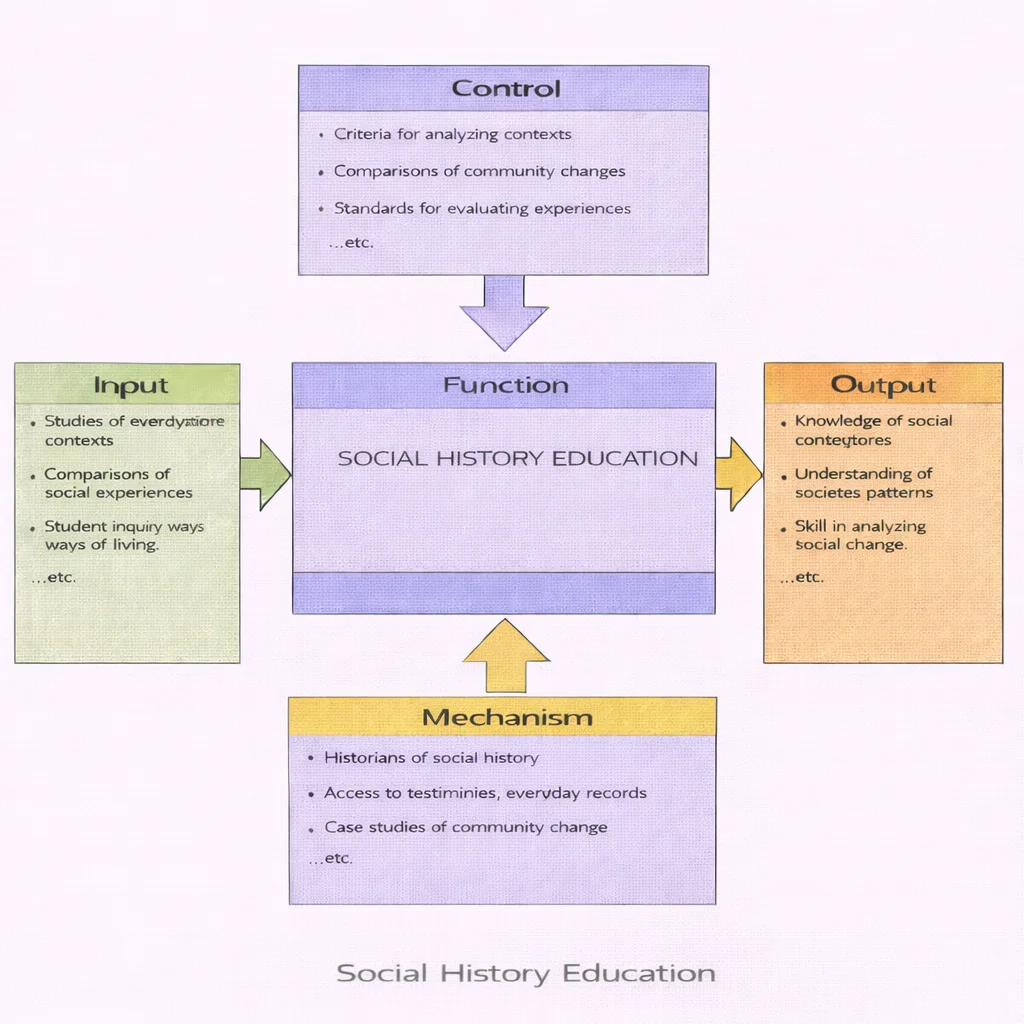
Click on any question below to reveal detailed analytical explanations and test your understanding of social history methods.Why is the IDEF0 model applied to Social History Education?
How does social history complement political and military history?
What is the significance of studying history "from below"?
Frequently Asked Questions
What is social history?
Social history is the study of how people lived in the past in their everyday settings—families, communities, workplaces, schools, and streets. It focuses on patterns of daily life, social relationships, identities, and experiences, rather than only on high politics, diplomacy, or military events.
How is social history different from political or diplomatic history?
Political and diplomatic history traditionally concentrate on states, leaders, institutions, and formal decision-making. Social history shifts attention to ordinary people and social groups, asking how broad political and economic structures were experienced in daily life and how people shaped change from below.
Which groups are commonly studied in social history?
Social historians often study workers, peasants, enslaved people, migrants, women, children, minority communities, and other groups that were underrepresented in earlier forms of history writing. They also examine families, neighbourhoods, associations, and subcultures across different classes and regions.
What types of sources do social historians use?
Social historians use a wide range of sources, including census data, parish and civil registers, court records, wage and price statistics, letters, diaries, oral histories, photographs, housing surveys, school records, newspapers, and material culture such as clothing, tools, and household objects.
How do quantitative methods contribute to social history?
Quantitative methods allow social historians to analyse large datasets on population, employment, health, migration, or household budgets. By using statistics and graphs, they can identify long-term trends and patterns that are not visible from individual documents alone, and then connect those patterns to lived experiences.
What is the relationship between social history and cultural or economic history?
Social history overlaps with cultural and economic history. It asks how economic structures shaped everyday life and how cultural meanings, values, and symbols influenced social relations. Many studies combine these perspectives, examining, for example, how work, family life, and cultural practices interacted in particular communities.
How does social history address issues of class, gender, race, and ethnicity?
Social historians pay close attention to how class, gender, race, ethnicity, and other identities structured access to resources, power, and recognition. They explore how hierarchies were maintained or challenged in everyday interactions, and how these categories changed over time in response to law, migration, conflict, and social movements.
How is social history connected to sociology and anthropology?
Social history shares questions and methods with sociology and anthropology, such as interest in social structures, communities, and cultural practices. Social historians often adapt sociological concepts and anthropological fieldwork techniques to historical sources, using them to interpret past societies and to compare them across time and place.
Can social history be studied at both local and global scales?
Yes. Social history can focus on a specific village, town, or neighbourhood, or it can examine broader patterns that link different regions, such as migration flows, labour markets, pandemics, or imperial networks. Many studies move between local case studies and wider comparisons to show how global forces shaped everyday lives.
What skills do students develop by studying social history?
Students learn to analyse varied sources, work with both quantitative and qualitative evidence, and reconstruct the perspectives of people whose voices are often fragmented or indirect. They also practice critical thinking about inequality, identity, and change, and learn to connect large-scale processes to personal experiences.
Why is social history important for understanding the present?
Social history shows that current debates about work, family, migration, health, education, and inequality have deep roots. By tracing how everyday life has changed over time, students can better understand why certain institutions, norms, and conflicts exist today and how they might be reshaped in the future.
How can studying social history prepare students for further study or careers?
Studying social history equips students with skills in research, data interpretation, communication, and empathy across differences. These abilities are valuable in fields such as education, public policy, social work, journalism, community organising, heritage and museums, and any career that requires understanding people in their social context.
Comprehensive Practice Module
Section 1: Foundational Review Exercises
- What is social history and what does it encompass?Answer: Social history is the study of the everyday lives, experiences, and social structures of people throughout time. It encompasses an analysis of cultural practices, economic conditions, family dynamics, and community interactions that have influenced the development of societies. By focusing on the experiences of ordinary individuals rather than just political or military events, social history provides a more comprehensive understanding of the human condition. This approach allows historians to explore how social norms, values, and institutions evolve and impact the broader historical narrative.
- How does social history differ from traditional political or military history?Answer: Social history differs from traditional political or military history in that it centers on the experiences and lives of everyday people rather than focusing solely on the actions of elites or major state events. While political history emphasizes governance, leadership, and policy decisions, and military history concentrates on wars and conflicts, social history examines cultural, economic, and social changes from the grassroots level. This perspective provides a more inclusive narrative of the past, highlighting how social movements, class dynamics, and cultural practices contribute to historical change. It offers a richer, multifaceted view of how societies develop over time.
- What role do cultural practices play in the development of social history?Answer: Cultural practices play a central role in social history as they shape the beliefs, behaviors, and everyday interactions of individuals within a society. These practices include traditions, rituals, art, and language, which collectively influence social cohesion and identity. By studying cultural practices, social historians gain insight into how communities interpret their world and preserve their heritage. This understanding helps to explain the continuity and change in societal norms over time and reveals the deep connections between culture and social organization.
- How does social history help in understanding the lives of ordinary people?Answer: Social history helps in understanding the lives of ordinary people by focusing on their daily experiences, struggles, and contributions to society. It examines aspects such as family life, work, education, and leisure, providing a window into the social fabric that underlies historical events. By highlighting the voices and perspectives of those often overlooked in traditional narratives, social history creates a more inclusive and empathetic account of the past. This approach enriches our understanding of historical developments by showing how the actions of everyday individuals collectively shape larger societal trends.
- What are some key methodologies used in the study of social history?Answer: Key methodologies in social history include qualitative research, such as oral histories, diaries, and personal correspondence, as well as quantitative methods like demographic analysis and statistical surveys. Researchers often use interdisciplinary approaches, drawing from sociology, anthropology, and economics to reconstruct the lived experiences of people. Archival research and the analysis of cultural artifacts also play a significant role in uncovering the nuances of everyday life. These diverse methodologies allow social historians to piece together comprehensive narratives that reflect the complexities of human society.
- How has social history contributed to our understanding of historical change?Answer: Social history has contributed to our understanding of historical change by emphasizing the influence of everyday experiences and grassroots movements on broader societal transformations. It reveals how shifts in cultural practices, social structures, and economic conditions can lead to significant historical developments. By focusing on the interactions and contributions of ordinary people, social history provides a more nuanced perspective on change that complements traditional political and military narratives. This approach allows historians to trace the evolution of societal values and the impact of collective action over time.
- What challenges do social historians face when reconstructing the past?Answer: Social historians face challenges such as limited availability of personal records and the potential bias in sources that predominantly reflect the experiences of dominant groups. They must often rely on fragmented evidence and interpret cultural artifacts to reconstruct the lives of ordinary people. Additionally, the subjective nature of personal narratives can complicate efforts to establish objective accounts of historical events. Despite these obstacles, innovative research methods and interdisciplinary approaches help social historians to overcome these challenges and offer richer, more inclusive insights into the past.
- How do social movements contribute to the study of social history?Answer: Social movements contribute significantly to the study of social history by highlighting the collective actions and grassroots efforts that drive societal change. These movements, often rooted in struggles for rights and equality, provide critical insights into the dynamics of power, resistance, and reform. By examining the origins, strategies, and impacts of social movements, historians can better understand how public sentiment and community mobilization influence the evolution of social and cultural norms. This focus on collective action enriches historical narratives by demonstrating the importance of ordinary people in shaping transformative change.
- How does social history intersect with other fields such as economic and cultural history?Answer: Social history intersects with economic and cultural history by exploring how the everyday lives and experiences of people are influenced by and, in turn, influence economic systems and cultural practices. Economic conditions, such as employment, wealth distribution, and market dynamics, directly affect social structures and relationships. Similarly, cultural history examines the evolution of art, language, and traditions that shape social identity and community bonds. By integrating these fields, social history provides a holistic understanding of the past, revealing the interconnectedness of economic, cultural, and social forces in driving historical change.
- What lessons can modern societies learn from the study of social history?Answer: Modern societies can learn valuable lessons from the study of social history by understanding how past social dynamics, cultural shifts, and grassroots movements have shaped present-day institutions and public life. These historical insights highlight the importance of inclusivity, civic engagement, and social justice in fostering resilient communities. They also underscore the potential for ordinary people to drive significant change and the importance of preserving diverse cultural traditions. By drawing on the experiences and lessons of the past, contemporary societies can better address current challenges and work toward building more equitable and sustainable futures.
Section 2: Analytical & Scenario-Based Exploration
- How can the study of social history contribute to a more inclusive understanding of historical narratives?Answer: The study of social history broadens our historical narratives by incorporating the experiences of diverse groups, including marginalized and underrepresented populations. By focusing on everyday life, social history provides a more comprehensive picture of the past that goes beyond the actions of elites and political leaders. This inclusive approach helps to reveal the complexity of historical events and the various factors that have shaped society over time. It allows for a deeper understanding of cultural and social dynamics that have often been overlooked in traditional accounts, fostering a richer and more equitable portrayal of history. This approach also encourages historians to challenge dominant narratives and to reexamine sources from multiple perspectives, creating a balanced historical record that reflects the diversity of human experience.
- In what ways can social history inform current debates on cultural preservation and modernization?Answer: Social history informs current debates on cultural preservation and modernization by providing insights into how societies have balanced tradition with progress throughout history. It offers examples of how cultural practices have evolved over time in response to changing economic and social conditions, demonstrating that preservation and innovation are not mutually exclusive. By examining historical cases, policymakers and cultural leaders can identify strategies that have successfully integrated traditional values into modern frameworks, ensuring that cultural heritage is maintained while embracing necessary reforms. This understanding can help contemporary societies navigate the tension between preserving cultural identity and adapting to globalization and technological change.
- How do changes in social structures, as recorded by social historians, affect political stability?Answer: Changes in social structures, as documented by social historians, have a profound impact on political stability by altering the relationships between different groups within society. Shifts in class dynamics, family structures, and community organization can either contribute to cohesion or lead to fragmentation, depending on how they interact with existing political institutions. Social historians have shown that periods of rapid social change often coincide with political upheaval, as traditional power structures are challenged and new forms of organization emerge. Understanding these dynamics is crucial for predicting and managing potential instability in times of social transformation.
- What role does technology play in reshaping social history in the modern era?Answer: Technology plays an increasingly vital role in reshaping social history by transforming the ways in which people communicate, work, and interact within society. The advent of digital technology and social media has revolutionized information dissemination, enabling rapid changes in social norms and cultural practices. Social historians now have access to vast digital archives and analytical tools that can uncover previously hidden patterns in human interaction, thus offering a more detailed and dynamic understanding of contemporary society. Furthermore, technology has catalyzed new social movements and forms of activism, which are reshaping the modern social landscape.
- How do grassroots movements influence social change according to social historical analysis?Answer: Grassroots movements influence social change by mobilizing local communities and fostering collective action that challenges established power structures. Social historical analysis shows that these movements often emerge from the bottom up, driven by shared experiences of marginalization and the desire for justice. They create platforms for citizen participation and provide a voice for those who have historically been excluded from mainstream political processes. By organizing protests, community initiatives, and public campaigns, grassroots movements drive reforms that reshape social norms and contribute to long-term cultural transformation.
- What insights can social historians provide on the evolution of gender roles in society?Answer: Social historians provide valuable insights into the evolution of gender roles by tracing the historical developments and cultural shifts that have defined the expectations and responsibilities of men and women. They examine how social, economic, and political factors have influenced gender dynamics, documenting the gradual transformation of traditional roles over time. These analyses reveal how movements for gender equality and feminist activism have challenged established norms, leading to significant advancements in rights and opportunities for women. These insights are crucial for addressing contemporary issues related to gender inequality and promoting informed public policy.
- How can the lessons from social history be applied to modern urban development and community planning?Answer: Lessons from social history can be applied to modern urban development and community planning by providing a deeper understanding of how social structures, cultural practices, and historical experiences shape human settlements. Social historians study the evolution of cities and communities, revealing patterns in urban growth, migration, and the formation of public spaces. These insights can guide contemporary planners in designing urban environments that promote social cohesion, inclusivity, and sustainability, ensuring that development reflects the unique identity and values of local communities.
- How do social historians analyze the impact of migration on cultural and societal change?Answer: Social historians analyze the impact of migration on cultural and societal change by examining the movement of people across regions and the resulting interactions between diverse cultures. Migration often acts as a catalyst for cultural exchange, leading to the blending of traditions, languages, and practices. Social historians use a variety of methodologies, including demographic studies and oral histories, to trace these patterns and assess their long-term effects on societal structure and cultural evolution, shedding light on both integration challenges and cultural enrichment.
- How can social history inform our understanding of the evolution of education systems?Answer: Social history informs our understanding of the evolution of education systems by examining how educational practices and institutions have developed in response to changing social, economic, and political contexts. Historians trace the origins of formal education from early cultural traditions to modern public schooling, highlighting the role of education in shaping societal values and promoting social mobility. This historical perspective reveals how shifts in education policy have been influenced by broader social reforms like industrialization and democratization.
- How do social historians evaluate the impact of technological advancements on societal transformation?Answer: Social historians evaluate the impact of technological advancements on societal transformation by analyzing how innovations reshape social structures, economic practices, and cultural norms over time. They study the ways in which technology influences communication, production, and daily life, comparing historical periods before and after significant technological changes. Technological advancements are seen as catalysts for change that often accelerate social mobility, alter power dynamics, and redefine the nature of work.
- How might the changing role of media influence social historical narratives?Answer: The changing role of media influences social historical narratives by altering the way events are recorded, interpreted, and disseminated. With the advent of digital and social media platforms, information spreads rapidly and is shaped by diverse perspectives. This democratization of media allows marginalized voices to contribute to the narrative, challenging traditional historiography and offering a more comprehensive, multi-layered view of the past, while presenting new challenges regarding source verification.
- How can comparative studies in social history contribute to understanding global cultural shifts?Answer: Comparative studies in social history contribute to understanding global cultural shifts by examining how different societies experience and respond to similar social phenomena. By analyzing the cultural, economic, and political contexts of various regions, historians can identify common patterns and unique responses that reveal the underlying dynamics of cultural change. This framework fosters mutual understanding and dialogue among cultures, informing contemporary discussions on globalization and identity.
Section 3: Quantitative & Demographic Calculations
- In an 18th-century industrial parish, the baseline population at the start of a decade was P0 = 12,500. Over 10 years, there were 4,200 births (B), 3,100 deaths (D), 1,800 in-migrants (I), and 950 out-migrants (E). Calculate the net natural increase, net migration, and total population at the end of the decade (P10).Solution:1. Net Natural Increase = Births - Deaths = 4,200 - 3,100 = 1,100 people.2. Net Migration = In-migrants - Out-migrants = 1,800 - 950 = +850 people.3. Total Population P10 = P0 + Net Natural Increase + Net Migration = 12,500 + 1,100 + 850 = 14,450 residents.
- Calculate the Crude Birth Rate (CBR) and Crude Death Rate (CDR) for an industrial town where the mid-year population is 45,000, annual live births are 1,575, and annual deaths are 1,080. Express both per 1,000 population.Solution:1. CBR = (Annual Births / Mid-Year Population) × 1,000 = (1,575 / 45,000) × 1,000 = 35 per 1,000.2. CDR = (Annual Deaths / Mid-Year Population) × 1,000 = (1,080 / 45,000) × 1,000 = 24 per 1,000.3. Annual Natural Growth Rate = CBR - CDR = 35 - 24 = 11 per 1,000 (or 1.1% per year).
- In a 19th-century textile city, 480 infants out of 2,400 live births died before reaching age 1 in a given year. Calculate the Infant Mortality Rate (IMR) per 1,000 live births.Solution:1. IMR = (Infant Deaths under 1 year / Total Live Births) × 1,0002. IMR = (480 / 2,400) × 1,000 = 0.20 × 1,000 = 200 per 1,000 live births (or 20%).
- To measure historical wealth concentration, calculate the Dependency Ratio for a rural district with the following age breakdown: Children (0–14 years) = 6,200; Working-Age Adults (15–64 years) = 11,000; Elderly (65+ years) = 1,800.Solution:1. Dependent Population = Children (0–14) + Elderly (65+) = 6,200 + 1,800 = 8,000.2. Working Population = 11,000.3. Dependency Ratio = (Dependent Population / Working Population) × 100 = (8,000 / 11,000) × 100 = 72.73 dependents per 100 working-age adults.
- A labor history archive records that nominal weekly wages for factory operatives increased from 15.00 shillings in 1840 to 18.75 shillings in 1850. Over the same decade, the consumer price index (cost of living) rose by 10%. Calculate the percentage increase in real wages.Solution:1. Nominal Wage Growth = [(18.75 - 15.00) / 15.00] × 100 = (3.75 / 15.00) × 100 = 25%.2. Real Wage Index = (1 + Nominal Growth Rate) / (1 + Inflation Rate) = (1 + 0.25) / (1 + 0.10) = 1.25 / 1.10 ≈ 1.1364.3. Real Wage Increase = (1.1364 - 1) × 100 = 13.64%.
- An urban historian measures overcrowding in a working-class district. In 1880, 28,000 inhabitants lived in 3,500 housing units across 140 city acres. Calculate the average housing occupancy (persons per house) and the population density (persons per acre).Solution:1. Housing Occupancy = Total Population / Total Housing Units = 28,000 / 3,500 = 8.0 persons per house.2. Population Density = Total Population / Total Acres = 28,000 / 140 = 200 persons per acre.
- In an early university literacy survey, 3,200 out of 5,000 men signed their marriage registers with a full signature rather than an 'X' mark, while 1,800 out of 4,500 women did the same. Calculate male, female, and overall literacy rates.Solution:1. Male Literacy Rate = (3,200 / 5,000) × 100 = 64.0%.2. Female Literacy Rate = (1,800 / 4,500) × 100 = 40.0%.3. Overall Literacy Rate = [(3,200 + 1,800) / (5,000 + 4,500)] × 100 = (5,000 / 9,500) × 100 ≈ 52.63%.
- A regional demographic study examines a population growing exponentially at an annual rate of r = 2.3% per year. Using the rule of 70, estimate the population doubling time in years.Solution:1. Rule of 70 Formula: Doubling Time t ≈ 70 / r (where r is the percentage growth rate).2. t ≈ 70 / 2.3 ≈ 30.43 years.3. The population will double in approximately 30.4 years.