

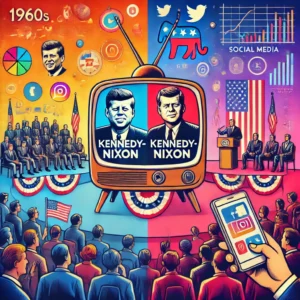
Historical Transition: This image combines traditional and modern campaign tools, anchoring the transition from broadcast television debates (like Kennedy-Nixon in 1960) to today’s smartphone-based social media platforms, big data analytics, and microtargeted messaging.
Winning the Vote: Strategy, Messaging, and Political Campaigns
Electoral History Overview
Curriculum Roadmap: Provides the foundational historical overview tracking how democratic elections evolved from localized voice votes into structured, institutional contests.
Suffrage & Civil Rights Movements
Curriculum Roadmap: Explores how grassroots social movements forced major political parties to expand campaign outreach to women, racial minorities, and working-class citizens.
Role of Technology in Elections
Curriculum Roadmap: Analyzes the hardware and software tools—from print presses and television to algorithmic data analytics—that changed how campaign messaging is delivered.
Electoral Fraud & Integrity
Curriculum Roadmap: Examines the ethical limits of campaign practices, assessing campaign finance regulation, dark money, disinformation, and election integrity oversight.
Comparative Electoral Systems
Curriculum Roadmap: Compares how candidate strategies differ under First-Past-The-Post single-member districts versus multi-member Proportional Representation list systems.
Anatomy of Modern Political Campaigns
Definition and Purpose
A political campaign is an organized, strategic effort designed to influence the decision-making process within a specific group, secure elective office, or advance policy initiatives.
Core Objectives
- Voter Education: Informing the electorate regarding candidate platforms, policy proposals, and track records.
- Voter Mobilization (GOTV): Structuring ground operations to maximize turnout among base supporters on election day.
- Persuasion: Winning over undecided, independent, or swing voters through targeted messaging and contrast advertising.
Historical Evolution of Political Campaigns
Early Campaigns (Informal & Localized)
In early representative systems, campaigning was localized and informal. In 19th-century America, candidates like Andrew Jackson utilized local town hall rallies, printed pamphlets, and partisan newspapers to connect with an expanding male electorate.
The Age of Mass Media (Radio & Print)
The invention of radio enabled political leaders to speak directly to millions of citizens simultaneously in their living rooms. Franklin D. Roosevelt’s “Fireside Chats” in the 1930s established a personal, intimate connection with voters during the Great Depression and World War II.
The Television Era
The 1960 Kennedy-Nixon debates marked a major turning point in political communications. Television forced campaigns to prioritize visual charisma, physical demeanor, and polished media presentation alongside substantive argument.
The Digital Revolution
The internet and social platforms transformed campaigns into two-way, continuous data-driven operations. Barack Obama’s 2008 campaign integrated digital organizing and small-donor online fundraising, while the 2016 campaign highlighted rapid-fire direct communications on social media channels.
Key Strategies in Political Campaigns
Messaging and Branding
- Slogan Development: Memorable slogans encapsulate core campaign themes (e.g., “Yes We Can”, “Make America Great Again”).
- Candidate Image Construction: Building a relatable narrative highlighting leadership, authenticity, and shared values.
Media, Advertising, and Microtargeting
- Traditional Media: High-impact television ads aimed at broad media markets (e.g., LBJ’s famous 1964 “Daisy” ad highlighting nuclear stakes).
- Data Analytics & Microtargeting: Analyzing voter registration lists, consumer data, and online behavior to deliver hyper-tailored political ads to narrow voter demographics.
Interactive Tool: Campaign Budget & Swing-State Resource Allocation Simulator
Distribute your total $100M Campaign Budget across 3 strategy channels to see how your spending allocation impacts expected turnout, persuasion rate, and Electoral College win probability.
Comparative Analysis of Global Political Campaigns
United States Presidential Campaigns
Characterized by extreme duration (often 18–24 months), massive private campaign finance (totaling billions of dollars), multi-state primary battles, and targeted Electoral College swing-state advertising.
United Kingdom Parliamentary Campaigns
Constrained by legally regulated, short campaign windows (typically 5–6 weeks), strict per-constituency spending caps, and bans on paid political television advertising (parties receive free public broadcast slots).
Indian Lok Sabha Elections
The largest democratic exercise globally, spanning multiple voting phases over weeks. Campaigns navigate hundreds of languages and cultural demographics, blending massive physical rallies with digital WhatsApp outreach.
Interactive Review: Campaign Tactics & Communication
Click on the concepts below to review key strategies in political campaign history:
What was the significance of the 1960 Kennedy–Nixon television debates?
How does Get-Out-The-Vote (GOTV) field strategy differ from persuasion messaging?
Why are political action committees (PACs) and Super PACs controversial in US campaign finance?
Frequently Asked Questions
What is a political campaign?
A political campaign is an organized, strategic effort by candidates, parties, or political groups to communicate policy platforms, persuade voters, and secure elective office.
Why are political campaigns central to democratic history?
They serve as the primary arena where political ideas are debated, leadership options are evaluated, and citizens are mobilized to exercise their democratic rights.
How did broadcast radio alter political campaigning?
Radio allowed candidates to bypass newspaper editors and speak directly to nationwide audiences in real time, establishing intimate personal connections with voters.
What is campaign microtargeting?
Microtargeting uses big data and analytics to isolate narrow voter demographics and deliver highly customized political advertisements tailored to their specific interests.
What is the difference between positive and negative campaigning?
Positive campaigning highlights a candidate’s achievements and policy proposals. Negative campaigning focuses on attacking an opponent’s character, record, or perceived shortcomings.
How do campaign finance laws vary globally?
Some nations (e.g., the US) permit substantial private fundraising and independent political spending, while others (e.g., the UK and France) enforce strict spending caps and provide public campaign subsidies.
What is grassroots campaigning?
Grassroots campaigning relies on volunteer networks conducting door-to-door canvassing, local rallies, phone banks, and community organizing to build support from the bottom up.
How does social media affect voter polarization during campaigns?
Algorithms designed to maximize online user engagement frequently amplify sensational or polarizing content, reinforcing ideological echo chambers among voters.
What primary sources do campaign historians analyze?
Historians examine campaign speech transcripts, television advertisements, press releases, internal polling memos, volunteer handbooks, campaign buttons, and financial disclosure ledgers.
How do campaign promises influence governance after elections?
Campaign promises establish an electoral mandate, framing executive legislative priorities and serving as a benchmark for public accountability in subsequent elections.
What skills do students gain from studying campaign history?
Students master rhetorical analysis, media literacy, quantitative polling data interpretation, strategic communications analysis, and critical evaluation of political messaging.
End-of-Page Practice Modules
Module 1: Foundational Review Questions
-
Define a political campaign and outline its core objectives.
Answer: A political campaign is an organized, strategic effort to win elective office or pass policy. Its core objectives are voter education, voter persuasion, and voter mobilization (GOTV). -
How did broadcast radio transform presidential campaigning during the Great Depression?
Answer: Radio allowed political leaders like FDR to deliver “Fireside Chats” directly into citizens’ homes, bypassing press filters and building direct personal rapport with millions. -
What key lesson did political strategists learn from the 1960 Kennedy-Nixon debates?
Answer: That candidate appearance, visual charisma, and television performance are as critical as verbal arguments in swaying public perception. -
Explain the difference between persuasion messaging and Get-Out-The-Vote (GOTV) operations.
Answer: Persuasion messaging targets undecided voters to change their minds, whereas GOTV operations target committed supporters to ensure they actually turn out to vote. -
What is political data microtargeting?
Answer: The practice of combining voter records with online behavioral data to send customized political ads to narrow voter demographics. -
How do campaign spending limits in the UK contrast with campaign finance rules in the US?
Answer: The UK strictly caps campaign spending per candidate and bans paid political TV ads, whereas the US permits substantial private fundraising and independent Super PAC spending. -
What role do primary elections play in modern campaign cycles?
Answer: Primaries allow party members to vote directly on who will represent the party as its official candidate in the general election. -
How did Lyndon B. Johnson’s 1964 “Daisy” ad impact political advertising history?
Answer: It demonstrated the powerful emotional appeal of negative contrast advertising by linking opponent policies to nuclear risks without explicitly naming the opponent. -
What is grassroots campaign organizing?
Answer: Bottom-up campaign organizing relying on local community volunteers for door-to-door canvassing, local events, and peer-to-peer phone banking. -
Why are campaign slogans significant in political communication?
Answer: Slogans distill complex ideological platforms into memorable, emotionally resonant catchphrases that anchor campaign branding.
Module 2: Analytical & Scenario-Based Inquiry
-
Analyze how the rise of digital microtargeting challenges traditional democratic debate.
Answer: Microtargeting allows candidates to send private, tailored, and sometimes contradictory messages to isolated voter groups, depriving the public of a shared, transparent national debate. -
Evaluate the trade-off between strict campaign finance limits and free speech arguments.
Answer: Proponents of spending limits argue they prevent wealthy donors from buying political influence. Opponents argue that spending money on political advertising is a protected form of political speech. -
How do majoritarian First-Past-The-Post systems alter campaign strategy compared to Proportional Representation?
Answer: In FPTP, campaigns focus heavily on winning narrow majorities in specific geographic “swing districts.” In PR, campaigns seek to maximize total national vote shares across all regions. -
Discuss the impact of negative contrast advertising on voter turnout.
Answer: While negative ads can effectively lower an opponent’s favorability ratings, political science research shows they can also induce voter cynicism and depress overall voter turnout. -
In what ways did social media platforms transform grassroots fundraising in 21st-century campaigns?
Answer: Social media allows campaigns to bypass traditional party mega-donors by collecting millions of small-dollar digital donations directly from grassroots supporters. -
Assess how algorithmic echo chambers on digital platforms affect voter polarization.
Answer: By feeding users content that reinforces existing political biases, algorithms isolate voters from opposing viewpoints, worsening partisan divides. -
How do short, legal campaign windows in parliamentary systems impact campaign strategy?
Answer: Short windows require rapid, highly disciplined campaign execution focused on core party platforms rather than multi-year candidate personality building. -
Why is candidate image management increasingly important in the era of high-definition digital media?
Answer: Modern 24/7 media coverage amplifies minor unscripted moments or visual missteps, making visual discipline and authenticity central to campaign branding. -
Evaluate the role of debates in modern campaigns when most voters have already formed partisan alignments.
Answer: While partisan voters rarely switch sides, televised debates remain crucial for persuading undecided swing voters and energizing base turnout. -
How do post-conflict or transitional societies adapt campaign practices to ensure peace?
Answer: Campaigns often adopt formal codes of conduct, avoiding inflammatory ethnic rhetoric and focusing on national reconciliation to prevent political violence.
Module 3: Step-by-Step Numerical Problems & Electoral Formulas
-
A campaign has a total budget of $10,000,000. It allocates 45% to broadcast TV, 25% to digital ads, 15% to field operations, and the remainder to administrative overhead. Calculate the exact dollar amount allocated to administrative overhead.
Answer: Step 1: Calculate sum of non-overhead percentages = 45% + 25% + 15% = 85%.
Step 2: Calculate overhead percentage = 100% – 85% = 15%.
Step 3: Calculate dollar amount = $10,000,000 × 0.15 = $1,500,000.
Result: Administrative overhead is $1,500,000. -
A campaign runs a digital ad buy costing $50,000 at a Cost Per Mille (CPM) of $10.00 (cost per 1,000 impressions). If the click-through rate (CTR) is 2.0%, calculate total ad impressions and total clicks generated.
Answer: Step 1: Calculate total impression units (in thousands) = $50,000 / $10.00 = 5,000.
Step 2: Total impressions = 5,000 × 1,000 = 5,000,000 impressions.
Step 3: Total clicks = 5,000,000 × 0.02 = 100,000 clicks. -
A field campaign needs to contact 60,000 voters via door-to-door canvassing. If one volunteer can knock on 15 doors per hour, calculate how many total volunteer hours are needed. If the canvassing drive lasts 4 weeks (working 10 hours per volunteer per week), how many volunteers are needed?
Answer: Step 1: Total volunteer hours needed = 60,000 / 15 = 4,000 hours.
Step 2: Hours provided per volunteer over 4 weeks = 4 weeks × 10 hours/week = 40 hours.
Step 3: Volunteers needed = 4,000 / 40 = 100 volunteers. -
In a swing district with 200,000 total voters, turnout is projected at 60%. Candidate Alpha needs 50% + 1 vote of cast ballots to win. If Candidate Alpha has 45,000 secured base votes, calculate how many additional swing votes Candidate Alpha must persuade to reach victory.
Answer: Step 1: Calculate total cast ballots = 200,000 × 0.60 = 120,000 votes.
Step 2: Calculate votes needed to win = (120,000 / 2) + 1 = 60,001 votes.
Step 3: Additional swing votes needed = 60,001 – 45,000 = 15,001 votes. -
A campaign raises funds from two sources: small digital donors (averaging $25 per donor) and large fundraising dinners (averaging $1,000 per donor). If the campaign raises $500,000 from 12,000 small donors, calculate how many large donors are needed to reach a overall $1,000,000 goal.
Answer: Step 1: Calculate revenue from small donors = 12,000 × $25 = $300,000.
Step 2: Calculate remaining funding needed = $1,000,000 – $300,000 = $700,000.
Step 3: Calculate large donors needed = $700,000 / $1,000 = 700 large donors. -
During a GOTV phone bank drive, 80 volunteers make calls for 3 hours each. If the average call duration is 3 minutes (20 calls per hour per volunteer) and 15% of reached voters agree to commit to vote, calculate the total committed voters generated.
Answer: Step 1: Total volunteer calling hours = 80 × 3 = 240 hours.
Step 2: Total calls made = 240 hours × 20 calls/hour = 4,800 calls.
Step 3: Committed voters generated = 4,800 × 0.15 = 720 voters. -
In a pre-election tracking poll of 1,200 voters, Candidate A has 48% support and Candidate B has 44% support, with a margin of error of ±3%. Calculate the confidence interval for Candidate A and state whether Candidate A’s lead is statistically significant.
Answer: Step 1: Candidate A interval = 48% − 3% to 48% + 3% (45% to 51%).
Step 2: Candidate B interval = 44% − 3% to 44% + 3% (41% to 47%).
Step 3: Since Candidate A’s lower bound (45%) overlaps Candidate B’s upper bound (47%), Candidate A’s lead is within the margin of error and not statistically significant.