
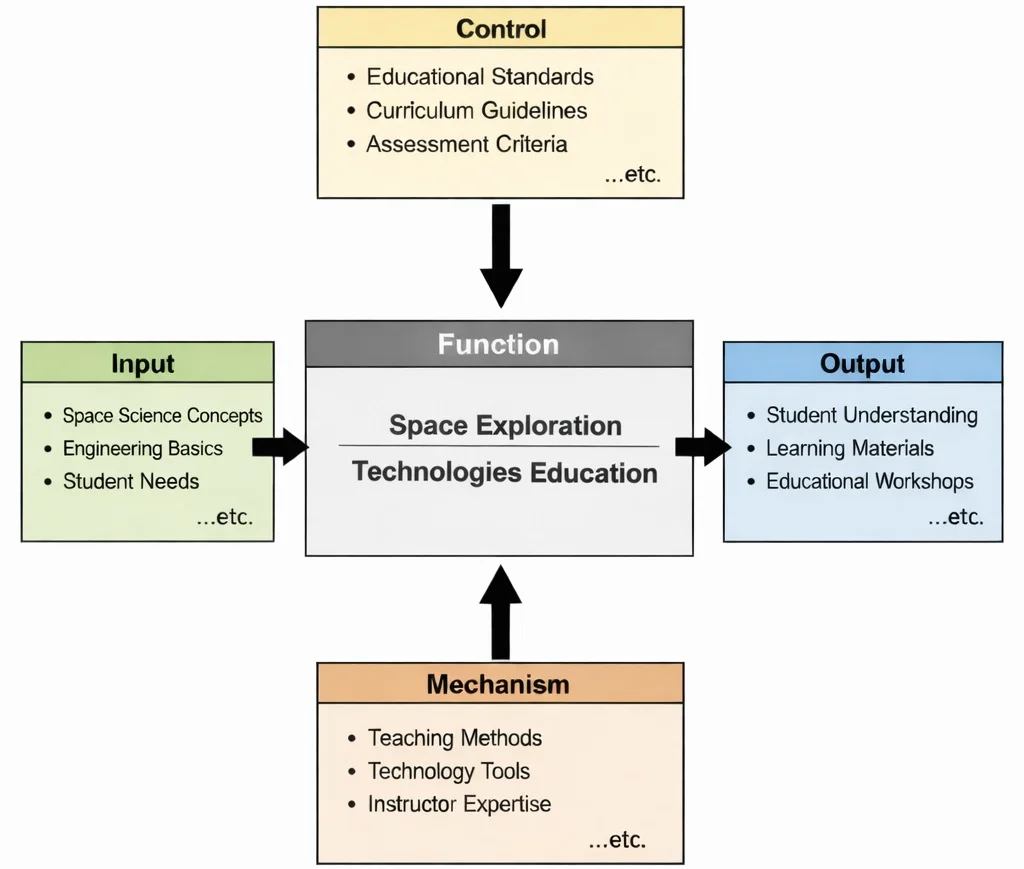
Space exploration technologies education can be understood as a purposeful system that turns curiosity about space into practical, structured competence. In this IDEF0 functional framework, the learning journey begins with core inputs: space science principles that explain the harsh vacuum, thermal extremes, and radiation constraints beyond Earth; engineering fundamentals that provide the quantitative language of trade-offs; and student diagnostic needs that determine pacing and mathematical scaffolding. Governed by formal controls—aerospace safety standards, orbital mechanics laws, curriculum frameworks, and assessment benchmarks—instruction remains anchored to engineering realities. Supported by mechanisms such as orbital trajectory simulators, hardware telemetry models, and interdisciplinary instructor expertise, learners develop systems-thinking competencies: evaluating propulsion efficiencies, designing closed-loop life-support architectures, formulating launch staging ratios, and planning robotic interplanetary missions.
Space exploration technologies represent the pinnacle of modern systems engineering, integrating breakthroughs across STEM disciplines to extend human presence and instrumentation into the cosmos. As sovereign space agencies and commercial launch providers deploy complex payloads into low Earth orbit and deep space, an advanced understanding of information technology, applied mathematics, and stochastic modeling from statistics becomes essential. These mathematical tools underpin orbital state estimation, trajectory optimization, and attitude determination and control systems (ADCS) required to operate in extraterrestrial environments.
The space engineering ecosystem comprises two interdependent domains: launch vehicles providing orbital insertion capability, and satellite systems sustaining operations across orbital planes. Spacecraft design relies heavily on robotics, high-dimensional data science, and high-frequency telemetry uplinks. Because round-trip light-time latency to Mars and outer planets spans minutes to hours, modern spacecraft increasingly incorporate autonomous systems powered by embedded artificial intelligence and machine learning for real-time hazard avoidance, automated docking, and anomaly triage.
Meeting the continuous power demands of deep-space operations has accelerated advances in energy storage systems, including radiation-hardened multi-junction photovoltaic arrays and radioisotope thermoelectric generators (RTGs). These technologies align with developments in smart manufacturing and Industry 4.0, where additive manufacturing and laser powder bed fusion allow engineers to 3D-print regeneratively cooled rocket thrust chambers. Furthermore, spacecraft telemetry networks reflect principles from IoT and smart sensor technologies, managing hundreds of thermal, vibrational, and pressure sensors over internal CAN and SpaceWire buses.
Modern aerospace also interfaces with quantum computing. Quantum communication links using polarized photon pairs leverage quantum superposition and quantum entanglement to execute Quantum Key Distribution (QKD) across ground-to-satellite paths. Similarly, quantum processors utilizing qubits and unitary quantum logic gates offer quadratic and exponential speedups for complex multi-body gravitational trajectory computations and satellite constellation scheduling.
Terrestrial engineering domains also benefit from aerospace research. Closed-loop life-support systems (ECLSS) borrow chemical scrubbing and greywater recovery cycles developed in environmental engineering and green building design. Earth-observation satellite constellations provide continuous multi-spectral imaging to model environmental changes, track planetary deforestation, and inform civil disaster engineering and risk mitigation. In life sciences, microgravity cell culturing aboard orbital laboratories expands biotechnology and protein crystal growth, while robust web and networking protocols coordinate international telemetry pipelines.

Mathematical & Astrodynamic Foundations
Space mission planning requires quantitative rigor governing gravitational potential wells, orbital energy conservation, and rocket momentum exchange. Unlike terrestrial transportation systems that push against an ambient medium, spacecraft maneuver through momentum expulsion in a vacuum, where trajectories are strictly dictated by Newtonian gravitation and orbital mechanics.
1. The Tsiolkovsky Rocket Equation & Staging Dynamics
Derived by Konstantin Tsiolkovsky in 1903 from Newton's third law and conservation of momentum, the ideal rocket equation calculates the maximum change in velocity (Δv) achievable by expelling propellant mass at constant exhaust velocity:
$$\Delta v = v_{\text{e}} \ln\left(\frac{m_0}{m_{\text{f}}}\right) = I_{\text{sp}} g_0 \ln\left(\frac{m_0}{m_{\text{f}}}\right)$$where:
- Δv: Total impulsive velocity change capability (m/s).
- ve: Effective exhaust velocity relative to the nozzle exit plane (m/s), defined as ve = Isp · g0.
- Isp: Specific impulse (seconds), the fundamental measure of propellant efficiency representing thrust delivered per unit weight-flow rate of propellant at Earth's surface.
- g0: Standard terrestrial gravitational acceleration (≈ 9.80665 m/s2).
- m0 / mf: Mass ratio, comparing the initial wet mass m0 (structure + avionics + payload + usable propellant) to the burnout dry mass mf (after propellant is depleted).
Problem: A modern kerosene/liquid oxygen (LOX/RP-1) rocket stage operates with an average vacuum specific impulse of Isp = 311.0 s (ve ≈ 3,050.0 m/s). To reach low Earth orbit (LEO), a vehicle requires an effective Δv of 9,400.0 m/s (including ∼ 1,600 m/s lost to atmospheric drag and gravity backpressure during vertical ascent). Calculate the required mass ratio m0 / mf for a single-stage-to-orbit (SSTO) vehicle.
$$ \begin{aligned} \frac{\Delta v}{v_{\text{e}}} &= \frac{9{,}400.0 \text{ m/s}}{3{,}050.0 \text{ m/s}} \approx 3.082 \\ \frac{m_0}{m_{\text{f}}} &= e^{3.082} \approx 21.80 \Rightarrow m_{\text{f}} = \frac{m_0}{21.80} \approx 0.0459 \cdot m_0 \end{aligned} $$Engineering Takeaway: For a single stage to reach orbit, burnout mass (structure, engines, tanks, and payload combined) cannot exceed 4.59% of the total initial launch pad mass. Because real-world aerospace structural fractions rarely drop below 5–7%, single-stage-to-orbit with chemical propellants is virtually impossible. This physical constraint necessitates multi-stage rockets, which discard empty propellant tanks and heavy sea-level engines mid-flight to reset the mass ratio in the upper atmosphere.
2. The Vis-Viva Equation & Specific Orbital Energy
Derived directly from the conservation of mechanical energy (kinetic plus gravitational potential energy) in a central two-body gravitational field, the Vis-Viva equation governs the speed of an orbiting body at any instantaneous point along a Keplerian conic section:
$$v^2 = \mu \left( \frac{2}{r} - \frac{1}{a} \right)$$where:
- v: Instantaneous relative orbital speed of the satellite (km/s).
- r: Instantaneous radial distance from the center of mass of the primary body (km), where r = Rbody + altitude.
- a: Semi-major axis of the orbit (km). By convention: a > 0 for closed ellipses, a → ∞ for parabolas, and a < 0 for hyperbolic escape trajectories.
- μ: Standard gravitational parameter (μ = GM), measuring gravitational strength (μEarth ≈ 398,600.4 km3/s2; μMoon ≈ 4,902.8 km3/s2; μMars ≈ 42,828.3 km3/s2).
Problem: The International Space Station (ISS) orbits Earth at a circular altitude of h = 400.0 km. Given Earth's mean radius RE = 6,371.0 km, calculate its circular velocity vcirc and the escape velocity vesc needed at that altitude to break free into an interplanetary trajectory.
$$ \begin{aligned} r &= R_{\text{E}} + h = 6{,}371.0 \text{ km} + 400.0 \text{ km} = 6{,}771.0 \text{ km} \\ \text{For a circular orbit } (a = r): \quad v_{\text{circ}} &= \sqrt{\frac{\mu}{r}} = \sqrt{\frac{398{,}600.4 \text{ km}^3/\text{s}^2}{6{,}771.0 \text{ km}}} \approx \sqrt{58.8687} \approx 7.673 \text{ km/s} \\ \text{For a parabolic escape } (a \to \infty): \quad v_{\text{esc}} &= \sqrt{\frac{2\mu}{r}} = \sqrt{2} \cdot v_{\text{circ}} \approx 1.4142 \times 7.673 \text{ km/s} \approx 10.851 \text{ km/s} \end{aligned} $$Engineering Takeaway: To escape Earth from low Earth orbit, a spacecraft must execute an impulsive propulsive burn adding Δvesc = vesc − vcirc ≈ 10.851 − 7.673 = 3.178 km/s.
3. Kepler’s Third Law (Harmonic Orbital Period)
Derived by Johannes Kepler empirically and later proved by Isaac Newton using gravitational attraction and centripetal equilibrium, Kepler's Third Law defines the exact mathematical period T required for a satellite to complete one orbital revolution:
$$T = 2\pi \sqrt{\frac{a^3}{\mu}}$$Rearranging this equation allows astrodynamicists to determine the required semi-major axis a for a specific desired period, such as synchronizing a satellite's rotation with the host planet (geostationary or areostationary orbits).
Problem: For a telecommunications satellite to remain stationary over a fixed longitude on Earth's equator, its orbital period must match Earth's sidereal rotation day: T = 23 hours, 56 minutes, and 4.09 seconds (≈ 86,164.1 seconds). Calculate the required semi-major axis a and the orbital altitude h above sea level.
$$ \begin{aligned} a^3 &= \mu \left( \frac{T}{2\pi} \right)^2 = (398{,}600.4 \text{ km}^3/\text{s}^2) \times \left( \frac{86{,}164.1 \text{ s}}{6.2831853} \right)^2 \\ a^3 &= 398{,}600.4 \times (13{,}713.45)^2 \approx 398{,}600.4 \times 1.88059 \times 10^8 \approx 7.49605 \times 10^{13} \text{ km}^3 \\ a &= \sqrt[3]{7.49605 \times 10^{13}} \approx 42{,}164.2 \text{ km} \\ h &= a - R_{\text{E}} = 42{,}164.2 \text{ km} - 6{,}371.0 \text{ km} \approx 35{,}793.2 \text{ km} \end{aligned} $$Engineering Takeaway: A geostationary satellite must orbit at an altitude of approximately 35,786 km (∼ 35,793 km under mean spherical radius), traveling at roughly 3.07 km/s to balance gravitational attraction with centripetal acceleration over a 24-hour diurnal cycle.
Key Subsystems in Modern Space Technologies
| Subsystem Domain | Primary Engineering Function | Key Operational Technologies |
|---|---|---|
| Propulsion Systems | Provides momentum transfer for launch ascent, orbital insertion, attitude control, and interplanetary transfer maneuvers. | Cryogenic liquid chemical engines (LOX/LH2, LOX/CH4), Hall-effect ion thrusters, nuclear thermal propulsion (NTP), solar sails. |
| Environmental Control & Life Support (ECLSS) | Maintains atmospheric partial pressures, thermal balances, carbon dioxide scrubbers, and water reclamation loops for crew survival. | Electrolytic oxygen generation (OGS), Sabatier catalytic CO2 methanation, multi-stage vapor compression distillation (VCD). |
| Deep-Space Telemetry & Navigation | Tracks position vectors, conducts radiometric ranging, and relays command/science data across interplanetary distances. | NASA Deep Space Network (DSN 70-meter dish arrays), optical laser communications (DSOC), X-band / Ka-band transponders. |
| In-Situ Resource Utilization (ISRU) | Harvests local extraterrestrial regolith and atmospheric gases to generate propellants, breathable oxygen, and shielding mass on-site. | Solid Oxide Electrolysis (MOXIE on Mars), thermal extraction of lunar permanently shadowed crater ice, regolith microwave sintering. |
| Thermal & Radiation Protection | Mitigates solar thermal flux, cryogenic deep-space sinks (3 K), Galactic Cosmic Rays (GCR), and Solar Particle Events (SPE). | Multi-Layer Insulation (MLI), carbon-composite ablative thermal protection systems (PICA-X), hydrogenated polymer shielding. |
Interactive Orbital Velocity & Mission Energy Simulator
Select a central celestial body and adjust orbital altitude to analyze circular speed, orbital period, and escape velocity using the Vis-Viva equation:
Why Study Space Exploration Technologies
1. Mastering Multidisciplinary Systems Engineering
Space missions operate with zero margin for mechanical failure. Studying space technologies teaches learners how to balance competing trade-offs across mass budgets, power margins, link budgets, and thermal loads. These systems-thinking frameworks prepare students for aerospace, clean tech, and automated manufacturing careers.
2. Direct Technological Spin-offs for Earth Sustainability
Solutions engineered for space survival translate directly to terrestrial conservation. Water reclamation loops on the ISS inform drought-resilient community water purification. Advances in space photovoltaics accelerate clean energy grids, while orbital Earth observation remains our most accurate tool for tracking climate change, deforestation, and extreme weather.
3. The Commercial Space Economy & Career Opportunities
The commercial space sector is growing into a trillion-dollar industry driven by satellite internet megaconstellations, lunar infrastructure under the Artemis Accords, commercial orbital platforms, and asteroid resource prospecting. A solid grounding in astrodynamics, robotics, and propulsion positions students at the forefront of this industrial transition.
🎥 Related Video: Why Study Emerging Technologies
Space exploration technologies synthesize advancements across propulsion thermodynamics, robotics, data science, and autonomous systems. This video from our Why Study series explores core reasons to engage with emerging technologies—from cross-disciplinary problem solving to technological leadership:
Direct Video Link: https://www.youtube.com/watch?v=bpJmvN8DmbA
Frequently Asked Questions on Space Exploration Technologies
1. What is the difference between specific impulse (Isp) and thrust?
Thrust is the instantaneous physical force (measured in Newtons) produced by an engine to accelerate a launch vehicle. Specific impulse (Isp, measured in seconds) represents propellant efficiency—how effectively the engine converts a unit of propellant mass into momentum. Chemical engines deliver massive thrust (meganewtons) but moderate efficiency (Isp ∼ 300–450 s), making them suitable for planetary lift-off. Electric ion engines produce low thrust (millinewtons) but exceptional efficiency (Isp > 3,000 s), making them ideal for long-duration deep-space cruise phases.
2. How have reusable launch vehicles transformed space access economics?
Expendable launch vehicles discard expensive avionics, turbo-machinery, and structural tanks after a single flight, forcing hardware costs to be amortized over just one mission. Reusable first stages perform boost-back and entry burns to land vertically, allowing the high-value rocket booster to fly dozens of times. This lowers launch costs per kilogram into low Earth orbit from over $10,000/kg down toward $1,500–$2,000/kg, enabling mega-constellations and scientific CubeSats.
3. What is In-Situ Resource Utilization (ISRU) and why is it necessary for Mars exploration?
Launching propellant and supplies from Earth's deep gravity well requires massive initial wet mass ratios. Under ISRU architectures, missions produce required resources on-site. For example, on Mars, extracting subsurface ice yields water for life support, while combining atmospheric carbon dioxide with hydrogen via the Sabatier reaction produces liquid methane (CH4) and oxygen (O2) rocket propellants to fuel return vehicles.
Comprehensive Space Exploration Technologies Practice Suite
Part A: Core Knowledge & Foundational Concepts
1. Distinguish between launch systems, spacecraft, and ground telemetry segments.
2. Why is reaching Low Earth Orbit (LEO) described as the most energy-intensive part of an interplanetary mission?
3. Why are Sun-synchronous polar orbits preferred for environmental Earth observation?
Part B: Strategic & Mission Engineering Analysis
1. How do round-trip telecommunication latencies govern autonomous robotics on Mars?
2. What physical mechanisms make space radiation hazardous to both astronauts and avionics?
Part C: Step-by-Step Quantitative Engineering Problems
Problem 1: Uniform Acceleration Launch Distance Calculation
Scenario: A launch vehicle accelerates from rest to an injection speed of v = 12,000.0 m/s over t = 180.0 seconds of constant, uniform net acceleration. Compute the acceleration rate and total distance traversed during the burn.
Step-by-Step Derivation:
$$ \begin{aligned} a &= \frac{v}{t} = \frac{12{,}000.0 \text{ m/s}}{180.0 \text{ s}} \approx 66.667 \text{ m/s}^2 \\ s &= \frac{1}{2} a t^2 = \frac{1}{2} \times 66.667 \text{ m/s}^2 \times (180.0 \text{ s})^2 \\ s &= 0.5 \times 66.667 \times 32{,}400 \approx 1{,}080{,}000 \text{ m} = 1{,}080.0 \text{ km} \end{aligned} $$Answer & Conclusion: The net acceleration is 66.67 m/s², covering a distance of 1,080.0 km.
Problem 2: Satellite Orbital Radius and Circumference
Scenario: A remote-sensing satellite is placed in a circular low Earth orbit at an altitude of h = 500.0 km. Given Earth's volumetric mean radius RE = 6,371.0 km, calculate total orbital radius r and path circumference C.
Step-by-Step Derivation:
$$ \begin{aligned} r &= R_{\text{E}} + h = 6{,}371.0 \text{ km} + 500.0 \text{ km} = 6{,}871.0 \text{ km} = 6.871 \times 10^6 \text{ m} \\ C &= 2\pi r = 2 \times 3.14159265 \times 6{,}871.0 \text{ km} \approx 43{,}171.8 \text{ km} \end{aligned} $$Answer & Conclusion: The orbital radius is 6,871.0 km and the orbital path circumference is approximately 43,172 km.
Problem 3: Chemical Combustion Total Thermal Energy Release
Scenario: A rocket stage consumes propellant at a constant mass flow rate of μprop = 250.0 kg/s for a burn duration of t = 180.0 seconds. If the chemical propellant mixture has an energy density of e = 43.0 MJ/kg, calculate total thermal energy released.
Step-by-Step Derivation:
$$ \begin{aligned} m_{\text{burned}} &= \mu_{\text{prop}} \times t = 250.0 \text{ kg/s} \times 180.0 \text{ s} = 45{,}000.0 \text{ kg} \\ E_{\text{total}} &= m_{\text{burned}} \times e = 45{,}000.0 \text{ kg} \times 43.0 \text{ MJ/kg} \\ E_{\text{total}} &= 1{,}935{,}000.0 \text{ MJ} = 1.935 \times 10^{12} \text{ Joules} \end{aligned} $$Answer & Conclusion: Total thermal energy released equals 1.935 × 10¹² J (1.935 Terajoules).
Problem 4: Interplanetary Cruise Transit Duration
Scenario: An Earth-to-Mars interplanetary probe travels along a transfer trajectory covering an arc distance of d = 2.25 × 10⁸ km at an average cruising speed of v = 40,000.0 km/h. Compute total transit duration in days.
Step-by-Step Derivation:
$$ \begin{aligned} t_{\text{hours}} &= \frac{d}{v} = \frac{2.25 \times 10^8 \text{ km}}{40{,}000.0 \text{ km/h}} = 5{,}625.0 \text{ hours} \\ t_{\text{days}} &= \frac{5{,}625.0 \text{ hours}}{24.0 \text{ hours/day}} = 234.375 \text{ days} \end{aligned} $$Answer & Conclusion: The cruise transit requires approximately 234.38 days (roughly 7.7 months).
Problem 5: Photovoltaic Solar Array Electric Power Output
Scenario: A space probe deploys a planar solar panel array with an active area of A = 10.0 m2. Operating under a solar irradiance flux of S = 1,000.0 W/m2 with an electrical conversion efficiency of η = 20.0%, calculate generated electrical power.
Step-by-Step Derivation:
$$ \begin{aligned} P_{\text{elec}} &= S \times A \times \eta \\ P_{\text{elec}} &= 1{,}000.0 \text{ W/m}^2 \times 10.0 \text{ m}^2 \times 0.20 = 2{,}000.0 \text{ W} = 2.0 \text{ kW} \end{aligned} $$Answer & Conclusion: The solar array generates exactly 2.0 kW of continuous electrical power.
Problem 6: Telemetry Downlink Data Volume Capacity
Scenario: An Earth-orbiting observatory downlinks raw sensor data at a constant rate of R = 5.0 Mbps (megabits per second) across an open ground station pass window of t = 2.0 hours. Compute total data downloaded in Gigabytes (GB).
Step-by-Step Derivation:
$$ \begin{aligned} t_{\text{sec}} &= 2.0 \text{ hours} \times 3{,}600 \text{ s/hour} = 7{,}200.0 \text{ s} \\ \text{Total Bits} &= 5.0 \times 10^6 \text{ bits/s} \times 7{,}200.0 \text{ s} = 3.6 \times 10^{10} \text{ bits} \\ \text{Total Bytes} &= \frac{3.6 \times 10^{10} \text{ bits}}{8 \text{ bits/byte}} = 4.5 \times 10^9 \text{ bytes} \\ \text{Total GB} &= \frac{4.5 \times 10^9 \text{ bytes}}{1 \times 10^9 \text{ bytes/GB}} = 4.50 \text{ GB} \end{aligned} $$Answer & Conclusion: Total transmitted data equals exactly 4.50 GB (or ∼ 4.19 GiB in binary notation).
Problem 7: Specific Impulse, Exhaust Velocity, and Engine Thrust
Scenario: A liquid rocket engine operates with a sea-level specific impulse of Isp = 300.0 s. Compute its effective exhaust velocity ve, and calculate total thrust generated when propellant mass flow rate is μprop = 2,000.0 kg/s (using g0 = 9.81 m/s2).
Step-by-Step Derivation:
$$ \begin{aligned} v_{\text{e}} &= I_{\text{sp}} \times g_0 = 300.0 \text{ s} \times 9.81 \text{ m/s}^2 = 2{,}943.0 \text{ m/s} \\ F_{\text{thrust}} &= \mu_{\text{prop}} \times v_{\text{e}} = 2{,}000.0 \text{ kg/s} \times 2{,}943.0 \text{ m/s} \\ F_{\text{thrust}} &= 5{,}886{,}000.0 \text{ N} = 5.886 \text{ MN} \end{aligned} $$Answer & Conclusion: The effective exhaust velocity is 2,943 m/s and total engine thrust is 5.886 MN.
Problem 8: Atmospheric Drag Orbital Altitude Decay
Scenario: In low Earth orbit, residual thermospheric drag causes a small satellite’s semi-major axis to decay at an average rate of 2.0 km per month. Starting from an initial circular altitude of h0 = 400.0 km, calculate satellite altitude after 6 months.
Step-by-Step Derivation:
$$ \begin{aligned} \Delta h &= 2.0 \text{ km/month} \times 6.0 \text{ months} = 12.0 \text{ km} \\ h_{\text{final}} &= h_0 - \Delta h = 400.0 \text{ km} - 12.0 \text{ km} = 388.0 \text{ km} \end{aligned} $$Answer & Conclusion: The final orbit altitude after 6 months is 388.0 km.
Problem 9: Planetary Surface Rover Traverse Distance
Scenario: A Martian exploratory rover navigates across Jezero Crater at an autonomous traverse rate of 1.20 km per sol (Martian solar day). Calculate the total distance traversed over an operating timeline of 180 sols.
Step-by-Step Derivation:
$$ \begin{aligned} d &= 1.20 \text{ km/sol} \times 180.0 \text{ sols} = 216.0 \text{ km} \end{aligned} $$Answer & Conclusion: Total cumulative distance traversed equals exactly 216.0 km.
Problem 10: Deep-Space Ion Thruster Velocity and Displacement
Scenario: An interplanetary ion probe accelerates from rest in deep space under continuous electric propulsion, producing a constant net acceleration of a = 0.050 m/s2 for t = 10,000.0 seconds. Calculate final velocity v and total distance s.
Step-by-Step Derivation:
$$ \begin{aligned} v &= a \times t = 0.050 \text{ m/s}^2 \times 10{,}000.0 \text{ s} = 500.0 \text{ m/s} \\ s &= \frac{1}{2} a t^2 = 0.5 \times 0.050 \text{ m/s}^2 \times (10{,}000.0 \text{ s})^2 \\ s &= 0.025 \times 10^8 = 2{,}500{,}000.0 \text{ m} = 2{,}500.0 \text{ km} \end{aligned} $$Answer & Conclusion: The final velocity is 500.0 m/s and total distance covered is 2,500.0 km.
Problem 11: Low Earth Orbit Daily Revolution Sizing
Scenario: A reconnaissance satellite operates in a circular orbit with an orbital period of exactly T = 90.0 minutes. Determine the exact number of complete revolutions executed within a standard 24-hour solar day.
Step-by-Step Derivation:
$$ \begin{aligned} t_{\text{day}} &= 24.0 \text{ hours} \times 60.0 \text{ mins/hour} = 1{,}440.0 \text{ minutes} \\ N_{\text{orbits}} &= \frac{1{,}440.0 \text{ minutes}}{90.0 \text{ minutes/orbit}} = 16.0 \text{ orbits} \end{aligned} $$Answer & Conclusion: The spacecraft completes exactly 16.0 full orbits per day.
Problem 12: Upper-Stage Momentum Transfer Total Impulse
Scenario: A cryogenic rocket upper stage expels a total propellant mass of mprop = 42,000.0 kg at a constant effective exhaust velocity of ve = 2,800.0 m/s. Compute the total impulse J delivered to the vehicle.
Step-by-Step Derivation:
$$ \begin{aligned} J &= \Delta p = m_{\text{prop}} \times v_{\text{e}} \\ J &= 42{,}000.0 \text{ kg} \times 2{,}800.0 \text{ m/s} = 117{,}600{,}000.0 \text{ N}\cdot\text{s} = 1.176 \times 10^8 \text{ N}\cdot\text{s} \end{aligned} $$Answer & Conclusion: Total impulse delivered to the spacecraft is 1.176 × 10⁸ N·s.
Space Exploration Technologies: Summary & Learning Wrap-Up
Space exploration technologies represent the structural apex of modern interdisciplinary engineering. Operating outside Earth's protective environment requires integrating propulsion thermodynamics, orbital mechanics, autonomous software control, radiation shielding, and closed-loop life support. By mastering the mathematical relationships that govern velocity budgets, satellite mechanics, and resource management, university-bound students establish the analytical foundation required to develop the next generation of launch architectures, deep-space probes, and planetary habitats.