
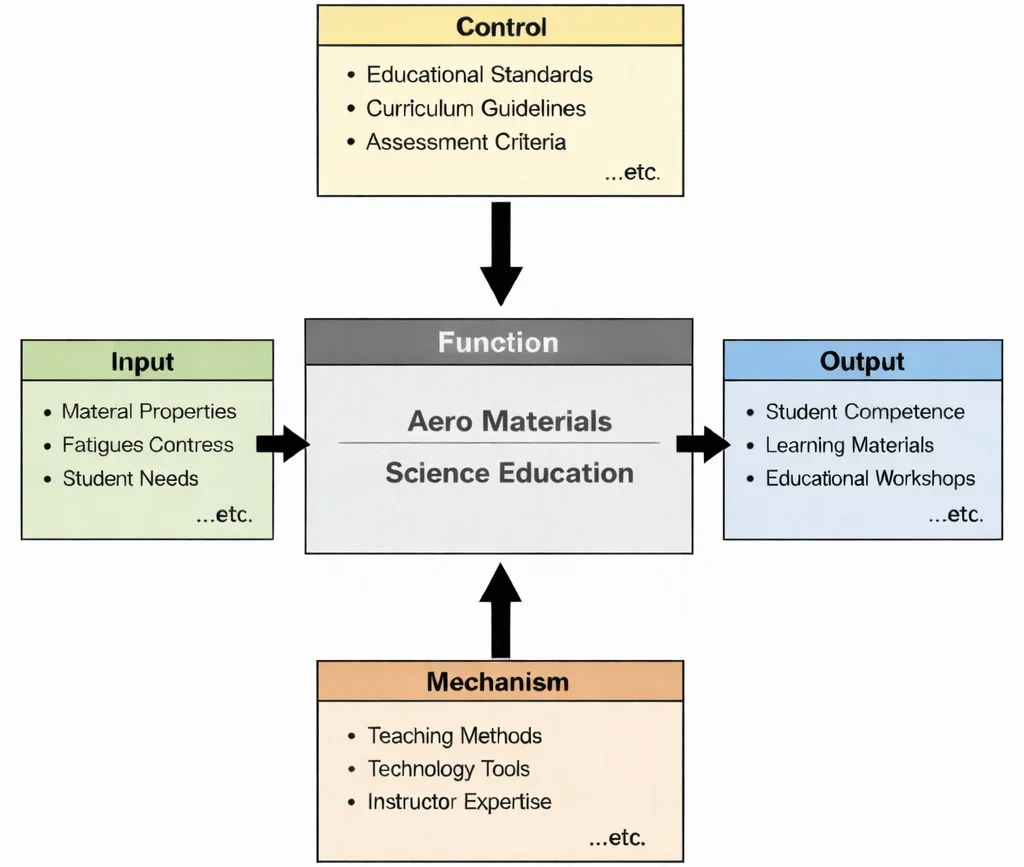
IDEF0 structural decomposition of Aero Materials Science Education: foundational constitutive material inputs channeled via regulatory certification standards, operationalized by multi-scale characterization tools, and producing flight-certified materials selection competence.

Aero Material Science: where multi-scale crystalline microstructure modeling, continuous-fiber composite layups, and environmental barrier coatings converge to dictate the mechanical limits of modern and next-generation flight vehicles.
A vibrant, high-tech illustration showing a jet aircraft displayed on a circular test platform inside a digital “materials lab.” In the foreground are rolled carbon-fiber composite sheets, textured panels, metal discs and tiles, and small lab bottles—suggesting testing, formulation, and characterization. Holographic diagrams and glowing lattice/microstructure motifs float around the scene, linking material properties (strength, weight, heat resistance) to aerospace design and performance.
Material Behaviour Under Extreme Aerospace Conditions
- \(\sigma\): Applied effective tensile stress (\(\text{MPa}\))
- \(A\): Material structure-dependent creep constant (\(\text{s}^{-1}\cdot\text{MPa}^{-n}\))
- \(n\): Stress exponent (typically \(3 \le n \le 8\) for dislocation climb in nickel superalloys)
- \(Q\): Activation energy for self-diffusion (\(\text{J/mol}\))
- \(R\): Universal gas constant (\(8.314 \text{ J}/(\text{mol}\cdot\text{K})\))
- \(T\): Absolute thermodynamic operating temperature (\(\text{K}\))
A second-generation single-crystal nickel-based superalloy turbine blade operates under a centrifugal tensile stress \(\sigma = 280 \text{ MPa}\) at a metal temperature \(T = 950^\circ\text{C}\) (\(1223.15 \text{ K}\)). Determine the steady-state creep strain rate \(\dot{\varepsilon}_{\text{cr}}\) and evaluate the total accumulated creep strain after \(1,500 \text{ hours}\) of continuous full-throttle operation given the following empirical material parameters:
- Creep constant: \(A = 1.25 \times 10^{-16} \text{ s}^{-1}\cdot\text{MPa}^{-4.5}\)
- Stress exponent: \(n = 4.5\)
- Activation energy: \(Q = 310 \text{ kJ/mol} = 310,000 \text{ J/mol}\)
- Universal gas constant: \(R = 8.314 \text{ J}/(\text{mol}\cdot\text{K})\)
Sequential Derivation & Calculation:
Step 1: Calculate the stress dependence term \(\sigma^n\):
$$\sigma^{4.5} = (280)^{4.5} = 1.2599 \times 10^{11} \text{ MPa}^{4.5}$$Step 2: Evaluate the thermal activation Boltzmann factor \(\exp\left(-\frac{Q}{R T}\right)\):
$$\frac{Q}{R T} = \frac{310,000 \text{ J/mol}}{8.314 \text{ J}/(\text{mol}\cdot\text{K}) \times 1223.15 \text{ K}} = \frac{310,000}{10,169.27} = 30.484$$ $$\exp(-30.484) = 5.767 \times 10^{-14}$$Step 3: Compute steady-state creep strain rate \(\dot{\varepsilon}_{\text{cr}}\):
$$\dot{\varepsilon}_{\text{cr}} = (1.25 \times 10^{-16}) \times (1.2599 \times 10^{11}) \times (5.767 \times 10^{-14}) = \mathbf{9.08 \times 10^{-19} \text{ s}^{-1}}$$Step 4: Convert operational duration to seconds and evaluate total accumulated strain:
$$t = 1,500 \text{ hours} \times 3,600 \text{ s/hr} = 5.40 \times 10^6 \text{ s}$$ $$\varepsilon_{\text{total}} = \dot{\varepsilon}_{\text{cr}} \times t = (9.08 \times 10^{-19} \text{ s}^{-1}) \times (5.40 \times 10^6 \text{ s}) = \mathbf{4.90 \times 10^{-12}} \quad (\text{negligible primary diffusion creep})$$Engineering Insight: Single-crystal superalloys eliminate high-angle grain boundary sliding, yielding extraordinarily low creep strain rates under design limit loads. However, if the localized turbine gas temperature surges by just \(50^\circ\text{C}\) to \(1000^\circ\text{C}\) (\(1273.15 \text{ K}\)), the exponential factor escalates the creep rate by nearly an entire order of magnitude, highlighting the necessity of internal film-cooling channels and thermal barrier coatings.
Aerospace & Aeronautical Hub
Connects material performance with mechanical, thermal, and environmental operational demands across the entire engineering curriculum.
Aero Materials Science
Studies how materials resist heat, mechanical stress, fatigue, and environmental degradation in atmospheric and space vehicles.
Aerospace Structures
Applies material mechanical properties to load-bearing airframe frameworks, wing spars, and structural integrity analysis.
Hypersonics & High-Speed Aerodynamics
Introduces extreme thermal environments requiring advanced heat-resistant ceramics and ablative surface materials.
Propulsion Systems
Requires high-temperature superalloys capable of withstanding extreme combustion temperatures and turbine stress.
Aerodynamics
Drives surface friction heating, particle erosion, and dynamic pressure loading onto outer aerodynamic skins.
Flight Mechanics
Relates material fatigue life and structural limits directly to repeated flight maneuver load cycles.
Control Systems & Robotics
Depends on material responsiveness and dimensional precision for actuator performance and embedded sensor placement.
Avionics
Requires specialized housing materials that shield delicate flight electronics from heat, vibration, and cosmic radiation.
Spacecraft Engineering
Utilizes materials specifically engineered for outgassing avoidance in vacuum, atomic oxygen resistance, and thermal cycling.
Satellite Technology
Focuses on ultra-lightweight structural frames and dimensional stability materials for optical satellite payloads.
Key Areas of Focus in Aero Materials Science
Lightweight and Durable Materials
- Composites:
- Definition: Materials made by combining two or more distinct components to create a material with superior properties.
- Examples in Aerospace:
- Carbon Fiber Reinforced Polymers (CFRPs):
- High strength-to-weight ratio, excellent fatigue resistance, and corrosion resistance.
- Used in aircraft fuselage, wings, and tail structures (e.g., Boeing 787 Dreamliner, Airbus A350).
- Glass Fiber Reinforced Polymers (GFRPs):
- Cost-effective alternatives for non-load-bearing structures.
- Applications include interior panels and radomes.
- Aramid Composites (e.g., Kevlar):
- High impact resistance, used in ballistic protection and structural components.
- Carbon Fiber Reinforced Polymers (CFRPs):
- Advantages:
- Weight reduction by up to 20%–50% compared to traditional metals.
- Design flexibility for complex shapes and integration of multifunctional properties.
- Titanium Alloys:
- Properties:
- High strength, lightweight, excellent corrosion resistance, and capability to withstand extreme temperatures.
- Applications:
- Aircraft engine components, landing gears, and fasteners.
- Spacecraft structures exposed to high thermal loads.
- Common Alloys:
- Ti-6Al-4V (used extensively in both aerospace and medical applications).
- Properties:
- Aluminum Alloys:
- Properties:
- Lightweight, corrosion-resistant, and cost-effective.
- Applications:
- Aircraft skins, wings, and fuselage components.
- Modern Developments:
- Aluminum-lithium alloys, offering enhanced stiffness and reduced weight.
- Properties:
- Magnesium Alloys:
- Properties:
- The lightest structural metal, with good machinability and vibration damping.
- Challenges:
- Lower strength compared to aluminum or titanium.
- Flammability concerns in certain environments.
- Applications:
- Non-critical aerospace components like brackets and housings.
- Properties:
Heat-Resistant Materials for Hypersonic Travel
- High-Temperature Ceramics (Ultra-High-Temperature Ceramics - UHTCs):
- Composition: Materials like zirconium diboride (\(\text{ZrB}_2\)) and hafnium carbide (\(\text{HfC}\)).
- Properties: Extreme thermal resistance, hardness, and oxidation resistance.
- Applications: Leading edges of hypersonic vehicles, thermal protection systems, and nose cones.
- Carbon-Carbon Composites (C/C):
- Properties: Excellent thermal stability, low thermal expansion, and high strength at elevated temperatures.
- Applications: Rocket nozzles, spacecraft heat shields, and hypersonic vehicle surfaces.
- Refractory Metals:
- Examples: Tungsten, molybdenum, tantalum, and niobium alloys.
- Properties: High melting points, excellent thermal conductivity, and strength.
- Applications: Critical components in rocket engines and hypersonic propulsion systems.
- Thermal Barrier Coatings (TBCs):
- Function: Thin layers of heat-resistant materials applied to engine components to protect against extreme temperatures.
- Materials: Yttria-stabilized zirconia (YSZ), often used in turbine blades and combustors.
- Metal Matrix Composites (MMCs):
- Composition: Reinforcing materials (like ceramic particles or fibers) embedded in a metallic matrix.
- Applications: Components requiring both high strength and thermal resistance.
Contemporary AI-Era Computational Paradigms in Aero Materials Science
Evaluate the configurational entropy of mixing \(\Delta S_{\text{mix}}\) and Gibbs free energy of mixing \(\Delta G_{\text{mix}}\) for an equimolar quinary refractory high-entropy alloy \(\text{Nb-Mo-Ta-W-V}\) (\(N = 5\), \(c_i = 0.20\)) at an operational leading-edge temperature \(T = 1600^\circ\text{C}\) (\(1873.15 \text{ K}\)). The machine-learning surrogate calculates a collective mixing enthalpy \(\Delta H_{\text{mix}} = -4.20 \text{ kJ/mol}\).
Step 1: Calculate the ideal molar configurational entropy \(\Delta S_{\text{mix}}\):
$$\Delta S_{\text{mix}} = -R \sum_{i=1}^5 c_i \ln c_i = -8.314 \times [5 \times (0.20 \ln 0.20)] = -8.314 \times \ln(0.20)$$ $$\Delta S_{\text{mix}} = -8.314 \times (-1.6094) = \mathbf{13.38 \text{ J}/(\text{mol}\cdot\text{K})}$$Step 2: Evaluate the entropic energy term \(T \Delta S_{\text{mix}}\):
$$T \Delta S_{\text{mix}} = 1873.15 \text{ K} \times 13.38 \text{ J}/(\text{mol}\cdot\text{K}) = 25,062.7 \text{ J/mol} = 25.06 \text{ kJ/mol}$$Step 3: Evaluate total Gibbs free energy of mixing \(\Delta G_{\text{mix}} = \Delta H_{\text{mix}} - T \Delta S_{\text{mix}}\):
$$\Delta G_{\text{mix}} = -4.20 \text{ kJ/mol} - 25.06 \text{ kJ/mol} = \mathbf{-29.26 \text{ kJ/mol}}$$Analysis: The substantially negative \(\Delta G_{\text{mix}}\) (\(-29.26 \text{ kJ/mol}\)) demonstrates that high configurational entropy decisively suppresses intermetallic compound segregation, stabilizing a robust single-phase BCC solid solution capable of withstanding extreme aerothermal flight environments.
Emerging Technologies and Innovations in Aero Materials Science
Additive Manufacturing (3D Printing)
- Applications: Lightweight structural components, engine parts, and heat-resistant materials. Enables the production of complex internal conformal cooling geometries and dramatically reduces the buy-to-fly material wastage ratio from 10:1 down to near 1.2:1.
- Materials: Titanium alloys (Ti-6Al-4V ELI), nickel-based superalloys (Inconel 718, Inconel 625), and high-performance polyether ether ketone (PEEK) polymers.
- Future Impact: Enables autonomous in-situ manufacturing on lunar and Martian surface stations, reducing reliance on Earth-based launch supply logistics.
Self-Healing Materials
- Definition: Materials engineered with autonomous microvascular networks or microencapsulated curing agents that automatically arrest and repair localized fatigue microcracks or delamination without manual intervention.
- Mechanisms: Embedded hollow glass fibers, microcapsules containing dicyclopentadiene (DCPD) with Grubbs' catalyst, or reversible Diels-Alder covalent cross-linking polymer matrices.
- Applications: Eliminating subsurface matrix cracking in pressurized composite passenger cabins and extending the service life of high-aspect-ratio composite wing spars.
Multifunctional Materials
- Definition: Materials that integrate structural mechanical load-bearing capability with embedded functional operations such as electrochemical energy storage, thermal dissipation, electromagnetic interference (EMI) shielding, and active acoustic damping.
- Examples: Structural composite batteries where carbon fiber tows act as battery electrodes and current collectors, alongside embedded piezoelectric PVDF films capable of real-time ultrasonic structural health monitoring.
Sustainable Materials
- Focus: Developing eco-friendly, circular-economy alternatives to traditional aerospace non-recyclable thermosets.
- Examples: High-performance continuous-fiber recyclable thermoplastics (such as PEKK and PPS) that can be remelted, consolidated, and reclaimed, alongside bio-derived phenolic resin substitutes for non-structural cabin interiors.
Applications of Aero Materials Science in Aerospace Engineering
Aircraft Design
Spacecraft and Satellites
Hypersonic Vehicles
Rotorcraft and Drones
Challenges in Aero Materials Development
Cost of Advanced Materials
Developing next-generation aerospace materials involves high research and development costs, particularly when using exotic elements such as titanium, niobium, or silicon carbide. These materials offer exceptional performance but often require complex extraction, purification, and processing techniques that drive up their price. In addition, the production scale for aerospace-grade composites like carbon-fiber-reinforced polymers (CFRPs) is limited by stringent quality control standards, which further inflates cost. For many commercial applications, this makes widespread adoption financially challenging. Governments and manufacturers must balance performance demands with cost-efficiency, especially in cost-sensitive sectors such as commercial aviation and unmanned aerial systems.Manufacturing Complexity
Advanced materials such as ceramic matrix composites (CMCs) and ultra-high-temperature ceramics (UHTCs) require manufacturing environments that operate at extremely high temperatures and pressures. Precision is critical, and defects must be minimized to avoid catastrophic failure during flight. Processes like autoclave curing and vacuum-assisted resin transfer molding are labor-intensive and time-consuming, often making production bottlenecks unavoidable. Furthermore, machining advanced alloys such as Inconel or tungsten alloys demands specialized tooling and cooling techniques due to their hardness and heat resistance. The entire fabrication workflow must be integrated with non-destructive testing (NDT) methods such as ultrasonic inspection, further increasing complexity.Environmental Resistance
Materials used in aerospace applications must perform reliably under extreme environmental conditions. These include rapid thermal cycling, prolonged exposure to UV radiation, atomic oxygen in low Earth orbit, salt-laden marine environments, and impact from micrometeoroids and debris. Achieving this resilience without adding significant weight is a formidable materials science challenge. Engineers must test for corrosion resistance, oxidation stability, and thermal fatigue. Additionally, aerospace vehicles like reusable rockets and high-speed drones require external coatings that retain protective properties after repeated exposure to extreme stress, making material selection both science-intensive and mission-critical.Sustainability
With global attention turning toward sustainable engineering, aerospace companies are being called upon to reduce their environmental footprint. This includes finding ways to recycle or reuse high-performance materials and reduce carbon emissions during production. However, many high-end aerospace materials are not easily recyclable due to their chemical complexity or multi-layered structure (e.g., hybrid composites). Researchers are investigating bio-inspired materials, sustainable polymers, and energy-efficient fabrication techniques, but these innovations remain in early stages. Meeting both performance standards and environmental regulations will continue to challenge the industry in years to come.
Future Directions of Aero Materials Science
Hypersonic Research
- Ongoing advances in hypersonic flight, which involves speeds greater than Mach 5, are driving the demand for materials that can withstand extreme thermal and mechanical stresses.
- Engineers are exploring ultra-high temperature ceramics (UHTCs), refractory metal alloys, and carbon-carbon composites that retain their structural integrity at temperatures exceeding 2000°C.
- Hypersonic vehicles face unique challenges such as ablation, shockwave heating, and surface erosion, making material selection critical for both structural and thermal performance.
- Research is also being conducted on aerothermal protection systems and aerodynamic surfaces that adapt dynamically to hypersonic flow environments.
- Agencies like DARPA and national laboratories are funding experimental testbeds and simulation tools to accelerate development in this field.
Recyclable Aerospace Materials
- As environmental sustainability becomes a key concern, aerospace manufacturers are investing in recyclable and reusable materials that reduce lifecycle waste.
- Efforts include the design of thermoplastic composites that can be remelted and reshaped, as well as metal alloys that retain mechanical properties after reprocessing.
- Closed-loop manufacturing models are being adopted to minimize material loss during production and enhance end-of-life material recovery.
- Recyclable aero materials are also being tested for commercial aviation to meet evolving regulations on emissions and sustainability benchmarks.
- Organizations like NASA Sustainability Program are promoting green engineering practices in aerospace development.
Integration with Smart Systems
- Future aerospace materials will increasingly serve not just structural functions, but also act as embedded sensory networks that provide real-time feedback on conditions like stress, fatigue, vibration, and thermal flux.
- Smart materials incorporate piezoelectric fibers, optical sensors, or conductive polymers capable of transmitting data to onboard health-monitoring systems.
- This integration enables predictive maintenance, reduces downtime, and enhances safety through early fault detection.
- Applications extend to aircraft wings, fuselage panels, and engine casings where real-time diagnostics are critical for performance and reliability.
- Such systems are being explored through interdisciplinary fields such as structural health monitoring (SHM) and cyber-physical systems (CPS).
Advanced Computational Tools
- The integration of artificial intelligence (AI) and machine learning (ML) is transforming how new aerospace materials are designed, simulated, and validated.
- Computational materials science now employs multiscale modeling, high-throughput simulations, and neural networks to predict material behavior under complex loading conditions.
- These tools drastically shorten the time from material discovery to deployment by automating the optimization of properties such as strength-to-weight ratio, corrosion resistance, and thermal conductivity.
- AI-assisted materials design also enables virtual screening of thousands of compositions before physical prototyping, reducing cost and experimentation cycles.
- As aerospace systems grow in complexity, the synergy between data science and materials engineering will be crucial for the next generation of aircraft, spacecraft, and propulsion systems.
Engineering Trade-offs
| Material Selection Trade-off | Primary Operational Benefit | Systemic Penalty / Risk Factor | Quantitative Design Metric |
|---|---|---|---|
| CFRP Composites vs. Aluminum Alloys | 20%–40% mass reduction; immunity to galvanic surface corrosion; tailored directional stiffness along load paths. | Subsurface Barely Visible Impact Damage (BVID); low through-thickness interlaminar shear strength; high raw tooling cost. | Specific Tensile Strength (\(\sigma_t / \rho\)): CFRP \(\approx 1100 \text{ kN}\cdot\text{m/kg}\) vs. Al 7075-T6 \(\approx 200 \text{ kN}\cdot\text{m/kg}\). |
| Ceramic Matrix Composites (CMCs) vs. Nickel Superalloys | Continuous operation at \(1200^\circ\text{C}\)–\(1400^\circ\text{C}\) without active cooling; one-third the density of superalloys. | High susceptibility to moisture/steam oxidation recession requiring Environmental Barrier Coatings (EBCs); low fracture toughness. | Operating Temperature Capability: SiC-SiC CMCs (\(\le 1400^\circ\text{C}\)) vs. CMSX-4 Single Crystal (\(\le 1150^\circ\text{C}\)). |
| Titanium Ti-6Al-4V vs. Stainless Steel 15-5 PH | Excellent cryogenic-to-moderate temperature strength-to-weight; exceptional resistance to chloride stress corrosion. | High raw material cost; severe galling tendency; rapid tool wear during precision subtractive machining. | Density (\(\rho\)): Ti-6Al-4V (\(4430 \text{ kg/m}^3\)) vs. 15-5 PH Steel (\(7800 \text{ kg/m}^3\)). |
| High-Stiffness Thermosets vs. Recyclable Thermoplastics | Thermosets (epoxies) feature established autoclave certification databases and high dimensional creep resistance. | Unrecyclable cross-linked polymer networks; long cycle times; hazardous cold-storage requirements for prepregs. | Autoclave Consolidation Cycle: Epoxy (6–8 hours) vs. Thermoplastic In-Situ Consolidation (sub-minute stamping). |
Consider a wide-body commercial transport aircraft with an Operating Empty Weight (OEW) of \(125,000 \text{ kg}\). Transitioning the wing and fuselage primary structure from aluminum 7075-T6 to carbon-fiber composite (CFRP) eliminates \(18,500 \text{ kg}\) of dead structural weight. By the Breguet Range Equation, where range \(R = \frac{V}{c_t} \frac{L}{D} \ln\left( \frac{W_{\text{initial}}}{W_{\text{final}}} \right)\), reducing empty weight at constant takeoff mass (\(W_{\text{initial}} = 240,000 \text{ kg}\)) enables an extra \(18,500 \text{ kg}\) of kerosene fuel or revenue-generating cargo payload, directly increasing maximum non-stop flight range by approximately \(1,420 \text{ km}\) while lowering lifecycle fleet fuel consumption by 14%.
Why Study Aero Materials Science
Understanding Aerospace Material Properties
Selection and Testing of Materials
Lightweight and High-Performance Design
Failure Analysis and Structural Integrity
Applications in Next-Gen Technologies
Interactive Material Stress-Strain & Fatigue Life Curve Simulator
Interactive runtime environment: https://prep4uni.online/stem/physical-technologies/aerospace-and-aeronautical-engineering/aero-materials-science/
Interactive Concept Review
Why are Carbon Fiber Reinforced Polymers (CFRPs) preferred over aluminum in primary airframes?
How do Ultra-High-Temperature Ceramics (UHTCs) survive hypersonic aerothermal heating?
What structural failure mechanism does fatigue testing prevent in aerospace engineering?
Aero Material Science - Conclusion
Frequently Asked Questions on Aero Materials Science
These FAQs help you see how material choices influence the safety, performance, and sustainability of modern aircraft and spacecraft.
What is aero materials science and why does it matter for aircraft design?
Aero materials science is the study of how materials behave under the extreme conditions found in flight and space, and how those materials can be tailored for use in structures, engines, and protective systems. It matters because every design decision about weight, strength, stiffness, temperature limits, and durability depends on material choice. Good material selection allows engineers to reduce mass, improve performance, and maintain safety margins over many years of service.
Why are strength-to-weight and stiffness-to-weight ratios so important in aerospace?
Aircraft and spacecraft must be strong enough to handle loads but light enough to fly efficiently. A high strength-to-weight ratio means a material can carry large loads with relatively little mass; a high stiffness-to-weight ratio helps the structure resist bending and vibration. Together, these ratios directly influence fuel burn, payload capacity, and overall performance, which is why lightweight alloys and composites are so widely used in wings, fuselages, and engine components.
How are composite materials used in modern airframes?
Composite materials, such as carbon fibre reinforced polymers, are used in wings, fuselage sections, tail surfaces, and control surfaces. They allow engineers to place fibres in directions that follow the main load paths, creating structures that are both strong and light. Composites also offer excellent fatigue and corrosion resistance, which reduces inspection and maintenance demands over the life of the aircraft.
What makes a material suitable for high-temperature regions like engines or hypersonic vehicles?
Materials for high-temperature regions must retain their strength and stiffness at elevated temperatures, resist oxidation and thermal shock, and tolerate rapid temperature cycling. Nickel-based superalloys, ceramic coatings, and emerging ultra-high-temperature ceramics are examples of materials engineered for these conditions. Without them, turbine blades, nozzles, and leading edges would soften or fail long before the mission is complete.
How do engineers assess fatigue and damage tolerance in aerospace materials?
Engineers perform fatigue tests by repeatedly loading material samples or structural elements to simulate the stress cycles experienced during take-off, cruise, landing, and turbulence. They also study crack initiation and growth to quantify damage tolerance. These data feed into design rules, inspection intervals, and life-limit calculations so that structures can operate safely even when small defects or cracks are present.
Why is corrosion resistance such a big issue for aircraft structures?
Aircraft operate in environments that include moisture, salts, temperature changes, and pollutants, all of which can attack metals over time. Corrosion can thin structural members, weaken joints, and damage fasteners if it is not controlled. Materials with good corrosion resistance, combined with protective coatings and careful drainage and sealing, help preserve structural integrity and reduce maintenance cost over decades of service.
How does aero materials science support more sustainable aviation?
Aero materials science supports sustainability by enabling lighter airframes and more efficient engines, which directly reduce fuel burn and emissions. Researchers also explore recyclable composites, bio-based resins, and manufacturing methods that use less energy and generate less waste. Together, these innovations help aviation move towards lower environmental impact without compromising safety or performance.
What background knowledge is helpful for students interested in aero materials science?
Students benefit from a solid grounding in physics, chemistry, and mathematics, along with introductory courses in materials science and mechanics of materials. As they progress, topics such as crystallography, fracture mechanics, composites, and high-temperature materials become important. Laboratory work, simple material testing, and small design projects all help to connect theory with practical aerospace applications.
End-of-Page Comprehensive Practice Module
Foundational Concept Review
- What is the primary focus of aero materials science in aerospace engineering? Answer: The primary focus of aero materials science is to understand, develop, and select materials that can survive the demanding loads, temperatures, and environments encountered by aircraft and spacecraft. It seeks combinations of properties such as high strength, adequate stiffness, low density, good fatigue performance, and resistance to corrosion and temperature extremes.
- Why are lightweight materials so important in aerospace applications? Answer: Lightweight materials are important because every kilogram of structural weight reduces the payload that can be carried or increases the fuel required to complete a mission. Using materials with low density but high strength and stiffness leads to lower operating costs, longer range, and reduced environmental impact.
- What are composites and why are they widely used in aerospace structures? Answer: Composites are materials made by combining at least two distinct constituents—typically strong, stiff fibres embedded in a lighter matrix—to produce a material with tailored properties. They offer outstanding strength-to-weight and stiffness-to-weight ratios, excellent fatigue behavior, and corrosion resistance.
- Can you give an example of a composite material used in modern aircraft and explain why it is chosen? Answer: Carbon fiber reinforced polymer (CFRP) is chosen for primary structures like wing skins and fuselage barrels because carbon fibers provide very high stiffness and strength at low weight, enabling improved fuel efficiency and lower emissions.
- What material properties are essential for components exposed to hypersonic or very high-speed flight? Answer: Essential properties include high-temperature strength, resistance to creep and thermal fatigue, low thermal expansion to limit distortion, and resistance to oxidation and thermal shock.
- How does corrosion resistance benefit aerospace materials and structures? Answer: Corrosion resistance limits chemical reactions that thin structural members, damage fasteners, and weaken joints. This extends inspection intervals, improves safety, and lowers lifetime maintenance costs.
- What is fatigue endurance and why is it critical for aerospace components? Answer: Fatigue endurance describes a material's ability to withstand repeated stress cycles without cracking or failing. It is critical because aircraft experience thousands of load cycles during flight, and fatigue endurance ensures defects do not rapidly grow into dangerous cracks.
- Why is thermal resistance an essential property for many aerospace materials? Answer: Aerospace components experience rapid temperature changes near engines or during re-entry. Thermal resistance ensures structures do not soften, creep, or oxidise excessively, maintaining structural integrity.
Analytical & Systems Engineering Challenges
- How might the development of new composite materials impact the future design of spacecraft? Answer: The development of new composite materials could lead to lighter and more durable spacecraft structures, enabling longer missions, increased payload capacities, and reduced launch costs.
- In what ways can nanotechnology influence advancements in aero materials? Answer: Nanotechnology can enhance aerospace materials by improving properties such as strength, thermal conductivity, and resistance to wear and corrosion, leading to more efficient and longer-lasting components.
- How do environmental factors in space, such as radiation and microgravity, affect material selection for spacecraft? Answer: Materials must be selected to withstand radiation exposure, which can degrade material properties, and to function effectively in microgravity, where traditional material behaviors may change.
- What are the challenges in recycling composite materials used in aerospace applications? Answer: Recycling composite materials is challenging due to the difficulty in separating the constituent components without degrading their properties, leading to limited recycling methods and higher costs.
- How does the choice of materials influence the maintenance and lifecycle costs of an aircraft? Answer: Choosing materials with higher durability and corrosion resistance can reduce maintenance frequency and costs, thereby extending the aircraft's service life and lowering overall lifecycle expenses.
- In what ways can additive manufacturing (3D printing) revolutionize the production of aerospace components? Answer: Additive manufacturing allows for the creation of complex, lightweight structures that are not feasible with traditional manufacturing methods, enabling rapid prototyping and customization of aerospace components.
- How do advancements in aero materials science contribute to the development of reusable launch vehicles? Answer: Advancements in materials science provide high-performance materials necessary to withstand the thermal and mechanical stresses of multiple launch and re-entry cycles, making reusable launch vehicles feasible and cost-effective.
Quantitative Calculations & Applied Analysis
- Calculate the Young's Modulus (\(E\)) in GPa of a composite test specimen that experiences an axial stress \(\sigma = 300 \text{ MPa}\) under an elastic strain \(\varepsilon = 0.002\).
Answer:
Step 1: Apply Hooke's Law: \(E = \frac{\sigma}{\varepsilon}\)
Step 2: Substitute values: \(E = \frac{300 \text{ MPa}}{0.002} = 150,000 \text{ MPa}\)
Step 3: Convert to GPa: \(E = \frac{150,000 \text{ MPa}}{1000} = \mathbf{150 \text{ GPa}}\) - A structural titanium tie-rod (Ti-6Al-4V) with cross-sectional area \(A = 0.0002 \text{ m}^2\) is subjected to a tensile load \(F = 120 \text{ kN}\). Given yield strength \(\sigma_y = 880 \text{ MPa}\), determine if the rod will yield and calculate its factor of safety (\(\text{FS}\)).
Answer:
Step 1: Calculate operating stress: \(\sigma = \frac{F}{A} = \frac{120,000 \text{ N}}{0.0002 \text{ m}^2} = 600,000,000 \text{ Pa} = 600 \text{ MPa}\)
Step 2: Compare with yield strength: \(600 \text{ MPa} < 880 \text{ MPa}\) (No plastic yielding occurs)
Step 3: Calculate Factor of Safety: \(\text{FS} = \frac{\sigma_y}{\sigma} = \frac{880 \text{ MPa}}{600 \text{ MPa}} \approx \mathbf{1.47}\) - A carbon-fiber wing spar weighs \(120 \text{ kg}\). If replaced by an aluminum alloy spar weighing \(200 \text{ kg}\), calculate the percentage weight reduction achieved by using the composite structure.
Answer:
Step 1: Calculate weight difference: \(\Delta W = 200 \text{ kg} - 120 \text{ kg} = 80 \text{ kg}\) reduction
Step 2: Percentage reduction: \(\frac{80 \text{ kg}}{200 \text{ kg}} \times 100\% = \mathbf{40.0\%}\) - Using Basquin's S-N equation for fatigue life estimation \(N_{\text{f}} = \left( \frac{A}{\sigma} \right)^{1/b}\), calculate the estimated fatigue lifespan in cycles for an alloy component subjected to a cyclic stress \(\sigma = 400 \text{ MPa}\), where material parameters are \(A = 1000 \text{ MPa}\) and \(b = 0.10\).
Answer:
Step 1: Calculate ratio: \(\frac{A}{\sigma} = \frac{1000 \text{ MPa}}{400 \text{ MPa}} = 2.5\)
Step 2: Calculate exponent: \(\frac{1}{b} = \frac{1}{0.10} = 10\)
Step 3: Solve for \(N_{\text{f}}\): \(N_{\text{f}} = (2.5)^{10} \approx \mathbf{9,536.74 \text{ cycles}}\) - A ceramic heat shield tile experiences a thermal gradient \(\Delta T = 800^\circ\text{C}\) across a thickness \(L = 0.02 \text{ m}\). Given a thermal conductivity \(k = 1.5 \text{ W}/(\text{m}\cdot\text{K})\), calculate the conductive heat flux (\(q\)) per unit area.
Answer:
Step 1: Fourier's Law of Heat Conduction: \(q = k \times \frac{\Delta T}{L}\)
Step 2: Substitute values: \(q = 1.5 \times \left( \frac{800}{0.02} \right) = 1.5 \times 40,000 = \mathbf{60,000 \text{ W/m}^2} \quad (60 \text{ kW/m}^2)\) - Calculate the density (\(\rho\)) in \(\text{kg/m}^3\) of an aluminum-lithium alloy block having a mass \(m = 5.1 \text{ kg}\) and volume \(V = 0.002 \text{ m}^3\).
Answer:
Step 1: Density formula: \(\rho = \frac{m}{V}\)
Step 2: Substitute values: \(\rho = \frac{5.1 \text{ kg}}{0.002 \text{ m}^3} = \mathbf{2,550 \text{ kg/m}^3}\) - An aircraft pressure vessel made of CFRP is subjected to an internal pressure cycle creating a peak hoop stress \(\sigma_{\max} = 450 \text{ MPa}\) and minimum hoop stress \(\sigma_{\min} = 50 \text{ MPa}\). Calculate the mean stress (\(\sigma_{\text{m}}\)) and stress amplitude (\(\sigma_{\text{a}}\)).
Answer:
Step 1: Mean Stress: \(\sigma_{\text{m}} = \frac{\sigma_{\max} + \sigma_{\min}}{2} = \frac{450 + 50}{2} = \mathbf{250 \text{ MPa}}\)
Step 2: Stress Amplitude: \(\sigma_{\text{a}} = \frac{\sigma_{\max} - \sigma_{\min}}{2} = \frac{450 - 50}{2} = \mathbf{200 \text{ MPa}}\)