
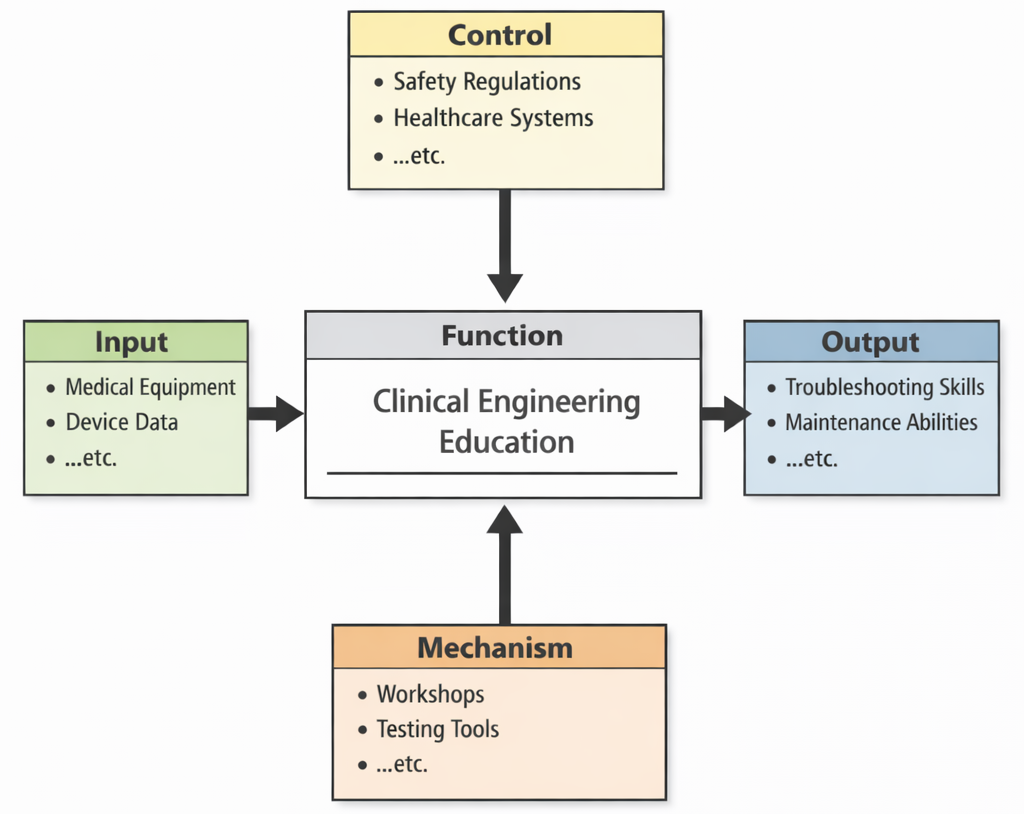
IDEF0 functional decomposition of Clinical Engineering Education: hospital medical device telemetry and maintenance logs transformed under regulatory and system controls into verified healthcare technology management competencies.

Clinical engineering keeps hospital technology safe, reliable, and ready for patient care—from imaging systems to bedside monitoring.
Biomedical Engineering – Knowledge Map & Cluster Navigation
Clinical Engineering (Current Node)
Ensures that medical technologies are deployed, maintained, and operated safely within complex healthcare environments.
Biomedical Signal Processing
Supports bedside monitoring systems that continuously interpret patient data for timely clinical decisions and alarm management.
Medical Imaging
Requires ongoing calibration, QA checks, and operational control of imaging equipment used in diagnosis and treatment planning.
Pharmaceutical Engineering
Interfaces with automated drug delivery systems, smart infusion pumps, and clinical drug delivery protocols.
Cardiovascular Engineering
Involves life-support and circulatory monitoring devices that demand strict reliability, preventative maintenance, and rapid response.
Rehabilitation Engineering
Includes assistive technologies and mobility aids that must be customized, safety-evaluated, and supported in clinical care.
Tissue Engineering & Regenerative Medicine
Introduces advanced cellular constructs requiring sterile clinical processing, bioreactor monitoring, and regulatory compliance.
Neural Engineering
Brings neurostimulation devices into clinical settings where precise signal calibration and patient safety monitoring are essential.
Biomaterials
Determines how implanted and device components behave under long-term clinical sterilization and physiological conditions.
Biomechanics
Provides the physical principles for evaluating patient load distribution and physical interactions with hospital hardware.
Bioinformatics
Contributes to integrated decision-support systems and electronic health record interfaces for aggregated device telemetry.
Biomedical Engineering (Hub Overview)
Connects hospital technology operational management to the broader engineering discipline driving medical advancement.
Core Functions of Clinical Engineering
1. Medical Equipment Management
- Procurement and Evaluation:
- Clinical engineers conduct needs assessments by collaborating with physicians, nurses, and administrators to identify gaps in medical infrastructure and equipment.
- They evaluate devices based on performance, total cost of ownership, lifecycle support, interoperability, and clinical impact.
- Structured procurement protocols are established to ensure transparency, vendor accountability, and adherence to institutional budgets.
- Health technology assessments (HTAs) involve analyzing safety data, clinical trial results, and cost-benefit models to inform evidence-based purchasing decisions.
- Installation and Commissioning:
- Engineers oversee the safe delivery and physical setup of equipment, ensuring structural compatibility, power supply, and environmental requirements (e.g., MRI shielding).
- They perform calibration checks, baseline performance measurements, and accuracy verifications in line with manufacturers’ specifications.
- Commissioning involves generating detailed test reports and functional validation to meet regulatory standards and internal quality benchmarks.
- Maintenance and Repairs:
- Routine inspections and preventive maintenance plans are scheduled based on risk stratification, usage frequency, and device criticality.
- Performance metrics such as downtime, mean time between failure (MTBF), and cost per user session are tracked and analyzed.
- Prompt corrective action is taken for malfunctioning devices, including parts replacement, sensor recalibration, or software updates.
- A centralized asset management system tracks maintenance history, service logs, warranty coverage, and replacement timelines.
2. Equipment Safety and Compliance
- Regulatory Compliance:
- Clinical engineers ensure devices are CE-marked, FDA-cleared, or registered under other recognized authorities.
- They maintain up-to-date documentation for ISO 13485, IEC 60601, and local regulatory mandates.
- Vigilance programs are implemented to report adverse events and track field safety notices and recalls.
- Risk Management:
- Engineers use failure mode and effects analysis (FMEA), root cause analysis (RCA), and risk registers to manage hazard control.
- They lead periodic safety audits, including electrical safety tests and software cybersecurity checks.
- Recall management includes quarantining unsafe equipment, coordinating with vendors, and communicating corrective instructions to clinical teams.
3. Technology Integration and Clinical Support
- System Integration:
- Clinical engineers integrate medical devices (e.g., patient monitors, infusion pumps, lab analyzers) with EHR and HIS systems via HL7, FHIR, or DICOM protocols.
- They manage middleware platforms and interface engines to ensure seamless data exchange and interoperability.
- Secure network architecture and encrypted data workflows are designed to prevent unauthorized access and comply with HIPAA/GDPR.
- Clinical Collaboration:
- Engineers support clinical procedures involving complex equipment (e.g., MRIs, CT scanners, robotic surgical systems).
- They attend rounds, offer on-call technical assistance, and optimize device utilization workflows.
- Engineers participate in multidisciplinary practice committees, offering input on device selection and technical feasibility assessments.
4. Training and Education
- Staff Training:
- Clinical engineers design structured training programs for nurses, technicians, and physicians on safe device handling and troubleshooting.
- They facilitate practical training sessions, competency assessments, and continuing education modules.
- Simulated scenarios are used to prepare clinical staff for emergency protocols, such as malfunction of ventilators or defibrillators.
- User Manuals and Protocols:
- Engineers develop SOPs, quick-reference cards, and vendor support guides tailored to institutional protocols.
- Visual aids such as infographics and embedded tutorial videos improve user comprehension and adoption.
- Regular revision of documentation ensures compliance with updated device firmware and institutional policies.
5. Research and Innovation
- Technology Assessment:
- Engineers monitor emerging technologies—augmented reality surgical systems, AI diagnostics, wearable monitors—and evaluate clinical readiness.
- They conduct pilot studies to measure performance, cost implications, and patient outcomes.
- Findings inform evidence-based adoption strategies and ROI analysis for institutional investment.
- Custom Device Development:
- Collaborating with biomedical engineering teams, clinical engineers prototype bespoke solutions—such as safety locks for infusion pumps or custom sensor mounts.
- They coordinate with regulatory bodies to validate changes in safety profiles, usability, and traceability.
- Rapid prototyping—using 3D printing, microcontrollers, or embedded software—enables agile development and real-world testing.
6. Strategic Management and Policy
7. Emergency Preparedness and Resilience
8. Data Analytics and Performance Optimization
Contemporary AI-Era Computational Paradigms in Clinical Engineering
A hospital clinical engineering department manages a fleet of 200 mechanical ventilators operating under continuous heavy clinical demand. Over a 1-year audit period (8,760 hours), the fleet logs a cumulative operating time of \(1,000,000 \text{ machine-hours}\) with 25 total unscheduled mechanical breakdowns. Calculate the Mean Time Between Failures (\(\text{MTBF}\)), the hourly failure rate (\(\lambda\)), and evaluate the reliability probability (\(R(t)\)) of an individual ventilator operating continuously across a 720-hour intensive care mission without failure using the exponential reliability model:
$$R(t) = \exp(-\lambda t) = \exp\left(-\frac{t}{\text{MTBF}}\right)$$Step 1: Calculate Mean Time Between Failures (\(\text{MTBF}\)):
$$\text{MTBF} = \frac{\text{Total Operating Hours}}{\text{Total Failures}} = \frac{1,000,000 \text{ hrs}}{25 \text{ failures}} = \mathbf{40,000 \text{ hours}}$$Step 2: Calculate hourly failure rate (\(\lambda\)):
$$\lambda = \frac{1}{\text{MTBF}} = \frac{1}{40,000 \text{ hrs}} = \mathbf{2.50 \times 10^{-5} \text{ failures/hour}}$$Step 3: Evaluate operational reliability \(R(720 \text{ hrs})\) over a 30-day continuous ICU deployment:
$$R(720) = \exp(-2.50 \times 10^{-5} \times 720) = \exp(-0.0180) = \mathbf{0.98216} \quad (\mathbf{98.22\%})$$Clinical Safety Insight: An operational reliability of \(98.22\%\) over 720 hours confirms high fleet dependability, but across a 200-unit hospital fleet, statistical expectation dictates that approximately 3.5 ventilators will experience component anomalies during month-long continuous support, necessitating strict preventive maintenance checks.
Engineering Trade-offs in Clinical Engineering
| Clinical Engineering Trade-off | Primary Operational Benefit | Systemic Penalty / Risk | Quantitative Design Metric |
|---|---|---|---|
| OEM Comprehensive Service Contracts vs. In-House Biomed Maintenance | Guarantees OEM certified replacement parts, priority dispatch, and liability transfer for complex imaging modalities. | Exorbitant annual service contract fees; slower response times for minor routine adjustments. | Annual Service Cost: OEM Contract (\(8\text{--}12\%\) of capital cost); In-House (\(\approx 3\%\)). |
| Rigorous IEC 60601 Electrical Isolation vs. Standard COTS Power | Protects vulnerable cardiac patients from lethal microshocks (\(I_{\text{leakage}} < 10 \text{ \mu A}\)). | Significantly increases medical device power supply cost, isolation transformer weight, and footprint. | Patient Leakage Current Limit: CF Applied Part (\(\le 10 \text{ \mu A}\) under single fault). |
| Connected IoMT Smart Medical Devices vs. Air-Gapped Legacy Hardware | Enables real-time EHR telemetry integration, automated asset tracking, and remote predictive maintenance. | Exposes hospital networks to ransomware attacks, patient data breaches, and medical device hijacking. | Cybersecurity Vulnerability Patch Latency: IoMT (\(>90 \text{ days}\) average vendor patch window). |
| Multi-Vendor Interoperability vs. Single-Vendor Proprietary Ecosystem | Optimizes initial procurement pricing by selecting best-in-class devices from competing manufacturers. | Complex middleware integration, custom HL7/FHIR translation errors, and finger-pointing during service failures. | Integration Overhead: Middleware Translation Latency (\(\approx 200\text{--}500 \text{ ms}\)). |
Consider a hospital asset portfolio of high-end diagnostic imaging equipment valued at \(C = \$15,000,000\). An Original Equipment Manufacturer (OEM) comprehensive service contract costs \(10\%\) of asset value annually, totaling \(\$1,500,000/\text{year}\). Transitioning to an in-house clinical engineering maintenance model staffed by certified biomedical engineers incurs annual staffing and spare parts costs of \(\$600,000\), plus an annual risk contingency reserve of \(\$150,000\) for specialized OEM emergency dispatches, totaling \(\$750,000/\text{year}\).
$$\text{Net Annual Savings} = \text{OEM Cost} - \text{In-House Cost} = \$1,500,000 - \$750,000 = \mathbf{\$750,000 \text{ saved per year}}$$Risk Management Caveat: While in-house management yields a 50% cost reduction, clinical engineering leadership must verify that staff hold specific OEM training certifications for high-complexity modalities (e.g., 3T MRI quench safety and linear accelerator calibration) to prevent catastrophic voiding of regulatory warranties.
Interactive Tool: Medical Device Risk & Reliability Simulator
Hospital Medical Equipment Reliability Simulator
Adjust equipment risk parameters below to evaluate Mean Time Between Failures (MTBF), preventive maintenance compliance, and life-cycle failure probability governing hospital technology asset fleets.
Interactive runtime environment: https://prep4uni.online/stem/physical-technologies/biomedical-engineering/clinical-engineering/
Key Areas of Clinical Engineering
Medical Equipment Management
- Procurement and Evaluation:
- Clinical engineers conduct needs assessments by collaborating with physicians, nurses, and administrators to identify gaps in medical infrastructure and equipment.
- They evaluate devices based on performance, total cost of ownership, lifecycle support, interoperability, and clinical impact.
- Structured procurement protocols are established to ensure transparency, vendor accountability, and adherence to institutional budgets.
- Health technology assessments (HTAs) involve analyzing safety data, clinical trial results, and cost-benefit models to inform evidence-based purchasing decisions.
- Installation and Commissioning:
- Engineers oversee the safe delivery and physical setup of equipment, ensuring structural compatibility, power supply, and environmental requirements (e.g., MRI shielding).
- They perform calibration checks, baseline performance measurements, and accuracy verifications in line with manufacturers’ specifications.
- Commissioning involves generating detailed test reports and functional validation to meet regulatory standards and internal quality benchmarks.
- Maintenance and Repairs:
- Routine inspections and preventive maintenance plans are scheduled based on risk stratification, usage frequency, and device criticality.
- Performance metrics such as downtime, mean time between failure (MTBF), and cost per user session are tracked and analyzed.
- Prompt corrective action is taken for malfunctioning devices, including parts replacement, sensor recalibration, or software updates.
- A centralized asset management system tracks maintenance history, service logs, warranty coverage, and replacement timelines.
Hospital Infrastructure and Facilities
- Critical Care Systems: Managing systems such as medical gas supply, isolation pressure, ventilators, and life-support devices.
- Operating Rooms and Intensive Care Units: Ensuring constant readiness and functionality of surgical robotics, anesthesia units, and critical care equipment.
- Diagnostic Imaging Centers: Overseeing the operation, shielding, and radiation safety maintenance of MRI, CT scanners, and X-ray systems.
Patient Monitoring and Diagnostic Devices
- Examples: ECG telemetry monitors, smart infusion pumps, hemodialysis machines, and anesthesia workstations.
- Responsibilities: Ensuring continuous operation, alarm safety configuration, and calibration in ICUs and emergency departments.
Health Information Technology Integration
- Clinical Information Systems: Integrating devices with EHR systems via HL7 and FHIR protocols for real-time data access.
- Remote Monitoring Solutions: Managing telemedicine platforms, home monitoring hardware, and wearable telemetry networks.
Emergency and Disaster Preparedness
- Role in Crisis Management: Preparing contingency plans for equipment functionality during power outages, cyberattacks, or pandemics.
- Critical Equipment Readiness: Maintaining generator backup connections, mobile diagnostic arrays, and emergency ventilator reserves.
Applications of Clinical Engineering
Medical Imaging Systems
- Management of Diagnostic Devices: CT scanners, MRI machines, ultrasound systems, and digital X-ray suites.
- Responsibilities: Regular calibration, image quality assurance checks, and radiation dose monitoring.
Life Support Systems
- Critical Equipment: Mechanical ventilators, defibrillators, anesthesia delivery systems, and ECMO units.
- Responsibilities: Ensuring high-reliability operation with zero unscheduled downtime in critical care environments.
Surgical Equipment
- Operating Room Devices: Surgical robots, electrosurgical units, laparoscopic towers, and sterilization autoclaves.
- Responsibilities: Managing precision calibration, electrical safety verification, and rapid OR technical support.
Patient Monitoring Systems
- Devices Managed: Multi-parameter bedside monitors, continuous pulse oximeters, invasive blood pressure transducers.
- Responsibilities: Continuous telemetry network maintenance and alarm fatigue reduction protocols.
Laboratory and Diagnostic Equipment
- Examples: Automated blood analyzers, PCR thermocyclers, and point-of-care diagnostic tools.
- Responsibilities: Routine performance checks, assay calibration verification, and biosafety cabinet testing.
Emerging Technologies in Clinical Engineering
Artificial Intelligence (AI) and Machine Learning
- Predictive maintenance algorithms that analyze device sensor logs to anticipate component failures before clinical disruption occurs.
- AI-driven diagnostic integration within imaging modalities to assist radiologists and streamline technical workflows.
Internet of Medical Things (IoMT)
- Networked medical devices enabling real-time asset tracking, automated location mapping, and remote parameter configuration.
- Continuous physiological streaming from home monitoring systems directly into hospital EHR dashboards.
Robotics and Automation
- Assisting in the installation, positioning, and maintenance of robotic surgical systems and automated pharmacy dispensing vaults.
- Automated UV-C disinfection robots and robotic material transport systems across hospital floors.
3D Printing in Medical Devices
- In-house fabrication of custom replacement components, ergonomic sensor mounts, surgical planning models, and patient-specific guides.
- On-demand rapid prototyping of obsolete plastic housing parts to extend device service lifespan.
Cybersecurity in Medical Devices
- Implementing strict medical device security profiles, managing patch deployments, and isolating vulnerable legacy firmware on segregated VLANs.
- Compliance with FDA post-market cybersecurity management guidelines and continuous threat monitoring.
Challenges in Clinical Engineering
- Regulatory Compliance: Navigating evolving regulatory frameworks (e.g., FDA, ISO 13485, IEC 60601) and ensuring every device maintains audited safety documentation throughout its operational life.
- Technology Integration: Bridging legacy medical equipment with modern cloud-based hospital information systems and ensuring interoperability across disparate vendor protocols.
- Budget Constraints: Balancing high capital acquisition costs for cutting-edge medical technologies with strict institutional operational budget limitations.
- Rapid Technological Advancements: Keeping clinical engineering teams continuously trained on emerging AI, IoT, and complex robotic platforms.
- Data Security & Cyber Threats: Safeguarding interconnected medical devices against ransomware attacks and unauthorized access without compromising clinical usability.
Future Trends in Clinical Engineering
- Smart Hospitals: Full integration of IoMT sensor networks, automated patient tracking, and smart room environmental controls driven by real-time clinical engineering management.
- Telemedicine Expansion: Managing clinical engineering infrastructure beyond hospital walls to support home hospital programs and remote diagnostic kits.
- AI-Driven Predictive Asset Management: Shift from scheduled preventive maintenance to real-time condition-based maintenance powered by embedded machine learning sensors.
- Sustainable Healthcare Technology: Adoption of green procurement principles, energy-efficient imaging systems, and eco-friendly medical plastic recycling protocols.
- Advanced Surgical Robotics: Expansion of autonomous and semi-autonomous surgical robotic platforms requiring high-precision field calibration and safety validation.
Why Study Clinical Engineering
Frequently Asked Questions
These FAQs connect clinical engineering principles to hospital operations, patient safety, and medical device management.
Do clinical engineers work directly with patients?
Clinical engineers rarely provide hands-on patient care, but their work directly impacts patient safety. They work behind the scenes to ensure that monitors, ventilators, imaging systems, and infusion pumps are safe, reliable, and available when clinicians need them.
How is a clinical engineer different from a biomedical equipment technician?
Biomedical equipment technicians focus mainly on day-to-day maintenance and repair of medical devices. Clinical engineers take on broader responsibilities such as equipment planning, technology assessment, IT integration, risk management, and policy development.
What does a typical day look like for a clinical engineer in a hospital?
A typical day involves evaluating equipment procurement needs, reviewing vendor technical specifications, investigating device incident reports, inspecting clinical units, and coordinating with hospital IT on cybersecurity and system integration.
Which subjects should pre-university students focus on if interested in clinical engineering?
Students should build strong foundations in physics, mathematics, basic electronics, and biology or physiology. University pathways typically include biomedical, electrical, or systems engineering with healthcare modules.
Is clinical engineering technical or managerial?
It is both. Clinical engineers understand hardware, networks, and regulatory standards, but also manage capital budgets, negotiate vendor contracts, draft institutional policies, and train clinical personnel.
How is the role changing with digital health and connected devices?
Connected devices require clinical engineers to actively manage medical device cybersecurity, HL7/FHIR interoperability, predictive maintenance data analytics, and cloud telemetry systems.
Interactive Concept Explorations
How does IEC 60601 electrical safety testing protect patients from macroshock and microshock?
What is the role of Root Cause Analysis (RCA) following a medical device sentinel event?
Clinical Engineering Practice Module
Section 1: Foundational Review Questions
1. What is clinical engineering, and how does it fit within biomedical engineering?
2. What primary stages comprise the medical equipment life cycle managed by clinical engineers?
3. How do clinical engineers directly support patient safety in hospital operations?
4. What is the core difference between a Clinical Engineer and a Biomedical Equipment Technician (BMET)?
5. How do clinical engineers contribute to health technology assessment (HTA) during procurement?
6. Why is interoperability essential when integrating medical devices with hospital information systems?
7. What role do clinical engineers play in medical device cybersecurity?
8. How does preventive maintenance (PM) reduce overall hospital operating costs?
9. What safety standards govern medical electrical equipment safety in healthcare facilities?
10. How do clinical engineers participate in emergency preparedness and disaster response?
Section 2: Analytical & Thought-Provoking Questions
1. How does clinical engineering bridge the gap between medical technology and patient care?
2. Why is preventive maintenance critical for medical devices, and how does it impact healthcare delivery?
3. How can clinical engineers balance innovation with cost-effectiveness in medical technology procurement?
4. In what ways can clinical engineers address cybersecurity threats in networked medical devices?
5. How do clinical engineers ensure compliance with regulatory standards, and why is this important?
6. What are the ethical considerations involved in clinical engineering, particularly in resource-limited settings?
7. How can data from medical devices be leveraged to improve healthcare outcomes, and what challenges might arise?
8. How can artificial intelligence (AI) enhance the role of clinical engineering in healthcare?
9. What strategies can clinical engineers use to ensure effective integration of new technologies into existing healthcare systems?
10. How does the Internet of Medical Things (IoMT) revolutionize clinical engineering, and what are the potential risks?
11. In what ways can clinical engineers contribute to disaster preparedness and emergency response in healthcare facilities?
12. How can clinical engineers drive sustainability in healthcare technology management?
Section 3: Quantitative Engineering Calculations
1. Ventilator Fleet MTBF & Hourly Failure Rate
Problem: A hospital fleet of 200 mechanical ventilators experiences 8 total unscheduled breakdown failures over an operational period of 100,000 cumulative machine-hours. Calculate the Mean Time Between Failures (\(\text{MTBF}\)) in hours and the hourly failure rate (\(\lambda\)).
Answer:
Step 1: Calculate Mean Time Between Failures (\(\text{MTBF}\)):
\(\text{MTBF} = \frac{\text{Total Operational Hours}}{\text{Total Failures}} = \frac{100,000 \text{ hrs}}{8 \text{ failures}} = \mathbf{12,500.0 \text{ hours}}\)
Step 2: Calculate hourly failure rate (\(\lambda\)):
\(\lambda = \frac{1}{\text{MTBF}} = \frac{1}{12,500.0 \text{ hrs}} = \mathbf{8.00 \times 10^{-5} \text{ failures/hour}}\)
The ventilator fleet MTBF is 12,500 hours with an hourly failure rate of 8.00 × 10⁻⁵ failures/hour.
2. MRI Scanner Total Cost of Ownership (TCO)
Problem: Calculate Total Cost of Ownership (TCO) over a 7-year service life for an MRI scanner with initial purchase price \(\$1,200,000\), annual maintenance contract \(\$85,000\), annual energy consumption \(\$15,000\), and a planned mid-life upgrade at Year 4 costing \(\$150,000\).
Answer:
Step 1: Calculate cumulative maintenance costs over 7 years:
\(7 \text{ yrs} \times \$85,000/\text{yr} = \$595,000\)
Step 2: Calculate cumulative energy costs over 7 years:
\(7 \text{ yrs} \times \$15,000/\text{yr} = \$105,000\)
Step 3: Sum all capital, maintenance, energy, and upgrade expenses:
\(\text{TCO} = \$1,200,000 + \$595,000 + \$105,000 + \$150,000 = \mathbf{\$2,050,000}\)
The 7-year Total Cost of Ownership for the MRI scanner is $2,050,000.
3. IEC 60601 Protective Earth Ground Resistance Verification
Problem: During an IEC 60601 electrical safety inspection, a patient monitor's protective earth conductor resistance is tested. A test current \(I = 25.0 \text{ A}\) flows through the ground wire and the measured voltage drop is \(V = 2.0 \text{ V}\). Calculate ground resistance \(R\) and determine if it passes the standard limit of \(\le 0.2 \text{ \Omega}\).
Answer:
Step 1: Apply Ohm's Law (\(R = \frac{V}{I}\)):
\(R = \frac{2.0 \text{ V}}{25.0 \text{ A}} = \mathbf{0.08 \text{ \Omega}}\)
Step 2: Compare against regulatory standard limit:
Since \(0.08 \text{ \Omega} \le 0.2 \text{ \Omega}\), the device passes the electrical safety test.
The calculated ground resistance is 0.08 Ω, which successfully complies with IEC 60601 safety limits.
4. Capital Budget Allocation for Infusion Pumps and Monitors
Problem: A clinical engineering department has a budget of \(\$500,000\) for device replacement. Infusion pumps cost \(\$2,500\) each and patient monitors cost \(\$5,000\) each. If the hospital requires a \(2:1\) ratio of pumps to monitors, calculate the maximum number of pumps and monitors that can be purchased.
Answer:
Step 1: Formulate the cost equation with ratio \(P = 2M\):
\(\text{Total Cost} = (\$2,500 \times 2M) + (\$5,000 \times M) = \$5,000M + \$5,000M = \$10,000M\)
Step 2: Solve for number of monitors (\(M\)):
\(\$10,000M = \$500,000 \Rightarrow M = \mathbf{50 \text{ monitors}}\)
Step 3: Calculate number of infusion pumps (\(P\)):
\(P = 2 \times 50 = \mathbf{100 \text{ pumps}}\)
The department can purchase 100 infusion pumps and 50 patient monitors.
5. Infusion Pump Calibration Flow Rate Error Check
Problem: An infusion pump delivers fluid at a set rate of \(120.0 \text{ mL/hr}\). During calibration, actual delivered volume over a \(30\)-minute test run is measured as \(57.0 \text{ mL}\). Calculate percentage flow rate error and determine if it falls within \(\pm 5\%\) tolerance.
Answer:
Step 1: Calculate expected volume over 30 minutes (\(0.5 \text{ hr}\)):
\(\text{Expected Volume} = 120.0 \text{ mL/hr} \times 0.5 \text{ hr} = 60.0 \text{ mL}\)
Step 2: Compute percentage flow rate error:
\(\text{Error \%} = \left(\frac{\text{Actual} - \text{Expected}}{\text{Expected}}\right) \times 100 = \left(\frac{57.0 - 60.0}{60.0}\right) \times 100 = \left(\frac{-3.0}{60.0}\right) \times 100 = \mathbf{-5.0\%}\)
Step 3: Compare against tolerance:
Since the error is exactly \(-5.0\%\), the pump meets the \(\pm 5\%\) tolerance specification at its lower boundary.
The flow rate error is -5.0%, passing inspection at the limit.
6. Hospital CT Scanner Annual Operational Availability
Problem: Calculate annual operational availability (\(A\)) in percentage for a hospital CT scanner operating \(24 \text{ hrs/day}\) (\(8,760 \text{ hrs/yr}\)) if it experiences \(120.0 \text{ hrs}\) of planned PM and \(80.0 \text{ hrs}\) of unscheduled repair downtime.
Answer:
Step 1: Calculate total downtime and operational uptime:
\(\text{Total Downtime} = 120.0 + 80.0 = 200.0 \text{ hours}\)
\(\text{Uptime} = 8,760.0 - 200.0 = 8,560.0 \text{ hours}\)
Step 2: Calculate operational availability percentage:
\(A = \left(\frac{\text{Uptime}}{\text{Total Time}}\right) \times 100 = \left(\frac{8,560.0}{8,760.0}\right) \times 100 = \mathbf{97.72\%}\)
The CT scanner operational availability is 97.72%.
7. ICU Ventilator Backup Battery Runtime Calculation
Problem: A backup battery system for an ICU ventilator must supply \(150.0 \text{ W}\) of continuous power during a grid failure. If the battery operates at a nominal DC voltage of \(24.0 \text{ V}\) with a total storage capacity of \(30.0 \text{ Ah}\), calculate maximum theoretical runtime in hours.
Answer:
Step 1: Calculate total energy capacity in Watt-hours (\(\text{Wh}\)):
\(E = \text{Voltage} \times \text{Ampere-hours} = 24.0 \text{ V} \times 30.0 \text{ Ah} = 720.0 \text{ Wh}\)
Step 2: Calculate maximum runtime in hours:
\(\text{Runtime} = \frac{\text{Total Energy}}{\text{Power Load}} = \frac{720.0 \text{ Wh}}{150.0 \text{ W}} = \mathbf{4.8 \text{ hours}}\) (\(4 \text{ hrs } 48 \text{ min}\))
The backup battery provides a maximum theoretical runtime of 4.8 hours.