
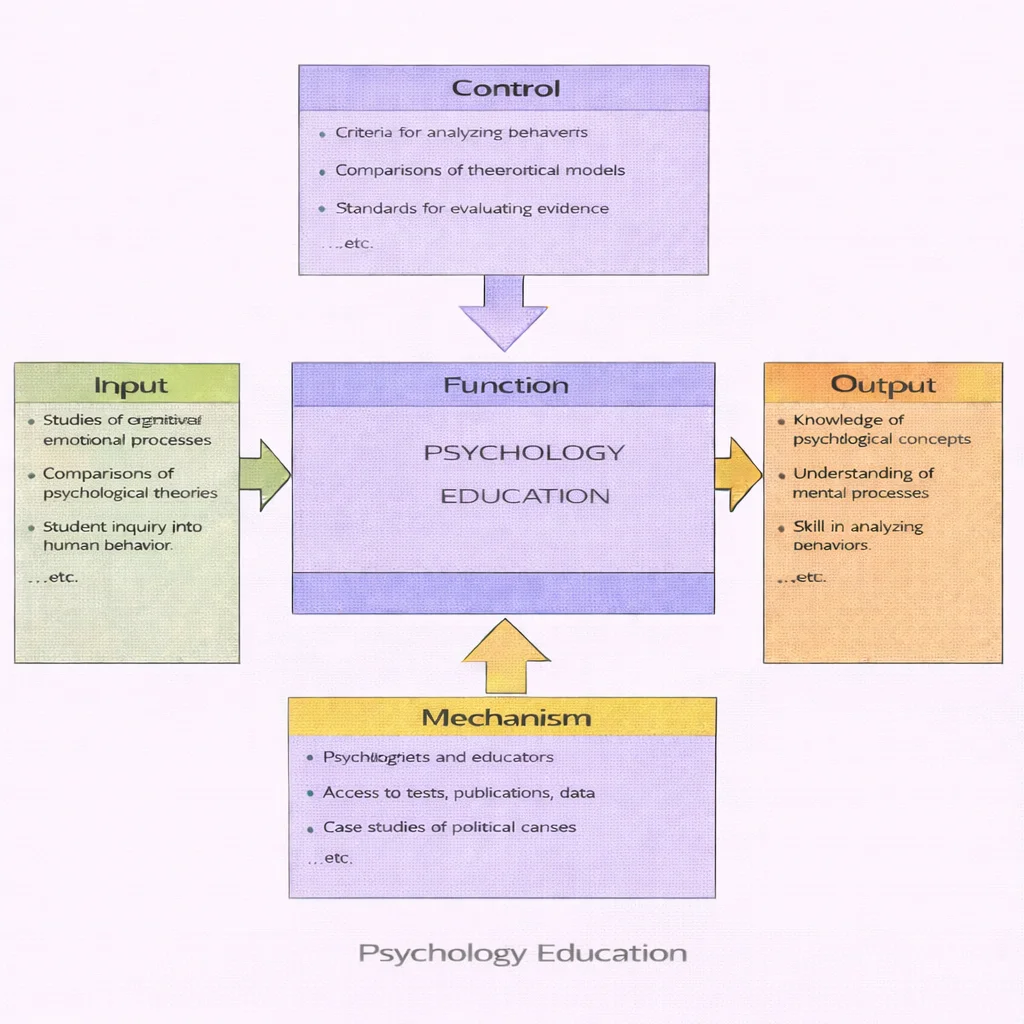
Psychology Education turns curiosity about human thought, emotion, and behaviour into disciplined understanding. Learners begin with inputs such as classic findings, competing theories, and their own questions about why people act as they do. That raw material is shaped by controls—clear standards for evidence, careful comparison of models, and criteria for interpreting behaviour—so that ideas do not drift into guesswork. With mechanisms such as trained educators, professional psychological tools and datasets, and well-chosen case studies, the learning process becomes concrete and testable. The outputs are more than memorised definitions: students gain a working vocabulary of psychological concepts, a clearer picture of mental processes, and practical skill in analysing behaviour thoughtfully and responsibly.
Psychology, the scientific study of mind and behavior, offers insights that extend across the entire spectrum of human experience. It plays a pivotal role in the humanities and social sciences, intersecting with fields such as sociology, which examines collective behaviors and institutions, and philosophy, which addresses foundational questions about consciousness, morality, and identity. From the motivations behind political decisions in political science to the influence of belief systems explored in religious studies, psychology provides a critical lens for understanding both individuals and societies.
As a discipline, psychology benefits greatly from cultural context and storytelling, which is why it often draws from the narratives found in literature. On the global stage, psychological factors underpin decision-making and conflict resolution in international relations, especially when evaluating risk, diplomacy, and negotiation. The application of psychological principles is further enhanced by the tools offered through emerging technologies, where human-machine interaction, digital mental health interventions, and behavioral analytics play an increasing role.
Cognitive science and psychological modeling are now deeply embedded in information technology and artificial intelligence and machine learning. These technologies seek to simulate or support human cognition, learning, and decision-making. In the realm of robotics and autonomous systems, understanding psychological responses to automation, trust, and ethical dilemmas becomes essential. Similarly, concerns about privacy and online behavior in cybersecurity often require a psychological approach to mitigate risks and improve user awareness.
Psychology is increasingly reliant on empirical methods supported by data science and analytics, as well as internet and web technologies for conducting online experiments, behavioral tracking, and psychometric testing. Foundational skills in mathematics and statistics are crucial for designing experiments, analyzing results, and validating theories.
Beyond the lab, psychology contributes to technological design and societal infrastructure. It informs the use of satellite technology in behavioral mapping or emergency response. The psychological dimensions of trauma and resilience are particularly relevant to fields such as earthquake and disaster engineering. Similarly, urban and regional planning must account for mental well-being through public space design, walkability, and access to community services.
Psychological insight is also integral to how we adapt to and adopt new systems. Whether designing more intuitive user interfaces through IoT and smart technologies, motivating behavior change for renewable energy adoption, or evaluating stress factors in environmental engineering, psychology provides the frameworks for aligning human behavior with systemic goals. Whether promoting better living through green building or supporting innovation through smart manufacturing, the study of psychology remains indispensable in shaping our future.

A vibrant, dreamlike scene centers on a stylized human face with an illuminated brain, framed by circular, mandala-like rings filled with symbols—eyes for perception, hearts for emotion, gears for cognition, and small figures representing behavior and social interaction. Around the edges are thoughtful, wise-looking portraits and swirling cosmic imagery, suggesting psychology’s blend of biology, experience, culture, and imagination. At the bottom, people appear to be observing, learning, or conversing, reinforcing the idea that psychology connects inner mental life with real-world relationships and everyday decisions.
Humanities & Social Sciences Cluster Navigation
Explore how Psychology integrates into the broader Humanities & Social Sciences curriculum roadmap and connects across interdisciplinary domains:
Overview
Foundational hub exploring the full landscape of human culture, society, and intellectual inquiry across all social science disciplines.
Anthropology
Examines human origins, evolutionary biology, and cross-cultural variations to complement individual psychological analyses.
Cultural Studies
Investigates media power dynamics and identity formation, connecting systemic media structures to social cognition.
History
Analyzes historical contexts and systemic transformations that shape collective behavior, memory, and generational trauma.
Literature
Provides narrative case studies and qualitative insights into human empathy, emotional motives, and personal perspective-taking.
Philosophy
Establishes the epistemological and ethical foundations for mind-body questions, morality, and theories of consciousness.
Political Science
Examines voter psychology, leadership dynamics, public opinion formation, and political decision-making behaviors.
International Relations
Applies behavioral theories to state-level negotiation, crisis decision-making, leader perception, and conflict resolution.
Psychology (Current Module)
Provides empirical scientific methods to model individual human cognition, perception, emotion, and behavioral processes.
Religious Studies
Explores the cognitive underpinnings of faith, ritual participation, existential coping mechanisms, and belief systems.
Sociology
Investigates macro-level social structures, institutional norms, and group dynamics alongside psychological micro-analyses.
Linguistics
Examines psycholinguistics, speech perception, cognitive language acquisition, and symbolic communication frameworks.
Branches of Psychology
Psychology is a diverse field, with several subfields focusing on specific aspects of human thought and behavior:
Clinical Psychology
- Definition: Focuses on diagnosing and treating mental, emotional, and behavioral disorders.
- Key Topics:
- Anxiety, depression, and schizophrenia.
- Therapy techniques, such as cognitive-behavioral therapy (CBT) and psychoanalysis.
- Applications:
- Providing psychotherapy for individuals and groups.
- Developing treatment plans for mental health disorders.
Cognitive Psychology
- Definition: Studies mental processes like perception, memory, problem-solving, and decision-making.
- Key Topics:
- How people process information and solve problems.
- The role of attention and memory in learning.
- Applications:
- Designing educational tools to enhance learning.
- Developing user-friendly technology interfaces.
Developmental Psychology
- Definition: Examines how people grow and change throughout their lifespan, from infancy to old age.
- Key Topics:
- Childhood cognitive development (e.g., Piaget’s stages).
- Adolescent identity formation and aging processes.
- Applications:
- Creating age-appropriate learning materials.
- Supporting healthy aging through interventions.
Social Psychology
- Definition: Explores how individuals influence and are influenced by others in social contexts.
- Key Topics:
- Group dynamics, conformity, and leadership.
- Prejudice, stereotypes, and interpersonal attraction.
- Applications:
- Promoting diversity and inclusion in workplaces.
- Developing anti-bullying programs in schools.
Industrial-Organizational Psychology
- Definition: Focuses on workplace behavior and organizational dynamics.
- Key Topics:
- Employee motivation, job satisfaction, and leadership styles.
- Ergonomics and workplace design.
- Applications:
- Enhancing employee productivity.
- Streamlining hiring and training processes.
Neuropsychology
- Definition: Studies the relationship between brain function and behavior.
- Key Topics:
- Brain injuries, neurological disorders, and cognitive impairments.
- The role of neurotransmitters in mental health.
- Applications:
- Assessing and rehabilitating patients with brain injuries.
- Exploring treatments for conditions like Alzheimer’s disease.
Forensic Psychology
- Definition: Applies psychological principles to legal and criminal justice systems.
- Key Topics:
- Criminal profiling and eyewitness testimony reliability.
- Mental health assessments in legal cases.
- Applications:
- Assisting in jury selection and trial preparation.
- Providing therapy for victims and offenders.
Key Concepts in Psychology
-
Nature vs. Nurture
- Debate over whether genetics (nature) or environment (nurture) plays a more significant role in shaping behavior.
-
Cognitive Processes
- Understanding how people perceive, think, and remember.
- Example: Studying biases like confirmation bias, where individuals favor information that aligns with their beliefs.
-
Behavioral Conditioning
- Learning theories, such as Pavlov’s classical conditioning and Skinner’s operant conditioning, explain how behaviors are acquired and modified.
-
Emotions and Motivation
- Exploring what drives behavior, from biological needs (e.g., hunger) to intrinsic motivations (e.g., personal growth).
-
Personality
- Studying traits and characteristics that define individual differences.
- Example: The Big Five personality traits (openness, conscientiousness, extraversion, agreeableness, neuroticism).
Interactive Model: Memory Retention & Ebbinghaus Forgetting Curve
Simulate how cognitive consolidation, spaced repetition, and memory retention decline over time according to Hermann Ebbinghaus’s exponential decay model: R = e–t/S (where R is retention, t is time in days, and S is memory strength factor).
Without review interventions, memory retention drops exponentially within the first 24 to 48 hours following learning.
Methods in Psychological Research
Psychology employs scientific methods to explore and understand behavior and mental processes:
-
Experimental Studies
- Controlled experiments to test hypotheses about behavior.
- Example: Testing the effects of sleep deprivation on memory.
-
Observational Studies
- Studying behavior in natural settings without manipulation.
- Example: Observing children’s play to understand social development.
-
Surveys and Questionnaires
- Collecting self-reported data on attitudes, beliefs, and experiences.
-
Case Studies
- In-depth analysis of a single individual or group to explore rare phenomena.
- Example: Studying a patient with a unique neurological condition.
-
Neuroimaging Techniques
- Tools like MRI and EEG to study brain activity and its correlation with behavior.
Applications of Psychology
-
Mental Health
- Treating psychological disorders through therapy and medication.
- Example: CBT for anxiety disorders.
-
Education
- Enhancing learning through psychological principles.
- Example: Implementing reward systems to encourage student engagement.
-
Healthcare
- Promoting healthy behaviors and managing chronic illnesses.
- Example: Stress management techniques for patients with hypertension.
-
Business and Industry
- Improving workplace efficiency and employee well-being.
- Example: Using personality assessments in hiring processes.
-
Legal Systems
- Assisting in criminal investigations and court proceedings.
- Example: Evaluating the credibility of eyewitness testimonies.
Contemporary Issues in Psychology
-
Mental Health Awareness
- Addressing stigma and increasing access to mental health services.
-
Technology and Psychology
- Exploring the impact of social media and digital devices on behavior and mental health.
-
Cross-Cultural Psychology
- Understanding how cultural differences influence behavior and cognition.
-
Artificial Intelligence
- Using AI to model cognitive processes and enhance psychological research.
Future Directions in Psychology
-
Integrative Approaches
- Combining insights from neuroscience, genetics, and psychology for a more holistic understanding of behavior.
-
Digital Interventions
- Developing apps and online platforms for mental health support.
-
Focus on Global Challenges
- Addressing issues like climate anxiety and the psychological impacts of displacement.
-
Personalized Psychology
- Tailoring interventions and therapies based on individual differences and genetic predispositions.
Why Study Psychology
Understanding Human Thought, Emotion, and Behavior
Psychology is the scientific study of how people think, feel, and act. For students preparing for university, studying psychology offers a powerful framework for understanding both individual behavior and social interaction. It reveals the internal processes—such as perception, memory, emotion, and motivation—that influence how people experience the world and relate to others.
Exploring Mental Health, Well-Being, and Personal Growth
Students gain insight into psychological disorders, therapeutic approaches, and strategies for mental wellness. By learning how stress, trauma, and resilience affect the mind, they become better equipped to care for their own emotional health and support others. Psychology encourages empathy and reflection, promoting personal growth and emotional intelligence.
Analyzing the Biological, Social, and Cognitive Dimensions of Behavior
Psychology bridges multiple perspectives—neuroscience, developmental psychology, social psychology, and cognitive science—to explain complex human behavior. Students study how the brain functions, how people develop across the lifespan, how social environments influence choices, and how thinking patterns shape decision-making. This interdisciplinary approach helps students understand behavior at both individual and systemic levels.
Applying Research Methods and Critical Thinking
Psychology emphasizes empirical research, requiring students to design experiments, collect and analyze data, and evaluate findings. This builds strong skills in critical thinking, statistical reasoning, and scientific inquiry. These abilities are valuable not only in psychology, but also across academic fields and professional disciplines that value evidence-based problem solving.
Preparing for Diverse Careers and Further Study
A foundation in psychology supports further study in clinical psychology, counseling, neuroscience, education, human resources, marketing, health sciences, and social work. It opens career pathways in healthcare, research, business, public policy, and education. For university-bound learners, psychology offers both a versatile academic discipline and a meaningful lens for understanding human nature and improving lives.
Interactive Concept Review Questions
Click on each question below to expand and reveal in-depth explanations:
How does Classical Conditioning differ from Operant Conditioning in behavioral psychology?
What is Cognitive Dissonance and how do individuals reduce it?
Why is double-blind designing vital in clinical and psychological trials?
Frequently Asked Questions: Psychology
What is psychology as a field of study?
Psychology is the scientific study of mind and behaviour. It investigates how people think, feel, and act as individuals and in groups, and how biological, cognitive, social, and cultural factors interact to shape human experience across the lifespan.
What are the main branches of psychology?
Major branches of psychology include cognitive psychology (thinking and perception), biological psychology and neuroscience (the brain and nervous system), developmental psychology (changes across the lifespan), social psychology (relationships and group behaviour), personality psychology, clinical and counselling psychology, health psychology, and organisational or industrial psychology.
Is psychology mainly about therapy and mental illness?
Therapy and mental health are important parts of psychology, but the field is broader. Psychologists also study learning, memory, decision-making, motivation, relationships, workplace behaviour, consumer choices, education, sport performance, and many other aspects of everyday life using scientific methods.
What research methods do psychologists use?
Psychologists use a range of research methods, including experiments, surveys, interviews, observations, case studies, psychometric tests, and neuroscientific techniques such as brain imaging and physiological recording. They apply statistical analysis to evaluate evidence and test hypotheses about behaviour and mental processes.
How is psychology different from common sense or self-help advice?
Common sense relies on personal experience, intuition, and cultural sayings, which can be biased or contradictory. Psychology uses systematic observation, controlled studies, and peer review to test ideas and challenge assumptions. This scientific approach helps distinguish accurate patterns from stereotypes and myths about human behaviour.
What does a typical psychology degree cover?
A typical psychology degree covers core topics such as biological, cognitive, developmental, and social psychology, research methods and statistics, personality and individual differences, and sometimes introductory modules in clinical, health, educational, or organisational psychology. Students usually complete independent research projects and may have opportunities for applied placements.
What skills do students gain from studying psychology?
Psychology students develop skills in critical thinking, research design, data analysis, and scientific writing. They learn to interpret statistics, evaluate evidence, design questionnaires and experiments, work ethically with people, and communicate complex ideas clearly. They also gain deeper insight into their own and others’ behaviour and emotions.
What kinds of careers can a psychology background lead to?
A psychology background can lead to careers in clinical and counselling services, education and special education, human resources and organisational development, marketing and consumer research, health promotion, social services, user experience and design, policy and research, and further postgraduate training in specialised areas of psychology or related fields.
Do you need strong mathematics to study psychology?
Psychology does involve quantitative methods, especially statistics for analysing data, but most undergraduate programmes start with introductory courses that build the required skills step by step. Comfort with basic algebra and a willingness to practise statistical reasoning are more important than advanced mathematics.
How does psychology relate to biology, sociology, and neuroscience?
Psychology is closely linked to biology and neuroscience when studying the brain and nervous system, hormones, and genetics. It overlaps with sociology when analysing group behaviour, social structures, and culture. Many areas of psychology are interdisciplinary, drawing on methods and insights from multiple fields to explain complex human behaviour.
What ethical issues are important in psychological research and practice?
Ethical issues in psychology include informed consent, confidentiality and privacy, avoidance of harm, fair treatment of participants and clients, responsible use of tests and diagnoses, and careful handling of sensitive data. Professional codes of ethics and review boards help ensure that research and practice respect the rights and dignity of individuals and communities.
How can students prepare for university-level psychology?
Students can prepare by reading introductory psychology textbooks, following reputable science communication about behaviour and the brain, revising basic statistics, and practising critical reading of research summaries in news articles. Being curious about people, open to questioning assumptions, and willing to engage with both numbers and narratives is excellent preparation for psychology study.
Psychology Conclusion
Psychology is a dynamic and impactful field that enhances our understanding of human behavior and mental processes. Its diverse branches and applications make it essential for addressing individual, societal, and global challenges. By combining scientific rigor with empathy and innovation, psychology continues to contribute to improving lives and fostering well-being in an ever-changing world.
🎯 Career Guidance Tool: Is Psychology Right For You?
Explore career pathways, check your fit, and assess your skills — before you commit to a degree.
Explore Psychology Career Options →Psychology Curriculum Assessment & Exercise Module
Section 1: Foundational Concept Review Questions
-
What is psychology and what does it study?
Answer: Psychology is the scientific study of behavior and mental processes, examining how individuals think, feel, and act. It investigates both observable actions and the underlying cognitive processes that drive them. The field encompasses various subdisciplines that explore different aspects of human experience, from perception and emotion to decision-making and social interactions. By employing empirical research methods, psychology seeks to understand and explain the complexities of the human mind and behavior. -
What are the main subfields of psychology and what do they focus on?
Answer: The main subfields of psychology include cognitive, behavioral, developmental, social, clinical, and biological psychology, among others. Cognitive psychology focuses on mental processes such as memory, perception, and problem-solving. Behavioral psychology studies observable behaviors and the ways in which they are learned or conditioned. Developmental psychology examines how individuals change over the lifespan, while social psychology investigates how interpersonal relationships and social contexts influence behavior. Clinical psychology is concerned with diagnosing and treating mental health issues, and biological psychology explores the physiological underpinnings of behavior. -
How do research methods in psychology contribute to our understanding of human behavior?
Answer: Research methods in psychology, including experiments, surveys, case studies, and observational studies, contribute significantly to our understanding of human behavior by providing systematic and empirical evidence. These methods allow researchers to test hypotheses, establish causal relationships, and explore correlations between variables. By employing both quantitative and qualitative approaches, psychologists can capture the complexity of human behavior and mental processes. The rigorous application of research methods ensures that findings are reliable, valid, and applicable to a broad range of real-world situations. -
What is the importance of cognitive psychology in understanding mental processes?
Answer: Cognitive psychology is crucial for understanding mental processes because it focuses on how people perceive, process, store, and retrieve information. This subfield provides insights into the mechanisms underlying thought, learning, memory, and problem-solving. By examining cognitive processes, researchers can develop models that explain how the mind works and how individuals interact with their environment. These insights are essential for designing educational programs, improving decision-making, and developing therapeutic interventions for cognitive impairments. -
How does developmental psychology explain changes in behavior across the lifespan?
Answer: Developmental psychology explains changes in behavior across the lifespan by studying the physical, cognitive, and social transformations that occur from infancy through old age. This subfield investigates how individuals grow and change in response to both biological and environmental factors. It examines key developmental milestones and the impact of early experiences on later life outcomes. Understanding these processes helps in designing interventions and educational strategies that support healthy development and address challenges at different stages of life. -
What role does social psychology play in understanding interpersonal relationships and group dynamics?
Answer: Social psychology plays a vital role in understanding interpersonal relationships and group dynamics by examining how individuals are influenced by the presence, actions, and attitudes of others. This subfield explores topics such as conformity, social influence, prejudice, and group behavior, offering insights into how social contexts shape personal attitudes and behaviors. It also investigates the factors that foster cooperation, conflict, and communication within groups. By understanding these dynamics, social psychology informs strategies to improve interpersonal relationships and promote social harmony. -
How do biological factors influence psychological processes and behavior?
Answer: Biological factors influence psychological processes and behavior by providing the physiological basis for how the brain and nervous system function. This includes the study of neurotransmitters, brain structures, and genetic influences that affect cognition, emotion, and behavior. Biological psychology integrates findings from neuroscience to explain how internal biological mechanisms interact with environmental stimuli. These insights are critical for understanding mental disorders, developing pharmacological treatments, and elucidating the complex interplay between biology and behavior. -
What is the significance of clinical psychology in addressing mental health issues?
Answer: Clinical psychology is significant in addressing mental health issues because it focuses on the assessment, diagnosis, and treatment of psychological disorders. Clinical psychologists apply evidence-based therapies and interventions to help individuals manage conditions such as depression, anxiety, and schizophrenia. Their work involves both research and practice, contributing to the development of effective treatment protocols and improving patient outcomes. By understanding the underlying causes of mental illness, clinical psychology plays a crucial role in promoting mental well-being and enhancing quality of life. -
How does psychology contribute to the improvement of educational practices?
Answer: Psychology contributes to the improvement of educational practices by providing insights into how students learn and process information. Research in educational psychology has led to the development of effective teaching methods, learning strategies, and assessment tools that cater to diverse learning styles. Psychological theories help educators design curricula that enhance student engagement, motivation, and retention of knowledge. By understanding the cognitive and emotional factors that influence learning, educators can create more inclusive and supportive educational environments that promote academic success. -
What are some contemporary challenges facing the field of psychology today?
Answer: Contemporary challenges facing the field of psychology include addressing the replication crisis, integrating digital technologies into research, and ensuring cultural sensitivity in psychological practices. The replication crisis raises concerns about the reliability of research findings, prompting calls for more rigorous methodologies. Additionally, the rapid advancement of technology requires psychologists to adapt their research methods and address issues related to digital behavior and online mental health. Ensuring that psychological theories and practices are inclusive and culturally relevant is also a critical challenge in an increasingly globalized world.
Section 2: Analytical & Thought-Provoking Case Studies
-
How can emerging technologies transform psychological research and practice?
Answer: Emerging technologies such as neuroimaging, virtual reality, and artificial intelligence are transforming psychological research and practice by providing more precise tools for measuring and analyzing human behavior. These technologies enable researchers to observe brain activity in real time, simulate complex social environments, and analyze large datasets to uncover patterns that were previously undetectable. This transformation allows for a deeper understanding of the neural and cognitive processes underlying behavior, leading to more targeted and effective interventions. Additionally, digital platforms facilitate remote therapy and online counseling, broadening access to mental health services. Integrating these technologies into everyday practice also poses challenges, including ethical concerns regarding privacy and data security. -
In what ways do cultural differences impact the interpretation and application of psychological theories?
Answer: Cultural differences impact the interpretation and application of psychological theories by influencing how behaviors, emotions, and mental processes are understood and valued in different societies. What is considered a normative behavior or emotional response in one culture may be viewed differently in another, leading to diverse interpretations of the same psychological phenomenon. Cultural context shapes the development of psychological constructs and can affect the effectiveness of therapeutic interventions. Consequently, psychologists must adapt theories and practices to be culturally sensitive and relevant. -
How might the integration of cross-cultural psychology influence global mental health initiatives?
Answer: The integration of cross-cultural psychology into global mental health initiatives can significantly enhance the effectiveness of these programs by ensuring that interventions are tailored to the unique cultural contexts of different populations. Cross-cultural psychology provides insights into how cultural beliefs, values, and practices influence mental health, helping to identify factors that contribute to psychological resilience or vulnerability in various societies. This understanding enables the design of culturally appropriate treatment methods and support systems that are more likely to be accepted and successful. -
What are the ethical challenges associated with psychological research in diverse populations?
Answer: Psychological research in diverse populations presents ethical challenges such as ensuring informed consent, protecting participants’ privacy, and avoiding cultural biases in data interpretation. Researchers must be sensitive to cultural differences that may affect how individuals perceive and engage with the research process. There is a risk of misrepresentation or exploitation if studies do not adequately account for these differences, which can undermine trust in the research community. Addressing these challenges requires robust ethical guidelines, culturally competent methodologies, and continuous dialogue with the communities involved. -
How can advancements in neuropsychology change our understanding of human cognition?
Answer: Advancements in neuropsychology, such as improved brain imaging technologies and computational modeling, are revolutionizing our understanding of human cognition by providing detailed insights into the neural mechanisms underlying thought and behavior. These technologies allow researchers to observe brain activity in real time and map complex neural networks, revealing how different regions interact during cognitive processes like memory, attention, and decision-making. This deeper understanding can lead to more precise diagnoses of cognitive disorders and the development of targeted treatments that address the specific neural deficits involved. -
How do social and environmental factors shape mental health outcomes?
Answer: Social and environmental factors play a crucial role in shaping mental health outcomes by influencing stress levels, access to resources, and overall quality of life. Factors such as socioeconomic status, social support networks, and community cohesion can either buffer individuals from or exacerbate the impact of psychological stressors. Environmental elements, including living conditions, exposure to pollution, and neighborhood safety, further contribute to mental well-being. Understanding the interplay between social and environmental influences is essential for developing effective mental health interventions. -
What are the implications of the replication crisis for psychological research and public trust?
Answer: The replication crisis, marked by difficulties in reproducing research findings in psychology, has significant implications for the credibility of the field and public trust in scientific research. It challenges the reliability of widely accepted studies and calls into question the robustness of psychological theories that underpin public policy and clinical practice. This crisis has prompted a reevaluation of research methodologies, encouraging greater transparency, rigor, and openness in the scientific process. Addressing these issues is critical for restoring confidence in psychological research. -
How does the study of personality psychology contribute to our understanding of individual differences?
Answer: The study of personality psychology contributes to our understanding of individual differences by exploring the unique patterns of thoughts, feelings, and behaviors that distinguish one person from another. This field examines traits, motivations, and behavioral tendencies through various theoretical frameworks and research methods, including psychometric assessments and longitudinal studies. By analyzing personality, psychologists can predict how individuals are likely to respond to different situations and understand the underlying causes of behavior.
Section 3: Numerical Problems & Statistical Solutions
-
Psychometric Z-Score Calculation: A clinical psychologist administers a standardized IQ assessment with a population mean (μ) of 100 and a standard deviation (σ) of 15. A participant scores 122 on the assessment. Calculate the participant’s standard Z-score and interpret their position relative to the mean.
Solution:Z = (X – μ) / σThe participant’s score lies 1.47 standard deviations above the population mean, placing them in approximately the 93rd percentile of cognitive performance on this normative scale.
Z = (122 – 100) / 15 = 22 / 15 = +1.47 -
Memory Retention Modeling (Ebbinghaus Decay): According to Ebbinghaus’s exponential forgetting model R = e–t/S, a student learns a list of vocabulary terms with a memory strength factor S = 2.0 days. Calculate the estimated percentage of retention (R) remaining after t = 4 days without review.
Solution:R = e-(4 / 2.0) = e-2.0 ≈ 0.1353 (13.53%)Without additional rehearsal or spaced repetition, the student is expected to retain approximately 13.53% of the initial material after 4 days. -
Experimental Effect Size (Cohen’s d): In an experiment testing a cognitive intervention, the treatment group achieves a mean score of M1 = 78 (SD = 10), while the control group achieves a mean score of M2 = 70 (SD = 10). Assuming a pooled standard deviation (SDpooled) of 10, calculate Cohen’s d to quantify effect size.
Solution:Cohen’s d = (M1 – M2) / SDpooledA Cohen’s d value of 0.80 represents a strong, highly meaningful experimental effect size in behavioral and psychological intervention studies.
d = (78 – 70) / 10 = 8 / 10 = 0.80 -
Chi-Square Independence Test Statistic: A social psychologist evaluates whether decision preference (Choice A vs. Choice B) is independent of gender. In a sample, the observed frequency for a cell is O = 45, while the expected frequency calculated under the null hypothesis is E = 30. Calculate the single cell contribution to the overall Chi-Square (χ2) statistic: (O – E)2 / E.
Solution:Cell Contribution = (45 – 30)2 / 30 = (15)2 / 30 = 225 / 30 = 7.50The contributed cell value to the overall total Chi-Square test statistic is 7.50. -
Classical Conditioning Acquisition Rate: In an operant conditioning chamber, a subject presses a lever 12 times in trial 1 (10 minutes) and 48 times in trial 4 (10 minutes). Calculate the percentage increase in behavioral response rate.
Solution:Percentage Increase = [(48 – 12) / 12] × 100% = [36 / 12] × 100% = 300%The response rate increased by 300% following positive reinforcement schedules across trial blocks. -
Standard Error of the Mean (SEM): A researcher samples N = 64 participants from a clinical trial measuring anxiety reduction scores. The sample standard deviation (s) is 16. Calculate the standard error of the mean (SEM = s / √N).
Solution:√64 = 8The standard error of the mean is 2.0 units, indicating the sampling precision around the estimated population mean.
SEM = 16 / 8 = 2.0 -
Signal Detection Theory (Sensitivity Index d’): In a visual perception experiment, a subject’s Z-score for Hit Rate is Z(Hit) = +1.28, and the Z-score for False Alarm Rate is Z(FA) = -0.52. Calculate the perceptual sensitivity index d’ = Z(Hit) – Z(FA).
Solution:d’ = 1.28 – (-0.52) = 1.28 + 0.52 = 1.80The participant exhibits a sensitivity index (d’) of 1.80, reflecting accurate signal discrimination capacity above random noise threshold.