
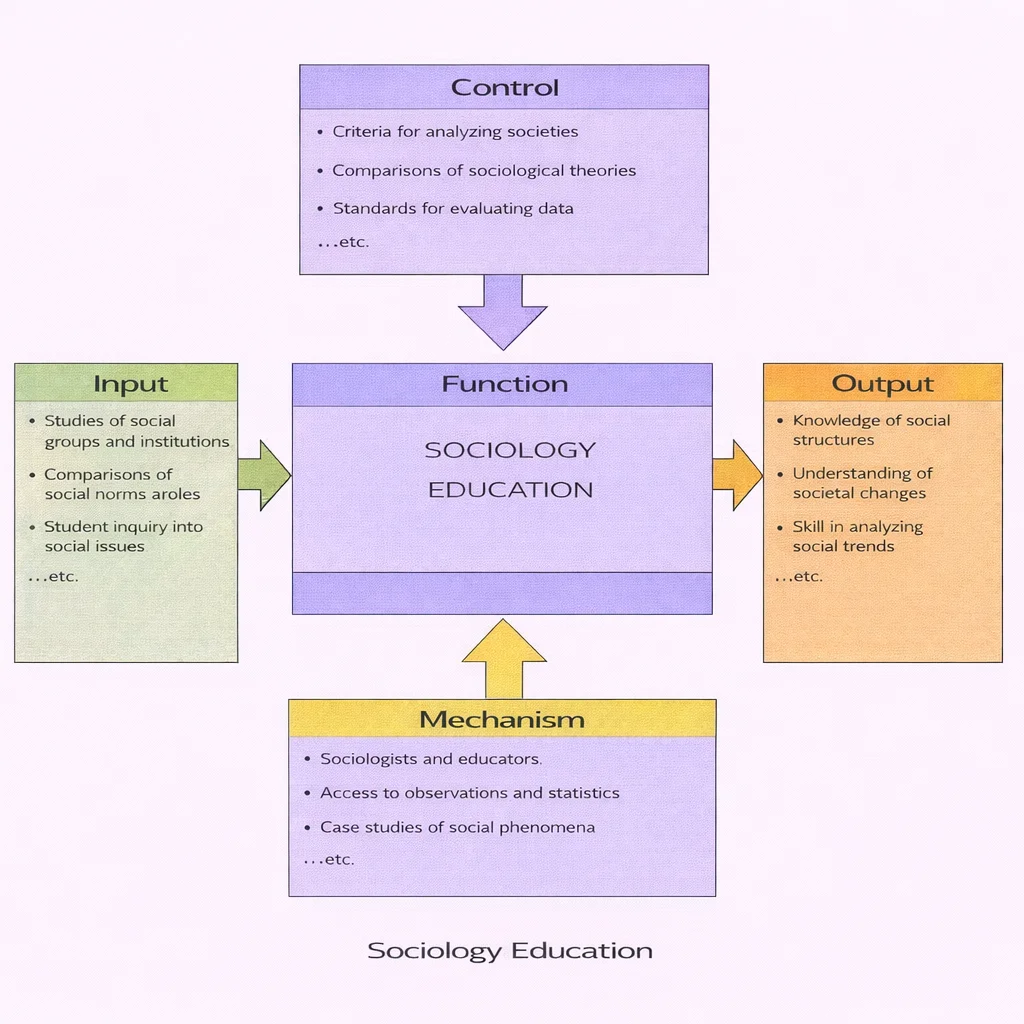
Sociology Education turns curiosity about everyday life into disciplined understanding. Learners begin with concrete inputs—observations of groups, institutions, norms, and real social issues—and these are not treated as mere opinions, but as material for careful study. The controls in the top box remind students that sociology is guided by standards: concepts and theories that frame questions, criteria that prevent shallow conclusions, and data-evaluation rules that separate strong evidence from weak claims. With the right mechanisms—trained educators, reliable statistics, and rich case studies—students practice linking personal experiences to larger patterns. The output is more than factual knowledge: it is a sharpened ability to read social structures, explain change over time, and analyze social trends with clarity, fairness, and evidence-based reasoning.
Sociology provides an essential lens for understanding how individuals and communities function within structured societies. It engages deeply with questions about identity, inequality, culture, and institutions. To fully appreciate these dynamics, students often draw upon adjacent disciplines such as religious studies to examine how belief systems influence behavior, or psychology to understand internal cognitive and emotional processes that shape social interaction. These fields intersect in meaningful ways, enabling richer analyses of complex human relationships.
In public policy, sociology complements political science by exploring the societal impact of governance structures and legal systems. Similarly, philosophy helps frame sociological questions about ethics, justice, and human values, while literature offers cultural narratives that reflect the lived experiences of different social groups. These diverse perspectives are united under the broader umbrella of humanities and social sciences, promoting interdisciplinary insight into the fabric of society.
Sociologists today must also grapple with the impact of emerging technologies on communities and identities. For example, platforms built on information technology and powered by artificial intelligence and machine learning are reshaping communication, labor, and privacy. The rise of robotics and autonomous systems also challenges traditional notions of work and social dependency, especially as automation displaces manual labor.
Digital life raises new sociological questions around surveillance and trust, bringing cybersecurity into sharper focus. Likewise, analysts rely on data science and analytics and statistics to study patterns in population behavior, opinion trends, and mobility. Quantitative tools from mathematics support predictive modeling, enabling evidence-based policy development.
Sociology also considers spatial inequalities and infrastructure development. Topics like urban and regional planning explore how socioeconomic factors affect city design, transportation, and resource distribution. Disasters are sociological as well as physical phenomena, and so earthquake and disaster engineering gains relevance in assessing the social vulnerabilities of affected populations.
Contemporary society is also shaped by environmental concerns. Faith-based and civic responses to climate change intersect with technological advances in environmental engineering and green building and sustainable design. Smart cities, supported by IoT and smart technologies, require sociological awareness of digital divides and access equity. As industries adopt smart manufacturing and Industry 4.0, labor relations, workplace norms, and community impacts continue to evolve.
Finally, global connectivity made possible through satellite technology and widespread internet and web technologies fosters new forms of collective behavior and identity politics. In response, sociologists increasingly investigate how these developments reshape kinship, culture, and social stratification across the world.

A vibrant, infographic-style illustration combining everyday social life with analytical tools: diverse people interacting in urban spaces, small-group discussions, and visual elements like charts, icons, and interconnected gears. A globe at the center suggests global society, while the open book anchors the academic study of social patterns—culture, inequality, organizations, and social change.
Humanities & Social Sciences Cluster Navigation
Explore how Sociology integrates into the broader Humanities & Social Sciences curriculum roadmap and connects across interdisciplinary domains:
Overview
Foundational hub exploring the full landscape of human culture, society, and intellectual inquiry across all social science disciplines.
Anthropology
Examines human social evolution, kinship networks, and cross-cultural ethnographic comparisons alongside sociological studies.
Cultural Studies
Investigates subcultures, popular media hegemony, identity construction, and power structures in contemporary social life.
History
Traces long-term institutional shifts, class struggles, labor movements, and systemic societal transformations across eras.
Literature
Provides qualitative literary expressions of lived social experiences, class disparities, and cultural narratives.
Philosophy
Provides critical theoretical frameworks for social justice, ethical governance, epistemology, and social contract theories.
Political Science
Analyzes legislative frameworks, state authority, public policy implementation, and political social movements.
International Relations
Examines global migration networks, transnational labor patterns, diplomatic relations, and cross-border inequality.
Psychology
Explores social cognition, group dynamics, interpersonal behavior, and social influence at the individual-group interface.
Religious Studies
Investigates religious institutions, secularization trends, community bonding rituals, and faith-based social movements.
Sociology (Current Module)
Applies empirical methods and social theory to evaluate social institutions, stratification, norms, and collective behavior.
Linguistics
Analyzes sociolinguistics, dialectal variation, linguistic discrimination, and the role of discourse in shaping social power.
Scope and Importance of Sociology
-
Understanding Social Structures
- Sociology investigates institutions like family, education, religion, and government to understand how they shape individual and group behavior.
- Example: Analyzing how the education system reinforces social hierarchies.
-
Addressing Social Inequalities
- Sociology examines disparities in wealth, power, and opportunities, providing frameworks to address issues like poverty, racism, and gender inequality.
-
Promoting Social Change
- By identifying patterns and problems within societies, sociology contributes to creating policies and movements for positive change.
- Example: Studying the dynamics of social movements like civil rights or feminism.
-
Fostering Global Awareness
- In a globalized world, sociology enhances understanding of cultural diversity and international relations.
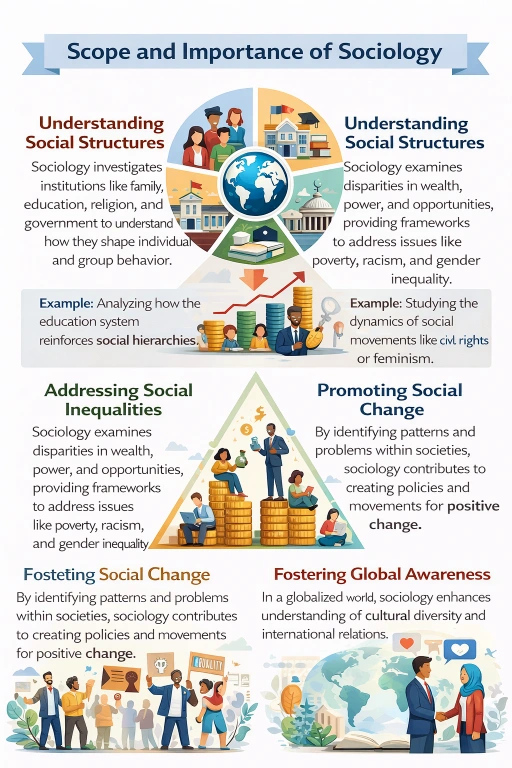
A clean educational infographic explaining the scope and importance of sociology through four core lenses. It highlights how sociology studies social institutions and structures, analyzes inequality in wealth and power, examines how movements and policies drive social change, and builds global awareness by helping learners understand cultural diversity and international relationships.
Branches of Sociology
Sociology encompasses several subfields, each focusing on specific aspects of social life:
1. Social Institutions
- Definition: Examines the roles and functions of major institutions in society.
- Key Institutions:
- Family: Structures and dynamics in family life.
- Religion: The role of faith in shaping morality and community.
- Education: How schools perpetuate or challenge social norms.
2. Social Stratification
- Definition: Studies the hierarchical arrangement of individuals in society based on class, race, gender, and other factors.
- Key Topics:
- Class systems and economic inequality.
- Discrimination and privilege.
- Social mobility and barriers.
3. Urban Sociology
- Definition: Explores the social dynamics of urban areas, including migration, housing, and urban planning.
- Key Topics:
- Urbanization and its impact on social life.
- Issues like overcrowding, gentrification, and segregation.
4. Sociology of Culture
- Definition: Investigates how culture shapes social behavior and identity.
- Key Topics:
- Language, art, and media as cultural tools.
- Subcultures and countercultures.
5. Sociology of Health and Medicine
- Definition: Examines the relationship between society and health, including healthcare systems and public health policies.
- Key Topics:
- Social determinants of health.
- The sociology of mental health and illness.
6. Environmental Sociology
- Definition: Studies the interaction between society and the environment, focusing on sustainability and ecological issues.
- Key Topics:
- Environmental justice and activism.
- The social implications of climate change.
7. Criminology and Sociology of Law
- Definition: Analyzes the causes of crime, the functioning of legal systems, and the social impacts of laws.
- Key Topics:
- Deviance and social control.
- The role of incarceration in society.
Key Concepts in Sociology
-
Socialization
- The process through which individuals learn and internalize the norms, values, and behaviors of their society.
-
Social Norms
- Unwritten rules that guide behavior within a group or society.
-
Roles and Status
- Roles: Expected behaviors associated with a particular social position.
- Status: A person’s position within the social hierarchy.
-
Social Networks
- The interconnected relationships among individuals and groups, influencing access to resources and opportunities.
-
Power and Authority
- Power: The ability to influence others.
- Authority: Legitimate power recognized by society (e.g., legal, traditional, charismatic authority).
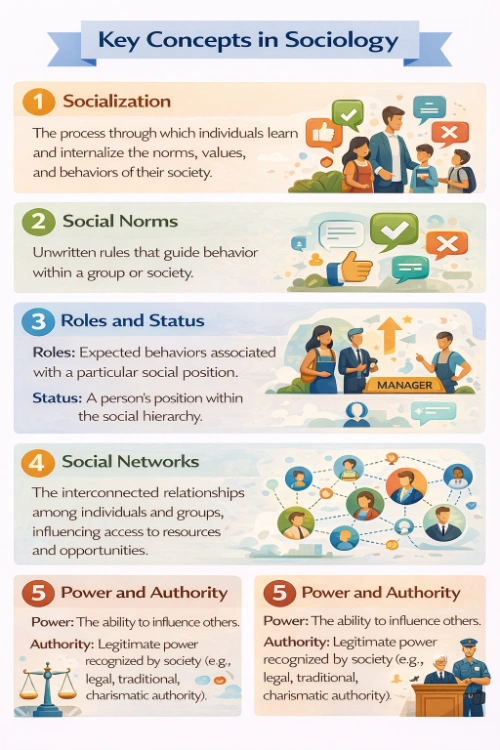
A clean educational infographic summarizing five core sociology concepts. Each numbered panel presents a key term—Socialization, Social Norms, Roles and Status, Social Networks, and Power and Authority—paired with a brief explanation and simple visual cues (speech bubbles, social roles, network links, and authority symbols) to help students grasp the meaning at a glance.
Interactive Model: Income Inequality & Lorenz Curve (Gini Coefficient Simulator)
Simulate population income distribution and calculate the Gini coefficient metric: Gini = A / (A + B), where Area A represents inequality between the line of perfect equality and the Lorenz curve.
This value indicates a moderate level of income stratification within the simulated population.
Research Methods in Sociology
Sociologists employ diverse methods to study society, combining qualitative and quantitative approaches:
-
Surveys and Questionnaires
- Collecting data on attitudes, behaviors, and demographics.
-
Interviews
- In-depth conversations to explore individual experiences and perspectives.
-
Participant Observation
- Immersing in a community or group to understand their practices and interactions.
-
Content Analysis
- Examining cultural artifacts like media, literature, or art to study societal norms and values.
-
Statistical Analysis
- Using data and statistical tools to identify patterns and trends.
Applications of Sociology
-
Public Policy and Social Reform
- Sociology informs policy-making in areas like healthcare, education, and housing.
- Example: Designing programs to address income inequality.
-
Urban Planning
- Applying sociological insights to create inclusive and sustainable urban environments.
-
Education
- Enhancing teaching methods by understanding social dynamics in classrooms.
-
Corporate Sector
- Studying workplace behavior to improve employee satisfaction and productivity.
-
Healthcare
- Addressing health disparities through public health campaigns and policies.
Contemporary Issues in Sociology
-
Globalization
- The impact of global interconnectedness on culture, economics, and politics.
-
Digital Sociology
- Examining the influence of social media and technology on human interaction.
-
Social Inequalities
- Understanding and addressing systemic inequalities in race, gender, and class.
-
Environmental Justice
- Advocating for equitable solutions to environmental challenges.
-
Migration and Multiculturalism
- Analyzing the social effects of migration and the integration of diverse populations.
Theoretical Perspectives in Sociology
-
Structural Functionalism
- Views society as a complex system with interdependent parts working together to maintain stability.
- Key Figures: Émile Durkheim, Talcott Parsons.
-
Conflict Theory
- Emphasizes power struggles and inequalities as driving forces in society.
- Key Figures: Karl Marx, C. Wright Mills.
-
Symbolic Interactionism
- Focuses on how individuals create meaning through interactions and symbols.
- Key Figures: George Herbert Mead, Erving Goffman.
-
Feminist Theory
- Analyzes the role of gender in shaping societal structures and practices.
- Key Figures: bell hooks, Simone de Beauvoir.
Future Directions in Sociology
-
Interdisciplinary Approaches
- Integrating insights from psychology, economics, and environmental science.
-
Focus on Technology
- Exploring the societal impact of artificial intelligence and automation.
-
Global Sociology
- Expanding studies to include non-Western perspectives and issues.
-
Action-Oriented Sociology
- Emphasizing applied sociology to solve real-world problems.
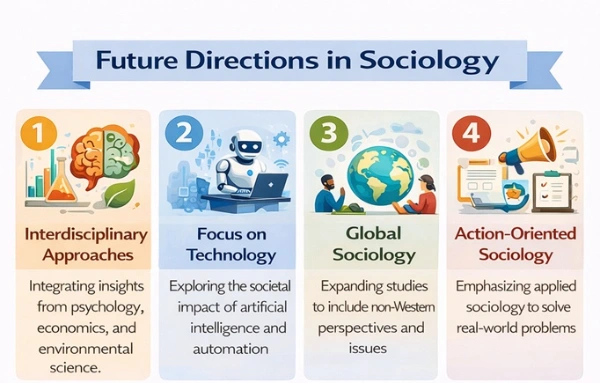
A clean educational infographic titled “Future Directions in Sociology,” presenting four key trends: (1) interdisciplinary approaches integrating insights from psychology, economics, and environmental science; (2) a focus on technology, especially the social impacts of AI and automation; (3) global sociology that broadens research beyond Western perspectives; and (4) action-oriented sociology emphasizing applied work to address real-world social problems.
Why Study Sociology
Understanding the Structure and Dynamics of Society
Sociology is the study of human society, social behavior, and the patterns that shape relationships, institutions, and communities. For students preparing for university, sociology provides essential tools for understanding how individuals are influenced by broader social forces such as culture, norms, laws, and institutions. It helps students grasp how societies function, evolve, and sometimes break down.
Exploring Social Inequality, Power, and Change
Students examine how factors like class, race, gender, age, and sexuality intersect to produce inequality and privilege. Sociology investigates how power is distributed and maintained, and how social movements challenge injustice and drive transformation. This critical perspective encourages students to think deeply about fairness, inclusion, and the possibilities for social progress.
Analyzing Everyday Life Through a Sociological Lens
Sociology turns a critical eye on the routines and structures of daily life—from education and family to religion, media, and work. Students learn to ask insightful questions about taken-for-granted practices and to see connections between personal experiences and larger societal patterns. This fosters a greater sense of awareness, empathy, and curiosity about the social world.
Applying Research Methods and Data Analysis
A key part of sociology is learning how to conduct empirical research using both qualitative and quantitative methods. Students gain skills in designing surveys, conducting interviews, analyzing data, and interpreting social patterns. These research abilities are valuable not only in academic study but also in many professions that require analytical thinking and evidence-based decision-making.
Preparing for Interdisciplinary Study and Civic Engagement
A foundation in sociology supports further study in social policy, criminology, education, gender studies, public health, urban planning, and political science. It also prepares students for careers in research, advocacy, social work, community development, and public service. For university-bound learners, sociology offers a powerful framework for understanding—and contributing to—the societies they live in.
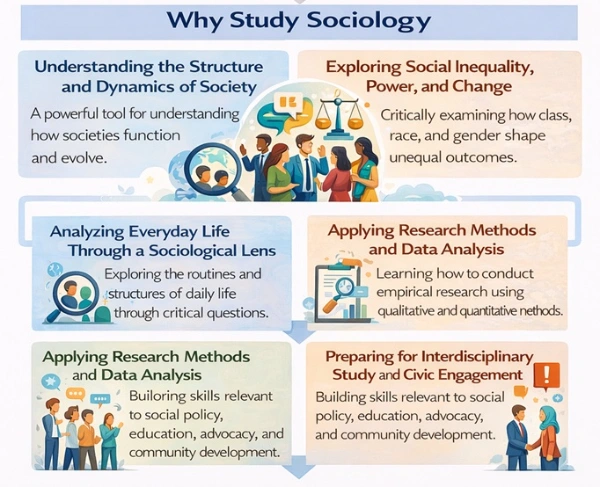
A clean, educational infographic headed “Why Study Sociology,” arranged in colored panels with icons (magnifying glass and globe, scales of justice, people in discussion, clipboard and charts). It highlights major learning outcomes: understanding how societies function and evolve; examining class, race, and gender in unequal outcomes; interpreting everyday routines through a sociological lens; applying qualitative and quantitative research methods; and building interdisciplinary skills for policy, education, advocacy, and community development.
Conclusion
Sociology is a vital discipline that deepens our understanding of society and human behavior. Its ability to analyze complex social phenomena and address pressing issues makes it indispensable in today’s world. By fostering critical thinking, empathy, and a commitment to social justice, sociology equips individuals and institutions to navigate and improve an increasingly interconnected and diverse global society.
Interactive Concept Review Questions
Click on each question below to expand and reveal in-depth explanations:
What is C. Wright Mills’s concept of the Sociological Imagination?
How does Karl Marx’s Conflict Theory differ from Émile Durkheim’s Functionalism?
What is the core emphasis of Erving Goffman’s Dramaturgical Analysis?
Frequently Asked Questions: Sociology
What is sociology as a field of study?
Sociology is the systematic study of society, social relationships, and social institutions. It explores how everyday life is shaped by groups, organisations, cultures, and structures such as class, gender, race, and power, and how these change over time.
How is sociology different from psychology and political science?
Psychology focuses mainly on individual minds and behaviour, while sociology looks at patterns that emerge in groups, institutions, and whole societies. Political science centres on power, governments, and public policy. Sociology overlaps with both, but its core interest is in how social structures and cultures shape everyday life and long-term change.
What are some major areas within sociology?
Major areas within sociology include social theory, research methods, social stratification and inequality, family and intimate life, education, work and organisations, urban and rural sociology, gender and sexuality, race and ethnicity, health and medicine, crime and deviance, culture and media, and globalisation and migration.
What kinds of questions do sociologists ask?
Sociologists ask questions such as: Why are resources and opportunities distributed unequally? How do families, schools, and workplaces shape people’s choices and chances? How do norms and laws emerge and change? Why do social movements arise? How do media and technology influence identity and community? These questions connect personal experiences to wider social patterns.
What research methods are used in sociology?
Sociology uses both quantitative and qualitative methods. These include surveys, questionnaires, and statistical analysis; interviews and focus groups; participant observation and ethnography; content and discourse analysis; comparative and historical research; and mixed-methods designs that combine different approaches to build a richer picture of social life.
What is social theory, and why is it important in sociology?
Social theory provides the concepts and frameworks that help sociologists interpret evidence and ask meaningful questions. Classic and contemporary theorists offer different ways of understanding power, inequality, identity, institutions, and change. Learning social theory helps students see beyond common sense explanations and think more critically about how societies work.
How does sociology approach issues of inequality and social justice?
Sociology examines how inequalities of class, gender, race, ethnicity, age, disability, and other factors are produced and reproduced through institutions, norms, and everyday interactions. It also studies resistance, social movements, and policy reforms that aim to reduce inequality. The goal is to understand patterns of advantage and disadvantage, not just to describe them.
How does sociology relate to everyday life?
Sociology shows that everyday experiences—such as going to school, using social media, working in a job, or forming friendships—are shaped by broader social forces. It helps students see how personal troubles can be connected to public issues, and how individual choices are made within particular cultural expectations and structural constraints.
What skills do students gain from studying sociology?
Students of sociology develop skills in critical thinking, research design, data analysis, and clear written and oral communication. They learn to interpret statistics, conduct interviews or observations, evaluate arguments about social problems, and work sensitively with diverse communities. These skills are valuable across many academic and professional paths.
What kinds of careers can a sociology background support?
A sociology background can support careers in social research and policy analysis, education, community and youth work, social services, human resources, marketing and market research, journalism and media, non-governmental organisations, urban planning, public health, and further study in law, social work, public administration, or academic research.
Is sociology a very statistical subject?
Many sociology programmes include quantitative methods and statistics so that students can understand and produce survey-based research, but they also emphasise qualitative approaches, theory, and essay writing. Students are normally introduced to statistics gradually, and they can often choose options that balance numerical and non-numerical methods according to their interests.
How can students prepare for university-level sociology?
Students can prepare for sociology by following news and documentaries about social issues, reading introductory sociology texts, and reflecting on how their own experiences relate to wider patterns of inequality, culture, and change. Practising essay writing, basic data interpretation, and open-minded discussion with people from different backgrounds is also excellent preparation.
🎯 Career Guidance Tool: Is Sociology Right For You?
Explore career pathways, check your fit, and assess your skills — before you commit to a degree.
Explore Sociology Career Options →Sociology Curriculum Assessment & Exercise Module
Section 1: Foundational Concept Review Questions
-
What is sociology and what does it study?
Answer: Sociology is the systematic study of society, social interactions, and cultural patterns. It examines how human behavior is shaped by social structures, institutions, and relationships. This field analyzes various aspects of social life, including norms, values, and social change. By understanding these elements, sociology provides insights into how societies function and evolve. -
How do sociologists study social behavior and interactions?
Answer: Sociologists study social behavior and interactions through a variety of research methods, including surveys, interviews, observations, and statistical analyses. These methods allow them to gather both quantitative and qualitative data on how individuals and groups behave in different contexts. They use these findings to identify patterns and draw conclusions about societal trends. This methodological diversity enables a comprehensive understanding of complex social phenomena. -
What are some major theoretical perspectives in sociology?
Answer: Major theoretical perspectives in sociology include functionalism, conflict theory, symbolic interactionism, and social constructionism. Functionalism views society as a system of interconnected parts that work together to maintain stability. Conflict theory focuses on power dynamics and social inequality, while symbolic interactionism emphasizes the importance of symbols and daily interactions in shaping society. Social constructionism examines how social realities are created through collective human agreement. -
How does sociology explain the concept of social stratification?
Answer: Sociology explains social stratification as the hierarchical arrangement of individuals and groups in society based on factors such as wealth, power, and prestige. This system of stratification determines the distribution of resources and opportunities, influencing social mobility and life chances. Researchers examine how class, race, and gender contribute to these inequalities. Understanding social stratification is essential for addressing issues of injustice and designing policies to promote social equity. -
What role do social institutions play in shaping society according to sociologists?
Answer: Social institutions such as family, education, religion, and government play a central role in shaping societal norms, values, and behaviors. They provide the structure within which individuals learn and interact, contributing to the socialization process and the maintenance of order. These institutions influence everything from personal identity to large-scale social policies. Sociologists study these structures to understand how they evolve and impact both individual lives and collective social outcomes. -
How does sociology contribute to our understanding of social change?
Answer: Sociology contributes to our understanding of social change by analyzing how and why societies transform over time. It examines the forces that drive change, including technological advancements, cultural shifts, and economic developments. Sociologists study historical and contemporary examples to identify patterns and dynamics that lead to new social norms and institutions. This analysis helps in developing theories and strategies for addressing current social issues and anticipating future trends. -
What is the significance of social identity in sociological research?
Answer: Social identity is significant in sociological research because it shapes how individuals perceive themselves and are perceived by others within society. It encompasses aspects such as race, gender, ethnicity, and class, which influence personal experiences and group dynamics. By studying social identity, sociologists can better understand issues of discrimination, privilege, and social cohesion. This research is critical for developing policies that promote inclusion and equity in diverse societies. -
How do sociologists approach the study of deviance and social control?
Answer: Sociologists approach the study of deviance and social control by examining the behaviors that violate social norms and the mechanisms society uses to enforce conformity. They analyze how norms are established, maintained, and challenged through formal and informal means. This study involves understanding the social, cultural, and economic factors that lead to deviant behavior and the impact of punishment and regulation on social order. Such research provides insights into the balance between individual freedom and societal stability. -
How can sociology help in understanding contemporary social issues?
Answer: Sociology helps in understanding contemporary social issues by providing tools and theories to analyze complex social phenomena, such as inequality, migration, and cultural change. It offers a framework for examining how these issues are rooted in historical and structural contexts. Through empirical research and critical analysis, sociology sheds light on the underlying causes and consequences of current social challenges. This knowledge is essential for developing effective policies and interventions aimed at promoting social well-being and justice. -
What impact has globalization had on social structures and cultural interactions?
Answer: Globalization has had a profound impact on social structures and cultural interactions by increasing connectivity and interdependence among nations. It facilitates the exchange of ideas, goods, and people, which leads to more dynamic and diverse cultural landscapes. Globalization challenges traditional social hierarchies and fosters new forms of identity and community formation. Sociologists study these changes to understand how global forces shape local experiences and contribute to social transformation.
Section 2: Analytical & Thought-Provoking Case Studies
-
How does the intersection of technology and sociology influence modern social interactions?
Answer: The intersection of technology and sociology influences modern social interactions by fundamentally altering how people communicate, form relationships, and build communities. Digital platforms such as social media have transformed traditional face-to-face interactions, creating virtual spaces where individuals can connect across geographical boundaries. This shift has led to new forms of social behavior and identity construction, as online interactions often reflect both the opportunities and challenges of digital communication. These technological changes prompt sociologists to explore the effects of digital communication on issues such as social isolation, cyberbullying, and the digital divide. -
What are the implications of social media on the formation of collective identity in contemporary societies?
Answer: Social media has significant implications for the formation of collective identity by providing platforms that allow individuals to share experiences and engage in group dynamics on a global scale. It facilitates the creation of communities based on shared interests, beliefs, and cultural backgrounds, thereby influencing how people perceive themselves and their social groups. However, social media can also lead to the formation of echo chambers, where homogeneous viewpoints reinforce existing biases. Understanding these dynamics is crucial for promoting a more inclusive digital public sphere. -
How does the study of migration intersect with sociological theories of identity formation?
Answer: The study of migration intersects with sociological theories of identity formation by examining how the movement of people across regions influences cultural, ethnic, and social identities. Migration often leads to the blending of different traditions and practices, resulting in the creation of hybrid identities that reflect both the heritage of the migrants and the influences of the host society. Sociologists analyze how migrants navigate the tension between preserving their original identity and adapting to new cultural contexts. -
How can understanding the historical development of social stratification inform modern efforts to reduce inequality?
Answer: Understanding the historical development of social stratification informs modern efforts to reduce inequality by revealing the long-term processes and institutional factors that have contributed to unequal resource distribution and social mobility. Historical analysis highlights how power, wealth, and status have been structured and perpetuated through various social systems, such as caste, class, and gender hierarchies. By examining these patterns, policymakers can identify the root causes of inequality and develop targeted interventions to dismantle discriminatory practices. -
What are the long-term effects of urbanization on social relationships and community structures?
Answer: Urbanization has long-term effects on social relationships and community structures by altering the traditional ways in which people interact and organize themselves. As populations concentrate in urban areas, the density and diversity of interactions increase, leading to more dynamic but sometimes more fragmented communities. Urban settings often foster anonymity and individualism, which can weaken traditional social bonds, but also create opportunities for new forms of social organization such as neighborhood networks and digital communities. -
How does the interplay between technology and society shape contemporary social norms?
Answer: The interplay between technology and society shapes contemporary social norms by influencing how individuals communicate, access information, and form relationships. Advances in digital technology have transformed traditional modes of interaction, leading to new communication practices that alter social expectations and behaviors, redefining notions of privacy, identity, and community. Understanding this interplay is essential for developing educational initiatives that promote digital literacy and responsible technology use. -
How might globalization influence social change and the evolution of cultural identity?
Answer: Globalization influences social change and the evolution of cultural identity by increasing the interaction and exchange of ideas, traditions, and values across borders. This process leads to the blending of cultures and the emergence of hybrid identities. While globalization can drive social change by challenging traditional cultural boundaries, it can also create tensions as local cultures negotiate global influences, sparking debates about cultural preservation versus adaptation. -
What are the social implications of increasing digital connectivity on interpersonal relationships?
Answer: Increasing digital connectivity transforms interpersonal relationships by allowing people to maintain social ties across vast distances. However, it can also reduce face-to-face communication, potentially leading to superficial interactions. Examining these implications enables sociologists to develop strategies that promote healthy digital interaction while mitigating social isolation and privacy concerns.
Section 3: Numerical Problems & Quantitative Solutions
-
Quantitative Gini Coefficient Calculation: In a simplified 2-person social economy, Person A earns Y1 = $20,000 and Person B earns Y2 = $80,000. Total income Y = $100,000. Calculate the exact Gini coefficient for this 2-person distribution: Gini = |Y1 – Y2| / (2 × Ytotal).
Solution:|Y1 – Y2| = |20,000 – 80,000| = 60,000The Gini coefficient for this 2-person income distribution is 0.300.
2 × Ytotal = 2 × 100,000 = 200,000
Gini = 60,000 / 200,000 = 0.300 -
Intergenerational Social Mobility Rate: A longitudinal sociological survey tracks 500 working-class offspring. Results show 125 offspring achieved upper-middle-class status, 225 achieved middle-class status, and 150 remained in working-class status. Calculate the upward intergenerational mobility rate (percentage of offspring reaching a higher class tier).
Solution:Upward Mobile Offspring = 125 + 225 = 350The rate of upward intergenerational social mobility in this cohort is 70.0%.
Upward Mobility Rate = (350 / 500) × 100% = 0.70 × 100% = 70.0% -
Crude Birth Rate (CBR) Demographics: A metropolis with an average annual population of P = 2,500,000 records 35,000 live births in a given year. Calculate the Crude Birth Rate per 1,000 residents: CBR = (Live Births / P) × 1,000.
Solution:CBR = (35,000 / 2,500,000) × 1,000 = 0.014 × 1,000 = 14.0 per 1,000The city’s Crude Birth Rate is 14.0 live births per 1,000 population per year. -
Dependency Ratio Calculation: A regional demographic census classifies a population of 100,000 as follows: Youth (ages 0–14) = 22,000; Working Age (ages 15–64) = 65,000; Elderly (ages 65+) = 13,000. Calculate the Total Dependency Ratio: [(Youth + Elderly) / Working Age] × 100.
Solution:Dependents = 22,000 + 13,000 = 35,000The Total Dependency Ratio is 53.85%, meaning there are approximately 53.85 dependent individuals for every 100 working-age citizens.
Total Dependency Ratio = (35,000 / 65,000) × 100 = 0.5385 × 100 = 53.85% -
Odds Ratio in Stratification Research: In a study evaluating university admission by socioeconomic status (SES), High SES applicants have an admission probability of p1 = 0.80 (Odds1 = 0.80 / 0.20 = 4.0), while Low SES applicants have an admission probability of p2 = 0.40 (Odds2 = 0.40 / 0.60 = 0.667). Calculate the Odds Ratio (OR = Odds1 / Odds2).
Solution:Odds Ratio (OR) = 4.0 / 0.6667 ≈ 6.00The odds of university admission for High SES applicants are 6.0 times higher than those for Low SES applicants. -
Urbanization Density Growth Rate: An urban district expands its population from D1 = 4,000 residents/km2 to D2 = 5,800 residents/km2 over a 12-year development window. Calculate the percentage change in population density.
Solution:Percentage Change = [(5,800 – 4,000) / 4,000] × 100% = [1,800 / 4,000] × 100% = 45.0%Urban population density increased by 45.0% over the 12-year period. -
Net Migration Rate (NMR): Over one year, a region experiences 12,000 in-migrants and 4,500 out-migrants across a total population of P = 1,500,000. Calculate the Net Migration Rate per 1,000 residents: NMR = [(In-migrants – Out-migrants) / P] × 1,000.
Solution:Net Migration = 12,000 – 4,500 = 7,500The Net Migration Rate is +5.0 per 1,000 residents per year.
NMR = (7,500 / 1,500,000) × 1,000 = 0.005 × 1,000 = 5.0 per 1,000