
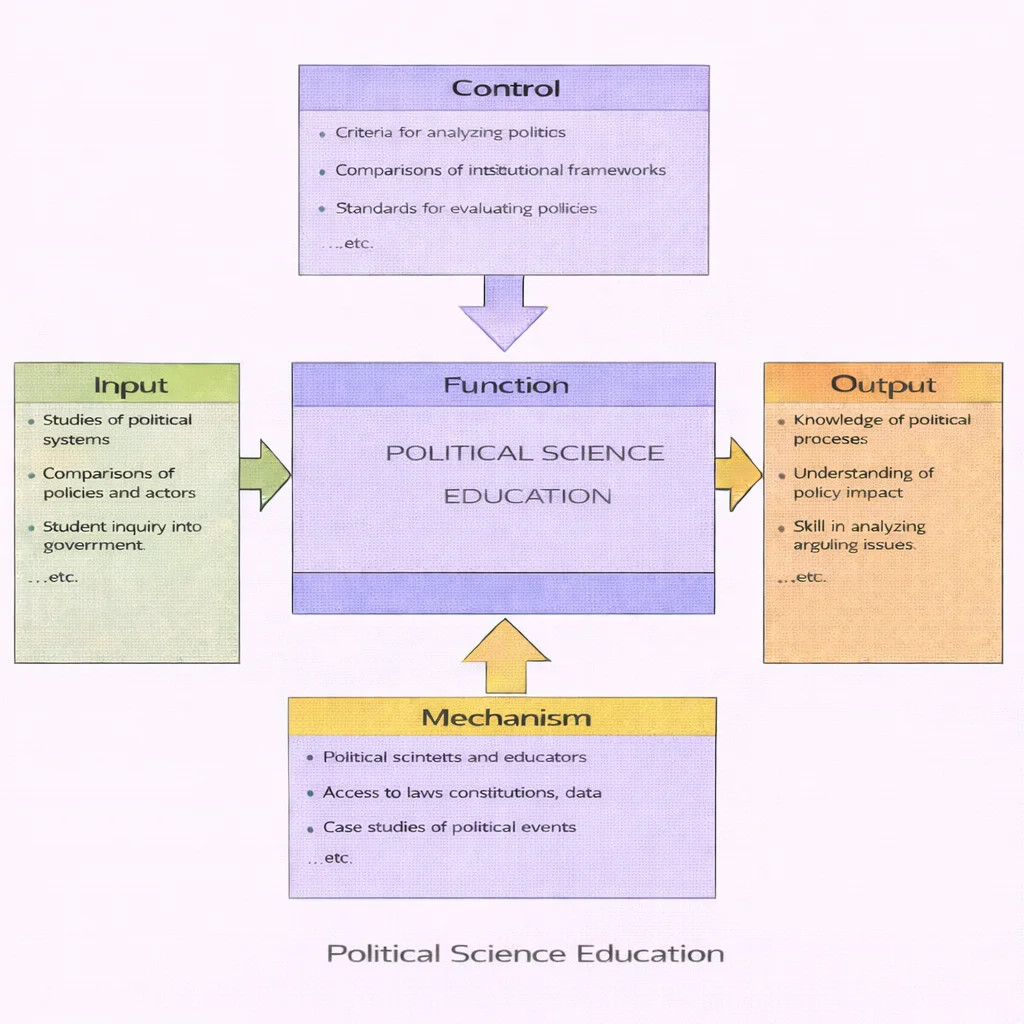
Political Science Education can be understood as a disciplined way of turning curiosity about power into clear thinking about public life. As the diagram suggests, learners begin with concrete inputs—political systems, real policies, and the lived questions people ask about government—and then work within controls that keep inquiry honest: agreed criteria, institutional comparisons, and standards for judging policies. With the help of mechanisms such as educators, primary sources (laws, constitutions, data), and carefully chosen case studies, students gradually move from “what happened?” to “why did it happen, and what follows from it?” The outputs are not only knowledge of political processes, but also a practical ability to trace consequences, weigh competing arguments, and speak with evidence rather than impulse—skills that matter in university study and in everyday citizenship.
Political science examines the structure, function, and evolution of political systems and institutions. As part of the broader humanities and social sciences, it intersects deeply with fields like sociology, which explores the fabric of societies that political systems serve, and psychology, which sheds light on voter behavior, leadership traits, and group dynamics. Political science also shares philosophical roots with philosophy, especially in ethics, justice, and the social contract.
Understanding how power is distributed and exercised also involves engagement with religious studies, as religion often shapes political ideologies, laws, and civic identity. In a globalized world, it is essential to relate political developments to international relations, where the interplay of diplomacy, conflict, and cooperation is crucial. Cultural context from literature also helps illuminate how political thought is expressed and contested across narratives and histories.
In contemporary contexts, political science increasingly interacts with emerging technologies. The rise of surveillance, digital campaigning, and algorithmic governance brings the field into close dialogue with information technology and artificial intelligence and machine learning. Governance models must now adapt to questions raised by robotics and autonomous systems as well as the vulnerabilities exposed by cybersecurity.
The use of political data, polling, and electoral modeling draws upon data science and analytics and engages with internet and web technologies, where digital platforms shape public discourse. Quantitative tools from mathematics and statistics are essential for analyzing voting behavior, public opinion, and resource allocation.
Political scientists also examine the role of physical and environmental infrastructure in shaping public policy. The deployment of satellite technology for global communications or climate monitoring has major geopolitical implications. Likewise, the impact of earthquake and disaster engineering on policy responses, or how urban and regional planning reflects political priorities, further illustrates the subject’s reach.
As sustainable development becomes a political imperative, fields such as IoT and smart technologies, renewable energy, and environmental engineering increasingly inform legislative agendas and international agreements. Likewise, issues of equity and efficiency play out in innovations like green building or smart manufacturing, where regulatory and ethical considerations intersect.
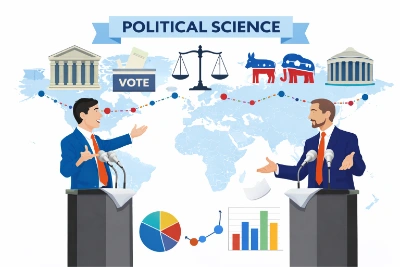
Understanding Power: Governance, Institutions, and Political Systems
Political Science examines how power is organised, exercised, and contested within and between societies. It explores institutions, governance structures, public policies, and political behaviour. Studying this field helps us understand how decisions are made, how authority is legitimised, and how societies seek order, justice, and stability.
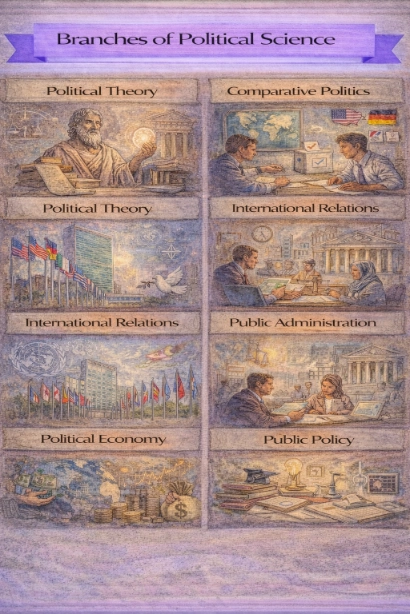
Branches of Political Science
Political science is divided into several key subfields, each focusing on a specific aspect of politics and governance:
Political Theory
- Definition: Explores the philosophical foundations of politics, examining ideas like justice, freedom, equality, and authority.
- Key Questions:
- What is the best form of government?
- How should power and resources be distributed?
- Classical Theories: Plato’s Republic and Aristotle’s Politics explore the nature of justice and the ideal state.
- Modern Theories: John Locke’s natural rights laid the groundwork for liberal democracies, while Karl Marx critiqued capitalism to envision a classless society.
Comparative Politics
- Definition: Studies and compares political systems, institutions, and practices across different countries.
- Key Topics:
- Types of governments: Democracies, autocracies, and monarchies.
- Electoral systems: Proportional representation vs. first-past-the-post.
- Political culture: Influence of societal norms on governance.
- Examples: Comparing the federal systems of the US and Germany, or examining democratic transitions in South Africa.
International Relations
- Definition: Focuses on interactions between nations, international organizations, and global actors.
- Key Areas: Diplomacy, war, peacekeeping, globalization, and economic interdependence.
- Examples: Analyzing Cold War state dynamics and evaluating multilateral treaties on climate change.
Public Administration
- Definition: Examines the implementation of government policies and the inner functioning of bureaucracies.
- Key Topics: Policy analysis, ethics in public service, public sector management, and administrative accountability.
Political Economy
- Definition: Studies the relationship between politics and economics, analyzing how political decisions affect financial systems and trade.
- Key Topics: Wealth distribution, income inequality, global trade agreements, and fiscal regulation.
Public Policy
- Definition: Focuses on the creation, implementation, and evaluation of public legislation and societal initiatives.
- Key Topics: Healthcare policy, education reform, climate regulation, and cost-benefit analysis.
Methods in Political Science
Political science employs a variety of methods to analyze political phenomena, blending qualitative and quantitative approaches:
- Quantitative Analysis: Uses statistical tools to study voting patterns, polling data, and economic policy impacts.
- Case Studies: In-depth examinations of specific events, legislative acts, or democratic transitions.
- Comparative Methods: Systematically comparing political structures across nations to isolate causal factors.
- Historical Analysis: Exploring the historical evolution of political institutions and ideological movements.
- Behavioral Approaches: Investigating psychological and social drivers influencing individual voter choices.
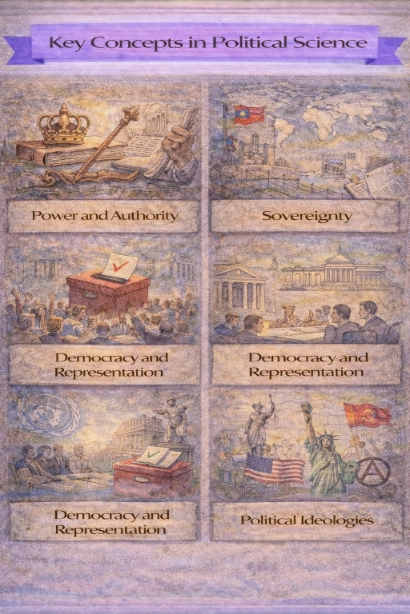
Key Concepts in Political Science
- Power and Authority: Power is the capacity to influence outcomes; Authority is legitimate power recognized by society (Traditional, Charismatic, Legal-Rational).
- Sovereignty: The fundamental principle of supreme independent authority over a geographic territory and population.
- Democracy and Representation: Systems centered on popular participation, evaluating direct versus representative governance models.
- Political Ideologies: Structured belief systems (Liberalism, Conservatism, Socialism, Anarchism) that outline ideal social orders.
Applications of Political Science
- Governance and Public Administration: Informing the structural design of electoral systems and legislative bodies.
- Policy-Making: Creating evidence-based solutions for economic regulation, environmental stewardship, and healthcare.
- Conflict Resolution: Providing frameworks for international mediation, peacekeeping, and diplomatic negotiation.
- Civic Education: Fostering informed democratic participation by explaining rights, duties, and institutional checks.
Contemporary Issues & Future Directions
Modern political science grapples with major shifts: Globalization challenging traditional state borders, the rise of Populism and Authoritarianism testing democratic institutions, Climate Politics demanding international cooperation, and Digital Surveillance re-defining cybersecurity and civil liberties. Future research increasingly relies on interdisciplinary big data modeling, computational polling, and decolonized non-Western analytical frameworks.
Why Study Political Science
1. Understanding How Power and Governance Operate in Society
Political science provides a critical foundation for analyzing political institutions, public decision-making, and how authority is established, maintained, or challenged.
2. Exploring Political Ideologies, Systems, and Institutions
Students compare democracies, monarchies, and authoritarian regimes while assessing how ideologies shape real-world public policy and institutional design.
3. Analyzing Policy, Law, and Global Affairs
It equips learners to evaluate complex policy areas—such as healthcare, national defense, and international diplomacy—providing tools to address transnational global crises.
4. Developing Critical Thinking, Research, and Communication Skills
The discipline cultivates rigorous data interpretation, qualitative analysis, objective reasoning, and structured debate necessary for civic engagement.
5. Preparing for Careers in Public Service, Law, and Policy
A degree opens direct pathways to legal practice, public administration, international diplomacy, political journalism, and non-profit advocacy.
Political Science: Conclusion
Political science remains an indispensable field for decoding the complexities of modern governance, power distribution, and public policy. By integrating empirical methodology with theoretical inquiry, the discipline equips citizens and leaders with the analytical tools needed to build transparent, effective, and just institutions in an interconnected world.
Interactive Electoral System Simulator (First-Past-The-Post vs Proportional)
Electoral system design radically alters political power distribution. In a Proportional Representation (PR) system, seats equal popular vote share. In a First-Past-The-Post (FPTP) system, district concentrations create electoral distortions:
Is Political Science Right For You?
Explore career pathways, check your fit, and assess your skills — before you commit to a degree.
Interactive Political Science Deep-Dives (Toggle to Reveal)
What is Duverger’s Law, and how does it explain party system structures?
How does the Principal-Agent Problem manifest within public administration?
Frequently Asked Questions
What is political science as a field of study?
Political science is the systematic study of power, government, and public life. It examines how political institutions work, how decisions are made, how citizens and groups try to influence those decisions, and how ideas about justice, authority, and rights shape political systems across time and place.
How is political science different from everyday politics or civic education?
Everyday politics involves campaigns, elections, news, and public debates. Civic education teaches basic rights, responsibilities, and structures of government. Political science goes further by asking analytical questions, testing explanations with evidence, and comparing different systems.
What are the major subfields within political science?
Major subfields include comparative politics, international relations, political theory, public policy, public administration, and political economy.
What topics can students expect to study in political science?
Students study constitutions, electoral systems, political parties, interest groups, voting behavior, bureaucracy, public policy, and international relations.
What research methods are used in political science?
Methods include quantitative statistical analysis, survey research, qualitative case studies, archival analysis, and formal political modeling.
How does political science relate to economics, sociology, and history?
It draws on economics for policy analysis, sociology for societal behavior, history for institutional origins, and law for constitutional structures.
Is political science a heavily statistical subject?
Some branches (like behavioral polling) use advanced statistics, while others (like political theory) rely entirely on qualitative argument analysis.
How does political science deal with bias and personal values?
It enforces systematic empirical research methods, objective hypothesis testing, transparent peer review, and logical argument evaluation.
Why is it useful to study political science today?
It equips citizens to analyze news objectively, understand legislative trade-offs, evaluate campaign claims, and make informed democratic decisions.
What skills do students gain from studying political science?
Critical reading, data interpretation, policy evaluation, persuasive writing, qualitative research, and structured debate.
What kinds of careers can political science prepare students for?
Public service, legal practice, policy consulting, journalism, international advocacy, intelligence analysis, and corporate public affairs.
How can students prepare for university-level political science?
By following global news from diverse perspectives, studying history, practicing analytical essay writing, and reviewing basic statistical concepts.
Comprehensive Political Science Practice Module
Part 1: Foundational Review Questions
-
What is political science and what are its primary areas of study?
Answer: Political science is the systematic study of government, power distribution, and political behavior. Its primary areas include comparative politics, international relations, political theory, public administration, political economy, and public policy. -
How do political theories contribute to our understanding of governance?
Answer: Political theories offer conceptual frameworks to evaluate state legitimacy, human rights, justice, and authority, guiding constitutional design and policy ethics. -
What methods do political scientists use to study political behavior?
Answer: Researchers utilize quantitative survey polling, statistical regression modeling, qualitative case studies, archival research, and field experiments. -
How does comparative politics help in understanding different governmental systems?
Answer: It contrasts democratic, autocratic, federal, and unitary systems across nations to isolate causal variables behind political stability and policy outcomes. -
What is the importance of international relations in contemporary political science?
Answer: It analyzes sovereign state interactions, diplomacy, security treaties, trade interdependencies, and global governance mechanisms addressing transnational issues. -
How do political institutions affect the functioning of a state?
Answer: Institutions establish formal legal rules, balance powers among branches, structure incentives, and maintain bureaucratic predictability. -
What major challenges do modern democracies face according to political science research?
Answer: Severe political polarization, erosion of institutional trust, algorithmic misinformation, campaign finance distortions, and populist authoritarian movements. -
How does public policy analysis contribute to political science?
Answer: It provides empirical cost-benefit tools to evaluate legislative effectiveness, administrative efficiency, and socio-economic equity. -
What role do political ideologies play in shaping policy outcomes?
Answer: Ideologies provide systematic values (e.g., state intervention vs. free markets) that dictate legislative prioritization and resource distribution. -
How has globalization impacted political science and international relations?
Answer: It has weakened absolute state sovereignty, elevated non-state multinational actors, and required cooperative global governance models.
Part 2: Analytical & Scenario-Based Questions
-
How do evolving political ideologies shape the future direction of global governance?
Answer: Emerging ideologies challenge existing post-WWII multilateral frameworks, demanding reformed international law to address global inequality and climate crises. -
In what ways can interdisciplinary approaches enhance political analysis?
Answer: Integrating economics, sociology, and data science allows political scientists to account for financial shocks, demographic shifts, and digital voter manipulation simultaneously. -
How does the concept of state sovereignty evolve in an interconnected world?
Answer: Absolute Westphalian sovereignty shifts to pooled sovereignty as states surrender partial autonomy to international bodies (e.g., EU, UN) to manage cross-border crises. -
What challenges do researchers face when evaluating political behavior on digital platforms?
Answer: Algorithmic opacity, data privacy restrictions, micro-targeted echo chambers, and distinguishing real human activity from automated social media bots. -
How can historical perspectives on political movements inform modern polarization strategies?
Answer: Analyzing historical periods of factional crisis (e.g., 19th-century electoral shifts) highlights how institutional safeguards and cross-party coalitions restore stability. -
How do political institutions evolve in response to changing societal needs?
Answer: Through constitutional amendments, administrative reform, and legal precedents driven by public advocacy and economic transformations. -
How does public opinion research enhance legislative decision-making?
Answer: It provides empirical feedback loops to representatives, ensuring legislative initiatives align with constituent preferences and civil expectations.
Part 3: Quantitative Political & Electoral Calculations
-
Gallagher Index of Electoral Disproportionality: In a 3-party election, Party A receives 40% of votes and 50% of seats; Party B receives 30% of votes and 30% of seats; Party C receives 30% of votes and 20% of seats. Calculate the Gallagher Index LSq.
Solution: LSq = √ [ 0.5 × Σ (Vi - Si)2 ]
Diff A: (40 - 50)2 = 100
Diff B: (30 - 30)2 = 0
Diff C: (30 - 20)2 = 100
Sum = 100 + 0 + 100 = 200
LSq = √ [ 0.5 × 200 ] = √100 = 10.0%. -
Effective Number of Parliamentary Parties (Laakso-Taagepera Index): In a parliament, three parties hold seat fractions s1 = 0.50, s2 = 0.30, and s3 = 0.20. Calculate the Effective Number of Parties N.
Solution: N = 1 / Σ (si2)
s12 = 0.25, s22 = 0.09, s32 = 0.04
Sum = 0.25 + 0.09 + 0.04 = 0.38
N = 1 / 0.38 ≈ 2.63 effective parties. -
Simple Majority Voting Threshold: A legislative body has 435 voting members. Calculate the minimum integer number of votes required to pass a bill requiring a simple majority of 50% + 1 vote.
Solution: Votes = Floor(435 / 2) + 1 = 217 + 1 = 218 votes. -
Electoral Quota (Droop Quota): A proportional representation district has V = 100,000 valid votes cast and D = 4 legislative seats available. Calculate the Droop Quota Q required for a party to win a seat.
Solution: Q = Floor[ V / (D + 1) ] + 1
Q = Floor[ 100,000 / (4 + 1) ] + 1 = Floor[ 20,000 ] + 1 = 20,001 votes. -
Survey Polling Margin of Error: A political survey samples n = 1,000 voters with an observed proportion p = 0.50 at a 95% confidence level (Z = 1.96). Calculate the Margin of Error MOE.
Solution: MOE = Z × √ [ (p(1 - p)) / n ]
MOE = 1.96 × √ [ (0.50 × 0.50) / 1000 ] = 1.96 × √ [ 0.00025 ] = 1.96 × 0.01581 ≈ 0.031 (or ±3.1%). -
Banzhaf Power Index: In a 3-person coalition voting system with total weight 100 and quota 51, Person A has 50 votes, Person B has 40 votes, and Person C has 10 votes. Identify the number of critical winning coalitions where Person A is decisive.
Solution: Winning coalitions: {A,B} (wt 90), {A,C} (wt 60), {A,B,C} (wt 100).
In {A,B}, removing A leaves 40 (<51) ⇒ A is critical.
In {A,C}, removing A leaves 10 (<51) ⇒ A is critical.
In {A,B,C}, removing A leaves {B,C} wt 50 (<51) ⇒ A is critical.
Person A is a critical voter in 3 winning coalitions. -
Turnout Percentage Calculation: A district contains 250,000 registered voters. On election day, 162,500 ballots are cast. Calculate the voter turnout percentage.
Solution: Turnout = (162,500 / 250,000) × 100 = 65.0%.
Humanities & Social Sciences Curriculum Cluster
Explore related disciplines within the Prep4Uni Humanities and Social Sciences pathway to build a well-rounded foundation for university-level study.
Humanities & Social Sciences Hub
The central portal connecting foundational theories, methodological frameworks, and interdisciplinary pathways across human culture and society.
Anthropology
Examines human societies and cultural diversity, showing how localized cultural customs influence political organization and authority.
Cultural Studies
Investigates media, identity, and power, examining how public narrative and digital campaigns shape modern political discourse.
History
Traces past political movements, institutional shifts, and state formations to provide necessary historical context for modern governance.
International Relations
Focuses on state interactions, diplomacy, security, and global treaties, extending domestic political science to the international arena.
Linguistics
Analyzes formal language structure, providing tools for discourse analysis, political rhetoric, and political speech evaluation.
Literature
Explores how narrative prose and drama critique state power, social hierarchies, and ideological struggles across history.
Philosophy
Provides theoretical roots for political theory, exploring ethics, justice, liberty, social contract theory, and rights.
Political Science
The systematic study of governance, power distribution, electoral systems, public policy, and political institutions.
Psychology
Examines cognitive processing, group dynamics, and behavioral drivers behind voting, leadership choices, and public polling.
Religious Studies
Investigates how religious faith traditions influence legal frameworks, civic identity, and political party platforms.
Sociology
Analyzes social stratification, class, and institutional structures that define the civil environments political systems govern.