
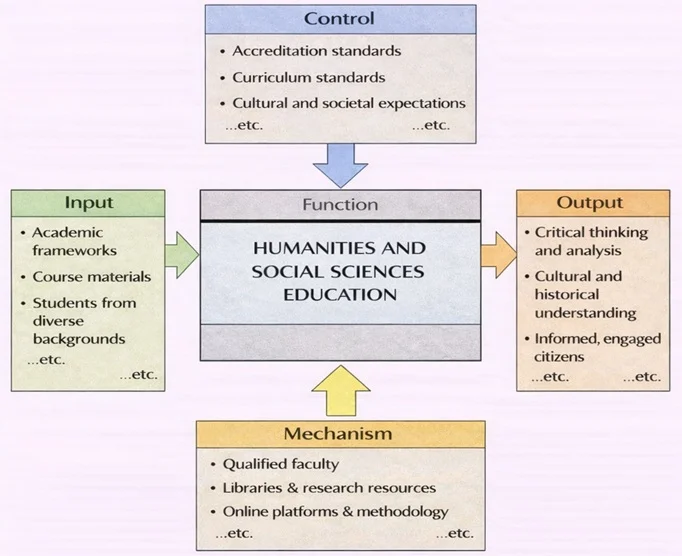
Humanities and Social Sciences Education can be seen as a purposeful learning function that turns curiosity into disciplined understanding of people, culture, and society. The inputs include academic frameworks that provide lenses for interpretation, course materials that supply evidence and ideas, and students from diverse backgrounds who bring lived experience and fresh questions into the classroom. The process is shaped by controls such as accreditation standards and curriculum standards, but also by cultural and societal expectations—because these fields do not only answer academic questions; they also respond to what communities care about, debate, and remember. The function is enabled by mechanisms: qualified faculty who guide inquiry and dialogue, libraries and research resources that anchor claims in reliable sources, and online platforms and methodology that broaden access and strengthen research practice. When these elements work together, the outputs are not merely content knowledge, but lasting capabilities—critical thinking and analysis, cultural and historical understanding, and the growth of informed, engaged citizens who can interpret complexity rather than fear it.
Humanities and Social Sciences form the living heart of our understanding of people, culture, and the shared spaces we call society. They invite us to explore how we think, feel, believe, create, and govern, weaving together lessons from history, art, ethics, and human interaction. Through these disciplines, we learn not only to interpret the past and understand the present, but also to imagine fairer, wiser futures.
In sociology, we uncover how families, communities, and nations shape identity and behavior. In psychology, we enter the intricate landscapes of thought, emotion, and motivation. Both perspectives deepen our grasp of what it means to live and act as part of a larger human story.
Belief systems and values come into focus through religious studies and philosophy. These fields sharpen our capacity to question, reason, and reflect on existence, morality, and purpose. Literature complements them by opening doors to empathy and cultural insight through storytelling and symbolic expression.
The political dimensions of life are explored in political science and international relations. These disciplines illuminate how governance, diplomacy, and global cooperation can resolve conflict, promote justice, and respond to crises — skills urgently needed in a rapidly changing world.
Today’s human-centered inquiry must also consider science and technology. Topics such as emerging technologies, information technology, robotics, cybersecurity, and data science are transforming economies, communities, and values — raising questions about ethics, equity, and human well-being.
The built environment links people with place through urban and regional planning and environmental engineering. These areas, along with satellite technology and disaster engineering, remind us that innovation must always account for cultural context and human needs.
New frontiers such as the Internet of Things and renewable energy connect technical progress with everyday life. When informed by statistics, behavioral understanding, and the humanistic lens, these advances can be harnessed for the greater good.
In a connected age, bridging the human and the technological has become a defining challenge. The integration of internet and web technologies, green building, and smart manufacturing with socially aware thinking ensures that progress remains sustainable, inclusive, and meaningful.

A richly detailed, colorful illustration showing a world globe at the center with the words “Humanities / Social Sciences.” Around it are students and researchers reading, writing, and using a laptop, alongside open books and academic symbols. Classical architecture and statues suggest history and philosophy, while charts, graphs, gears, and interconnected diagrams suggest research methods, social analysis, and data-informed thinking—together portraying how these fields study people, societies, and meaning from many angles.
Choose a Doorway into the Humanities and Social Sciences
Step into a world of inquiry that unites the past, present, and future of human thought and society. Explore our second-level sub-hubs and related interdisciplinary pathways using the comprehensive roadmap below.
Explore Discipline Sub-Hubs & Interdisciplinary Clusters:
Anthropology
Discover the rich diversity of human cultures, past and present. Anthropology bridges human biology, history, and social practice to explain cultural variation and identity.
Cultural Studies
Examine how media, popular culture, and power structures interlock to shape social identities, everyday practices, and modern ideological debates.
History
Trace the rise and fall of civilizations, political transformations, and socio-economic shifts to understand how past decisions construct our contemporary world.
International Relations
Investigate how sovereign states, non-governmental actors, and global alliances interact through diplomacy, trade, conflict resolution, and global governance.
Linguistics
Unlock the scientific analysis of language syntax, phonetics, semantics, and sociolinguistic evolution as a cognitive and cultural tool.
Literature
Analyze literary narratives, poetry, and drama to examine empathy, symbolic representation, human motives, and social critique across historical eras.
Philosophy
Engage with rigorous debates surrounding epistemology, ethics, logic, and metaphysics to build strong normative and analytical reasoning skills.
Political Science
Analyze governance structures, constitutional frameworks, political behavior, policy formulation, and the dynamics of institutional authority.
Psychology
Investigate human mental processes, emotional development, cognitive mechanisms, and behavioral dynamics using empirical research methodology.
Religious Studies
Compare global theological systems, sacred traditions, ritual practices, and institutional religions within comparative historical contexts.
Sociology
Evaluate structural inequalities, institutional dynamics, social stratification, family systems, and macro-level community organizations.
Stories Beyond History
A reflective archival series highlighting personal testimonies, unsung figures, and community narratives overlooked in traditional historical textbooks.
See the Bigger Picture
The humanities and social sciences do not stand alone—they are threads woven through the broader fabric of knowledge. Connect insights across disciplines to uncover ideas that enrich your understanding from fresh angles:
Arts, Design & Media
Explore creative expression across visual arts, music, theatre, and design—where imagination meets cultural influence.
Business, Economics & Law
Understand how markets, economic policy, legal frameworks, and regulatory systems shape society.
Education
Examine how people learn, how pedagogical methodologies evolve, and how educational equity impacts future generations.
Health
Discover how physical, mental, and social health determinants interlock to influence community well-being.
STEM
Dive into scientific inquiry, technological innovation, engineering design, and mathematical modeling.
Courses
Access structured university prep pathways, comprehensive syllabi, and practice materials across diverse subjects.
Key Areas of Focus of Humanities and Social Sciences
🔸 Understanding Human Culture
Explore the richness of human expression through literature, visual and performing arts, religion, and philosophy. These disciplines offer insights into cultural identity, moral frameworks, and the creative spirit that shape civilizations.
🔸 Examining Societal Structures
Analyze how societies are organized, governed, and transformed over time. Topics such as political systems, social institutions, economic frameworks, and historical movements help students understand the dynamics of collective human life.
🔸 Analyzing Human Relationships
Investigate the nature of interpersonal, societal, and intercultural relationships. Disciplines like sociology, psychology, and anthropology help explain communication, behavior, social cohesion, and the pursuit of social progress.
Applications of Humanities and Social Sciences
🔸 Academic and Professional Relevance
The humanities and social sciences provide essential foundations for careers in education, public policy, international relations, journalism, cultural heritage, and community development. These disciplines cultivate a deep understanding of human behavior, historical context, and societal challenges—skills highly valued across sectors.
🔸 Real-World Problem Solving
From addressing social inequality to interpreting political events and designing inclusive policies, knowledge from the humanities and social sciences supports thoughtful analysis and ethical decision-making. It fosters a holistic view of complex issues, enriching public discourse and civic engagement.
Core Skills Developed by Studying Humanities and Social Sciences
🔸 Critical and Reflective Thinking
Students learn to analyze arguments, assess evidence, and challenge assumptions. This strengthens independent thinking and intellectual curiosity—key qualities for academic success and informed citizenship.
🔸 Effective Communication
Reading comprehension, essay writing, debate, and presentation skills are central. Students develop the ability to articulate complex ideas clearly and persuasively across diverse formats and audiences.
🔸 Cultural and Ethical Awareness
Studying global cultures, belief systems, and historical perspectives nurtures empathy, tolerance, and intercultural understanding—crucial for today’s interconnected world.
How Humanities and Social Sciences Prepare You for University
The interdisciplinary and inquiry-based nature of humanities and social sciences aligns closely with university-level expectations. These subjects encourage independent research, interpretive analysis, academic writing, and evidence-based reasoning—forming a strong foundation for a wide range of university majors.
Moreover, early exposure to diverse disciplines allows students to refine their academic interests and career goals. It also strengthens their readiness for coursework in liberal arts, education, communication, and the social sciences.
Lifelong Relevance of Humanities and Social Sciences Beyond University
Humanities and social sciences don’t just prepare students for exams—they prepare them for life. The intellectual habits formed through studying human culture and society continue to guide lifelong learning, civic participation, and professional adaptability in a rapidly changing world.
Why Study Humanities and Social Sciences
Understanding Human Experience Across Time and Cultures
Humanities and social sciences explore the ways people think, behave, create, and interact within societies. These disciplines—including history, literature, philosophy, sociology, anthropology, political science, and more—help students examine the complexity of human life through multiple lenses. For students preparing for university, studying the humanities and social sciences offers a rich foundation for understanding cultural heritage, ethical values, and the forces that shape our world.
Building Critical Thinking and Analytical Skills
One of the central goals of the humanities and social sciences is to foster independent and reflective thought. Students learn to analyze texts, debate ideas, interpret evidence, and evaluate arguments. These skills are highly transferable to university coursework across disciplines and are essential for informed citizenship, academic success, and lifelong learning.
Strengthening Communication and Persuasive Writing
Studying these fields helps students express their ideas clearly and persuasively in both spoken and written form. Whether crafting an analytical essay, delivering a presentation, or engaging in dialogue, students develop the ability to communicate complex ideas with precision and clarity. These abilities are foundational for success in university and vital in careers that require effective interpersonal or public communication.
Exploring Social Structures, Inequality, and Global Challenges
Social sciences in particular encourage students to investigate how societies function and how issues such as inequality, governance, identity, and globalization influence our lives. By studying real-world problems through economic, political, and cultural frameworks, students are better equipped to understand and contribute to the world around them. This engagement nurtures civic responsibility and global awareness during their university journey.
Preparing for Diverse and Interdisciplinary Career Paths
A background in the humanities and social sciences prepares students for a wide range of careers in education, law, journalism, public policy, international relations, cultural preservation, and nonprofit leadership. It also provides a strong foundation for graduate studies and professional training. For students entering university, these disciplines offer both intellectual depth and real-world relevance, empowering them to think broadly, question deeply, and act thoughtfully in a rapidly changing world.
Interactive Module: Social & Academic Impact Simulator
Use the simulator below to model how allocations across educational mechanisms (Faculty Guidance, Digital Archives, and Policy Alignment) impact critical thinking capabilities, cultural literacy, and civic engagement outputs over a 10-year timeline.
Interactive Topic Exploration & Self-Check
Click on the questions below to test your baseline understanding of foundational humanities and social science concepts:
What distinguishes the methodological approach of Humanities from Social Sciences?
How does interdisciplinary study between STEM and Humanities benefit public policy?
Why is empirical data literacy increasingly essential for social scientists?
Frequently Asked Questions
What are the humanities and social sciences?
The humanities and social sciences are fields that study people, ideas, cultures, societies, and institutions. Humanities subjects such as history, philosophy, literature, and cultural studies explore how people make meaning through language, art, and belief. Social sciences such as sociology, economics, politics, geography, and anthropology analyse patterns in human behaviour and social structures using evidence, theory, and critical reasoning.
How does the Humanities and Social Sciences hub on Prep4Uni.online support university preparation?
The Humanities and Social Sciences hub brings together core concepts, case studies, and guiding questions from many disciplines, helping you see connections between history, politics, economics, culture, and media. It is designed to build skills that universities value: critical reading, structured argument, comparative thinking, and the ability to relate abstract theory to real-world examples.
What school subjects are most relevant if I want to study humanities or social sciences at university?
Subjects such as history, geography, literature, social studies, economics, and a second language are particularly relevant. However, mathematics and science can also be helpful for data analysis, research methods, and understanding contemporary issues like climate change or technology policy. Strong reading, writing, and communication skills are essential across all humanities and social science pathways.
What types of degrees and careers can grow out of humanities and social sciences?
Degrees might include history, political science, economics, sociology, psychology, international relations, cultural studies, media studies, philosophy, or area studies. Graduates work in education, public service, diplomacy, journalism, cultural institutions, non-governmental organisations, business and management, policy analysis, marketing, consulting, and many emerging roles that require strong analytical and communication skills.
Why are critical thinking and argumentation so central in these disciplines?
Humanities and social sciences often deal with complex questions that do not have a single correct answer. You are expected to evaluate sources, compare interpretations, and construct a reasoned argument supported by evidence. Critical thinking helps you spot assumptions, clarify concepts, weigh trade-offs, and explain why one explanation is stronger than another instead of just memorising facts or opinions.
How do humanities and social sciences help me understand current global issues?
Global issues such as inequality, climate change, migration, public health, technological disruption, and cultural conflicts are shaped by history, institutions, and ideas. Humanities and social science perspectives help you trace where these issues come from, whose voices are heard or ignored, how policies are made, and how media narratives shape public opinion. This gives you tools to interpret the news more critically and to imagine alternative futures.
How is evidence used in humanities compared with social sciences?
In the humanities, evidence may include texts, artworks, archival sources, and cultural practices, and the focus is often on close reading, interpretation, and context. In the social sciences, evidence may include surveys, statistics, interviews, field observations, and experiments, with more emphasis on patterns, models, and generalisations. The Humanities and Social Sciences hub helps you see how different disciplines ask questions and justify their claims.
What skills will I develop by exploring this Humanities and Social Sciences hub?
You will strengthen your skills in critical reading, summarising and paraphrasing complex texts, constructing arguments, evaluating evidence, comparing case studies, and writing clearly for different audiences. You will also practise connecting ideas across subjects, such as linking economic history to political institutions, or cultural geography to migration and urban planning.
How can I use the pages in this hub to prepare for essay-based assessments?
You can use the overview sections to identify key themes, then turn the guiding questions into practice essay prompts. Try planning short outlines, identifying relevant examples from history, politics, law, media, or culture, and drafting thesis statements with two or three supporting points. Reviewing feedback from your teachers alongside the material on Prep4Uni.online will help you refine structure, clarity, and use of evidence.
How do humanities and social sciences connect to quantitative skills and data analysis?
Many social science disciplines, such as economics, political science, and sociology, use data to test hypotheses and evaluate policies. Even in more text-focused subjects, you may encounter charts, survey findings, or demographic data. Learning basic statistics and data literacy helps you interpret evidence, question causal claims, and engage with research critically rather than accepting numbers at face value.
What if I enjoy both STEM subjects and humanities or social sciences?
Enjoying both areas can be a strength. Many real-world problems, such as climate adaptation, urban design, digital ethics, or health policy, require combined insights from STEM and the humanities and social sciences. You might consider interdisciplinary paths such as philosophy of science, science communication, environmental policy, digital humanities, or data science applied to social questions, and use this hub to explore those bridges.
How should I navigate the Humanities and Social Sciences hub on Prep4Uni.online?
Start with the main Humanities and Social Sciences overview, then explore linked pages such as history, cultural studies, media and communication, economics, law, and geography. For each page, skim the introduction, identify key concepts, and try a few review or reflection questions. Over time, you can build a personal map of how different topics connect, which will help you choose future courses and keep your learning coherent rather than scattered.
Comprehensive Learning & Assessment Module
Section 1: Foundational Mastery Questions
- What is the primary significance of studying humanities and social sciences in university education?
Answer: Studying humanities and social sciences provides a deep, evidence-based understanding of human culture, history, and social structures. It fosters critical thinking, qualitative and quantitative analysis of societal issues, empathy, and an appreciation for diverse perspectives, equipping students for informed citizenship and public policy engagement. - How do humanities disciplines specifically contribute to our understanding of human culture?
Answer: Humanities disciplines (such as literature, philosophy, and history) analyze cultural and intellectual artifacts, narrative traditions, and ethical frameworks. They help trace the moral and conceptual evolution of societies, offering historical and textual context for contemporary social debates. - What role does empirical research play in the social sciences when addressing societal challenges?
Answer: Empirical research in the social sciences uses quantitative surveys, data analytics, interviews, and observational studies to identify systemic patterns in human behavior. These findings supply objective evidence needed to evaluate social programs, shape public policy, and mitigate socio-economic inequality. - In what ways does philosophical inquiry enhance critical thinking and decision-making?
Answer: Philosophical inquiry challenges individuals to systematically question underlying assumptions, evaluate logical arguments, and analyze moral dilemmas. This strengthens intellectual rigor, enables structured debate, and improves normative decision-making across complex policy domains. - How do history and literature complement each other in illuminating the human condition?
Answer: History provides factual records, structural chronologies, and institutional analyses of past events, while literature captures subjective emotional realities, moral conflicts, and cultural voices. Together, they offer a holistic understanding of how human beings experience societal shifts. - Why is cultural diversity essential to the development of robust social science frameworks?
Answer: Cultural diversity prevents ethnocentric bias by introducing varied models of social organization, kinship, authority, and value systems. Incorporating diverse perspectives ensures social theories and policy solutions are globally applicable and culturally equitable. - How does globalization impact research priorities within humanities and social sciences?
Answer: Globalization shifts research focus toward transnational movements, cross-cultural exchange, migration, global trade policy, and digital communication networks, requiring interdisciplinary and comparative research frameworks. - What are the core educational benefits of engaging with classical texts in modern curricula?
Answer: Classical texts expose students to foundational philosophical debates and historical ideas that shaped modern institutions. Analyzing these complex texts strengthens close reading, textual criticism, and conceptual synthesis skills.
Section 2: Analytical & Scenario-Based Inquiry
- How is the emergence of digital humanities transforming traditional archive research and literary criticism?
Answer: Digital humanities integrates computational methodologies (such as natural language processing, text mining, digital mapping, and database visualization) with qualitative criticism. This allows scholars to analyze massive text corpora, discover broad thematic trends across centuries, and democratize access to historical primary sources. - In what ways can an interdisciplinary synthesis of sociology, economics, and political science address urban housing crises?
Answer: Economics evaluates market supply, demand dynamics, and subsidies; political science analyzes zoning policies, municipal governance, and regulation; sociology examines community displacement, racial segregation, and social cohesion. Combining these perspectives produces equitable and realistic housing policy designs. - How does algorithmically driven social media content alter public perception of social science research?
Answer: Social media accelerates the dissemination of research but often distorts nuanced findings into sensationalized headlines or echo chambers. To mitigate misinterpretation, social scientists must engage in public science communication, publishing accessible summaries while maintaining research integrity. - Analyze how historical context informs modern legal debates regarding artificial intelligence and copyright law.
Answer: Historical examination of past technological disruptions (such as the printing press, photography, and radio broadcasting) reveals how legal frameworks previously balanced creator rights with public domain access, guiding modern jurists in designing novel AI intellectual property standards. - Evaluate the ethical implications of using utilitarian versus deontological frameworks in public health emergency allocations.
Answer: Utilitarian frameworks prioritize maximizing total saved lives (focusing on aggregate outcomes), whereas deontological frameworks emphasize individual rights, duty, and equal access regardless of utility. Balancing these ethical theories prevents discrimination against vulnerable groups during resource scarcity. - How do changes in global migration patterns challenge traditional nation-state concepts in international relations?
Answer: Transnational migration creates dual citizenship, diaspora networks, and multicultural identity spaces that complicate strict territorial sovereignty concepts, compelling political scientists to redefine national identity, border management, and international human rights governance. - In what ways can educational systems restructure humanities curricula to foster civic resilience against disinformation?
Answer: Curricula can integrate source evaluation, media literacy, formal logic, and historiography. Teaching students to analyze authorial bias, evidence provenance, and argumentative coherence equips them to critically evaluate digital information streams.
Section 3: Applied Quantitative & Methodological Exercises
- In a university social science survey of N = 1,200 students, 360 respondents reported majoring in Humanities disciplines. Calculate the sample proportion (p) and compute the 95% confidence interval margin of error using standard normal approximation (±1.96).
Answer:Sample Proportion: p = 360 / 1200 = 0.30 (30%)
Standard Error (SE) = √[ p(1 - p) / N ] = √[ (0.30 × 0.70) / 1200 ] = √[ 0.21 / 1200 ] = √[ 0.000175 ] ≈ 0.01323
Margin of Error (ME) at 95% Confidence = 1.96 × SE = 1.96 × 0.01323 ≈ 0.0259 (or 2.59%)
Confidence Interval: 30% ± 2.59% (27.41% to 32.59%) - A educational grant of $500,000 is allocated between two humanities research mechanisms: Digital Archives (A) and Faculty Mentorship (M). If Mentorship receives $120,000 more than twice the amount allocated to Digital Archives, calculate the exact funding assigned to each mechanism.
Answer:Let A = Funding for Digital Archives and M = Funding for Mentorship.
System of equations:
1) A + M = 500,000
2) M = 2A + 120,000
Substitute Equation 2 into Equation 1:
A + (2A + 120,000) = 500,000
3A + 120,000 = 500,000
3A = 380,000
A = $126,666.67
Calculate M:
M = 500,000 - 126,666.67 = $373,333.33
Result: Digital Archives = $126,666.67; Mentorship = $373,333.33. - A sociological study tracks research publication output across a university department over 4 years. The counts are Year 1 = 40, Year 2 = 52, Year 3 = 68, Year 4 = 88. Assuming quadratic growth represented by P(t) = at2 + bt + c where t is year number, determine the constant second difference to confirm the model rate and calculate Year 5 output.
Answer:First Differences (Δ1):
Year 1 to 2: 52 - 40 = 12
Year 2 to 3: 68 - 52 = 16
Year 3 to 4: 88 - 68 = 20
Second Differences (Δ2):
16 - 12 = 4
20 - 16 = 4
Constant second difference Δ2 = 4, confirming quadratic growth.
Projecting Year 5 First Difference:
Δ1 (Year 4 to 5) = 20 + 4 = 24
Projected Year 5 Output = 88 + 24 = 112 publications. - Calculate the weighted mean score for a student's Humanities assessment portfolio with the following components: Historiography Essay (score = 85, weight = 30%), Literature Analysis (score = 92, weight = 25%), Philosophy Presentation (score = 78, weight = 20%), and Final Research Project (score = 88, weight = 25%).
Answer:Weighted Mean = (Score1 × Weight1) + (Score2 × Weight2) + (Score3 × Weight3) + (Score4 × Weight4)
Weighted Mean = (85 × 0.30) + (92 × 0.25) + (78 × 0.20) + (88 × 0.25)
Weighted Mean = 25.5 + 23.0 + 15.6 + 22.0 = 86.10
Final Weighted Portfolio Score: 86.10 / 100 - A public policy institute measures community civic participation index (CPI) as a function of annual educational public funding per capita (x in hundreds of dollars): CPI(x) = 40 + 12x - 0.8x2. Find the optimal per capita funding amount that maximizes civic participation.
Answer:This is a quadratic function f(x) = -0.8x2 + 12x + 40 with a = -0.8, b = 12.
The maximum vertex occurs at x = -b / (2a):
x = -12 / [ 2 × (-0.8) ] = -12 / (-1.6) = 7.5
Since x is in hundreds of dollars: 7.5 × $100 = $750 per capita.
Maximum CPI = 40 + 12(7.5) - 0.8(7.5)2 = 40 + 90 - 0.8(56.25) = 130 - 45 = 85 points.
Optimal Funding: $750 per capita yields a maximum CPI score of 85. - In a comparative linguistics study analyzing word frequency distribution in ancient texts, Concept A appears 450 times in 15,000 words, while Concept B appears 280 times in 8,000 words. Compute the relative frequency per 1,000 words for both concepts and determine which concept has a higher relative density.
Answer:Concept A Density = (450 / 15,000) × 1,000 = 0.030 × 1,000 = 30.0 occurrences per 1,000 words.
Concept B Density = (280 / 8,000) × 1,000 = 0.035 × 1,000 = 35.0 occurrences per 1,000 words.
Comparison: Concept B has a higher relative density (35.0 vs. 30.0 per 1,000 words). - An archaeological carbon-dating analysis uses the decay formula N(t) = N0 × e-λt. If an artifact retains 65% of its initial carbon-14 (N(t) / N0 = 0.65) and the decay constant λ ≈ 0.000121 per year, calculate the age of the artifact in years.
Answer:0.65 = e-0.000121t
Take natural logarithm (ln) of both sides:
ln(0.65) = -0.000121t
-0.430783 ≈ -0.000121t
t = -0.430783 / -0.000121 ≈ 3,560.19 years.
Estimated Age: Approximately 3,560 years old.