Prepare for University Studies & Career Advancement
Structure and Evolution of the Universe
The Structure and Evolution of the Universe explores the quantitative physical mechanisms through which the cosmos developed from an amorphous, hot, dense early state into the highly organized anisotropic network of galaxies, clusters, filaments, and voids observed today. It asks one of the most expansive questions in theoretical astrophysics: how did a nearly uniform primordial plasma fluid undergo structural phase transitions to form a complex cosmic web spanning billions of light-years?
This topic sits at the absolute analytical heart of modern cosmology. It bridges observational astronomy with theoretical high-energy physics, merging massive datasets from deep redshift surveys, weak gravitational lensing maps, the temperature power spectrum of the Cosmic Microwave Background, and expansion rate metrics to reconstruct the historical growth configuration of the universe.
The standard hot Big Bang Theory establishes the required thermodynamic background for analyzing this evolution. Rather than modeling an explosion of matter outward into an existing vacuum, it describes the uniform metric expansion and cooling of spacetime geometry. As the scale factor expanded, thermal kinetic energy fell below the ionization and binding thresholds of fundamental matter fields, neutral gas decoupled from radiation, and self-gravity slowly began to amplify microscale density perturbations into macroscale structures.
Over billions of years of cosmic time, gravity pulled matter into galaxies, galaxy clusters, and immense, thread-like filament structures. Complementing these high-density regions are expansive, empty volumes known as cosmic voids. This macroscale architecture is formally defined as the cosmic web, serving as definitive empirical proof that the universe evolved from a highly isotropic distribution into a complex, hierarchically clustered network.
The dynamics of this large-scale structural growth are governed by invisible mass-energy components that dominate contemporary cosmology. Non-baryonic dark matter operates as the primary gravitational scaffolding, establishing deep potential wells that pull ordinary baryonic matter into structural configurations long before decoupling. Conversely, the negative pressure profile of dark energy acts as a global anti-gravitational force, driving the accelerated expansion of the spacetime metric and altering how matter clusters over deep time.
Models of cosmic inflation provide the required initial conditions for this entire system. Inflationary theory dictates that a brief period of hyper-exponential space expansion stretched microscopic subatomic quantum fluctuations out to macroscopic scales. These scale-invariant quantum variations became the initial density perturbations that later seeded the formation of every galaxy and cluster in existence.
For university physics students, the fundamental premise is clear: the universe is a dynamically evolving system. Its modern large-scale structure is not an arbitrary or static arrangement, but the predictable mathematical product of gravity, dark matter, and radiation balancing against metric expansion over cosmic time.
Structure and Evolution of the Universe: illustrating the cosmic web, dark matter filaments, and the expansion of space from the Big Bang
Reflection: How Did the Universe Become Structured?
Use this prompt to connect the early universe with the cosmic web we observe today.
If the early universe was nearly uniform, how could it later form galaxies, clusters, filaments, and voids?
Your thinking prompt: Think about tiny early density differences, gravity, dark matter, expansion, and time.
Suggested reflection: The early universe was almost uniform, but not perfectly uniform. Tiny density differences existed. Gravity slowly amplified these differences, especially with the help of dark matter. Denser regions attracted more matter and eventually formed galaxies and clusters, while less dense regions became cosmic voids.
Key takeaway: The large-scale structure of the universe grew from tiny early fluctuations amplified by gravity over billions of years.
Formation of Cosmic Patterns and Growth
The structure and evolution of the universe explains how matter became organised into galaxies, galaxy clusters, filaments, and vast cosmic voids. This navigation section connects large-scale structure formation with the wider Cosmology cluster.
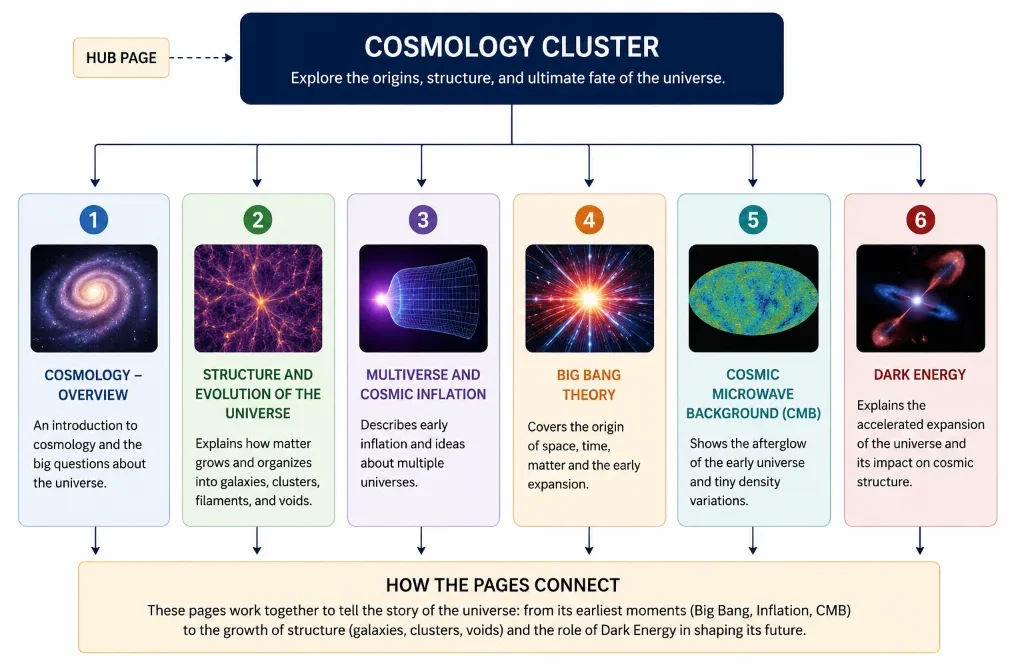
A structure chart showing how the main Cosmology pages connect, from the origin and early expansion of the universe to cosmic structure, the CMB, inflation, and dark energy.
This structure chart presents the Cosmology cluster as a connected set of learning pages. It shows Cosmology Overview as the hub page, linked to Structure and Evolution of the Universe, Multiverse and Cosmic Inflation, Big Bang Theory, Cosmic Microwave Background, and Dark Energy. The chart helps students see how these pages work together to explain the universe’s origin, early conditions, large-scale structure, expansion history, and possible future.
Provides the broad initial framework for cosmic evolution, including expansion, cooling, matter formation, and the early conditions for structure growth.
Modifies the long-term growth of cosmic structure by accelerating the expansion of the universe and changing how matter clusters over time.
The Fluid Mechanics of Gravitational Instability
To model the physical transformation of the universe from a smooth gas into a web-like configuration, astrophysics implements linear perturbation theory. A localized region of space with mass density \(\rho(\vec{x}, t)\) is evaluated relative to the uniform global background density \(\bar{\rho}(t)\) using a dimensionless parameter known as the <strong>density contrast</strong>, \(\delta\):
In an expanding FLRW background universe, the growth of this density contrast for a non-relativistic pressureless fluid component (such as cold dark matter) is governed by a second-order linear differential equation derived from fluid dynamics and Poisson’s field equation:
$$\ddot{\delta} + 2H(t)\dot{\delta} – 4\pi G \bar{\rho}_m(t)\delta = 0$$
Where \(\dot{\delta}\) and \(\ddot{\delta}\) represent the first and second time-derivatives of the density contrast, \(H(t)\) is the time-dependent Hubble parameter, and \(\bar{\rho}_m(t)\) is the mean matter density background. The second term, \(2H(t)\dot{\delta}\), functions mathematically as a friction or damping term known as <strong>Hubble drag</strong>. This term illustrates how the metric expansion of space acts directly to slow down the rate of gravitational clustering.
In a static, non-expanding universe, perturbations grow exponentially. However, because of the dampening effect of Hubble drag in an expanding universe, the linear density contrast scales much slower—growing proportionally with the cosmic scale factor (\(\delta \propto a(t)\)) during the matter-dominated era. Once these localized overdensities scale past the linear limit (\(\delta > 1\)), the perturbation detaches from the global expansion field and undergoes non-linear gravitational collapse to form a bound halo structure.
Large-Scale Structure of the Universe
On the largest scales, the universe is not arranged randomly. Galaxies are organised into a vast network of clusters, filaments, walls, sheets, and voids. This pattern is often called the cosmic web.
The Cosmic Web
The large-scale architecture of the universe. Dense nodes contain bound galaxy clusters, while enormous low-density regions form cosmic voids. Between them stretch long filaments of matter made of galaxies, gas, and dark matter.
The Role of Dark Matter
Acts as the invisible scaffolding for galaxy formation. In the early universe, regions with slightly higher dark matter density attracted ordinary baryonic matter into their deep gravitational potential wells, initiating structural collapse.
Gravitational Clustering
The continuous mechanism where gravity amplifies tiny primordial overdensities over billions of years, driving matter to stream along filaments into massive bound nodes.
Reflection: Why Is the Universe Web-Like?
Use this prompt to connect tiny early density differences with today’s cosmic web.
Why did matter form galaxies, clusters, filaments, and voids instead of spreading out perfectly evenly?
Your thinking prompt: Think about density fluctuations, dark matter, gravity, and billions of years of growth.
Suggested reflection: The early universe was nearly uniform but not perfectly uniform. Tiny density differences existed. Gravity amplified these differences, especially where dark matter was slightly denser. Matter gathered into dense regions, while less dense regions became voids.
Key takeaway: The cosmic web is the result of gravity magnifying small early differences over cosmic time.
Galaxy Formation and Evolution
Galaxies formed as matter collected inside dark matter halos. These halos acted as gravitational wells, drawing in gas that could cool, collapse, and form stars. Over time, small early galaxies merged and grew into larger galaxies.
Star formation inside galaxies depends on the availability of cold gas. When gas clouds collapse under gravity, new stars form. Over cosmic time, the overall star formation rate of the universe rose, reached a peak billions of years ago, and then gradually declined. Feedback processes from supernovae and active galactic nuclei heat or expel gas, regulating how fast galaxies grow and form new stars.
Reflection: Why Ask Questions About Galaxy Architecture?
Use this prompt to think about the dynamic nature of galaxies.
Why should we view galaxies as evolving systems rather than static objects?
Your thinking prompt: Think about continuous mass accretion, gas recycling loops, stellar lifecycles, and galaxy mergers.
Suggested reflection: Galaxies are open dynamical systems that evolve continuously. They ingest pristine gas from intergalactic filaments, transform that matter into stars through stellar processes, and re-disperse enriched material back into the environment during supernova events. This continuous feedback loop means galaxy structures remain deeply connected to wider cosmic changes.
Outstanding Questions and Frontiers
While modern lambda-cold-dark-matter (\(\Lambda\text{CDM}\)) parameters reliably model the macroscale evolution of the cosmic web, significant structural frontiers remain open. High-resolution surveys continue to analyze the physical constraints of cosmic voids to test alternative theories of gravity, while advanced high-performance supercomputing simulations strive to track how baryonic matter feedback scales inside complex dark matter halos.
Glossary of Key Universe Structure Terms
Cosmic Web
The structural blueprint of the macroscale universe, configured as an anisotropic network of dense filaments and sheets enclosing vast empty voids.
Gravitational Instability
The process through which minor initial density deviations continuously amplify over time, drawing matter into high-density potential wells.
Cosmic Voids
Enormous, low-density regions within the cosmic web containing minimal baryonic matter or galactic groupings.
Frequently Asked Questions about Cosmic Structure
What is the cosmic web? The cosmic web is the largest known pattern of matter in the universe, composed of galaxies and dark matter arranged in long filaments separated by enormous empty spaces called voids.
What role does dark matter play in structure formation? Dark matter acts as the structural foundation for the universe. Because it does not interact with light, it collapsed early under its own gravity, creating invisible gravitational wells that pulled ordinary gas matter together to form the first stars and galaxies.
Structure and Evolution: Review Questions and Answers
How do tiny temperature variations in the CMB relate to modern galaxies? Answer: The tiny temperature variations correspond to early density variations. Gravity amplified these differences over billions of years, drawing matter into dense areas to form modern galaxies.
What is the function of dark matter in galaxy clustering? Answer: Dark matter provides the dominant gravitational scaffolding for cosmic structure. It forms extensive halos that pull regular gas together, accelerating the growth of galaxies and stabilizing large clusters.
Comprehensive 7-Problem End-of-Chapter Bank
Quantitative and Kinematic Problems
1. Recessional Velocity Determinations at Cosmological Scales
Calculate the recessional expansion velocity (\(v\)) of a galaxy located at a proper distance baseline of exactly \(50\,\text{Mpc}\) from our coordinate center. Assume a modern expansion constant value of \(H_0 = 70\,\text{km/s/Mpc}\).
Click to expand solution
Apply the first-order linear Hubble profile equation: $$v = H_0 d$$ Substitute the target parameters into the equation: $$v = 70\,\text{km/s/Mpc} \times 50\,\text{Mpc} = 3500\,\text{km/s}$$ The galaxy is moving away due to coordinate expansion at an apparent velocity of \(3500\,\text{km/s}\).
2. Cosmological Age Extraction via Constant Expansion Approximations
Determine the first-order age metric (\(t\)) of the expanding universe using the characteristic baseline equation \(t \approx \frac{1}{H_0}\). Assume the fundamental SI unit transformation value of \(H_0 = 2.27 \times 10^{-18}\,\text{s}^{-1}\).
Click to expand solution
Evaluate the inverse Hubble parameter expression: $$t \approx \frac{1}{H_0} = \frac{1}{2.27 \times 10^{-18}\,\text{s}^{-1}} \approx 4.405 \times 10^{17}\,\text{seconds}$$ Convert the time profile from fundamental seconds into solar years: $$t \approx \frac{4.405 \times 10^{17}\,\text{s}}{3.156 \times 10^7\,\text{s/yr}} \approx 1.396 \times 10^{10}\,\text{years}$$ The constant expansion model yields a characteristic age profile of approximately \(14\,\text{billion years}\).
3. Volumetric Expansion Effects on Cosmic Matter Densities
If the physical distance scale metrics separating coordinate grids double uniformly throughout an expanding universe, analyze the corresponding fractional drop in the average mass density profile of non-relativistic matter.
Click to expand solution
The volume metric \(V\) of a spatial region scales with the cube of its linear distance dimensions (\(V \propto d^3\)). If distance doubles, the volume scales up by a factor of \(2^3 = 8\). Because mass density \(\rho\) shares an inverse relationship with volume for a fixed conservation mass (\(\rho \propto \frac{1}{V}\)), increasing the volume by a factor of eight forces the matter density to decrease: $$\rho_{\text{new}} = \frac{\rho_{\text{initial}}}{8}$$ The average matter density decreases by a factor of exactly \(8\) due to volumetric scale expansion.
4. Mean Density Extraction of Bound Gravitational Haloes
An automated cosmological sky survey maps a compact galaxy cluster holding a total mass boundary of \(M = 5.0 \times 10^{44}\,\text{kg}\) inside a measured physical radius coordinate of \(r = 1.0 \times 10^{22}\,\text{m}\). Compute its mean density profile (\(\rho_{\text{avg}}\)).
Click to expand solution
First, compute the spatial volume of the structure assuming spherical coordinate bounds: $$V = \frac{4}{3}\pi r^3 = \frac{4}{3}\pi \times (1.0 \times 10^{22}\,\text{m})^3 \approx 4.189 \times 10^{66}\,\text{m}^3$$ Now, resolve the density equation using the mass distribution: $$\rho_{\text{avg}} = \frac{M}{V} = \frac{5.0 \times 10^{44}\,\text{kg}}{4.189 \times 10^{66}\,\text{m}^3} \approx 1.193 \times 10^{-22}\,\text{kg/m}^3$$ The average mass density profile of the bound galaxy cluster is approximately \(1.19 \times 10^{-22}\,\text{kg/m}^3\).
5. Growth Factors of Linear Density Contrasts
A localized primordial density contrast fluctuation parameter increases its absolute amplitude value from an initial linear margin of \(\delta_i = 0.01\) (\(1\%\)) up to a non-linear threshold of \(\delta_f = 0.10\) (\(10\%\)). Determine the exact factor growth of the perturbation.
Click to expand solution
Calculate the scalar ratio between the final and initial states: $$\text{Growth Factor} = \frac{\delta_f}{\delta_i} = \frac{0.10}{0.01} = 10$$ The density contrast perturbation expanded by a factor of exactly \(10\).
6. Potential Energy Estimation of Self-Gravitating Systems
Estimate the gravitational bound potential energy (\(U\)) of a cosmic structure possessing a total mass value of \(M = 1.0 \times 10^{44}\,\text{kg}\) and a characteristic spatial scale size of \(R = 1.0 \times 10^{22}\,\text{m}\). Assume the Newtonian energy approximation formula \(U \approx \frac{GM^2}{R}\), with Newton’s constant \(G = 6.674 \times 10^{-11}\,\text{m}^3\text{kg}^{-1}\text{s}^{-2}\).
Click to expand solution
Set up the calculation track using the Newtonian baseline expression: $$U \approx \frac{G M^2}{R}$$ Substitute the given mass and radius variables: $$U \approx \frac{(6.674 \times 10^{-11}\,\text{m}^3\text{kg}^{-1}\text{s}^{-2}) \times (1.0 \times 10^{44}\,\text{kg})^2}{1.0 \times 10^{22}\,\text{m}}$$ $$U \approx \frac{(6.674 \times 10^{-11}) \times (1.0 \times 10^{88})}{1.0 \times 10^{22}} = \frac{6.674 \times 10^{77}}{1.0 \times 10^{22}} \approx 6.674 \times 10^{55}\,\text{Joules}$$ The approximate gravitational potential energy locked within the structure is \(6.67 \times 10^{55}\,\text{J}\).
7. Structural Collapses Against Global Metrical Expansion Fields
Explain why highly localized overdense structures (like galaxies and dense clusters) can undergo gravitational collapse and remain bound, despite the continuous, accelerating metric expansion of the wider universe.
Click to expand solution
The evolution of a structure depends on the local competition between global metric expansion and local self-gravity. According to Poisson’s equation, if the density contrast inside a localized patch scales high enough, the inward gravitational acceleration generated by the local mass concentration exceeds the outward acceleration field driven by expansion and dark energy. Once a region crosses this non-linear threshold, it detaches completely from the cosmic FLRW flow, collapses, and establishes a stable, gravitationally bound virialized system.
Next Core Cosmological Cornerstone
Now that you have tracked the evolution of the large-scale cosmic web, continue your sequence down to the mysterious force accelerating its expansion.