
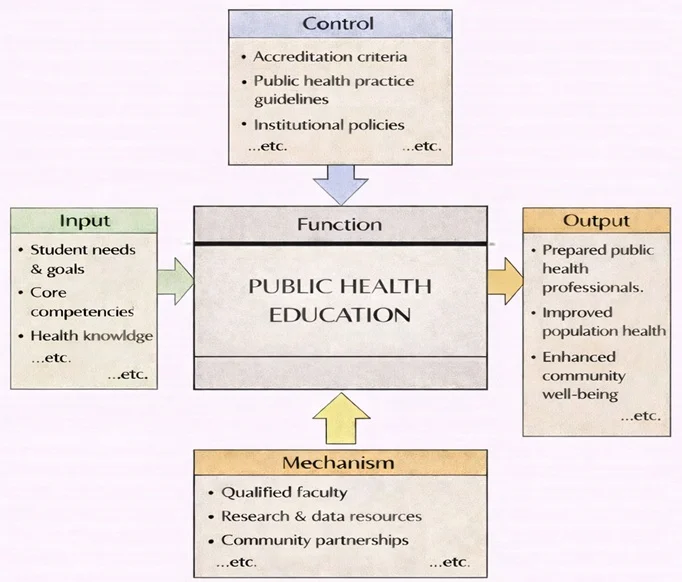
Public Health Education transforms student needs and learning goals into real capability for protecting and improving population health. Guided by accreditation requirements, public health practice guidelines, and institutional policies, it sets clear standards for what learners must know and be able to do. Using the right mechanisms—qualified faculty, research and data resources, and strong partnerships with communities and health agencies—this function connects classroom learning to real public health problems. The outputs are graduates prepared for public health roles, stronger prevention and response skills, and, ultimately, healthier and more resilient communities.
Public health is the science and practice of protecting and improving the health of populations through organized efforts, education, research, and policies. It focuses on preventing disease, prolonging life, and promoting health equity for all individuals, especially the most vulnerable. Unlike clinical medicine, which treats individual patients, public health addresses health issues on a community or societal level, emphasizing prevention over cure.
Public health integrates diverse fields such as epidemiology, environmental health, health policy, and behavioral sciences to understand and address complex health challenges. It aims to reduce health disparities, improve access to healthcare, and enhance the overall quality of life through sustainable interventions.
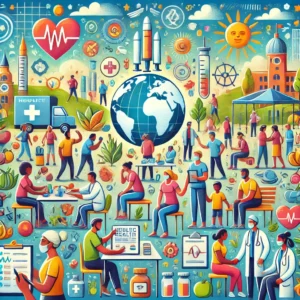
This colorful scene presents public health as a community-wide effort. A globe at the center symbolizes population health and global connections, while surrounding groups show everyday public health activities: clinic visits, health education, vaccination and screening, data monitoring, and support for families and older adults. Icons such as heart-rate symbols, medical crosses, charts, and laboratory items highlight surveillance, research, and evidence-based decision-making. Outdoor settings, clean-water and environment cues, and diverse people working together emphasize prevention and shared responsibility—improving wellbeing not just for individuals, but for whole communities.
Focus of Public Health
The primary focus of public health is to prevent illness and promote health at the community, national, and global levels. It involves understanding the determinants of health—social, economic, and environmental factors—and implementing evidence-based strategies to address these determinants. Public health professionals collaborate with governments, non-profits, healthcare providers, and community organizations to design and implement programs that improve health outcomes.
Public health efforts range from controlling infectious diseases to addressing chronic conditions, ensuring clean water and air, and promoting healthy behaviors. The discipline emphasizes education, advocacy, and policy-making to create healthier environments and empower individuals to lead healthier lives.
Key Areas in Public Health
1. Epidemiology
- Definition: The study of the distribution and determinants of diseases and health conditions in populations.
- Key Functions:
- Monitoring disease patterns to identify outbreaks.
- Investigating causes and risk factors of diseases.
- Evaluating the effectiveness of public health interventions.
- Applications:
- Containing infectious diseases like COVID-19 through contact tracing and vaccination programs.
- Studying the rise of chronic conditions such as obesity and diabetes.
- Example Projects:
- Researching the link between smoking and lung cancer.
- Tracking seasonal influenza trends to predict outbreaks.
2. Health Policy and Management
- Definition: The development, implementation, and evaluation of policies to improve healthcare delivery and public health outcomes.
- Key Focus Areas:
- Designing healthcare systems that are efficient and equitable.
- Regulating healthcare costs and access.
- Addressing social determinants of health through policy.
- Applications:
- Formulating national vaccination strategies.
- Advocating for universal healthcare coverage.
- Examples:
- The Affordable Care Act in the United States, aimed at increasing healthcare access.
- Tobacco control policies to reduce smoking rates.
3. Community Health
- Definition: Focuses on improving health at the local level through education, resources, and preventive care.
- Key Activities:
- Conducting health awareness campaigns on topics like nutrition, exercise, and mental health.
- Implementing preventive screenings for conditions such as hypertension and cancer.
- Building partnerships with community organizations to address specific health needs.
- Applications:
- Reducing obesity through school-based wellness programs.
- Promoting breastfeeding in underserved communities to improve infant health.
Applications of Public Health
1. Managing Public Health Crises
- Overview: Public health professionals are at the forefront of responding to crises such as pandemics, natural disasters, and bioterrorism threats.
- Examples:
- Coordinating global efforts to control the COVID-19 pandemic through testing, treatment, and vaccination.
- Managing Ebola outbreaks by educating communities and implementing quarantine measures.
- Impact:
- Saving lives through rapid response and containment.
- Mitigating long-term health and economic impacts of crises.
2. Reducing Health Disparities
- Overview: Public health seeks to eliminate disparities in health outcomes caused by socioeconomic, racial, or geographic inequalities.
- Examples:
- Addressing food deserts in urban areas by promoting community gardens and healthy food access.
- Providing free or low-cost prenatal care to reduce maternal and infant mortality.
- Impact:
- Improving equity in health outcomes across diverse populations.
3. Disease Prevention and Control
- Overview: Prevention is a cornerstone of public health, encompassing both communicable and non-communicable diseases.
- Examples:
- Immunization programs to prevent diseases like measles and polio.
- Public campaigns to reduce smoking and promote physical activity.
- Impact:
- Reducing healthcare costs by preventing diseases before they occur.
4. Promoting Environmental Health
- Overview: Public health addresses environmental factors that impact health, such as air quality, water safety, and climate change.
- Examples:
- Regulating industrial emissions to reduce air pollution.
- Ensuring access to clean drinking water in rural areas.
- Impact:
- Protecting communities from environmental hazards.
Emerging Trends in Public Health
Digital Health and Telemedicine
- Leveraging technology to deliver health services and monitor populations remotely.
- Examples: Mobile health apps, wearable health monitors, and telehealth consultations.
Global Health Collaboration
- Strengthening international partnerships to address transnational health issues like pandemics and antibiotic resistance.
Focus on Mental Health
- Integrating mental health into primary healthcare to address the growing burden of mental illnesses.
Precision Public Health
- Using data analytics and genomics to target interventions more effectively.
Climate and Health
- Addressing the health impacts of climate change, such as heatwaves, vector-borne diseases, and food insecurity.
Challenges in Public Health
Resource Constraints
- Limited funding and resources, especially in low-income countries, hinder public health efforts.
Health Misinformation
- The spread of misinformation, particularly on social media, undermines public health campaigns.
Inequities in Access
- Socioeconomic and geographic barriers prevent equal access to healthcare services.
Emerging Diseases
- New and re-emerging infectious diseases pose ongoing threats to public health systems.
Future Directions in Public Health
Data-Driven Public Health
- Expanding the use of big data, AI, and machine learning to predict and address health trends.
Sustainable Health Systems
- Developing systems that are resilient to economic, environmental, and social changes.
Global Vaccination Initiatives
- Ensuring equitable distribution of vaccines for diseases like COVID-19, malaria, and tuberculosis.
Integration of Behavioral Sciences
- Incorporating behavioral insights to design more effective health interventions.
Why Study Public Health
Understanding the Health of Populations and Communities
Addressing Global Challenges with Evidence-Based Solutions
Promoting Health Equity and Social Justice
Developing Skills in Communication, Collaboration, and Policy
Preparing for a Wide Range of Health-Focused Careers
Interactive Epidemiological SEIR Spread & Intervention Simulator
Simulate disease transmission dynamics across a population. Adjust the transmission rate (β) and vaccination coverage rate to observe containment outcomes.
Public Health: Conclusion
Public health is essential for building healthier, more resilient communities. By focusing on prevention, education, and policy-making, it addresses the root causes of health challenges and strives to improve outcomes for all populations. Through advancements in technology, global collaboration, and innovative strategies, public health continues to evolve, tackling emerging issues while ensuring equitable access to healthcare. As societies face new and complex challenges, public health will remain at the forefront of efforts to protect and promote human well-being.
Is Public Health Right For You?
Explore career pathways, check your fit, and assess your skills — before you commit to a degree.
Frequently Asked Questions – Public Health
What is public health in simple terms?
Public health is the science and practice of protecting and improving the health of populations rather than focusing only on individual patients. It aims to prevent disease, extend life, and promote wellbeing through organised efforts such as vaccination, health education, policy, environmental protection, and community programmes.
How is public health different from clinical healthcare?
Clinical healthcare focuses on diagnosing and treating illness in individual patients, while public health focuses on preventing problems and improving health at community, national, or global levels. Public health professionals study patterns of disease, risks, and social conditions, then design policies and programmes to protect entire populations.
Why is public health important in today’s world?
Public health is vital for preventing outbreaks, managing pandemics, reducing the burden of chronic diseases, improving maternal and child health, addressing environmental risks, and tackling health inequalities. It helps societies use resources wisely and protect vulnerable groups, especially in a world that is highly connected and rapidly changing.
What kinds of topics and areas does public health cover?
Public health covers many areas, including epidemiology, biostatistics, environmental health, health promotion, health policy and management, global health, occupational health, maternal and child health, infectious disease control, and the social determinants of health such as housing, education, and income.
Which school subjects are useful preparation for studying public health at university?
Helpful subjects include biology and general science for understanding disease and the body, mathematics or statistics for working with data, and humanities or social sciences such as geography, economics, sociology, or history for understanding societies and inequalities. Languages and communication-based subjects are also valuable for working with diverse communities.
What skills and personal qualities are important for future public health professionals?
Public health professionals need analytical skills to interpret data, curiosity about how systems work, and clear communication skills to explain risks and recommendations. They also need teamwork, cultural sensitivity, ethical awareness, and persistence, because changing behaviour and policy often takes time and careful negotiation.
What do students typically learn in a public health degree or major?
Students usually learn epidemiology, biostatistics, health systems and policy, environmental and occupational health, global health, health promotion, research methods, and ethics. Many programmes also include case studies, projects with communities or agencies, and opportunities to explore topics such as nutrition, mental health, or infectious diseases in more depth.
What types of jobs and careers can public health graduates pursue?
Public health graduates can work in government health departments, hospitals and health systems, NGOs, international organisations, research institutes, community agencies, and private companies. Roles include epidemiologist, health promotion officer, policy analyst, programme coordinator, data analyst, community health worker, and health communications specialist.
How does public health address health inequalities and social determinants of health?
Public health recognises that health is shaped by social factors such as income, education, housing, employment, gender, and discrimination. It works to reduce inequalities by collecting evidence on who is most affected, designing targeted interventions, influencing policy, and partnering with communities to create fairer conditions for health.
How is data used in public health decision-making?
Public health relies heavily on data from sources such as surveillance systems, surveys, and health records. Professionals use this data to detect outbreaks, identify risk factors, evaluate programmes, and set priorities. Skills in analysing, interpreting, and communicating data are central to modern public health practice.
What is global health and how does it relate to public health?
Global health is a branch of public health that focuses on health issues that cross borders, such as pandemics, climate change, migration, and access to essential medicines. It emphasises cooperation between countries and organisations to improve health for all, especially in low-resource settings and marginalised populations.
How does the Public Health page on Prep4Uni.online support my study and career planning?
The Public Health page on Prep4Uni.online helps you see how biology, statistics, social sciences, and policy come together to improve population health. It introduces key concepts, links school subjects to university expectations, and gives you a clearer picture of the many career paths where you can combine data, policy, and community work to make a difference.
Public Health: Interactive Review Questions
1. What is public health and why is it a critical field?
2. How do preventive care measures contribute to public health?
3. What are some of the major challenges faced by public health professionals today?
4. How does public health policy influence community wellness?
5. What is the role of education in advancing public health?
6. How do social determinants impact public health outcomes?
7. What role does research play in shaping public health interventions?
8. How can technology improve public health surveillance and response?
9. What strategies can be implemented to reduce health disparities in vulnerable populations?
10. How does global collaboration contribute to addressing international public health challenges?
Comprehensive Practice Modules
Section 1: Core Concept Mastery (Foundational Questions)
-
Define epidemiology and its primary role in public health surveillance.
Answer: Epidemiology is the scientific study of the distribution and determinants of health-related states or events in specified populations, serving as the foundational tool for tracking outbreaks, monitoring disease trends, and guiding preventive interventions. -
What is the difference between primary, secondary, and tertiary prevention in public health?
Answer: Primary prevention aims to prevent disease before it occurs (e.g., vaccination); secondary prevention focuses on early detection and prompt treatment (e.g., cancer screenings); tertiary prevention aims to mitigate the impact of an established disease and restore function (e.g., rehabilitation). -
Define herd immunity and explain its significance in controlling infectious disease transmission.
Answer: Herd immunity occurs when a large portion of a community becomes immune to an infectious disease (via vaccination or prior infection), making the spread from person to person unlikely and protecting vulnerable, non-immune individuals. -
What is meant by the term "social determinants of health" (SDOH)?
Answer: SDOH are the non-medical factors influencing health outcomes—conditions in which people are born, grow, work, live, and age, including economic stability, education, social context, healthcare access, and physical environment. -
State the primary objective of environmental health within public health practice.
Answer: The primary objective is to monitor and combat environmental hazards—such as air and water pollution, toxic chemical exposure, and unsanitary conditions—to protect human populations from disease. -
What is zoonotic disease transmission?
Answer: Zoonotic transmission refers to infectious diseases that spread naturally between vertebrate animals and humans, such as avian influenza, rabies, and Ebola. -
Define health equity and contrast it with health equality.
Answer: Health equality means providing everyone with the exact same resources, whereas health equity ensures that each individual receives the specific resources and support needed to attain their highest level of health, accounting for historical and systemic disparities. -
What is the core function of biostatistics in public health research?
Answer: Biostatistics applies statistical reasoning and methods to analyze biological, medical, and public health data, enabling researchers to draw valid conclusions, evaluate program efficacy, and quantify risk factors.
Section 2: Clinical Scenarios & Analytical Thinking
-
An urban community experiences a sudden cluster of gastrointestinal illness linked to municipal water supply contamination. Outline the immediate epidemiological and public health response steps.
Answer: The response requires declaring a public health alert, issuing boil-water advisories, conducting active case finding and contact tracing, collecting water samples for pathogen identification (e.g., E. coli or cryptosporidium), isolating the point source, and providing emergency hydration and medical treatment to affected residents. -
Evaluate the ethical tensions that arise when implementing mandatory quarantine measures during a severe respiratory pandemic.
Answer: Mandatory quarantine balances collective community safety and disease containment against individual civil liberties, freedom of movement, and economic autonomy. Authorities must ensure transparent communication, proportional restrictions, and basic provisions (food, medical care) for quarantined individuals. -
A health department notes significantly higher rates of type 2 diabetes in low-income neighborhoods characterized as "food deserts." Propose a multi-sectoral public health intervention.
Answer: Interventions include partnering with local stakeholders to establish community gardens and farmers' markets offering affordable fresh produce, incentivizing grocery store development in underserved zones, implementing mobile health screening clinics, and running culturally tailored nutritional education programs. -
Analyze how climate change alters the geographic distribution and incidence of vector-borne illnesses like malaria or dengue fever.
Answer: Rising global temperatures and altered precipitation patterns expand the viable habitats and breeding seasons for vectors such as mosquitoes (e.g., Aedes aegypti), enabling them to survive in previously temperate regions and exposing immunologically naive populations to novel infection risks. -
Discuss the role of behavioral science in designing an effective public health campaign to reduce youth vaping rates.
Answer: Behavioral science insights reveal that traditional scare tactics often fail among adolescents due to perceived invulnerability. Effective campaigns leverage peer social norming, counter-marketing that exposes manipulative tobacco industry tactics, and digital engagement platforms that reframe vaping as uncool or addictive. -
Compare centralized national healthcare funding models with decentralized regional models regarding outbreak response agility.
Answer: Centralized models can rapidly mobilize vast financial resources and procure vaccines uniformly across a nation, but may suffer from bureaucratic delays. Decentralized models allow regional health departments to tailor interventions to local demographics instantly, but risk fragmented policies and unequal resource distribution. -
A rural county faces severe healthcare workforce shortages. Propose a technological and community-based strategy to bridge this gap.
Answer: Implement telehealth infrastructure and mobile health units to provide remote specialist consultations, train and deploy trusted community health workers (CHWs) to conduct home screenings and health education, and offer tuition-repayment incentives for medical graduates practicing in rural areas. -
Assess the impact of social media health misinformation on vaccine hesitancy and formulate a counter-strategy.
Answer: Misinformation creates fear and distrust by exploiting emotional narratives and distorted statistics. Counter-strategies require proactive public health communication, engaging trusted community leaders and healthcare professionals as messengers, and partnering with digital platforms to flag false claims while amplifying peer-reviewed evidence.
Section 3: Epidemiological Calculations & Quantitative Diagnostics
-
In a town of 50,000 residents, an epidemiologist identifies 250 active cases of influenza during a winter month. Calculate the point prevalence of influenza per 1,000 population.
Answer:Prevalence = (Number of existing cases / Total population) × 1,000The point prevalence is 5 cases per 1,000 residents.
Prevalence = (250 / 50,000) × 1,000 = 0.005 × 1,000 = 5 cases per 1,000 population -
During a 1-year surveillance period in a cohort of 2,000 healthy individuals, 80 new cases of type 2 diabetes are diagnosed. Calculate the cumulative incidence rate over this 1-year period (expressed as a percentage).
Answer:Cumulative Incidence = (Number of new cases / Total population at risk) × 100%The 1-year cumulative incidence rate is 4.0%.
Cumulative Incidence = (80 / 2,000) × 100% = 0.04 × 100% = 4.0% -
An outbreak investigation reveals 120 people who consumed tainted potato salad at a picnic, out of 150 total attendees who ate the food. Calculate the attack rate percentage.
Answer:Attack Rate = (Number of ill people / Total number of people exposed) × 100%The attack rate for the food item is 80.0%.
Attack Rate = (120 / 150) × 100% = 0.80 × 100% = 80.0% -
In a clinical trial for a new hypertension screening tool, 450 out of 500 patients who truly have hypertension test positive. Meanwhile, out of 500 healthy patients, 50 test positive (false positives). Calculate the sensitivity of the screening test.
Answer:Sensitivity = True Positives / (True Positives + False Negatives)The screening test sensitivity is 90.0%.
Sensitivity = 450 / (450 + 50) = 450 / 500 = 0.90 or 90.0% -
Using the same data from Question 4 (450 true positives, 50 false negatives, 50 false positives, and 450 true negatives out of 500 healthy patients), calculate the specificity of the test.
Answer:Specificity = True Negatives / (True Negatives + False Positives)The screening test specificity is 90.0%.
True Negatives = 500 - 50 (false positives) = 450
Specificity = 450 / (450 + 50) = 450 / 500 = 0.90 or 90.0% -
A case-control study investigating lung cancer and air pollution exposure finds that 300 cases and 100 controls were exposed to high industrial pollution, while 200 cases and 400 controls were unexposed. Calculate the Odds Ratio (OR).
Answer:Odds Ratio (OR) = (a × d) / (b × c)The Odds Ratio is 6.0, indicating strong association between pollution exposure and disease.
Where a = exposed cases (300), b = exposed controls (100), c = unexposed cases (200), d = unexposed controls (400).
OR = (300 × 400) / (100 × 200) = 120,000 / 20,000 = 6.0 -
Calculate the basic reproduction number (R0) if the transmission coefficient (β) is 0.40 per day and the recovery rate (γ) is 0.10 per day.
Answer:R0 = β / γThe basic reproduction number is 4.0.
R0 = 0.40 / 0.10 = 4.0 -
Based on the R0 calculated in Question 7, determine the critical vaccination threshold (Vc) required to achieve herd immunity.
Answer:Critical Vaccination Threshold (Vc) = 1 - (1 / R0)A vaccination coverage of at least 75.0% is required to establish herd immunity.
Vc = 1 - (1 / 4.0) = 1 - 0.25 = 0.75 or 75.0%