

A vibrant, tech-themed cybersecurity illustration. At the top, the title reads “CYBERSECURITY” with the subtitle “Protecting Systems, Data, and People.” A radiant shield with a padlock forms the focal point, with digital dashboards and icons radiating outward. On the left, a hooded figure at a laptop represents “Network Security.” On the right, a cloud-and-lock graphic labeled “Identity & Access” highlights authentication and permissions. Nearby panels labeled “Application Security” suggest secure software and threat monitoring. At the lower right, “Cryptography” appears alongside a magnifying glass over a digital pattern, implying encryption and investigation. Along the bottom, a control-desk scene and icons connect cybersecurity to “AI,” “Software Development,” and “Governance and Regulation,” emphasizing the field’s technical and policy dimensions.
Cybersecurity protects digital systems and data, becoming increasingly critical as global reliance on connected technologies continues to grow.
How Cybersecurity Skills Are Built in Practice (IDEF0 Model)
Cybersecurity is not learned through theory alone—it is developed through structured practice under real-world constraints. The IDEF0 model below shows how knowledge is transformed into usable security capability.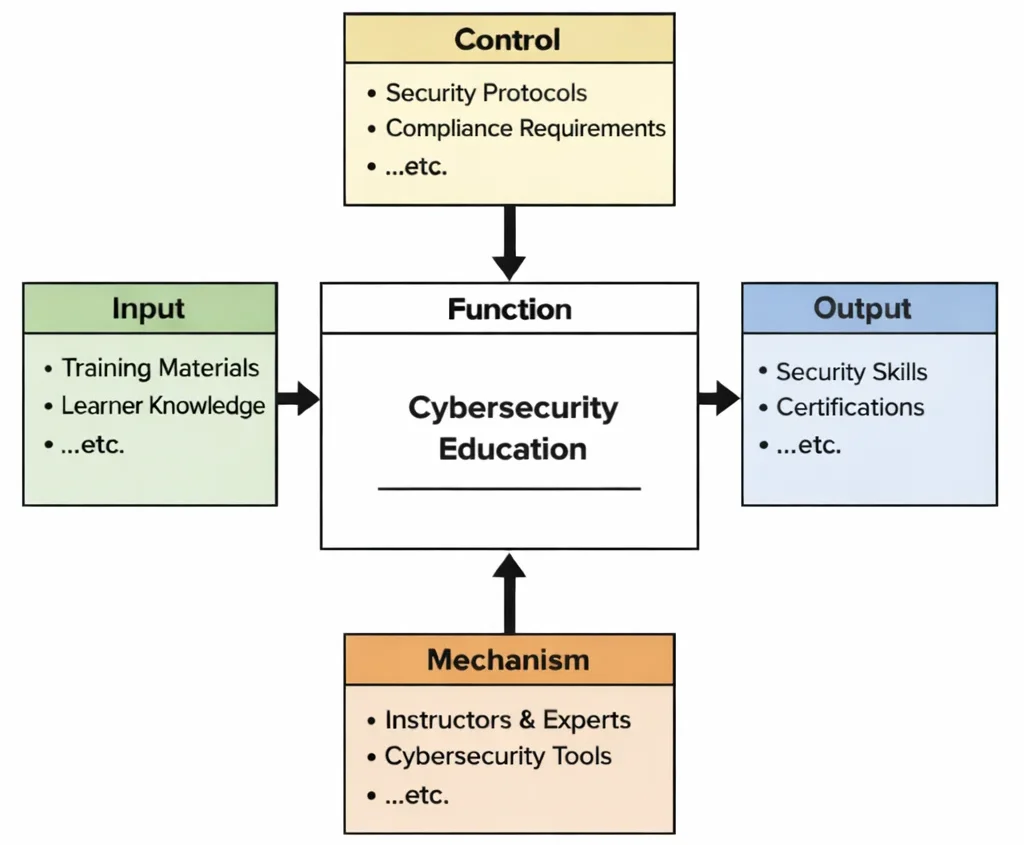
Cybersecurity – Protecting Systems, Data, and People
Cybersecurity is about keeping the digital world trustworthy. As more services move into the cloud, devices connect through complex networks, and organizations rely on software for everyday operations, the risks from hacking, malware, fraud, and data leaks grow sharply. Cybersecurity focuses on identifying threats, reducing vulnerabilities, and designing systems that remain resilient even when attackers are persistent and unpredictable.
Why is cybersecurity critical in modern digital systems?
Answer: Cybersecurity ensures that systems remain reliable, data stays protected, and users can trust the services they depend on. As organizations operate across cloud platforms and data-driven systems, even a small weakness can lead to widespread disruption or data exposure.
A simple cloud misconfiguration has, in real cases, exposed millions of user records—showing how minor oversights can escalate into major security failures.
This hub introduces core areas you will meet in further study and practice: securing networks and applications, managing identities and access, protecting data with cryptography, responding to incidents and digital forensics, and using threat intelligence to stay ahead of evolving attacks. You will also see how cybersecurity connects to AI, software engineering, and governance. Whether you are interested in hands-on technical roles, security architecture, or policy and strategy, this page helps you understand how the pieces fit together and what skills to build next.
A vibrant, tech-themed cybersecurity illustration. At the top, the title reads “CYBERSECURITY” with the subtitle “Protecting Systems, Data, and People.” A radiant shield with a padlock forms the focal point, with digital dashboards and icons radiating outward. On the left, a hooded figure at a laptop represents “Network Security.” On the right, a cloud-and-lock graphic labeled “Identity & Access” highlights authentication and permissions. Nearby panels labeled “Application Security” suggest secure software and threat monitoring. At the lower right, “Cryptography” appears alongside a magnifying glass over a digital pattern, implying encryption and investigation. Along the bottom, a control-desk scene and icons connect cybersecurity to “AI,” “Software Development,” and “Governance and Regulation,” emphasizing the field’s technical and policy dimensions.
Cybersecurity protects digital systems and data, becoming increasingly critical as global reliance on connected technologies continues to grow.
How Cybersecurity Skills Are Built in Practice (IDEF0 Model)
Cybersecurity is not learned through theory alone—it is developed through structured practice under real-world constraints. The IDEF0 model below shows how knowledge is transformed into usable security capability.
In this framework, inputs include foundational concepts, examples, and prior technical knowledge. Controls such as security protocols, compliance requirements, and organizational policies define what must be protected and how security work is judged. Mechanisms—including tools, labs, and expert guidance—enable learners to interpret logs, detect anomalies, and take action.
The output is not just awareness of threats, but the ability to apply disciplined protection: identifying weaknesses early, implementing standard defensive measures, and responding systematically when incidents occur.
For example, analyzing unusual login activity in a lab setting teaches not only how attacks appear, but how structured response procedures are applied in real security operations.
Exploring Cybersecurity – From Secure Networks to Cyber Resilience
Cybersecurity is made up of interconnected domains that work together to protect systems, data, and users across modern digital environments.
Network Security
Enforces traffic inspection, perimeter firewalls, micro-segmentation, and intrusion prevention systems to defend data during transit across connected infrastructures.
Application Security
Integrates secure coding standards, automated static/dynamic vulnerability testing (SAST/DAST), and input sanitization to block SQL injection and cross-site flaws.
Cloud Security
Establishes zero-trust access boundaries, automated posture management (CSPM), object encryption, and configuration hardening across multi-tenant cloud platforms.
Endpoint Security
Hardens user laptops, servers, and mobile hardware against zero-day malware, enforcing patch management, disk encryption, and Endpoint Detection and Response (EDR).
Identity & Access Management
Governs user and machine access through multi-factor authentication (MFA), role-based permissions (RBAC), single sign-on (SSO), and least-privilege enforcement.
Cryptography
Applies mathematical block ciphers (AES-256), public-key infrastructures (PKI), and secure hashing to guarantee data confidentiality, authenticity, and non-repudiation.
Incident Response & Forensics
Orchestrates threat containment playbooks, forensic memory extraction, log timeline analysis, and system recovery procedures following network breaches.
Threat Intelligence
Collects and analyzes adversary tactics, techniques, and procedures (TTPs) across dark web channels and telemetry feeds to proactively adjust defensive postures.
Ethical Hacking & Pen Testing
Executes controlled, adversarial attack simulations to uncover unpatched exploit pathways before malicious threat actors exploit them in production.
Cybersecurity Awareness
Mitigates human risk vectors through anti-phishing simulations, security hygiene training, and behavioral design that reinforces organizational defenses.
Policy & Governance
Codifies security governance frameworks, risk appetite thresholds, regulatory compliance (GDPR, HIPAA, ISO 27001), and mandatory security audit trails.
CPS Security
Safeguards cyber-physical systems where digital software controls physical hardware, ensuring safety and integrity in smart grids, robotics, and medical devices.
OT Security
Protects operational technology networks, SCADA systems, and industrial PLCs in critical infrastructure facilities against physical disruption and sabotage.
AI & Cybersecurity
Leverages machine learning for automated anomaly detection while securing AI models against adversarial prompt injection, data poisoning, and model evasion attacks.
Emerging Areas
Investigates frontier security paradigms including Post-Quantum Cryptography (PQC), zero-knowledge proofs, edge privacy models, and mesh security architectures.
How Cybersecurity Maps to Real-World Operations (NIST CSF)
Cybersecurity in practice is not a collection of tools—it is a coordinated workflow. The NIST Cybersecurity Framework (CSF) provides a widely used structure for organizing security activities across the lifecycle of an attack, supported by governance and policy frameworks.
How do organizations actually manage cybersecurity end-to-end?
Answer: Organizations manage cybersecurity by structuring their efforts into stages: understanding what needs protection, putting safeguards in place, detecting threats early, responding quickly, and restoring operations. This lifecycle approach ensures that security is continuous rather than reactive.
A ransomware attack on a company often reveals gaps across multiple stages—not just detection, but also backup readiness and recovery planning.
Identify — What needs to be protected?
- Asset inventory, business process mapping, and data classification
- Risk assessment and supplier risk management
Protect — How do we prevent attacks?
- Identity and access management (IAM), application security, endpoint and network protection
- Data protection, encryption, and user awareness training
Detect — How do we spot threats early?
- Monitoring systems, logs, and telemetry
- Threat intelligence and behavioral analytics
Respond — What happens when an attack occurs?
- Incident response plans, containment strategies, and communication procedures
- Forensics, legal considerations, and stakeholder coordination
Recover — How do systems return to normal?
- Backup and restore processes, resilience planning, and system improvements
- Review and learning from incidents to strengthen future defense
Managing Risk and Trust in Cybersecurity Systems
Cybersecurity is not just about blocking attacks—it is about making informed decisions under uncertainty. Organizations must decide what to protect, how much protection is enough, and how to balance security with usability and cost.
How do organizations decide what to trust and what to protect?
Answer: Organizations manage cybersecurity by assessing risk and limiting trust. Instead of assuming systems are safe, they evaluate potential threats, estimate impact, and apply controls accordingly. Zero Trust extends this idea by requiring continuous verification rather than relying on assumed internal security.
A company allowing remote access to internal systems may require continuous authentication and device verification rather than trusting users simply because they are inside the network.
Risk-Based Thinking: Prioritizing What Matters
- Identify critical assets: systems, data, and services that must be protected
- Assess threats and vulnerabilities: what could go wrong and how likely it is
- Evaluate impact: financial loss, operational disruption, or reputational damage
- Prioritize controls: focus resources where risk is highest
Zero Trust: Never Assume, Always Verify
- No implicit trust: every user, device, and request must be verified
- Continuous authentication: access decisions are dynamic, not one-time
- Least privilege: users receive only the access they need
- Micro-segmentation: systems are isolated to limit damage if breached
Why This Matters in Practice
Traditional security assumed that systems inside a network could be trusted. Modern environments—cloud systems, remote work, and interconnected services—break this assumption. Risk-based thinking and Zero Trust provide a more realistic approach to securing complex systems.
Designing Secure Systems: Layers and Architecture
Cybersecurity is built into systems through layered design. Instead of relying on a single defense, modern systems use multiple protective layers so that if one fails, others continue to protect the system.
How are secure systems designed to withstand real-world attacks?
Answer: Secure systems are designed using layered architecture, where different parts of the system—networks, applications, identities, and data—are protected independently. This reduces the chance that a single failure will compromise the entire system.
A web application may still protect sensitive data through encryption and access controls even if a vulnerability is discovered in its interface.
Layered Security: Defense in Depth
- Network layer: firewalls, segmentation, and traffic monitoring
- Application layer: secure coding, validation, and vulnerability testing in application security
- Identity layer: authentication, authorization, and access control
- Data layer: encryption, backup, and integrity protection
System Integration: How Layers Work Together
Security layers do not operate independently—they interact continuously. For example, identity systems control access to applications, while network controls restrict where requests can originate. Effective security depends on how well these layers are integrated.
Why Architecture Matters
Poorly designed systems often fail even when individual components are secure. A strong architecture ensures that security is built into the system from the start, rather than added later as a patch.
Understanding Cyber Threats in Real Systems
Cybersecurity exists because systems are constantly exposed to threats. These threats are not abstract—they are active, evolving, and often targeted. Understanding how attacks occur helps explain why security measures are necessary.
What kinds of threats do real-world systems face?
Answer: Real-world systems face a wide range of threats, including attempts to steal data, disrupt services, or gain unauthorized access. Attackers exploit weaknesses in software, human behavior, and system design, often combining multiple techniques to achieve their goals.
A phishing email that tricks an employee into revealing login credentials can bypass even well-designed technical security controls.
Common Types of Cyber Threats
- Malware: software designed to damage, disrupt, or gain unauthorized access to systems
- Phishing and social engineering: manipulating users into revealing sensitive information, addressed through cybersecurity awareness
- Ransomware: encrypting data and demanding payment for its release
- Denial-of-Service (DoS): overwhelming systems to make services unavailable
- Insider threats: risks arising from trusted users misusing access
How Attacks Actually Happen
Attacks rarely occur in a single step. An attacker may begin by gathering information, then exploit a vulnerability, escalate privileges, and move through systems to reach valuable data. This sequence shows why security must operate across multiple layers.
Why Threat Awareness Matters
Understanding threats helps organizations design better defenses, train users more effectively, and respond quickly when incidents occur. Without awareness of how attacks work, security measures may be incomplete or misaligned with real risks.
Cybersecurity as a Connected System
Cybersecurity is not a single discipline or tool—it is a coordinated system of practices, decisions, and designs working together. From identifying risks and designing secure architectures to responding to threats and improving over time, each part contributes to the resilience of the whole.
What does it mean to understand cybersecurity as a system?
Answer: Understanding cybersecurity as a system means seeing how protection, detection, response, and recovery are interconnected. Weakness in one area can affect the entire system, while strong integration creates resilience even when individual components are challenged.
A system with strong detection but weak response may still suffer major damage, showing that security depends on how well all parts work together.
As digital systems become more complex—spanning cloud platforms, interconnected networks, and intelligent applications—cybersecurity becomes less about isolated tools and more about how systems are designed, managed, and continuously improved. This perspective helps students move beyond memorizing concepts and toward thinking like practitioners.
Engineering FAQs: Cybersecurity Architecture & System Defense
What is cybersecurity in simple terms?
Cybersecurity is the practice of protecting systems, networks, data, and users from digital threats. It involves preventing attacks, detecting anomalous activity in real time, and responding swiftly to mitigate impact when incidents occur.
Why is cybersecurity important in modern systems?
Modern systems rely on interconnected networks, public cloud infrastructure, and real-time data flows. A single unpatched vulnerability or stolen credential can trigger widespread data breaches, operational downtime, and financial loss, making cybersecurity essential for digital trust.
What skills are needed to study cybersecurity?
Cybersecurity requires a balance of technical and analytical competencies: understanding operating systems, computer networking, and cryptography, alongside critical risk evaluation, threat modeling, and incident analysis capabilities.
What is the difference between cybersecurity and information security?
Cybersecurity specifically focuses on protecting digital assets, networks, and internet-connected systems from digital attacks. Information security is a broader discipline covering data privacy and protection across all mediums, including physical paperwork, records, and organizational controls.
How do organizations manage cybersecurity in practice?
Organizations adopt standardized risk management frameworks (such as NIST CSF or ISO 27001) to continuously audit assets, enforce zero-trust identity policies, monitor network telemetry, run automated vulnerability scans, and execute incident response playbooks.
Is cybersecurity only about technology?
No. Cybersecurity heavily incorporates human factors, governance, and operational policies. Social engineering attacks exploit human psychology rather than software flaws, making security awareness training, access controls, and policy enforcement equally vital.
Is Cybersecurity Right for You?
Choosing a field of study involves more than understanding concepts—it requires knowing how your interests and thinking style align with the discipline.
Explore this interactive tool to reflect on whether cybersecurity matches your strengths and preferences:
Cybersecurity — Review Questions and Answers
These questions help reinforce core concepts regarding system-level security architecture, defense-in-depth, risk management, and human factors in digital protection.
Core System Defense Concepts
1. Why is cybersecurity considered a system rather than a single solution?
Answer: Cybersecurity relies on interconnected components—prevention, threat detection, incident response, and recovery—working synchronously. A failure in any single control point compromises the entire perimeter, requiring security to be engineered as an integrated system.
2. Why is layered security (Defense in Depth) more effective than relying on a single defense?
Answer: Defense in Depth ensures that if a malicious threat bypasses one defensive boundary (e.g., an external network firewall), secondary security layers (such as endpoint host isolation, IAM role permissions, and database encryption) continue to block data exfiltration.
3. How does risk-based thinking influence cybersecurity decisions?
Answer: Risk-based thinking evaluates asset criticality alongside likelihood and impact ratings. This prevents equal spending on low-value targets, directing financial and engineering resources toward protecting mission-critical databases and core infrastructure.
4. Why is human behavior a critical factor in cybersecurity?
Answer: Social engineering tactics (such as spear phishing or credential harvesting) exploit human trust and fatigue rather than technical software bugs. Bypassing human-layer security can invalidate strict technical network controls, making security awareness training mandatory.
IT Topics – Explore the Digital Landscape
Explore the key areas of information technology, from intelligent systems and cloud platforms to software development and cybersecurity.
Information Technology – Overview
Provides the overarching structural blueprint, mapping out how hardware runtimes, network backbones, data pipelines, and application software unite.
Artificial Intelligence (AI)
Explores neural network architectures, machine learning models, autonomous decision engines, and AI safety controls.
Cloud Computing
Details elastic distributed infrastructure, virtual compute pools, serverless execution, and global cloud deployment models.
Cybersecurity
Protects digital systems, networks, identities, and data assets through defense-in-depth architecture, threat intelligence, and zero-trust governance.
Data Science & Analytics
Transforms structured and unstructured data streams into actionable business intelligence using statistical models and big data processing.
Software Development
Covers software engineering principles, algorithm design, system architecture patterns, and application lifecycle management.
Web Development
Builds responsive client-side user interfaces, server-side web APIs, and scalable full-stack web applications using modern browser engines.
Networking & Telecommunication
Examines transport protocols, wireless communication channels, switching infrastructure, and global telecommunication standards.